Topic clusters are no longer a “nice to have” SEO tactic. They have become a core way search engines and AI systems understand what your website is about.
Did you know?
That shift has changed how content should be planned, written, and structured. Blogs built around scattered keywords struggle to compete with sites that organize their content into connected, topic-focused hubs.
This guide explains what topic clusters are, how they work, and how to build them in a way that improves search visibility, engagement, and long-term performance, across both traditional search engines and AI platforms.
This is especially important for LLM-driven discovery—understanding how to rank in chatgpt often comes down to whether your site shows connected topical coverage AI can trust and reuse.
- AI search is moving beyond keywords and rewarding context, topical depth, and entity relationships.
- Topic clusters (pillar + supporting pages + internal links) help search engines and AI understand your site’s authority.
- Clusters improve Search Engine Visibility by strengthening topical signals, reducing content cannibalization, and improving site navigation.
- To build clusters: pick 3–5 pillar topics, map intent-based subtopics, and add bidirectional internal links (pillar ↔ clusters).
- To keep results growing: refresh pillar + cluster pages regularly, add new subtopics, and track performance at the cluster level (not page-by-page only).
What is a Topic Cluster?
A topic cluster is a content structure where multiple related pages are organized around one central topic to build clear topical authority.
At the center of the cluster is a pillar page. This page covers the main topic broadly and acts as the primary reference point. Supporting it are cluster pages, each focused on a specific subtopic or user question. All pages are connected through intentional internal links.
Here is an example of a topic cluster where Social Media Marketing is the pillar page and all connected pages are cluster pages:
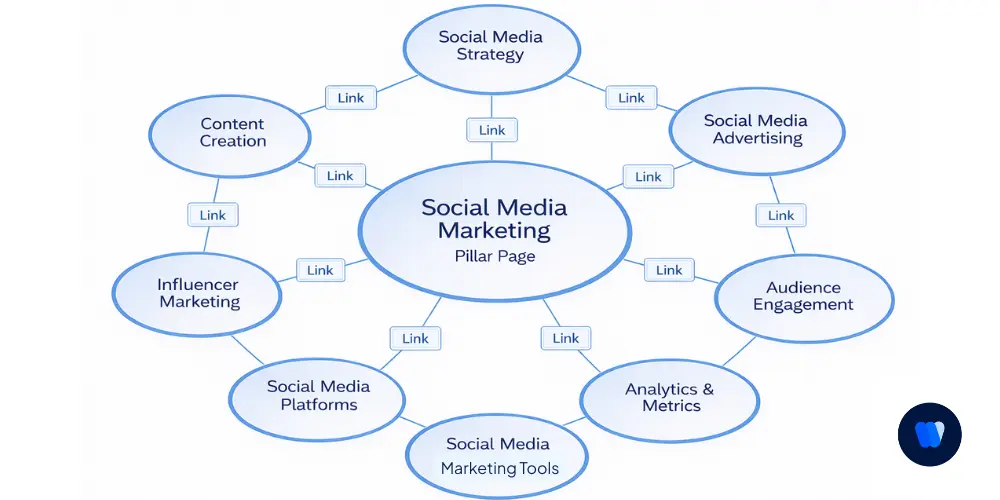
This setup clarifies semantic relationships for search engines and AI systems, helps them understand topical relationships, strengthens authority, and improves visibility across related search queries.
What are the Core Components of Topic Clusters?
Here are the three core components of topic clusters:
1. Pillar Page (Hub Content)
A comprehensive resource (typically 2,500-4,000 words) that covers a broad subject at a high level. The pillar serves as the authoritative foundation for the entire cluster.
Example: “Complete Guide to Social Media Marketing” (pillar page)
2. Cluster Pages (Spoke Content)
Focused articles (800-1,500 words) that dive deep into specific subtopics. Each cluster page addresses a distinct aspect of the pillar topic.
Examples:
- “Top Social Media Marketing Tools”
- “Best Strategies for Social Media Marketing for Small Businesses”
- “How to do Influencer Marketing in 2026”
3. Internal Linking Structure
Internal links connect all cluster pages back to the pillar, and the pillar linking out to all clusters — this also supports site-wide strength, which is the goal behind many domain authority tips. This creates a semantic web that search engines and AI systems can easily navigate.
How Do I Create a Topic Cluster for My Website From Scratch? [7 Easy Steps]
Building a topic cluster is about creating a connected content system, not publishing random posts. You pick one main topic, create a pillar page that covers it broadly, then publish supporting pages that each answer a specific subtopic.
Everything is tied together with intentional internal links so search engines and readers can understand how it all fits.
Below are the 7 steps you can follow on how to structure your website using topic clusters for better AI visibility and Google rankings:
Start with a topic that is closely tied to your business, your audience’s needs, and your expertise. The best core topics have enough depth to support multiple related pages, but are not so broad that you end up writing vague content.
A quick check: can you realistically create 5-10 supporting pages around that topic without repeating yourself? If yes, it’s a strong candidate.
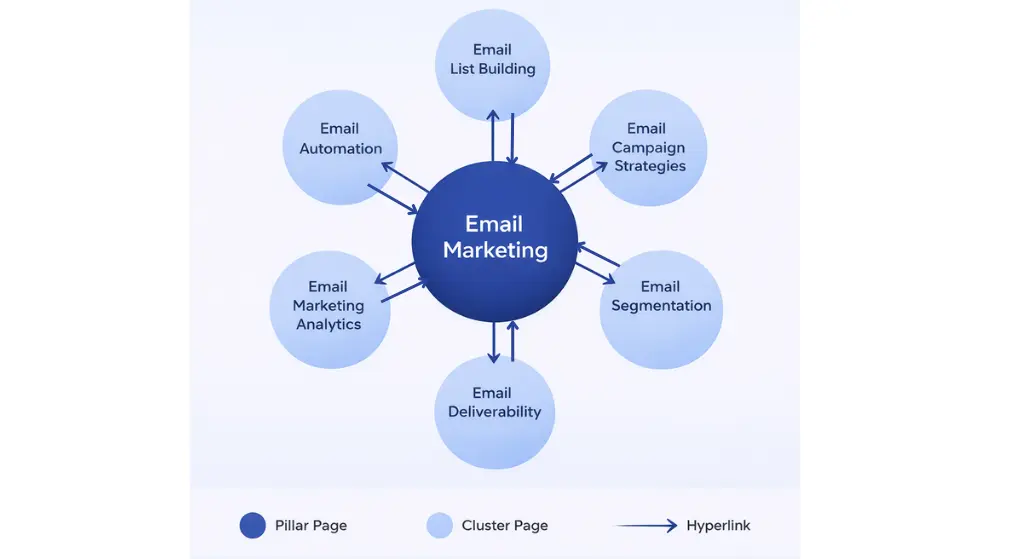
Keep the topic broad enough for multiple pages, but focused enough to avoid becoming oversized and unfocused.
- learning the basics (definitions, how it works)
- setup and tools (templates, sequences, deliverability)
- improvement (A/B testing, segmentation, subject lines)
- evaluation (best tools, comparisons, alternatives)
This is where people go wrong. They collect 50 keyword variations that all mean the same thing, then publish overlapping articles.
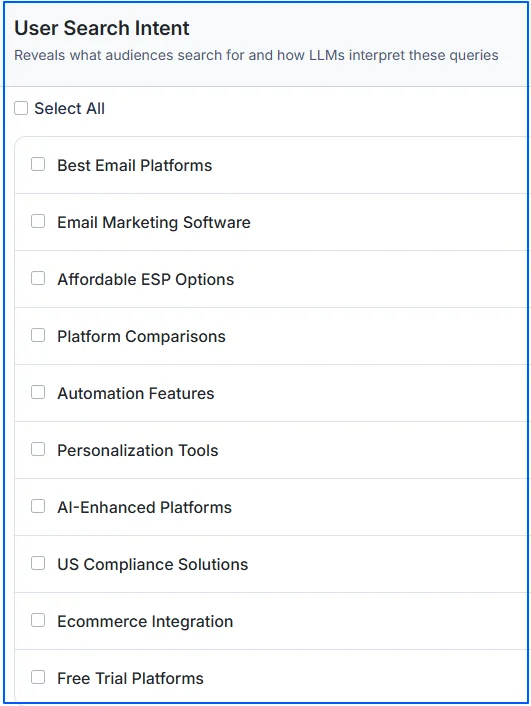
Instead, group subtopics by intent. For example, a core topic like “email marketing” could naturally branch into intents like:
This aligns with the idea that clusters are made of a pillar plus subpages that cover associated subtopics. Wellows helps you identify the search intent for your seed keyword.
- intent (informational, commercial, transactional)
- search volume (is there demand?)
- difficulty/competition (how hard to rank?)
Now use keyword research to confirm what people actually search for and to prioritize what to publish first. You’re mainly looking at:
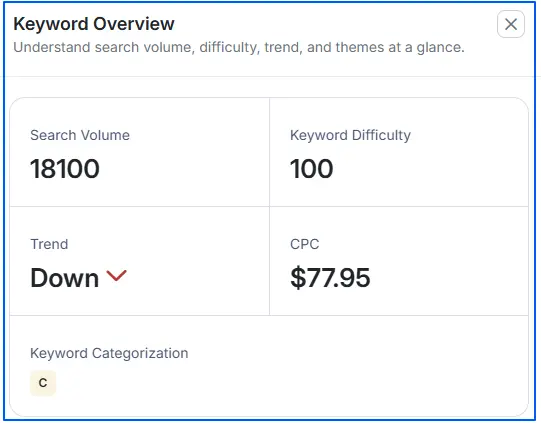
This step helps you avoid building a cluster around topics that sound good but have little search interest.
- explain the main topic clearly
- cover the major subtopics at a high level
- guide readers to deeper pages when they want specifics
Your pillar page should:
A pillar is not just a long blog post. It is a structured hub that introduces the cluster pages.
Each cluster page should have one job: answer one specific question or satisfy one intent really well. That focus matters because it reduces overlap and helps each page rank for its own set of related terms.
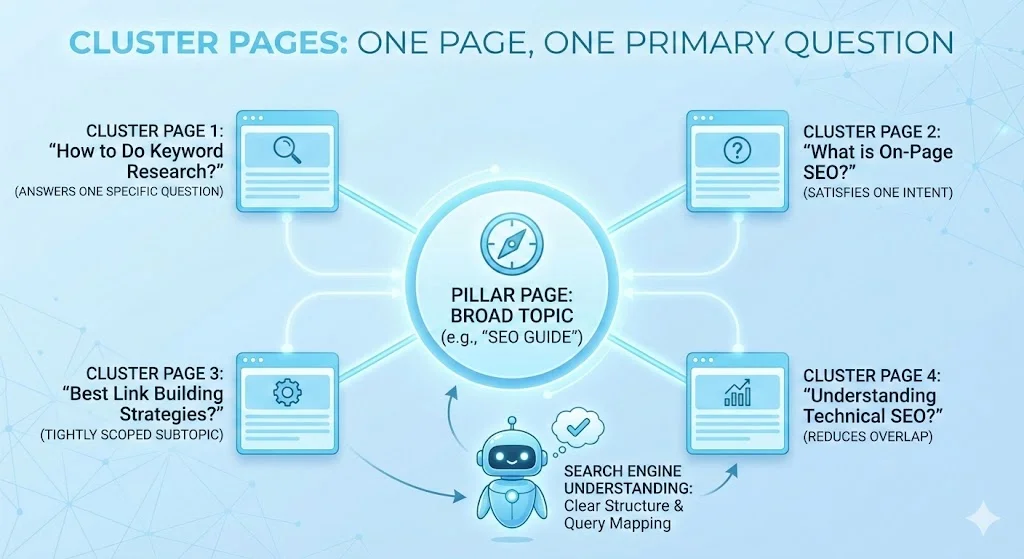
When each supporting page stays tightly scoped to a single subtopic, search engines can more easily understand how the content fits together and which queries each page should rank for.
- The pillar page links to every cluster page
- Each cluster page links back to the pillar page
- Cluster pages can link to each other when it’s genuinely helpful
Internal linking is what turns a group of related articles into a true topic cluster. Without clear, intentional links, search engines and users see separate pages instead of a connected topic.
Don’t dump links in a “related articles” block and call it a cluster. Place links contextually inside paragraphs where a reader naturally wants the next answer.
- pillar page first (so the hub exists)
- highest-demand cluster pages next
- remaining cluster pages based on gaps and performance
The order in which you publish content affects how quickly search engines understand the structure of your topic cluster. Starting with the right foundation helps every new page fit into a clear, logical framework from day one.
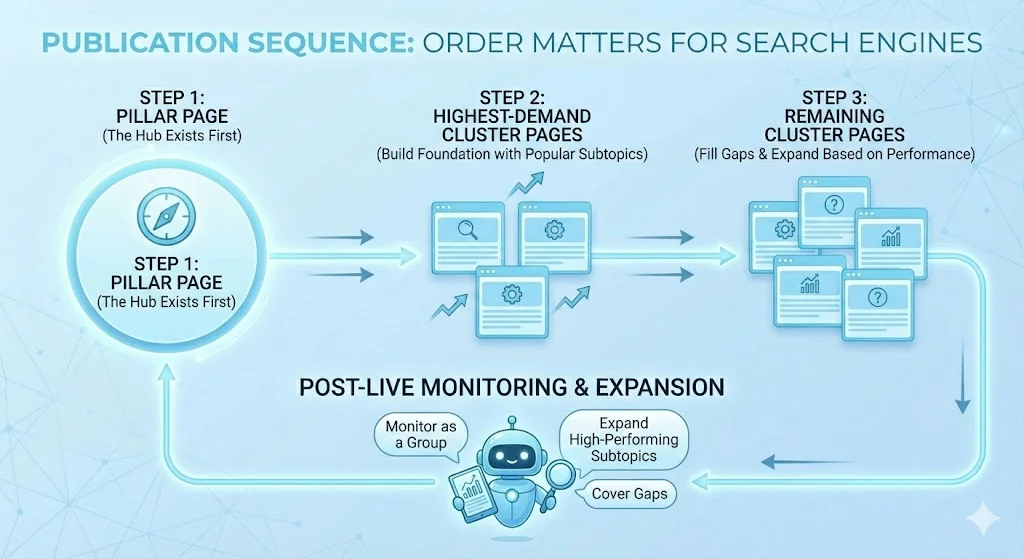
Once the cluster is live, monitor it as a group and expand based on what performs well, where users engage most, and which subtopics still need coverage.
Research from Google’s AI Search documentation confirms that AI Overviews prioritize websites demonstrating topical breadth and depth through interconnected content structures (Google Search Central, 2025). Single-page content, no matter how comprehensive, lacks the cross-referencing signals AI systems use to validate expertise.
How Do I Create My First Topic Cluster Strategy for a Small Business Blog?
For a small business blog, the goal is to start focused and build depth, not publish at scale. Below are the 5 tips for you to follow:
- Choose one core topic that directly relates to your product, service, or a key customer pain point. The topic should be narrow enough to stay focused but broad enough to support multiple supporting pages.
- Create a single pillar page that explains the topic clearly and acts as the central reference point for the cluster.
- Publish three to five cluster pages that each answer one specific question or intent your audience commonly searches for.
- Connect all pages with clear, contextual internal links so users and search engines understand how the content fits together.
- Monitor performance at the topic level and expand the cluster gradually based on engagement, impressions, and content gaps.
This approach helps small business blogs build topical authority without needing large content volumes or complex workflows.
How Wellows Helps You Create Topic Clusters?
Wellows is an AI visibility platform that gives you the insights and tools needed to plan and optimize structured content like topic clusters.
Here’s how Wellows supports topic clustering:
1. Turning a Seed Keyword Into a Topic Cluster
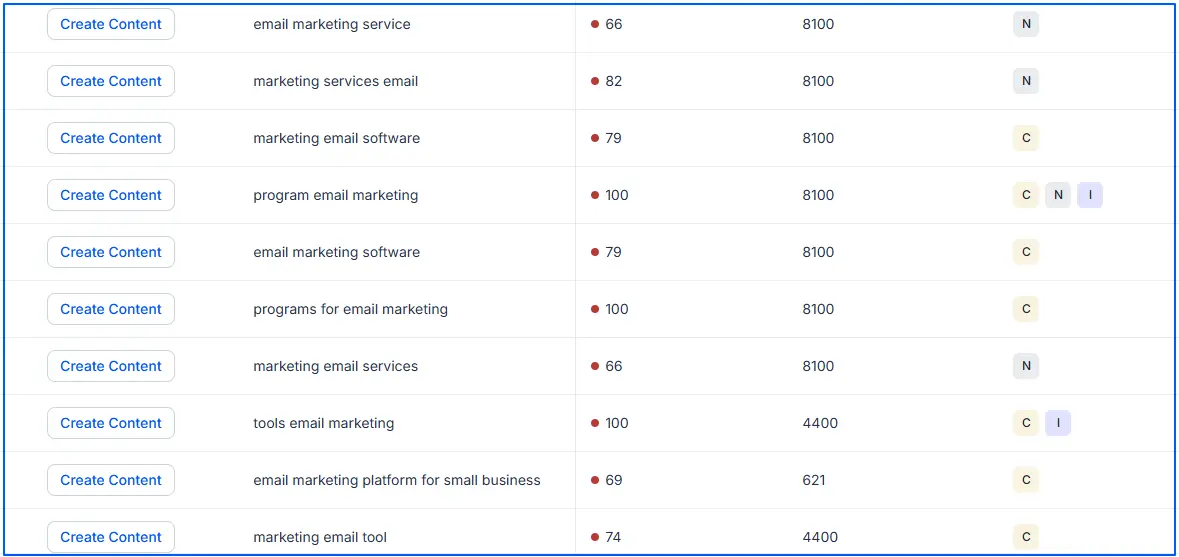
When you enter a seed keyword in Wellows, it expands it into hundreds of related keyword opportunities that naturally belong to the same topic. This makes it easier to think in clusters instead of isolated keywords.
Each keyword includes search volume, difficulty, and intent, helping you decide whether it fits a pillar page or a supporting cluster page.
2. Intent-Based Grouping for Content Structure
Wellows automatically categorizes keywords by search intent, such as commercial, informational, or navigational. This is especially useful when building topic clusters, because it prevents you from mixing different intents on the same page.
Instead of guessing which keywords belong together, you can group them logically, for example:
- Broad commercial terms for pillar pages
- Informational or comparison queries for cluster content
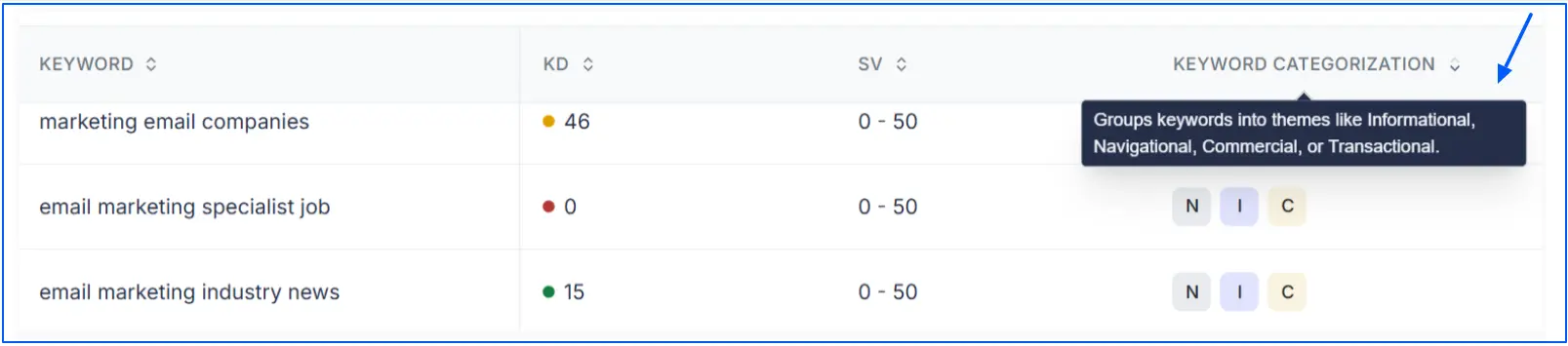
This keeps each page focused, reduces overlap, and strengthens topical clarity.
3. Visibility Signals That Help You Prioritize Pages
Wellows also shows SERP visibility signals alongside keywords, helping you identify which opportunities are more realistic to target first. Creating SERP-driven topic clustering with AI reduces the guesswork.
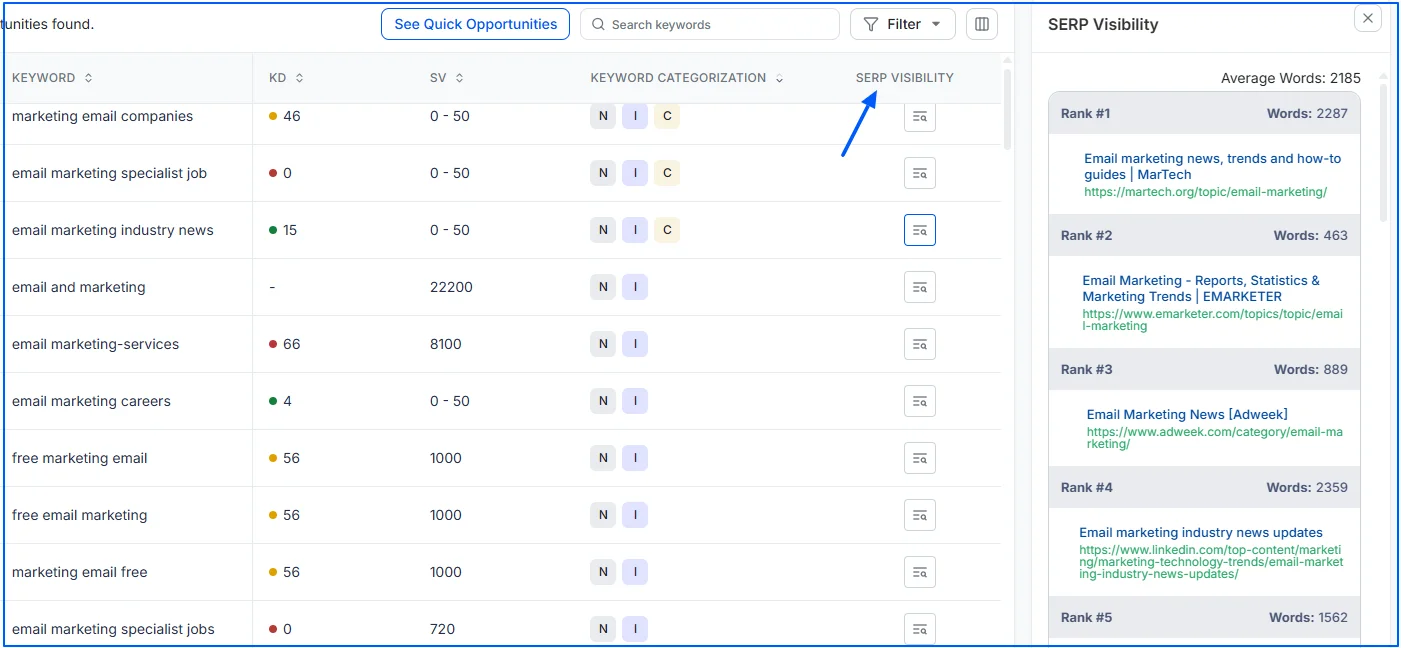
This allows you to:
- Launch high-impact cluster pages early
- Sequence content based on difficulty and demand
- Avoid chasing overly competitive terms too soon
Together, these features make it easier to turn a single seed keyword into a well-planned, intent-driven topic cluster, rather than a disconnected list of blog ideas.
4. Build Topic Clusters Based on Real User Intent
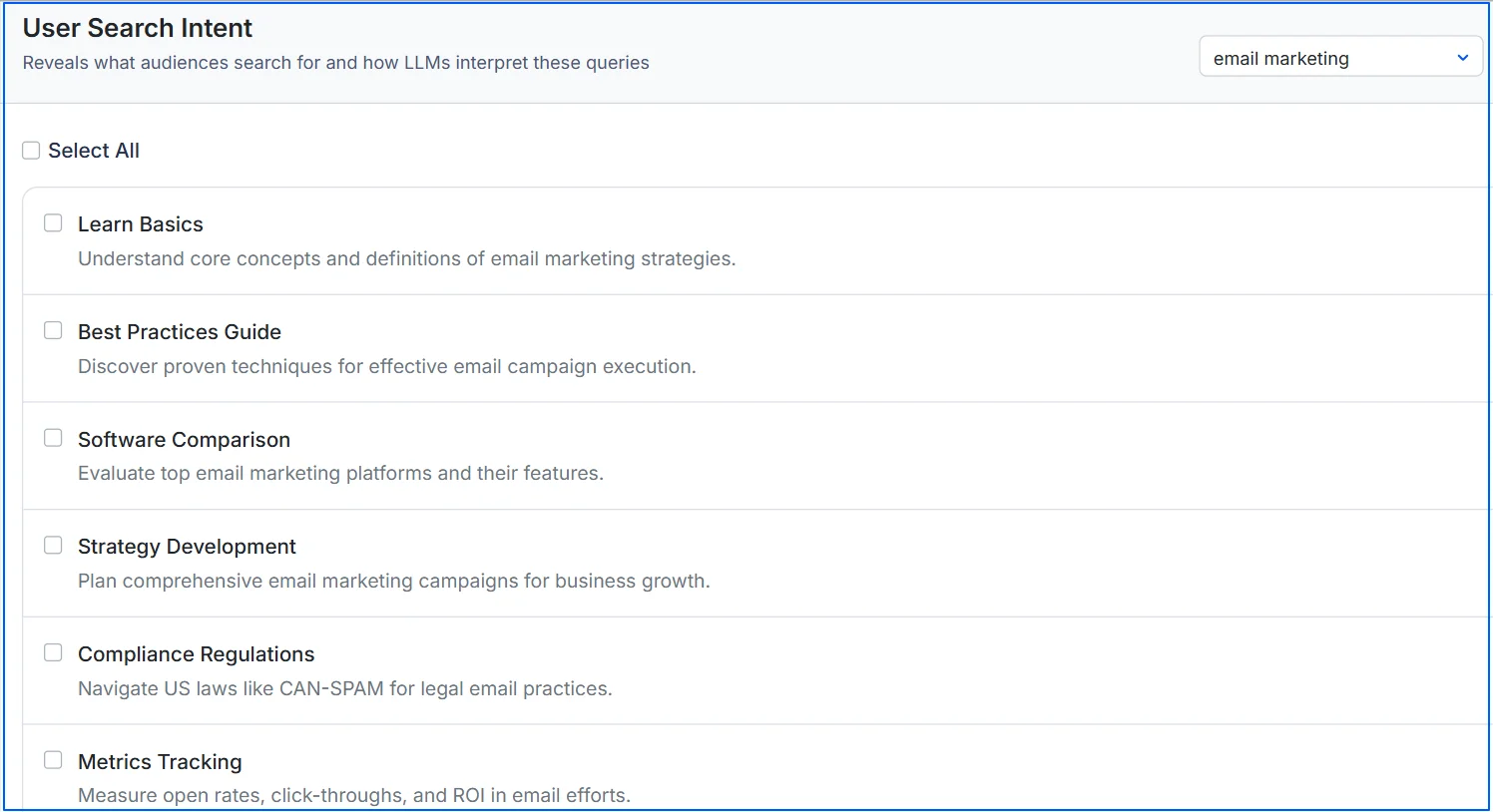
Wellows breaks down a topic into clear user intent groups, showing what people are actually trying to achieve when they search.
Each intent category acts as a natural cluster pillar or sub-cluster, making it easier to decide which pages should exist and what each page should focus on. This helps avoid mixing multiple intents on a single page, which often weakens rankings.
By aligning clusters with how both users and AI systems interpret queries, Wellows helps you create topic clusters that are clearer, more focused, and easier to scale over time.
5. Content Creation in One Workflow
Each keyword opportunity includes a “Create Content” action, allowing you to move directly from research to execution. This removes friction between planning and writing, which is often where cluster strategies break down.
The content-brief and drafts created by Wellows are optimized for AI search visibility.
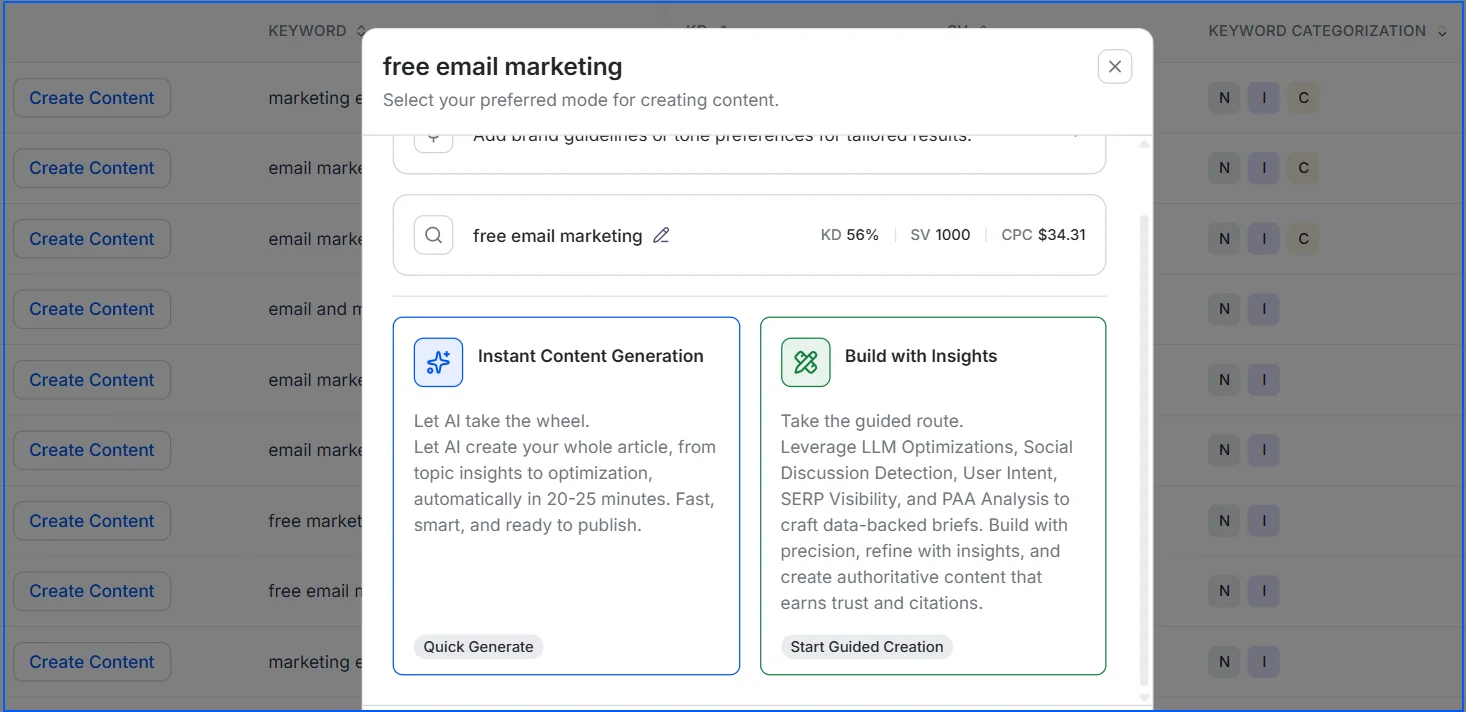
By seeing all related keywords in one place and acting on them individually, you can build a topic cluster gradually while maintaining structure and intent alignment.
How AI Helps Identify the Right Topics and Subtopics for Your Clusters?
Building effective topic clusters requires identifying the right subtopics that support your pillar. Below are the 5 examples on how can AI insights guide pillar vs cluster strategies:
1. Search Intent Patterns
AI analyzes query intent distribution to identify what users actually want to know. For example, a query like “email marketing” generates intents including:
Types:
- Informational: “what is email marketing”
- Commercial: “best email marketing tools”
- Transactional: “email marketing services for small business”
- Navigational: “Mailchimp vs Constant Contact”
2. People Also Ask (PAA) Questions
Google’s PAA boxes reveal related questions users ask. AI tools extract these systematically to identify cluster opportunities.
Example PAA Questions for Email Marketing:
- How do I start email marketing?
- What is a good open rate for email marketing?
- How often should I send marketing emails?
- What are the best email marketing platforms?
3. Entity Relationships
AI identifies semantic entities (concepts, brands, tools, techniques) related to your topic. Mapping these relationships reveals subtopics competitors miss.
Example Entities for Email Marketing:
- Concepts: automation, segmentation, deliverability, A/B testing
- Tools: Mailchimp, HubSpot, ActiveCampaign
- Techniques: drip campaigns, welcome series, re-engagement
- Metrics: open rate, CTR, conversion rate, bounce rate
4. Content Gaps Competitors Miss
AI-powered competitor analysis identifies topics your competitors cover and gaps they overlook. This reveals differentiation opportunities.
Data:
5. Query Fan-Out Sub-Intents
Optimizing for query fan-out helps AI search engines understand your content as they expand queries into multiple sub-intents. Identifying these sub-intents reveals clear opportunities for creating supporting cluster pages.
You can try using Wellows Query Fan-Out Generator to analyze how AI systems expand queries and map those expansions into supporting cluster pages.
Example Query Fan-Out for Email Marketing ROI:
- How to calculate email marketing ROI
- Average email marketing ROI by industry
- Tools to measure email marketing ROI
- Improving email marketing ROI
- Email marketing ROI vs social media ROI
How Do Topic Clusters Improve Topical Authority, and Why Does Google Care?
Topic clusters improve topical authority by helping search engines understand what your site is genuinely authoritative about, not just which individual keywords it mentions.
When content is organized around a central topic with clearly linked subpages, search engines can evaluate the entire cluster as a connected knowledge set, rather than judging pages in isolation. This allows Google to associate your site with a topic area instead of a single query.
Topic clusters strengthen topical authority by:
- Establishing clear subject ownership through a pillar page
- Reinforcing relevance via tightly related supporting pages
- Sending strong internal linking signals that define topic relationships
- Expanding coverage across long-tail and semantic variations
Google cares about topical authority because it reduces ambiguity. A site with structured, interconnected coverage is easier to trust, easier to rank, and easier to surface across multiple related searches, including AI-driven results.
As search and AI-powered systems evolve, ranking decisions rely less on exact keyword matching and more on depth, consistency, and contextual coverage. Topic clusters align with this approach by demonstrating sustained expertise across an entire topic.
Did you know?
Are Topic Clusters Still Relevant After Google’s Latest Algorithm Updates?
Yes, topic clusters are still relevant after Google’s latest updates, and for a simple reason: they support the exact things Google keeps rewarding, helpful content, clear site structure, and strong internal linking.
Google’s own guidance says links help it find new pages to crawl and are used as a signal for relevancy. A topic cluster is basically an internal-linking and relevance system applied at scale.
Core updates are also broad quality-focused changes, not “one trick” updates. If your cluster strategy produces genuinely useful pages (not thin variations) and connects them in a logical way, it aligns with what core updates aim to surface: more relevant, satisfying results.
Where people get burned is confusing “topic clusters” with “publishing lots of near-duplicate pages.” Recent quality systems, including the shift of helpfulness evaluation into core ranking systems, make that kind of output riskier.
Clusters work best when each page has a distinct purpose and adds real value.
Can Topic Clusters Help Reduce Bounce Rates on My Website?
Yes, they can, but not because clusters magically “fix” bounce rate. They help by giving visitors a clear next step that matches what they came for.
When someone lands on a cluster page and sees relevant internal links to closely related answers, they are more likely to click, explore, and stay longer. That improves engagement signals like pages per session and time on site, and it often reduces “one-and-done” visits.
Topic clusters can reduce bounce rates by:
- Guiding readers to the next most relevant article in their journey
- Keeping users inside the same topic instead of sending them back to Google
- Helping visitors self-navigate based on intent (beginner, comparison, how-to)
- Increasing perceived trust because the site feels organized and complete
Did you know?
Why are Topic Clusters Essential for GEO and AI Search Optimization?
Generative Engine Optimization (GEO) is the practice of optimizing content to appear in AI-generated answers from systems like ChatGPT, Gemini, Perplexity, and Google AI Overviews.
Unlike traditional SEO where ranking #1 guarantees visibility, GEO requires comprehensive topical coverage that AI systems can trust and cite—the same foundation that shapes how to rank in Google AI Overviews when Google is selecting sources at the passage level.
How AI Systems Evaluate Content for Citations
When generative engines process a query, they:
Fan out the query into 12–15 sub-queries covering different intents
Retrieve passages from multiple sources across the web
Evaluate topical authority by analyzing Breadth of coverage (does the site address related subtopics?), Depth of expertise (are answers substantiated with data?), Content freshness (is information current?), and Internal coherence (do pages support each other?)
Synthesize and cite sources demonstrating the highest confidence signals
Do links from topical authority sites help with AI visibility? Yes, links from topical authority sites can help with AI visibility by reinforcing trust and relevance signals. When authoritative sources reference your content, AI systems are more likely to recognize and validate your expertise.
Analysis of 6.8 million AI citations across ChatGPT, Gemini, and Perplexity revealed:
- Websites with topic clusters received 3.2x more citations than single-page competitors
- 86% of AI citations came from sites with 5+ interconnected pages on the topic
- Average cluster architecture had 1 pillar + 8 cluster pages
- Bi-directional internal linking increased citation probability by 2.7x (Yext AI Citation Study, 2025)
Key Insight: AI systems don’t just evaluate individual pages—they evaluate your entire topical footprint, which is a major part of how to rank in Perplexity because Perplexity tends to cite sources that demonstrate breadth + depth across a topic.”
How Do Topic Clusters Improve Content Authority in Generative Search?
Content authority in generative search is measured by how confidently AI systems can validate your expertise. Here are five ways AI-driven content clusters for AEO can help improve your topical authority:
1. Semantic Signal Amplification
When multiple pages on your site address related subtopics, search engines recognize semantic relationships between them. This creates a topical authority graph that reinforces your expertise.
Example: A pillar page on “Email Marketing” linking to clusters on “Email Automation,” “List Segmentation,” “Deliverability,” and “Analytics” signals comprehensive expertise—not just surface-level knowledge.
2. Internal Link Equity Distribution
Topic clusters strategically distribute link equity (PageRank) from high-authority pages to supporting content. This lifts the entire cluster in rankings, not just individual pages.
Data: Websites implementing topic clusters see average internal PageRank increase of 34% for cluster pages within 60 days (Moz, 2025).
3. Reduced Content Cannibalization
Without clusters, multiple pages often compete for the same keywords—confusing search engines about which page to rank. Clusters eliminate this by:
Assigning distinct subtopics to each cluster page
Using the pillar as the primary ranking page for broad terms
Targeting long-tail queries with cluster pages
4. Enhanced E-E-A-T Signals
Google’s Experience, Expertise, Authoritativeness, and Trustworthiness (E-E-A-T) guidelines emphasize demonstrating expertise across a topic. Topic clusters provide concrete proof by:
Covering topics comprehensively (Expertise)
Citing credible sources across multiple pages (Authoritativeness)
Maintaining consistent, updated information (Trustworthiness)
Showcasing first-hand insights and data (Experience)
5. AI Confidence Through Cross-Referencing
AI systems validate information by cross-referencing claims across multiple sources. Standard analytics show traffic, not whether AI systems cite your cluster pages. Teams that need that visibility often evaluate Peec AI alternatives with prompt-level tracking to measure AI authority, not just assume it.
Example: If your pillar states “Email marketing delivers $42 ROI per $1 spent” and a cluster page provides the detailed case study proving this, AI systems recognize internal corroboration—a strong trust signal.
Is Topic Clustering Better Than Traditional Keyword Research for Content Strategy?
Topic clustering is best seen as an upgrade to keyword research, not a replacement.
Traditional keyword research shows what people search for, but on its own it often leads to isolated pages and overlapping content. Topic clustering fixes this by organizing content around a core topic, with supporting pages focused on specific subtopics or intents.
Keywords still matter, but they are used to map and prioritize the cluster, not to plan each page in isolation.
- Build topical authority in a niche, not just rank one article
- Rank for many related long-tail queries over time
- Reduce keyword cannibalization between similar posts
- Improve internal linking and user journeys across related pages
- Validate search volume before you write anything
- Prioritize which cluster pages to publish first
- Find quick-win opportunities (low competition terms)
- Optimize titles, headings, and on-page language
Use keyword research to find real queries and prioritize them, then use topic clustering to organize those queries into a structure that search engines, users, and AI systems can understand.
Did you know?
A 2025 case study of 50 B2B SaaS websites implementing pillar-cluster architecture found:
- 63% increase in “primary topic” keyword rankings within 90 days
- Average domain authority increase of 8 points over 6 months
- 4.7x more internal link equity flowing to priority pages
- AI citation rate increased from 12% to 41% for pillar topics (Backlinko, 2025)
How Long Does It Take to See SEO Results From Implementing Topic Clusters?
Topic clusters usually don’t deliver overnight wins, because the real benefit comes from building connected authority over time. That said, you can often spot early movement before the big gains show up.
A realistic timeline looks like this:
- 2–6 weeks: Search engines discover the new structure, pages get crawled and indexed, and you may see small ranking shifts.
- 6–12 weeks: Early traction on long-tail queries, better internal link discovery, and steadier impressions in Search Console.
- 3–6 months: More noticeable improvements, especially if the cluster covers the topic well and internal linking is clean.
- 6–12 months: Strong compounding effect as the cluster expands, earns links, and builds topical authority.
What affects the timeline most:
- Your site’s authority: Newer sites usually take longer than established ones.
- Content quality and completeness: Thin or overlapping pages slow progress.
- Internal linking strength: Clusters only work in AI Search Engines if the links are intentional and contextual.
- Publishing frequency: Launching a pillar with multiple cluster pages tends to work faster than publishing one page per month.
- Competition: Tough niches take longer to break into.
Did you know?
What are the Most Common Topic Cluster Mistakes to Avoid?
Topic cluster mistakes usually happen when content is planned page-by-page instead of as a connected system and these mistakes lead to visibility issues in both search engines and AI platforms. Fixing them is mostly about tightening intent, structure, and internal links so every page has a clear role.
| Mistake | How to Fix It |
|---|---|
| Creating too many pillar pages | Pick fewer core topics and build depth with strong supporting cluster pages. |
| Publishing pages without a clear search intent | Assign one primary intent per page (guide, comparison, pricing, how-to) and stick to it. |
| Weak or missing internal linking | Link pillar → clusters and clusters → pillar contextually during writing, not as an afterthought. |
| Overlapping topics that cause keyword cannibalization | Map subtopics before writing, then merge, redirect, or differentiate similar pages. |
| Treating categories as topic clusters | Create a true pillar page that explains the topic, then link to focused supporting pages. |
| Not updating older content to fit the cluster | Refresh existing posts, align them to intent, and add them into the pillar linking structure. AI platforms like ChatGPT cite content 76.4% of the time from pages updated in the last 30 days. |
| Expecting quick wins without expanding coverage | Publish consistently, fill topic gaps, and improve internal linking as new pages go live. |
Read More Articles
- 8 Most Effective Strategies for AI Visibility Enhancement
- How SERP Visibility Analysis Uncovers Competitor Gaps in 2026
- AEO Vs GEO (2026): Differences, Use Cases & Which To Prioritize
- How Brand Signals Shape AI Search Visibility in 2025
- How Can Startups Use a GenAI Visibility Stack for Growth
- Reddit For GEO (2025): Boost AI Citations And Google SEO
- Save 50+ Hours: Automation for Agency Workflows in 2025
FAQs
A thematic cluster is a group of interlinked pages focused on a shared theme or subject area. It helps search engines and users understand content relationships beyond individual keywords.
They are closely related and often refer to the same structure. Both use a central hub or pillar page supported by interlinked subpages. Topic clusters place more emphasis on search intent, internal linking, and topical authority, which makes them better suited for modern SEO and AI-driven search.
A keyword targets a single search term, while a topic cluster targets a broader subject through multiple related pages. Clusters focus on intent and coverage, not isolated phrases.
Topic clusters can work for YouTube channels just as well as for websites. Instead of pages and internal links, you use playlists, video titles, descriptions, and cross-video linking to build topical depth.
Yes, topic clusters can be created per language, with separate pillar and cluster pages for each. Proper hreflang implementation is important to avoid overlap.
For AI-SEO that ties topic cluster planning to content briefs, Wellows helps you go straight from keyword intent and cluster mapping into AI-assisted brief creation and draft generation. This lets you plan topics and generate structured content outlines in one workflow, reducing manual steps and improving consistency with search intent.
Yes, it’s worth it for local businesses when done on a small, focused scale. Topic clusters help service pages rank better by clearly connecting treatments, services, FAQs, and local intent content. For dentists or plumbers, even one well-built cluster around a core service can improve visibility, trust, and conversions without needing a large content volume.
Conclusion
When built correctly, topic clusters help you create clearer content structures, stronger internal linking, and more useful experiences for readers.
They also give your site a better chance to earn long-term visibility across search results and AI-powered answers as search continues to evolve.
If you focus on intent, structure, and consistency instead of quick wins, topic clusters become a strong foundation for scalable SEO and AI visibility.