Search is changing faster than ever and agencies can feel it.
For years, SEO audits meant checking keywords, backlinks, and technical issues. But now, search engines aren’t the only ones deciding what content gets seen. Large Language Models (LLMs) like ChatGPT, Google’s AI Overviews, and other AI assistants are shaping how people discover brands, answers, and recommendations.
This shift raises a big question for agencies: Can LLM audits become part of modern SEO?
If AI tools are summarizing content, recommending brands, and answering user queries directly, then ranking on Google alone is no longer enough. Agencies need to understand how AI models see their clients, what they mention, and why some brands show up while others stay invisible.
In this blog, we’ll explore what LLM audits really mean for SEO, why agencies should care, and whether this new approach can give them a real competitive edge in an AI-driven search world.
- Search visibility now extends beyond Google rankings to AI systems like ChatGPT, Google AI Overviews, Gemini, and Perplexity.
- LLM audits show how AI models understand, trust, and mention brands in AI-generated answers.
- Unlike traditional SEO audits, LLM audits focus on entities, mentions, context, and authority, aligning with GEO.
- LLMs prioritize entity clarity, trusted sources, and relevance, not keyword placement.
- For agencies, AI search visibility is now a core responsibility, especially in zero-click environments.
- LLM audits help explain why brands appear (or don’t) in AI answers and close reporting gaps traditional SEO tools miss.
- A complete LLM audit covers entity presence, mentions, authority signals, content structure, and competitor visibility.
- LLM audits uncover new keyword and topic opportunities by revealing AI-driven content gaps and intent signals.
- Agencies can integrate LLM audits into existing SEO workflows without replacing traditional SEO.
- Adopting LLM audits helps agencies future-proof client visibility in an AI-first search landscape.
What Is an LLM Audit in SEO?
An LLM audit in SEO is the process of checking how Large Language Models (LLMs) understand, recognize, and mention a brand across AI-driven search experiences. Instead of focusing only on rankings in traditional search results, an LLM audit looks at AI visibility, how often and in what context a brand appears in answers generated by AI tools.
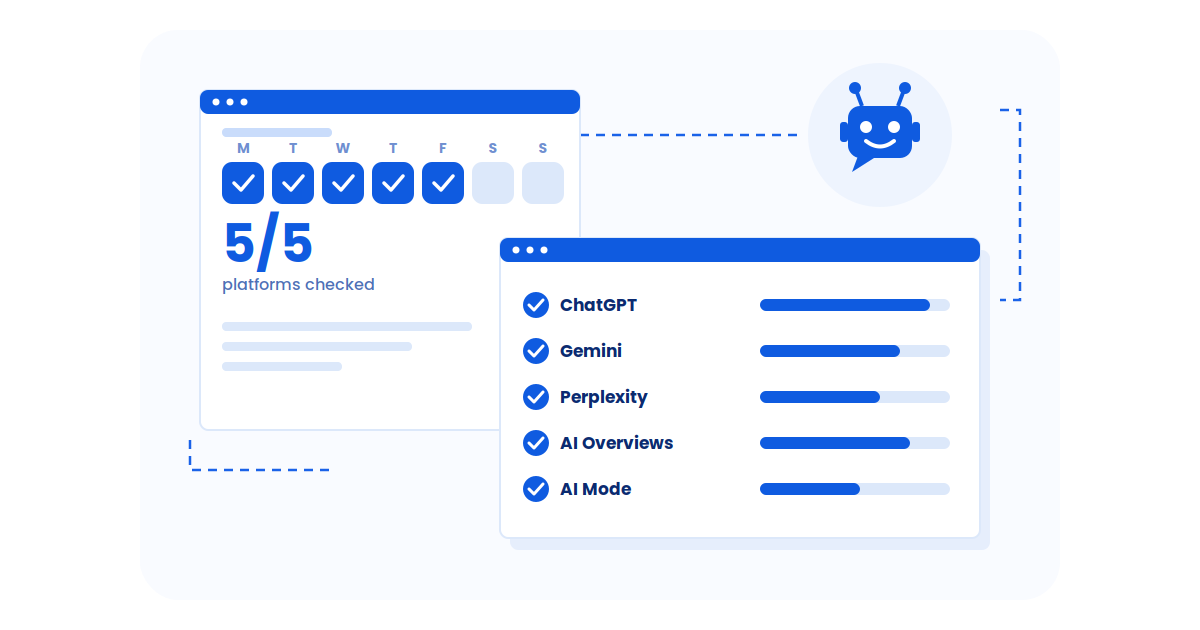
As search expands beyond blue links, AI search engines and assistants like Google AI Overviews, ChatGPT, Gemini, and Perplexity are becoming new discovery channels that are reshaping how Digital Marketing Agencies drive visibility.
An LLM audit helps agencies understand whether their clients are visible in these AI-generated responses or completely missing, an issue directly tied to what is generative engine optimization.
How LLM Audits Differ from Traditional SEO Audits
To understand LLM audits clearly, it helps to see how they compare with existing audit types:
- Traditional SEO audits focus on websites and SERPs. They analyze keywords, backlinks, technical SEO, page speed, content quality, and on-page optimization to improve rankings in Google’s organic results.
- AI visibility audits look at whether a brand appears in AI-powered results, summaries, or answer boxes. These audits often track brand mentions but don’t fully explain why AI systems choose certain sources.
- LLM audits go deeper. They analyze how LLMs interpret a brand as an entity, how often it is mentioned, the context of those mentions, and whether AI models trust the brand enough to reference it in their answers.
In short, traditional audits optimize for search engines, while LLM audits optimize for AI understanding—highlighting the growing gap between SEO vs GEO.
What LLMs Evaluate When Generating Answers
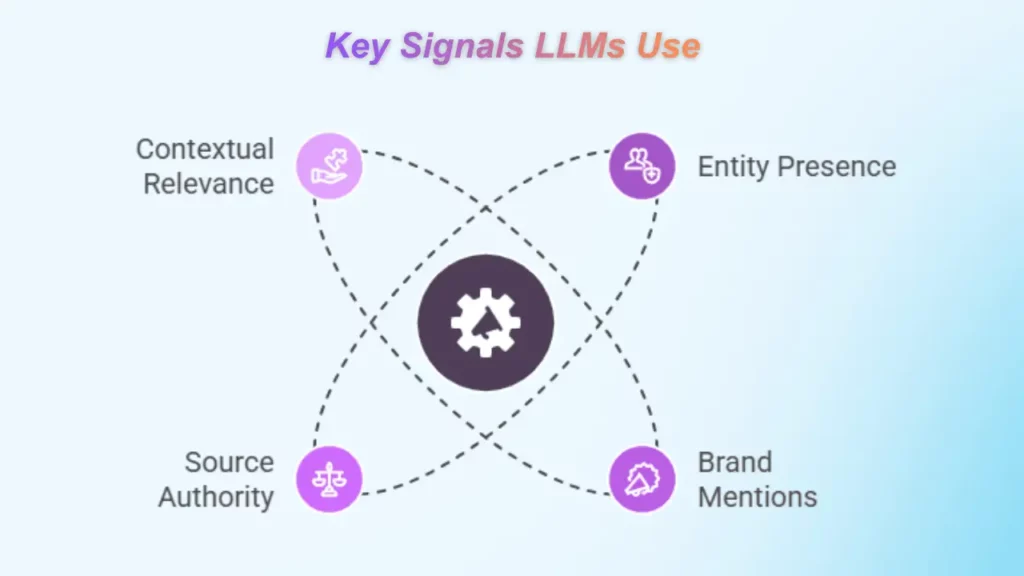
LLMs don’t rank pages the way search engines do. Instead, they evaluate information based on patterns, credibility, and context. A strong LLM audit examines the key signals AI models rely on, including:
- Entity presence: Whether a brand exists as a clearly defined entity across trusted sources on the web.
- Brand mentions (explicit and implicit): Explicit mentions use the brand name directly, while implicit mentions refer to the brand without naming it—both influence AI recognition.
- Source authority: LLMs prefer information from reliable, well-cited, and authoritative sources when forming responses.
- Contextual relevance: How closely a brand is associated with specific topics, industries, or problems within AI-generated answers.
By understanding these factors, agencies can move beyond traditional SEO and start optimizing for visibility in AI-powered search experiences, where LLMs—not just algorithms—decide what users see.
Why LLM Audits Matter for Modern SEO Agencies
LLM audits are no longer a “nice to have” for agencies, as AI search visibility for agencies becomes a core responsibility in how brands are discovered and recommended.. They are becoming a business necessity. As AI changes how people search, agencies must adapt how they measure visibility, success, and value for their clients.
From Keyword Rankings to Answer & Entity Visibility
Traditional SEO success was easy to explain: “You rank #3 for this keyword.”
But in AI-driven search, users don’t always see rankings, they see answers.
LLMs surface brands based on entity understanding, topical relevance, and trust, not just keyword placement. A brand can rank well in Google and still be invisible in AI-generated responses. LLM audits help agencies track whether their clients are recognized as authoritative entities, not just optimized pages.
The Rise of Zero-Click and AI-Generated Answers
With Google AI Overviews, ChatGPT, Gemini, and Perplexity, users often get what they need without clicking a website. In fact, more than half of Google searches (about 58.5% in the U.S. and 59.7% in the EU) now result in zero clicks, signaling how search behavior is increasingly resolved on the results page itself. (Wordtracker, 2024)
This creates a growing zero-click environment, where visibility happens inside AI answers instead of search results.
For agencies, this means:
- Less traffic doesn’t always mean less influence
- Brand mentions inside AI responses now matter as much as rankings
- Being referenced can be more valuable than being clicked
LLM audits allow agencies to measure presence in these AI-generated answers, something traditional SEO tools can’t do well.
Clients Are Asking the Hard Questions
More clients are starting to ask:
“Why don’t we show up in AI results?”
This question is becoming common and uncomfortable. Because standard SEO reports don’t have a clear answer. Rankings, impressions, and clicks don’t explain why AI tools ignore certain brands.
A practical starting point is how to audit brand visibility on LLMs, so you can show where the brand appears, how it’s framed, and what’s missing.
LLM audits give agencies a way to respond with clarity by showing:
- Whether the brand exists as a trusted entity
- How often it’s mentioned by LLMs
- What competitors AI prefers and why
SEO Reporting Gaps in Traditional Tools
Most SEO tools were built for search engines, not AI models. They track keywords, backlinks, and traffic, but they don’t explain:
- AI brand visibility
- Implicit mentions
- Entity strength
- Topic-level authority in LLMs
This creates a reporting gap that agencies struggle to fill, especially when it comes to measuring AI search engine visibility. LLM audits close that gap by adding AI visibility metrics to SEO reporting, helping agencies stay relevant, proactive, and future-ready.
For modern SEO agencies, LLM audits aren’t about replacing traditional SEO—they’re about expanding it by helping agencies combine SEO and GEO into a single strategy.
How LLM Audits Differ From Traditional SEO Audits
Traditional SEO audits and LLM audits serve different goals—even though they’re often confused. One focuses on how pages rank, while the other focuses on how brands are understood and referenced by AI. For modern agencies, knowing the difference is critical.

Below is a clear, side-by-side comparison to show how both approaches differ.
| Aspect | Traditional SEO Audit | LLM Audit |
| Primary goal | Improve keyword rankings in SERPs | Improve brand visibility in AI-generated answers |
| Core signals | Ranking signals (links, on-page SEO, technical health) | Training & inference signals (mentions, context, authority) |
| How content is processed | Crawled and indexed by search engines | Ingested as knowledge by LLMs |
| Role of links | Backlinks pass authority and ranking power | Links matter less than mentions and citations |
| Brand signals | Brand helps indirectly with trust and CTR | Brand acts as a recognizable entity |
| Focus unit | Keywords and pages | Entities, concepts, and topics |
| Visibility outcome | Position in search results | Inclusion or exclusion in AI a |
In short, traditional SEO audits optimize for ranking, while LLM audits optimize for recognition and trust in an AI-first search landscape.
What Should an LLM Audit Include? (Core Framework)
An effective LLM audit goes beyond surface-level checks. It focuses on how AI models understand, trust, and reference a brand when generating answers. For agencies, this framework turns AI visibility into something measurable, actionable, and reportable.
Below are the core components every LLM audit should include.
Entity & Brand Presence Analysis
The first step is confirming whether the brand exists as a recognizable entity in the AI ecosystem.
Key questions an LLM audit should answer:
- Is the brand clearly recognized as a distinct entity by LLMs?
- Is the brand information consistent across the web, including name, descriptions, and associations?
- Does the brand align with existing knowledge graph signals, such as categories, products, founders, or industries?
If a brand lacks entity clarity or has inconsistent references, LLMs struggle to confidently include it in AI-generated answers.
Explicit & Implicit Mentions
Mentions matter more than most agencies realize, especially in AI-driven systems.
An LLM audit should analyze:
- Explicit mentions where the brand name is directly used
- Implicit mentions where the brand is referenced without being linked
- Co-occurrence with important industry terms, problems, and solutions
- The quality of context surrounding those mentions
Not all mentions are equal. LLMs favor brands that appear in relevant, informative, and authoritative contexts, not generic or promotional content.
Source & Authority Signals
LLMs rely heavily on trusted sources when forming answers. This makes where a brand is mentioned just as important as how often.
A strong LLM audit evaluates:
- Which trusted domains reference the brand
- Whether mentions appear in content types LLMs prefer, such as guides, explainers, research, and comparisons
- The difference between reputable citations and low-trust or spammy mentions
Mentions from high-authority sources strengthen AI trust, while low-quality references may be ignored—or worse, dilute credibility.
Content Alignment With AI Answer Patterns
LLMs are built to answer questions, not rank pages. Your content must match how AI systems extract information.
An LLM audit should assess:
- Whether content clearly answers “what,” “why,” and “how” questions
- If information is structured in a way that’s easy for AI to extract
- Use of clear definitions, bullet lists, step-by-step explanations, and FAQs
Content that mirrors AI answer patterns has a much higher chance of being included in AI-generated responses.
Competitive LLM Visibility
Visibility is relative. If your client isn’t appearing, someone else is.
An LLM audit must include:
- Which competitors are showing up in AI answers
- The signals that explain why those competitors are selected
- Gaps in coverage, context, or authority your client can exploit
This competitive insight turns an LLM audit from a diagnostic tool into a growth strategy.
Together, these components form a practical framework agencies can use to diagnose AI visibility issues, justify strategic changes, and help clients stay discoverable in an AI-first search world.
How LLM Audits Reveal New Keyword and Topic Opportunities for SEO
Large Language Model (LLM) audits play a growing role in identifying new keyword and topic opportunities by revealing how AI systems interpret, prioritize, and surface content. Instead of relying only on traditional keyword tools, LLM audits help agencies uncover emerging queries, overlooked topics, and contextual gaps driven by user intent. that influence visibility in AI-driven search experiences.
1. Assessing Brand Presence Across AI Platforms
The first step is to review how a brand appears across major AI tools such as ChatGPT, Gemini, Claude, and Perplexity. Agencies can test a variety of queries related to the brand, its offerings, leadership, and industry to understand how AI systems currently respond.
Key areas to review include:
- Mentions and descriptions: Whether the brand is referenced and how its role or expertise is explained.
- Citations and attributions: Whether the brand is credited directly, indirectly, or not at all within AI-generated answers.
Establishing this baseline helps agencies identify where a brand lacks visibility, appears inconsistently, or is missing from relevant AI conversations.
2. Conducting Gap Analysis
Once baseline visibility is established, agencies can compare expected coverage with actual AI output to uncover gaps that represent SEO opportunities.
This analysis may reveal:
- Missing references: Situations where a brand should logically appear but doesn’t.
- Competitor dominance: Topics or questions where competitors are consistently cited instead.
- Outdated or inaccurate AI responses: Signals that content or entity data needs updating.
- Keyword and topic blind spots: Concepts AI associates with the industry but not with the brand.
- Entity and knowledge gaps: Missing connections that prevent AI systems from fully understanding the brand.
- Structured data weaknesses: Technical omissions that reduce clarity for AI models.
These gaps often point directly to new keywords, topics, and content angles worth targeting as part of a modern keyword strategy checklist.
3. Utilizing Specialized Tools for Optimization
Agencies can support LLM audits with tools designed to surface semantic and topical insights rather than just search volume.
These tools can help by:
- Analyzing semantic coverage and entity relationships within existing content
- Mapping question-based search intent that mirrors how users interact with AI assistants
- Identifying readiness for AI-driven discovery and content extraction
Used together, these insights help agencies uncover topics that traditional keyword research tools often overlook.
4. Implementing Content Strategies
Insights from LLM audits should directly inform content development and optimization strategies.
Effective approaches include:
- Topic clusters: Building comprehensive coverage around core themes to strengthen topical authority.
- Hub-and-spoke models: Creating a central resource supported by detailed subtopic pages that improve clarity and internal linking.
- Structured data optimization: Enhancing content with schema markup to improve interpretability for AI systems.
By aligning content with how AI models extract and organize information, agencies can target new keywords and topics that improve both search visibility and AI inclusion.
When applied correctly, LLM audits help agencies move beyond surface-level keyword research. They uncover emerging topics, conversational queries, and contextual opportunities that reflect how people actually search—and how AI systems choose what to surface—making them a powerful addition to modern SEO strategy.
How can a Small SEO agency integrate LLM audit findings into its existing SEO audit process?
Integrating Large Language Model (LLM) audit insights into an existing SEO audit process allows agencies to extend optimization beyond traditional search engines and into AI-driven discovery. For small SEO agencies, this integration doesn’t require reinventing workflows,just expanding them strategically.
1. Assess AI Visibility and Content Structure
Start by evaluating how AI systems interpret, summarize, and reference your content. This goes beyond rankings and looks at whether your pages provide clear, well-structured, and context-rich information that AI models can easily extract. Pay attention to content clarity, topical depth, accuracy, and format diversity (definitions, lists, explanations), as these directly influence how AI-generated answers are formed.
2. Enhance Brand and Entity Recognition
Ensure your brand, services, and areas of expertise are clearly defined and consistently communicated across your site. Strong entity clarity helps AI models understand who you are, what you offer, and where you fit within your industry. When brand signals are fragmented or vague, AI systems are less likely to confidently reference them in generated responses.
3. Implement Structured Data and Schema Markup
Structured data helps AI systems interpret content relationships more accurately. By using schema markup, agencies can clarify entities, attributes, and connections between topics. Reviewing schema implementation during an audit helps identify gaps, inconsistencies, or missing elements that may limit AI comprehension and visibility.
4. Monitor AI Mentions and Brand Positioning
Track how and where your brand appears in AI-generated answers across different platforms. This includes identifying whether the brand is mentioned accurately, positioned competitively, or omitted entirely. Monitoring these patterns helps agencies spot visibility issues early and adjust content, messaging, or authority signals accordingly.
5. Balance Automation with Human Expertise
Automation can surface patterns and visibility trends at scale, but human judgment is essential for interpreting what those findings mean. Strategic decisions—such as refining messaging, improving topical authority, or aligning content with brand voice—require professional insight. The most effective audits combine AI-powered analysis with human-led evaluation.
By integrating LLM audit findings into the SEO audit process, agencies can extend their visibility efforts beyond rankings, strengthen AI-driven brand recognition, and align with proven ways how agencies deliver AI search visibility in practice.
Is It Worth Investing in LLM Audit Tools for Small Business Clients?
Investing in LLM audit tools can make sense for local SEO agencies and small business clients when approached with the right expectations. As AI systems such as ChatGPT and Perplexity increasingly influence how users discover services and recommendations, visibility within these platforms is becoming just as important as traditional local rankings.
LLM audit tools help agencies understand how accurately a business is represented in AI-generated responses, whether key information is being referenced correctly, and where gaps exist in AI recognition. These insights allow agencies to refine content structure, entity clarity, and contextual signals so AI systems can more confidently surface the business in relevant answers.
Modern LLM audit tools can also integrate smoothly into existing SEO processes. Instead of adding complexity, they often streamline analysis by enabling agencies to evaluate multiple signals at once and surface insights through simple, query-based interactions. This makes it easier to incorporate AI visibility checks into sales conversations, reporting, and ongoing optimization without overhauling current systems.
Overall, investing in LLM audit tools can be a smart strategic decision for local SEO agencies that want to stay ahead of changing search behavior. When used thoughtfully, these tools help ensure small business clients remain visible not only in local search results, but also in the AI-generated answers increasingly shaping how customers find and choose services.
LLM Audits vs GEO (Generative Engine Optimization)
LLM audits and Generative Engine Optimization (GEO) are closely related, but they serve different roles in AI-focused SEO. One explains the problem, the other fixes it.
How LLM Audits Support GEO
An LLM audit shows how AI models currently understand a brand—while GEO works to improve that understanding.
LLM audits identify visibility gaps in AI search engines like Google AI Overviews, ChatGPT, Gemini, and Perplexity
GEO uses those insights to optimize content, entities, and authority signals
Without an audit, GEO is guesswork. With one, it’s strategic.
The Audit → Optimization → Measurement Loop
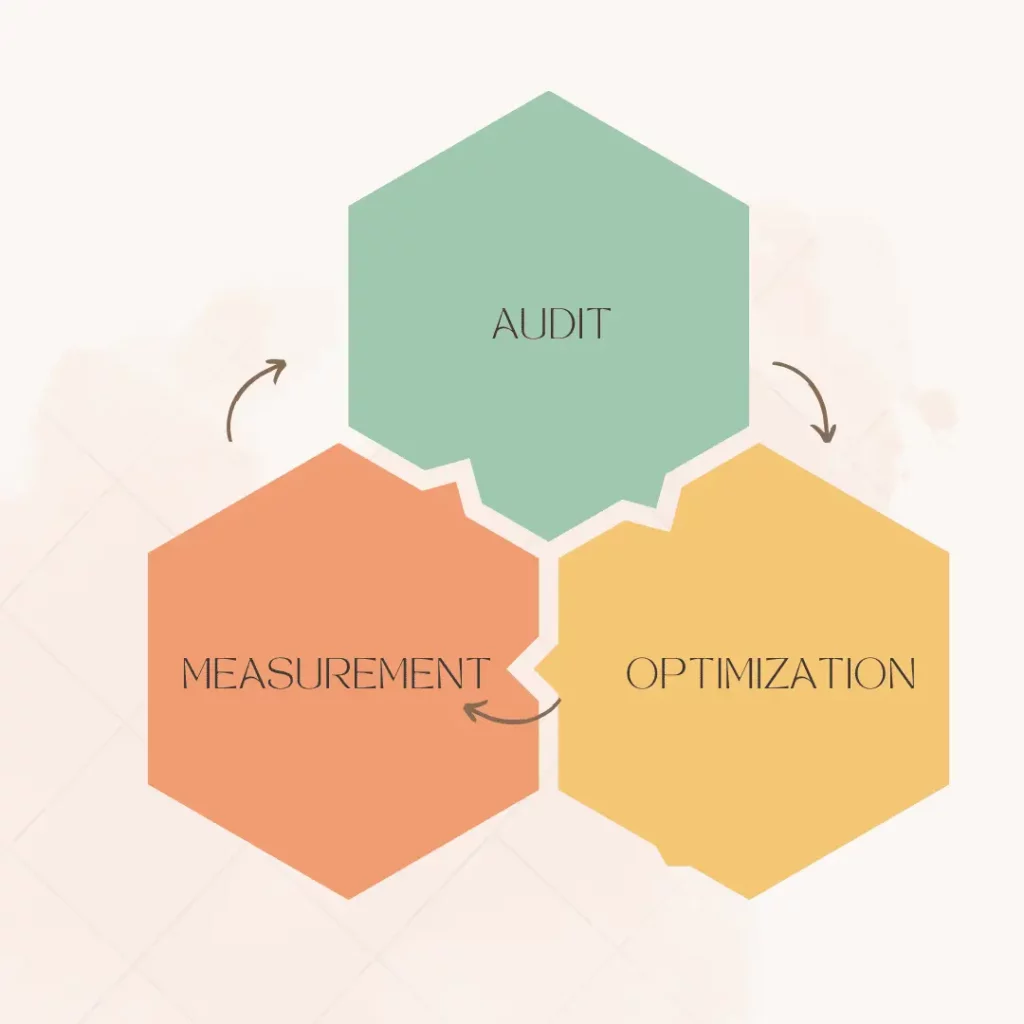
Effective GEO follows a simple loop:
- Audit: Identify entity gaps, weak mentions, and missing authority
- Optimize: Align content and brand signals with AI answer patterns
- Measure: Track changes in AI mentions and visibility
This loop turns AI visibility into a repeatable process, not a one-off effort.
Why LLM Audits Are the Foundation of GEO
GEO depends on how well AI understands and trusts a brand.
LLM audits provide:
- A clear AI visibility baseline
- Direction for optimization
- Proof of progress beyond rankings and traffic
Simply put: LLM audits show where you stand. GEO helps you move forward.
Tools Agencies Can Use for LLM Audits
LLM audits don’t rely on one single tool. Instead, agencies use a combination of platforms, testing methods, and manual analysis to understand how brands appear in AI-generated answers. The goal isn’t volume—it’s clarity.
Below are the key tool categories agencies should focus on.
AI visibility platforms are designed to track brand presence inside AI search engines and assistants, not just traditional SERPs. These tools help agencies see:
- Whether a brand appears in AI answers
- How often it’s mentioned
- Which competitors are referenced instead
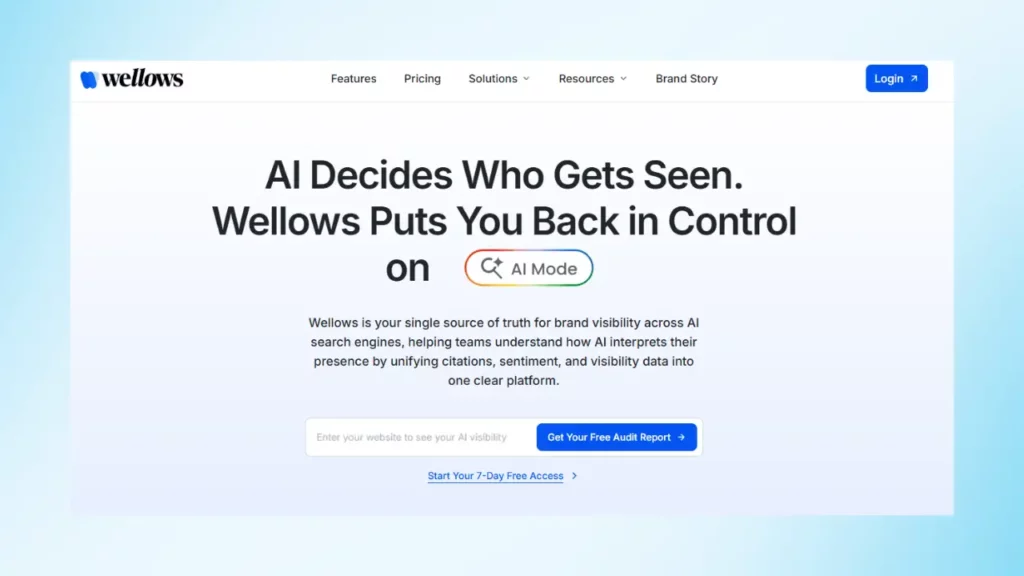
Wellows, focus on entity recognition, implicit and explicit mentions, and AI discoverability, making them useful for structured LLM audits.
One of the simplest and most effective LLM audit methods is prompt testing.
Agencies can:
- Ask consistent “what,” “how,” and “best” questions in tools like ChatGPT, Gemini, and Perplexity
- Track which brands appear, how they’re described, and what sources are cited
- Compare responses across tools to spot patterns and gaps
While manual, prompt testing provides direct insight into how LLMs generate answers in real time.
LLM audits should always compare traditional SERPs with AI-generated responses.
This helps agencies identify:
- Brands that rank well but don’t appear in AI answers
- Brands that appear in AI answers without strong rankings
- Topic-level gaps between SEO performance and AI visibility
These comparisons reveal where traditional SEO stops working—and where AI visibility begins.
LLM audits work best when automation and human analysis are combined.
- Automated tools scale visibility tracking and competitor monitoring
- Manual review ensures context quality, accuracy, and relevance are properly evaluated
Agencies that rely only on automation miss nuance. Agencies that rely only on manual checks struggle to scale.
The most effective LLM audits blend both—turning AI visibility into a practical, repeatable service.
Common Mistakes Agencies Make With LLM SEO
LLM SEO is new, and many agencies are applying old SEO habits to a completely different system. This leads to wasted effort, poor results, and confused clients. Below are the most common mistakes agencies should avoid.
- Treating LLM SEO like keyword stuffing: Repeating keywords doesn’t help LLMs. AI models look for clarity, context, and authority—not keyword density. If the brand isn’t understood as an entity, keywords won’t fix visibility.
- Over-optimizing prompts instead of presence: Forcing brand mentions through clever prompts creates short-term results. LLMs don’t retain prompt history—they rely on trusted patterns across the web. Real LLM SEO improves overall brand presence, not prompt tricks.
- Ignoring off-site signals: Many agencies focus only on on-site content and forget that LLMs heavily rely on off-site validation. Authoritative mentions, citations, and third-party references play a major role in AI trust.
- Reporting rankings instead of visibility: Keyword rankings don’t explain AI visibility. LLM SEO should report on brand mentions in AI answers, entity recognition, and competitive presence—not just SERP positions.
Avoiding these mistakes helps agencies build credible, measurable, and future-ready LLM SEO strategies instead of applying outdated SEO tactics to AI systems.
Are LLM Audits Replacing Traditional SEO Audits?
No — LLM audits are not replacing traditional SEO audits. They complement them.
Traditional SEO is still the foundation. LLM audits build on top of it.
- Why technical SEO still matters: Search engines still need to crawl, index, and rank pages. Site speed, indexability, internal linking, structured data, and clean architecture are essential. If technical SEO is broken, content won’t perform well in SERPs—or be trusted as a reliable source anywhere.
- Where traditional SEO audits stop: Traditional audits focus on rankings, traffic, backlinks, and on-page optimization. They explain how pages perform in search engines, but they don’t show whether a brand appears in AI-generated answers or how LLMs interpret brand authority.
- Where LLM audits begin: LLM audits start where traditional SEO ends. They analyze entity recognition, brand mentions, context quality, and visibility inside AI search engines like Google AI Overviews, ChatGPT, Gemini, and Perplexity.
Did you know?
In short:
- Traditional SEO audits ensure your site is search-ready
- LLM audits ensure your brand is AI-visible
Agencies that combine both deliver a complete, future-proof SEO strategy.
FAQs
Final Verdict: Should SEO Agencies Adopt LLM Audits?
Yes. And not because it’s trendy, but because it’s inevitable.
Search is no longer limited to rankings and blue links. AI systems are already shaping how users discover brands, make decisions, and choose recommendations. Agencies that ignore this shift risk falling behind—not due to poor SEO skills, but because the rules of visibility are changing.
Early adopters of LLM audits will stand out as strategic leaders, not just service providers. They’ll be the agencies that can explain why brands appear (or don’t appear) in AI answers—and what to do about it.
LLM audits aren’t about chasing hype. They’re about understanding how AI interprets authority, relevance, and trust—and using that insight to guide smarter SEO decisions.
Agencies that adopt LLM audits now won’t replace traditional SEO.
They’ll expand it, protect client visibility, and lead in an AI-first search landscape.