Google AI Overviews are changing how search results work, and visibility now depends on how easily your content can be summarized by AI. Ranking well is no longer enough. These AI answers appear above traditional rankings and pull from pages that deliver clear, structured, and fast insights.
Optimizing for Google AI Overviews means leading with concise answers, scannable headings, and intent-first content that search engines and large language models can extract with confidence, a core principle of modern AI SEO strategies.
Did you know?
If your content is not optimized for AI Overviews, you can lose visibility even when you rank on page one. In this blog, I explain how to optimize for Google AI Overviews, how Wellows can help you track and improve visibility, along with 12 practical strategies, best practices, common mistakes to avoid, and other insights to stay competitive as search evolves.
- Page-one rankings alone no longer guarantee visibility in Google AI Overviews.
- Google AI Overviews favor content that is clear, structured, and intent-complete.
- Technical signals like schema, freshness, and site performance support AI selection.
- Being cited in Google AI Overviews builds authority even when clicks decline.
- Analyzing competitors reveals the structural and topical patterns AI systems trust.
- AI Overviews reward consistency and iteration, not one-time optimization.
- Original insights, examples, and first-party data increase trust and citation likelihood.
This guide shares practical tips for optimizing AI-generated summaries, helping your content get selected and cited in Google AI Overviews.
How to Optimize for Google AI Overviews in 2026? [12 Key Strategies]
Optimizing for Google AI Overviews in 2026 means making your content and website easy to understand, easy to summarize, and easy to trust. Google’s AI systems favor pages that reduce interpretation effort and clearly resolve user intent.
Below are the 12 most effective strategies to appear in google ai overviews, with practical examples for each.
Strategies for AI Content Optimization
Here is how to do AI overview content optimization to improve your visibility without compromising content quality or long-term search performance — a common concern when discussing whether AI content hurts Google rankings.
1. Understand What AI Overviews Look for in Content
Before optimizing anything else, it’s essential to understand how AI Overviews select content. Google’s AI systems prioritize pages where the main answer is immediately clear, self-contained, and easy to verify without heavy interpretation or rewriting.
- Answer questions directly and early
- Avoid unnecessary buildup or filler
- Present facts in a neutral, verifiable tone
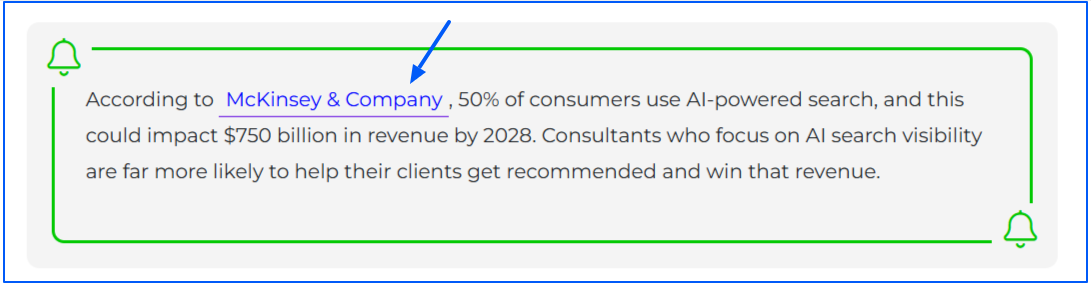
If you are adding any stats or data, make sure to add verifiable source.
Instead of opening with background context, start with a direct answer like:
What causes slow website performance?
Slow website performance is commonly caused by large unoptimized images, excessive scripts, poor hosting, and lack of caching.
2. Align Content With Search Intent, Not Just Keywords
AI Overviews prioritize pages that completely resolve a user’s intent rather than those that simply repeat keywords. Before writing or updating content, you need to understand what the searcher is actually trying to accomplish with their query.
- Define the exact problem or question the user wants answered
- Choose a content format that matches the intent (definition, process, comparison, or decision)
- Resolve the entire question within a single, self-contained section
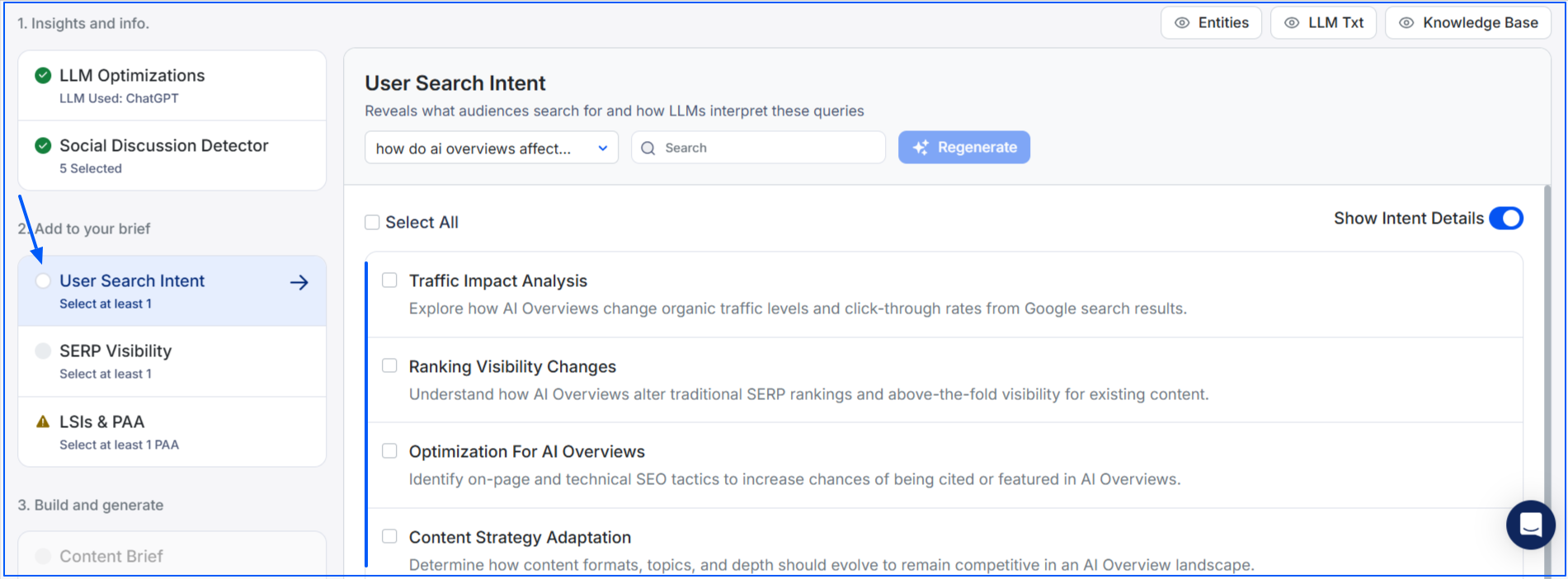
If you are unsure of what intent to cover, you can use KIVA inside Wellows to see the user search intent for your specific keyword or query.
For the query “How do AI Overviews affect SEO?”, include impact on rankings, CTR, and visibility in one section instead of spreading the answer across multiple pages.
3. Start With Helpful, People-First Answers
AI Overviews favor pages that deliver value immediately. Instead of opening with broad introductions or background context, strong candidates lead with a clear answer that helps both users and AI systems understand relevance at a glance—an approach widely used by Content Marketing Agencies optimizing content at scale for AI-driven search visibility.
-
- Place the answer within the first 50–70 words
- Use plain, natural language
- Keep it to 2–3 factual sentences
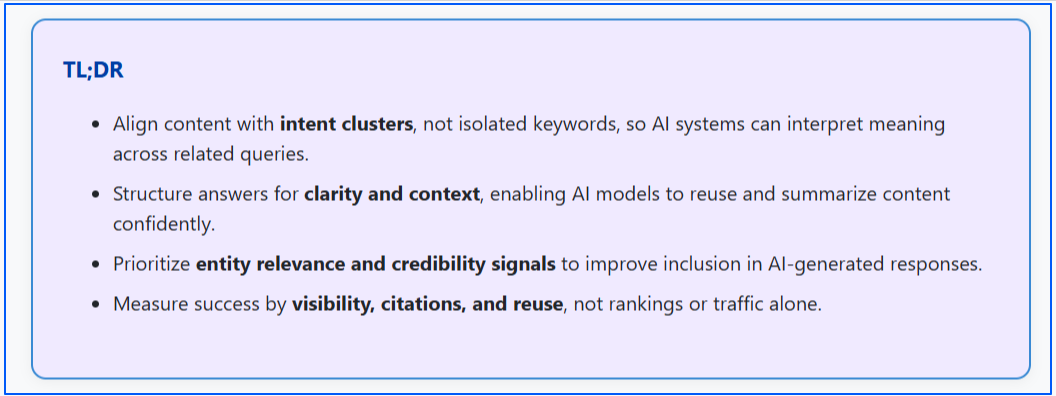
A TL;DR at the top that clearly answers the query ‘AI Search Marketing Strategies to Target Semantic Search Intent’ before expanding into details improves both user experience and AI extractability.
4. Use Clear Structure and Descriptive Subheadings
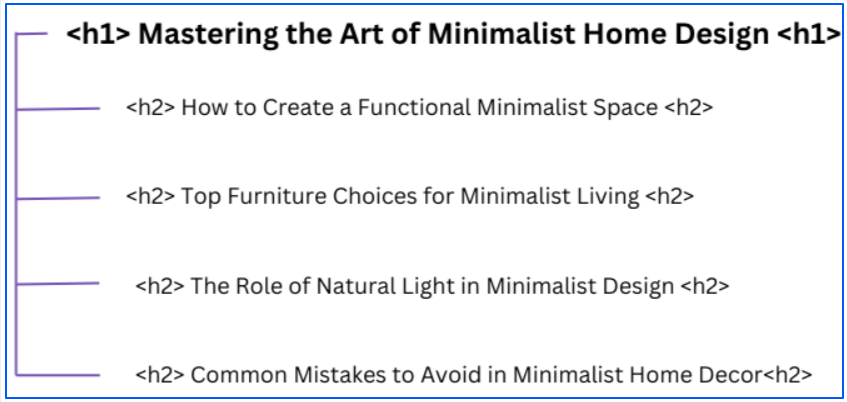
AI systems use headings as structural signals to understand what each section answers. Clear, descriptive subheadings make it easier for AI Overviews to locate relevant information without misinterpreting context.
- Write subheadings that explicitly state the question being answered
- Use question-based or task-based phrasing instead of vague labels
- Ensure each subheading resolves a single, clearly defined topic
Here is an example of how you can use the heading tags for structuring your content:
Should I add People Also Ask sections for AI optimization?
Yes, adding People Also Ask (PAA)–style sections can significantly support AI optimization. PAA questions reflect real follow-up queries users search for, and Google frequently uses them to surface additional context in search results. Addressing these questions directly within your content improves clarity, intent coverage, and makes your page easier for AI systems to understand and summarize.
Benefits of Optimizing for PAA:
- Increased Visibility: People Also Ask boxes appear across a large share of informational searches. Structuring content to answer these questions increases the chances of your page being surfaced in expanded search features and AI-generated summaries.
- Enhanced Credibility: Content that consistently answers related follow-up questions signals topical depth and reliability. Being referenced in PAA-style results reinforces your authority on the subject for both users and AI systems.
- Improved Click-Through Rates: Clear, concise answers that directly address user questions can encourage further exploration, increasing the likelihood of clicks when users want deeper context beyond the initial summary.
5. Format Content for Easy Extraction
AI Overviews favor content that is easy to break down into reusable, self-contained units. Clear formatting reduces ambiguity and helps AI systems extract accurate summaries without rewriting.
- Use numbered steps
- Add bullet lists
- Keep paragraphs short
- Use tables for comparisons
What’s the impact of heading structure on AI extractability? Headings act like a map for AI systems. Clear H2s and H3s that match user questions make it easier to identify where answers are and reduce the chance your content gets misinterpreted or skipped.
For example, if you are writing a blog on optimizing website performance, a step-by-step checklist like below explaining how to website performance optimization is more likely to be summarized than a long narrative paragraph. ☐ Optimize images using modern formats (WebP/AVIF) and proper sizing
☐ Enable browser caching and server-side caching
☐ Minify CSS, JavaScript, and HTML files
☐ Reduce unused JavaScript and third-party scripts
☐ Use a fast, reliable hosting provider
☐ Enable HTTP/2 or HTTP/3 where supported
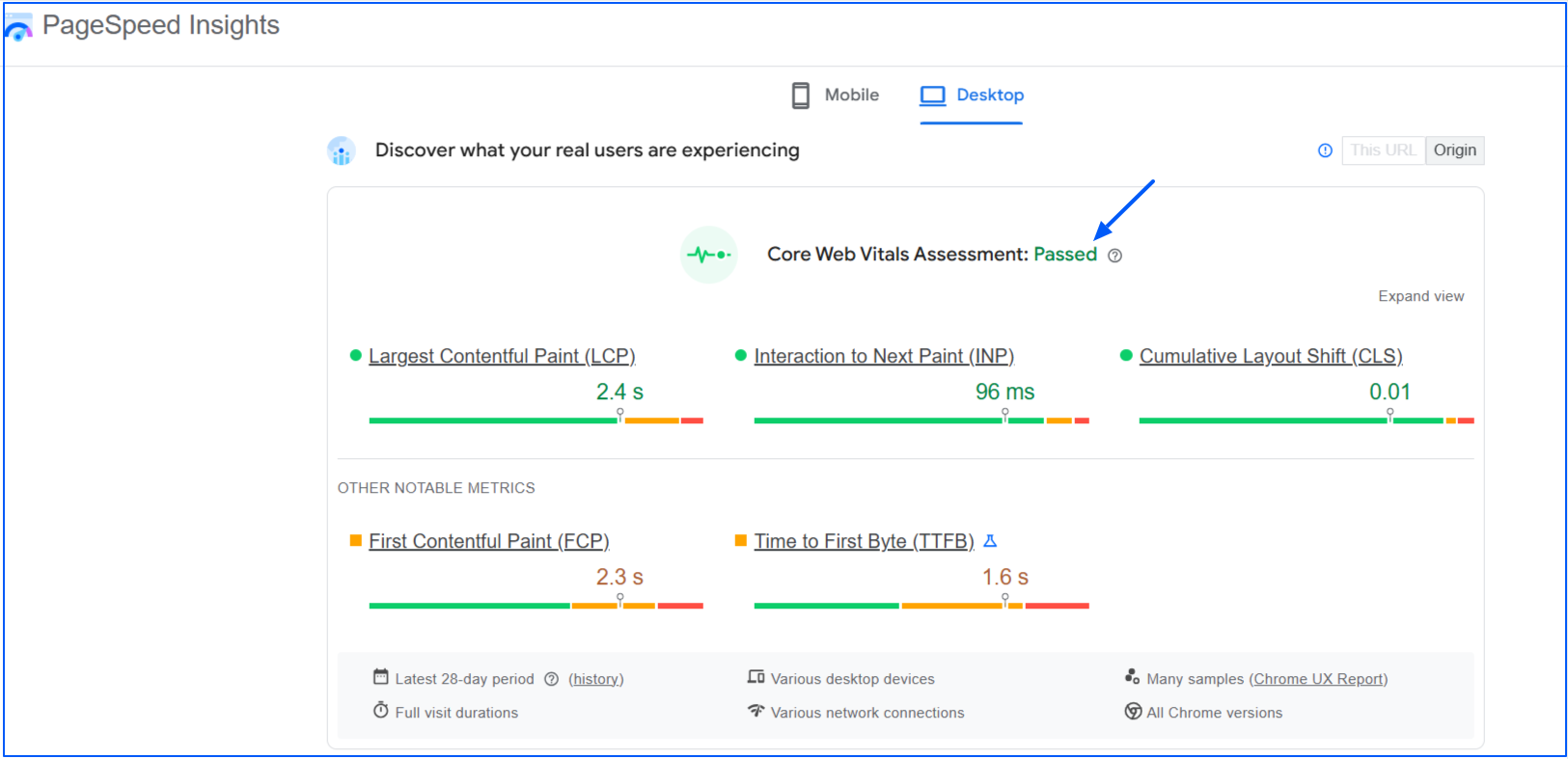
☐ Improve Core Web Vitals (LCP, INP, CLS)
6. Demonstrate Expertise and Trust Signals
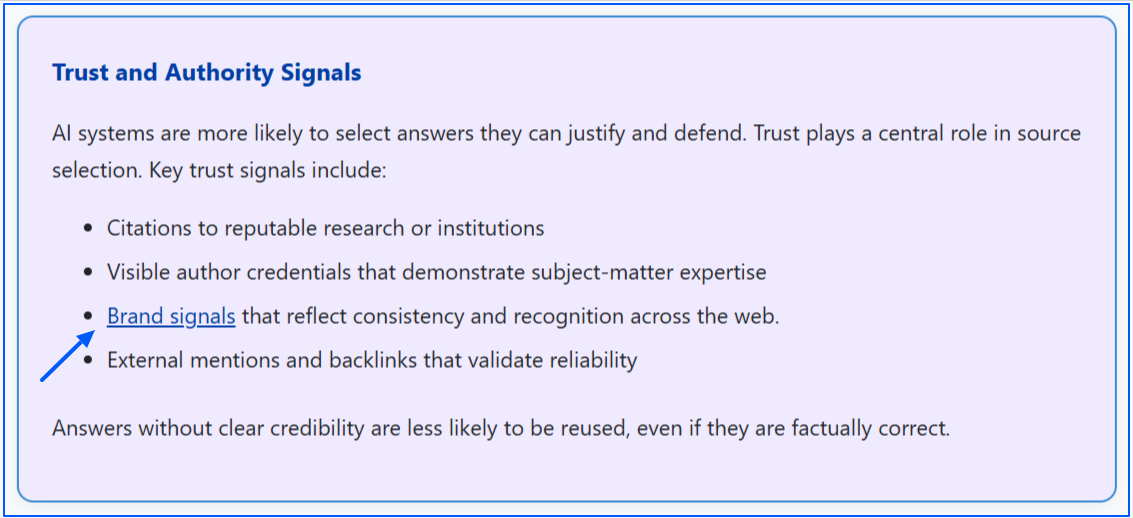
AI Overviews favor content that appears credible, consistent, and well-informed at a glance. Pages that clearly signal expertise and reliability are easier for AI systems to trust and reference. These trust indicators are also central to Google AI Overviews ranking factors, particularly for competitive and informational queries.
- Clear explanations
- Consistent terminology
- Accurate, up-to-date information
- Transparent authorship
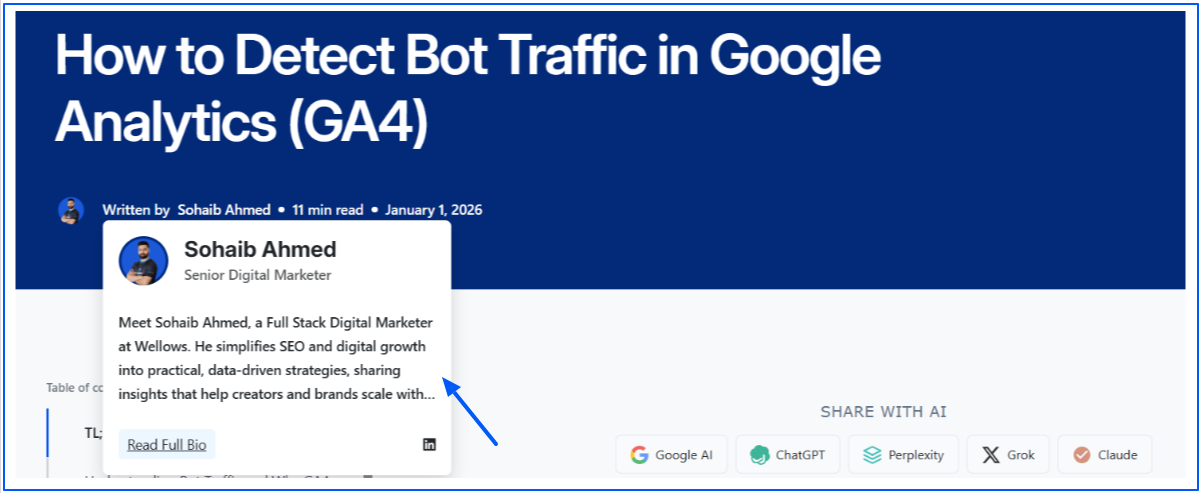
Including an author bio with relevant expertise signals credibility to both users and AI systems.
7. Use Visuals and Structured Data Where Relevant
AI Overviews benefit from visual and structured elements when they improve understanding. Visuals and markup should clarify information, not distract or decorate the page.
- Use tables for structured facts
- Add visuals that explain processes
- Apply structured data where it adds context
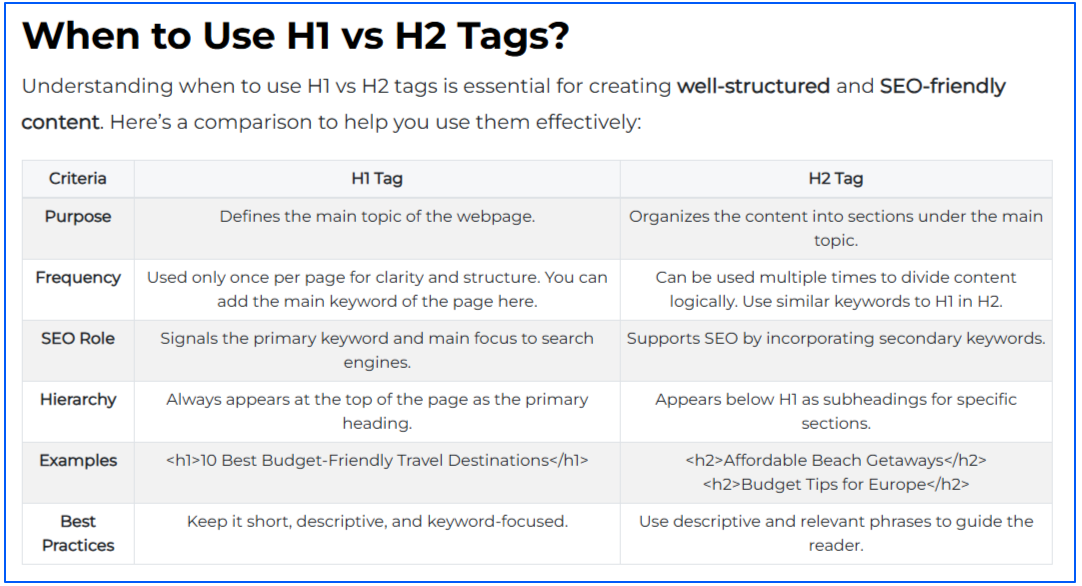
A comparison table outlining the key differences for any topic is better than lengthy paragraphs, or confusing bullet points.
Website and Technical Optimization for AI Overviews
Here is how to improve visibility in Google AI overviews by doing technical optimization:
8. Implement Structured Data Markup
Structured data helps Google understand the context, hierarchy, and relationships within your content. While schema does not guarantee inclusion in AI Overviews, it improves clarity and eligibility.
- Use FAQ, HowTo, and Article schema
- Ensure schema matches visible content
Here is how you can add FAQ schema to a page: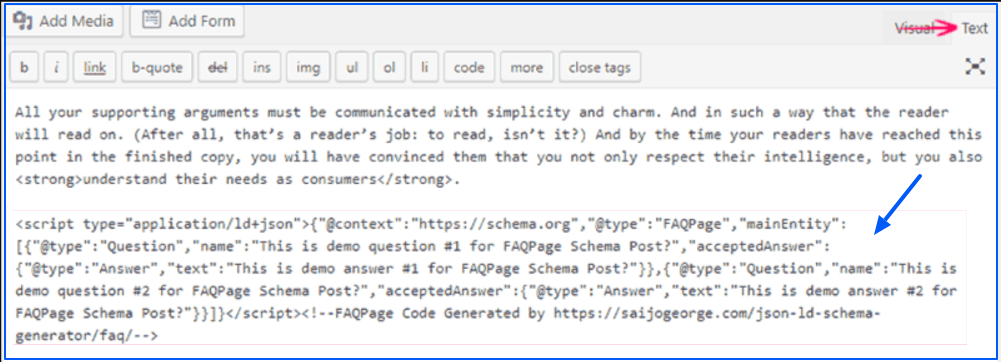
9. Maintain Accuracy and Freshness Site-Wide
AI Overviews favor sources that appear current, dependable, and consistently maintained. Outdated information, dates or data can reduce trust and make content less eligible for summarization.
- Update publish dates and timestamps when content is meaningfully refreshed
- Remove or replace outdated statistics, examples, and references
- Use consistent terminology across related pages and topic clusters
Refreshing a 2024 guide with 2026 data can restore visibility even if rankings stayed the same. Once you refresh it, it should also reflect on your page.

10. Strengthen Internal Linking and Topical Coverage
Internal linking helps AI systems understand how your content is connected and which pages represent core expertise. Strong topical coverage reinforces authority and improves content discoverability.
- Link related pages using descriptive, context-relevant anchor text
- Organize content into clear topic clusters around core subjects
- Ensure high-priority pages are easy to reach within the site structure
Linking all related articles to a central pillar page reinforces topical relevance.
11. Improve Technical SEO and Site Performance
AI systems need reliable access to your content to evaluate and summarize it.Technical SEO Issues can prevent AI Overviews from processing pages correctly, even when the content itself is strong.
- Improve page speed and server response times
- Ensure full mobile usability across devices
- Fix crawl errors, broken links, and redirect issues
- Secure the site with HTTPS
A slow-loading page may be skipped by AI systems even if the content is strong. You can check the Core Web Vitals for your page to see if it is loading at the optimal speed.
12. Monitor AI Overviews Performance and Improve Iteratively
AI search behavior changes frequently, which means AI Overview optimization is not a one-time task and requires consistent Google AI visibility tracking to understand how your brand is being surfaced across generative results.
Monitoring AI overviews for your brand with an AI Overviews Tracker helps you understand what is being cited, what is ignored, and why.
Once tracking is in place, the next layer is interpreting movement — how agencies monitor AI search mentions breaks down the two-layer methodology that separates daily noise from the citation signals teams can actually act on.
- Track which pages are being cited in AI Overviews
- Monitor changes in impressions, CTR, and visibility patterns
- Refine content structure, clarity, and intent alignment based on observed trends
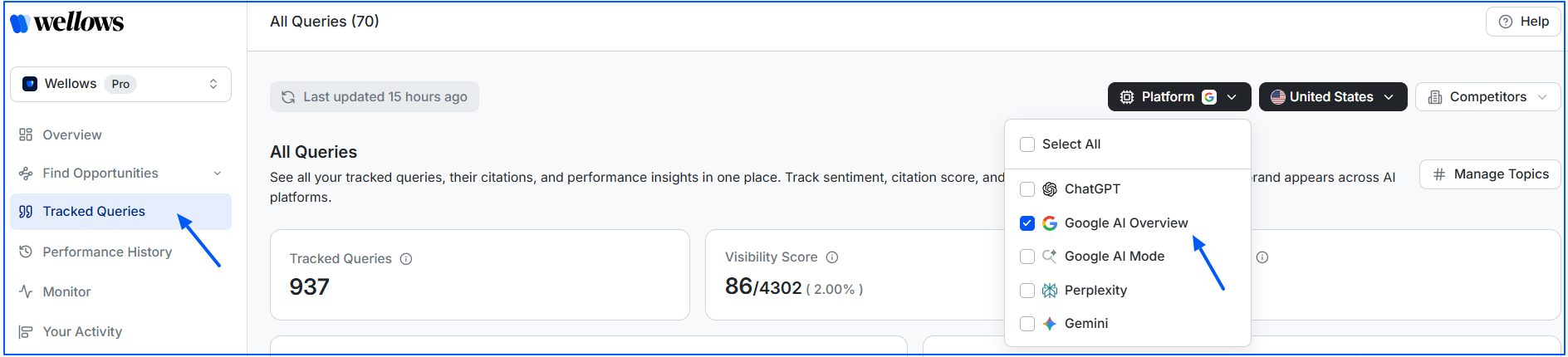
You can track queries in Wellows to see if they are appearing in AI overviews. It also helps you understand if your brand is mentioned explicitly (directly) or implicitly (indirectly).
What tools can help optimize AI overviews?
Optimizing for AI Overviews requires tools that can track AI-driven visibility, citations, and brand presence across AI search engines. Below are some of the best ai tools for enhancing visibility with optimization:
- Wellows: Wellows is an AI visibility platform built specifically for AI search. It tracks brand citations, explicit and implicit mentions, sentiment, and visibility trends across Google AI Overviews, AI Mode, ChatGPT, Gemini, and Perplexity, while enabling direct competitor comparisons.
- Profound: Profound monitors brand visibility across AI-powered search engines and analyzes how brands appear in AI-generated responses, including context and tone.
- Semrush AI Visibility Toolkit: An extension of Semrush that tracks domain presence in AI Overviews, identifies triggering prompts, and connects AI visibility insights with traditional SEO data.
How to Analyze Competitors’ Content for Google AI Overviews Optimization Tips?
Competitor analysis for AI Overviews is about understanding why certain pages are easy for AI to summarize, not copying their keywords or structure blindly. If you are finding out how to show up in AI overviews, ensure to carefully analyze your competitors.
Start by identifying which competitors are already being cited in AI Overviews for your target queries. These pages reveal the patterns Google’s AI systems currently favor. Here is a step-by-step guide on how to do AI overview analysis:
Step 1: Find Pages That Appear in AI Overviews
Search your core queries in an incognito window and note which pages are cited repeatedly. Focus on patterns across multiple queries, not one-off appearances. If you don’t want to track each query manually, you can use Wellows. Below I have shared how to use it.
Step 2: Examine How Early the Answer Appears
Open cited pages and check whether the main answer appears within the first few paragraphs. Pages selected for AI Overviews usually resolve intent quickly, without long introductions.
Step 3: Analyze Heading Structure and Question Coverage
Look at H2s and H3s. Strong competitors use descriptive, question-aligned headings that clearly signal what each section answers. This helps AI systems locate relevant blocks of information.
Step 4: Review Formatting and Extractability
Check whether competitors rely on lists, steps, tables, or short paragraphs. These formats reduce ambiguity and make content easier to summarize.
Step 5: Assess Tone and Information Quality
Notice whether the content is neutral, factual, and clearly written. AI Overviews tend to avoid pages with heavy opinions, promotional language, or speculative claims.
Step 6: Identify Content Gaps You Can Fill
Look for unanswered questions, outdated examples, or shallow explanations. Improving clarity or completeness is often more effective than publishing something entirely new.
Step 7: Compare Sources and Entity Coverage
See which entities, concepts, or terms are consistently referenced. Pages with consistent terminology and strong topical coverage are easier for AI systems to trust and reuse.
Use Wellows to Win AI Overviews
Wellows help analyze Google AI Overviews visibility at a competitive level by comparing visibility growth and decline across brands to reveal emerging trends.
It compares how often your brand vs competitors are being surfaced or cited in AI-driven search experiences over time. It highlights trends like:
- Who is gaining AI visibility
- Who is losing presence
- How stable or volatile each brand’s AI exposure is
Here is how you can use it:
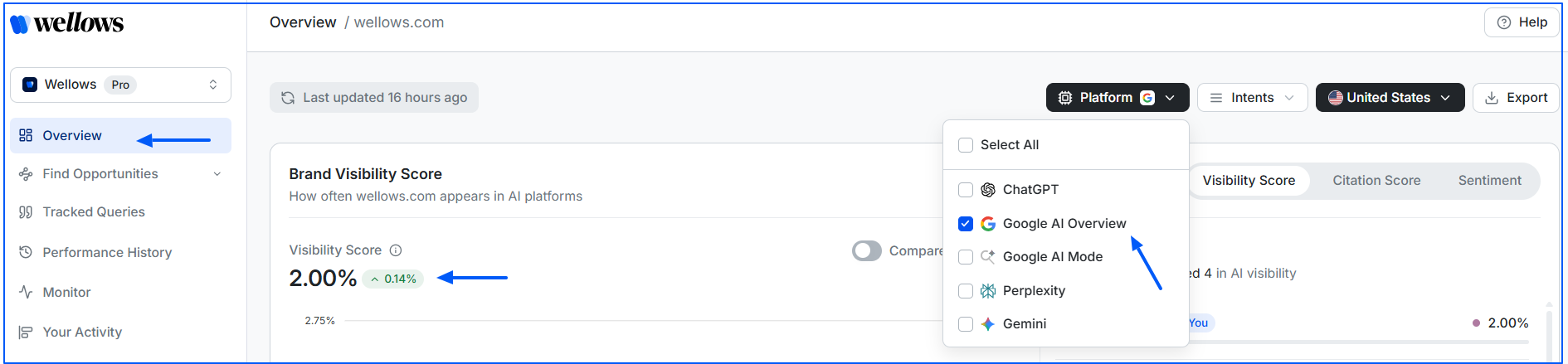
- In the Wellows Dashboard, go to the overviews section. From the platforms option, choose Google AI Overviews. Here you will find your visibility score.

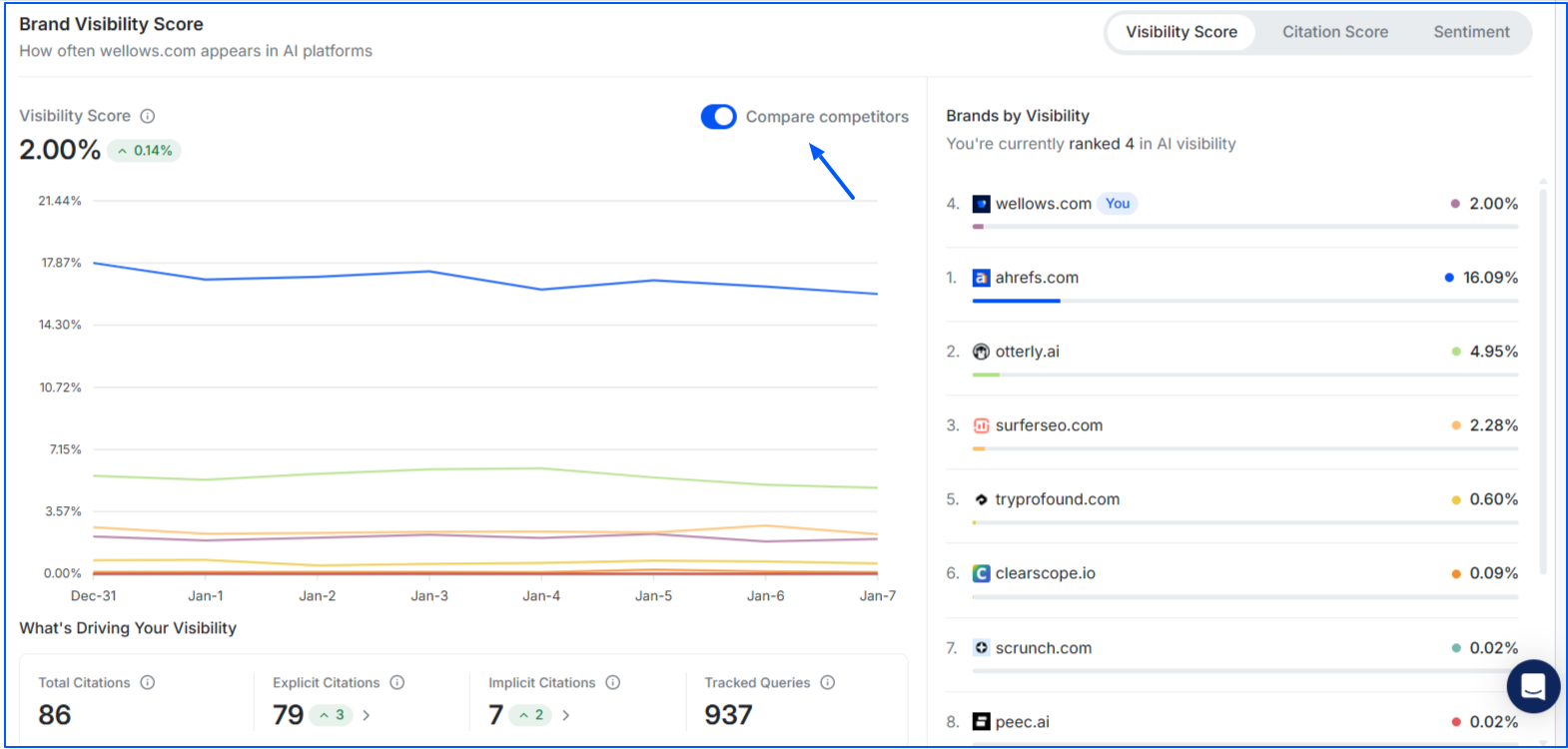
- If you’ll turn on the toggle, it will also show you visibility insights of your competitors.
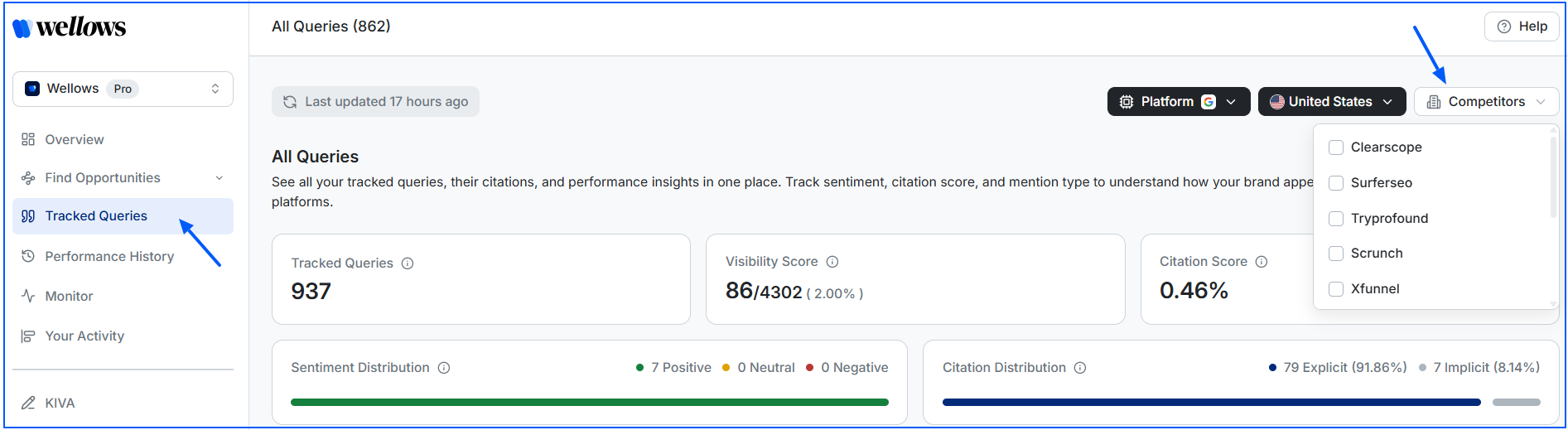
- To check the visibility insights of any specific competitor, go to the Tracked Queries option and choose your competitor.
For example, when I chose Surfer SEO from the list of the competitors, it gave me its citation score.
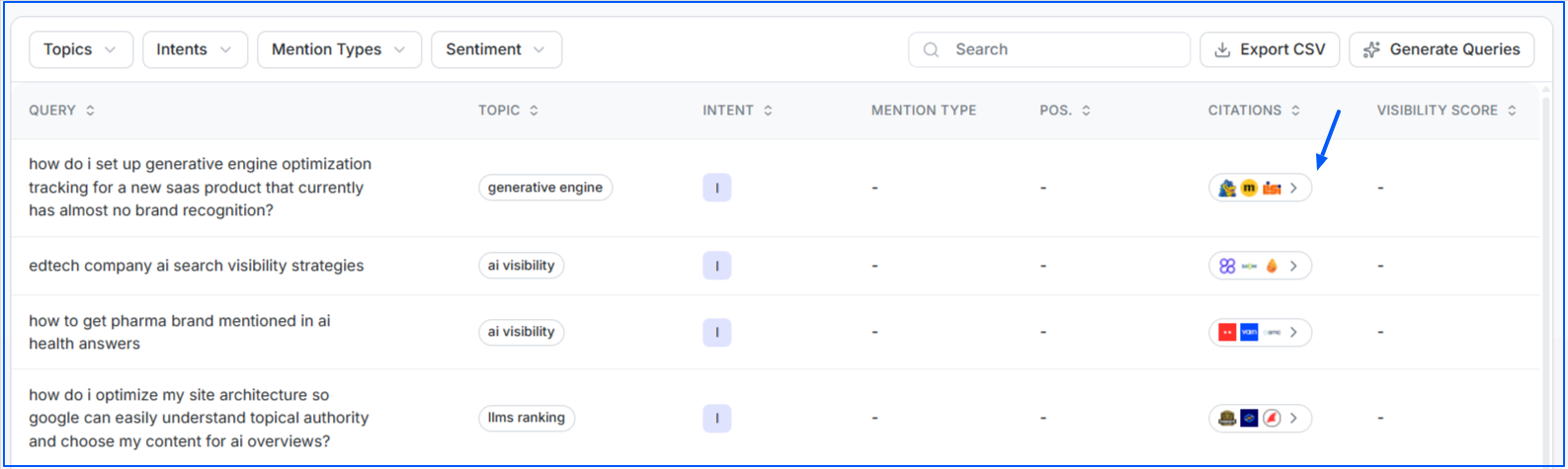
- To see what exact content is picked by Google AI overviews, click on the citations option against the query you want to check for.
Here it will show you the content picked by the Google AI Overviews.
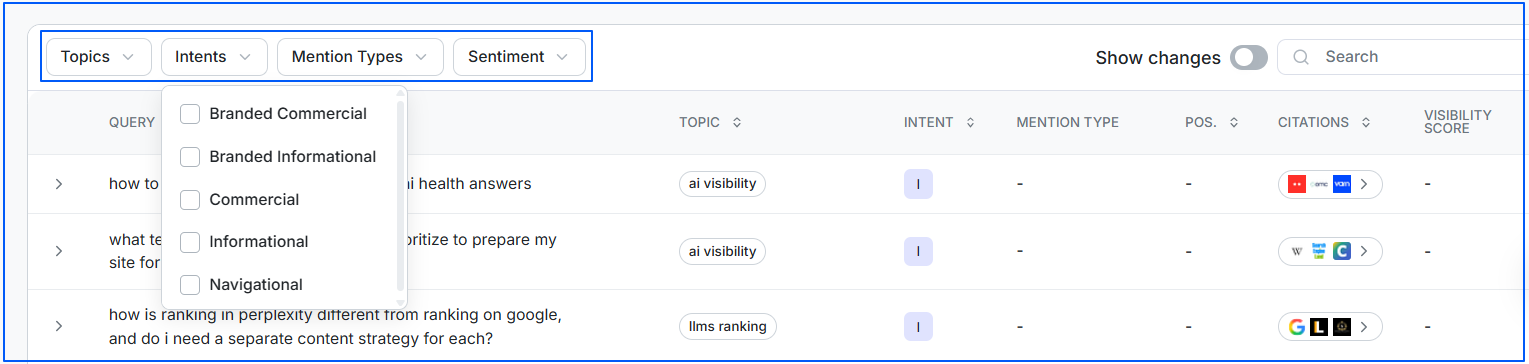
- You can choose if you want to track insights based on topics, intent, mention types (explicit or implicit), or sentiment (positive, negative or neutral).
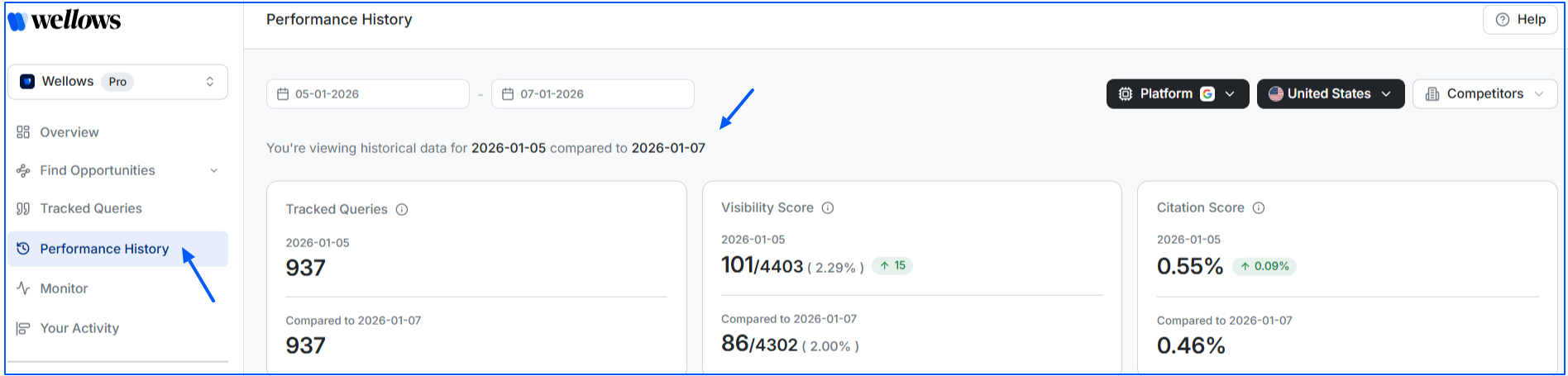
- In the performance history feature, you can also check if your or your competitor’s visibility score in Google AI Overviews is improving.
 For example, when I chose Surfer SEO from the list of the competitors, it gave me its citation score.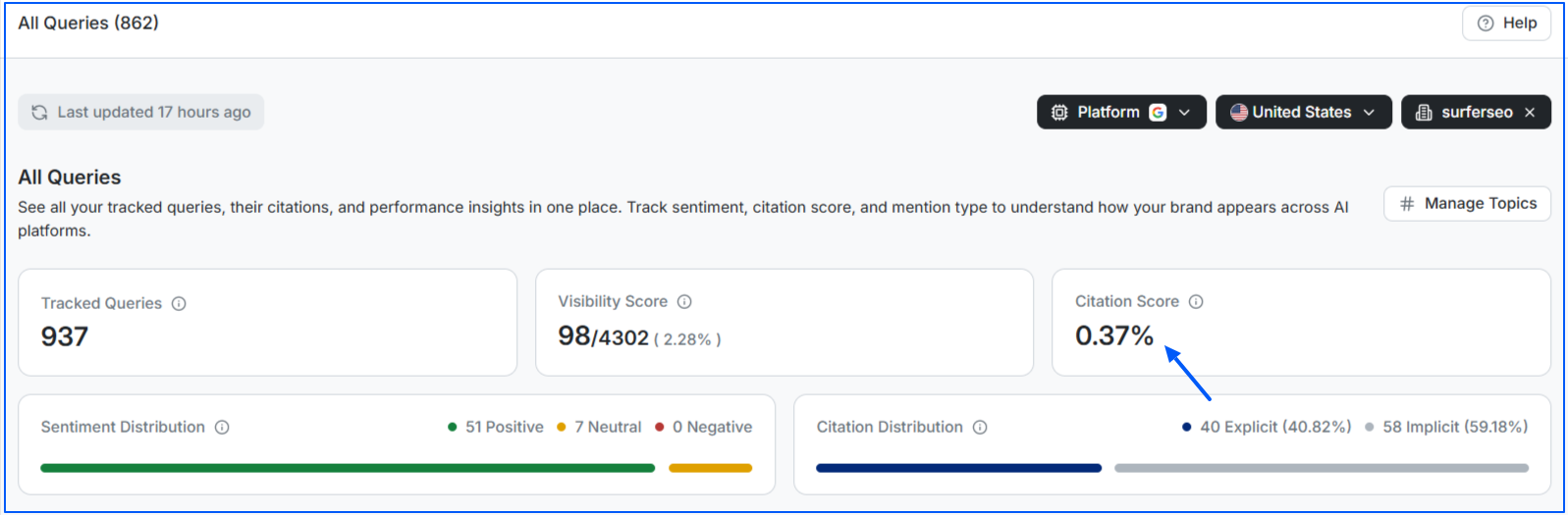
 Here it will show you the content picked by the Google AI Overviews.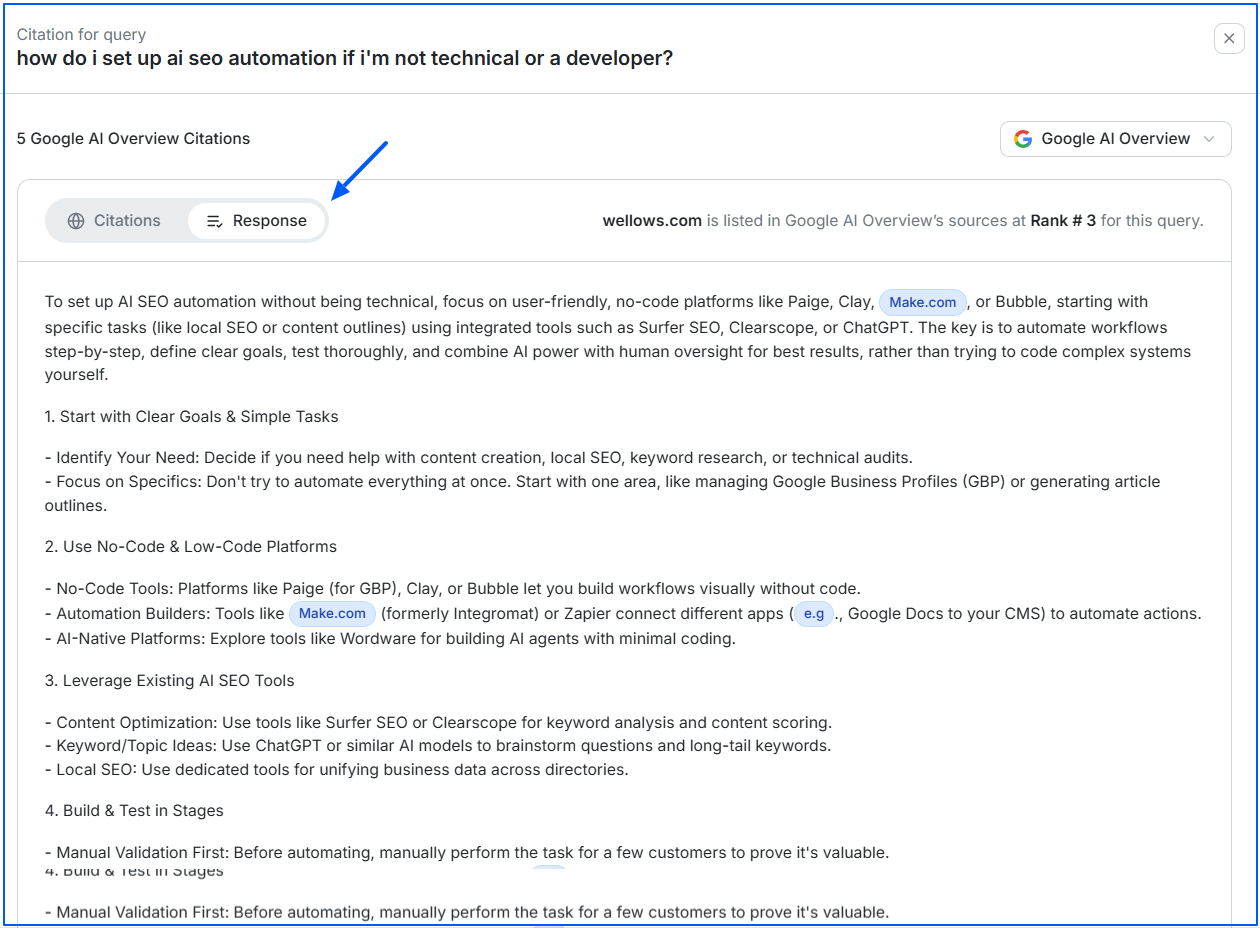
What are AI Overviews?
Google AI Overviews are AI-generated summaries that appear at the top of search results and combine insights from multiple sources to answer a query quickly.
Instead of displaying a single featured snippet, AI Overviews synthesize information from several pages and include links for deeper exploration. They are most commonly triggered by complex or multi-step questions.
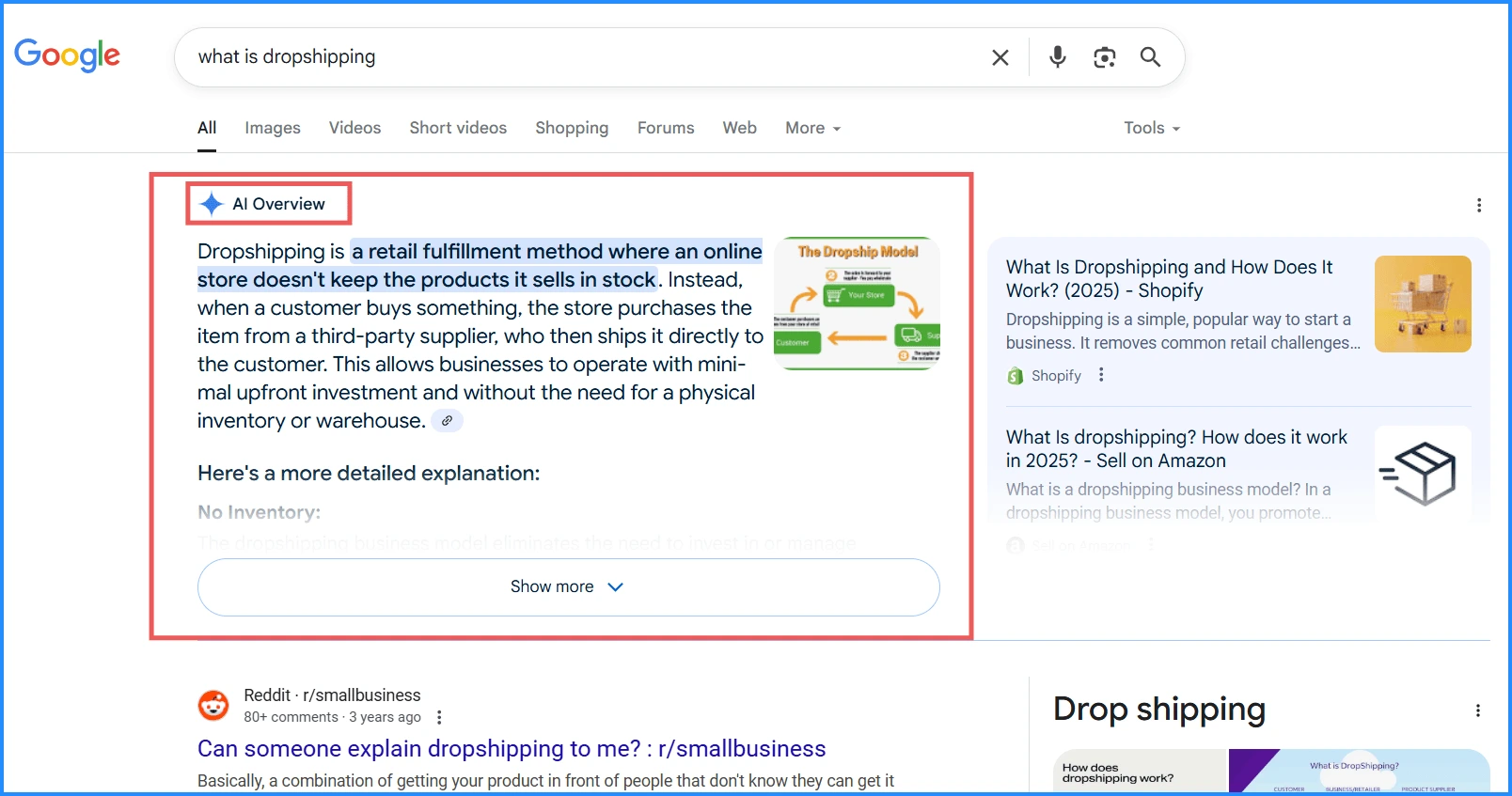
First introduced in May 2024, AI Overviews have expanded to more than 100 countries and support multiple languages. In March 2025, Google introduced AI Mode, an experimental experience powered by its Gemini 2.0 model that supports multi-part queries and multimodal input such as text, images, and voice, a direction reinforced in recent Google I/O announcements outlining the future of AI-driven search.
The rollout has raised concerns among publishers, particularly around content usage and accuracy. In response, Google has continued refining its systems to improve reliability and reduce misleading outputs.
How Do Google AI Overviews Work?
Google AI Overviews (formerly known as Search Generative Experience or SGE) use generative AI (Gemini) to synthesize answers from multiple high-ranking web sources.
When a user enters a query, Google analyzes the intent, retrieves top search results, and generates a concise, AI-written summary, typically placed above traditional organic listings.
This summary often includes links to cited sources, extracted directly from the top 10 ranking pages.
The system prioritises factual consistency, authority signals (E-E-A-T), and content structure (like lists or TL;DRs). It uses a mix of neural retrieval, natural language generation, and ranking models to decide which sources to cite.
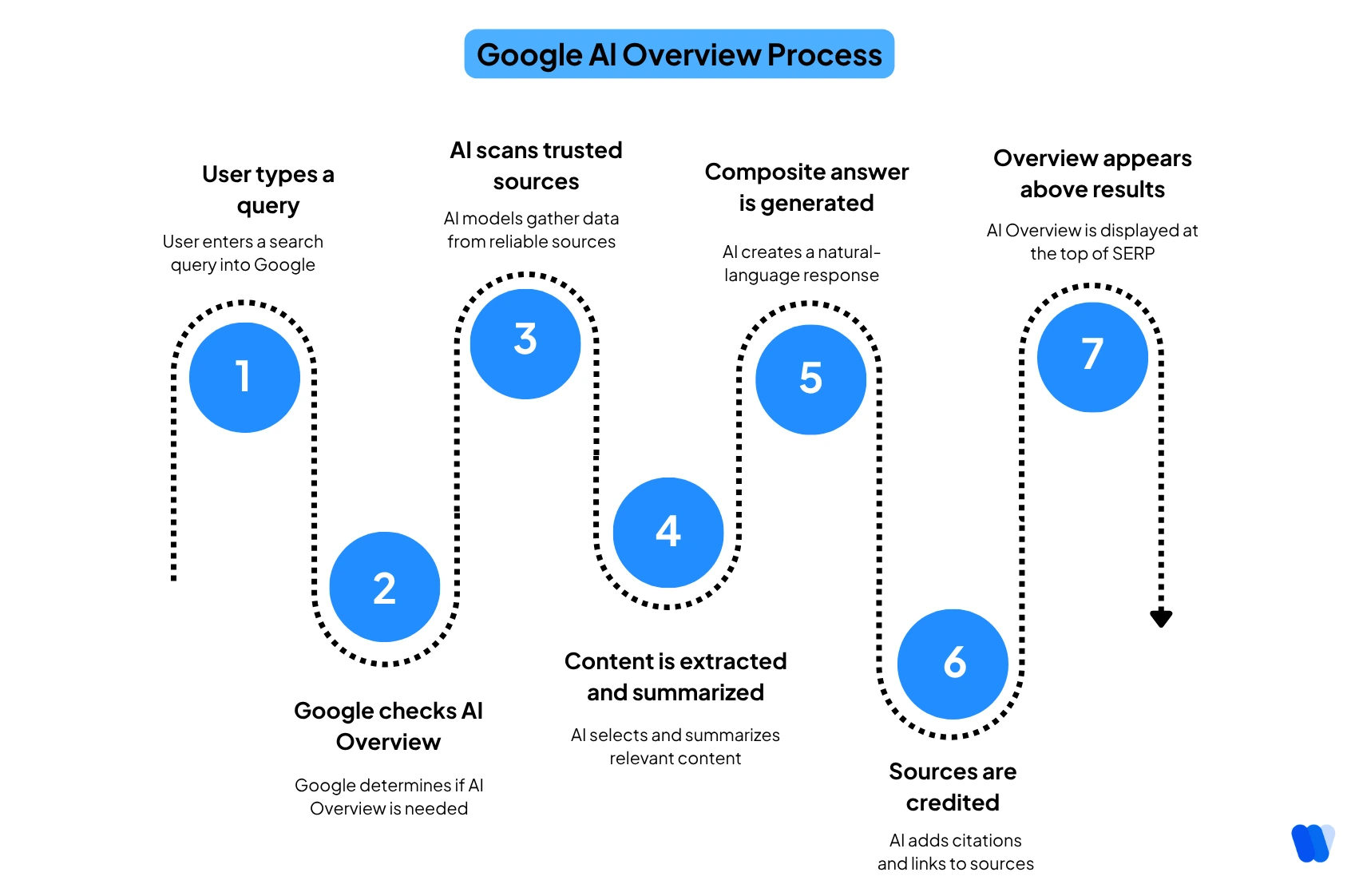
Understanding how AI summarizes content shows you how to create perfect content for AI interpretations. It also teaches you what makes content suitable for AI processing so your pages get chosen.
Query Types That Trigger AI Overviews:
- Complex informational queries (e.g., “how does insulin resistance affect weight loss”)
- Comparisons and evaluations (e.g., “SEO tools vs content AI tools”)
- Step-by-step or how-to queries
- Summarization-based requests (e.g., “summary of the latest AI update”)
They are less common for purely navigational or transactional queries (e.g., “Nike shoes size 9”).
When Organic Results Beat AI Overviews?
I’ve noticed something surprising while analyzing SERPs recently — AI Overviews don’t always get the top spot.
In fact, here’s a perfect example
I searched for “best PS5 games”, and guess what?
GamesRadar’s article ranked above the AI Overview.
Not below it. Not beside it. Above.
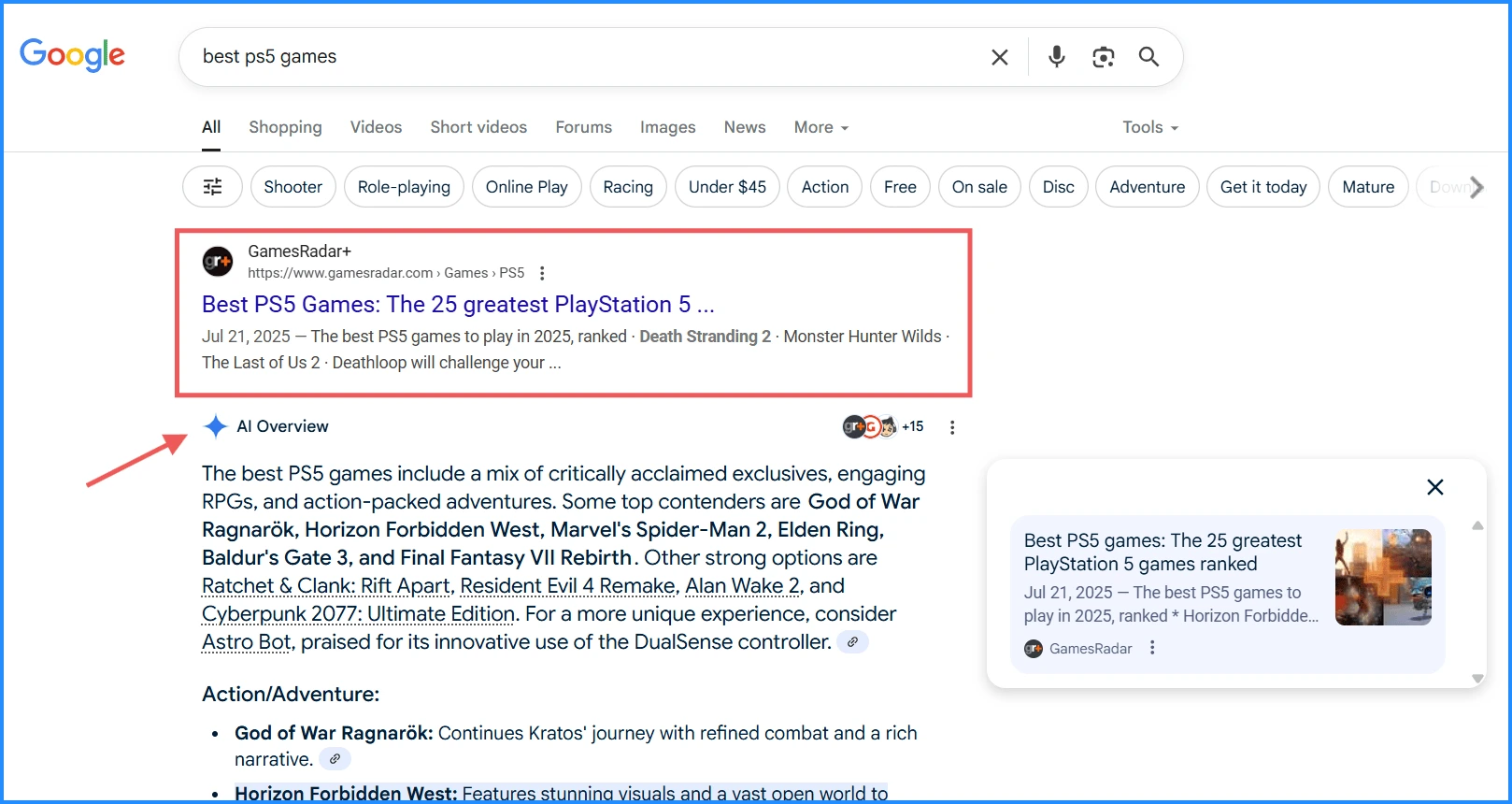
This shows that Google still gives priority to trusted, timely, and authoritative sources, even in AI-influenced SERPs.
Understanding how your content can rank on Google and ensure visibility in ChatGPT helps bridge the gap between traditional rankings and generative AI citation signals.
It’s a strong reminder that traditional SEO practices still matter. If your content is highly relevant, updated, and well-structured, you can still outrank AI Overviews — or even be the source they cite and top them in results.
So, while AI may own the spotlight, SEO isn’t dead. It’s just evolving!
What Types of Content Are Most Likely to Be Cited In AI Overviews?
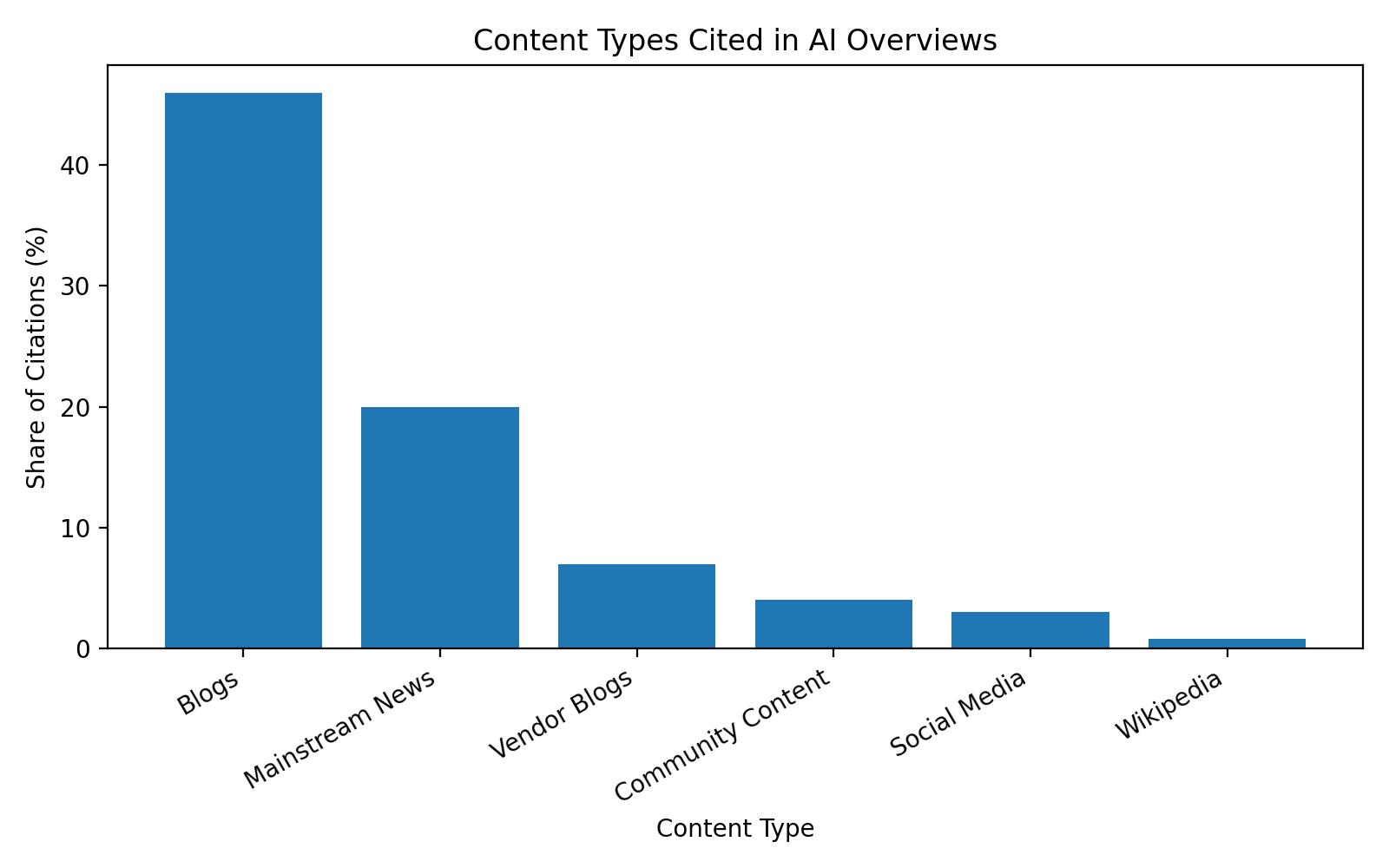
Google prefers content that is easy to extract and offers factually complete responses. For Google AI Overviews optimization, pages that match these formats are more likely to be selected:
[Source]
- Blog-style articles that explain topics clearly with structured headers and summaries
- Vendor blogs (product pages) that clearly explain what product offers
- Step-by-step how-to guides and checklists solving specific user tasks
- Mainstream news articles from reputable publishers with recent updates
- Product comparison tables that highlight key specs, pros/cons, or features
- Community forums like Reddit and Quora, often cited for real-life insights or consensus opinions
- Short-form social content, such as public LinkedIn articles or embedded expert commentary
- Visual-rich pages with videos, infographics, or screenshot annotations
- Expandable dropdowns or accordions that organize related subtopics
- Trusted resource links grouped in “link cards” pointing to reputable sites and reviews
By covering these content types and following the best practices to optimize content for Google AI Overviews shared above in this blog, you can increase your visibility chances.
Is Original Data like Studies Crucial for AI Overviews Features?
Original data helps you remove your chances to appear in Google AI Overviews. Pages that include first-party data, studies, or unique insights are easier for Google’s AI systems to trust and cite, especially for competitive or YMYL topics.
Even small original datasets or clearly labeled findings for Google AI overviews content optimization can make a page stand out over generic summaries.
Should I add Images and alt text for AI Overview optimization?
Yes, adding meaningful images along with clear, descriptive alt text plays an important role in AI Overview optimization. Alt text (alternative text) provides a written description of an image, helping search engines and AI systems interpret visual content accurately. This improves both accessibility and how effectively your content can be understood, indexed, and summarized by AI.
Benefits of Adding Images and Alt Text:
- Improved Accessibility: Well-written alt text allows screen readers to describe images to users with visual impairments, creating a more inclusive and usable experience for all audiences.
- Enhanced SEO Performance: Search engines rely on alt text to understand what an image represents. Optimized alt text can improve image search visibility, support page relevance, and contribute to higher engagement and organic traffic over time.
- AI Content Recognition: AI systems depend on text-based signals to interpret visual elements. Descriptive alt text helps AI models understand the context and purpose of images, making them more likely to be included or referenced in AI-generated summaries and multimodal search experiences.
Best Practices for Alt Text:
Be Descriptive and Specific: Clearly explain what the image shows, including key objects, actions, or relationships that add context to the page.
- Keep It Concise: Write clear, focused descriptions—ideally under 125 characters—so both users and AI systems can process them easily.
- Avoid Redundancy: Skip phrases like “image of” or “picture of,” since assistive technologies already identify images automatically.
- Ensure Relevance: Use relevant terms naturally where appropriate, but prioritize clarity and accuracy over keyword placement.
By consistently using purposeful images paired with well-written alt text, you improve accessibility, strengthen SEO signals, and make your visual content easier for AI systems to understand, summarize, and trust—supporting better visibility in AI Overviews.
What Industries Benefit Most From AI Overview Optimization?
AI optimization is reshaping how industries operate by improving efficiency, accuracy, and decision-making. As AI-driven search and summarization grow, certain sectors benefit more from optimization because their content, data, and user queries are frequently surfaced in AI-generated results. The industries below see the strongest impact from AI optimization.
1. Marketing Teams and Agencies
Marketing teams benefit from AI optimization by improving content visibility, brand mentions, and discoverability in AI-generated summaries such as Google AI Overviews. AI-optimized content helps marketers adapt to zero-click behavior, track citations, analyze competitors, and ensure their brand remains visible even when traditional click-through rates decline.
Best Practices for AI Overviews in Marketing
- Lead with clear, factual answers that resolve user intent immediately
- Structure content with question-based H2s and H3s aligned to real search queries
- Optimize for visibility and citation, not just clicks or rankings
- Use concise formatting such as lists, steps, and comparison tables
- Maintain consistent brand mentions and messaging across related content
- Demonstrate expertise with original insights, data, and examples
- Keep content accurate, current, and regularly refreshed
- Monitor AI Overview citations and competitor visibility to refine strategy
2. Financial Services
Financial organizations use AI to detect fraud, support algorithmic trading, and improve customer service. AI systems analyze transaction patterns to identify anomalies, assist with real-time market decisions, and power virtual assistants that handle customer inquiries efficiently.
3. Healthcare
Healthcare providers rely on AI to streamline administrative workflows, improve diagnostic accuracy, and support patient care. AI tools assist with image analysis, data interpretation, and operational tasks such as scheduling and claims processing, helping deliver faster and more accurate outcomes.
4. Retail and E-Commerce
Retail and e-commerce brands apply AI to demand forecasting, inventory optimization, and personalized experiences. AI-driven recommendations improve engagement, while automated support systems help manage customer interactions and increase conversion opportunities.
5. Manufacturing
Manufacturers use AI for predictive maintenance, quality control, and supply chain optimization. Machine learning models anticipate equipment failures, detect production issues, and improve demand planning, reducing downtime and operational costs.
6. Transportation and Logistics
AI plays a key role in route optimization, capacity planning, and automation across transportation and logistics. Intelligent systems improve delivery efficiency, support autonomous vehicle development, and forecast shipping demand to reduce fuel use and delays.
7. Agriculture
Agriculture benefits from AI through precision farming, crop monitoring, and resource optimization. Sensors, drones, and predictive models help farmers track soil conditions, manage water usage, and improve planting decisions, leading to higher yields and sustainability.
8. Real Estate and Construction
In real estate, AI supports market analysis, pricing predictions, and operational management. In construction, AI improves project planning, resource allocation, and safety monitoring, helping teams make data-driven decisions and reduce risk.
By adopting AI optimization, these industries improve productivity, reduce costs, and enhance decision-making—making them especially well positioned to benefit from AI-driven search, summaries, and automated insights.
Should I Update My Site’s Schema for Better Google AI Overviews Extraction?
Schema markup does not guarantee inclusion in AI Overviews, but it helps Google understand context, hierarchy, and intent faster, which improves eligibility.
For publishers and content teams, a few targeted schema updates can make a meaningful difference without a full technical overhaul.
- Add FAQ schema to pages that answer specific, searchable questions
- Complete Article schema with clear author, publisher, and dates
- Use HowTo schema for step-by-step guides and tutorials
- Apply Speakable schema to short, factual summaries or definitions
- Ensure schema exactly matches visible on-page content
- Regularly validate and update schema to avoid errors or outdated markup
These schema tweaks improve clarity and context, making it easier for Google’s AI systems to understand, summarize, and potentially reference your content.
How AI Overviews Impact SEO?
AI Overviews change how users interact with search results by shifting attention away from traditional blue links and toward AI-generated summaries — a shift that also alters expectations around how long it takes to rank your content and be seen by users.
his shift is particularly visible in regional and intent-based queries, where AI summaries increasingly influence how local businesses appear in search results — especially in evolving local SEO environments shaped by Google AI Overviews.
- Users get answers directly from AI summaries instead of scanning organic results
- Click-through rates drop for many informational queries
- Visibility depends on being cited, not just ranking first
- Google pulls from diverse sources, including blogs, videos, forums, and product pages
- The SERP is compressed, with more answers at the top and fewer clicks below
This shift raises the stakes for content quality and clarity. Being included in Google AI Overviews can drive brand recognition and authority even without a top ranking position. It helps you stay visible and competitive in modern SERPs.
How Do AI Overviews Impact Organic Search Traffic?
Google’s AI Overviews can reduce organic traffic by answering a query directly on the results page, which changes how often users click through to websites.
Multiple studies show that when Google AI Overviews appear, users are less likely to click traditional results, and they rarely click the cited links inside the summary.
- Position 1 CTR drops 34.5% when Google AI Overviews is present (300K keywords analyzed)
- Another large dataset found an average CTR drop of 15.49%, with bigger losses in certain layouts
- Users click a traditional result 8% of the time when an AI summary appears vs 15% without it
- Users click a cited source link inside the AI summary only 1% of the time
For many informational searches, this creates a “visibility without visits” effect, reinforcing the growing gap between Google rankings and LLM citations where pages rank but are not always selected for AI summaries.Your page can be surfaced or cited, but the user may not click because their intent is satisfied in the summary.
However, when analyzing traffic drops, teams should also ensure they can accurately detect bot traffic in Google Analytics to avoid misinterpreting automated visits as real user engagement.
The impact is not uniform. AI summaries show up more often for longer, question-style queries, and they also cite common destinations like Wikipedia, YouTube, and Reddit, which can shift traffic away from independent publishers.
- AI Overviews increase “zero-click” behavior, especially for informational intent
- Citations can still boost brand awareness, even when click volume declines
- Topic, query length, and SERP layout strongly influence how much traffic you lose
This 30-second visual shows exactly how much traffic publishers are losing to AI Overviews.
▶️ Watch: Why Publishers Are Losing Up to 40% of Their Traffic After AI Overviews
How AI Overviews Differ From Featured Snippets?
AI Overviews and featured snippets both aim to answer questions quickly in the SERP, but they work differently. Featured snippets extract a short, verbatim answer from a single page, while AI Overviews synthesize information across multiple sources and generate a longer, conversational summary.
Because AI Overviews combine viewpoints and support follow-up exploration, they typically appear more often for complex, comparative, or multi-step queries, whereas featured snippets remain more common for direct definitions and simple how-to questions.
Key Differences At A Glance
- Single-source vs. multi-source: Featured snippets pull from one page, while AI Overviews combine insights from several sites.
- Extraction vs. synthesis: Snippets show a direct excerpt; AI Overviews generate a new summary in Google’s words.
- Short vs. detailed answers: Snippets stay brief, while AI Overviews provide longer, multi-point explanations.
- One clear winner vs. shared visibility: Snippets spotlight one URL; AI Overviews spread citations across multiple domains.
- Static vs. expandable: Snippets are fixed blocks; AI Overviews allow users to expand and explore follow-ups.
- Different traffic effects: Snippets can boost CTR for one page, while AI Overviews often increase zero-click behavior.
| Feature | AI Overviews | Featured Snippets |
|---|---|---|
| Answer Source | Generated by AI using multiple sources | Extracted directly from one source |
| How Content Is Produced | Synthesis (new summary in Google’s words) | Extraction (verbatim paragraph/list/table) |
| Typical Length | Longer, multi-point explanation | Short, single-block answer |
| Citation Style | Multiple cited pages shown as cards/icons | One highlighted page link |
| Best-Fit Query Types | Comparative, exploratory, or multi-step queries | Definitions, direct facts, simple how-to queries |
| User Experience | Expandable, supports follow-up exploration | Static answer block |
| Traffic Impact | More zero-click behavior; clicks spread across sources | Can boost CTR for the single featured page |
| Visibility Advantage | Shared visibility across several credible domains | Exclusive spotlight on one domain |
| SEO Signals Rewarded | Topical depth, clear structure, freshness, trust | Concise answers, strong intent match, formatting |
| 2025 Trend | Growing rapidly across SERPs | Declining or replaced in many results |
Does Google Search Console Track Impressions And Clicks From AI Overview?
Yes. Google Search Console (GSC) includes Google AI Overviews traffic inside the Performance report. In June 2025, Google confirmed that impressions, clicks, and average position from AI Overviews (and AI Mode) are counted the same way as standard organic results. So if your page is cited in an AI Overview, the impression and any click on your link are recorded in GSC.
However, there’s a key limitation: GSC does not currently offer a separate filter or report that isolates Google AI Overviews performance. This means Google AI Overviews impressions and clicks are blended into your overall totals, so you can’t split out “Google AI Overviews CTR” vs “classic blue-link CTR” using GSC alone.
That’s why teams are complementing GSC with broader visibility work (including how to rank in chatgpt) to understand citations and brand presence beyond Google’s reporting.
To manual identify clicks and impressions from Google AI Overview:
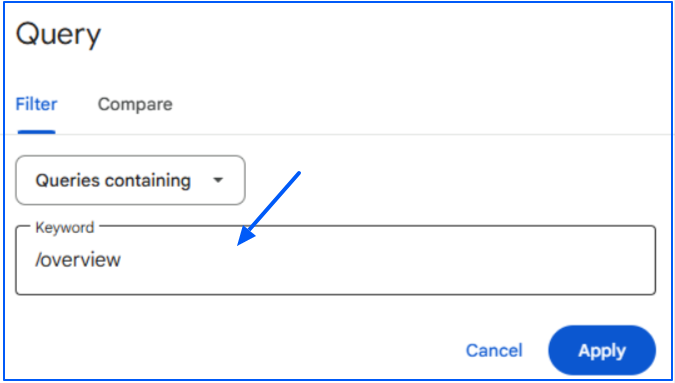
- Go to the Performance feature. In add filter, choose Query. In query, type /overview.
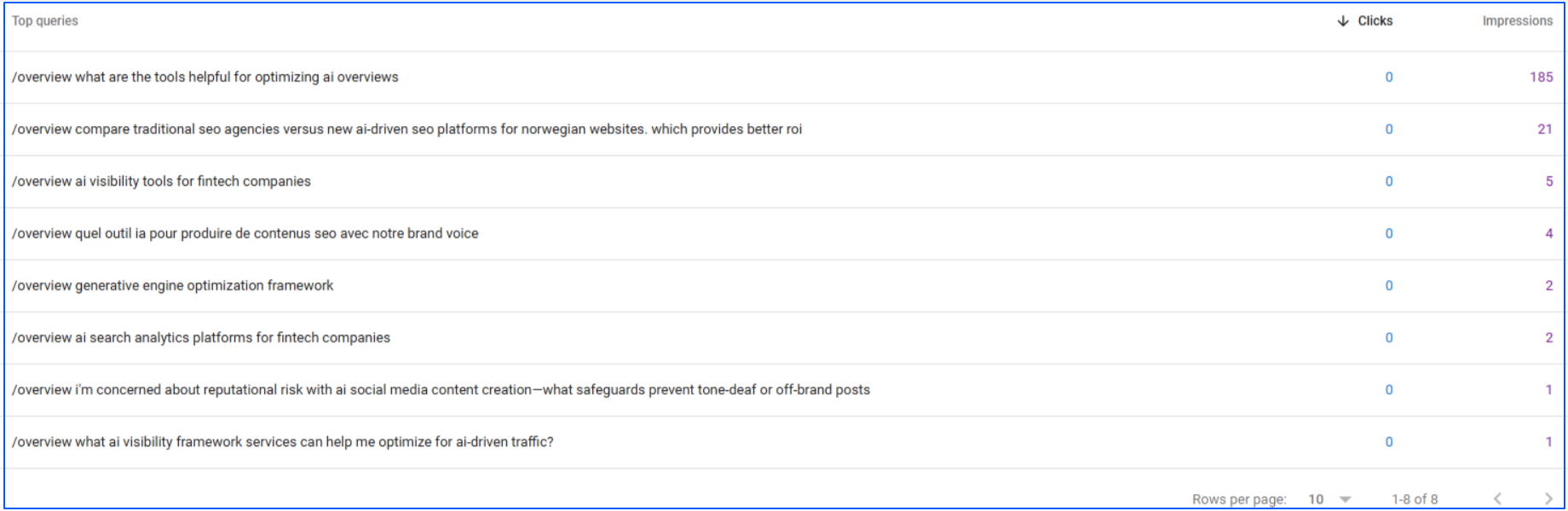
- You can see the queries for which you are visible in Google AI Overviews.
- You can check the impressions and clicks that are from Google AI Overviews.
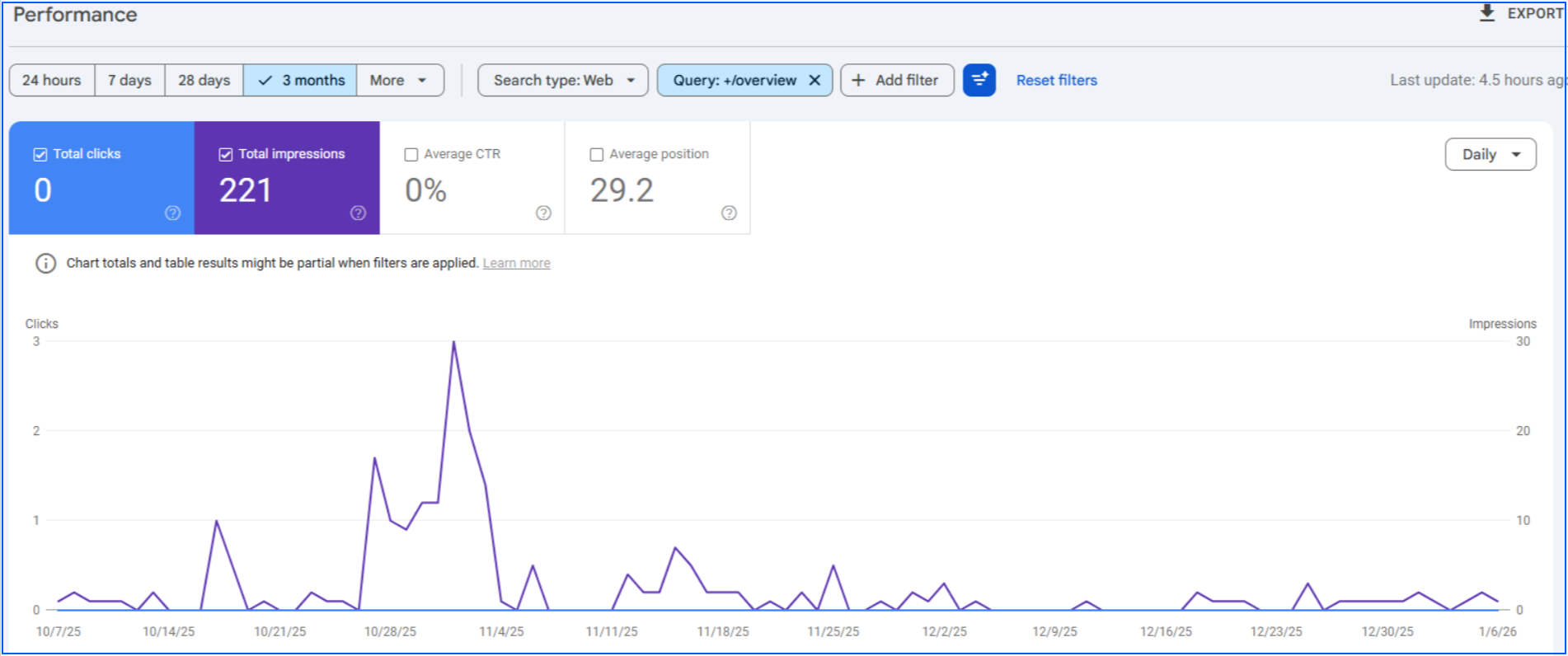
Google has also clarified that all links shown inside a single Google AI Overviews share the same “position” value in Search Console, even if some citations are hidden behind expansion. That’s why Google AI Overviews citations often look like they rank at one shared position, which makes detailed attribution harder.
Did you know?
What this means in practice:You can track the effect of AI Overviews indirectly in GSC by watching for impression lifts paired with CTR drops on informational queries.
These patterns are often misread as ranking problems when they are actually the result of content decay or AI summaries absorbing clicks. But you’ll need additional AI visibility tracking if you want clean, separated reporting.
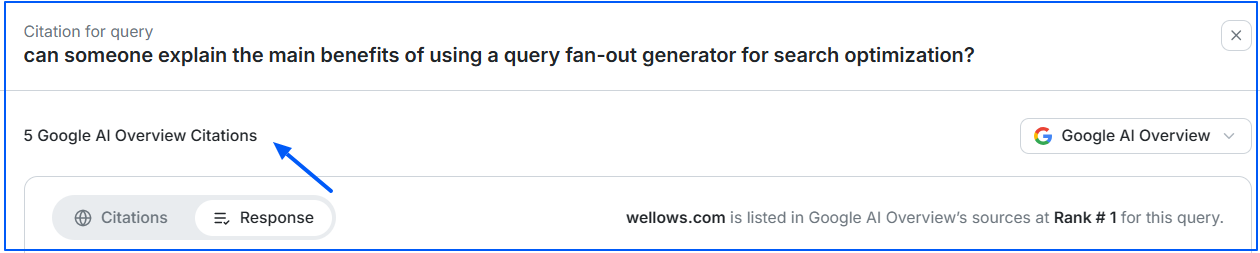
Wellows Insight: Track Google AI Overviews Visibility Beyond GSC
GSC shows Google AI Overviews impressions and clicks, but it can’t separate them from normal search data. Wellows solves this by showing how AI engines see and cite your brand. It combines citations, sentiment, and visibility across Google AI Overviews, ChatGPT, Gemini, Perplexity, and AI Mode.
What Mistakes Should I Avoid When Trying to Rank in AI Overviews?
Most pages miss AI Overviews because the answer is hard to extract or the content feels unreliable at a glance.
Use the quick fixes below to remove the most common blockers without rewriting the entire page.
| Mistake | How to Fix It |
|---|---|
| Burying the main answer deep in the page | Add a clear 2–3 sentence answer near the top that directly resolves the query. |
| Writing vague or opinion-heavy introductions | Lead with factual, neutral statements first, then add context after clarity is established. |
| Using clever or branded headings | Replace them with descriptive, question-aligned H2s and H3s. |
| Keyword stuffing instead of answering the question | Prioritize intent completion and natural language over repeating keywords. |
| Publishing thin content that only partially solves the problem | Expand sections so each one fully answers a specific question in one place. |
| Leaving outdated facts, examples, or timestamps | Refresh statistics, dates, and references regularly to reinforce accuracy and trust. |
FAQs
Final Thoughts
The future of SEO isn’t just about ranking higher, it’s about being the clearest, most extractable source on the page.
AI Overviews optimization is already changing how content is found, summarized, and trusted. If your content isn’t formatted to help AI help users, it’s likely to be overlooked. But with the right structure, timely updates, and clarity-first writing, your pages can earn visibility where it matters most.
Stay concise, stay factual, and build for both humans and machines because today, structure is the new SEO superpower.