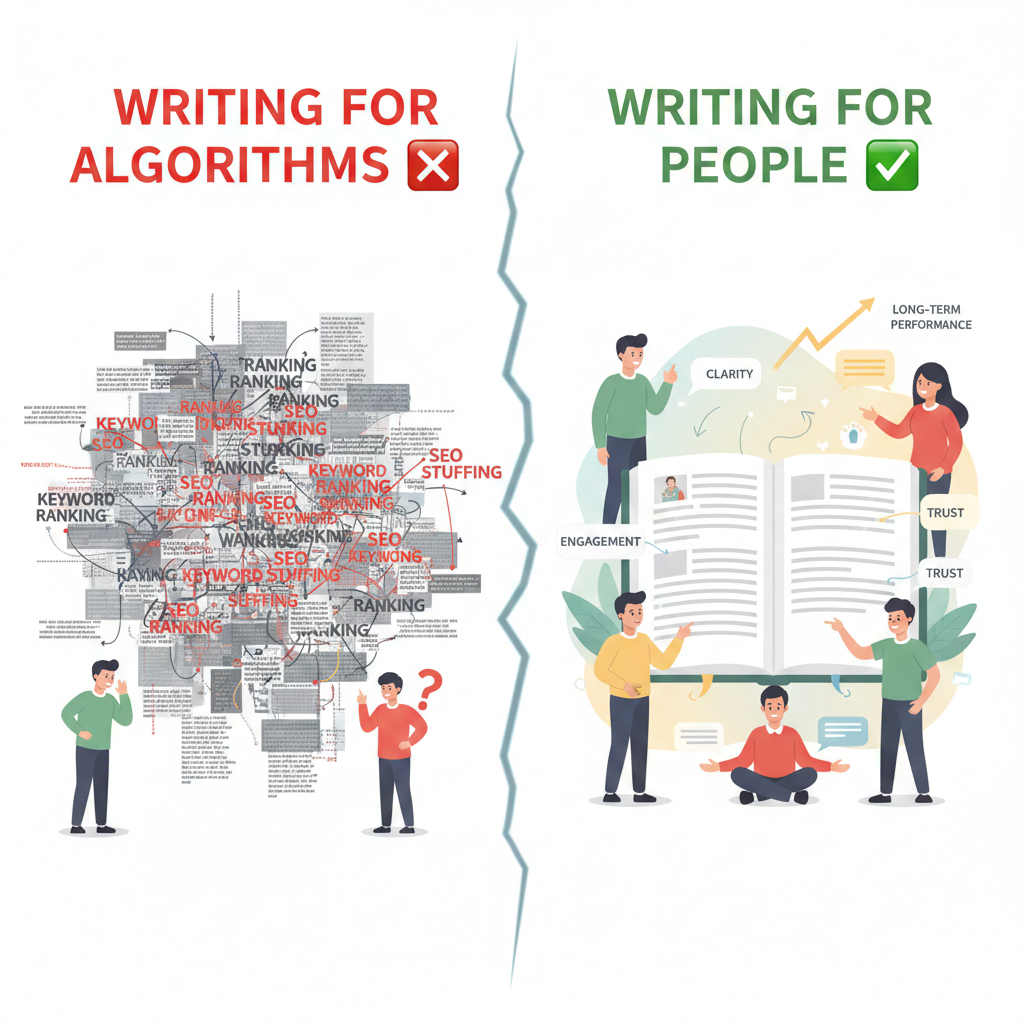
There was a time when writing content felt more like following a technical checklist than communicating with real people. If you placed the right keywords in the right places, followed a recommended word count, and repeated phrases often enough, your page had a decent chance of ranking.
During that period, it did not always matter whether the content was enjoyable to read or even particularly helpful, as long as it appeared optimized and aligned with what search engines expected at the time.
That approach no longer produces consistent or lasting results. Today, content performs best when it feels like it was written by someone who understands the reader’s situation, challenges, and intent. Strong content reflects an awareness of what people are trying to solve, what they want to learn, and why they searched for the topic in the first place.
When brands write content for people first, rather than focusing solely on search engines, they stop guessing what an algorithm might prefer and instead focus on delivering clarity, relevance, and genuine value.
Search engines have adapted to reward this behavior because it aligns with their core purpose: helping users find useful information quickly and confidently.
Writing for people is no longer a “nice to have” approach or a branding exercise. It has become the foundation of sustainable visibility, long-term engagement, and content that continues to perform even as algorithms evolve.
Why Has Writing for People Become More Important Than Writing for Algorithms?
Search engines have matured significantly over the past decade. Earlier ranking systems relied heavily on surface-level signals such as keyword repetition, exact-match phrases, and backlink volume. While those elements still exist and play a role, they are no longer sufficient on their own to determine content quality or relevance. Modern algorithms place much greater emphasis on how users interact with content after clicking on it. They analyze whether readers stay on a page, scroll through multiple sections, and engage with the material, or whether they leave quickly because the content fails to meet expectations. This shift has made user satisfaction one of the strongest indicators of quality, a standard that applies even to AI Content which must be carefully refined to ensure it resonates with human readers. Writing primarily for algorithms often creates problems that are immediately noticeable to readers, such as: Overuse of the same phrases repeated in slightly different ways Awkward sentence structures designed to force keywords into place Content that appears long but lacks clear explanations or depth Choosing to write content for people first requires a different mindset altogether. It means slowing down, explaining ideas logically, and anticipating the questions a reader might ask next. Instead of padding content to meet a word count, you focus on making every paragraph earn its place. When content feels clear, intentional, and genuinely useful, readers stay longer, engage more deeply, and trust the source, which ultimately supports long-term performance and reduces content decay.
What Does “People-First Content” Actually Mean in Practice?
People-first content begins with intention rather than optimization. Before writing a single sentence, you decide who the content is for and what problem it needs to solve.
The primary goal is not ranking for a phrase, but helping someone walk away with a clearer understanding than they had before.
In practice, people-first content consistently demonstrates a few defining characteristics. It uses straightforward language instead of unnecessary jargon, explains concepts step by step without assuming prior knowledge, and avoids filler sentences that add length without meaning.
Strengthening those characteristics often involves content optimization for AI visibility, which keeps language clean, intent clear, and structure aligned with how real readers move through a page. The writing feels structured and purposeful, guiding the reader from one idea to the next rather than overwhelming them with information.
This approach is especially important for long-form content. Length itself does not discourage readers. Confusion does. When an article is well organized and written with clarity, readers are willing to invest time because they feel guided, respected, and supported throughout the reading experience.
People-first content makes the reader feel that the writer anticipated their questions and answered them thoughtfully.
How Does Google Evaluate Helpful, People-First Content?
Google does not evaluate content emotionally, but it closely observes patterns that reflect human behavior. One of the strongest indicators of helpful content is whether users find what they need without returning to the search results to look for a better answer.
Pages that perform well typically address the main question early and then expand on it with meaningful detail. They avoid simply rewriting existing articles and instead provide clarity, context, or depth that other pages lack.
Helpful content often fills content gaps by addressing overlooked questions or explaining complex ideas more clearly than competitors.
High-performing pages usually share these qualities:
- They feel complete rather than fragmented or rushed
- They explain concepts instead of making vague or unsupported claims
- They guide readers logically through the topic
When users feel satisfied after reading, they spend more time on the page and are more likely to explore additional content. Over time, these behaviors reinforce visibility, credibility, and trust.
Why Is E-E-A-T Still Important for People-First Writing?
E-E-A-T represents how readers naturally evaluate information, even if they are not consciously labeling it that way. When someone reads an article, they instinctively assess whether the author understands the topic, whether the information feels accurate, and whether it can be trusted.
Experience becomes visible when content reflects real-world understanding rather than abstract theory. Expertise appears through clear explanations, accurate details, and logical reasoning. Authority builds through consistency and depth across related topics. Trust is reinforced when content is transparent, current, and responsibly written.
This framework has become even more important in an era of widespread AI-generated content. While AI tools can assist with research, structure, and efficiency, they cannot replace accountability or judgment. People-first content combines technology with human insight to ensure that information remains accurate, practical, and reliable.
How Can AI Be Used Without Sacrificing Content Quality?
AI is most effective when it supports the writing process rather than replacing it entirely. Many teams use AI tools to plan structure, identify content gaps, or create an initial AI Content Brief that outlines what should be covered in an article.
Responsible use of AI often includes:
Using AI for research support and topic organization
Creating clear prompts for content marketing teams
Reviewing and editing outputs carefully to preserve clarity and tone
Ensuring originality to avoid plagiarism
UThis balance helps maintain a strong readability score, protect originality, and prevent content cannibalization across similar pages.
Human oversight remains essential throughout the process. Editors decide what sounds natural, what needs deeper explanation, and what should be removed altogether.
This balance helps maintain a strong readability score, protect originality, and prevent content cannibalization across similar pages.
How Do You Write Long-Form Content That People Actually Want to Read?
Long-form content succeeds when it respects the reader’s time and attention. People are willing to read longer articles when each section adds value and moves the topic forward rather than repeating the same idea in different words. Clear structure plays a critical role here. Each section should focus on a single idea and transition smoothly into the next. Paragraphs should remain readable, and repetition should only be used when it reinforces understanding rather than padding length. Strong long-form content typically: When written well, long-form content becomes a reference point. Readers return to it, bookmark it, and share it because it consistently delivers clarity and depth.

How Can You Identify and Fix Content Gaps Over Time?
Content should never be treated as something that is finished and forgotten. Over time, the way people search changes, new questions appear, and expectations grow.
An article that once answered everything clearly can slowly become less helpful if it no longer reflects how readers think or what they need today. Content gaps appear when readers still feel confused, need to search again for answers, or find better explanations on other websites.
The easiest way to spot these gaps is by paying attention to how people interact with your content. If visitors leave quickly, do not scroll very far, or repeatedly ask similar questions, it often means the content is missing important information or clarity.
Sometimes the topic is correct, but the explanation is too brief or assumes the reader already understands more than they actually do.
Some common signs that content gaps may exist include:
Common warning signs include:
Readers leaving the page without spending much time engaging with the content
Questions from users that suggest certain points were not explained clearly enough
Sections that feel outdated or do not reflect current practices or knowledge
Fixing these gaps usually does not require creating entirely new content. Updating and improving existing pages is often more effective because it builds on what is already working.
Adding clearer explanations, expanding important sections, and updating examples can make a big difference in how helpful the content feels.
This process also helps prevent content decay, which happens when content slowly loses relevance over time.
Regularly reviewing and improving content ensures that it continues to meet real reader needs.
When content stays clear, complete, and up to date, it remains useful for both readers and search engines for the long term.
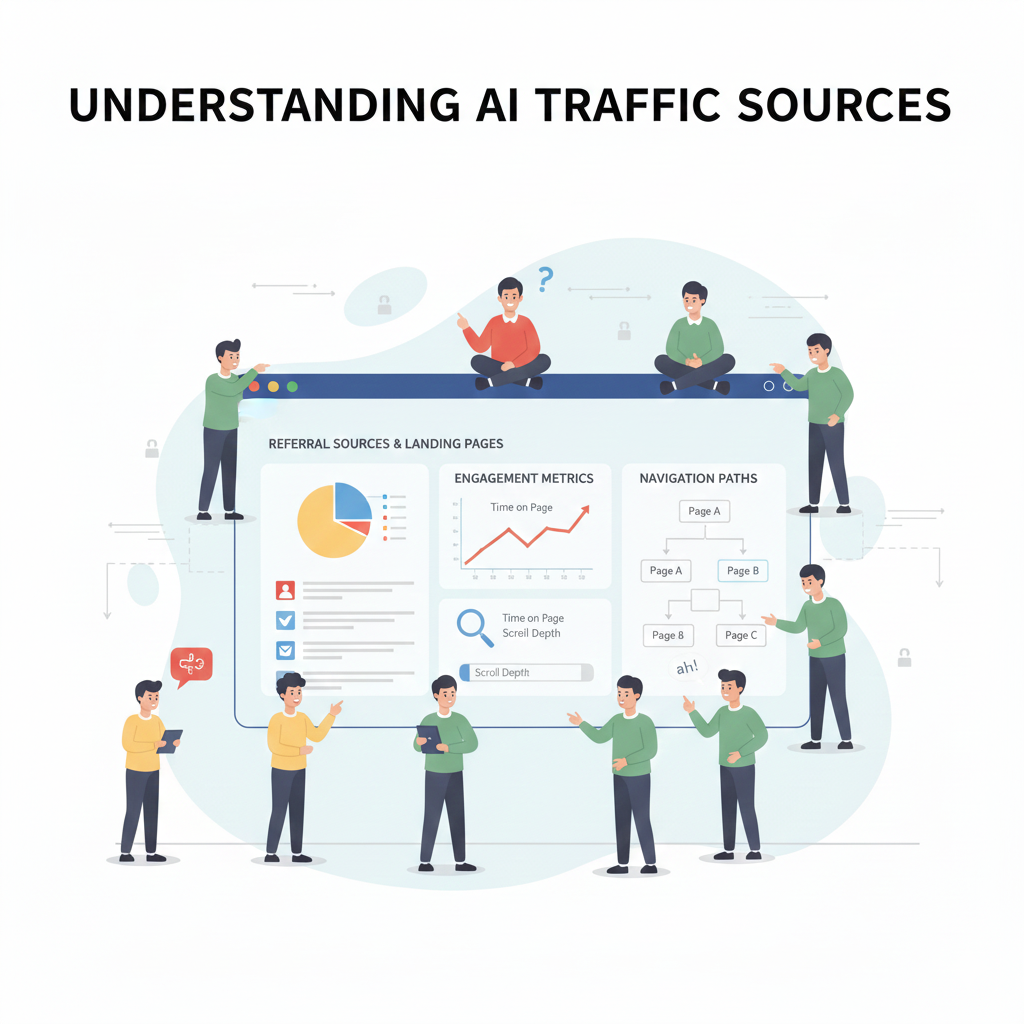
How Can You Understand Where AI-Driven Traffic Comes From?
AI-driven discovery is increasing, but it does not always appear as a clearly labeled referral source. Using Google Analytics and other analytics tools, patterns can still be identified by observing user behavior rather than relying on perfect attribution. Useful insights often come from reviewing: The goal is not precise tracking, but understanding which content resonates and how people discover it.
What Are Common Signs of Search Engine-First Content?
Search engine-first content often feels unnatural to readers. It may rely heavily on repeated phrases, stretch ideas to meet word counts, or fail to clearly explain its purpose or audience.
Common warning signs include:
Awkward phrasing that interrupts flow
Awkward phrasing that interrupts flow
Pages that do not clearly help a specific reader
This type of content often experiences declining engagement and faster content decay because it prioritizes algorithms over understanding.
How Can SEO Support People-First Content Instead of Controlling It?
SEO works best when it enhances structure and accessibility rather than dictating every sentence. Headings help readers navigate content, internal links guide exploration, and keywords clarify topic relevance without disrupting flow.
When SEO supports clarity instead of replacing it, content becomes easier to find without losing its human focus. This balance allows people-first content to perform well consistently over time.
FAQs:
Conclusion:
Learning how to write content for people first is a long-term commitment rather than a short-term tactic, but it is the approach that consistently builds trust, engagement, and visibility.Clear explanations build trust, trust encourages engagement, and engagement supports visibility across search and discovery platforms.
If your content genuinely helps someone understand a topic more clearly or make a better decision, you are already aligned with what modern search systems aim to reward. Everything else follows naturally from that foundation.
Read More Articles