⚡ Content Optimization is live — see exactly what to change to get cited in ChatGPT, Perplexity & Gemini
See How it Works
Stop Content Decay Before It Hurts Your Rankings
Connect your GSC and track 16 months of signals to detect early declines, quantified with a predictive 0–100 decay score.
Early-warning decay detection for high-value pages
Predictive decay scoring based on long-term GSC data
Identify root causes: traffic, CTR, impressions, position
Protect revenue pages with prioritization filters
ON THIS PAGE
What Is Content Decay?
Content decay refers to the gradual decline in organic traffic and search rankings for a specific piece of content over time.
When you publish new content on your website, search engines crawl and index it. After some time, that content may begin ranking for certain search terms and start bringing consistent traffic to your business.
However, even if you never update the content, its performance can decline. Traffic may drop, rankings may fall, and the content may lose its ability to attract potential customers.
It's important to note that content decay doesn't strictly apply to older articles. In fact, some older pages can continue performing well for years. But over time, content can become outdated, less relevant, or misaligned with what users currently want. Because search engines aim to provide the most accurate and useful information, content must stay fresh and aligned with current trends.
Even newer content can experience decay. When left unaddressed, decaying content can negatively impact your overall visibility, brand authority, and ultimately your sales and profits.
How to figure out which content is decaying and what to do about it
Identifying decaying content is simple when you use Wellows' free Content Decay Tool. It analyzes your Google Search Console (GSC) performance data to show which URLs are losing visibility over time so you can decide what to update, optimize, or consolidate.
Step-by-step: How to find decaying content
Open Wellows' Content Decay Tool
Click on "Connect GSC." Grant access so the tool can pull impression and click data directly from your Search Console.
Select your Property
Choose the website you want to analyze.
Set your date range
Options include:
- Last 24 hours
- Last 7 days
- Last 28 days
- Last 3 months
- Last 6 months
- Last 12 months
- Last 16 months
Set your decay threshold
This determines how much performance drop qualifies as decay.
Click "Run Analysis"
What happens next
Once the tool completes the analysis, it will display all URLs that meet your decay criteria. These are pages whose impressions have significantly dropped over the selected time period.
Click any URL in the list to view detailed insights, including:
- The percentage decrease in impressions
- The decay percentage for that specific URL
- A comparison of past vs. current performance
10 Effective Strategies to Reverse Content Decay in 2025 and Beyond
Content decay is slowly killing your SEO efforts, and you might not even realize it. The median publisher experienced a 10% year-over-year traffic decline in the first half of 2025, with some sectors seeing even steeper drops. This isn't just a temporary dip - it's a fundamental shift in how content performs over time.
But here's the good news: content decay isn't permanent. With the right approach, you can recover lost traffic and even surpass your previous performance. Let's explore 10 proven strategies that brands are using to breathe new life into their declining content.
1. Update and Refresh the Content
The Future Impact
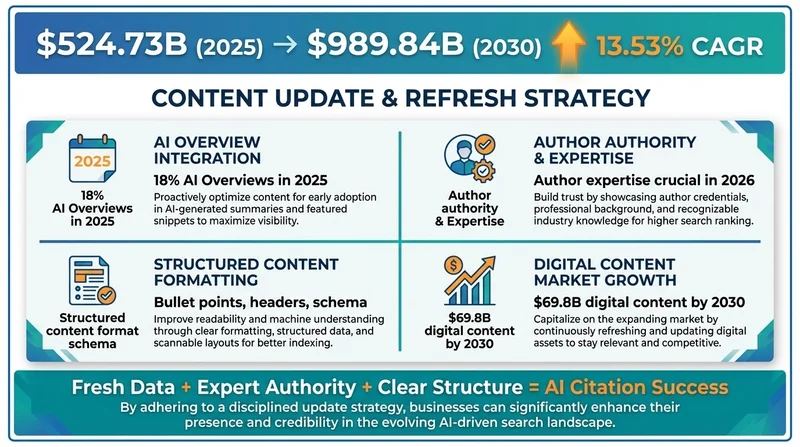
The content marketing market stands at $524.73 billion in 2025 and is projected to reach $989.84 billion by 2030, with a 13.53% CAGR. This explosive growth means competition for visibility is intensifying and fresh, updated content is your competitive advantage.
Start by adding current data and statistics. AI Overviews appeared in about 18% of Google searches in March 2025, and that number is growing rapidly. Every outdated statistic you replace with current figures signals freshness to both search engines and AI systems.
Rewrite sections that reference outdated tools, discontinued services, or obsolete best practices. In 2026, the author level will become the most scrutinized signal for both rankings and AI citations as algorithms get better at evaluating expertise.
Improve your structure and formatting too. Break up those massive text blocks. Add bullet points and clear subheadings. Clear structure helps AI systems extract and understand your key points more effectively when considering your content for citations.
Consider expanding your content depth as well. The digital content creation market is estimated to grow at a CAGR of 13.9% from 2025 to 2030, reaching $69.8 billion. Comprehensive, deep content stands out in this crowded landscape.
← Back to Navigation2. Improve Search Intent Alignment
The 2026 Reality
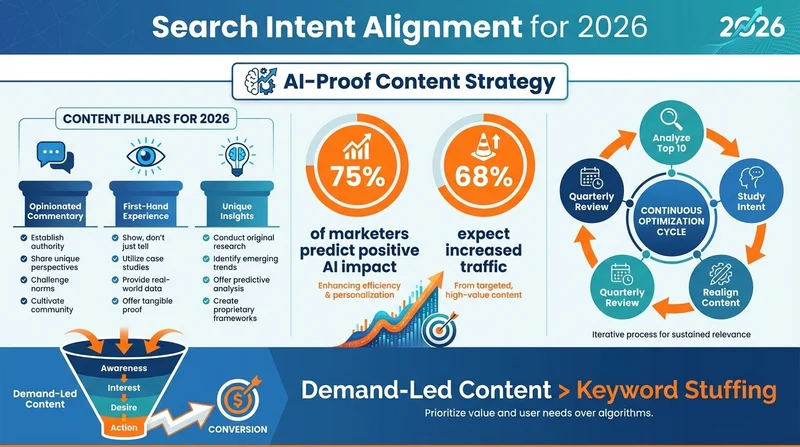
Top SEOs report that the content performing best in 2026 is content AI can't easily imitate: opinionated commentary, first-hand experience, and unique insights. This is the direction search intent is heading.
Check your target keywords in Google right now. Look at what's ranking. AI search engines are transforming discovery patterns, and 75% of marketers believe AI-enabled search engines will positively impact their content, with 68% predicting increased traffic.
Study the top 10 ranking pages carefully. What questions are they answering? How deep do they go? What format works best? Then realign your content to match that evolving intent.
In 2026, demand-led content that captures attention and builds affinity will drive SEO success. Conversational AI is transforming how users search, making natural language and genuine helpfulness more important than keyword stuffing.
Make this a quarterly habit. Search intent shifts faster than you think, and AI systems adapt to these shifts instantaneously. What worked in mid-2025 may already be outdated by early 2026.
← Back to Navigation3. Optimize for Better On-Page SEO
The 2025-2026 Landscape
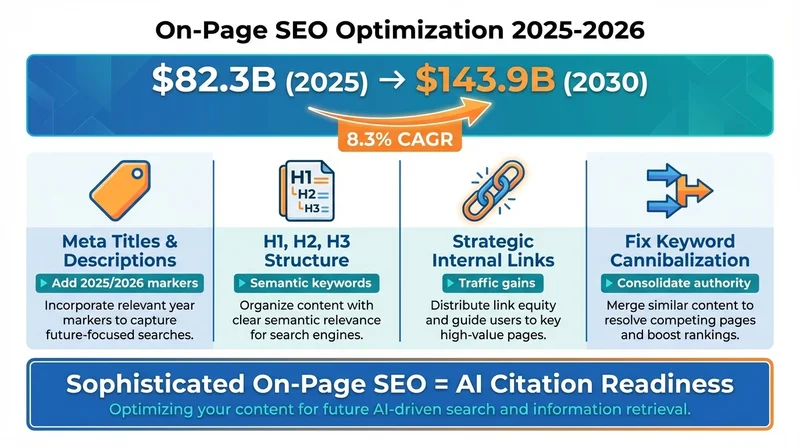
The SEO industry, estimated at $82.3 billion in early 2025, will reach $143.9 billion by 2030, growing at a CAGR of 8.3%. This growth reflects the increasing sophistication required for on-page optimization.
Start with your meta titles and descriptions. Add current year markers like "2025" or "2026" to signal freshness. AI systems often reference these elements when determining content recency for potential citations.
Restructure your headers next. Your H1, H2, and H3 tags should be clear, keyword-rich, and helpful. Use semantic variations and long-tail keywords naturally throughout. Well-structured headers help AI systems understand and extract your key points for citations.
Add strategic internal links. Sites with well-structured internal linking strategies continue to see significant organic traffic gains, and internal linking helps AI systems understand your topical authority across content ecosystems.
Fix keyword cannibalization while you're at it. If multiple pages compete for the same keyword, merge or redirect them. This consolidates your ranking signals and builds stronger authority, something AI systems evaluate when choosing citation sources.
← Back to Navigation4. Enhance Content Quality and Depth
The Authority Factor
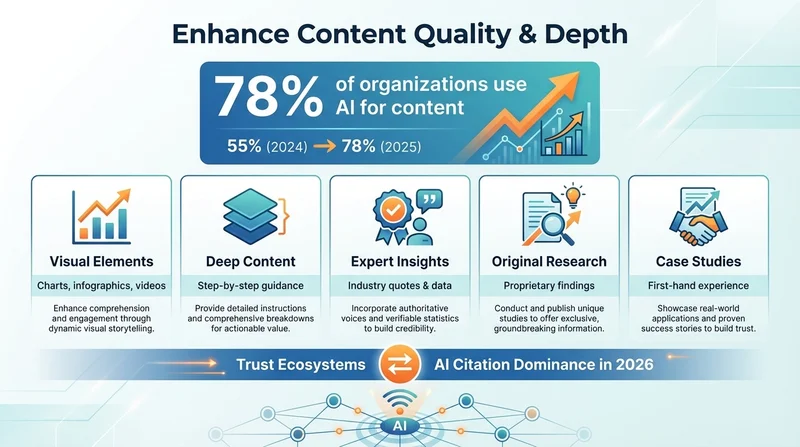
78% of organizations reported using AI for content creation and optimization in 2025, up from 55% the year before. The bar for content quality is rising dramatically.
Add visual elements to your content. Charts, tables, infographics, and videos increase engagement dramatically. While AI systems can't "see" visuals yet, they recognize pages with rich multimedia as more comprehensive and authoritative.
Go beyond surface-level information. Provide detailed step-by-step guidance, troubleshooting tips, and real-world applications. Deep, comprehensive content is exactly what AI systems prefer to cite because it provides complete, trustworthy answers.
Include expert insights and original data whenever possible. Add quotes from industry leaders, share proprietary research findings, or conduct your own surveys. This uniqueness strengthens your authority and makes your content more citation-worthy for AI systems that prioritize primary sources.
Don't forget case studies and first-hand experience. In 2026, content built on trust ecosystems (networks of authentic, interconnected assets) will deepen credibility and dominate AI citations.
← Back to Navigation5. Improve User Experience on the Page
The Mobile-First Future
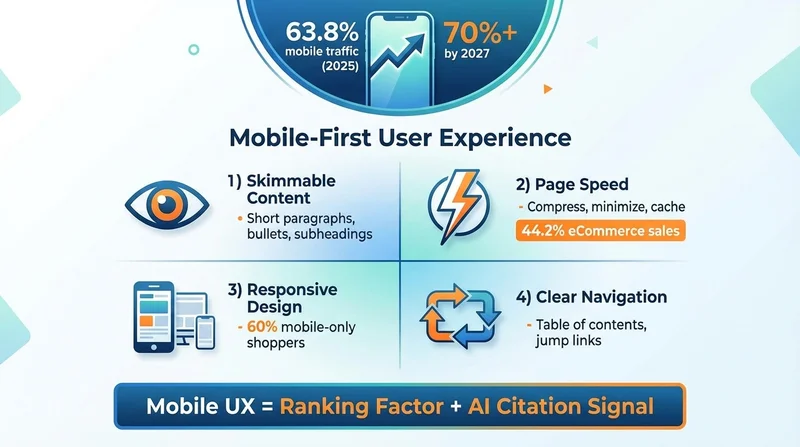
In 2025, mobile device website traffic accounts for 63.8% of total web traffic, and projections show this climbing to over 70% by 2027. User experience is a critical ranking factor and AI citation signal.
Make your content skimmable. Use short paragraphs, clear subheadings, bullet points, and highlight key information. Interestingly, AI systems also "scan" content structure when evaluating citation-worthiness.
Improve your page speed aggressively. Compress images, minimize code, and enable caching. Mobile is projected to drive 44.2% of all U.S. retail eCommerce sales in 2025, and every speed improvement captures more of this massive market.
Ensure mobile optimization through responsive design. 60% of online shoppers exclusively use mobile devices to make shopping decisions in 2025, and this percentage continues climbing.
Add clear navigation elements. Use table of contents, jump links, and logical content hierarchy. Clear structure also helps AI systems understand and extract specific sections of your content for targeted citations.
← Back to Navigation6. Update Keywords and Target New Opportunities
The 2025-2026 Keyword Evolution
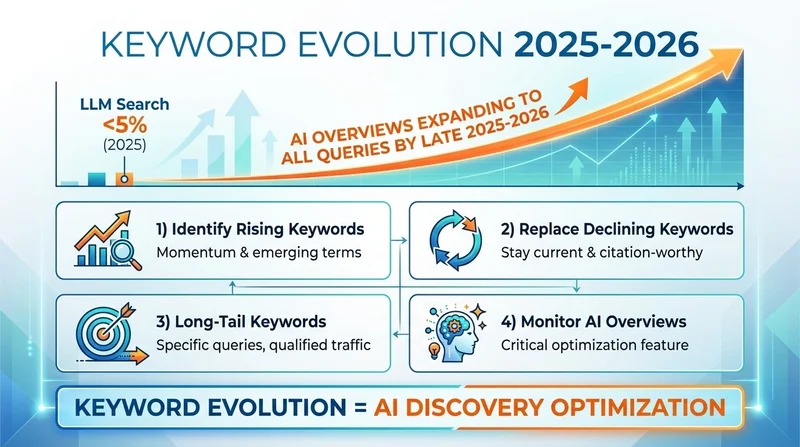
Search behavior is evolving rapidly as AI changes discovery patterns. LLM usage is still under 5% of global search queries in 2025, but this is growing exponentially, creating new keyword opportunities.
Use SEO tools to identify rising keywords related to your topic. Look for search terms gaining momentum that you haven't targeted yet. AI systems are particularly attuned to trending topics and emerging terminology.
Replace declining keywords with current, high-volume alternatives. Using outdated terminology signals to AI systems that your content may be stale and unworthy of citation.
Expand with long-tail keywords. These specific, lower-competition phrases drive qualified traffic (people who know exactly what they want). AI systems often cite content that matches specific, detailed queries rather than generic ones.
Monitor AI Overview appearances as this feature continues expanding. Industry experts predict AI Overviews will expand to cover all query types by late 2025 and throughout 2026, making optimization for these features critical.
← Back to Navigation7. Strengthen Internal Linking
The Architecture Advantage
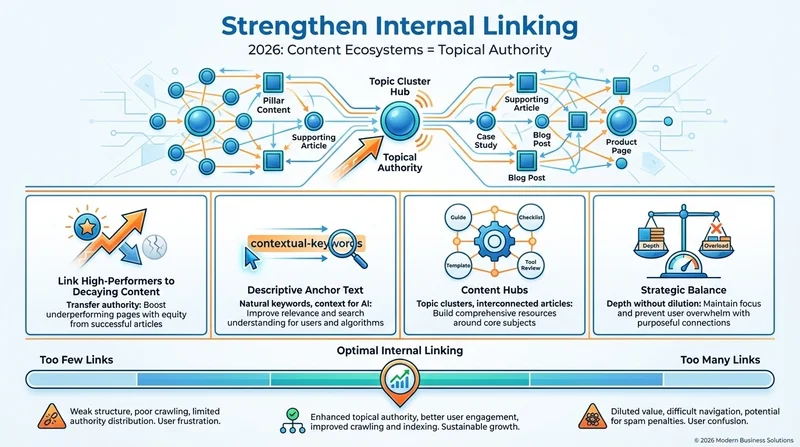
In 2026, SEO will be driven by interconnected content ecosystems that demonstrate comprehensive topical authority. Internal linking is the foundation of these trust networks.
Link from your high-performing pages to your decaying content. This transfers authority and helps search engines rediscover and revalue those declining pages. It also helps AI systems understand the relationships between your content pieces.
Use descriptive anchor text that incorporates your keywords naturally. Descriptive anchor text helps AI systems understand context when they're evaluating which sources to cite.
Create content hubs by organizing related articles into topic clusters with strategic internal linking. For AI citations, topical authority is becoming increasingly important. Systems prefer citing sources that demonstrate comprehensive knowledge across interconnected content.
Balance is key. Too few internal links and you miss opportunities to demonstrate your content ecosystem's depth. Too many and you dilute value and confuse both search engines and AI evaluation systems.
← Back to Navigation8. Build External Backlinks
The 2026 Backlink Reality
Backlinks aren't dead in the AI era, but they're evolving. In 2026, AI will cite brands with strong public reputations and active PR efforts. Your brand's good name is becoming as important as your link profile.
Here's why this matters for AI citations: brand search volume (not backlinks) is now the #1 predictor of LLM citations. But backlinks still build that brand awareness and domain authority that drives search volume.
Promote your refreshed content actively. Reach out to websites that previously linked to your content and let them know you've made substantial updates. Many will update their links or add new ones.
Create linkable assets that naturally attract backlinks. Original research, comprehensive guides, interactive tools, and data-driven infographics are link magnets. These are also exactly the types of content that AI systems prefer to cite: authoritative, original, and data-backed.
Focus on quality over quantity. In 2026, backlink quality and contextual relevance will matter far more than raw numbers for both traditional SEO and AI citation algorithms.
← Back to Navigation9. Merge, Redirect, or Remove Underperforming Pages
The Quality Signal
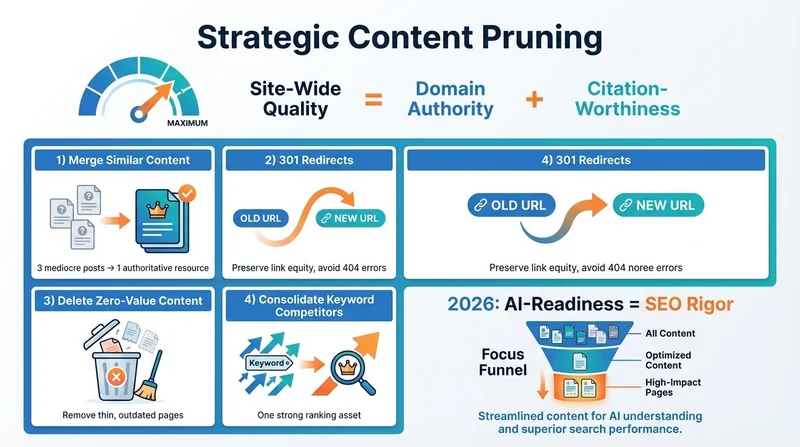
Sometimes the best way to fix content decay is strategic pruning. With AI systems evaluating overall site quality, low-quality pages hurt your entire domain's authority and citation-worthiness.
Merge similar content into comprehensive resources. If you have three mediocre blog posts on the same topic, combine them into one authoritative piece. AI systems prefer citing one definitive resource over multiple scattered pieces.
Use 301 redirects for outdated URLs. Point old pages to more relevant, updated content. This preserves any existing link equity and prevents 404 errors. AI systems that encounter broken links note these as negative quality signals.
Delete zero-value content that can't be salvaged. AI evaluation systems assess site-wide quality, and thin, outdated content drags down your entire domain's trustworthiness and citation potential.
Consolidate pages competing for the same keywords. Merge competing pages to create one stronger, singular ranking asset that AI systems can confidently cite as the authoritative source.
Focus your resources on high-impact pages. In 2026, marketing teams that treat AI-readiness with the same rigor as SEO will be better prepared for the new visibility landscape.
← Back to Navigation10. Monitor Performance Regularly
The Continuous Evolution
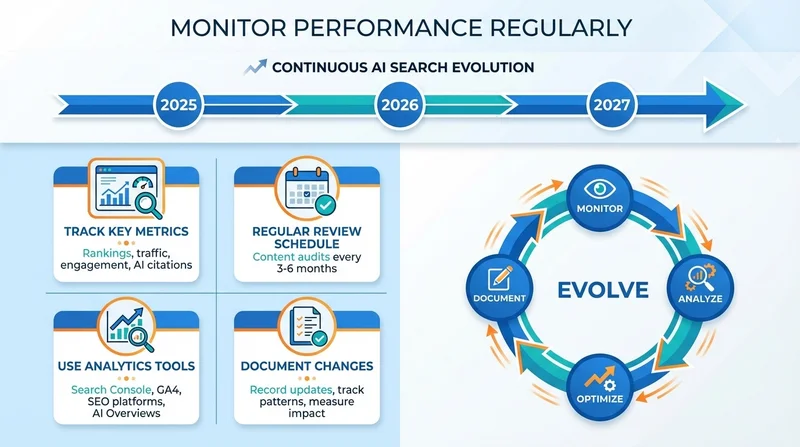
Content optimization isn't a one-and-done fix. With AI search evolving rapidly throughout 2025 and 2026, ongoing monitoring is essential to stay ahead of decay.
Track key metrics consistently: rankings, organic traffic, engagement metrics, and increasingly AI citation appearances. These numbers tell the story of your content's health in both traditional and AI-powered search.
Set regular review schedules. Conduct comprehensive content audits every 3-6 months to identify early warning signs before significant traffic loss occurs.
Use analytics tools effectively. Google Search Console, Google Analytics, and dedicated SEO platforms can identify declining pages early. Start tracking AI Overview appearances as this data becomes more readily available throughout 2025.
Document your changes and their impact. Keep records of what you updated, when, and what results you saw. As AI search evolves throughout 2025-2027, your documentation will reveal patterns about what makes content citation-worthy.
← Back to NavigationPutting It All Together: The AI Citation Imperative
Content decay is inevitable, but traffic loss and AI citation invisibility don't have to be. The median publisher experienced a 10% year-over-year traffic decline in the first half of 2025, but those investing in content refresh are seeing the opposite trend.
The content marketing market is exploding, projected to grow from $524.73 billion in 2025 to $989.84 billion by 2030. This growth means more competition for visibility, making content maintenance and optimization more critical than ever.
Brands that treat content as a living asset requiring continuous investment are winning. They align with user intent rather than chasing algorithms. They measure everything and make data-driven decisions.
They integrate SEO best practices across technical, on-page, and off-page elements. And most importantly, they prioritize user experience in every optimization decision, knowing that satisfied users lead to both traditional SEO success and AI citation favorability.
The Future Is AI-First: Act Now or Become Invisible
Here's the uncomfortable truth: we're witnessing a fundamental shift in how people discover information. Traditional "10 blue links" search is being replaced by AI-generated answers with selective citations.
By 2026, Gartner predicts search query volume will drop 25% as users increasingly rely on AI assistants. In this new landscape, being on page one isn't enough. You need to be one of the sources actually cited by AI systems.
AI systems have no patience for outdated, decayed content. They're trained to prioritize freshness, accuracy, authority, and comprehensiveness. Content that worked perfectly in early 2025 is already becoming invisible in late 2025's AI-powered search results.
Answer engines are the new search frontier going into 2026. The brands adapting now will dominate AI citations for years to come. Those that ignore this shift will find themselves systematically excluded from the future of search.
Every piece of decayed content on your site is a missed opportunity for AI citations. Every outdated statistic is a signal to AI systems to look elsewhere. Every broken internal link or thin content piece reduces your overall domain authority in the eyes of these new gatekeepers.
But the opportunity is enormous for those who act now.