
We believe one of the biggest mistakes in AI visibility today is that too many teams are told to create more content before they have checked whether the right page already exists on their site. That sounds productive, but in practice it often creates overlap, weakens authority, and sends multiple URLs after the same intent. At that point, publishing more is not strategy. It is noise.
"The real issue is not just what content to produce. It is whether you should be producing new content at all."
- Masab
What most AI visibility tools still get wrong
Many workflows still begin by asking the user to select a URL and optimize it. But that assumes the chosen page is already the right one. When that assumption is wrong, the result is usually duplication, cannibalization, and fragmented authority across pages that should not be competing with each other in the first place.
We built Wellows to approach that problem differently. Our view is simple: update before you create. Instead of defaulting to new content, the system first checks whether your site already has the right asset to improve. If it does, that page becomes the optimization target. If it does not, only then should a team create something new.
Why this matters
When teams optimize the strongest existing page instead of creating unnecessary overlap, authority compounds where it should. That is better for search clarity, better for AI citation visibility, and better for every team trying to turn visibility strategy into real execution.
Why we built Content Optimization
We did not want to build another tool that simply tells teams what to write next. We wanted to build a system that helps them make a smarter decision first. For AI visibility, that means knowing whether the opportunity should be won by improving an existing page, reinforcing a topical cluster, or creating something truly new only when the site has a real gap.
That decision layer is what we believe has been missing from the category. Too much of the market still describes the problem. We wanted to build software that helps teams make the right move next.
How the system works
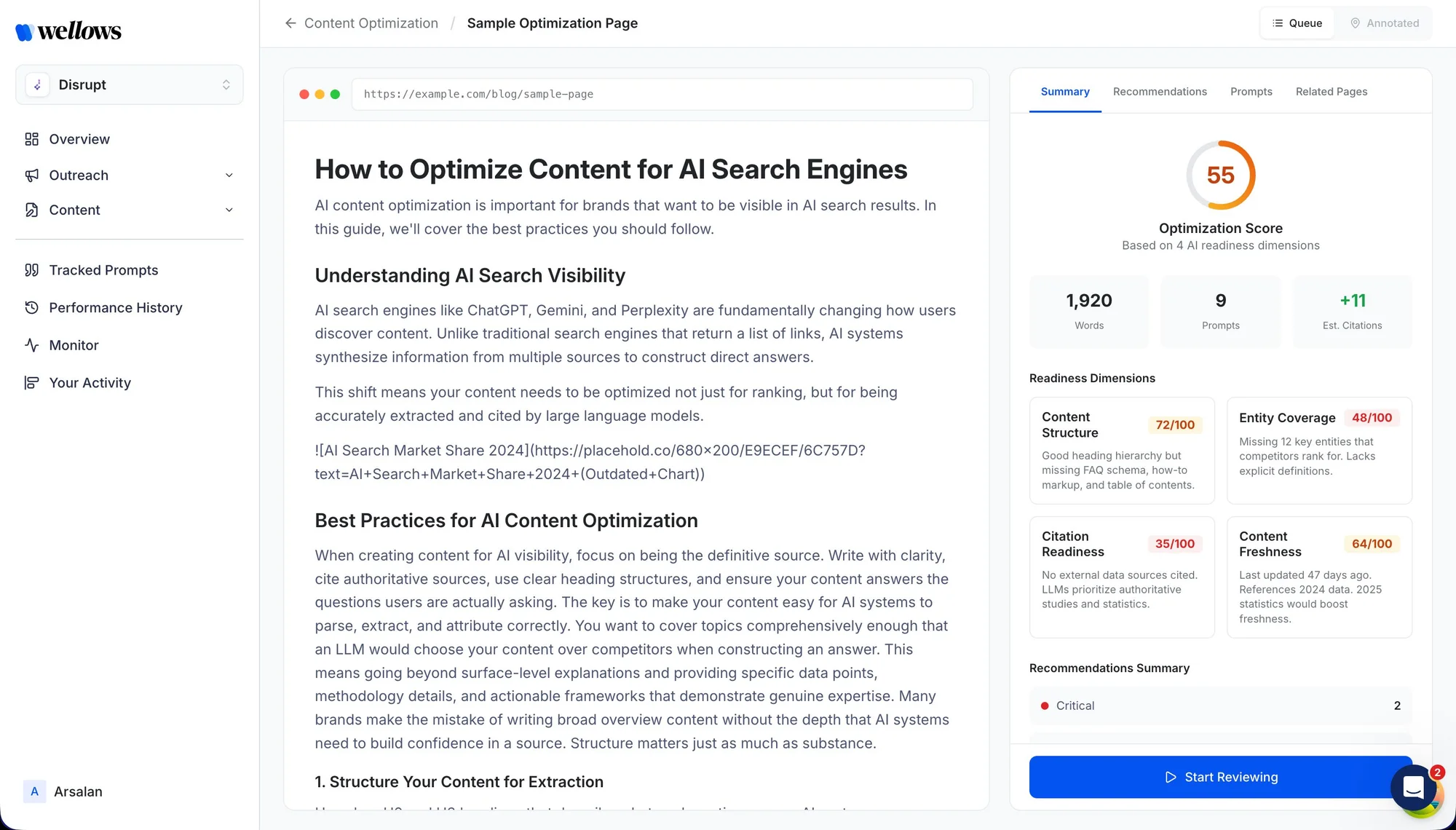
The workflow starts with the prompts a business wants visibility for across AI platforms. From there, Wellows scans the domain, identifies relevant pages, and uses intent and relevance scoring to determine which single page is best positioned to win. The goal is not to find the easiest URL to edit. It is to find the right page to strengthen.
Prompt-first workflow
Teams start with the prompts they want to win, not with a manual guess about which page to optimize.
Site-wide scan before recommendation
The system reviews the domain to identify overlapping content and reduce the risk of two URLs competing for the same intent.
Best-page selection
Intent and relevance scoring select one best candidate for optimization. If no strong page exists, the system identifies a genuine new-content opportunity.
Gap analysis and internal linking
Wellows highlights what is missing line by line and recommends internal links that can strengthen the page and the broader topic cluster.
Built around what LLMs are already rewarding
For each target prompt, the system analyzes the URLs already being cited by language models and breaks down the shared structure, entities, depth, and content signals behind those results. That gives teams a clearer picture of what "citation-worthy" actually looks like for a specific query, instead of relying on generic best-practice advice.
That intelligence is translated into precise recommendations. If currently cited pages go deeper on a key section and the selected page only mentions it lightly, the system identifies that gap directly and shows what needs to be added, revised, or expanded. It also suggests internal linking opportunities so the improvements strengthen authority across the topic, not just on one isolated URL.
"Wellows checks first, writes second."
What this means for customers
For customers and prospects, this is not just about content efficiency. It is about trust in the decision process. If your team is going to invest in AI visibility, you need confidence that you are reinforcing the right page, protecting existing authority, and creating new assets only when there is a real strategic need.
We believe that is how content optimization should work going forward: less guesswork, less duplication, fewer wrong turns, and a much clearer path from visibility insight to execution.
Where we believe the category is going
AI visibility does not need more dashboards that only describe the problem. It needs software that helps teams act on it correctly. In our view, the future of the category is not "tell me what to write." It is "tell me what is already working, what should be fixed, and only then what should be created."
That belief is what shaped this launch. Wellows is building toward a smarter execution layer for AI visibility—one that protects authority before it expands it.