
Starting a business is exciting, but without a clear roadmap, even the best ideas can fail. For founders asking how to start a business, structure matters more than speed. From validating your concept to securing funding and building a solid foundation, every step matters. This complete startup checklist will guide you from initial idea to successful execution, helping you avoid common mistakes and build a business designed to thrive.
Whether you’re a first-time founder or a serial entrepreneur, having a structured startup planning checklist prevents costly mistakes and keeps your launch on track. Research shows that 50% of startups fail within five years, often due to preventable oversights in planning, validation, or execution.
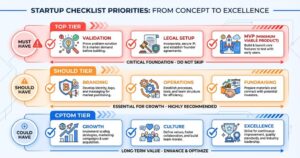
This guide breaks down everything you need to know into three priority levels: Must Have (non-negotiables that put your startup at serious risk if missing), Should Have (strongly recommended for stability and growth), and Could Have (nice to haves that improve long-term outcomes).
At the end, you’ll find a free downloadable PDF version of this complete checklist to keep you organized throughout your startup journey.
1. Idea & Planning
- Validate a real problem through customer interviews and market research before building, as market validation is the foundation of every successful startup.
- Define a specific target customer with clear pain points, behaviors, and buying intent.
- Create a concise value proposition that explains who you help, what problem you solve, and why your solution is different.
- Confirm willingness to pay early to avoid investing months into an unproven idea.
2. Legal & Financial Setup
- Choose the right legal structure based on liability protection, tax treatment, and future funding plans.
- Register the business, obtain tax IDs, licenses, and assign intellectual property to the company.
- Open a dedicated business bank account and set up bookkeeping to track cash flow accurately.
- Understand burn rate and runway early, since running out of cash is one of the most common startup failure factors.
3. Product & Operations
- Build a minimum viable product that tests the core assumption, not a fully polished solution.
- Clearly define founder roles, ownership, and decision-making authority to prevent internal conflict.
- Install simple systems for task management, customer support, payments, and documentation.
4. Branding & Marketing
- Develop clear messaging so customers instantly understand what you offer and who it is for.
- Launch a simple website or landing page with one primary call to action.
- Choose one acquisition channel to focus on first instead of spreading resources thin, a principle baked into every effective startup launch checklist.
- Build trust through consistent branding, early testimonials, and clear onboarding.
5. Launch & Growth
- Start with a soft launch to early users and refine the product using real feedback, a critical step in any business launch checklist.
- Track key metrics such as acquisition, retention, and revenue to guide decisions.
- Iterate quickly based on data, as only about 50% of new businesses survive beyond five years.
- Scale marketing, hiring, and systems only after demand and product-market fit are proven.
Startup Checklist by Priority: What You Must, Should, and Could Have
This priority-based startup checklist helps founders focus on what truly matters at each stage. When founders ask what’s included in the founders startup checklist, the answer is clarity, sequencing, and risk reduction. It separates critical non-negotiables from growth enhancers and long-term improvements so you can execute in the right order without wasting resources.
| Must Have (Non-Negotiables) | Should Have (Stability & Growth) | Could Have (Long-Term Excellence) |
|---|---|---|
| Problem & Market Validation | Brand & Positioning | Growth & Scaling Experiments |
| Clear Value Proposition | Operations & Processes | Product & Customer Excellence |
| MVP Focused On Core Problem | Sales & Marketing Strategy | |
| Team & Ownership | Fundraising Readiness | |
| Legal & Company Setup | Risk Management & Compliance | |
| Go-To-Market Basics | ||
| Financial Institutions | ||
| Culture & Leadership |
✅ MUST HAVE: Non-Negotiables for Startup Success
Without these foundational elements, your startup faces serious risks. That’s why what’s included in the foundrs startup checklist? should always start with non-negotiables. These aren’t optional extras—they’re the critical building blocks that determine whether your business can survive and grow.
1. Problem & Market Validation
Before you invest months building a product, you need evidence that people actually want what you’re creating. Market validation isn’t about asking friends if your idea sounds cool. It’s about finding genuine demand signals.
Why this matters: According to CB Insights, 42% of startups fail because there’s no market need for their product. You can build the most elegant solution in the world, but if nobody has the problem you’re solving, your startup won’t survive.
Essential validation checkpoints:
- One clear problem statement written in simple language that anyone can understand
- Target customer clearly defined: demographics, behaviors, pain points
- Evidence the problem exists: customer interviews (minimum 20 to 30), survey data, search volume trends
- Users actively searching for solutions: online communities discussing the problem, existing competitors with traction
- Willingness to pay validated: not just “would you use this?” but “would you pay $X for this?”
- Market size roughly estimated: Total Addressable Market, Serviceable Available Market, Serviceable Obtainable Market
Reality check from founders: A startup founder shared their experience: “I spent 6 months building before talking to a single potential customer. When I finally showed it to people, they said ‘that’s nice, but we don’t actually have that problem.’ Don’t make my mistake. Validation is not optional.”
2. Solution & Value Proposition
Once you’ve validated the problem, your solution needs to clearly and measurably address it. Vague promises don’t build businesses. Specific, different value does.
Solution validation checklist:
- Clear value proposition in one sentence: “We help [target customer] achieve [benefit] by [unique approach]”
- Solution directly solves the core problem: no scope creep or feature bloat at this stage
- Differentiation from existing alternatives: why would someone choose you over competitors or the status quo?
- Measurable benefit for users: save X hours per week, increase revenue by Y%, reduce costs by Z%
- Assumptions documented and prioritized: what must be true for this to work? Test the riskiest assumptions first
Did you know?
The “Mom Test” for Validation
Reading “The Mom Test” by Rob Fitzpatrick is essential for every founder. The book teaches you how to have customer conversations that reveal truth rather than polite encouragement. Key principle: Don’t ask “Would you use this?” Ask “Tell me about the last time you experienced [problem]” and “What have you tried to solve it?”
3. Product (MVP)
Your MVP (Minimum Viable Product) isn’t about building a basic version of your dream product. It’s about building the smallest thing that lets you learn the most about your customers with the least effort.
Common MVP mistake: Founders often confuse MVP with “minimum features.” An MVP should validate your riskiest assumption, not showcase your technical abilities. Atlassian’s product team defines it as “that version of a new product which allows a team to collect the maximum amount of validated learning about customers with the least effort.”
Example: During the software startup early stage journey, a team building a SaaS product might assume automation is the main value. An MVP could simply be a manual service behind the scenes, testing whether users care about the outcome before investing in full automation.
MVP development checklist:
- MVP scope defined: what’s the absolute minimum to test your hypothesis?
- Only essential features included: ruthlessly cut anything not core to solving the main problem
- MVP solves the core use case: even if rough around the edges, it must deliver the promised value
- Product usable by real users: not just developer friendly, but actually functional for your target customer
- Feedback loop established: how will you collect, analyze, and act on user feedback?
- Clear learning goals for MVP: what specific questions will this MVP answer?
From the trenches: A programmer founder reflected: “I had a database schema, user flow, and was ready to code. But the best advice I got was talk to 30 potential customers first. Half of them revealed needs I hadn’t considered. The other half proved my initial assumptions were wrong. Those conversations saved me 3 months of building the wrong thing.”
4. Team & Ownership
Founder disputes destroy more startups than bad ideas. Crystal clear roles, equity splits, and decision making authority from day one prevent the conflicts that tear teams apart later.
Team foundation checklist:
- Founder roles clearly defined: who owns product? Sales? Operations? No overlap or confusion
- Decision making authority assigned: who has final say on what? How do you break deadlocks?
- Equity split agreed and documented: based on contribution, risk, and commitment, not just friendliness
- Founders agreement signed: includes vesting schedules, cliff periods, and exit terms
- Skills gaps identified: what expertise do you lack? How will you fill those gaps?
Critical Warning
Many founders split equity 50/50 to “keep it fair.” This is a recipe for disaster. As Y Combinator notes, 50/50 splits guarantee stalemates. Someone needs to be the tiebreaker. If you can’t agree who that should be now, you’re not ready to start a company together.
5. Legal & Company Setup
Proper legal structure protects you personally, makes fundraising possible, and ensures you’re compliant with regulations. Cutting corners here creates expensive problems down the road.
Legal foundation checklist:
- Company legally registered: choose structure (LLC, Corporation, Sole Proprietorship, Partnership) based on your growth plans and funding needs), a non-negotiable step in any company startup planning checklist.
- IP ownership assigned to company: all code, designs, and intellectual property must be owned by the company, not individual founders
- Business bank account opened: separate personal and business finances from day one
- Basic accounting set up: bookkeeping system, expense tracking, revenue recognition
- Required licenses obtained: business licenses, professional certifications, industry specific permits. For example, a handyman business startup requirements checklist would include local trade permits, bonding, and liability coverage.
- Data privacy basics covered: privacy policy, terms of service, GDPR, CCPA, or local data protection compliance if applicable
How to Choose the Right Business Structure as Part of my Startup Checklist?
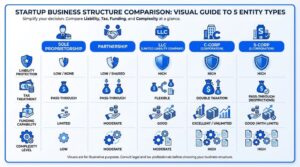
Choosing the right business structure requires matching your liability tolerance, tax strategy, and funding plans to the specific characteristics of each entity type, because this decision directly impacts your personal asset protection, tax obligations, and ability to raise capital.
According to U.S. Small Business Administration data, the business structure you choose influences everything from day-to-day operations to how much of your personal assets are at risk, making it one of the most critical early decisions for founders.
Start by evaluating three core factors in this order:
- Personal liability exposure: Sole proprietorships and partnerships offer no personal asset protection, meaning creditors can pursue your home, savings, and personal property for business debts. Research from the Business Initiative shows that 50.8% of new businesses fail within five years, and without liability protection, founders risk losing everything. LLCs and corporations create legal separation between personal and business assets.
- Tax implications and compliance burden: Pass-through entities (LLCs, S-Corps, sole proprietorships) avoid double taxation because profits flow directly to owners’ personal tax returns. C-Corporations face corporate-level taxation plus shareholder dividend taxation, but offer advantages for reinvesting profits. The IRS reports that tax treatment varies significantly by structure, with S-Corps potentially saving owners thousands annually on self-employment taxes.
- Funding and growth trajectory: If you plan to raise venture capital, investors typically require C-Corporations because they need multiple share classes and clear ownership structures. Silicon Valley Bank data confirms that C-Corps are the venture capital standard due to their flexibility with equity and investor protections.
Business Structure Decision Matrix:
| Structure | Liability Protection | Tax Treatment | Best For | Typical Cost |
|---|---|---|---|---|
| Sole Proprietorship | None – unlimited personal liability | Pass-through (Schedule C) | Solo freelancers, low-risk service businesses | $0-$300/year |
| Partnership | None for general partners | Pass-through (Form 1065) | 2+ partners in professional services | $500-$1,500/year |
| LLC | Yes – shields personal assets | Pass-through (can elect S-Corp) | Most small businesses, bootstrapped startups | $100-$800/year |
| S-Corporation | Yes – shields personal assets | Pass-through with payroll tax savings | Profitable service businesses ($60K+ profit) | $800-$2,500/year |
| C-Corporation | Yes – shields personal assets | Double taxation (corporate + personal) | VC-backed startups, high-growth tech companies | $1,000-$5,000/year |
Source: Cost data compiled from SBA, state filing fees, and registered agent services as of 2025.
Expert Insight: Based on analysis of startup survival data and founder outcomes, the evidence suggests most early-stage founders benefit from starting with an LLC for liability protection and flexibility, then converting to a C-Corp only when actively raising institutional capital. This approach avoids premature complexity while maintaining optionality.
However, if you know from day one you’ll pursue venture funding within 12-18 months, incorporating as a Delaware C-Corp immediately saves the conversion hassle and potential tax complications.
Real Founder Experience: As one Reddit founder in r/Entrepreneurs shared: “Went with an LLC for my startup, gave me that sweet limited liability without the corporate fuss. It felt like the perfect balance of protection and flexibility.” Another in r/startups noted their SaaS business doing $30K MRR stayed as a single-member LLC until investors required conversion to C-Corp.
Yes, sole proprietorships follow a simplified 10-step checklist because they require less formal structure than corporations or LLCs, though this simplicity comes at the cost of unlimited personal liability. According to IRS guidelines, sole proprietors can begin operations immediately but must complete specific registration and compliance steps to operate legally.
Complete Sole Proprietorship Startup Checklist:
- Validate your business concept (2-4 weeks): Conduct market research, identify your target customer, and confirm demand. CB Insights research found that 42% of startups fail because there’s no market need, making validation non-negotiable even for simple sole proprietorships.
- Create a basic business plan (1 week): Document your target market, revenue model, startup costs, and monthly expenses. While sole proprietorships don’t require formal business plans for registration, the SBA recommends this step for securing financing and maintaining focus.
- Choose and register your business name (1-3 days): If operating under a name different from your legal name, file a “Doing Business As” (DBA) or fictitious name with your local county clerk or state agency. Check name availability through your state’s business registry first.
- Obtain an EIN from the IRS (same day): While not required for sole proprietors without employees, an Employer Identification Number separates business and personal finances and is typically required to open a business bank account. Apply free at IRS.gov.
- Register for state and local taxes (1-2 weeks): Depending on your location and business type, register for sales tax permits, unemployment insurance tax, and local business taxes. Requirements vary significantly by state and industry.
- Obtain necessary licenses and permits (2-6 weeks): Research federal, state, and local requirements for your industry. Professional services may need occupational licenses, while retail locations require zoning approval and health permits. Use the SBA’s license lookup tool to identify requirements.
- Open a dedicated business bank account (1 week): Essential for separating personal and business finances, simplifying tax preparation, and establishing business credit. Most banks require your DBA registration and EIN.
- Set up bookkeeping and accounting systems (1-2 days): Implement QuickBooks, FreshBooks, or Wave to track income, expenses, and estimated quarterly taxes. Proper records are required for tax compliance and business decision-making.
- Secure business insurance (1-2 weeks): General liability insurance protects against customer injuries and property damage claims. Data from The Hartford shows that 35% of general liability claims involve bodily injury. Average cost: $45/month according to Insureon.
- Understand ongoing compliance (ongoing): File Schedule C with your personal tax return annually, pay estimated quarterly taxes if expecting to owe $1,000+ annually, and maintain required licenses. Failure to file properly can trigger IRS penalties and interest.
Critical Warning About Sole Proprietorships: According to Business Initiative analysis of 1994-2021 data, while 67.9% of new businesses survive at least two years, sole proprietorships face unique risks. Unlike LLCs or corporations, you have unlimited personal liability, if someone sues your business or if you default on business debt, they can pursue your house, car, savings, and personal assets.
The Zebra reports that 36-53% of small businesses are sued each year, making personal liability exposure a serious consideration.
A founder in r/smallbusiness explained: “You can just set up a bank account and tell them that you are running as a sole proprietor. They won’t need the EIN. I think they need a social security number and DBA registration if you’re not using your own name.”
When to Consider Upgrading: If your sole proprietorship grows revenue beyond $60,000 annually, employs others, faces significant liability risk (physical services, professional advice, product sales), or plans to raise funding, converting to an LLC or corporation provides critical protections. The conversion process is straightforward and often costs $500-$2,000 depending on state and legal assistance.
- Similar to sole proprietorship but with multiple owners
- Partners share liability and obligations
- Requires partnership agreement
- Best for: Small businesses between trusted partners
A partnership is a simple and flexible business structure where two or more people run a business together. It works well when partners share responsibilities, resources, and decision making.
- Protects personal assets from business liabilities
- Flexible tax treatment (can elect different tax options in many jurisdictions)
- Less paperwork than corporations
- Best for: Most small businesses, especially those not raising venture capital funding
A Limited Liability Company, or LLC, is one of the most popular business structures for startups and small businesses. It offers a balance of legal protection, flexibility, and simple management.
- Separate legal entity
- Can issue multiple share classes
- Often required for venture capital funding
- May have double taxation (corporate plus personal on dividends)
- Best for: High growth startups planning to raise institutional capital
A C Corporation is a more formal business structure designed for companies with big growth plans. It is commonly chosen by startups that aim to raise venture capital or scale internationally.
- Avoids double taxation
- May have shareholder restrictions depending on location
- Best for: Profitable businesses with specific ownership requirements
What Is an S Corporation?
An S Corporation is a tax focused business structure available in certain jurisdictions. It is ideal for businesses that want corporate benefits while avoiding double taxation.
Note: Business structure names and rules vary by country. In the US, you might form a Delaware C Corporation. In the UK, it’s a Limited Company. In other regions, similar structures exist with different names. Consult local regulations or a legal professional in your jurisdiction.
Understanding & Including Bylaws or Operating Agreements in the Startup Checklist for a Corporation
You should include bylaws in your startup checklist for a corporation. They act as internal rules that guide management, decision making, and daily operations. While not usually filed with the state, bylaws are essential for governance and often required for banking, funding, and other business activities.
- Board composition and meeting procedures
- Shareholder voting rights and procedures
- Officer roles and responsibilities
- Stock or share issuance and transfer procedures
- Amendment process
Most jurisdictions require that corporations establish bylaws to ensure consistent and agreed upon governance. However, bylaws typically don’t need to be filed with the government. They’re internal documents kept with your corporate records.
If you form an LLC (or equivalent), you’ll have an Operating Agreement instead, which serves a similar purpose.
6. Go-To-Market Basics
Building a great product means nothing if nobody knows it exists. Your go to market strategy determines how you’ll reach customers, convert them, and retain them.
Go to market essentials checklist:
- Ideal customer profile defined: beyond demographics, what are their behaviors, motivations, and buying triggers?
- First acquisition channel chosen: don’t try everything at once. Pick one channel to master first
- Pricing model decided: based on value delivered, not just costs plus margin
- First users or customers onboarded: even if manual and not scalable, get those first 10 customers
- Customer feedback collected: structured process for capturing, analyzing, and acting on feedback
- Basic support process in place: how will customers get help when things go wrong?
Channel selection reality: Many founders waste resources trying multiple channels at once. Y Combinator advises: Do things that don’t scale at first. Airbnb’s founders personally photographed hosts’ properties. That level of manual effort helped them understand what customers truly needed.
7. Financial Foundations
You need to understand your financial reality with brutal honesty. Startups don’t die from competition. They die from running out of money while not knowing their runway.
Financial clarity checklist:
- Startup costs estimated: one time expenses to launch (legal, equipment, initial inventory). For instance, in a retail business startup checklist, this would include inventory, point of sale systems, and physical space setup.
- Monthly burn calculated: fixed plus variable costs per month
- Runway understood: how many months until you run out of money?
- Revenue model defined: how do you make money? What’s the path to profitability?
- Break even assumptions outlined: at what revenue level do you become profitable? How realistic is that timeline?
These fundamentals apply to any business checklist for startups, from solo founders to growing teams.
Burn rate reality check: If you’re spending $20,000 per month and have $120,000 in the bank, your runway is 6 months. But smart founders plan for 18 to 24 months of runway before needing to raise more capital. That’s enough time to hit meaningful milestones that make the next round easier.
8. Culture & Leadership
- Mission and vision written: why does your company exist? Where are you heading?
- Core values defined: the principles that guide decisions and behavior
- Feedback culture established: regular one on ones, peer feedback, retrospectives
- Founder coaching or peer group: external support and accountability
- Hiring culture documented: what kind of people do you want? How do you find and evaluate them?
⚠️ SHOULD HAVE: Strongly Recommended for Stability & Growth
These elements aren’t technically required for launch, but they significantly improve your chances of long term success and credibility with stakeholders when included in a launch readiness checklist.
9. Brand & Positioning
Your brand is how customers perceive you. Even early stage startups benefit from clear, consistent branding that communicates professionalism and builds trust.
Brand basics checklist:
- Company name finalized: memorable, available as a domain, trademarkable
- Domain secured: .com preferred, but .io, .ai, or industry specific domains work too
- Basic brand identity: logo, color palette, typography. Don’t overthink it, but be consistent
- Simple website or landing page: explains what you do, for whom, and how to get started
- Clear messaging: value proposition, positioning, and key benefits articulated consistently
Branding on a budget: You don’t need an expensive agency brand package. Tools like Canva, Figma, and affordable platforms offer quality templates. Focus on clarity and consistency over perfection. Zapier’s advice is spot on: A company with a simple, casual tone and one or two brand colors and basic designs will do far better than a company that tries out a different tone with each social post.
10. Operations & Processes
Documenting processes early prevents chaos as you grow. What’s obvious to you today won’t be obvious to new hires six months from now.
Operational foundation checklist:
- Task and project management system: Asana, Monday, Notion. Pick one and stick with it
- Internal documentation started: how things work, where files live, who owns what
- Hiring plan outlined: what roles do you need? When? At what cost?
- Contractor agreements ready: templates for freelancers, consultants, advisors
- KPIs defined: what metrics actually matter for your business? How will you track them?
The systemization advantage: Prepare the business as if someone needed to take it over and run it for you. This means having a method to process orders, pay bills, pay employees, pay taxes, and maintain your permits. Systemization lets you scale without chaos.
For example, a tech startup checklist often includes documenting how tasks are assigned in your project tool, where standard operating procedures are stored, who approves expenses, and which KPIs each role is accountable for, so new hires can operate independently without constant founder input.
11. Sales & Marketing
Go to market basics from the Must Have section get you started. Sales and marketing strategy scales you up.
Sales & marketing checklist:
- Marketing strategy documented: target channels, messaging, campaigns planned for next 6 to 12 months
- Content or outreach plan: what content will you create? What outreach will you do?
- CRM or lead tracking system: HubSpot, Salesforce, Pipedrive. Track every interaction
- Onboarding flow defined: how do new customers get value quickly?
- Retention strategy considered: keeping customers is cheaper than acquiring new ones
12. Fundraising Readiness
Even if you’re bootstrapping now, being investor ready gives you options. This section effectively becomes a startup due diligence checklist for founders preparing for scrutiny. Most fundraising preparation helps you run your business better anyway.
Investor readiness checklist:
- Pitch deck prepared: problem, solution, market, traction, team, ask (10 to 15 slides max)
- Financial projections created: 3 year revenue, expense, and cash flow forecasts
- Cap table documented: who owns what? What’s diluted with new investment?
- Data room assembled: all corporate documents, financials, contracts, IP organized for due diligence
- Target investors identified: which VCs, angels, or funds invest in companies like yours?
- Preparing a capitalization table requires systematically documenting every equity holder, security type, share count, ownership percentage, and vesting schedule in a spreadsheet or dedicated software, because even minor errors in equity tracking can derail funding rounds or create expensive disputes.
- Early stage (pre-funding): Google Sheets or Excel templates are sufficient. Download templates from Y Combinator or Cooley GO.
- After first funding: Migrate to dedicated software like Carta, Pulley, or Shareworks. These platforms model dilution, handle 409A valuations, and maintain audit trails required for due diligence.
- New investor shares and percentage: Calculate using: Investment Amount ÷ Price Per Share
- Post-money valuation: Total shares outstanding × Price Per Share
- Dilution impact: Each shareholder’s percentage decreases proportionally unless they participate in the round
- New ownership distribution: Recalculate all percentages based on expanded share count
- Liquidation preferences: Preferred stock typically includes 1x or 2x liquidation preference, meaning investors get paid before common shareholders in exit
- Update immediately after any equity event: New hires with options, vesting milestones, option exercises, SAFE conversions, funding rounds
- Reconcile with legal documents: Cap table must match stock purchase agreements, option grants, and board resolutions. Discrepancies create due diligence nightmares.
- Back up regularly: Cap table is a mission-critical document. Use version control, cloud storage with access controls, and regular exports.
- Limit access: Only founders, CFO, and legal counsel should have edit access. Investors and employees can receive read-only snapshots.
According to Carta’s research, the cap table serves as the official record of your company’s equity ownership structure and becomes increasingly critical as you add investors, employees, and advisors.
Step-by-step cap table creation process:
1. Choose your cap table platform:
2. Set up essential columns:
| Column | Information Tracked | Why It Matters |
|---|---|---|
| Shareholder Name | Legal name of person or entity | Must match government-issued ID for tax reporting |
| Security Type | Common stock, preferred stock, options, warrants, SAFEs | Each type has different rights, liquidation preferences, conversion terms |
| Number of Shares | Total shares owned or granted | Determines ownership percentage and voting power |
| Price Per Share | Purchase price (can be $0.00001 for founders) | Establishes 409A strike price for options, dilution calculations |
| Investment Amount | Shares × Price Per Share | Tracks capital contributed by each shareholder |
| Ownership % | Shareholder shares ÷ Fully diluted shares | Fully diluted includes issued + reserved options |
| Vesting Schedule | Cliff date, vesting period, acceleration terms | Typical: 4-year vest, 1-year cliff. Protects company if someone leaves early |
| Vested Shares | Shares earned as of date | Only vested shares have voting rights and value in acquisition |
3. Include option pool from the start:
Reserve 10-20% of fully diluted shares for employee stock options, even if you haven’t hired anyone yet. Silicon Valley Bank data shows investors expect to see a proper option pool before funding, and creating it later dilutes founders disproportionately.
Example: If your company has 10M shares and you want a 15% option pool, you need to reserve 1.765M shares (10M × 0.15 ÷ 0.85) to ensure employees end up with 15% after dilution.
4. Document each financing round:
After each funding event, update your cap table to reflect:
Example dilution scenario:
| Stage | Founder A | Founder B | Option Pool | Investors | Total Shares |
|---|---|---|---|---|---|
| Formation | 5M (50%) | 3M (30%) | 2M (20%) | 0 | 10M |
| Seed ($2M at $8M post) | 5M (38.5%) | 3M (23.1%) | 2M (15.4%) | 3M (23.1%) | 13M |
| Series A ($10M at $40M post) | 5M (30.8%) | 3M (18.5%) | 2M (12.3%) | 6.25M (38.5%) | 16.25M |
5. Maintain accuracy and version control:
Common cap table mistakes that destroy value: Research compiled from Cake Equity and Founder’s CPA identifies these critical errors:
- Giving advisors too much equity too early: Advisors typically receive 0.1-0.5% with 2-year vesting, not 2-5% outright. Over-allocation here dilutes founders unnecessarily.
- Not implementing vesting schedules: All founder and employee equity should vest over 4 years with 1-year cliff. Without vesting, departed co-founders retain full ownership.
- Inconsistent data across documents: Cap table, stock ledger, and legal agreements must match exactly. Discrepancies cause failed fundraising and M&A deals.
- Ignoring fully diluted calculations: Always calculate ownership on fully diluted basis (including all options, warrants, and convertible securities), not just issued shares.
- Not planning for future dilution: Model out 2-3 funding rounds to understand how much your ownership will decline. Founders should target retaining 20-30% post-Series B.
Expert Insight: Based on analysis of cap table errors that derailed funding, the evidence suggests that the most expensive mistakes happen in the first 12 months when founders grant equity casually without vesting or proper valuation. The research shows that 65% of startup failures stem from co-founder conflict, with equity disputes being a primary driver.
A properly structured cap table with clear vesting, documented contributions, and regular updates prevents these conflicts. The recommended approach is to treat your cap table as a legally binding document from day one, even when it’s just founders and a Google Sheet—establish vesting, assign fair splits based on contribution and risk, and update it every time any equity changes hands.
A founder in r/businessanalysis explained the reality: “Cap tables get messy after a few rounds. SAFE/convertible note conversions are confusing. Founders don’t know how future fundraising will affect their ownership.”
- Traction metrics: prove demand with real numbers
- Financial model: demonstrate path to profitability
- Market research: show market size and growth potential
- Competitive analysis: explain your differentiation
- Team credentials: prove you can execute
- Product demo: let investors experience the solution
- Customer testimonials: social proof from real users
- Cap table clarity: clean ownership structure
- Legal compliance: all corporate documents in order
- Clear use of funds: exactly how you’ll spend investment capital
Securing funding requires mastering financials, pitching, and due diligence.
13. Risk & Compliance
Understanding risks and having mitigation plans shows maturity and protects your business from catastrophic failures, which is why risk assessment belongs in every startup due diligence checklist.
Risk management checklist:
- Legal risks reviewed: contracts, liability exposure, regulatory compliance
- Technical risks identified: single points of failure, security vulnerabilities, scalability limits
- Data security measures in place: encryption, access controls, regular backups
- Backup and recovery plan: what happens if servers crash? If data is lost?
- Insurance considered: general liability, professional liability, directors and officers, cyber insurance
Should I get business insurance early in my startup checklist?
Yes, obtaining business insurance before you begin revenue-generating operations protects your startup from catastrophic financial exposure that could otherwise bankrupt the company and put personal assets at risk.
Four critical triggers that require immediate insurance:
- Signing your first client contract or service agreement: Clients routinely require proof of insurance (Certificate of Insurance) before work begins, especially for B2B services, consulting, or any work performed on client premises.
- Hiring your first employee: Workers’ compensation insurance is legally mandated in most U.S. states once you have even one employee. Penalties for non-compliance include fines of $1,000-$10,000 per violation, potential criminal charges, and personal liability for workplace injuries. Check requirements at your state labor department.
- Leasing office or retail space: Commercial landlords require general liability insurance as a lease condition, typically with the landlord named as an additional insured. Expect minimum coverage requirements of $1-2 million.
- Raising institutional funding: Investors require Directors and Officers (D&O) insurance to protect board members from personal liability in shareholder lawsuits. This becomes mandatory at Series A or when you add outside directors.
Essential insurance types for startups by stage:
| Insurance Type | What It Covers | When You Need It | Average Annual Cost |
|---|---|---|---|
| General Liability | Customer injuries, property damage, advertising injury | Before first customer interaction or office lease | $540/year ($45/month) per Insureon |
| Professional Liability (E&O) | Errors, negligence, failure to deliver services as promised | Before providing professional services or advice | $800-$3,000/year depending on industry |
| Workers’ Compensation | Employee injuries, medical costs, lost wages | Required by law when hiring first employee | $800-$2,500/year for low-risk office work |
| Commercial Property | Office contents, equipment, inventory against theft/damage | When you have significant physical assets | $500-$2,000/year based on asset value |
| Cyber Liability | Data breaches, ransomware, customer data loss, notification costs | If you store customer data or process payments | $1,000-$7,500/year based on data volume |
| Directors & Officers (D&O) | Protects executives from lawsuits over business decisions | When raising institutional capital or adding outside directors | $1,200-$5,000/year for startups |
Why early insurance prevents catastrophic losses: Data from Insurance Advisor shows that burglary and theft account for 54% of business insurance claims, while bodily injury claims make up 35% of general liability claims according to The Hartford.
Without insurance, a single lawsuit can cost $50,000-$500,000+ in legal fees and settlements—even if you win. The Zebra’s research found that 36-53% of small businesses are sued annually, and 90% face litigation at some point in their lifetime.
Business Owner’s Policy (BOP) – The Startup-Friendly Package: A Business Owner’s Policy bundles general liability and commercial property insurance at 20-30% lower cost than purchasing separately. Typical BOP costs $500-$1,500/year for service businesses and provides $1-2 million in liability coverage plus property protection. This is the recommended starting point for most startups.
How to get insurance efficiently:
- Assess your specific risks (30 minutes): Industry, physical products vs. services, client contracts, employee count, data handling, physical location.
- Get 3-5 quotes (1-2 days): Use brokers like Insureon, Thimble, or Vouch (startup-focused) to compare coverage and pricing.
- Review coverage limits and exclusions (1 hour): Don’t just choose the cheapest—understand what’s covered, exclusions, deductibles, and claims process.
- Purchase and obtain Certificate of Insurance (same day): Most policies activate within 24 hours. Request certificates to provide to clients, landlords, or partners.
- Review annually: As revenue grows, employee count increases, or you expand services, increase coverage limits appropriately.
Insurance cost as percentage of revenue: Small businesses typically spend 1-2% of annual revenue on insurance. A startup with $100,000 in first-year revenue should budget $1,000-$2,000 for basic coverage (general liability + professional liability). This increases to $3,000-$7,000 once you add workers’ comp, cyber liability, and D&O insurance.
Expert Insight: Based on analysis of startup insurance claims and failure patterns, the evidence suggests that the cost of insurance ($1,500-$3,000 annually for typical coverage) is negligible compared to the risk of a single uninsured incident. One customer injury lawsuit, one data breach, or one professional negligence claim can cost $100,000-$1,000,000+ and bankrupt an early-stage company.
The recommended approach is to obtain general liability insurance immediately before your first revenue-generating activity, add professional liability (E&O) before signing your first client contract, secure workers’ compensation before hiring your first employee, and layer in cyber liability and D&O as you scale and raise capital.
Delaying insurance to save $200/month is a false economy that exposes founders to catastrophic downside risk.
Note: Insurance requirements and availability vary significantly by country and industry. For example, in some regions like the US, a Business Owner’s Policy bundles general liability and property insurance affordably. In other regions, insurance structures differ. Research local requirements and options.
💡 COULD HAVE: Nice to Haves for Long Term Excellence
These elements improve leverage, polish, and long term outcomes. Many successful startups skip these initially and add them as they scale.
14. Growth & Scaling
- Growth experiments planned: hypothesis driven testing of growth levers
- Automation tools implemented: reduce manual work, improve efficiency
- Scalable architecture: technical infrastructure that can handle 10x growth
- Advanced analytics: cohort analysis, attribution modeling, predictive metrics
- Partnerships explored: strategic alliances, distribution partners, co marketing opportunities
15. Product & Customer Excellence
- UX improvements: continuously refine the user experience
- Customer success processes: proactive support to ensure customers achieve outcomes
- Feature roadmap defined: prioritized backlog aligned with strategy
- User community built: forums, Slack groups, user groups for engagement and feedback
- Advocacy or referral program: turn happy customers into your sales force
Where can I Find a Startup Checklist for E-Commerce Businesses?
Comprehensive e-commerce startup checklists are available from platforms like WooCommerce, Gorgias, and industry organizations, but most lack the critical pre-launch validation and post-launch retention strategies that determine long-term survival.
Research from GrowthList shows that e-commerce startups face an 80% failure rate, with most failing within the first 120 days due to poor market fit, inadequate funding, or unrealistic customer acquisition costs.
Complete E-Commerce Startup Checklist (8-16 Weeks):
Phase 1: Pre-Launch Validation (Weeks 1-4)
- Identify a profitable niche: Use Google Trends, Amazon Best Sellers, and keyword research tools to find products with consistent demand and manageable competition. Validate that customer acquisition cost (CAC) is 3x lower than lifetime value (LTV).
- Analyze target customer behavior: Create detailed customer personas including demographics, online shopping habits, pain points, and preferred platforms. Understanding customer behavior is critical, as 10-20% of e-commerce businesses succeed—those that deeply understand their customers.
- Competitive research: Identify 5-10 direct competitors, analyze their pricing, product selection, shipping policies, and customer reviews. Look for gaps you can exploit.
- Validate willingness to pay: Create a simple landing page with product descriptions and email capture. Run small paid ad tests ($100-$500) to gauge genuine interest before investing in inventory.
Phase 2: Legal and Financial Foundation (Weeks 2-5)
- Choose business structure: Most e-commerce businesses benefit from LLC protection due to product liability risk and customer data handling. C-Corps make sense if raising significant capital.
- Register business and obtain EIN: File with your state and get federal tax ID from IRS.
- Open business bank account and payment processing: Separate finances and set up Stripe, PayPal, or Square for payment processing. Consider merchant accounts if selling high-value items.
- Understand sales tax obligations: After the 2018 Wayfair decision, economic nexus requires collecting sales tax in states where you exceed transaction or revenue thresholds (typically $100K+ in sales or 200+ transactions).
- Calculate startup costs and runway: Budget for inventory, platform fees, marketing ($1,500-$5,000+ monthly for viable traffic), shipping supplies, insurance, and 6-12 months operating expenses.
Phase 3: Website and Technical Setup (Weeks 4-8)
- Select e-commerce platform: Shopify (easiest, 2.9% + $0.30 per transaction), WooCommerce (flexible, requires WordPress knowledge), BigCommerce (enterprise features), or custom-built (expensive but unlimited control). Shopify’s launch checklist covers platform-specific steps.
- Design user-friendly store: Mobile-responsive design (70%+ of e-commerce traffic is mobile), fast load times (under 3 seconds), clear navigation, high-quality product images, detailed descriptions.
- Implement secure payment gateways: SSL certificate (required for PCI compliance), trusted payment processors, clear security badges to build trust.
- Set up analytics and tracking: Google Analytics 4, Facebook Pixel, platform analytics to track traffic sources, conversion rates, cart abandonment, and customer behavior.
Phase 4: Product and Inventory Management (Weeks 6-10)
- Source products: Decide between manufacturing, wholesale purchasing, dropshipping, or print-on-demand. Each has different margin, control, and cash flow implications.
- Establish supplier relationships: Negotiate terms, order samples, verify quality, establish reorder processes and lead times.
- Set competitive pricing: Factor in product cost, shipping, platform fees (typically 2-5%), payment processing (2.9% + $0.30), marketing (15-30% of revenue), and desired profit margin (typically 30-50% for sustainability).
- Implement inventory management: Use platform tools or dedicated systems (TradeGecko, Cin7) to track stock levels, automate reordering, prevent overselling.
Phase 5: Marketing and Customer Acquisition (Weeks 8-12)
- Develop marketing strategy: Focus on 1-2 channels initially. Options include Google Shopping ads (high intent), Facebook/Instagram ads (visual products), SEO content, influencer partnerships, email marketing.
- Build email list from day one: Offer 10-15% discount for first-time subscribers. Email marketing generates $42 for every $1 spent according to Campaign Monitor.
- Create content marketing plan: Blog posts answering customer questions, product guides, comparison articles to capture organic search traffic and build authority.
- Set up retargeting: Install Facebook Pixel and Google remarketing tags to re-engage visitors who didn’t purchase (typically converts 2-3x better than cold traffic).
Phase 6: Operations and Fulfillment (Weeks 10-14)
- Choose shipping strategy: Compare carriers (USPS, UPS, FedEx), offer multiple speed options, consider flat-rate vs. calculated shipping. Free shipping increases conversion but requires higher margins.
- Set up fulfillment workflow: In-house packing and shipping, third-party logistics (3PL), or dropshipping. Document packaging standards, shipping timelines, order processing procedures.
- Implement order tracking: Automated tracking emails, branded tracking pages, proactive delivery updates increase customer satisfaction and reduce support inquiries.
- Establish return policy: Clear terms (30-60 days typical), easy process, prepaid return labels for high-value items. E-commerce return rates average 20-30%, so build this into your model.
Phase 7: Customer Service and Retention (Weeks 12-16)
- Set up support channels: Email support (required), live chat (increases conversion 3-5x), phone support (optional for premium brands), social media monitoring.
- Create FAQ and help center: Answer common questions about shipping, returns, product care, sizing to reduce support volume.
- Implement post-purchase email sequence: Order confirmation, shipping notification, delivery confirmation, review request (7-14 days after delivery), replenishment reminders for consumables.
- Track key metrics: Conversion rate (industry average 1-3%), average order value, customer acquisition cost, customer lifetime value, cart abandonment rate (typically 60-80%).
Expert Insight: Based on analysis of e-commerce failure patterns and successful launches, the evidence suggests that founders who invest 60-80 hours in pre-launch validation, audience building, and demand testing before spending on inventory significantly outperform those who build first and market later. The 80% failure rate primarily affects businesses that assume “if you build it, they will come.”
Successful e-commerce founders validate demand, pre-sell where possible, and achieve their first 10-50 customers through manual, unscalable methods (direct outreach, influencer gifting, niche community engagement) before investing in paid advertising or large inventory orders.
In r/ecommerce, successful founders emphasized: “Store, email platform, social media accounts, ad accounts (verify them to avoid bans in the future), pixels & conversion tags (ensure it’s tracking properly before you spend money).”
Another in r/Entrepreneur shared their exact playbook: “Start with one product, validate it works, then expand. Don’t launch with 50 SKUs—you’ll spread yourself too thin and won’t know what resonates.”
Common Startup Mistakes to Avoid
Learning from others’ mistakes is cheaper than making your own. Here are the most common startup pitfalls and how to avoid them.
1. Building Without Validation
- Mistake: Spending months building a product before talking to customers.
- Reality: CB Insights found that 42% of startups fail because there’s no market need.
- Solution: Talk to 20 to 30 potential customers before writing code. Read “The Mom Test” to learn how to conduct effective customer interviews.
2. Equal Founder Equity Splits
- Mistake: Splitting equity 50/50 or equally to “keep it fair.”
- Reality: Equal splits guarantee stalemates. When co-founders can’t agree, the company stalls.
- Solution: Split equity based on contribution, risk, and commitment. Someone needs to have final say. Use vesting schedules, typically 4 years with 1 year cliff.
3. Ignoring Burn Rate and Runway
- Mistake: Not tracking monthly expenses or understanding how long money will last.
- Reality: Burning through money too quickly is a top failure reason.
- Solution: Calculate burn rate monthly. Aim for 18 to 24 months of runway. When runway drops below 6 months, fundraising becomes desperate.
4. Hiring Too Fast or Too Slow
- Mistake: Either hiring a full team before product market fit, or trying to do everything yourself for too long.
- Reality: Premature hiring drains cash. But founder burnout and slow progress hurt just as much.
- Solution: Use contractors and part time help early. Make your first full time hire in your weakest area. Hire slowly, fire quickly.
5. Neglecting Customer Feedback Loops
- Mistake: Building features based on assumptions instead of customer input.
- Reality: The best product teams constantly collect customer feedback. Airbnb’s founders personally stayed with hosts to understand needs.
- Solution: Establish regular customer interviews, satisfaction surveys, and usage analytics. Make feedback review part of weekly routines.
6. Overcomplicating the MVP
- Mistake: Building too many features before launch, trying to perfect everything.
- Reality: “If you’re not embarrassed by your first version, you launched too late.” Reid Hoffman, LinkedIn founder
- Solution: Identify the one core value proposition. Build only what’s needed to deliver that value. Launch, learn, iterate.
7. Wrong Business Structure for Your Goals
- Mistake: Choosing a business structure that doesn’t align with your funding plans.
- Reality: Venture capitalists typically require corporations. Converting between structures later is expensive and complicated.
- Solution: If you plan to raise institutional capital, research what structure investors in your region prefer. Otherwise, simpler structures like LLCs offer flexibility and tax benefits in many jurisdictions.
8. Skipping Legal Documentation
- Mistake: Operating without founders’ agreements, contracts, or IP assignments.
- Reality: Legal disputes with co-founders or early employees can destroy companies. Handshake deals don’t hold up.
- Solution: Document everything. Use standard templates where available (Y Combinator has some, Cooley GO offers others). Have an attorney review key agreements.
9. Pricing Too Low
- Mistake: Under pricing to attract customers, thinking you’ll raise prices later.
- Reality: Customers anchored to low prices resist increases. Low prices also signal low value.
- Solution: Price based on value delivered, not cost plus markup. It’s easier to discount than to raise prices later. Business software should rarely be under $100 per month.
10. Solo Founder Going It Alone
- Mistake: Trying to handle everything yourself without co-founders, advisors, or mentors.
- Reality: Data shows that teams with 2 to 3 founders perform better than solo founders. Startups are brutally hard. Support matters.
- Solution: Find co-founders who complement your skills. Build an advisory board. Join founder communities. Don’t isolate yourself.
Download Your Complete Startup Checklist For Free
Ready to put this checklist into action? Download the complete PDF version to track your progress, share with co-founders, and ensure nothing falls through the cracks.
The downloadable PDF includes:
- ✅ All checklist items organized by priority (Must Have, Should Have, Could Have)
- 📊 Startup readiness scorecard to assess your current stage
Did you know?
Your Next Steps
Starting a business is a marathon, not a sprint. This checklist provides a roadmap, but your journey will be unique. Here’s how to move forward:
- Print or download this checklist and review it with your co-founders as a starting business checklist template you can adapt as your startup evolves
- Assess where you are: mark off what you’ve already completed
- Prioritize ruthlessly: focus on Must Have items first
- Set weekly goals: tackle 2 to 3 checklist items per week using this checklist for startup execution
- Talk to customers constantly: validation never stops
- Join founder communities: learn from others on the same journey
- Review progress monthly: are you moving forward or spinning wheels?
Remember, perfect is the enemy of done. You don’t need to check every box before launching. But you do need to be honest about risks you’re taking by skipping critical steps.
The difference between startups that succeed and those that fail often comes down to discipline. Having startup planning checklists, following it, and being brutally honest when you’re cutting corners that matter.
Frequently Asked Questions
If you form a corporation, bylaws are typically required (though not usually filed with the government). Bylaws govern internal operations like board meetings, voting procedures, officer roles, and share issuance.
Think of them as your company’s operating manual. If you form an LLC or equivalent, you’ll have an Operating Agreement instead, which serves a similar purpose. Requirements vary by jurisdiction, so check local laws.
Get insurance before you need it. Critical milestones that trigger insurance needs include: signing your first client contract (they often require proof of insurance), hiring your first employee (workers’ compensation may be legally required in your region), leasing office space (landlords typically require general liability), and closing a funding round (investors may require directors and officers coverage).
Basic business insurance packages vary by country and industry, but generally cost between $400 to $1,200 per year for most startups.
The 10 most important items when preparing to raise funding: proven traction metrics, financial model showing path to profitability, market size and growth potential, clear competitive differentiation, strong founding team, working product demo, customer testimonials, clean cap table, all legal documents organized, and specific use of funds. Investors want evidence you can execute, not just a good idea.
Spend 2 to 4 weeks on initial validation through customer interviews, market research, and competitive analysis before writing code. Talk to at least 20 to 30 potential customers. If you can get 5 to 10 people to commit to paying before you build it, you’ve found real demand.
The time you invest in validation is nothing compared to months building something nobody wants. As The Lean Startup teaches, build, measure, learn, but talk to customers first.
Conclusion
Building a startup is one of the hardest things you’ll ever do, but also one of the most rewarding. This startup checklist won’t make the journey easy, but it will help you avoid the most common pitfalls that stop founders.
The startups that succeed aren’t necessarily those with the best ideas. They’re the ones that understand how to start a business with discipline, validation, and adaptability.
Have questions about your startup journey? Drop them in the comments below. We’re here to help you navigate from idea to execution.