Most AI startup lists repeat the same names. This one doesn’t. It highlights the hottest AI startups that are actually winning customers, pulling in large funding rounds, and getting used inside real teams in 2026.
The signal is already clear. In the first week of 2026, Elon Musk’s xAI closed a $20 billion funding round, while LMArena reached a $1.7 billion valuation in under four months. Top AI companies like Anthropic, Perplexity AI, Mistral AI, and Anysphere are attracting capital for tools already used in healthcare, enterprise software, search, and developer workflows.
In 2025 alone, top AI startups raised nearly $150 billion, accounting for more than 40 percent of global venture capital, with foundation model companies raising $80 billion. Strong AI startups don’t just raise capital; they show up consistently across AI search and knowledge platforms. Checking their visibility coverage with one of the best AI visibility tools can offer an early signal of credibility and influence.
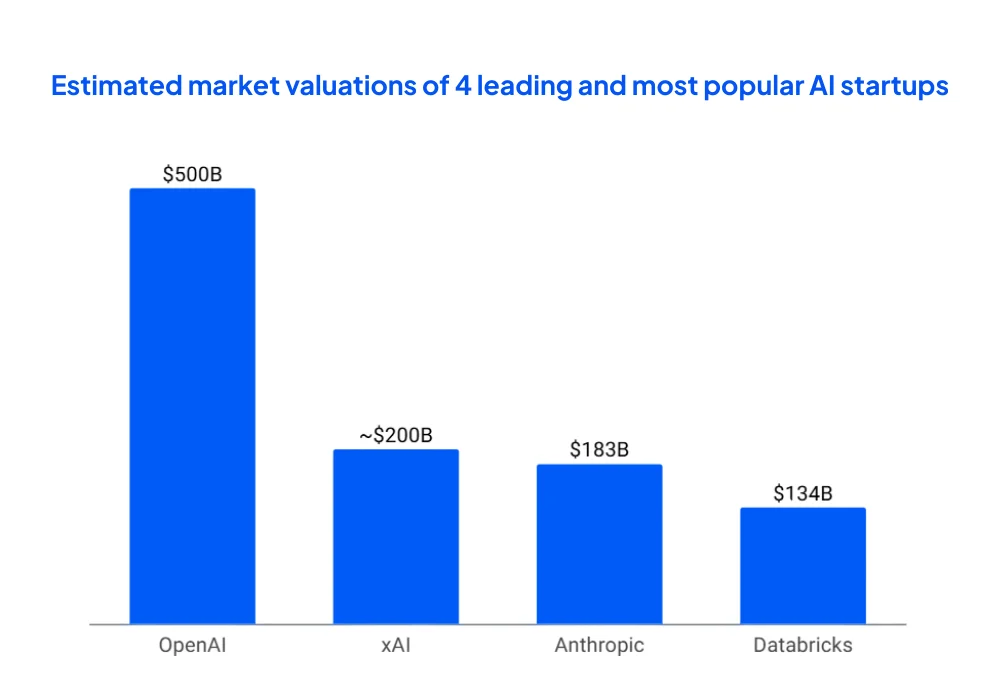
The hottest AI startups of 2026 are building autonomous agents and vertical AI platforms, with OpenAI ($500B), xAI ($200B+), Anthropic ($183B), and Databricks ($134B) dominating, while fastest growing AI Startups like Anysphere, Cognition AI, and Harvey are scaling from zero to unicorn status.
Top 5 Leading & Highly Funded AI Startups:
- OpenAI: Frontier AI models, $500B valuation
- Anthropic: Safety-focused AI, $183B, $13B Series F
- xAI: AGI ambitions, $200B+, $20B Jan 2026
- Databricks: Enterprise AI platform, $134B, $4.8B ARR
- Anysphere (Cursor): AI coding assistant, $29.3B, $1B ARR
Other Hot Startups:
- AI Agents & Infrastructure: Cognition AI (autonomous coding)
- Enterprise & Productivity: Harvey (legal AI), Glean (enterprise search)
- Creative & Media AI: Runway (video generation), Hugging Face (open-source models)
- Healthcare: Ambience Healthcare (clinical AI)
- Developer Tools: Replicate (model hosting), Together AI (AI orchestration)
Key Trends & Sectors:
- Autonomous AI Agents: Moving beyond chatbots to action-taking systems, 41% CAGR, 40%+ of enterprise budgets.
- Enterprise & Vertical AI: Industry-specific platforms for healthcare, legal, and enterprise workflows dominate 40%+ of funding
- Foundation Models & Infrastructure: Companies racing to build next-gen LLMs and deployment infrastructure, $80B+ invested in 2025
- Developer Tools: AI coding tools growing fastest, representing 20% of new startups with rapid ARR scaling
- AI Safety: Interpretable and responsible AI development becoming table stakes, led by Anthropic and SSI
For a deeper breakdown of Most Popular AI Startups, Fastest Growing AI Startups, Most Promising AI Startups, and Emerging AI Startups, continue reading below.
85 Hottest AI Startups [2026 Updated]
Here are 85 hottest AI startups in 2026 that investors are watching closely for rapid growth and long-term impact.
Most Popular AI Startups 2026 (100B+ Valuation)
The undisputed titans reshaping entire industries with frontier AI.
Creating safe and beneficial artificial intelligence for all humanity
📍 Location: San Francisco, California, USA
💰 Valuation: $500 billion (October 2025, via secondary share sale reported by Reuters)
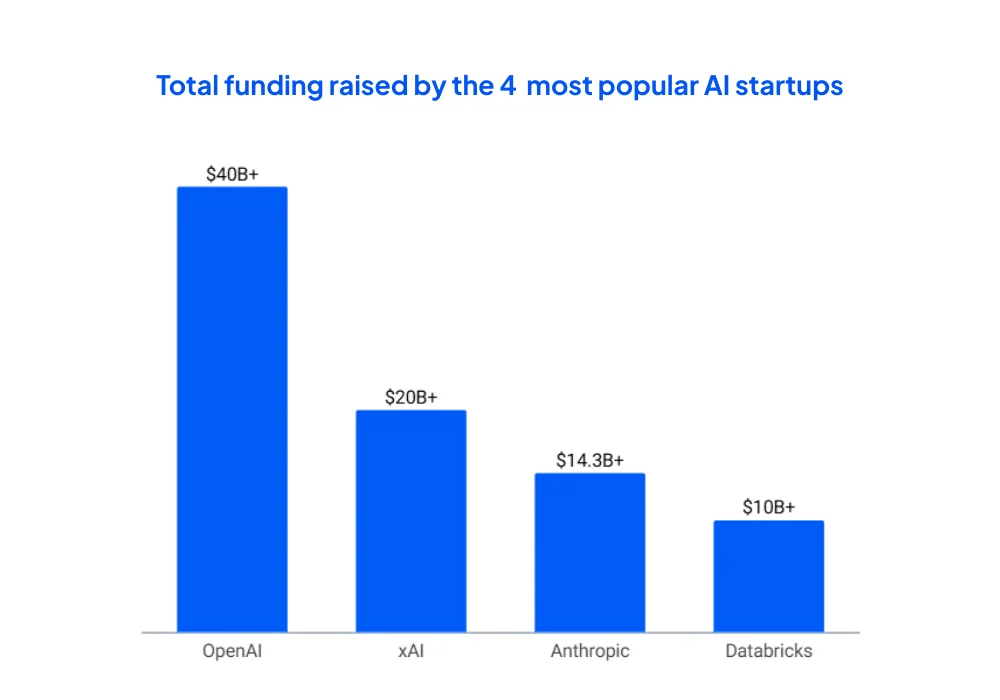
💵 Total Funding: $40B+ (including a $40B round in March 2025 at a $300B post-money valuation, confirmed by OpenAI)
👥 Employees: 4,500–8,000 (range reported by PitchBook)
🏁 Founded: 2015
Why they’re dominating 2026:
OpenAI raised $40 billion at a $300 billion post-money valuation in March 2025 and later reached a $500 billion valuation by October through secondary share sales.
The company projects annual recurring revenue growth from $6 billion to $20 billion by 2026, according to Forbes. ChatGPT continues to dominate consumer AI globally while enterprise adoption accelerates across Fortune 500 companies.
👥 Who Uses It: Microsoft, Salesforce, Stripe, Shopify, Morgan Stanley, PwC, Khan Academy
🔑 Key Investors: Microsoft, Thrive Capital, Nvidia, SoftBank, Khosla Ventures, Tiger Global
Building AI to understand the universe
📍 Location: San Francisco Bay Area & Palo Alto, California, USA
💰 Valuation: ~$200 billion (estimated based on January 2026 reports by CNBC)
💵 Total Funding: $20B+ (including a $20B round in January 2026 from Nvidia, Cisco, and Fidelity)
👥 Employees: 200+ (rapidly expanding)
🏁 Founded: 2023
Why they’re one of the hottest:
Elon Musk’s xAI raised $20 billion in January 2026 from Nvidia, Cisco, and Fidelity, signaling massive confidence in the company’s AGI ambitions. Musk reportedly told employees that xAI could achieve AGI as early as 2026. The company is also expanding infrastructure and leasing additional office space near Tesla’s Palo Alto campus.
👥 Who Uses It: Tesla (internal), X/Twitter integration, early enterprise beta users (not publicly disclosed)
🔑 Key Investors: Nvidia, Cisco, Fidelity, Sequoia Capital, Andreessen Horowitz, Valor Equity Partners
Building reliable, interpretable, and steerable AI systems
📍 Location: San Francisco, California, USA
💰 Valuation: $183 billion
💵 Total Funding: $14.3B+ (including a $13B Series F in September 2025, confirmed by Anthropic)
👥 Employees: 2,300–3,000 (reported by TrueUp)
🏁 Founded: 2021
Why they’re a top contender:
Anthropic’s $13B Series F round at a $183B valuation was the largest AI funding round of 2025. Founded by former OpenAI executives, the company’s Claude assistant emphasizes safety and interpretability. Despite facing copyright lawsuits alongside OpenAI, Anthropic continues rapid enterprise adoption.
👥 Who Uses It: Notion, Quora (Poe), DuckDuckGo, Zoom, Boston Consulting Group, Bridgewater Associates
🔑 Key Investors: Google, Menlo Ventures, Spark Capital, Salesforce Ventures, Zoom Ventures
Unified data and AI platform for the enterprise
📍 Location: San Francisco, California, USA
💰 Valuation: $134 billion (December 2025, confirmed by Databricks)
💵 Total Funding: $10B+ (including a $4B Series L in December 2025, reported by CNBC)
👥 Employees: 8,000+
🏁 Founded: 2013
Why they’re dominating enterprise AI:
Databricks surpassed a $4.8B revenue run rate with over 55% year-over-year growth. The $4B Series L at a $134B valuation – up from $100B just months earlier – demonstrates unstoppable momentum in enterprise data intelligence.
👥 Who Uses It: Shell, Comcast, Condé Nast, H&M, Nationwide, over 10,000+ enterprise customers
🔑 Key Investors: Andreessen Horowitz, Nvidia, General Catalyst, Insight Partners, Microsoft, Salesforce Ventures
💡 What These 4 Giants Have in Common:
Notice a pattern? All four raised mega-rounds in 2025-2026 ($4B–$40B). Why? Enterprise AI isn’t experimental anymore – it’s mission-critical infrastructure. Companies are betting billions that AI will automate 30-50% of knowledge work by 2027.
🔥 Hot Take: Which most popular AI Startups will IPO first? OpenAI, xAI, Anthropic, or Databricks?
Fastest Growing AI Startups 2026 (10B–100B Valuation)
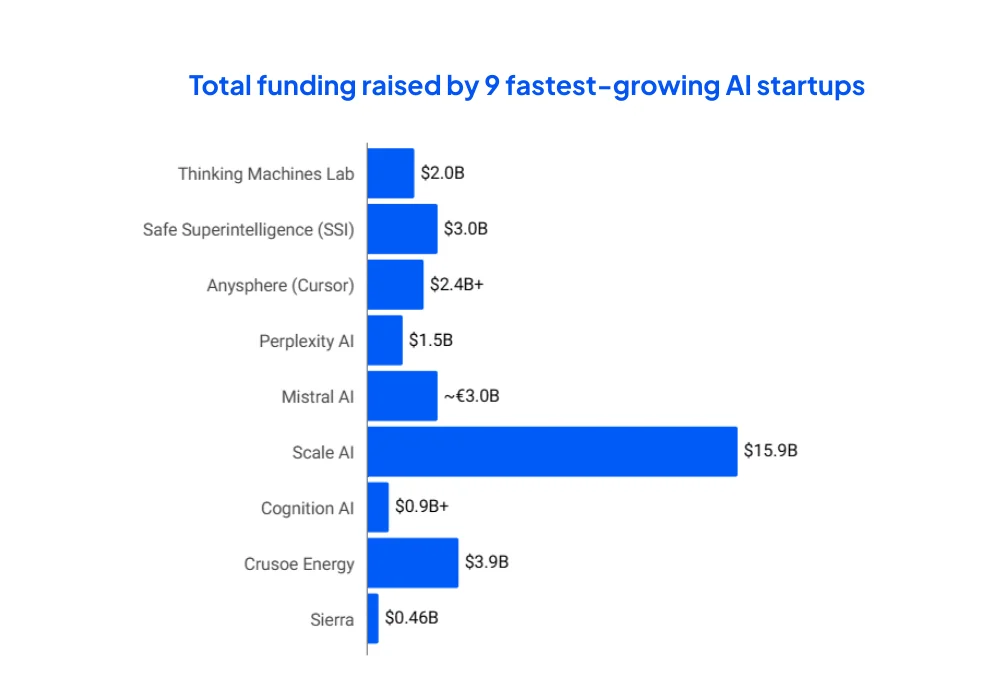
Many of these companies are growing faster than any previous generation of Tech Startups, reaching multi-billion-dollar valuations in under three years, while increased competition inside AI search ecosystems is driving demand for generative engine optimization agencies that help brands rank across AI-powered answer engines.
Building broadly capable AI systems
📍 Location: San Francisco, California, USA
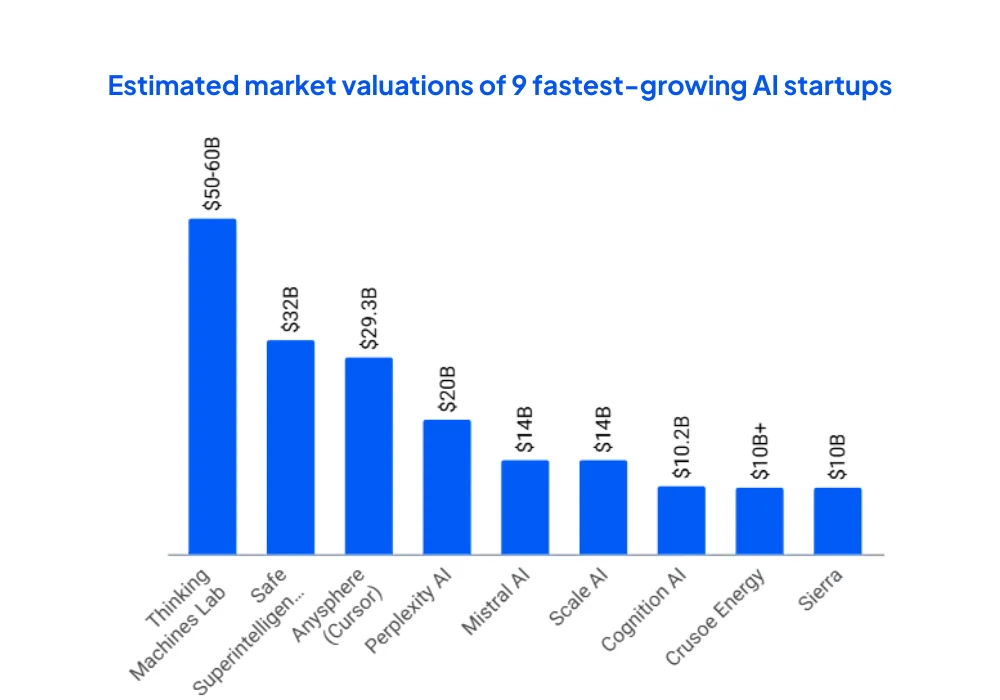
💰 Valuation: $50B–$60B (in funding talks as of November 2025, reported by Bloomberg)
💵 Total Funding: $2B (seed round in July 2025 at a $12B valuation)
👥 Employees: 100+ (rapidly growing)
🏁 Founded: February 2025
Why they’re the fastest riser:
Founded by former OpenAI CTO Mira Murati, Thinking Machines Lab raised a historic $2B seed round at a $12B valuation in July 2025. Just months later, the company entered talks to quadruple its valuation to $50B–$60B.
👥 Who Uses It: Pre-product (stealth mode); no public customers yet
🔑 Key Investors: Andreessen Horowitz, Nvidia, AMD, Cisco, Jane Street Capital
Developing safe superintelligence
📍 Location: Palo Alto, California, USA & Tel Aviv, Israel
💰 Valuation: $32 billion (April 2025, reported by TechCrunch)
💵 Total Funding: $3B (including a $2B round in April 2025 at a $32B valuation)
👥 Employees: 50+ (stealth mode)
🏁 Founded: 2024
Why they’re building the future:
Co-founded by former OpenAI chief scientist Ilya Sutskever, SSI raised $2B at a $32B valuation led by Alphabet. Despite having no product or revenue, the round reflects investor confidence in Sutskever’s mission to build safe superintelligence.
👥 Who Uses It: Pre-product (research phase); no public customers yet
🔑 Key Investors: Alphabet (Google), Nvidia, NFDG, Greenoaks Capital, CoreNest Capital, Datapower Ventures
The AI-native code editor for superhuman productivity
📍 Location: San Francisco, California, USA
💰 Valuation: $29.3 billion (November 2025, reported by TechCrunch)
💵 Total Funding: $2.4B+ (including $2.3B Series D in Nov 2025)
👥 Employees: 300+ (reported by CNBC)
🏁 Founded: 2022
Why they’re the fastest-growing SaaS ever:
Cursor crossed $1B in annualized revenue just 24 months after launch. ARR scaled from $100M in January 2025 to $500M by June and $1B+ by November. The $2.3B Series D just five months after Series C reflects unprecedented developer adoption.
👥 Who Uses It: 500,000+ developers including teams at Perplexity, Midjourney, Replicate, Scale AI
🔑 Key Investors: Thrive Capital, Andreessen Horowitz, Benchmark, Index Ventures, Sequoia Capital
🧑💻 Developer Poll: Have you tried Cursor? If not, what’s stopping you?
AI-powered search engine
📍 Location: San Francisco, California, USA
💰 Valuation: $20 billion (September 2025, reported by TechCrunch)
💵 Total Funding: $1.5B (Series D: $200M in Sep 2025)
👥 Employees: 1,600 (reported by TrueUp)
🏁 Founded: 2022
Why they’re redefining search:
Perplexity’s valuation surged from $520M in early 2024 to $20B by September 2025. Despite copyright disputes and media scrutiny, user growth and investor confidence continue accelerating.
👥 Who Uses It: 100M+ monthly users; adopted by developers, researchers, and knowledge workers globally
🔑 Key Investors: IVP, Jeff Bezos, Nvidia, Bessemer Venture Partners
Open-source foundation models from Europe
📍 Location: Paris, France
💰 Valuation: $14 billion (September 2025, reported by CNBC)
💵 Total Funding: ~€3B including €2B Series C led by ASML
👥 Employees: 500+ (reported by Wikipedia)
🏁 Founded: 2023
Why they’re Europe’s AI champion:
Mistral doubled valuation from $6B to $14B in under a year following ASML’s €2B investment. The company builds open-source models competing with OpenAI and Anthropic, anchoring Europe’s AI sovereignty.
👥 Who Uses It: Orange, BNP Paribas, Renault, Deutsche Telekom, European Commission
🔑 Key Investors: ASML, Andreessen Horowitz, Lightspeed, General Catalyst, Nvidia
Training data and evaluation for frontier AI
📍 Location: San Francisco, California, USA
💰 Valuation: $14 billion (June 2025, confirmed by Y Combinator)
💵 Total Funding: $15.9B (including $14.3B Series G in Jun 2025)
👥 Employees: 1,000+
🏁 Founded: 2016
Why they’re critical AI infrastructure:
Scale AI raised one of 2025’s largest rounds and is projected to reach $2B in revenue. The company supplies training data and evaluation to OpenAI, Meta, Google, and U.S. defense agencies.
👥 Who Uses It: OpenAI, Meta, Google, U.S. Department of Defense, General Motors, Flexport
🔑 Key Investors: Accel, Index Ventures, Tiger Global, Founders Fund, Nvidia
Autonomous AI software engineers
📍 Location: San Francisco, California, USA
💰 Valuation: $10.2 billion (September 2025, reported by TechCrunch)
💵 Total Funding: $900M+
👥 Employees: 200+
🏁 Founded: 2023
Why they’re leading AI coding:
Cognition’s Devin agent grew from $1M ARR in September 2024 to $73M ARR by June 2025. The company’s acquisition of Windsurf and rapid ARR growth signal strong product–market fit in autonomous software engineering.
👥 Who Uses It: Used by development teams at Fortune 500 companies and startups (specific customers not publicly disclosed)
🔑 Key Investors: Founders Fund, Index Ventures, Khosla Ventures, Elad Gil
Energy-first AI infrastructure company
📍 Location: San Francisco, California, USA
💰 Valuation: $10B+ (October 2025, reported by Reuters)
💵 Total Funding: $3.9B (Series E: $1.375B in Oct 2025)
👥 Employees: 1000+
🏁 Founded: 2018
Why they’re powering AI infrastructure:
Crusoe tripled valuation after raising $1.375B led by Mubadala. The company builds energy-efficient AI data centers using stranded natural gas and is constructing a 1.2GW AI campus.
👥 Who Uses It: OpenAI, Oracle, Dell Technologies (data center infrastructure partnerships)
🔑 Key Investors: Nvidia, Fidelity, Founders Fund, Valor Equity, Mubadala
Conversational AI agents for enterprise customer service
📍 Location: San Francisco, California, USA
💰 Valuation: $10 billion (September 2025, reported by CNBC)
💵 Total Funding: $460M (including a $350M round in September 2025)
👥 Employees: 150+
🏁 Founded: 2023
Why they’re the enterprise darling:
Co-founded by former Salesforce co-CEO Bret Taylor and ex-Google VP Clay Bavor, Sierra reached $100M ARR in under two years. The $350M round at a $10B valuation backs Sierra’s conversational AI agents for large enterprise customer service teams.
👥 Who Uses It: WeightWatchers, SiriusXM, OluKai, ADT
🔑 Key Investors: Sequoia Capital, Benchmark, ICONIQ Growth, Thrive Capital, Salesforce Ventures
📊 A Trend We’re Seeing Across Fastest Growing AI Startups:
Notice how 7 out of 9 companies were founded in 2022-2025? The “Fastest Growing AI Startups” category is dominated by recent founders who left OpenAI, Google, or Salesforce to start their own ventures. This is the “Great Unbundling of Big Tech AI” happening in real time.
🎤 Your Take: Which Fastest Growing AI Startups ($10B-$100B) will hit $100B first? Anysphere, Perplexity, Mistral, or Sierra?
Did you know?
Most Promising AI Startups 2026 (1B–10B Valuation)
Category leaders dominating vertical AI markets.
Wafer-scale AI chips for frontier model training
📍 Location: Sunnyvale, California, USA
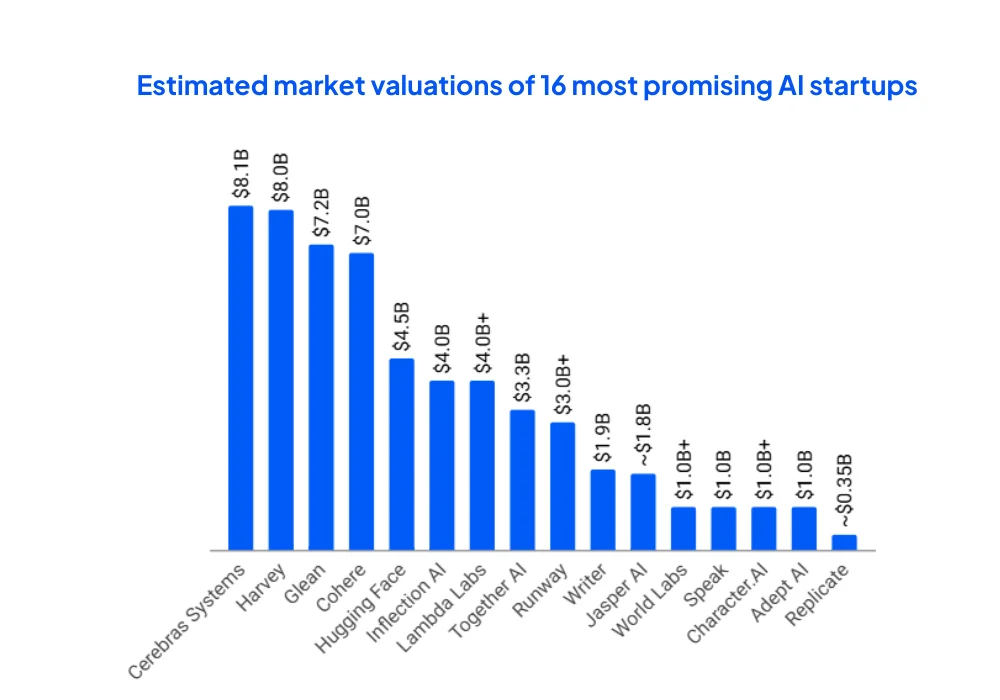
💰 Valuation: $8.1 billion (September 2025, reported by CNBC)
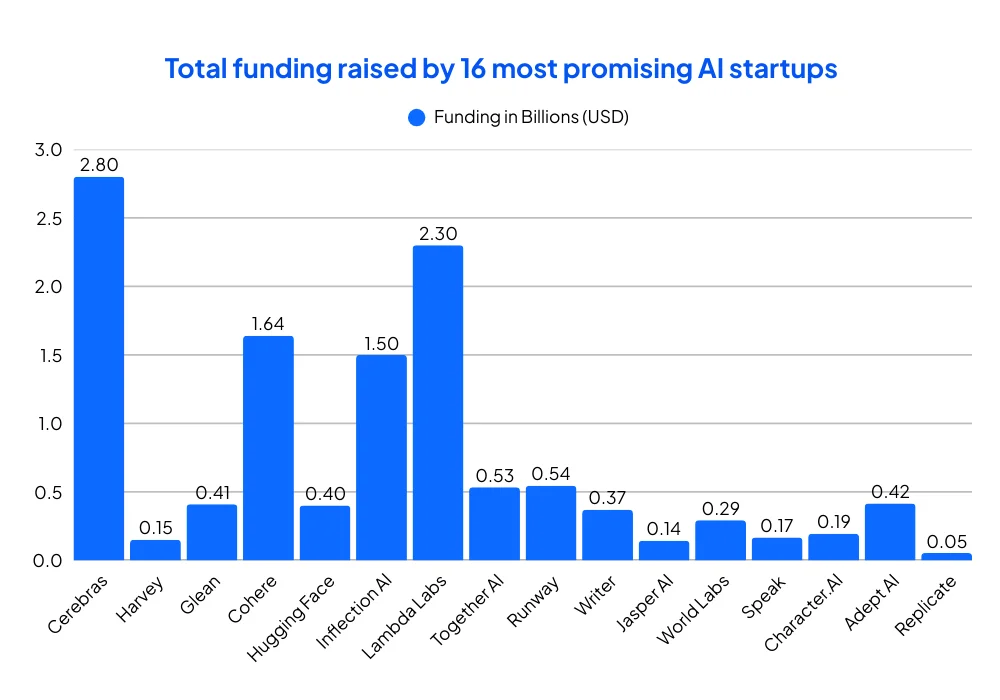
💵 Total Funding: $2.8B+ (including $1.1B Series G in Sep 2025)
👥 Employees: 600+
🏁 Founded: 2016
Why they’re challenging Nvidia:
Cerebras raised $1.1B at an $8.1B valuation and later delayed its IPO to pursue a stronger 2026 listing. The company builds the world’s largest AI chips, offering an alternative to Nvidia for large-scale model training.
👥 Who Uses It: Mayo Clinic, GSK (pharmaceuticals), AstraZeneca, Argonne National Laboratory
🔑 Key Investors: Fidelity Management, Abu Dhabi Growth Fund, Alpha Wave Ventures, Coatue Management
AI copilots for legal professionals
📍 Location: San Francisco, California, USA
💰 Valuation: $8 billion (December 2025, reported by TechCrunch)
💵 Total Funding: $150M+
👥 Employees: 200+
🏁 Founded: 2022
Why they’re transforming legal tech:
Harvey raised $150M led by Andreessen Horowitz at an $8B valuation. The platform helps lawyers with research, drafting, and analysis, becoming the highest-valued legal AI startup to date.
👥 Who Uses It: Allen & Overy, PwC Legal, Macfarlanes, O’Melveny & Myers, 10,000+ legal professionals
🔑 Key Investors: Andreessen Horowitz, Sequoia Capital, Kleiner Perkins, Conviction, Elad Gil
AI-powered enterprise search and work assistant
📍 Location: Palo Alto, California, USA
💰 Valuation: $7.2 billion (December 2025, reported by Fortune)
💵 Total Funding: $410M (Series F: $150M in Dec 2025)
👥 Employees: 201–500
🏁 Founded: 2019
Why they’re the enterprise search leader:
Glean doubled ARR from $100M to $200M in just nine months. The Series F round at a $7.2B valuation backs its AI platform connecting enterprise data and workflows.
👥 Who Uses It: Databricks, Confluent, Reddit, Sony Electronics, Duolingo, 1,000+ enterprises
🔑 Key Investors: Sequoia Capital, Kleiner Perkins, Lightspeed, Altimeter Capital, DST Global
Enterprise-focused foundation models and agentic AI
📍 Location: Toronto, Ontario, Canada
💰 Valuation: $7 billion (September 2025, reported by TechCrunch)
💵 Total Funding: $1.64B
👥 Employees: 2,800+ (reported by PitchBook)
🏁 Founded: 2019
Why they’re Canada’s AI unicorn:
Cohere reached $100M ARR in 2025. Founded by Google Brain alumni, Cohere focuses on enterprise and sovereign AI solutions rather than consumer chatbots.
👥 Who Uses It: Oracle, Salesforce, LivePerson, McKinsey & Company
🔑 Key Investors: Nvidia, Radical Ventures, Inovia Capital, Salesforce Ventures, BDC
The open-source hub for AI models and datasets
📍 Location: New York, New York, USA & Paris, France
💰 Valuation: $4.5 billion (reported by Sacra)
💵 Total Funding: $400M
👥 Employees: 400+
🏁 Founded: 2016
Why they’re the GitHub of AI:
Hugging Face hosts over 500,000 models and 100,000 datasets, becoming the default open-source platform for AI development. The platform is used by Google, Meta, Microsoft, and Amazon to build and deploy AI systems.
👥 Who Uses It: Google, Meta, Microsoft, Amazon, Bloomberg, Grammarly, 50,000+ organizations
🔑 Key Investors: Salesforce Ventures, Intel Capital, AMD, Google, Nvidia, Amazon
Highly personalized conversational AI assistants
📍 Location: Palo Alto, California, USA
💰 Valuation: $4 billion (reported by TrueUp)
💵 Total Funding: $1.5B+ (including $1.3B Series B)
👥 Employees: ~60 (reported by TrueUp)
🏁 Founded: 2022
Why they’re building massive infrastructure:
Co-founded by Reid Hoffman and Mustafa Suleyman, Inflection raised $1.3B from Microsoft, Bill Gates, and Nvidia to build one of the world’s largest AI clusters. The company focuses on deeply personalized AI assistants at unprecedented scale.
👥 Who Uses It: 6M+ registered users for Pi assistant (consumer-focused)
🔑 Key Investors: Microsoft, Reid Hoffman, Bill Gates, Nvidia, Eric Schmidt
GPU cloud infrastructure for AI training and inference
📍 Location: San Francisco, California, USA
💰 Valuation: $4B+ (estimated, reported by SalesTools)
💵 Total Funding: $2.3B (Series E: $1.5B in Nov 2025)
👥 Employees: ~600 (reported by TrueUp)
🏁 Founded: 2012
Why they’re the AI cloud alternative:
Lambda raised $1.5B after securing a multibillion-dollar Microsoft deal. The platform positions itself as an alternative to hyperscalers with Nvidia-backed GPU infrastructure.
👥 Who Uses It: Microsoft, Intel, Raytheon, researchers and AI startups globally
🔑 Key Investors: TWG Global, Nvidia, Andrej Karpathy, ARK Invest
Open and custom model cloud platform
📍 Location: San Francisco, California, USA
💰 Valuation: $3.3 billion (February 2025, reported by Crunchbase)
💵 Total Funding: $534M
👥 Employees: ~160 (reported by Yahoo Finance)
🏁 Founded: 2022
Why they’re disrupting cloud AI:
Together AI doubled valuation with Nvidia-backed funding. The platform enables developers to deploy open and custom models without vendor lock-in.
👥 Who Uses It: Hugging Face, Character.AI, LAION, EleutherAI, 10,000+ developers
🔑 Key Investors: General Catalyst, Nvidia, Coatue, Salesforce Ventures
AI video generation for creators and studios
📍 Location: New York, New York, USA
💰 Valuation: $3B+ (April 2025, reported by Wikipedia)
💵 Total Funding: $544M
👥 Employees: 200+
🏁 Founded: 2018
Why they’re leading creator AI:
Runway raised $308M Series D led by General Atlantic. Its Gen-3 model powers Hollywood workflows and creator platforms globally.
👥 Who Uses It: A24 Films, The New York Times, VICE Media, 10M+ creators
🔑 Key Investors: General Atlantic, Fidelity, Nvidia, Google
Enterprise-grade generative AI for content and workflows
📍 Location: San Francisco, California, USA
💰 Valuation: $1.9 billion (reported by Crunchbase)
💵 Total Funding: $369M
👥 Employees: 250+
🏁 Founded: 2020
Why enterprise chooses them:
Writer reached unicorn status with a $200M Series C. The platform differentiates with governance, security, and compliance for Fortune 500 adoption.
👥 Who Uses It: Accenture, Intuit, Uber, L’Oréal, Spotify, Deloitte
🔑 Key Investors: Premji Invest, ICONIQ Growth, Insight Partners
AI content generation for marketing teams
📍 Location: Austin, Texas, USA
💰 Valuation: ~$1.8B (mid-2026 estimate, reported by Fueler)
💵 Total Funding: $143M
👥 Employees: 500+
🏁 Founded: 2021
Why they’re the content AI leader:
Jasper surpassed 1.8M monthly users and reached unicorn status after a $125M raise. The platform focuses on marketing-first AI workflows.
👥 Who Uses It: IBM, Anthropic, Logitech, Canva, Zendesk, 100,000+ teams
🔑 Key Investors: Insight Partners, Coatue, Bessemer
Spatial intelligence and 3D world models
📍 Location: San Francisco, California, USA
💰 Valuation: $1B+ (reported by TechCrunch)
💵 Total Funding: $291.5M
👥 Employees: ~30
🏁 Founded: 2024
Why they’re building spatial intelligence:
Founded by Fei-Fei Li, World Labs focuses on embodied AI and 3D world modeling. Backed by top AI researchers and funds.
👥 Who Uses It: Pre-product (research phase); no public customers yet
🔑 Key Investors: Andreessen Horowitz, NEA, Radical Ventures
AI-powered language learning through conversation
📍 Location: San Francisco, California, USA
💰 Valuation: $1 billion (December 2024, reported by TechCrunch)
💵 Total Funding: $165.8M
👥 Employees: 253
🏁 Founded: 2016
Why they’re revolutionizing language learning:
Speak reached $100M revenue with ~10M users. The platform leverages conversational AI for immersive language education.
👥 Who Uses It: 10M+ app downloads; 500,000+ paying subscribers across Korea, Japan, US
🔑 Key Investors: Accel, OpenAI Startup Fund, Y Combinator
Entertainment-focused conversational AI
📍 Location: Menlo Park, California, USA
💰 Valuation: $1B+ (reported by Tracxn)
💵 Total Funding: $193M
👥 Employees: 100+
🏁 Founded: 2021
Why they’re navigating challenges:
Character.AI surpassed 20M active users but faces monetization and valuation pressure. Google invested $2.7B via a reverse acquihire while the platform continues operating.
👥 Who Uses It: 20M+ monthly active users (consumer entertainment platform)
🔑 Key Investors: Andreessen Horowitz, Google, Nat Friedman
Agentic AI for autonomous task execution
📍 Location: San Francisco, California, USA
💰 Valuation: $1 billion (reported by TexAu)
💵 Total Funding: $415M
👥 Employees: 60–120
🏁 Founded: 2022
Why they’re pioneering agentic AI:
Adept raised $415M to build agents that complete complex software tasks. Amazon hired the founders while Adept continues operating independently.
👥 Who Uses It: Limited public customer data (stealth/beta phase); focus on enterprise pilots
🔑 Key Investors: General Catalyst, Greylock, Spark Capital
API platform for running open-source AI models
📍 Location: San Francisco, California, USA
💰 Valuation: ~$350M (estimated, reported by SalesTools)
💵 Total Funding: $52.5M
👥 Employees: 50+
🏁 Founded: 2019
Why they’re democratizing AI models:
Replicate enables developers to run open-source models via API without managing infrastructure. The company raised $40M Series B led by Andreessen Horowitz.
👥 Who Uses It: Photoroom, DALL-E Mini (Craiyon), Copy.ai, Descript, 10,000+ developers
🔑 Key Investors: Andreessen Horowitz, Y Combinator, Sequoia Capital
🔥 Why the Most Promising AI Startups ($1B–$10B) Category Is Suddenly Exploding:
Vertical AI is winning because general-purpose tools can’t compete on depth, a pattern we’ve also seen across SaaS startups focused on industry-specific solutions. Harvey knows legal workflows. Glean understands enterprise search. Runway masters video creation.
These startups captured $15B+ in funding in 2025 alone because investors realize: The future isn’t one AI to rule them all – it’s specialized AI agents for every job function. But before reaching this stage, founders should use a startup checklist to cover key steps from ideation to early traction.
💬 Your Pick: Which $1B-$10B startup will 10x first? Harvey (legal), Glean (search), or Runway (video)?
Emerging AI Startups 2026 (<1B or Undisclosed Valuation)
The next generation of AI startups to watch in 2026.
AI operating system for healthcare workflows
📍 Location: San Francisco Bay Area, California, USA
💵 Total Funding: $243M (Series C, 2025)
💰 Valuation: Not publicly disclosed
👥 Employees: 101–200
🏁 Founded: 2020
Why they’re emerging:
Ambience Healthcare builds an AI-powered operating system for clinical documentation, coding, and workflows, helping reduce administrative burden on clinicians.
👥 Who Uses It: UCSF Health, Memorial Hermann, John Muir Health, several hospital systems
🔑 Key Investors: Andreessen Horowitz, Optum Ventures, HTGF
AI meeting assistant for productivity and sales
📍 Location: Not publicly specified
💵 Total Funding: $17M (Series A, 2024)
💰 Valuation: Not publicly disclosed
👥 Employees: ~171
🏁 Founded: 2020
Why they’re growing:
Fathom.ai provides AI-powered meeting summaries and insights, gaining strong traction across sales, customer success, and productivity teams.
👥 Who Uses It: 200,000+ users across sales and customer success teams globally
🔑 Key Investors: Not publicly disclosed
Early-stage AI productivity assistant
📍 Location: Not publicly specified
💵 Total Funding: Not disclosed
💰 Valuation: Not publicly disclosed
👥 Employees: Early-stage team
🏁 Founded: Recent
Why they’re emerging:
Mujo AI is developing a productivity-focused AI assistant in early stages, with limited public information available.
👥 Who Uses It: Limited public data (early beta users)
🔑 Key Investors: Not publicly disclosed
🌐 Website
AI voice synthesis platform
📍 Location: Not publicly specified
💵 Total Funding: Not disclosed
💰 Valuation: Not publicly disclosed
👥 Employees: Early-stage team
🏁 Founded: Recent
Why they’re emerging:
Noiz AI is building an AI-driven voice synthesis platform, currently in early development.
👥 Who Uses It: Limited public data (beta users)
🔑 Key Investors: Not publicly disclosed
🌐 Website
AI-powered note-taking tool
📍 Location: Not publicly specified
💵 Total Funding: Unfunded (bootstrapped)
💰 Valuation: Not publicly disclosed
👥 Employees: Small team
🏁 Founded: 2023
Why they’re growing fast:
NoteGPT is a bootstrapped AI note-taking product experiencing rapid user growth since launch.
👥 Who Uses It: 500,000+ users (students, researchers, professionals)
🔑 Key Investors: None (bootstrapped)
🌐 Website
Privacy-first AI chat platform
📍 Location: Singapore
💵 Total Funding: Unfunded
💰 Valuation: Not publicly disclosed
👥 Employees: 2–10
🏁 Founded: Recent
Why they’re emerging:
Okara focuses on privacy-first AI chat, targeting Singapore and broader Asian markets.
👥 Who Uses It: Early adopters in Singapore and Asia
🔑 Key Investors: None yet
🌐 Website
Early-stage browser productivity tool
📍 Location: Not publicly specified
💵 Total Funding: $220K (bootstrapped)
💰 Valuation: Not publicly disclosed
👥 Employees: ~2
🏁 Founded: Recent
Why they’re starting:
Opttab is an early-stage browser productivity tool generating early revenue while remaining fully bootstrapped.
👥 Who Uses It: Early beta users
🔑 Key Investors: None (bootstrapped)
🌐 Website
AI gaming assistant
📍 Location: Not publicly specified
💵 Total Funding: Not disclosed
💰 Valuation: Not publicly disclosed
👥 Employees: Early-stage team
🏁 Founded: Recent
Why they’re emerging:
Overguide is developing an AI-powered assistant for gamers, currently in early development stages.
👥 Who Uses It: Early gaming community beta users
🔑 Key Investors: Not publicly disclosed
🌐 Website
Early-stage AI workspace platform
📍 Location: Not publicly specified
💵 Total Funding: Unfunded
💰 Valuation: Not publicly disclosed
👥 Employees: Small team
🏁 Founded: Recent
Why they’re starting:
Papr.ai is building an AI-powered workspace platform and remains in very early stages with no external funding.
👥 Who Uses It: Early beta testers
🔑 Key Investors: None yet
🌐 Website
AI-powered research and academic platform
📍 Location: Not publicly specified
💵 Total Funding: Minimal funding disclosed
💰 Valuation: Not publicly disclosed
👥 Employees: 11–50
🏁 Founded: 2016
Why they’re growing:
SciSpace helps researchers analyze academic papers using AI-powered explanations, citations, and summaries.
👥 Who Uses It: 1M+ researchers and students globally
🔑 Key Investors: Not publicly disclosed
Personal knowledge management AI tool
📍 Location: Not publicly specified
💵 Total Funding: Not disclosed
💰 Valuation: Not publicly disclosed
👥 Employees: Early-stage team
🏁 Founded: Recent
Why they’re emerging:
Shadow is developing a personal knowledge management AI tool, currently in early development with limited public information.
👥 Who Uses It: Early adopters (beta phase)
🔑 Key Investors: Not publicly disclosed
🌐 Website
AI meeting transcription and summaries for productivity teams
📍 Location: Sydney, Australia
💰 Valuation: Not publicly disclosed
💵 Total Funding: $12.77M (including $10M Series A in August 2024, reported by PitchBook)
👥 Employees: 23 (reported by PitchBook)
🏁 Founded: 2020
Why they’re growing:
Tactiq provides bot-free meeting transcription for Zoom, Google Meet, and Microsoft Teams, processing over 1 million meetings weekly. The company reached $1.6M revenue with 6,000+ customers in 2024 and completed a $10M Series A in August 2024. Tactiq differentiates through real-time AI summaries, action items, and workflow automations without requiring an AI bot to join meetings.
👥 Who Uses It: 10,000+ companies including productivity and sales teams; 1M+ meetings transcribed weekly
🔑 Key Investors: Flashpoint, Mucker Capital, Antler
Cloud-based mobile app testing on real devices
📍 Location: India
💰 Valuation: Not publicly disclosed
💵 Total Funding: Bootstrapped (no external funding, confirmed by Tracxn)
👥 Employees: Small team (2-10 estimated)
🏁 Founded: 2025
Why they’re emerging:
NativeBridge (formerly Autoflow) revolutionizes mobile development by bringing native apps to any browser with a single magic link. The platform provides instant access to 3,000+ real iOS and Android devices for testing, demos, and PR reviews without physical hardware. Despite being bootstrapped, NativeBridge has gained organic traction from developers across 110+ countries.
👥 Who Uses It: Developers and QA teams across 110+ countries; focused on mobile app developers, founders, and enterprise testing teams
🔑 Key Investors: Bootstrapped (no external funding)
🌐 Website | 💼 LinkedIn | 💼 For Founders
Visual workspace for AI-assisted thinking and knowledge management
📍 Location: Not publicly specified
💰 Valuation: Not publicly disclosed
💵 Total Funding: Bootstrapped (no external funding)
👥 Employees: Solo founder / small team (1-5 estimated)
🏁 Founded: 2024-2025 (recent launch)
Why they’re emerging:
Dessix.io creates a visual workspace where humans and AI collaborate through shared understanding. Unlike traditional note-taking tools, Dessix dynamically organizes information and builds contextual environments around user focus, inspired by cognitive psychology principles.
The platform supports multiple AI models including Gemini, OpenAI, Claude, Qwen, DeepSeek, and Grok, with all data stored locally in-browser for privacy. Featured in PKM Weekly as an emerging AI-based note-taking app.
👥 Who Uses It: Knowledge workers, researchers, content creators, consultants, analysts, and lifelong learners focused on AI-assisted thinking
🔑 Key Investors: Bootstrapped (no external funding)
AI-powered to-do list that turns web context into managed tasks
📍 Location: South Korea
💰 Valuation: Not publicly disclosed
💵 Total Funding: Bootstrapped (no external funding)
👥 Employees: Small team (2-5 estimated)
🏁 Founded: January 2026
Why they’re emerging:
2-b.ai is a browser-based AI task management tool that combines the structure of a to-do list with LLM intelligence. With a single drag, users can turn any web context from Gmail, Google Docs, Notion, or articles into an AI-assisted task that breaks down automatically.
The platform integrates with Google Calendar, uses GPAI-compliant AI models for security, and offers AI chat functionality to create, refine, and organize tasks effortlessly. Launched on Product Hunt in January 2026 with 416+ upvote points as “Todoist meets ChatGPT inside your browser.”
👥 Who Uses It: Knowledge workers, students, busy professionals managing multiple projects, productivity enthusiasts seeking AI-assisted task management
🔑 Key Investors: Bootstrapped (no external funding)
Natural language AI agent platform for autonomous workflow automation
📍 Location: Not publicly disclosed
💰 Valuation: Not publicly disclosed
💵 Total Funding: $3.4M (Seed round, 2024)
👥 Employees: 11-50 employees
🏁 Founded: 2023
Why they’re emerging:
Instruct enables anyone to build autonomous AI agents using plain English descriptions. Unlike traditional automation tools requiring technical expertise, Instruct allows users to describe tasks, connect apps, and watch AI agents execute work across multiple platforms.
Raised $3.4M from Lakestar and Creandum in 2024, launching publicly in October 2025. Instruct 2.5 introduces real-time iteration—users watch agents work, fix problems on the spot, and save successful tasks as recurring workflows with one message.
👥 Who Uses It: Sales teams, recruiters, operations managers, educators, businesses across marketing, finance, education seeking AI workflow automation
🔑 Key Investors: Lakestar, Creandum
🌐 Website | 💼 LinkedIn | 🚀 Product Hunt
AI data copilot that generates charts, metrics, and insights from databases
📍 Location: United States
💰 Valuation: Not publicly disclosed
💵 Total Funding: Backed by top investors (amount undisclosed)
👥 Employees: Small team (5-15 estimated)
🏁 Founded: 2024-2025
Why they’re emerging:
Livedocs transforms data analysis by combining CSV/database connectivity with an AI copilot that generates charts, metrics, and plain-English insights instantly—no setup required. The platform replaces traditional data tools like Jupyter, Hex, and Deepnote with a collaborative workspace featuring Python, SQL, DuckDB, and Polars support.
Users can ask questions in natural language instead of writing code, share insights as interactive apps rather than screenshots, and process large datasets with blazing-fast performance. Launched publicly in January 2026, Livedocs positions itself as “everything you need to analyze data in one place,” targeting data teams tired of stitching together multiple tools.
👥 Who Uses It: Data analysts, business intelligence teams, data scientists, product managers, and technical teams needing fast data analysis and visualization
🔑 Key Investors: Backed by leading investors (names undisclosed)
Spec-based AI coding platform for building production-ready web apps
📍 Location: United States
💰 Valuation: Not publicly disclosed
💵 Total Funding: Not publicly disclosed
👥 Employees: Small team (2-10 estimated)
🏁 Founded: 2025
Why they’re emerging:
Capacity.so introduces “Spec Coding”—a structured approach where founders define specifications first, then let AI build production-ready code. Unlike vibe coding, Capacity acts as an AI cofounder that understands your vision, writes maintainable code, and helps ship features faster.
The platform emphasizes precise output matching exact requirements, faster development with fewer iterations, and easy changes through spec updates. Featured on Product Hunt as a tool for solo founders and small teams, Capacity enables going from concept to production in hours instead of weeks, with better architecture and reduced risk through specification validation.
👥 Who Uses It: Solo founders, startup teams, indie hackers, non-technical entrepreneurs building SaaS products and web applications
🔑 Key Investors: Bootstrapped or early-stage (not disclosed)
🌐 Website | 🚀 Product Hunt
Autonomous AI Chief Marketing Officer for Meta and Google Ads
📍 Location: San Francisco, CA (AgentProd Inc.)
💰 Valuation: Not publicly disclosed
💵 Total Funding: Not publicly disclosed
👥 Employees: Small team (5-15 estimated)
🏁 Founded: 2024-2025
Why they’re emerging:
Muze AI replaces $10K-15K/month marketing agencies with a $999/month autonomous AI platform that creates, launches, and optimizes Meta and Google Ads end-to-end. Trained on $10M+ in actual ad spend and 19,000+ high-performing ads, Muze delivers an average 27% ROAS lift across campaigns.
The platform analyzes websites in 3 minutes, generates 5-10 ad variations per product, and auto-optimizes 24/7—pausing underperformers (ROAS < 2.5x) after 3 days, scaling winners by 20% when ROAS > 4.0x, and detecting creative fatigue 14 days before CTR drops.
With direct API integration to Meta/Google/Shopify and support for 95+ languages, Muze serves 200+ agencies and brands with white-label reporting and product-level ROAS tracking.
👥 Who Uses It: E-commerce brands, Shopify merchants, marketing agencies, performance marketers, DTC brands seeking automated ad management
🔑 Key Investors: Bootstrapped or early-stage (not disclosed)
All-in-one AI platform for creating anime, comics, and animated videos
📍 Location: Singapore
💰 Valuation: Not publicly disclosed
💵 Total Funding: Not publicly disclosed
👥 Employees: 10-50 estimated
🏁 Founded: 2024-2025
Why they’re emerging:
Elser AI is the world’s first all-in-one AI anime and movie generator, transforming text and images into complete animated videos with script, storyboarding, character creation, voiceover, and editing in a single platform. Founded by Phil Liu, CEO of Elser Global Pte. Ltd., the platform features 200+ templates, 40+ creation tools, and specialized models for anime, live action, and short dramas.
The platform generates anime shorts 40% smoother than traditional tools and supports over 10,000 creators and small studios. Launched globally in December 2025, Elser AI enables solo creators to produce high-quality original animation without large teams or expensive software, turning ideas into full production-ready videos in seconds.
👥 Who Uses It: Anime creators, content creators, storytellers, small animation studios, social media influencers, and fans creating original IP
🔑 Key Investors: Not publicly disclosed
🌐 Website | 🚀 Product Hunt | 📰 News
AI-powered spreadsheet with natural language agent for data analysis
📍 Location: United States
💰 Valuation: Not publicly disclosed
💵 Total Funding: Not publicly disclosed
👥 Employees: Small team (2-10 estimated)
🏁 Founded: 2024-2025
Why they’re emerging:
Pane is the first agentic spreadsheet where AI edits cells and formulas with human-level precision. Users can talk to their spreadsheet in natural language—sort, filter, calculate, and transform data with simple commands via the Pane Agent.
The platform combines traditional spreadsheet power with AI capabilities: full formula support (SUM, AVERAGE, VLOOKUP), CSV/Excel/PDF import, interactive charts (bar, line, pie, scatter), cloud sync, and auto-generated dashboards.
Featured on Product Hunt, Pane helps modern teams work faster and smarter by eliminating manual data manipulation and enabling instant visualization of insights through natural language commands.
👥 Who Uses It: Data analysts, business teams, operations managers, finance professionals, and teams needing fast spreadsheet analysis without complex formulas
🔑 Key Investors: Bootstrapped or early-stage (not disclosed)
🌐 Website | 🚀 Product Hunt
Visual password manager using images and 3D characters for authentication
📍 Location: United States
💰 Valuation: Not publicly disclosed
💵 Total Funding: Not publicly disclosed (3 patents granted)
👥 Employees: Small team (5-15 estimated)
🏁 Founded: 2022-2023
Why they’re emerging:
PicKey is the world’s first visual password manager that replaces master passwords with personal photographs combined with 3D animated collectables. Founded by Gaurav Upadhyay, CEO of Neural Heaven Inc., PicKey holds 3 patents for visual authentication technology.
The platform eliminates typing by using camera-based authentication with advanced AI that’s robust to objects moving around. PicKey features MagicPass—a patented algorithm that stores only unique indices instead of full passwords, never actually storing password text.
Users can share passwords securely, track security progress with badges and rewards, and leverage three-level security: device, biometrics, and visual authentication through their camera.
👥 Who Uses It: Security-conscious individuals, families sharing passwords, users struggling with password fatigue, and people seeking memorable authentication methods
🔑 Key Investors: Bootstrapped (3 patents granted)
🌐 Website | 💼 LinkedIn (Founder) | 🚀 Product Hunt Profile
Browser-based GIS platform for collaborative mapping and geospatial analysis
📍 Location: Oslo, Norway
💰 Valuation: Not publicly disclosed
💵 Total Funding: $2M Pre-Seed (November 2024)
👥 Employees: 10-25 estimated
🏁 Founded: 2021
Why they’re emerging:
Atlas.co is redefining geospatial analysis by bringing GIS capabilities out of expensive, complex software into a freemium browser-based platform. Founded by Harald Tryti Rieber, Marius Hofgaard, Vegard J. Løwe, and Fredrik Moger while still at university, Atlas positions itself as the “Figma of geospatial data.”
The platform enables anyone to visualize and analyze location data without GIS expertise or six-figure licenses. Raised $2M pre-seed led by Pale Blue Dot in November 2024. Atlas replaces costly traditional GIS setups with AI-powered tools for creating interactive maps, analyzing patterns, building dashboards, automating workflows, and capturing field data—all with real-time collaboration and unlimited free viewers.
👥 Who Uses It: Sales teams mapping territories, marketing agencies analyzing markets, operations teams optimizing logistics, retail/real estate/energy companies working with location data
🔑 Key Investors: Pale Blue Dot (lead), plus other European VCs
🌐 Website | 📰 Funding Announcement | 💼 Crunchbase
Open-source AI design agent for generating UI mockups in VS Code
📍 Location: United States
💰 Valuation: Not publicly disclosed
💵 Total Funding: Bootstrapped / Open Source
👥 Employees: Solo founder / small team (1-5 estimated)
🏁 Founded: 2025
Why they’re emerging:
Superdesign is the first open-source AI product designer that lives directly inside VS Code, Cursor, Windsurf, and Claude Code. Founded by Jason Zhou, a product designer, Superdesign generates UI mockups, components, and wireframes from natural language prompts with context-aware design capabilities.
The platform addresses “AI slop design” by providing a curated prompt library with guidance for style, animation, and interaction patterns. Launched on Product Hunt in January 2026, Superdesign enables PM, designers, and developers to create high-fidelity UI with proper context and guidance, integrating seamlessly with modern AI coding tools.
👥 Who Uses It: Product managers, UI/UX designers, developers, indie hackers, and teams building web applications with AI-assisted coding tools
🔑 Key Investors: Open source / Bootstrapped
🌐 Website | 🚀 Product Hunt | 💼 GitHub | 🐦 Twitter/X
AI product photography platform for creating hyper-realistic images and videos
📍 Location: United States
💰 Valuation: Not publicly disclosed
💵 Total Funding: Not publicly disclosed
👥 Employees: Small team (5-15 estimated)
🏁 Founded: 2024-2025
Why they’re emerging:
Adject transforms simple product photos into professional e-commerce visuals with realistic models and lifestyle scenes in seconds—eliminating expensive photoshoots and studio rentals. The platform creates hyper-realistic product images and videos instantly from a single upload.
Version 1.5 introduced project-based workflow, allowing brands to organize generations by project, style products on models, create lifestyle scenes, and produce eye-catching visuals that stand out in online stores. Adject cuts traditional photography costs (models, studios, editing) by over 90%, making professional marketing accessible to every brand while maintaining high-quality output that helps increase clicks and conversions.
👥 Who Uses It: E-commerce brands, Shopify store owners, online retailers, fashion brands, product marketers, and small businesses needing professional product photography
🔑 Key Investors: Not publicly disclosed
🌐 Website | 🚀 Product Hunt
AI-powered LinkedIn content creation and scheduling platform for B2B professionals
📍 Location: Not publicly specified
💰 Valuation: Not publicly disclosed
💵 Total Funding: Not publicly disclosed (Bootstrapped or early-stage)
👥 Employees: Small team (5-15 estimated)
🏁 Founded: 2024-2025
Why they’re emerging: Postiv AI helps B2B professionals and founders turn ideas into professional LinkedIn posts and carousels in minutes. Founded by Carolina Posma, the platform combines AI-powered writing with tone learning, carousel creation, scheduling, and analytics to help users save 10+ hours per week on LinkedIn content creation.
The platform features AI Writer (learns your tone, creates drafts via chat), Carousel Maker (templates and brand-consistent designs), Schedule & Post (calendar view, optimal timing), Knowledge Ingest (from LinkedIn, YouTube, web, PDFs, voice notes), Inspiration Feed (track creators and save posts), and multilingual support for 15+ languages including English, Spanish, German, French, Portuguese, and more.
LinkedIn-compliant scheduling (OAuth, not automation), team collaboration with role-based access, and agency features for multi-client management. Plans start at $99/seat/month with a 7-day $1 trial for the Professional plan.
👥 Who Uses It: B2B founders, LinkedIn creators, marketing teams, agencies, consultants, thought leaders, and sales professionals building their personal brand on LinkedIn
🔑 Key Investors: Bootstrapped or early-stage (not disclosed)
🌐 Website | 💼 LinkedIn | 💼 Founder LinkedIn
Voice AI agent for credit brokers that qualifies leads and automates deal flow
📍 Location: Barcelona, Spain
💰 Valuation: Not publicly disclosed
💵 Total Funding: Not publicly disclosed (Early-stage)
👥 Employees: Small team (5-15 estimated)
🏁 Founded: 2023-2024
Why they’re emerging: Braco is a Voice AI agent built for modern credit and loan brokers to automate the lead-to-deal process. Co-founded by Nacho Pujol and Dani Fuyà Espinar, it instantly calls leads after form submission, qualifies creditworthiness through natural conversation, collects documents, and syncs everything to CRM systems.
It integrates with HubSpot, Salesforce, Pipedrive, and Odoo with two-way sync, smart retries, and human-like voice interactions. By automating first contact, qualification, and handover, Braco cuts time-to-engagement from hours to seconds, boosts conversions, and lets brokers focus on closing deals instead of chasing leads.
👥 Who Uses It: Credit brokers, loan officers, mortgage brokers, financing companies, and lending institutions focused on lead qualification and deal flow automation
🔑 Key Investors: Not publicly disclosed
🌐 Website | 💼 LinkedIn | 👤 Co-Founder Nacho Pujol
AI-powered personal knowledge base that saves, summarizes, and connects all your content
📍 Location: Amsterdam, Netherlands
💰 Valuation: Not publicly disclosed
💵 Total Funding: $1.5M Pre-Seed (December 2024)
👥 Employees: 10-20 estimated
🏁 Founded: 2024
Why they’re emerging: Recall is an AI-powered knowledge platform trusted by 500,000+ professionals. After going viral on Hacker News, it raised $1.5M in pre-seed funding led by Jason Calacanis, with support from top VCs and angel investors.
It automatically saves and one-click summarizes content from articles, videos, podcasts, PDFs, Google Docs, TikToks, and notes, organizing everything into a self-updating knowledge graph. Key features include chatting with your knowledge base, semantic search, spaced repetition, Markdown export, and strong privacy-first data ownership, with cross-device sync and no credit card required to start.
👥 Who Uses It: Researchers, students, writers, knowledge workers, consultants, lifelong learners, content creators, and professionals managing large amounts of information
🔑 Key Investors: Jason Calacanis (lead), Blockchain Founders Capital, Rocket Capital, angel investors
🌐 Website | 📰 Funding Announcement | 📚 Privacy Policy | 📊 Tracxn Profile
Open-source voice dictation tool for typing 4x faster across all apps
📍 Location: Not publicly specified
💰 Valuation: Not publicly disclosed
💵 Total Funding: Bootstrapped / Open Source
👥 Employees: Small team (1-5 estimated)
🏁 Founded: 2025
Why they’re emerging:
Voquill is the open-source alternative to WisprFlow, enabling users to type 4x faster using voice across any application. The platform works system-wide on macOS, Windows, and Linux, functioning in any text field without app-specific integrations.
Featured on Product Hunt, Voquill offers smart AI-powered text cleanup that removes filler words, hesitations, and false starts automatically. The platform provides complete privacy with local processing, offline mode, and BYOK (bring your own API key) options.
Users can process everything on-device without internet connection, ensuring data never leaves their machine. Voquill is fully open-source on GitHub, offering freemium pricing with Pro tier at $8/month for advanced features.
👥 Who Uses It: Writers, developers, content creators, professionals with typing fatigue, remote workers, and privacy-conscious users needing fast dictation
🔑 Key Investors: Open source / Bootstrapped
🌐 Website | 🚀 Product Hunt | 💻 GitHub
Offline AI transcription and meeting note platform for Mac and Windows
📍 Location: Not publicly specified
💰 Valuation: Not publicly disclosed
💵 Total Funding: Not publicly disclosed
👥 Employees: Small team (2-10 estimated)
🏁 Founded: 2024-2025
Why they’re emerging:
SessionPilot is a native desktop app for Mac and Windows that transcribes, summarizes, and organizes meetings completely offline. Built for professionals and teams prioritizing security, accuracy, and productivity, SessionPilot processes all data locally without cloud dependency.
The platform features speaker identification (diarization), AI-generated summaries with structured meeting notes, auto-generated to-do lists, multi-language support (Dutch, German, Swedish, Finnish), and cross-platform compatibility. Beta tested by individuals at major organizations, SessionPilot is ideal for confidential or regulated discussions where data privacy is paramount.
The fully offline architecture ensures sensitive meeting content never leaves the user’s device, while maintaining lightning-fast performance and team collaboration capabilities.
👥 Who Uses It: Legal teams, healthcare professionals, financial advisors, enterprise security teams, government agencies, and organizations handling confidential discussions
🔑 Key Investors: Not publicly disclosed
🌐 Website
AI-native ERP platform for scaling AI agents profitably
📍 Location: San Francisco, CA
💰 Valuation: Not publicly disclosed
💵 Total Funding: Y Combinator backed (amount undisclosed)
👥 Employees: 12
🏁 Founded: 2021
Why they’re emerging:
Aden is an AI-native, multi-agent ERP platform that unifies projects, inventory, human resources, and finance for project-driven businesses. Founded by Vincent Jiang and Timothy Zhang through Y Combinator, Aden provides real-time financial governance for AI agents in production.
The platform serves as a drop-in SDK for commercializing AI agents, replacing opaque API bills with precise cost control and enabling companies to monitor AI agent spending, enforce spending limits, and scale profitably.
Aden’s Agentic Resource Planning (ARP) system helps teams across construction, manufacturing, and professional services streamline project management, product delivery, and knowledge sharing. The platform connects every layer of operations into an intelligent network powered by AI architecture, transforming traditional manual reporting into real-time decision engines.
👥 Who Uses It: Construction companies, manufacturing firms, professional services, project-driven businesses, and teams building commercial AI agent products
🔑 Key Investors: Y Combinator
🌐 Website | 💼 LinkedIn | 🚀 Y Combinator | 📰 Blog
AI-powered CRM for building genuine relationships and managing pipelines
📍 Location: Paris, France
💰 Valuation: Not publicly disclosed
💵 Total Funding: $4.5M Seed (June 2023)
👥 Employees: 55
🏁 Founded: 2020
Why they’re emerging:
Folk is a modern AI-powered CRM used by 4,000+ companies, blending relationship management with automation. Founded by Jean-Yves Poilleux and Simo Lemhandez, it raised $4.5M in seed funding (Accel-led, June 2023). By 2024, Folk reached $8.3M ARR with a 55-person team.
Key strengths include 1-click LinkedIn lead capture, AI-driven enrichment and outreach, 6,000+ integrations, collaborative pipelines, and sales dashboards. The platform auto-enriches contacts, surfaces strong connections, and scales personalized outreach with AI drafts. SOC 2 Type I, GDPR, Google Security certified, and rated 4.9/5 on G2 and 4.8/5 on Product Hunt.
Notably, the founders used Folk itself to raise the seed round, validating strong product-market fit.
👥 Who Uses It: Sales teams, startups, agencies, recruiters, VCs, consultants, and business development professionals managing deals, fundraising pipelines, and client relationships
🔑 Key Investors: Accel (lead), 50+ operator angels
🌐 Website | 💼 Crunchbase | 📰 Funding Story | 📊 Revenue Data
First AI Test Engineer that autonomously builds and maintains Playwright test automation
📍 Location: Boston, MA (HQ); Tel Aviv, Israel (R&D)
💰 Valuation: Not publicly disclosed
💵 Total Funding: €4.6M (~$5M USD, June 2024)
👥 Employees: 20-40 estimated
🏁 Founded: 2023
Why they’re emerging:
BlinqIO is redefining software testing with the first autonomous AI Test Engineer that creates and maintains full Playwright end-to-end test suites. Founded by Tal Barmeir and Guy Arieli (ex-Experitest, acquired by TPG/Digital.ai), the company raised €4.6M in June 2024 led by Flint Capital.
Named a 2025 Gartner Cool Vendor, BlinqIO enables “vibe testing,” where users click through an app and AI instantly generates production-ready tests, auto-maintains them through UI changes, and intelligently routes failures. Customers report 95% testing cost savings and 80% faster time-to-market. The platform is enterprise-ready with on-prem deployment, SOC 2 Type 2 and ISO 27001, and integrations with TestRail, JIRA, and SSO.
👥 Who Uses It: QA teams, DevOps engineers, software development teams, and enterprises needing scalable, self-healing E2E web app test automation
🔑 Key Investors: Flint Capital (lead), Inovia Capital
🌐 Website | 💼 LinkedIn | 🏆 Gartner Cool Vendor | 📰 Funding News
AI-first ATS (Applicant Tracking System) built for startups to hire faster and smarter
📍 Location: India
💰 Valuation: Not publicly disclosed
💵 Total Funding: Bootstrapped (no external funding disclosed)
👥 Employees: Small team (2-10 estimated)
🏁 Founded: 2024-2025
Why they’re emerging:
Binary is a lightweight AI-powered ATS for startups, built for speed and simplicity. Founded by Shikhar Saxena, it launched publicly in November 2025 to help startups create engaging application forms, review candidates faster with AI, and close hiring loops quickly.
Key features include video-based application forms, AI auto-tagging for rapid screening, a superfast review mode with keyboard shortcuts, and built-in email replies with templates. Binary offers a generous free plan, simple transparent pricing, free ATS migration, and is already trusted by 200+ startups—making it a strong fit for early-stage teams hiring in the AI era.
👥 Who Uses It: Startup founders, early-stage companies, hiring managers, and HR teams looking for a simple, AI-powered alternative to bloated enterprise ATS platforms
🔑 Key Investors: Bootstrapped (no external funding)
🌐 Website | 💼 Founder LinkedIn | 🐦 Founder X/Twitter
Open-source voice interface to run your desktop coding agent from your phone
📍 Location: Not publicly specified
💰 Valuation: Not publicly disclosed
💵 Total Funding: Not publicly disclosed (Open source)
👥 Employees: Small team (1–5 estimated)
🏁 Founded: 2025–2026 (recent launch)
Why they’re emerging: Sled solves a real bottleneck with agentic coding: coding agents often need human input every 10–60 minutes, and if you’re away from your desk they stall. Sled lets you talk to Claude Code, OpenAI Codex, or Gemini CLI from your phone (in-browser), sends your voice instructions over a secure tunnel, and reads responses back aloud—so you can keep your agent moving while walking around, on the couch, or away from your laptop.
It’s explicitly built to keep code local (agent runs on your machine; “code never leaves your machine”) while enabling remote mobile control via Tailscale or ngrok (with strong warnings to secure your tunnel). Voice processing can be disabled via DISABLE_VOICE_MODE, and the repo notes audio/agent responses are sent through Layercode for voice processing (not stored).
👥 Who Uses It: Developers, indie hackers, startup engineers, and teams running Claude Code / Codex / Gemini CLI agents who want hands-free, mobile-first agent control
🔑 Key Investors: Not publicly disclosed (Open source)
🌐 Website | GitHub | Product Hunt
On-device AI companion app that remembers you—private, offline-first, no account required
📍 Location: Not publicly specified
💰 Valuation: Not publicly disclosed
💵 Total Funding: Not publicly disclosed
👥 Employees: Solo founder / small team (1–5 estimated)
🏁 Founded: 2025–2026 (recent launch)
Why they’re emerging: Colloqio is a “100% On-Device AI” companion that runs entirely on your phone: the model downloads once (noted as ~2GB) and then conversations work offline, with no account required and “zero data collection.” It creates memories (name, nicknames, preferences) and emphasizes privacy by keeping conversations on-device; only premium avatar generation uses cloud processing.
👥 Who Uses It: Consumers who want a private AI companion, people who want offline AI chat on iPhone/iPad, and privacy-conscious users who don’t want cloud-based “AI girlfriend/companion” data retention
🔑 Key Investors: Not publicly disclosed
AI-powered FinOps + automation platform for multi-cloud cost optimization
📍 Location: Berlin, Germany (YC listing); registered office listed in Wilmington, DE, USA (company terms)
💰 Valuation: Not publicly disclosed
💵 Total Funding: $500K (Seed/Pre-seed reported)
👥 Employees: 8
🏁 Founded: 2022
Why they’re emerging: Cloudchipr targets a high-impact pain point: cloud waste and cost governance across AWS, GCP, and Azure. Beyond dashboards, it emphasizes automation workflows to continuously scan environments and clean up idle/orphaned resources. The site highlights “AI-Powered Intelligence” (AI co-pilot for cloud cost management) plus strong outcome claims like customers saving $180k/mo on average, engineering teams saving 200h/mo on average, and over $200m saved in total so far.
YC lists Cloudchipr as “Workflow Automation for Cloud Operations,” founded in 2022 by Ashot Ayvazyan and Suren Marashlyan, with 8 employees based in Berlin, Germany.
👥 Who Uses It: Engineering teams, FinOps teams, DevOps/SRE, finance leaders, and multi-cloud organizations needing continuous cost optimization + automated enforcement
🔑 Key Investors: Y Combinator; Flyer One Ventures; Decacorn Capital; Triple S Ventures (as described publicly).
No-code platform that gets your business “inside ChatGPT” (and other AI assistants) to turn conversations into customers
📍 Location: San Francisco Bay Area, California (LinkedIn); legal venue listed as San Francisco, CA (Terms)
💰 Valuation: Not publicly disclosed
💵 Total Funding: Not publicly disclosed (no public round details)
👥 Employees: 2–10
🏁 Founded: 2025–2026
Why they’re emerging: Noodle Seed positions itself as a fast “AI app” builder for businesses. By connecting a website, the platform enables customers to discover, browse, book, and buy through conversation. The company highlights privacy-first positioning and notes SOC 2 and GDPR compliance efforts in progress.
The product follows a self-serve pricing ladder (Free, Plus, Custom) targeting small businesses and teams. Plus plans highlight advanced integrations such as HubSpot, Google Calendar, Outlook, Shopify, and Google My Business.
👥 Who Uses It: SMBs and teams seeking AI-based discoverability, lead capture, booking, and conversational sales
🔑 Key Investors: Not publicly disclosed
🌐 Website | 💼 LinkedIn | 📌 Founders page
AI-generated learning paths that turn open-source repositories into structured, interactive learning journeys
📍 Location: Not publicly specified
💰 Valuation: Not publicly disclosed
💵 Total Funding: Bootstrapped / not publicly disclosed
👥 Employees: Not publicly disclosed
🏁 Founded: Not publicly specified
Why they’re emerging: OS Ninja helps developers explore open-source projects through AI-generated learning paths, combining tutorials, diagrams, and documentation into guided journeys.
Its Product Hunt launch highlights multiple learning modes, including deep-dive, Socratic, Feynman, and traditional book-style approaches, positioning the product as a high-signal way to navigate complex OSS ecosystems.
👥 Who Uses It: Developers and learners onboarding into complex open-source repositories
🔑 Key Investors: Bootstrapped / not publicly disclosed
🌐 Website | 🚀 Product Hunt | 💻 GitHub
Agentic AI to discover non-dilutive capital such as grants, credits, and equity-free investments
📍 Location: Not publicly specified
💰 Valuation: Not publicly disclosed
💵 Total Funding: Bootstrapped / not publicly disclosed
👥 Employees: Solo founder or small team (estimated 1–5)
🏁 Founded: 2025–2026
Why they’re emerging: 21st Fund focuses on helping founders discover non-dilutive funding opportunities using an agentic workflow. The platform promotes access to grants, credits, and equity-free capital up to $2M or more.
The Product Hunt introduction by the maker highlights the beta launch and early-stage positioning of the platform.
👥 Who Uses It: Startup founders and operators seeking equity-free funding sources
🔑 Key Investors: Bootstrapped / not publicly disclosed
🌐 Website | 🚀 Product Hunt | 🧑💻 Makers
Speech-to-text AI models and audio intelligence APIs powering Voice AI apps at scale
📍 Location: San Francisco, CA (founded); New York (CEO based)
💰 Valuation: ~$290M–$300M (estimated 2024)
💵 Total Funding: $115M+ (Series C: $50M Dec 2023; Series B: $30M Jul 2022; Series A: $28M Mar 2022)
👥 Employees: 65–119 (varied sources, 2024)
🏁 Founded: 2017
Why they’re emerging: AssemblyAI provides state-of-the-art speech-to-text and audio intelligence APIs used by today’s top Voice AI companies. The platform delivers industry-leading Word Error Rate (WER), up to 30% fewer hallucinations than competitors, and is preferred by 73% of end users in unbiased evaluations.
The company serves 600M+ inference calls and 840M+ API calls per month, processing over 40 terabytes of audio daily. AssemblyAI’s models power everything from AI notetakers to voice agents, with full speech understanding capabilities including speaker diarization, automatic formatting, and multilingual detection.
With Series B funding led by Insight Partners (2022) and Series C participation from top VCs, AssemblyAI has achieved $10.4M in revenue (2024) and continues to scale infrastructure that handles millions of hours without throttles.
👥 Who Uses It: Top Voice AI companies, AI notetakers, contact centers, healthcare tech, developers building speech-powered applications
🔑 Key Investors: Insight Partners (Series B lead), Accel (Series A lead), Y Combinator, John & Patrick Collison (Stripe founders), Nat Friedman, Daniel Gross
🌐 Website | 💼 CEO LinkedIn | 📚 Docs | 🏢 Crunchbase
Turn pitch decks into interactive AI-powered experiences with real-time investor insights
📍 Location: Not publicly specified
💰 Valuation: Not publicly disclosed
💵 Total Funding: Not publicly disclosed (appears bootstrapped or early-stage)
👥 Employees: Small team (1–10 estimated)
🏁 Founded: 2025–2026 (recent launch)
Why they’re emerging: InteractPitch transforms static pitch decks into interactive, async experiences where founders’ AI avatars answer investor questions in real-time. After uploading a deck, founders add context per slide, clone their voice and appearance, and share a mobile-first link that investors can explore on their schedule—via text or voice.
The platform provides founders with granular engagement analytics: time spent per slide, questions asked, topics that resonated, and intent signals—all before the first live pitch. This pre-read approach cuts fundraising timelines by giving investors context upfront and letting founders walk into meetings with warm, informed leads.
Used by high-growth teams including Sprinto, Hiver, and Neverinstall, InteractPitch positions itself as a way to make first impressions count by turning pitch decks into conversations that investors actually engage with.
👥 Who Uses It: Startup founders raising capital, growth-stage companies, VCs and angels who want async pitch reviews
🔑 Key Investors: Not publicly disclosed (bootstrapped or early-stage)
🌐 Website | 🚀 Product Hunt
Effortlessly build your AI team for everything you do—move faster, stay organized, learn quicker
📍 Location: Not publicly specified
💰 Valuation: Not publicly disclosed
💵 Total Funding: Not publicly disclosed (no funding rounds identified in public sources)
👥 Employees: Solo founder or small team (1–5 estimated)
🏁 Founded: 2025–2026 (recent launch)
Why they’re emerging: Dopamine.chat helps users build personalized AI teams to streamline workflows like cleaning inboxes, summarizing customer feedback, and automating repetitive tasks. The product description emphasizes removing friction so users can actually get things done: move faster, stay organized, learn quicker, and stay ahead.
Launched on Product Hunt (January 2026), Dopamine.chat targets individuals and teams who want quick AI-powered automation without complex setup. The maker, Ron, describes the tool as solving the need for simple conversational commands to manage daily workflows.
Given its early-stage status and limited public information, Dopamine.chat appears to be a bootstrapped or self-funded project focused on personal productivity and AI-assisted task management.
👥 Who Uses It: Individuals and teams looking for AI-powered productivity automation and workflow management
🔑 Key Investors: Bootstrapped or not publicly disclosed
🌐 Website | 🚀 Product Hunt
The #1 Full Stack Agentic Vibe Coding Platform—turn any idea into a working app in seconds
📍 Location: Not publicly specified
💰 Valuation: Not publicly disclosed
💵 Total Funding: Not publicly disclosed (appears bootstrapped or Y Combinator backed)
👥 Employees: Small team (1–10 estimated)
🏁 Founded: 2024–2025 (recent launch)
Why they’re emerging: Blink.new is the world’s fastest AI app builder, helping users turn ideas into beautiful, fully working apps in seconds. The platform offers built-in Auth, database, edge functions, and AI integration—no developers needed. Users report building MVPs in hours that would have taken teams weeks, with one founder noting they “got further in 5 days than in a year.”
Positioned as an “agentic vibe coding platform,” Blink creates AI apps that think, use tools, and complete tasks autonomously. The platform is praised for superior Firebase/Supabase integrations, minimal errors, and one-shot MVP generation with “strict code standards, stability, and higher reliability” compared to competitors like Lovable, Bolt, and Replit.
Y Combinator backed, Blink is used by builders, startups, and creators to launch MVPs, internal tools, SaaS products, and websites up to 20× faster.
👥 Who Uses It: Non-technical founders, no-code builders, startups, indie makers, agencies building client MVPs
🔑 Key Investors: Y Combinator (W25 batch)
🌐 Website | 🚀 Product Hunt | 🏢 YC Profile
Full-featured websites with AI—AI builder for creating beautiful, content-rich, multi-page sites with a built-in CMS
📍 Location: Not publicly specified
💰 Valuation: Not publicly disclosed
💵 Total Funding: Not publicly disclosed (limited public information available)
👥 Employees: Small team (1–10 estimated)
🏁 Founded: Not publicly specified (recent launch)
Why they’re emerging: Fimo is an AI builder for creating beautiful, content-rich, multi-page websites with a built-in content management system. The platform focuses on generating full-featured websites rather than single landing pages.
While public information about Fimo.ai is limited, the platform appears to target users looking for an end-to-end website creation solution with integrated content management capabilities.
👥 Who Uses It: Content creators, small businesses, agencies, marketers needing full website solutions
🔑 Key Investors: Not publicly disclosed
🌐 Website
Open-source TypeScript framework for building AI agents, workflows, and production-ready AI applications
📍 Location: Not publicly specified (founders based in US)
💰 Valuation: Not publicly disclosed
💵 Total Funding: $13M Seed (Oct 2025)
👥 Employees: 8 (2024)
🏁 Founded: 2024
Why they’re emerging: From the team behind Gatsby, Mastra is the leading open-source TypeScript agent framework for building AI-powered applications and agents with a modern stack. It includes model routing (40+ providers), autonomous agents, graph-based workflows, human-in-the-loop capabilities, evals, and observability under the Apache 2.0 license.
Mastra raised $13M from YC, Paul Graham, Gradient Ventures, Basis Set Ventures, Peak XV Partners, and GitHub Fund, with participation from Vercel and Replit CEOs. The framework went viral on Hacker News and GitHub, jumping from 1,500 to 7,500 stars in one week.
Getting millions of downloads each month, Mastra integrates with React, Next.js, Node.js, or deploys as a standalone server. It supports MCP servers via the Model Context Protocol.
👥 Who Uses It: TypeScript developers, AI engineers, startups, enterprises
🔑 Key Investors: Y Combinator (W25), Paul Graham, Gradient Ventures, Basis Set Ventures, Peak XV Partners, Kindred Ventures, GitHub Fund
🌐 Website | 💻 GitHub | 🚀 Product Hunt
World’s first AI data analyst transforming raw datasets into professional reports in minutes
📍 Location: Not publicly specified (likely US-based)
💰 Valuation: $1.1M revenue reported (2024)
💵 Total Funding: Not publicly disclosed (appears bootstrapped or early-stage)
👥 Employees: 1-10 (small team, 2025-2026)
🏁 Founded: 2024-2025
Why they’re emerging: Ada.im leverages cutting-edge LLM and intelligent agent architecture to automate the traditionally tedious processes of data cleaning, SQL writing, and data report generation. The platform transforms disorganized raw data into actionable, professional reports in approximately 5 minutes, minimizing manual analyst effort.
The tool supports a “human-in-the-loop” process, allowing real-time collaboration and content refinement during automated report generation. It unifies data from internal databases, external APIs, and real-time web feeds into a single platform, breaking down data silos. Featured as a #2 ranked product in September 2025 with a 4.8 rating based on 44 reviews on Product Hunt.
👥 Who Uses It: Data analysts, business intelligence professionals, product managers, finance teams, and anyone handling complex datasets across industries
🔑 Key Investors: Not publicly disclosed (bootstrapped or pre-seed)
🌐 Website | 💼 LinkedIn | 🏆 Product Hunt
Unified platform for building and deploying enterprise-grade browser agents and web automation
📍 Location: San Francisco, CA, USA
💰 Valuation: Not publicly disclosed
💵 Total Funding: $2.5M pre-seed round
👥 Employees: 5 (as of 2025)
🏁 Founded: 2025
Why they’re emerging: Notte is pioneering a transformative browser infrastructure for AI agents, turning complex websites into structured, agent-ready environments. The platform provides zero-config infrastructure with headless and headfull browser sessions, live debugging capabilities, undetectable fingerprints, global proxy networks, and real-time session playback.
Backed by Y Combinator (S25 batch), Notte raised a $2.5M pre-seed round led by Horizon Capital, Endeavor Catalyst, and Wheelhouse. The platform is compatible with Playwright, Puppeteer, CDP, and WebDriver, making it the fastest and most reliable open-source framework for browser-based agents. Developers praise it for eliminating the need to stitch multiple tools together, offering secure credential storage and authentic agent identities.
👥 Who Uses It: Software developers, AI engineers, automation teams, enterprise companies building web agents and browser automation workflows
🔑 Key Investors: Y Combinator, Horizon Capital, Endeavor Catalyst, Wheelhouse, Founders Fund ($500K noted)
🌐 Website | 💼 LinkedIn | 🎯 Y Combinator | 🏆 Product Hunt
AI calendar assistant built for teams using Google Calendar with natural language control
📍 Location: Not publicly specified
💰 Valuation: Not publicly disclosed
💵 Total Funding: Not publicly disclosed (appears bootstrapped or pre-seed)
👥 Employees: 1-5 (small team, 2026)
🏁 Founded: 2025-2026
Why they’re emerging: Callum brings full AI-powered calendar control to teams, enabling users to view schedules, find focus time, create events, reschedule meetings, and manage calendars through natural language commands. Unlike single-user calendar assistants, Callum understands multi-person meetings, shared availability, and real-world scheduling constraints.
The platform integrates seamlessly with Google Calendar and works on mobile devices, making it accessible for on-the-go teams. Launched on Product Hunt in January 2026, Callum helps teams supercharge their scheduling workflows by eliminating manual calendar management tasks and surfacing intelligent meeting suggestions.
👥 Who Uses It: Teams, sales professionals, executives, project managers, and anyone managing multiple meetings and complex scheduling across Google Calendar
🔑 Key Investors: Not publicly disclosed (bootstrapped or pre-seed stage)
🌐 Website | 🏆 Product Hunt
AI-enabled digital product design and development for ventures
📍 Location: Belgrade, Serbia
💰 Valuation: Not publicly disclosed
💵 Total Funding: Not publicly disclosed (bootstrapped)
👥 Employees: 11–50
🏁 Founded: 2014
Why they’re emerging: Presta helps ventures design, build, and scale digital products using a mix of strong UX, modern development, and AI-driven workflows.
👥 Who Uses It: Early-stage and growth venture across SaaS, eCommerce, and consumer tech, including teams building AI-enabled products and platforms
🔑 Key Strengths: AI-ready product design, MVP development, UX/UI, scalable web and mobile development, and AI feature integration support
🌐 Website
AI-powered YouTube thumbnail generator—Midjourney for creators needing custom thumbnails instantly
📍 Location: Not publicly specified
💰 Valuation: Not publicly disclosed
💵 Total Funding: Bootstrapped (no external funding disclosed)
👥 Employees: Solo founder / small team (1-3 estimated)
🏁 Founded: 2025-2026
Why they’re emerging: Thumbfa.st enables YouTubers to generate professional thumbnails by dropping in their face, grabbing inspiration from any YouTube thumbnail, and describing their vision—AI generates it instantly. Users can iterate until perfect, solving the persistent challenge of creating eye-catching thumbnails that drive click-through rates.
The platform allows creators to generate up to 4 thumbnails at once with unlimited inspirations. Launched on Product Hunt in January 2026, Thumbfa.st addresses a critical need for content creators who need consistent, high-quality thumbnails featuring their personal brand without extensive design skills or tools like Photoshop.
👥 Who Uses It: YouTubers, content creators, video marketers, social media influencers, and anyone producing video content requiring custom thumbnails
🔑 Key Investors: Bootstrapped (no external funding)
🌐 Website | 🏆 Product Hunt
Local-first AI assistant with personal knowledge management—unifies files, meetings, emails, and web content
📍 Location: Not publicly specified
💰 Valuation: Not publicly disclosed
💵 Total Funding: $6.27M raised (Note: This may refer to the separate VR company “Remio” with $4.5M seed funding)
👥 Employees: Small team (1-10 estimated, 2026)
🏁 Founded: 2025-2026
Why they’re emerging: Remio is building “Your Personal ChatGPT” that unifies files, meetings, emails, and web content to create an AI that thinks and works like the user. The platform emphasizes local-first architecture with personal knowledge management, transforming “messy info” into “clear insights.”
Running exclusively on Windows 10+ (x64) and M-Chip Macs, Remio is designed for knowledge workers who handle large volumes of information—managers, professionals, engineers, researchers, and students. The desktop application provides AI-powered assistance while maintaining privacy through local-first data storage. The platform offers a 15% discount on annual plans with code REMIO2026.
👥 Who Uses It: Knowledge workers, managers, professionals, engineers, researchers, students, product managers, and anyone managing complex information workflows
🔑 Key Investors: Founders Inc, Khosla Ventures, The Venture Reality Fund (funding details may refer to separate VR company)
🌐 Website
Voice and screenshot-to-task AI tool—turn passing thoughts into organized action items instantly
📍 Location: Not publicly specified
💰 Valuation: Not publicly disclosed
💵 Total Funding: Bootstrapped (offering lifetime founder deals, no external funding disclosed)
👥 Employees: Small team (2-5 estimated)
🏁 Founded: 2025-2026
Why they’re emerging: GetThis revolutionizes task capture by allowing users to speak or snap screenshots—AI sorts brain dumps, organizes grocery runs, and categorizes tasks instantly. The platform addresses the universal problem of thoughts disappearing too fast and tasks dying in message threads.
Ranked #3 Product of the Day on Product Hunt in January 2026, GetThis offers unlimited voice-to-task conversion, screenshot scans, and smart text parsing. The platform is praised for being “lightweight yet powerful,” with users highlighting its ability to capture thoughts without stopping work. GetThis launched with special Lifetime Founder deals at $89 (41% off) and Diamond plans at $149.
👥 Who Uses It: Busy professionals, teams, remote workers, anyone juggling multiple tasks, students, entrepreneurs, and people who need frictionless task capture
🔑 Key Investors: Bootstrapped (no external funding)
🌐 Website | 🏆 Product Hunt
Vercel for AI Agents—Deploy Claude Agent SDK agents to production in seconds with auto-scaling sandboxes
📍 Location: San Francisco, CA, USA
💰 Valuation: Not publicly disclosed
💵 Total Funding: $500K pre-seed (Y Combinator-backed)
👥 Employees: 3-person team (2025)
🏁 Founded: 2025
Why they’re emerging: Castari is building the deployment infrastructure for Claude Agent SDK agents, enabling developers to go from code to production in under 5 minutes with zero code modifications required.
The platform handles auto-scaling, logging, observability, and secure sandboxed execution while developers maintain full ownership of their codebase with zero vendor lock-in—your agents run anywhere, Castari just provides the infrastructure layer.
👥 Who Uses It: AI developers, startups building agentic applications, engineering teams deploying Claude Agent SDK projects, and companies needing production-grade AI agent infrastructure
🔑 Key Investors: Y Combinator (F25 batch), Convoi Ventures
🌐 Website | 🎯 Y Combinator
AI Excel analyst for power users—autonomous modeling, error-checking, and analysis with full audit trails
📍 Location: Not publicly specified
💰 Valuation: Not publicly disclosed
💵 Total Funding: $6M seed round (January 2026)
👥 Employees: Small team (estimated 5-15)
🏁 Founded: 2025 (Y Combinator F25)
Why they’re emerging: Crunched delivers institutional-grade accuracy and auditability for Excel power users, transforming tasks that take days into hours through autonomous AI agents that build formula-driven models, catch errors end-to-end, and maintain complete audit trails where every edit is tracked and every source cited.
Built with ISO 27001 certification, SOC 2 Type II compliance, and zero training on customer data, Crunched enables investment banking, private equity, and consulting teams to execute complex financial modeling, spreads, and deep research while maintaining the rigor professionals need to stand behind their work.
👥 Who Uses It: Investment banking analysts, private equity deal teams, management consultants, transaction advisors, real estate investors, and Excel power users in finance requiring accurate, auditable modeling
🔑 Key Investors: First Round Capital (lead), Y Combinator, 20VC
🌐 Website | 🎯 Y Combinator | 💼 LinkedIn
Finance Automation with AI Computer Agents—Automating billing, reconciliation, and ERP workflows end-to-end
📍 Location: London, United Kingdom
💰 Valuation: Not publicly disclosed
💵 Total Funding: $3.4M seed round (led by 14 Peaks, 20VC, Cohen Circle, and Y Combinator)
👥 Employees: Small team (~5–10)
🏁 Founded: 2025
Why they’re a top contender: Zalos builds AI-powered computer agents that automate repetitive finance workflows across enterprise systems. Finance teams traditionally spend hours logging into internal tools, downloading usage data, managing Excel-based billing models, and manually creating invoices inside ERPs.
Zalos automates this process end-to-end, helping companies improve operational speed and financial efficiency.
Customers report:
• Invoices sent 5 days faster, creating ~15% improvement in free cash flow
• Better pricing control, enabling a 1% price increase, worth ~7% profit increase
👥 Who Uses It: Enterprise finance and billing teams
🔑 Key Investors: 14 Peaks, 20VC, Cohen Circle, Y Combinator
🌱 The Emerging Startup Opportunity:
These 11 companies (entries 30-85) represent the next wave of AI innovation. Most are bootstrapped or early-funded, proving you don’t need billions to build impactful AI products. Notice how many are solving niche problems: healthcare documentation, meeting notes, academic research, gaming coaching.
💎 Hidden Gem Alert: Which emerging startup will become a unicorn first in 2027?
Did you know?
Final Takeaway: What Makes a “Hot” AI Startup in 2026?
After analyzing 85 of the hottest AI startups, here’s what separates winners from the rest:
- Speed to $100M ARR: The fastest AI startups (Anysphere, Sierra, Glean) hit $100M+ ARR in under 2 years
- Vertical dominance: Most promising AI startups (Harvey for legal, Ambience for healthcare) outperform generalists
- Founder pedigree matters: 70% of top-funded startups have founders from OpenAI, Google, Meta, or Salesforce
- Infrastructure is king: GPU cloud, data labeling, and AI chips attracted $30B+ in 2025 funding
- Enterprise beats consumer: B2B AI startups raised 4x more than consumer-focused ones
🔮 2026 Prediction: We’ll see 5-10 AI IPOs, 50+ unicorns, and the first $1 trillion AI company (likely OpenAI or Anthropic).
Top 3 New AI Startups on Product Hunt Today
Beyond funding rounds, early momentum shows up in daily product launches. Product Hunt has become a reliable signal for spotting new AI startups that are shipping real products and gaining immediate user traction.
The launches below highlight three AI products trending today on Product Hunt. Each one reflects how fast startup ideas are moving to adoption, often before they appear in funding headlines or industry rankings.
Open-source agentic engineering platform—AI coding assistant with 500+ models for every step of development
📍 Location: Not publicly specified
💰 Valuation: Not publicly disclosed
💵 Total Funding: $8M seed round (December 2025)
👥 Employees: 20-person team (2025)
🏁 Founded: 2025
Why they’re emerging: Kilo is the all-in-one agentic engineering platform co-founded by former GitLab CEO Sid Sijbrandij, offering open-source AI coding assistance with access to 500+ models, transparent pay-per-use pricing, and features that sync across every interface, from mobile to VS Code to JetBrains.
With 420,000+ downloads and $2.2M revenue in 2025, Kilo enables developers to code at thought speed with AI code reviews, Memory Bank for architectural decisions, and Orchestrator Mode to plan, build, and audit simultaneously—making every developer 1000x more productive.
👥 Who Uses It: Software developers, engineering teams, startups, enterprises, and anyone building with AI-assisted coding tools
🔑 Key Investors: Cota Capital (lead), Breakers, General Catalyst, Quiet Capital, Tokyo Black
🌐 Website | 🏆 Product Hunt
Real-time retrieval engine for AI-powered personalized search, feeds, and recommendations
📍 Location: New York, NY (Brooklyn headquarters)
💰 Valuation: Not publicly disclosed
💵 Total Funding: $8M Series A + $1.9M seed = $9.9M total
👥 Employees: 19-person team (2024)
🏁 Founded: 2022 (Y Combinator W22)
Why they’re emerging: Shaped is a unified, queryable relevance engine providing sub-50ms query latency
for personalized search, feeds, and agents using ShapedQL—a SQL-like interface that compiles queries into optimized multi-stage ranking pipelines.
The platform achieved $2.9M revenue in 2024 by enabling product and engineering teams to drive 10x increases in experimentation velocity and achieve ~7 days from data connection to production, replacing manual boost factors with native AI models that learn from user behavior.
👥 Who Uses It: Marketplaces, e-commerce platforms, content companies, SaaS products requiring personalized search, recommendation systems, and AI agents
🔑 Key Investors: Madrona Ventures (Series A lead), Y Combinator, Liquid 2 Ventures, Rogue Capital, Susa Ventures, Uncommon Capital
🌐 Website | 🏆 Product Hunt |💼 LinkedIn | 🎯 Y Combinator
Alfi—AI-powered group chat assistant with social skills, built into SMS, WhatsApp, and Telegram
📍 Location: Not publicly specified
💰 Valuation: Not publicly disclosed
💵 Total Funding: Y Combinator-backed (X25 batch), bootstrapped to $440K revenue
👥 Employees: 4-person team (2025)
🏁 Founded: 2024
Why they’re emerging: Text.ai built Alfi, an AI assistant with social skills that joins group chats naturally across SMS, WhatsApp, and Telegram, no new apps or signups needed, reaching 100,000+ users across 150+ countries with 10M+ messages exchanged.
Alfi settles debates, helps plan activities, creates and edits images (100,000+ generated in weeks), provides “Group Chat Wrapped” analytics, and makes conversations more useful without disrupting existing communication patterns—supported by Y Combinator and SV Angel.
👥 Who Uses It: Friend groups, families, remote teams, anyone using group chats on messaging platforms for planning, decision-making, and staying connected
🔑 Key Investors: Y Combinator (X25 batch), SV Angel
🌐 Website | 💼 LinkedIn | 🎯 Y Combinator
What Methodology I Used to Select the Hottest AI Startups?
Identifying the hottest AI startups in 2026 required more than tracking headlines or large funding rounds. I used a data-driven framework focused on growth momentum, real revenue, investor quality, and market impact to separate strong companies from short-term hype.
Selection was based on five core factors:
-
- Funding and valuation momentum, prioritizing startups with rapid valuation growth and short gaps between funding rounds
- Revenue growth and market traction, including ARR milestones, enterprise adoption, and customer demand
- Investor quality, with preference for backing from Tier-1 firms such as Sequoia, Andreessen Horowitz, Benchmark, and Y Combinator
- Product differentiation, evaluating whether the company delivers a clear edge rather than repackaging existing tools, supported by strong technical foundations and disciplined on-page SEO that make positioning and messaging structurally clear
- Category leadership and timing, focusing on startups that lead or clearly dominate their niche
All data was verified using multiple sources, including company announcements, Crunchbase, PitchBook, TechCrunch, Forbes, and Venture Capital Journal. Unverified valuations, rumored funding rounds, and outdated figures were excluded to ensure accuracy.
This methodology highlights AI startups with proven demand, strong backing, and sustained growth rather than those driven by publicity alone.
Which AI Startups are Backed by Y Combinator and Worth Investing in?
Y Combinator has backed multiple AI startups showing strong traction, major funding, and clear market demand. Notable YC-backed AI startups to watch include:
- Harvey AI – Legal AI for contract review and automation; reached unicorn status after raising $600M+.
- Anysphere (Cursor) – AI-native code editor used by engineers at leading AI labs. Cursor crossed $1 billion in annualized revenue within three years
- Decagon – Enterprise AI agents for workflow automation; raised $131M Series C at a $1.5B valuation.
- Gamma – Generative AI for presentations and collaboration; raised $68M Series B at a $2.1B valuation.
- Intuition – Spatial-temporal AI agents for 3D gaming and training; raised a $133.7M seed round.
- Tala Health – Healthcare AI automation; raised a $100M seed round at a $1.2B valuation.
- Wonderful – Conversational AI and sector-specific agents; raised $100M Series A at a $700M valuation.
- 1mind – AI agent platform for personal and work automation; raised $30M Series A.
Key stat: More than 40 percent of recent Y Combinator startups are building AI-first products, based on YC partner commentary cited.
Bottom line: YC-backed AI startups that pair accelerator validation with large follow-on rounds, fast ARR growth, and enterprise adoption tend to stand out as stronger early-stage investment candidates.
How Capital is Flowing into the Hottest AI Startups this Year?
AI startups raised record-breaking funding as investors focused on foundation models, infrastructure, and specialized hardware.
- OpenAI raised a $40B venture round in March 2025 led by SoftBank at a $300B post-money valuation to expand U.S. AI data center infrastructure, according to Crunchbase.
- Anthropic secured a $13B Series F in September 2025 at a $183B valuation, led by Iconiq, Fidelity, and Lightspeed, to scale its Claude models and core AI infrastructure.
- Project Prometheus, founded by Jeff Bezos, raised $6.2B in seed funding in November 2025 to apply AI to engineering and manufacturing across computing, aerospace, and automotive sectors.
- Databricks closed a $4B+ Series L in December 2025 at a $134B valuation to accelerate growth of its AI-powered data lakehouse platform.
- Unconventional AI raised a $475M seed round at a $4.5B valuation to develop energy-efficient, brain-inspired AI chips.
Overall, these rounds show that the largest investments are flowing into foundational AI capabilities and infrastructure, signaling strong long-term investor confidence in AI as core economic infrastructure.
What are the Predictions for Hottest AI Startups Valuations in 2026?
As of early 2026, AI startup valuations are expected to further polarize between category leaders and the rest of the market. OpenAI has reached an estimated $500B valuation, while Anthropic is valued around $350B, reflecting sustained investor confidence in frontier model providers.
In 2025 alone, valuations surged rapidly. Cursor (Anysphere) jumped from $2.6B at the end of 2024 to $29.3B by November 2025, while Harvey scaled from $3B to $8B within the same year, driven by back-to-back funding rounds, as reported by Fortune.
Looking ahead, investors expect enterprise AI spending to consolidate around fewer vendors, multiple $50B+ AI IPOs including Databricks, and valuation compression of 20–40% for non-leaders.
FAQs
Its position is further strengthened by OEM and platform partnerships, including Samsung testing Perplexity inside Bixby.
Investors usually participate via direct private rounds, VC funds such as NFX, or angel platforms like OurCrowd. Most opportunities require accredited investor status and long-term risk tolerance.
Another practical route is investing in AI-focused ETFs or publicly listed top AI companies, since most direct startup rounds require accredited investor status.
Final Thoughts
The hottest AI startups of 2026 show a simple shift. Money is going to companies that save time, reduce manual work, and fit naturally into daily jobs like healthcare, law, and software. Growth and real usage matter more than big promises.
At the same time, smaller and early tools show how fast good ideas can turn into real products. In 2026, the startups that win will be easy to use, solve clear problems, and grow through real demand.
💬 Join the Conversation:
- Which startup from this list will IPO first in 2026? (OpenAI, Databricks, Cerebras, or Perplexity)
- Are you building an AI startup? (Share your story – we’d love to feature emerging founders!)
📌 Bookmark this page – we update this list with the latest valuations, funding rounds, and emerging players.