For startup founders, “AI discoverability” is quickly becoming as important as SEO. Buyers are asking assistants like ChatGPT, Perplexity, and Gemini what to buy, who to trust, and what tool fits their use case, and getting a summarized shortlist, not 10 blue links. Google’s AI Overviews now has 2 billion monthly users, so this isn’t a “future” channel, it’s already a discovery layer.
Here’s the shift: you don’t just want rankings, you want inclusion, citations, and accurate brand representation inside AI answers. In a study analyzing almost 8,000 unique citations across 57 queries, sources varied by engine (ChatGPT vs Gemini vs Perplexity vs AI Overviews), which is why startups need a multi-surface checklist.
To make this practical, I’ve created a printable AI discoverability checklist for startups that breaks this entire process into clear, scorable steps founders can execute weekly and review monthly, without guessing what actually improves AI visibility.
AI discoverability checklist for startups is about becoming easy for AI systems to understand, trust, and recommend. This means building clear authority, structuring content so AI can extract and cite it accurately, reinforcing brand signals across the web, and maintaining strong technical foundations so AI engines can reliably access your content.
Foundational SEO & Authority
- E-E-A-T (Experience, Expertise, Authoritativeness, Trustworthiness): Demonstrate real-world expertise through firsthand experience, original insights, data-backed explanations, and clear founder or author attribution. AI systems prefer sources that show lived experience rather than generic summaries.
- Topical authority: Cover your core topics comprehensively using hub-and-cluster content instead of isolated articles. AI favors sources that explain a subject deeply and consistently.
- Technical SEO readiness: Ensure your site is crawlable, fast, and stable. Strong Core Web Vitals, clean HTML rendering, and accessible key pages help AI engines retrieve and reuse your content reliably.
- Consistent branding signals: Use the same brand name, positioning, and descriptions across your website, social profiles, directories, and reviews so AI systems recognize a single, unified entity – this is the core of entity SEO for startups.
Content Optimization for AI
- Structured data (schema markup): Apply schema such as Organization, Product, FAQ, and HowTo to clearly label what your content represents. This reduces ambiguity and improves accurate AI citations.
- Chunk-level retrieval: Write short, self-contained sections that answer one question at a time. AI systems often extract individual paragraphs rather than entire pages.
- Answer-first synthesis: Present key facts clearly and early, followed by brief supporting details. This makes it easier for AI to quote and summarize your content correctly.
- Citation-worthiness: Include concrete data, definitions, and original insights that AI can confidently reference instead of vague marketing claims.
- Multi-modal support: Support text with visuals such as diagrams, screenshots, or illustrations. AI systems increasingly rely on non-text signals for understanding and trust.
Brand & Marketing for the AI Era
- Build presence beyond your website: Publish and participate on platforms AI engines frequently cite, including community forums, review platforms, and professional networks.
- Clarify AI usage and positioning: Clearly explain how your product uses AI (or doesn’t) to avoid misinterpretation and strengthen trust signals.
- Human-in-the-loop credibility: Highlight human oversight, review, and accountability for important content and decisions, which reinforces trust.
Monitoring & Iteration
- Monitor AI visibility: Track where and how your brand appears in AI-generated answers, including mentions, citations, and accuracy of representation.
- Test and refine continuously: Experiment with content structure, wording, and formats using LLM SEO to learn what AI systems extract and cite most often, then iterate based on results.
Why AI Discoverability Is Now a Core Growth Channel for Startups?
AI answers are reducing the number of options a buyer sees, and changing the click behavior that traditional SEO depended on. Pew found people clicked traditional results in 8% of visits when an AI summary appeared vs 15% without, which means “being the best blue link” is no longer the whole game.
Think of AI discoverability as a growth channel with a different funnel: visibility → mention/citation → click (sometimes) → signup. Your job is to become easy to understand, easy to cite, and hard to ignore.
- AI answers shrink the shortlist: Treat your category like it has 3–5 “slots,” not 10. A practical way to feel this: ask Perplexity “best X for startups” and see how few names repeat.
- Clicks are rarer, so trust matters more: Pew found people clicked a cited source inside an AI summary only 1% of the time, so when you do earn the click, your page has to convert.
- Founders get a “free distribution hack” if they do it right: One Indie Hackers builder reported AI became their third largest traffic source after focusing on crawl access, schema, and skimmable Q&A content.
Where Startups Get Discovered by AI? (The AI Discovery Surface)
AI engines don’t learn from “your website only.” In the analysis of ~8,000 citations, Google AI Overviews pulled from a broad mix including blogs and community sources, while ChatGPT skewed more toward Wikipedia and major news sites.
Pew also found the most frequently cited sources in Google AI summaries included Wikipedia, YouTube, and Reddit, so community and multimedia aren’t “nice-to-have.”
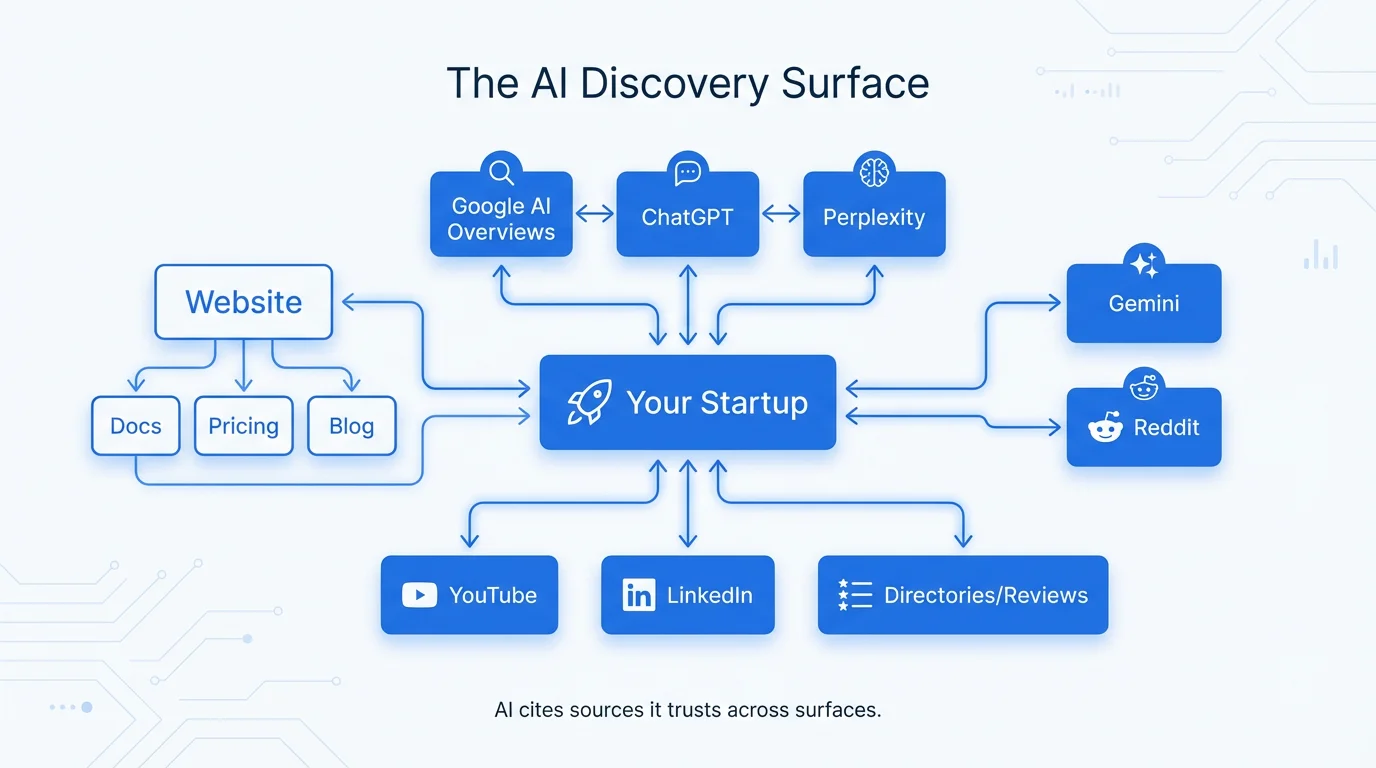
- Your website: Homepage, product, pricing, docs, blog, FAQs. Tip: if your docs live behind login, publish a public “Docs Overview” page so crawlers can still understand what you do.
- Trusted public platforms: Community content matters because AI engines cite it (especially Google AI surfaces). Example: answer a real Reddit question with genuine help, then link your guide only if it’s the best next step.
- Directories & reviews: “Best tools” lists, comparisons, review portals. Tip: use consistent product naming so the same entity is recognized across sources.
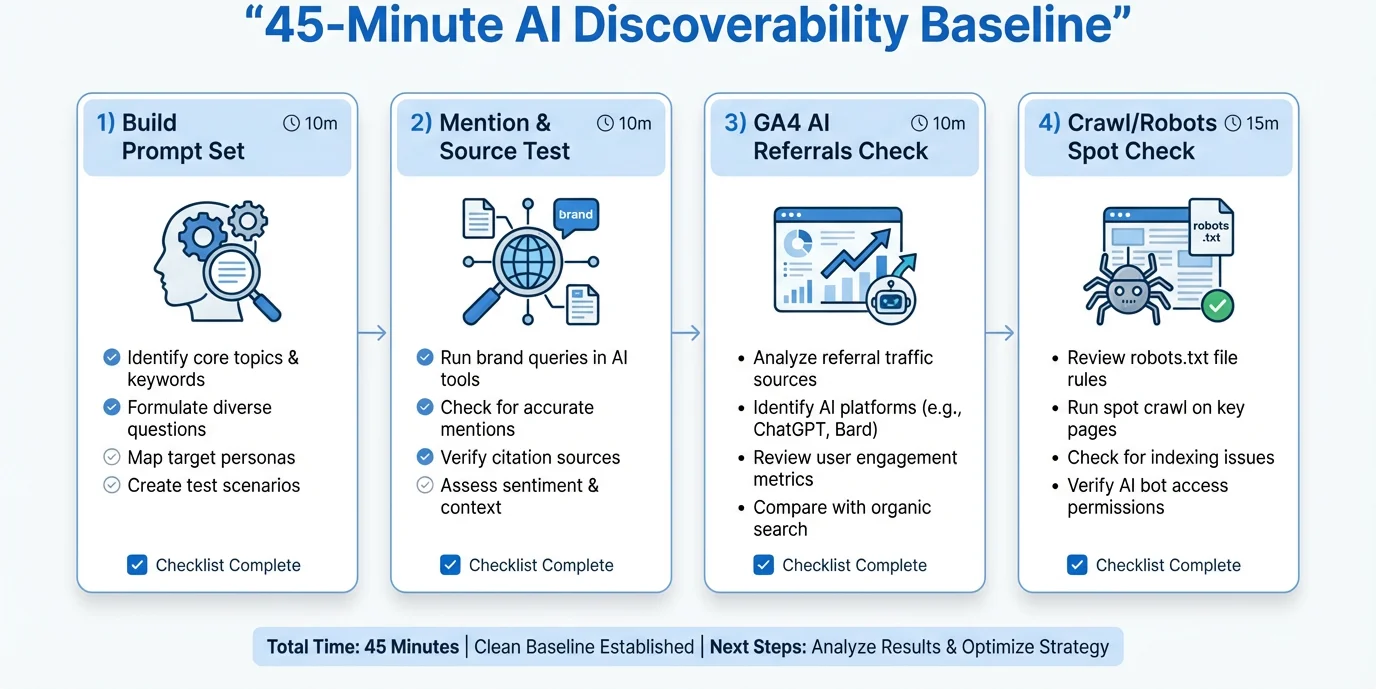
Before You Optimize: Set Baseline for Following AI Discoverability Checklist for Startups (45-Minute Setup)
Before changing content, adding schema, or buying tools, you need a baseline. In simple terms, a baseline answers one question: “How visible is my startup in AI answers today?”
Without this step, founders often “optimize blindly” and have no way to tell what actually worked. A practical AI discoverability baseline has three parts: prompt testing, traffic checks, and crawl verification.
There’s also a mindset shift required. AI summaries reduce clicks. Research shows click-through rates drop to around 8% compared to 15% when AI summaries are not present. That means success is no longer just about traffic. Your real KPIs become: Are we mentioned? and Are we cited?
Did you know?
- Baseline prompt set (10 minutes): Write 15 realistic questions your ideal customer would ask an AI tool.Example: “Alternatives to X for small teams” or “Best invoice automation for freelancers.”Tip: include at least five “X vs Y” prompts, comparison questions trigger AI answers more often and reveal competitive gaps quickly.
- Mention and source test (10 minutes): Run those prompts in ChatGPT, Perplexity, and Gemini. Log whether your brand appears, which competitors are mentioned, and what sources are cited.This mirrors the weekly testing loop many founders use to steadily improve AI visibility.
- GA4 AI referrals check (10 minutes): Review AI-related referrers in Google Analytics 4 and note which pages receive visits.Tip: pricing, comparison, and alternatives pages are often the first AI-driven touchpoints, optimize those before writing more blog content.
- Crawl and robots spot check (15 minutes): Ensure important pages are indexable and not blocked by robots.txt or firewall rules.Tip: treat crawler access as part of go-to-market readiness, not something to “fix later.”
Step 1: Build Your Minimum Viable Entity Kit for AI (Entity SEO Foundation)
AI systems don’t “understand” your startup the way a human does. They don’t infer meaning from clever copy or branding. Instead, they build a mental model of your company based on repeated, consistent signals across the web. This model is called an entity.
If your entity is unclear, inconsistent, or incomplete, AI systems either won’t mention you, or they’ll describe you incorrectly. This is where entity SEO for startups becomes essential. For startup founders, this is critical. AI will not “figure it out later.” If your positioning is vague today, that vagueness compounds everywhere your brand appears.
For instance, if an AI answers the question, “What are the best accounting startups?” and includes a company that actually builds AI-powered HR analytics software, this signals an entity mismatch. The startup’s content failed to clearly reinforce its true category, so the AI associated it with a broader or incorrect business software entity. This is how weak entity SEO leads to irrelevant visibility, confused users, and lower-quality leads.
- Write a 1-sentence positioning line (use it everywhere): This sentence defines who you are, who you’re for, and what problem you solve—without ambiguity.
Template: “[Startup] is a [category] for [ICP] that helps them [job] using [mechanism].”
Example: “FinTrack is an AI expense management platform for small businesses that automates receipt tracking and spend analysis.”
Why this matters: AI systems reuse this sentence structure when explaining or recommending you.
Tip: If this sentence changes across your homepage, LinkedIn, and Product Hunt, AI may treat them as different entities. - Create an “Entity Page” (About) that’s clear: Your About page should answer four questions clearly: what you do, who it’s for, what category you belong to, and what you are not.
Example: “Not designed for enterprise ERP systems.” This reduces AI misclassification.
Common mistake: Treating the About page like a marketing manifesto instead of an identity reference. - Make trust basics visible and explicit: Include contact information, privacy policy, and security status.
Tip: If you’re pre-SOC2, say “SOC2 in progress” instead of staying silent. Why this helps: Silence looks worse than transparency to both humans and AI.
Did you know?
Step 2: Technical Access and Crawl Readiness for AI
AI discoverability fails silently when technical access is broken. Your content may be excellent, but if AI crawlers can’t reach it, it simply doesn’t exist to them. This is not an advanced optimization. It’s the foundation.
Founder reality check: founders who succeeded didn’t outsmart AI, they made their sites easy to crawl, published clearly structured content, tested results, and repeated the process weekly.
- Decide intentionally what AI bots can access: Review your robots.txt and ensure that AI crawlers can reach pages that clearly explain what your business or website is about.
Example: Core pages that define your offering or content focus, such as About pages, product or service overviews, topic hubs, FAQs, documentation, pricing or plans (if applicable), and comparison or use-case pages, all help AI systems understand when and how to recommend you.
Common mistake: blocking explanatory or foundational pages during early development and never revisiting them. When pages that define your purpose, scope, or audience are inaccessible, AI systems struggle to classify and surface your site accurately. - Decide intentionally what AI bots can access: Review your robots.txt and ensure you are not blocking important pages.
Example: Pricing, documentation, and comparison pages are essential for accurate recommendations.
Common mistake: blocking “/docs” or “/pricing” during early development and never revisiting it. Don’t block by accident, especially key pages like docs/pricing that AI needs to recommend you accurately. - Ensure critical content is available in HTML: Many AI crawlers do not reliably execute JavaScript.
Example: If your pricing table loads only via client-side JS, AI may never see it.
Tip: Use server-side rendering or prerendering for key pages. - Review WAF and CDN rules regularly: Security tools often block bots by default.
Example: Perplexity and other AI tools may require allowlisting.
Tip: If mentions suddenly drop, check firewall/WAF logs before rewriting content.
Did you know?
Step 3: Structured Data That Helps AI Understand You
Structured data is how you remove ambiguity for machines. From an entity SEO perspective, schema markup is how you tell AI systems exactly who you are, what you offer, and how you should be classified.
While humans can infer meaning from context, AI systems rely heavily on explicit signals that explain what a page represents. Think of structured data like labels on storage boxes. Without labels, someone might guess what’s inside. With labels, there’s no confusion.
For startups, this matters because misclassification is common. Many AI tools confuse products, services, and categories when schema is missing or incomplete.
- Add Organization schema to establish identity: This schema tells AI your official name, website, logo, and verified profiles.
Example: Including LinkedIn and GitHub profiles helps AI distinguish a SaaS startup from a content site or agency.
Common mistake: relying only on homepage text and skipping structured signals entirely. - Use Product or SoftwareApplication schema for clarity: This explains what your product does, who it’s for, pricing model, and category.
Example: If your product integrates with Slack and Notion, structured data makes it easier for AI to recommend you for “tools that work with Slack.”
Tip: Match schema categories to how customers describe you, not internal jargon. - Apply FAQ schema to decision-making pages: FAQs on pricing, feature, and comparison pages help AI answer objections directly.
Example: “Is this suitable for solo founders?” or “What happens if I cancel?”
Common mistake: adding FAQs only to blog posts instead of revenue-driving pages.
Did you know?
Step 4: Content Design for AI Extraction and Quotation
AI systems do not read your website like a human. They don’t scroll or skim. Instead, they break pages into small sections and decide which pieces are useful enough to reuse in answers. This means every section on your site must work on its own. If a paragraph is pulled out of context and shown in an AI answer, it should still make sense.
- Start every section with a direct answer: Open with a clear 2–3 sentence explanation before adding detail.
Example: “AI discoverability is how likely your brand is to be mentioned or cited in AI-generated answers.”
Why this matters: AI systems often extract only the first few sentences.
Common mistake: starting with storytelling instead of the answer. - Use definition-style sentences deliberately: Phrases like “X is…”, “Use X when…”, and “X works best for…” are highly reusable.
Tip: If a sentence could stand alone inside ChatGPT, it’s written correctly. - Break content into self-contained chunks: Use short paragraphs, bullets, and clear transitions.
Example: Replace one long paragraph with “What it is”, “Why it matters”, and “How to use it”. - Show freshness clearly: Add visible “Last updated” dates to important pages.
Tip: Updating quarterly builds more trust than rewriting yearly.
Did you know?
Step 5: Prompt-Centric Content Strategy for Startups
AI search changes how people ask questions, which is especially visible among fast‑moving AI startups competing for early mindshare. Instead of short keywords, users ask full, specific questions. Pew found searches with 10+ words triggered AI summaries 53% of the time, and question-based queries triggered them 60% of the time. This means your content strategy should begin with prompts, not keywords.
- Build a prompt library (50–100 prompts): Collect real questions from sales calls, onboarding, support, and demos. Split by stage: problem-aware, solution-aware, product-aware.
Example: “Best invoicing software for freelancers who hate spreadsheets.”
Tip: Keep a separate list for “X vs Y” prompts, they drive citations heavily. - Publish one prompt-focused page per week: Each page should answer one question completely.
Common mistake: cramming multiple prompts into one page. - Write fair, balanced comparisons: AI engines can cite vendor content if it’s genuinely helpful.
Tip: Overly salesy content is less likely to be reused.
AI-generated queries often mirror how people explore startup ideas, match your content to long-tail questions users ask first.
Did you know?
Step 6: Micro FAQs and Real User Questions
Micro FAQs are one of the fastest ways to improve AI discoverability. They work because AI systems actively look for clean question-and-answer pairs. Many founders report that adding strong FAQs to key pages improves AI mentions faster than publishing long blog posts.
- Add 8–15 micro FAQs to high-intent pages: Focus on homepage, pricing, feature, and comparison pages.
Example: “Does this replace Zapier?”, “How long does setup take?”
Common mistake: placing all FAQs only on blog content. - Answer in two layers: Start with one quotable sentence, followed by short bullets.
Example: “Not built for enterprise; best for 2–50 person teams; enterprise roadmap Q4.” - Use real questions from real conversations: Pull from demos, support tickets, and objections.
Tip: If a question comes up twice in a week, it deserves an FAQ.
Did you know?
Step 7: Topic Authority and Internal Knowledge Mapping
AI systems don’t evaluate content page by page. They look at how deeply and consistently you cover a topic across your site. This is often called topical authority. In practice, this means one strong page is rarely enough, especially for subjects like a legal checklist for startups where compliance, risks, and use cases overlap.
AI search can “fan out” a question into sub-questions, rewarding topical depth across clusters rather than one shallow page. That’s why internal linking and hub architecture show up in advanced AI search checklists. Think of it like this: you’re building an internal “knowledge map” that makes it easy for humans and machines to navigate your expertise.
- Create one clear hub page per core topic: A hub page introduces the topic and links to all related sub-pages.
Example: A hub called “AI Customer Support for Shopify” that links to setup guides, comparisons, costs, and limitations.
Why this matters: AI uses hubs to understand what topics you “own.” - Support each hub with focused sub-pages: Each sub-page should answer one specific question.
Example: “AI support tools for Shopify,” “AI vs human support,” “Setup time for AI support tools.”
Common mistake: publishing many shallow pages without a clear hub tying them together. - Use descriptive internal links: Link pages using meaningful anchor text.
Example: “AI support tools for Shopify” instead of “click here.”
Tip: internal links are signals that help AI understand how ideas relate.
Did you know?
Step 8: Authority, Mentions, and Brand Trust Signals
AI engines cite what they trust. Trust is built when your brand appears consistently across multiple credible sources, not just on your own website. Research shows that AI systems pull from a mix of websites, platforms, and community content, which means your authority must extend beyond owned media.
- Put real people on your site: Use founder bios, author profiles, and team pages.
Example: A short founder bio explaining experience and role.
Why this matters: “Admin” or anonymous bylines reduce trust. - Show proof with specific outcomes: Numbers are easier for AI to quote than vague claims.
Example: “Reduced ticket resolution time by 31%.”
Common mistake: using generic testimonials without measurable results. - Earn third-party mentions: Podcasts, newsletters, roundups, and niche directories all reinforce credibility.
Tip: The goal isn’t backlinks alone, it’s consistent validation.
Did you know?
Step 9: Publish on Trusted Platforms Where AI Learns
AI systems don’t learn only from company websites. They learn heavily from community platforms where real users discuss tools and experiences. Pew lists Reddit among frequently cited sources, which explains why community presence matters for AI discoverability.
- Reddit (help-first approach): Answer questions honestly and only mention your product when it genuinely helps.
Example: Explaining pros and cons of different tools before referencing your own.
Common mistake: dropping links without context. - YouTube: Publish short walkthroughs and category explainers. YouTube is a frequent citation source
Example: “How AI customer support works for Shopify stores.”
Tip: Add “Who it’s for / Not for” in descriptions. - LinkedIn: Share founder POV posts that clearly define your category.
Tip: Turn your one-sentence positioning into a recurring post theme.
Did you know?
Step 10: Turn AI Traffic into Signups and Leads
AI summaries reduce clicks, but the traffic that does arrive is often high-intent. Pew found sessions ended after AI summaries 26% of the time vs 16% without, which means every visit matters more.
- Make the first screen crystal clear: In under five seconds, explain what you do, who it’s for, and what to do next.
Common mistake: vague hero sections that look good but explain nothing. - Match CTAs to intent: Research visitors need low-friction actions; decision-ready visitors need demos or pricing.
Example: “Download the checklist” vs “Start a free trial.” - Create decision-support pages: Pricing FAQs, migration guides, and comparisons reduce friction.
Tip: These pages convert “curious AI traffic” into pipeline.
SaaS startups converting AI traffic well often win by aligning Q&A content to pricing pages and signup journeys.
Did you know?
Step 11: Measurement, Monitoring, and Proving ROI
AI discoverability is not traditional rank tracking. Many founders don’t measure it at all. One entrepreneur reported 80% of companies don’t track AI mentions, which makes improvement almost impossible.
- Run a monthly prompt audit: Re-run the same prompts and log mentions, citations, and sentiment.
Tip: Consistency matters more than frequency. - Benchmark against competitors: Compare how often competitors appear for the same prompts.
Example: If three competitors show up and you don’t, that’s a content gap, not a mystery. - Track AI referral pages: Even partial data shows where AI traffic lands.
Tip: Optimize those pages first. - Fix misrepresentation quickly: Update positioning, FAQs, and About pages if AI gets you wrong. This feedback loop is essential for maintaining accurate entity SEO as your product, messaging, or market evolves.
Did you know?
Step 12: AI Discoverability Tools Stack (Lean & Startup-Friendly)
You don’t need an enterprise stack to start. But you do need a way to see whether you’re being mentioned and cited across engines, because “no tracking” is where most teams get stuck.
- AI visibility and citation tracking: Use Wellows to track mentions/citations and competitor gaps across AI platforms daily. If you’re resource-constrained, this is the one tool that replaces “manual spreadsheet chaos.”
Why this matters: Manual tracking doesn’t scale and often misses trends. - Manual AI testing tools: ChatGPT, Perplexity, and Gemini for prompt testing and verification.
Tip: Use the same prompts consistently to track progress. - Analytics: Google Analytics 4 to identify AI referral patterns.
- Technical baseline: Crawl/index checks + schema validation using tools like ScreamingFrog.
Tip: keep a “launch checklist” so new pages don’t ship noindex/blocked.
Did you know?
The Startup Execution Roadmap (0–30, 31–60, 61–90 Days)
AI Overviews are already at global scale, with 2 billion monthly users, so speed matters: early movers lock in entity + authority signals while competitors still think “classic SEO only.”
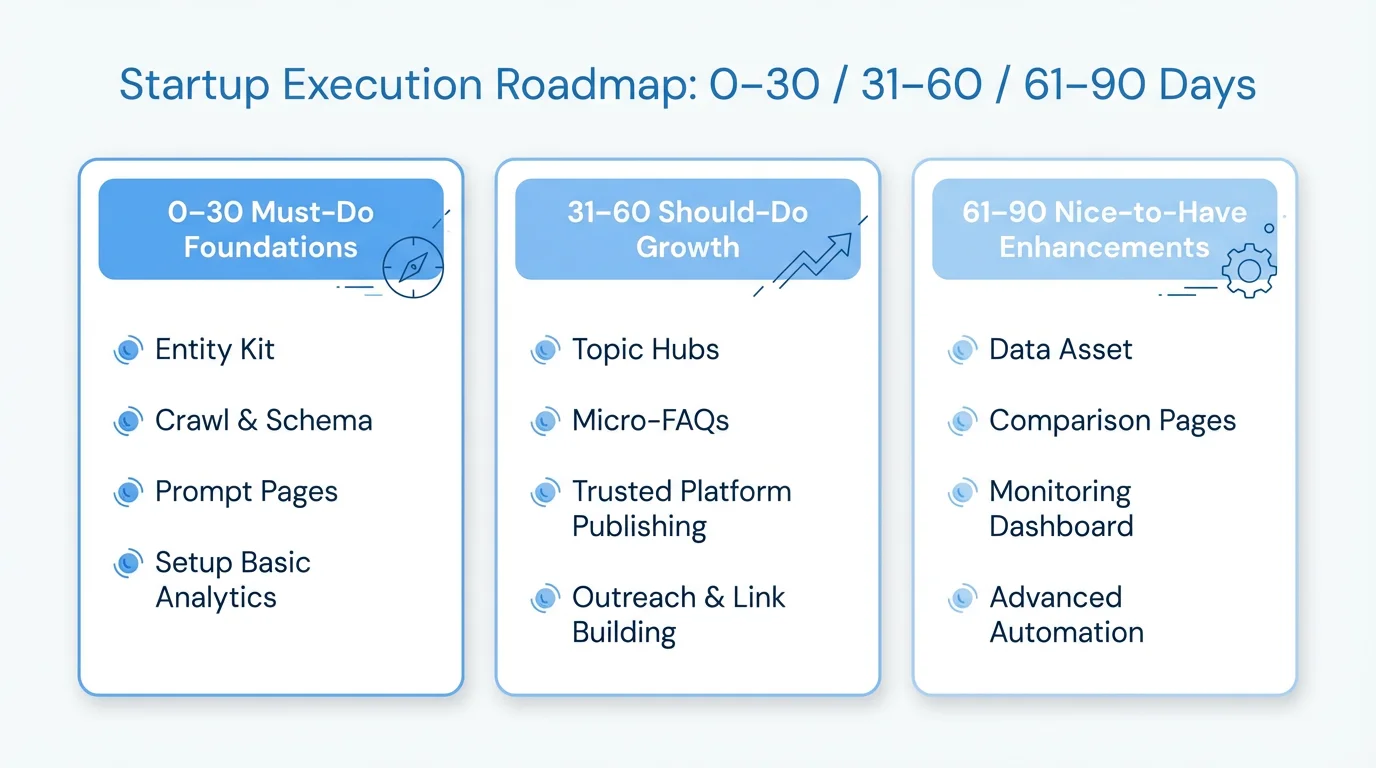
- Days 0–30 (Must-do foundations): Ship your entity kit, fix crawl readiness, add core schema, publish 4 prompt-pages. Tip: treat this like a product sprint, not a marketing project.
- Days 31–60 (Should-do growth): Build 2 hubs + supporting pages, add micro-FAQs to top pages, start trusted platform publishing (Reddit/LinkedIn/YouTube). Tip: consistency beats volume.
- Days 61–90 (Nice-to-have enhancements): Publish a data-backed asset, create comparison/migration pages, add a lightweight monitoring dashboard. Tip: your “original data” becomes the easiest thing for others to cite.
AI Discoverability Checklist for Startups [Printable PDF for Free]
This is how you should use the checklist once you download it:
- Use weekly: Treat it like a growth sprint backlog (ship a few “critical” items every week).
- Score monthly: Move from “Foundation Stage” → “AI Ready Stage”.
- Re-check quarterly: Especially after launches, pivots, or messaging changes.
Should I Focus on Google, ChatGPT, Perplexity, or all AI platforms for my Startup?
Startups should prioritize Google’s AI ecosystem first due to its global scale, comprehensive infrastructure support, and startup-specific benefits, while treating ChatGPT and Perplexity as complementary distribution channels. Google AI Overviews serves 2 billion monthly users globally, representing approximately 25% of the world’s population, while ChatGPT has 800 million weekly active users and Perplexity serves a smaller but highly engaged research-focused audience.
Google’s ecosystem offers startups several strategic advantages beyond search visibility. Through Google Cloud’s AI Startup Program, eligible companies receive up to $350,000 in cloud credits over two years, access to advanced AI models including Gemini, Imagen, and Veo, hands-on technical support and mentorship from Google’s AI teams, and integration with Firebase Studio for rapid development.
These infrastructure benefits significantly reduce early-stage burn rate and accelerate product development timelines for AI-native startups.
Platform citation behavior varies significantly based on query type and user intent. Analysis from Search Engine Land of nearly 8,000 AI citations found that ChatGPT heavily favors Wikipedia (27% of citations) and established authority sources, while Google AI Overviews pull from a broader mix including community platforms like Reddit and YouTube.
Yext’s analysis of 6.8 million AI citations revealed that Gemini, ChatGPT, and Perplexity define trust differently—Gemini prioritizes recency and Google-indexed authority, ChatGPT leans toward encyclopedic and established sources, and Perplexity emphasizes transparency with consistent source citations.
For most startups, a tiered approach delivers the best return: establish entity clarity and authority signals on Google first (strong SEO foundation, structured data, and indexed content), ensure content is accessible to all major AI crawlers (GPTBot, PerplexityBot, ClaudeBot), build presence on high-trust platforms AI systems cite frequently (Reddit, YouTube, LinkedIn, industry blogs), and monitor performance across platforms to identify where your startup gains traction naturally.
This strategy ensures foundational visibility while allowing startups to double down on platforms showing organic momentum.
Expert judgment based on adoption patterns and infrastructure value: startups building AI-powered products benefit most from Google’s comprehensive ecosystem, which combines search visibility, cloud infrastructure, model access, and developer tools in one integrated platform.
ChatGPT and Perplexity serve as powerful amplification channels for content distribution and brand awareness, but typically function best as secondary channels rather than primary infrastructure platforms. Startups should optimize content once for AI-readability (clear structure, entity markup, citation-worthy data) rather than creating separate strategies per platform, as the fundamentals of entity clarity, authority signals, and accessible content carry across all AI systems.
Why isn’t my Startup Showing Up in AI Search Answers even though we have a Good Product?
Your startup’s absence from AI-generated search results, despite having a strong product, may stem from several factors:
- Limited online presence: AI systems rely on publicly available information. If your startup has minimal content, few mentions, or limited exposure beyond your own website, AI tools may not recognize or reference your brand.
Example: A great product with only a homepage and pricing page is often invisible to AI. - Insufficient content depth: AI tools favor detailed, informative content that fully answers user questions.
Example: A site with only short feature descriptions may lack the depth AI needs to treat it as authoritative.
Tip: Depth matters more than volume. - Semantic gaps in content: AI prioritizes content that matches how real people ask questions.
Example: If users ask “best tool for X,” but your content only says “our solution offers Y,” AI may skip you. - Low authority and trust signals: Established brands are cited more often because they appear consistently across trusted sources. New startups often lack these signals early on.
Tip: Trust is built through repetition across multiple platforms, not overnight.
To improve your startup’s visibility in AI-generated search results, focus on the following actions:
- Create comprehensive, problem-focused content: Publish guides, case studies, and explanations that answer specific user questions in your niche.
Example: “How startups solve X problem” performs better than generic product pages. - Write for conversational queries: Structure content using natural language and real questions users would ask AI tools.
Tip: If it sounds like something a human would ask out loud, it’s the right direction. - Build external authority: Earn mentions on reputable platforms, industry blogs, and trusted publications.
Example: Being referenced in a niche roundup or expert article. - Use structured data: Apply schema markup to clarify what your product is, who it’s for, and how it works.
Why this helps: Structured data makes it easier for AI to extract and reuse accurate information.
Did you know?
How do I Get My Startup Mentioned in ChatGPT and AI Search Results?
To enhance your startup’s visibility in AI-driven search results, such as those generated by ChatGPT, consider implementing the following strategies:
- Optimize for Generative Engine Visibility (GEO): Publish high-quality, authoritative content that answers real industry questions and solves common problems. When your content consistently provides clear and helpful explanations, AI systems are more likely to treat your startup as a reliable source.
Example: Writing clear guides, explainers, or comparison pages that directly address what users ask AI tools. - Participate in industry conversations: Engage in forums, webinars, podcasts, and community discussions where your expertise is visible publicly. These environments often influence the data AI systems learn from. Focus on helping first, not promoting, helpful contributions build trust signals.
- Implement structured data and schema markup: Use structured data to clearly define your business name, product, services, and FAQs. This helps AI systems understand exactly who you are and what you offer.
Example: Marking up FAQs and product information so AI can extract accurate answers. - Leverage public relations and earned mentions: Secure mentions in credible media outlets, industry blogs, and relevant directories. AI systems often reference well-known and trusted sources when generating answers. Even a few strong mentions are more valuable than many low-quality ones.
- Build entity-based, contextual backlinks: Earn backlinks from authoritative sites within your industry that mention your startup in a relevant context. This helps AI associate your brand with specific topics.
Example: Being cited in an industry roundup or expert article related to your product category. - Maintain consistent branding and messaging: Use the same brand name, description, and positioning across your website, social profiles, and third-party platforms. Consistency reduces confusion for AI systems. Small variations in naming can cause AI to treat your brand as multiple entities.
- Monitor and adapt to AI search behavior: Track how often your startup appears in AI-generated answers and which competitors are mentioned instead. Use this insight to refine content, positioning, and authority signals.
Example: Adjusting FAQs or About pages when AI explains your product incorrectly.
Did you know?
How do I Build Topical Authority for my Startup to Get Recommended by AI Systems?
Building topical authority is essential for enhancing your startup’s brand visibility and credibility, especially in AI-driven search environments. AI systems prioritize content that demonstrates comprehensive expertise and trustworthiness. To establish and strengthen your topical authority, consider the following strategies:
- Develop comprehensive content clusters: Organize content around core themes using one pillar page supported by related sub-pages. This signals to AI that your startup understands a topic in depth.
- Research topics and long-tail queries: Focus on real user questions and intent-driven topics rather than only high-volume keywords. Content that mirrors natural language performs better in AI answers.
- Use structured data: Apply FAQ, HowTo, and entity-related schema to clearly label your content. This reduces ambiguity and helps AI extract accurate information.
- Publish authoritative content: Create clear, detailed, and experience-backed content instead of generic marketing copy. Depth and clarity matter more than volume.
- Strengthen internal linking: Use descriptive internal links to connect related pages within each topic. This reinforces relationships between concepts for AI systems.
- Monitor and refine continuously: Track which topics gain visibility and expand strong clusters over time. Topical authority grows through iteration, not one-time publishing.
Did you know?
What Tools can I Use to Monitor if AI Platforms are Recommending my Startup?
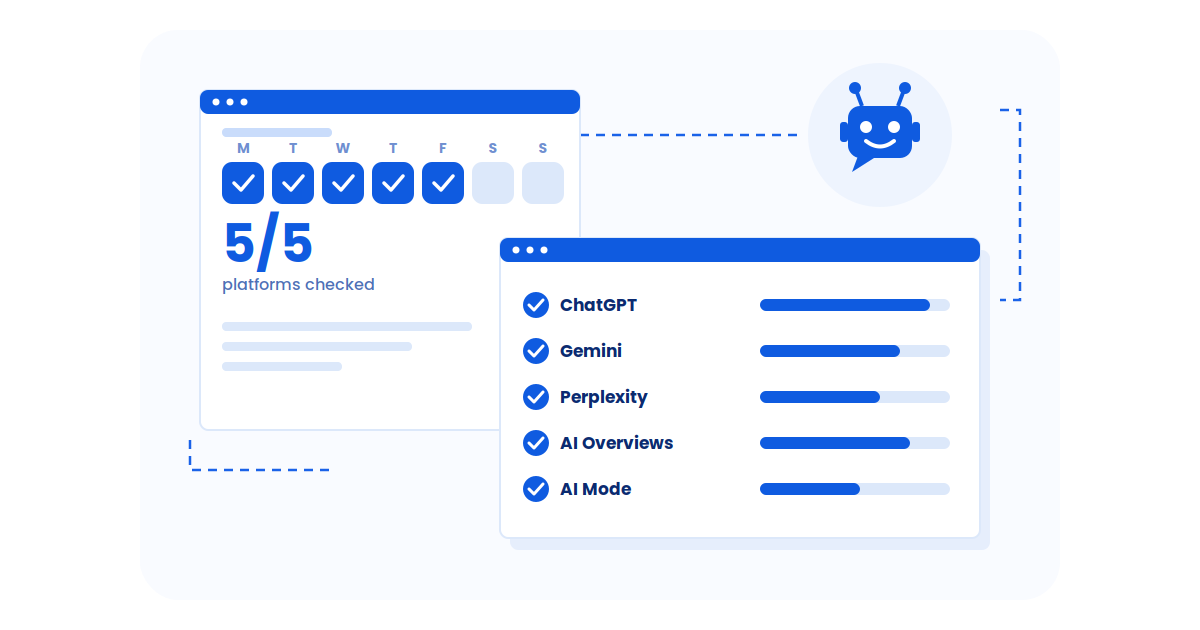
Startups need dedicated AI visibility monitoring to track how ChatGPT, Perplexity, Google Gemini, and AI Overviews mention and cite their brand across thousands of query variations. Wellows provides centralized tracking that monitors brand mentions, citation frequency, sentiment analysis, and competitor positioning across major AI platforms daily.
According to industry discussions on Reddit, approximately 80% of companies don’t track AI mentions at all, creating a blind spot that prevents founders from understanding whether their optimization efforts are working.
Wellows specifically tracks whether your startup appears in AI-generated answers, how accurately AI describes your product and positioning, which competitors are mentioned alongside you, and what sources AI platforms cite when referencing your category. The platform provides visibility scoring, sentiment tracking (positive, neutral, or negative mentions), citation gap analysis showing missed opportunities, and competitor benchmarking across the same query set.
Monitoring alone does not create AI discoverability. Tools like Wellows help startup founders identify patterns in AI representation, detect misclassification early (such as being described in the wrong category), measure whether content and authority improvements influence AI visibility over time, and understand which optimization tactics actually drive measurable changes.
One indie hacker reported on Reddit that after systematically optimizing for AI discoverability, AI platforms became their “third largest traffic source” within a month, demonstrating the measurable impact of strategic visibility efforts.
Effective AI visibility tracking requires consistent prompt auditing (running the same user questions monthly to track changes), sentiment monitoring (ensuring AI describes your product accurately and positively), competitor gap analysis (identifying why competitors appear when you don’t), and conversion measurement (tracking whether AI-driven traffic converts differently than traditional sources).
Without structured tracking, startups optimize blindly and cannot connect visibility improvements to business outcomes.
What Metrics Should I Track to Measure my Startup’s AI Visibility Progress?
To effectively measure your startup’s AI visibility progress, consider tracking the following key performance indicators (KPIs):
To understand whether your AI visibility efforts are working, you need metrics that go beyond traditional rankings and traffic. The following KPIs help founders measure how often, how accurately, and how effectively AI platforms surface their startup.
- AI Share of Voice (SOV): Measures how often your startup appears in AI-generated answers compared to competitors.
Example: If your brand appears in 400 out of 1,000 AI responses for a query, your SOV is 40%. A rising SOV indicates improving AI visibility. - Citation frequency and link rate: Tracks how often AI systems mention your brand and include a link to your website.
Higher citation and link rates signal stronger authority and trust. - Sentiment and representation quality: Evaluates whether AI describes your startup accurately and positively. This helps identify misrepresentation or unclear positioning early.
- Factual density score: Measures how much detailed, specific information AI pulls from your content. Higher factual density suggests AI views your content as rich and authoritative.
- Topic authority: Assesses how many topics AI systems associate your brand with as a trusted source. Broader topic recognition reflects deeper expertise.
- AI referral traffic: Tracks website visits coming from AI platforms. This shows whether AI visibility is translating into real user engagement.
- Lead-to-cash impact: Measures how AI-driven leads convert into revenue. This connects AI visibility directly to business outcomes.
Did you know?
What are the Common AI Discoverability Mistakes Startups Make?
Many companies still don’t track AI mentions and confuse AI visibility with “just doing SEO,” which shows up repeatedly in founder discussions.
Mistake: Only optimizing the homepage
Mistake: No schema, no FAQs
Mistake: Blocking bots by accident
Mistake: Blocking bots by accident
Mistake: Writing fluff
Mistake: No off-site presence
FAQs
- SEO: Rank pages in Google/Bing so people click.
Example: you want “best SOC2 tool for startups” to land on your comparison page. - GEO (Generative Engine Optimization): Get your brand included/cited in AI answers. E
Example: you want AI to mention you as an option (with a source link) when someone asks “SOC2 fast for startups.” - AEO (Answer Engine Optimization): Format content as crisp answers so engines can lift it cleanly.
Example: your pricing page directly answers “How much does it cost?” in 2 lines + bullets.
invisible in AI answers if AI systems can’t clearly understand or trust your brand.
SEO focuses on rankings and clicks, while AI discoverability focuses on inclusion, citations, and trust. You can rank #1 in Google and still be invisible in AI answers if AI systems can’t clearly understand or trust your brand.
Consistent visibility usually builds over 1–3 months as AI systems repeatedly encounter and validate your brand across multiple sources. AI discoverability compounds faster with consistency than with volume.
For most startups, Google’s ecosystem is the best foundation, while other platforms act as amplification layers rather than separate strategies.
Final Thoughts – AI Discoverability Checklist for Startups
AI discoverability isn’t a buzzword. It’s a new distribution layer where startups either become the recommended answer, or get replaced by competitors in the AI shortlist.
If you want a simple execution rule: make your brand easy to understand (entity kit), your content easy to extract (chunk + FAQ design), and your authority easy to verify (trusted mentions). Then measure and iterate, using a structured framework like the AI discoverability checklist for startups, ideally supported by a dedicated AI visibility layer such as Wellows.