Does domain authority matter for AI citations? Yes, but not like it did in Google Search. Authority no longer determines who gets cited. Smaller, lower-authority sites are cited regularly. What authority changes is how often you’re cited, across how many engines, and how long those citations persist.
To understand that relationship, we analyzed 20.5 million citations collected by Wellows across ChatGPT, Perplexity, Gemini, Google AI Overviews, and Google AI Mode, spanning 386,000 domains across 42 markets.
The results explain why the debate seems so divided. Nearly half (47.9%) of all citations come from domains below DA 40, suggesting authority matters little. Yet just 301 DA 90+ domains capture 17.0% of all citations, averaging 11,574 citations each. Both observations are true.
Authority doesn’t determine whether you get cited, but it strongly influences the scale, reach, and persistence of those citations.
- What we analyzed: 20.5 million scored AI citations across ChatGPT, Gemini, Perplexity, Google AI Overviews, and Google AI Mode, collected from March 8 to July 31, 2026.
- Authority does not block entry. Nearly half of all citations, 47.9%, come from domains under DA 40.
- Authority still concentrates outcomes. Just 301 DA 90+ domains take 17.0% of all citation share, averaging 11,574 citations each.
- Google’s AI surfaces stayed the most authority-heavy the whole time. Their median cited DA stayed around 47 to 50.
- ChatGPT and Perplexity changed mid-study. ChatGPT shifted sharply toward stronger domains in July. Perplexity made a smaller version of the same move two weeks later.
- Authority still buys staying power and reach. In the pre-shift persistence window, DA 90+ domains were still cited two months later 92.0% of the time; sub-40 domains only 44.3%.
- Comparison pages have the lowest authority bar. Their median cited DA is just 34.
- Most cited pages mention no brand at all. 90.4% of scored citations are ghost citations.
The Short Answer: Domain Authority Doesn’t Stop You Getting Cited. It Changes How Often You Show Up.
If you only look at citation share, domain authority looks weak. If you look at citations per domain, it looks very strong. That is why people keep reaching opposite conclusions from similar data.
| DA band | Citation share | Distinct domains | Citations per domain |
|---|---|---|---|
| 1 to 39 | 47.9% | 346,348 | 28 |
| 40 to 69 | 24.9% | 36,868 | 139 |
| 70 to 89 | 10.2% | 2,245 | 928 |
| 90 to 100 | 17.0% | 301 | 11,574 |
of scored AI citations come from domains under DA 40
346,348 distinct lower-authority domains earned citations in five months. But at the top of the curve, 301 DA 90+ domains averaged 11,574 citations each, roughly 400x the low-band rate.
Source: Wellows internal citation dataset, Mar 8 to Jul 31 2026, 20.5M scored citationsThis is the real pattern. Lots of sites can get cited. Very few get cited again and again. Most of the volume sits with just 301 domains, a list small enough to fit on six printed pages.
What domain authority means in this study
Domain authority (DA) is a 1 to 100 score estimating a website’s overall link-based strength. It is a domain-level measure, not a page-level quality score. In this study, we use it to test whether stronger domains get cited more often, across more engines, and for longer periods of time.
One reason is simple: high-authority sites have earned trust across many topics over time. AI engines still cite smaller sites when they provide the best answer, but across a broad range of prompts they return to the same trusted domains. Authority doesn’t get you cited, it makes you more likely to be cited repeatedly.
This also explains why studies claiming “DA is dead” and complaints that “big sites win everything” both seem right. Page-level correlations look weak because the long tail of low-authority sites is large and noisy. Domain-level concentration looks strong because a small number of high-authority sites receive citations over and over. Both patterns exist at the same time.
Which AI Engines Rely Most on Domain Authority?
The biggest split in the dataset is not between strong domains and weak ones. It is between engines. Each AI engine has its own appetite for authority and two of them changed while we were measuring.
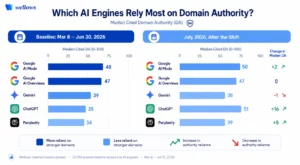
That matters enough that we split the engine table in two. ChatGPT and Perplexity both shifted toward stronger sources in July 2026. A single pooled median across the full five months would average two different phases into one number that describes neither.
Baseline: March 8 to June 30, 2026
| Engine | Citations | Median cited DA | % under DA 40 | % from DA 90+ |
|---|---|---|---|---|
| Google AI Mode | 3.45M | 48 | 40.4% | 24.6% |
| Google AI Overviews | 3.62M | 47 | 40.8% | 23.8% |
| Gemini | 1.79M | 39 | 51.3% | 9.1% |
| ChatGPT | 3.70M | 35 | 55.5% | 10.3% |
| Perplexity | 3.36M | 34 | 58.7% | 11.0% |
July 2026, after the shift
| Engine | Citations | Median cited DA | % under DA 40 | % from DA 90+ | Change in median |
|---|---|---|---|---|---|
| Google AI Mode | 0.97M | 50 | 39.6% | 29.9% | +2 |
| Google AI Overviews | 1.01M | 47 | 41.1% | 25.0% | 0 |
| Gemini | 0.63M | 38 | 53.4% | 8.7% | −1 |
| ChatGPT | 1.11M | 51 | 39.8% | 14.0% | +16 |
| Perplexity | 0.87M | 39 | 50.7% | 12.8% | +5 |
Google’s AI products leaned hardest on stronger domains the whole time, and that barely changed. Gemini stayed where it usually sits: closer to ChatGPT’s old sourcing pattern than to Google’s own search surfaces. The engines that changed were ChatGPT and Perplexity.
ChatGPT: The Door Was Wide Open. In July It Narrowed.
For most of our window ChatGPT was one of the two easiest engines for smaller sites to get cited on: median cited DA of 35 from March through June, with 55.5% of citations going to domains under DA 40 and only 10.3% coming from the DA 90+ tier.
Then, beginning around July 7, that changed. By the end of the month ChatGPT’s median cited DA was sitting in the low 50s, sub-40 share had fallen to 39.8%, and DA 90+ share had risen to 14.0%. The shift held into early August.
Perplexity: The Same Move, Two Weeks Later and Smaller.
Perplexity was the most open engine in the dataset through June: median cited DA 34, with 58.7% of citations going to domains under DA 40.
From July 23 it moved in the same direction as ChatGPT, though less sharply. Holding the tracked project set constant, its daily median rose from 37 into the high 40s and stayed there into August. Perplexity is still the more accessible of the two. It is just not as open as it was in June.
Google AI Mode: The Most Authority-Weighted Surface, Consistently.
AI Mode had the highest median cited DA in the dataset in both periods, 48 in the baseline and 50 in July, with DA 90+ domains supplying roughly a quarter of its citations throughout. If your buyers ask questions in AI Mode, the link equity you built for traditional SEO still carries into AI visibility.
Google AI Overviews: Flat, and Close to AI Mode.
AI Overviews ran at a median cited DA of 47 in both periods, making it the most stable engine in the study. Both Google surfaces sit within a few points of each other on median DA and draw roughly a quarter of their citations from the DA 90+ tier, while the other three engines sit well below that.
Gemini: Google’s Brand, ChatGPT’s Old Sourcing Pattern.
Gemini’s median cited DA was 39 in the baseline period and 38 in July, with the lowest top-tier reliance of all five engines at 8.7%. Just because Gemini and Google share data does not mean they pick sources the same way.
As of July, Gemini is the most accessible engine for lower-authority domains. That was not true two months earlier.
The practical takeaway: if your AI visibility program is measured on Google’s AI surfaces, authority still matters a lot, and it has mattered consistently. If your market lives in ChatGPT or Perplexity, authority mattered much less than having the best page for the question until July, when both engines moved toward stronger domains. Gemini is now the easiest door for smaller sites.
The July Shift: ChatGPT Started Citing More Institutional Sources Mid-Study
Roughly three weeks before publication, the engine we had described as the most open to small sites stopped being that.
Between July 7 and July 14, 2026, ChatGPT’s median cited domain authority jumped from the mid-30s to the low 50s and stayed there. Perplexity made a smaller move beginning July 23. Gemini, Google AI Overviews, and Google AI Mode did not.
A jump this large usually points to the pipeline, not the web. Every control supported that conclusion:
- Not project mix: 35 of 40 comparable projects rose (median +11 DA points).
- Not domain re-scoring: average DA across shared domains stayed flat (32.7 to 32.9); the mix changed.
- Not topic churn: identical project-topic pairs rose from 33 to 53.
- Not collection artefacts: the shift remained under identical measurement conditions.
- Not an industry-wide change: only ChatGPT and later Perplexity moved.
point rise in ChatGPT's median cited domain authority, July 2026
The pooled increase is +16 points. On the strictest like-for-like comparison, it is +8. The true effect lies between them.
Source: Wellows internal citation dataset, Mar 8 to Jul 31 2026; constant-project, constant-topic and constant-measurement controls
What changed
ChatGPT’s share of citations from DA below 40 fell from 58% to 35%, while DA 70–89 roughly doubled and DA 90+ rose from 9.6% to 16.2%. Source diversity also narrowed by about 15%.
The gains came mainly from institutional sources such as government and regulatory bodies, public health organisations, academic archives, major technology vendors’ documentation, consumer-testing organisations, and established technology publishers. Government domains alone grew from 2.6% to 8.1% of citations.
It wasn’t simply an authority filter, the biggest gainer was a DA 38 specialist site, suggesting deep topical expertise still mattered.
Two other signals moved
From July 10, ChatGPT began exposing the search queries behind nearly every answer we collected, up from about one in twenty before. On July 22, the day before Perplexity’s shift, average Perplexity responses became 26% shorter.
These aren’t sourcing metrics, but all three changes appeared within the same fortnight while the other engines remained stable. We can’t say what changed internally, only that the signals moved together.
Why it matters: a five-month ChatGPT average of 38 blends two distinct phases, around 35 for four months, then the low 50s in July. A single benchmark can therefore hide meaningful shifts.
Can Small Websites Get Cited by AI? Yes. Can They Keep Those Citations? Usually Not.
One of the clearest findings in the dataset is that smaller sites absolutely can get cited. There is no meaningful authority floor below which citation becomes impossible.
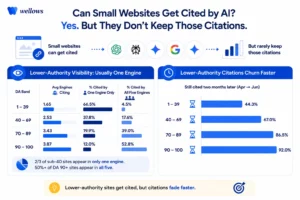
346,348 domains under DA 40 earned citations in this five-month window, together accounting for 47.9% of all scored citation share. On Perplexity and ChatGPT for most of the baseline period, lower-authority domains were the majority of cited sources. What they usually did not get was repetition, portability, or staying power.
Lower-Authority Visibility Is Often Limited to One Engine
| DA band | Avg engines citing | % cited by one engine only | % cited by all five |
|---|---|---|---|
| 1 to 39 | 1.65 | 66.5% | 4.5% |
| 40 to 69 | 2.53 | 37.8% | 17.6% |
| 70 to 89 | 3.43 | 19.9% | 39.0% |
| 90 to 100 | 3.87 | 12.0% | 52.8% |
Two thirds of sub-40 domains appear in only one engine’s source pool. More than half of DA 90+ domains appear in all five. Smaller sites do get visibility, but usually on one engine, not across all of them.
Lower-Authority Citations Also Churn Much Faster
To avoid mixing this result with the July engine shift, we measured persistence on the pre-shift window: domains cited in April and checked again in June.
| DA band | Still cited two months later (Apr → Jun) |
|---|---|
| 1 to 39 | 44.3% |
| 40 to 69 | 67.0% |
| 70 to 89 | 86.5% |
| 90 to 100 | 92.0% |
Even before the July re-weighting, lower-authority citations dropped out much faster than top-tier ones.
Some of this is volume itself, since a domain cited thousands of times has more chances to reappear. But the practical takeaway holds either way: if you are a lower-authority site, you usually have to keep defending those wins and which is why continuous LLM citation tracking matters more at the bottom of the authority curve than the top .
Which Content Types Need the Least Authority to Win AI Citations?
Content format changes the authority bar more than most marketers expect. In this dataset, the spread across formats is wider than the spread across engines.
| Content category | Share of all citations | Median cited DA | % under DA 40 |
|---|---|---|---|
| How to guides | 32.1% | 38 | 55.4% |
| Product feature pages | 25.7% | 38 | 51.5% |
| Review content | 15.8% | 42 | 46.4% |
| UGC and community | 12.0% | 100 | 13.6% |
| Comparison content | 8.9% | 34 | 58.8% |
Comparison pages have the lowest authority barrier among owned content. Their median cited DA is just 34, and 58.8% of citations go to domains below DA 40. That makes them one of the best opportunities for challenger brands: lower competition, high purchase intent, and relatively under-served.
Because comparison pages sit closest to conversion, missing these opportunities is costly. Readers comparing Peec AI alternatives or AIClicks alternatives are often evaluating which platform can identify high-intent citation opportunities before competitors capture them.
How-to guides are the volume layer behind them. They represent 32.1% of all citations in the dataset at a median cited DA of 38. If comparison pages are the high-intent play, how-to guides are the scalable visibility play.
The intent signal points the same way. Commercial and transactional prompts cite weaker domains than informational ones. The closer a query is to a decision, the lower the authority bar often becomes.
Why UGC Looks Impossible on the Chart
The UGC row’s median DA of 100 does not mean community content requires authority. It means community citations overwhelmingly flow to a tiny cluster of DA 100 platforms. Reddit alone accounts for 5.4% of all scored citations, and YouTube for 4.1%.
Everything after those two sits well below 1% each at this scale. 88% of AI citations still go to the open web, not to platforms.
Who Wins Inside Each Authority Band?
Averages flatten the most interesting part of the pattern. Citations are not spread evenly inside an authority band — and how unevenly they are spread changes completely as you move up the bands.
| Band | Citations to the single most-cited domain | Share of the band taken by its top 10 domains | Domains needed to reach half the band’s citations | The archetype |
|---|---|---|---|---|
| DA 1 to 39 | 322K | 6.5% | 2,848 | Niche specialists that dominate one topic |
| DA 40 to 69 | 89K | 10.4% | 241 | Vendor and product domains |
| DA 70 to 89 | 172K | 36.0% | 23 | Technology publishers |
| DA 90 to 100 | 1.11M | 81.5% | 2 | Platforms |
domains needed to reach half of all citations in the lowest and highest authority bands
The low band is a genuine long tail: it takes nearly three thousand domains to account for half its citation volume. The top band is a duopoly. Two domains carry half of everything cited above DA 90.
Source: Wellows internal citation dataset, Mar 8 to Jul 31 2026, 20.5M scored citationsThree things stand out.
The low band is the only competitive market in AI search. Its top ten domains account for just 6.5% of the band’s citations, and no single domain holds more than 3.3%. If you are a lower-authority site, you are not fighting an entrenched incumbent for a slot. You are entering the one tier where volume is genuinely distributed.
Specialists out-cite publishers fifty authority points above them. The most-cited domain under DA 40 earned 322,000 citations, nearly double the most-cited domain in the entire DA 70 to 89 publisher tier, which managed 172,000. Depth inside one topic beats breadth across many, and it beats a large authority gap.
Concentration rises steeply with authority. Half of the DA 70 to 89 band’s citations go to 23 domains. Half of the DA 90+ band goes to two. The top of the curve is not a crowded field of prestigious publishers; it is a very small number of platforms absorbing an enormous share, with everything else in the tier splitting what is left.
The progression across the four tiers is consistent: specialist, then vendor, then publisher, then platform. Each band rewards a different kind of site, and only one of them is open.
Takeaway: The archetypes reflect the mix of prompts and topics tracked on our platform, which skews toward commercial and product-comparison queries. A dataset built on news or academic prompts would likely surface a different set of archetypes in the middle bands. The concentration pattern; flat at the bottom, extreme at the topis the finding that should generalise.
Most AI-Cited Pages Mention No Brand at All
90.4% of the 20.5 million cited pages are ghost citations i.e. sources that don’t mention any tracked brand. AI answers are mostly built from brand-neutral content like guides, documentation, explainers, and forum discussions. In other words, AI rewards useful content long before it rewards brand mentions.
The remaining 9.6% is split almost evenly between two very different types of pages.
| Type | What it is | Share of citations | Distinct domains | Negative sentiment |
|---|---|---|---|---|
| Implicit mention | A third-party page mentions the brand but doesn’t link to it | 5.1% | 24,690 | 4.6% |
| Explicit mention | The brand’s own page is used as the source | 4.5% | 293 | 0.1% |
| Ghost | No brand mentioned | 90.4% | 379,457 | — |
About half of all brand visibility in AI comes from other websites mentioning you instead of citing you. Those mentions appear across nearly 25,000 domains, compared with just 293 domains where brands are cited directly. Mentions are far more common than citations.
These aren’t low-quality sites. They have a median Domain Authority of 41, almost identical to the ghost layer’s 42. That matches Ahrefs’ finding that brand mentions are a stronger predictor of AI visibility than Domain Rating. Authority and mentions each play a different role in how AI chooses sources.
Most criticism also lives outside your website. Negative sentiment appears on 4.6% of pages that mention a brand without linking to it, compared with just 0.1% on a brand’s own cited pages. Around one in twenty third-party pages mentioning your brand contains negative sentiment. Those pages influence AI answers, but because they don’t link to you, they never appear in referral traffic.
Even for branded searches, the pattern holds. When someone asks about a brand by name, only 52.6% of the sources AI reads involve that brand. Nearly half of your branded AI answer is still shaped by third-party content you don’t control.
How This Compares With Other Industry Data
Recent industry studies have mostly landed on a “domain authority is dead” narrative, with page-level correlations showing almost no relationship between DA and citation likelihood. Our data does not contradict that. It explains it.
- Page-level correlation looks weak because 346,000 low-DA domains cited a handful of times each will drown almost any coefficient.
- Domain-level concentration looks strong because 301 domains take one in six citations.
- The effect is engine-specific. A blended number averages different authority patterns together.
Authority affects how often and how long a domain gets cited. Brand presence affects whether the answer knows you exist at all.
When Authority Still Matters in AI Search and When It Does Not?
If Google’s AI surfaces are where your buyers search, authority still matters a lot. AI Overviews and AI Mode clearly favor stronger domains, and they have done so consistently.
If your audience lives in ChatGPT and Perplexity, authority mattered much less for most of this study window. But July is the warning: the most open door in AI search is not guaranteed to stay open, and the engines do not announce when they move it.
If you are a smaller site, the goal is not to join the DA 90+ club. You win by going after the kinds of pages those biggest sites do not dominate: comparison pages, how-to content, and narrow-topic specialist coverage.
That is also why AI visibility solutions for growth marketing agencies are gaining attention: growth teams need more than rankings to compete with larger domains, and the right system helps them identify winnable citation opportunities, protect those wins as engines shift, and connect AI visibility back to revenue before the window closes.
What This Data Suggests You Should Do Next
This study measures citation behavior at scale. It does not prove that one ranking factor directly causes a citation outcome. What it does show is where sites with different authority profiles already win, and where effort is most likely to compound.
What this means in practice:
- if you’re a brand, this data tells you where smaller sites can still win and which engines are getting harder.
- If you’re an agency, it tells you why blended AI visibility reporting is no longer enough and why engine-level tracking matters.
What the Authority Data Supports
Report AI visibility by engine, not as one blended number
- Report each engine separately, not only as a blended score
- Treat Google’s AI surfaces and answer engines as different channels
- Watch for step changes, not just month-end averages
A blended AI visibility number describes no engine that actually exists.
Prioritize comparison pages first
- Median cited DA of 34
- 58.8% of comparison citations go to domains under DA 40
- Only 8.9% of total citation supply, which means lower saturation
The easiest owned-content citations sit closest to the buying decision.
Go deep on one topic before expanding
- The top sub-40 domain earned 322,000 citations inside one niche
- Depth beats breadth in AI citation systems
- Concentrated topical ownership is more defensible than thin expansion
Specialists can out-cite publishers fifty DA points above them inside their own topic.
Keep defending lower-authority wins
- Re-check cited pages regularly
- Refresh or strengthen pages that lose citations
- Track implicit brand mentions as well as explicit ones
Monitoring is how smaller sites make up for weaker staying power.
Methodology
We analyzed 20.5 million scored citations collected on the Wellows platform between March 8 and July 31, 2026, across ChatGPT, Gemini, Perplexity, Google AI Overviews, and Google AI Mode. The dataset spans 386,000 cited domains across 42 markets.
Because ChatGPT and Perplexity changed during July, engine-level authority metrics are reported separately for the March–June baseline and July, rather than pooled. Our collection pipeline remained unchanged throughout.
Under identical recording conditions, ChatGPT’s median cited Domain Authority increased from 38 (July 5) to 48 (July 9). We report this as an observation from our dataset and make no claims about changes inside either provider’s systems.
All other analyses, including authority bands, content categories, and mention types, use the full dataset. Re-running them on the March–June baseline produced the same direction and ranking of results. Persistence uses the April–June window to avoid distortion from the July shift.
Approximately 98% of citations have a Domain Authority score. The remaining ~2% are primarily blank domains, very new sites, and domain-resolution edge cases.
Nine markets (US, AU, PH, GB, AE, IE, TR, DE, and SA) account for 96.7% of scored citations, with the US representing 76.5%, so regional findings should be interpreted as US-weighted.
Project composition varied over the collection period, particularly around July 23, when tracked project counts temporarily declined. Results should therefore be interpreted as pooled cross-sectional observations unless a like-for-like comparison is explicitly stated.
Domains were normalized (for example, removing www) and assigned their median observed Domain Authority, placing each domain into a single authority band. Band rankings reflect the mix of tracked prompts on the Wellows platform and describe observed citation behavior, not causal ranking factors.
Yes, but mostly as a force multiplier rather than a hard gate. In this dataset, 47.9% of 20.5 million scored citations went to domains under DA 40, which shows lower-authority sites can absolutely get cited. But 301 domains at DA 90+ absorbed 17.0% of all citations and averaged 11,574 citations each, meaning authority still compounds into volume, reach, and durability.
Google AI Mode relies on authority the most, with a median cited DA of 48 in the March–June baseline and 50 in July, and roughly a quarter of its citations coming from DA 90+ domains. Google AI Overviews follows closely at 47 in both periods. As of July 2026, Gemini relies on authority the least, at a median cited DA of 38.
In our dataset, yes. Between July 7 and July 14, 2026, ChatGPT’s median cited domain authority rose from the mid-30s to the low 50s and held there into August. Its share of citations going to domains under DA 40 fell from 58% to 35%, with institutional and government sources gaining the most share. Perplexity made a smaller version of the same move from July 23. Gemini and Google’s AI surfaces did not change.
Yes, and for most of our window, the median cited source on ChatGPT would have counted as “weak” in most traditional SEO audits. In July, ChatGPT moved toward stronger domains, which is its own lesson: the most open door in AI search is not guaranteed to stay open.
Ghost citations are cited sources that mention no tracked brand at all. In this dataset, 90.4% of AI-cited pages were ghost citations, meaning most of the source layer behind AI answers is brand-neutral rather than explicitly branded.
Comparison content has the lowest authority bar in the owned-content set, with a median cited DA of 34 and 58.8% of citations going to domains under DA 40.
Conclusion
Domain authority in AI search is neither dead nor all-powerful. It is no longer a gatekeeper: nearly half of all citations in our dataset come from domains below DA 40, and for most of the study the median source cited by ChatGPT and Perplexity would have been considered “low authority” by traditional SEO standards.
What authority still buys is scale, reach, and persistence. DA 90+ domains receive roughly 400× more citations, more than half appear across all five engines, and their citations are twice as likely to persist over two months (92.0% vs. 44.3%).
Midway through the study, ChatGPT shifted sharply toward higher-authority domains, with Perplexity following two weeks later. The lesson is simple that today’s opportunity is not guaranteed tomorrow, and AI engines rarely announce these changes.
After analyzing 20.5 million citations, the question is no longer whether authority matters. It matters in how often you’re cited, how broadly you’re cited, and how long those citations endure.