

Perplexity Visibility Tracker
Across 804,058 Perplexity answers we analyzed, the average answer cites 4.82 sources — and 76% of brand references come through third-party sites, not the brand's own. The Wellows Perplexity Visibility Tracker shows you exactly where your brand lands: explicit citations (your domain linked), implicit citations (third-party mentions), your ranking position (2.84 on average), and the queries driving them. Free, no signup — see your citation profile in minutes.
What we learned from 804,058 Perplexity answers Wellows analyzed
Source: Wellows Perplexity Citation Data, Sept 2025–May 2026 (3.87M citations, 265 industries, 27 regions). See the full analysis →
Go Beyond Perplexity. Track Your Visibility Across All AI Platforms
Monitor how your brand appears in Perplexity, ChatGPT, Google AI Overviews, AI Mode, and Gemini. All in one place with Wellows.
Explicit Citations
Your domain link appears directly in Perplexity responses. Explicit citations are the most valuable — they drive traffic and build credibility with AI-powered decision makers.
Implicit Citations
Third-party websites and publishers mention your brand in their content. These implicit citations build authority and create pathways to explicit citations.
Explicit Opportunities
See where direct AI citations are possible but missing across major AI platforms.
Implicit Opportunities
Discover authority-building opportunities that influence how AI answers are formed.
How to Use Perplexity Visibility Tracker
Add Domain
Paste your URL. No signup needed. The tool analyzes your content and generates intent-driven queries.
Get Score
Run a visibility check to view your citation profile, explicit citations, implicit mentions, and citation positions across Perplexity.
Refine
Review entities, JTBD, pain points. Refine queries and re-run to see updated results.
TL;DR — Quick Overview
What It Does
The Perplexity Visibility Tracker analyzes where your brand appears in Perplexity AI's generated responses. It measures both direct citations (your domain linked as a source) and indirect mentions (third-party sites citing you that Perplexity references). The tool identifies visibility gaps where competitors appear but you don't.
Key Metrics Tracked
- Explicit Citations: Your domain directly linked
- Implicit Citations: Your mentions via other sites
- Citation Position: Where you rank in answers
- Sentiment Analysis: Positive/neutral/negative mentions
How It Works
- Enter Domain: Input your website URL
- AI Analysis: Tool extracts entities and generates relevant search queries
- Perplexity Search: Queries run across Perplexity and data collected
- Citation Detection: Explicit citations and implicit mentions identified
- Results Report: Visibility score, positions, and opportunities displayed
- Refinement: Edit queries and re-run for deeper analysis (session-only)
What You Get
- Brand Visibility Score: Overall citation performance
- Explicit Citations: Direct domain citations
- Implicit Citations: Third-party websites mentioning your brand
- CSV Export: Download results for further analysis
Perplexity Visibility Tracker: How to Measure & Improve Your Brand's Presence
Table of Contents
What is Perplexity Visibility Tracker?
A Perplexity visibility tracker is a specialized monitoring tool that tracks and analyzes how your brand, website, or content appears in Perplexity AI's search results. Unlike traditional SEO tools that measure keyword rankings, a Perplexity visibility tracker monitors citations, source attributions, and brand mentions within AI-generated answers. It reveals when, where, and how often Perplexity references your content as a trusted source.
These tracking tools provide essential metrics including citation frequency, source positioning, sentiment analysis, and competitive benchmarking. By monitoring your visibility in Perplexity's citation-first search environment, you gain actionable insights to optimize your generative engine optimization (GEO) strategy. Most teams track Perplexity alongside other answer engines, so it helps to know how the best AI visibility tools compare on coverage and citation data.
💡 Key Insight
Citation tracking in AI search is becoming the new backlink analysis. The brands that learn who cites them in AI answers — and act on it first — will lead their categories.
Why Perplexity Visibility Matters
Perplexity is one of the fastest-growing AI search engines, particularly popular among professionals and researchers. Being cited in Perplexity means your brand appears as a trusted resource to decision-makers actively searching for solutions. It also has to be earned separately: our AI citation overlap study found Perplexity never cites 89.1% of the websites ChatGPT uses for the same question, so strong visibility elsewhere doesn't carry over.
- Direct Authority: Perplexity prioritizes authoritative, reliable sources with verified expertise.
- New Referral Channel: Perplexity citations drive high-quality traffic from intent-driven users.
- Competitive Advantage: Early movers in Perplexity visibility gain long-term citation advantages.
What 804,058 Perplexity Answers Reveal About Getting Cited
We analyzed every Perplexity answer Wellows tracked between September 2025 and May 2026 — 804,058 answers and 3.87 million citations across 265 industries and 27 regions. Most "how to rank in Perplexity" advice is guesswork. This isn't. Here's what actually earns a citation.
sources per answer
The average Perplexity answer cites nearly five sources — and the count has climbed from ~4.0 to 5.0 across our tracking window. More slots, but more competition for each one.
is the #1 cited domain
Reddit, YouTube, and LinkedIn are three of the five most-cited domains in Perplexity. Community and user-generated platforms get cited more often than most brand websites.
of brand references are implicit
When a brand appears in a Perplexity answer, it shows up through a third-party source 76% of the time — not a direct link to its own site. Tracking only your own citations misses most of your visibility.
average citation position
Being cited isn't the finish line. The typical citation lands around position three, so where you appear in the source list — not just whether you appear — decides how much authority you actually get.
positive sentiment
Of the brand mentions Perplexity surfaces, 68.8% read positive, 27.2% neutral, and 4% negative. Visibility and reputation are different metrics — and both move.
Source: Wellows Perplexity Citation Data, Sept 2025–May 2026. n = 804,058 answers, 3,874,470 citations, 140,560 distinct domains, 265 industries, 27 regions.
Did You Know?
Three of the five most-cited domains in Perplexity aren't brand websites at all — they're Reddit, YouTube, and LinkedIn. Perplexity leans heavily on community and user-generated content, which means third-party validation often matters more for your visibility than your own site does.
Source: Wellows Perplexity Citation Data (804,058 answers analyzed, 2025–2026).
How Perplexity Visibility Tracking Works
Domain Input
Enter your domain or brand name into the tracker. The system establishes your digital identity for monitoring across Perplexity's AI-generated responses.
Query Creation
The tool generates or allows you to input relevant search queries and prompts related to your industry, products, or services. These queries simulate real user searches to test your visibility comprehensively.
Citation Tracking
The tracker monitors when and how Perplexity cites your domain in its answers. It identifies every instance where your website appears as a source, capturing the full context of each citation.
Explicit Wins Calculated
Explicit wins occur when your domain appears directly as a cited source in Perplexity's answer. The tracker counts how many queries result in direct citations, giving you a clear metric of your primary visibility.
Implicit Wins Calculated
Implicit wins track when third-party domains that cite or mention your brand appear in Perplexity's responses. This measures your indirect visibility through partner sites, review platforms, or media coverage that Perplexity trusts.
Ranking Position Tracked
The system records your position in Perplexity's citation order—whether you're the primary source, secondary reference, or listed among additional sources. Higher positions indicate stronger authority.
Sentiment Analyzed
Advanced trackers analyze the sentiment and context of citations—whether mentions are positive, neutral, or negative. This ensures you understand not just visibility, but reputation quality.
Actionable Ways to Boost Perplexity Visibility
- Clarify Your Entity Identity: Strengthen structured data and media mentions to improve recognition.
- Build Topic Clusters: Create comprehensive content around your core industry themes.
- Generate PR & Authority: Secure media mentions and expert coverage to reinforce authority signals.
- Close Citation Gaps: Address prompts where competitors appear but you don't.
- Monitor Continuously: Treat Perplexity optimization as an ongoing discipline.
How Perplexity AI Is Transforming Search
Perplexity AI is accelerating major changes in digital search by moving away from the conventional list-of-links approach that dominated traditional SERPs. As a citation-first engine, it delivers direct answers while attributing every source it uses. This new structure, fueled by large language models, now shapes consumer trust and influences clicks during their research.
The rapid growth of generative engine optimization (GEO) is a response to these changes. Visibility now means being cited by Perplexity and other AI search engines and not just achieving a top ranking among standard links.
For brands, monitoring traditional rankings alone no longer provides a full picture — consistent AI citation analysis is essential for modern SEO and digital PR.
💡 Key Insight
Perplexity's citation-first model changes how consumers discover and trust brands. If you're not being cited, you're not in the consideration set — regardless of your Google rankings.
Adapting to this environment requires new strategies: monitoring which content is featured as AI-cited sources, benchmarking visibility in Perplexity, and enhancing authority signals. Therefore, for brands, it is essential to optimize content to rank in Perplexity. The increased use of AI trackers discussed in industry communities underscores the urgency of automating brand monitoring in Perplexity.
How to Track Brand Citations in Perplexity AI
Brand citation monitoring in Perplexity involves determining when and how your website or entity appears as a cited source in Perplexity's replies. This requires more than monitoring keyword positions. It captures the context, sequence, and specific language of every brand reference using a comprehensive Perplexity visibility measurement system.
Why It Matters
Visibility analytics now go beyond site visitor counts—they include checking whether Perplexity refers to your content and the way it does so. Organized verification confirms your digital content is selected for referrals and earns consumer trust.
Key Metrics to Track in Perplexity Visibility Tools
Citation Frequency
How often does your brand appear in answers for relevant queries?
Source Position
Are you the primary source, or buried in the "see also" links?
Sentiment & Context
Is the AI summarizing your content accurately and positively?
Query Analysis
Which specific user prompts are triggering your brand mentions?
How to Optimize for Generative Engines: GEO vs. Traditional SEO
Generative engine optimization (GEO) addresses the process of being cited by AI search engines. While classic SEO aims for blue-link rankings, GEO increases your brand's chance of being chosen as a trusted source in AI-produced responses.
GEO intersects with two related optimization approaches: Answer Engine Optimization (AEO), which focuses on structuring content to directly answer user questions (think featured snippets and voice search results), and LLM SEO, which optimizes content specifically for how large language models parse, understand, and retrieve information.
While AEO targets question-answer formats, and LLM SEO focuses on semantic understanding and context, GEO encompasses both by ensuring your brand becomes the preferred citation source across all AI-powered search experiences.
💡 Key Insight
The shift from ranking for keywords to being cited as a source is one of the biggest changes in search in years. Brands that don't optimize for AI citations now risk disappearing from the answers their customers rely on.
Traditional SEO
- ✓ Targets blue links & snippets
- ✓ Focuses on Keywords & Metadata
- ✓ Success metric: Page Rankings
- ✓ Linear search behavior
generative engine optimization (GEO)
- ✓ Targets Citations & Answers
- ✓ Focuses on E-E-A-T & Structure
- ✓ Success metric: Source Attribution
- ✓ Conversational/Prompt based
Perplexity selects sources from high-authority sites with excellent structure and community approval, so efforts need to cover your full website, reviews, and networks beyond a homepage or blog.
What are Proven Tips to Boost Your Perplexity Search Visibility
Implementing targeted visibility tips for Perplexity can dramatically increase your citation rate. Here are actionable strategies that deliver measurable results:
Quick Navigation
1. Optimize Your Schema Markup
Implement Organization, Article, Product, and FAQ schema types. Perplexity AI heavily relies on structured data to understand and categorize content.
What our data shows: Across 3.87M Perplexity citations, the sources that get pulled in are overwhelmingly well-structured, machine-readable pages. Schema is how you make your content easy for Perplexity to parse and attribute.
2. Create Comparison and "Best Of" Content
Perplexity frequently cites authoritative comparison pages and roundup articles. Create in-depth comparisons like "Best [Product Category] for [Use Case]" with data tables, pros/cons lists, and expert analysis.
What our data shows: Comparison and roundup pages are heavily represented among Perplexity's cited domains. When users ask "best X for Y," Perplexity assembles its answer from list-style sources — so being on those lists matters as much as having your own.
3. Build a Robust FAQ Section
Answer common questions in your niche directly and concisely. Use natural language that matches how users actually ask questions. Structure FAQs with FAQ schema for maximum AI visibility.
What our data shows: Perplexity cites ~5 sources per answer and rewards content that answers the exact question asked. Tightly-scoped Q&A content is some of the most citation-eligible content you can publish.
4. Earn Reviews on Trusted Platforms
Actively collect reviews on G2, Trustpilot, Capterra, and industry-specific platforms. Perplexity prioritizes domains with strong third-party validation. Aim to earn mentions in AI search marketing.
What our data shows: 76% of brand references in Perplexity are implicit — they come from third-party sources, not the brand's own site. Reviews on G2, Trustpilot, and Capterra are exactly the kind of third-party validation Perplexity pulls from.
5. Get Listed in Industry Directories
Submit your business to authoritative industry directories and "top companies" lists. Being featured in credible roundups significantly increases your citation probability.
What our data shows: Three of the five most-cited domains in Perplexity are community and UGC platforms (Reddit, YouTube, LinkedIn). Getting featured in credible third-party roundups and communities is one of the highest-leverage ways to earn implicit citations.
What are the Core Features of the Perplexity Visibility Tracking Tool
The Perplexity visibility tracker gives you detailed insights into how your brand or website is referenced in Perplexity's answers. Modern methods for tracking and analyzing visibility have evolved to provide comprehensive, real-time monitoring across AI search platforms. Together these turn the tool into a complete Perplexity monitoring platform.
Mention Detection
Track both implicit and explicit citations or brand mentions and analyze the sentiment of those mentions, so you can track Perplexity mentions continuously.
Benchmarking
Review your brand mention and citation position in Perplexity.
Prominence Scoring
Determine if your organization leads answers or is a footnote.
Historical Analytics
Access visibility reports and visualizations to track progress, new appearances, or source losses over time.
Recommended Platform: Wellows
The numbers on this page come from Wellows. The same citation-tracking engine that analyzed 804,058 Perplexity answers runs on your domain — so you're not optimizing on hunches, you're measuring the same signals at brand level: explicit and implicit citations, position, sentiment, and competitor share of voice.
For businesses seeking an affordable, comprehensive Perplexity and other AI search engine visibility measurement system, Wellows stands out as the ideal solution. Wellows offers a free trial and budget-friendly plans designed specifically for small businesses and startups.
Key features include LLM citations tracking, competitive benchmarking, an LLM Query Builder for creating user-centric prompts, and region-specific monitoring—perfect for businesses targeting specific markets.
Wellows helps you boost AI search visibility by providing actionable insights as explicit opportunities for content creation and implicit opportunities for easy outreach.
Try 7 Day Free Trial💡 Key Insight
Tracking your AI visibility is no longer optional — it's becoming as fundamental as tracking Google rankings once was. The advantage now is that affordable tools put this within reach of smaller businesses, not just enterprises.
Setting Up Perplexity AI Ranking and Visibility Tracking
Understanding how a Perplexity visibility tracker works helps you maximize its value. Tools like Wellows provide sophisticated methods for tracking and analyzing visibility across AI-powered search engines through a systematic workflow. Here's how to set up ongoing tracking:
- 1Add your domain and competitors. Track your own citations alongside rivals so every run measures share of voice, not just whether you appear.
- 2Build query sets around real intent. Perplexity is prompt-based, so frame the questions your buyers actually ask rather than isolated keywords.
- 3Run a baseline analysis. Capture your starting point across explicit citations, implicit mentions, ranking position, and sentiment.
- 4Schedule recurring tracking. Re-run regularly so new citations, lost citations, and competitor movement are logged over time instead of viewed as one-off snapshots.
- 5Export and share. Pull results into CSV or visibility reports to prove progress and prioritize where to build authority next.
Find Your Visibility Opportunities with Wellows
To identify explicit opportunities (appear directly in Perplexity more often) and implicit opportunities (get recommended through third-party domains in Perplexity more frequently), try Wellows. The platform provides actionable insights on both direct citation gaps and off-site authority building opportunities to maximize your AI search presence.
Why Audit Your Visibility?
Regular audits validate that your brand, products, and key assets are cited in high-value, commercially relevant queries. Conduct a comprehensive LLM brand visibility audit to identify outdated or unclear brand information that affects perceptions in AI answers.
💡 Key Insight
Brands that ignore AI visibility risk losing ground to competitors who invest in it. Regular audits of your LLM presence are quickly becoming standard practice, not a nice-to-have.
How Wellows Helps You Win Visibility in Perplexity
Wellows doesn't just tell you whether you show up in Perplexity—it tells you what to do next. Instead of treating "AI visibility" like a vanity metric, it translates Perplexity presence into concrete actions that help your brand earn more citations, show up in more answers, and improve steadily over time.
Wellows supports tracking and optimization across multiple AI platforms, with a strong focus on Perplexity as part of its broader feature set.
1) Brand Visibility Score in Perplexity
Wellows calculates a Brand Visibility Score by checking whether your brand is actually cited inside Perplexity-generated responses. That means you're measuring the thing that matters: your presence in the answers people read, not abstract keyword rankings.
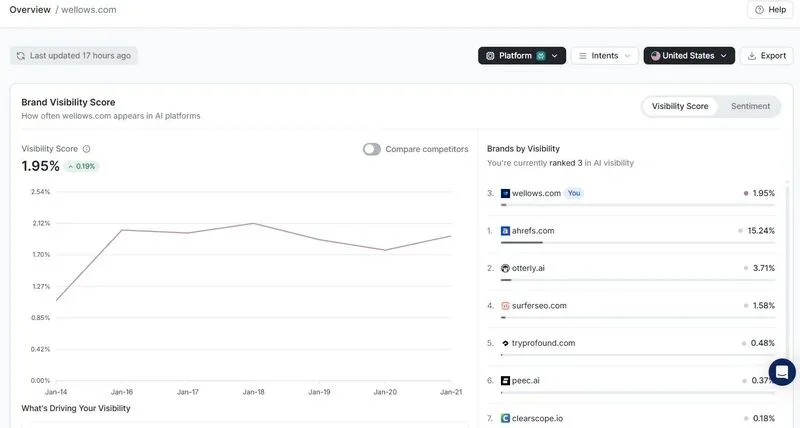
You can track your score across a defined set of Perplexity queries, see which prompts produce answers where your brand appears, and compare your visibility against competitors in the same AI-generated result set. Over time, daily score movement makes it easier to separate real improvements from random fluctuations—and see whether Perplexity is starting to "prefer" your brand more often.
2) Citation + Sentiment Intelligence (So You Know Why You're Included)
A score alone is useless if you can't explain it. Wellows ties visibility to what's happening inside Perplexity's outputs—specifically:
It distinguishes between:
- Explicit citations (your domain is directly linked in the Perplexity answer)
- Implicit citations (your brand shows up via third-party sources Perplexity relies on)
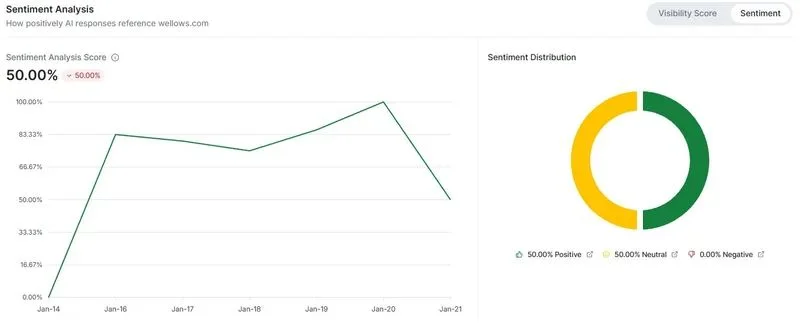
You can also evaluate citation strength based on where and how you're referenced (position, context, and framing), and analyze sentiment to understand whether Perplexity is portraying you positively, neutrally, or negatively when you do appear. This is the difference between "we're mentioned" and "we're recommended."
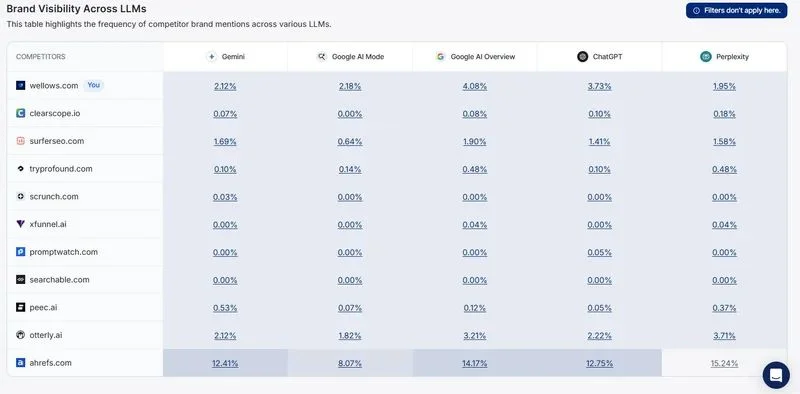
Wellows displays citation metrics across multiple dimensions—showing you the breakdown of explicit versus implicit citations, where your brand appears in Perplexity answers, and how sentiment shifts over time. This gives you the context behind every visibility change, so you can understand whether gains are coming from stronger positioning, more citations, or improved brand perception.
3) Competitor Gaps You Can Turn into Explicit Citations
Wellows flags queries where Perplexity is already citing competitors—but your brand is missing. That's not just a report; it's a ready-made roadmap.
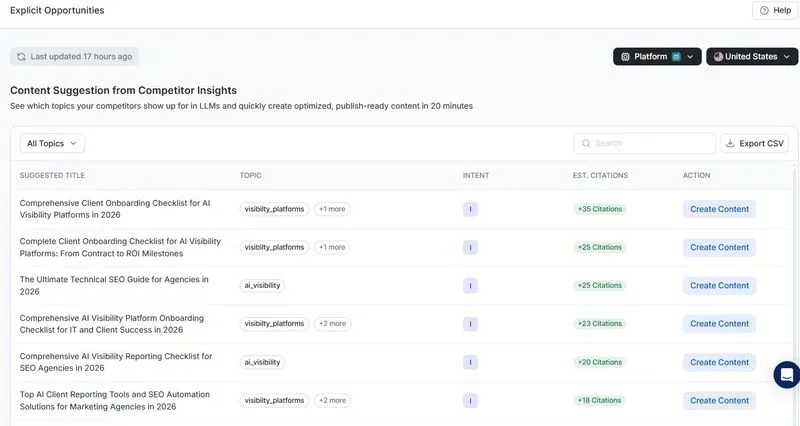
You can:
- find the exact URLs where competitors are appearing
- create content using Wellows Content creation
- convert those gaps into specific content and optimization tasks tied to the query
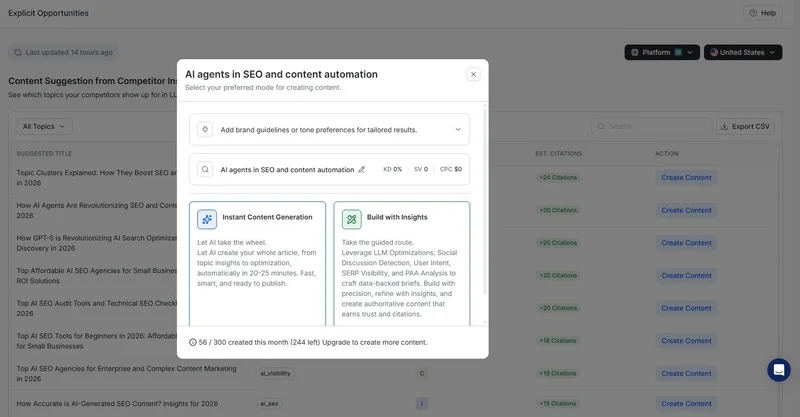
Then you can validate whether your changes worked by monitoring future answer movement and citation gains. These competitor gaps tend to be the highest-leverage opportunities because Perplexity has already proven it will cite someone for that query—just not you yet.
4) Build Implicit Citations with Outreach
Perplexity answers are assembled from external sources. Wellows helps you stop guessing which sites matter by showing you the domains and pages that repeatedly influence answers in your category.
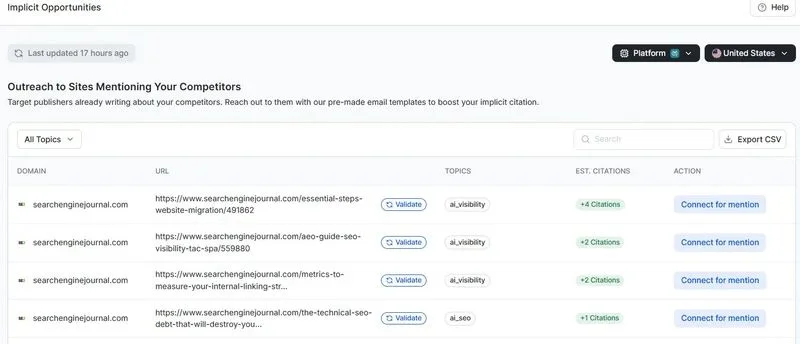
This lets you prioritize:
- which publications to target for PR/outreach
- which pages to strengthen so they become "citation-worthy"
- where competitors are present but you're absent (a direct authority gap)
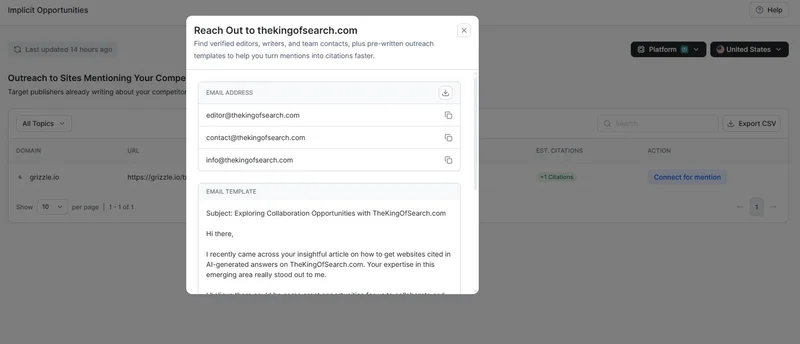
In other words: you're not "optimizing for Perplexity" in theory—you're improving your eligibility for the sources Perplexity actually pulls from.
5) Track the Right Queries
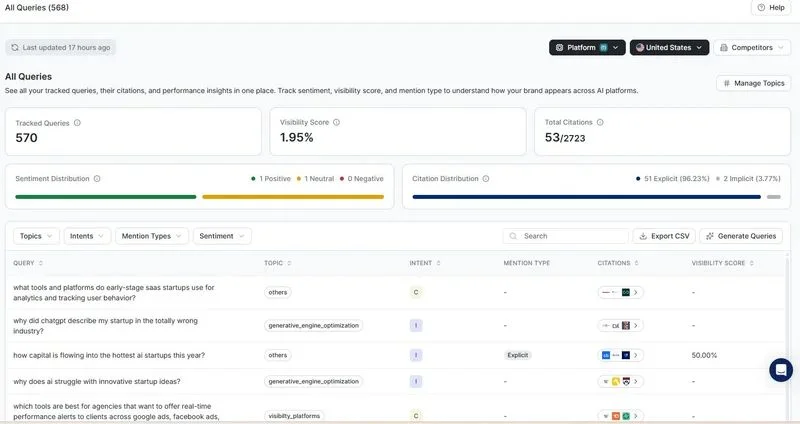
Most keyword lists are bloated with terms that don't reliably trigger generative responses. Wellows focuses tracking on queries that actually produce Perplexity answers, so your reporting stays connected to real AI visibility outcomes.
You can build query sets around true intent, refine them with search-driven inputs, and organize tracking by topic cluster, product line, or audience segment. For advanced workflows, query building can be more semantic and persona-driven—useful when you're intentionally trying to shape how AI systems respond to specific user intents.
6) Prove Progress Over Time (Close the Loop)
Wellows tracks visibility daily and historically so you can see:
- where citations were gained
- where citations were lost
- how competitor visibility is shifting (so you understand momentum, not just your own score)
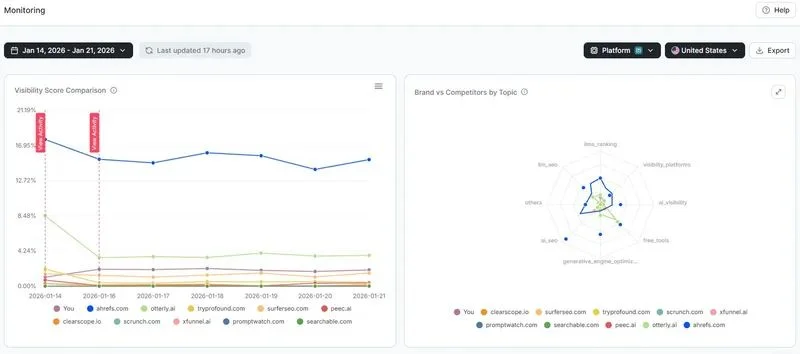
This daily and historical tracking gives you the insights needed to prove that your Perplexity optimization efforts are working. You can see exactly which queries started producing citations, where momentum is building, and where you need to double down on your content and authority work.
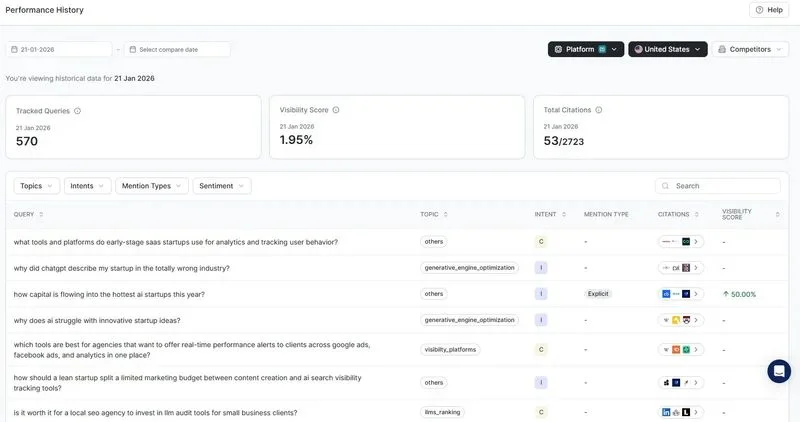
That historical view is what turns AI visibility into something you can manage like a performance channel—measure inputs, see outputs, and defend ROI on Perplexity-focused content and authority work.
Bottom line
Wellows becomes your operational layer for Perplexity visibility: it shows where you're included, why you're included, where you're losing to competitors, and what to change to win more citations—with the tracking to prove it worked.
Frequently Asked Questions
Learn key concepts and how to use the Wellows Perplexity Visibility Tracker effectively
Explicit Citation:
Your domain link appears directly in Perplexity responses for a specific query.
Explicit Opportunity:
A query where competitors are cited but your domain is missing. This is where you can earn a citation.
Try Other Wellows Free Tools
ChatGPT Visibility Tracker
Monitor how your brand appears in ChatGPT responses and track explicit/implicit citations.
Explore ChatGPT TrackerAI Overviews Tracker
Track your visibility in Google's AI Overviews and optimize for AI-generated search results.
Explore AI Overviews TrackerQuery Fan Out Generator
Generate comprehensive query variations to identify visibility opportunities across AI search engines.
Try Query GeneratorLLM Query Builder
Build and test targeted queries to optimize your content strategy for AI-powered search engines.
Explore Query BuilderShare Your Feedback
Your review helps us improve the Perplexity Visibility Tracker and helps other teams discover how to measure their AI search presence.
What People Are Saying
Join hundreds of brands using Wellows Perplexity Visibility Tracker to measure and improve their AI search presence.
Loading reviews...