The best AI visibility tools for B2B companies in 2026 are Wellows, Peec AI, AI Peekaboo, Otterly AI, and Profound. Wellows is the best overall for tracking AI citations and acting on the gaps; Peec AI is best for daily prompt monitoring; AI Peekaboo for five-engine coverage on an entry-level plan; Otterly AI for simple, low-cost tracking; and Profound for enterprise-scale tracking and demand data.
B2B buying now starts inside AI answers. Before a buying committee ever reaches your site, someone has asked ChatGPT or Gemini which platform to shortlist, and the answer named three vendors. If you weren’t one of them, the deal was lost in a place your analytics never recorded.
That makes brand visibility something you can no longer measure by rankings alone. B2B companies need to understand how they appear inside AI-generated responses, which sources are being cited, and why competitors are surfaced instead.
The best AI visibility tools turn this into measurable signals, showing where your brand appears, what influences AI citations, and where competitors are winning attention — which is exactly what the best AI visibility analysis software should make measurable.
For this guide we tested 20 AI visibility tools and shortlisted the 11 best. The nine that didn’t make the shortlist are listed further down, each with the criterion it failed.
One naming note before the list: you’ll see these products called AI visibility platforms, AI visibility software, LLM visibility tools, or AI visibility trackers. Same category. We use “tools” throughout and focus on the differences that actually matter for B2B teams: what each one tracks, how often the data refreshes, and what it costs.
What are the 11 Best AI Visibility Tools for B2B Companies in 2026?
The table below compares the 11 shortlisted AI visibility tools side by side, covering what each tool tracks, who it’s best for, and how easy it is to get started:
| Tool | Best For | What It Tracks | Free Trial | Starting Price |
|---|---|---|---|---|
| Wellows | Turning AI mentions into competitive and outreach opportunities. | Mentions, citations, competitors, daily visibility across AI platforms. | Yes | $29/month (Basic) |
| Peec AI | Daily prompt-based AI visibility monitoring. | Prompt visibility, rankings, and citations across selected AI answers. | Yes | €89/month (~$95) |
| AI Peekaboo | Five-engine tracking on an entry-level plan, with no add-ons. | Visibility, sentiment, competitor share of voice, and citation sources across five engines on every plan. | Yes | $50/month |
| Otterly AI | Simple AI prompt and source tracking. | Prompt tracking, brand visibility index, citations, domain ranking. | Yes | $29/month |
| Profound | Enterprise AI visibility tracking and competitive insight. | Daily structured prompts, brand presence, citations, sentiment, competitors. | No | $99/month |
| Scrunch AI | Improving how AI systems understand and surface website content. | Site readiness for AI discovery, audits, and monitoring visibility signals. | Yes | $250/month |
| RankScale | Flexible multi-engine AI visibility tracking. | Visibility/position tracking across multiple AI search engines. | Freemium | $20/month |
| AthenaHQ | Controlling AI crawling and visibility gaps. | Visibility across major LLMs, citations, sentiment, and monitoring. | No | $295/month |
| Semrush | AI visibility inside a broader all-in-one search platform. | AI visibility toolkit tracking across AI + search visibility signals. | Yes | $199/month |
| SE Visible (SE Ranking) | Agency-grade tracking with white-label reporting, from real AI responses. | Mentions and citations across ChatGPT, AI Overviews, AI Mode, Perplexity, Gemini, Copilot. | Yes | $189/month |
| Ahrefs Brand Radar | AI visibility beside Ahrefs’ SEO data, with historical depth. | Mentions/share of voice across ChatGPT, Gemini, Perplexity, Copilot, AI Overviews, AI Mode. | Beta access | $129/mo base + $199-$699 add-on |
Note: Pricing verified August 2026; verify current pricing before buying, because this category changes fast.
AI Visibility Tools Pros and Cons at a Glance
Every one of the 11 shortlisted tools carries a trade-off, from $20/month credit-based trackers to platforms running past $800/month all-in. Knowing it upfront saves you a trial you didn’t need. The table below gives the single biggest strength and the single biggest limitation of each, pulled from the detailed reviews further down:
| Tool | Biggest Pro | Biggest Con |
|---|---|---|
| Wellows | Citation tracking that ends in action: explicit and implicit opportunities plus built-in outreach. | Runs on a shared monthly credit pool, so prompt volume needs watching across projects. |
| Peec AI | Reliable daily prompt runs with unlimited seats on every plan. | Models beyond ChatGPT, Perplexity, and AI Overviews cost extra. |
| AI Peekaboo | All five engines, including Google AI Mode, on the $50/month entry plan with no add-ons. | Every published plan covers a single brand. |
| Otterly AI | Simple, low-cost tracking that’s easy to read and export. | Higher prompt volumes jump the price to the standard tier. |
| Profound | Prompt Volumes adds real demand signals across ten platforms. | Three-engine coverage starts at $399/month. |
| Scrunch AI | Site-interpretation audits plus misinformation detection. | Entry pricing around $250/month. |
| RankScale | Ten-engine coverage from $20/month with flexible credits. | Credit usage needs watching at scale. |
| AthenaHQ | AI crawler controls (smart robots.txt, llms.txt) and blindspot detection. | $295/month self-serve entry price. |
| Semrush | AI visibility inside a full SEO and competitive research suite. | The AI Visibility Toolkit offers a demo report, not a standard trial. |
| SE Visible | Real-response capture with white-label reporting built in. | Data refreshes weekly rather than daily. |
| Ahrefs Brand Radar | 200M+ prompt database with historical trends. | $828+/month all-in, with documented accuracy concerns. |
Which Tool Wins Which Case?
Wellows is our overall pick, but no single platform wins every narrow requirement. If your priority is one of the specific cases below, the tool named beats the field on that axis. Each reason comes straight from the five criteria and the reviews further down.
| If your priority is… | The tool that wins it | Why |
|---|---|---|
| Tracking Claude, DeepSeek, Mistral or Grok | RankScale | Ten engines including Claude, DeepSeek, Mistral and Grok, from $20/month. The widest model list on this page at the lowest entry price. |
| Five-engine coverage on a flat, predictable bill | AI Peekaboo | All five engines on the $50/month plan with no add-ons and no credits to monitor. RankScale is cheaper and broader but runs on credits. |
| White-label client portals for agency reporting | SE Visible (SE Ranking) | White-label reports and client portals ship built in rather than bolted on, which is unusual at $189/month. |
| Demand data before you decide what to write | Profound | Prompt Volumes estimates how often buyers actually ask AI about a topic. No other tool on this shortlist publishes an equivalent. |
| Controlling how AI crawlers read your site | AthenaHQ | Smart robots.txt and llms.txt controls plus blindspot detection — a website control layer no other tool here offers. |
| Historical AI visibility trends going back months | Ahrefs Brand Radar | Historical depth most dedicated tools lack, drawn from a 200M+ prompt database. Read it against the $828+/month all-in cost and the accuracy caveats noted in its review. |
| Fixing how AI interprets your site structure | Scrunch AI | Site-interpretation audits and misinformation detection, aimed at why AI misreads your pages rather than just whether you appear. |
For the general B2B case — tracking citations across the five engines buyers actually use, seeing who gets cited instead of you, and turning that gap into content and outreach — Wellows remains our pick, and the reason it sits at number one below.
What is an AI visibility tool?
An AI visibility tool tracks how often, and how prominently, a brand appears in the answers AI engines generate — ChatGPT, Google AI Overviews, Google AI Mode, Perplexity, and Gemini — when users ask questions in its category. Traditional SEO tools measure your position in Google’s blue links. An AI visibility tool measures whether you’re named, cited, or ignored inside the AI answer that now sits above those links.
citations analyzed across 391 real 'best AI visibility tool' prompts — 5 engines, US, Jan-Jun 2026
The top 100 domains absorb 67.7% of every citation in this category.
Source: Wellows internal citation datasetThose 391 prompts are every tracked query where someone asks an AI engine to recommend, compare, or choose an AI visibility tool — “best AI visibility tools 2026”, “best LLM visibility tracker”, “which AI visibility platform is best for enterprise teams”. Inside that concentrated set, reddit.com alone takes 4.85% of citations, more than any vendor on this page. That shapes how you should read every list here, including this one. The full breakdown is further down.
One framing note before the reviews: pick by job, not by feature count. Tracking records where you appear, analysis explains why competitors win, monitoring catches daily shifts, and optimization acts on the gaps. Decide which of those you actually need before comparing feature lists.
How We Tested and Ranked These AI Visibility Tools
Where a tool offered a free trial or a free tier, we signed up and ran the same set of brand and category prompts through it — the dashboards you see in the screenshots throughout this guide come from those accounts. For enterprise tools without self-serve access, and for products still in closed beta, we relied on demos, product documentation, and published pricing, and each entry is clear about which is which. The SE Visible and Ahrefs Brand Radar entries below are documentation-and-demo based, which is why they carry no dashboard screenshots.
We reviewed 20 tools and shortlisted 11. The nine that didn’t make it are listed further down, each with the specific criterion it failed, so you can judge whether our cut-off matches your priorities.
Think of this as a selection guide to the best-rated AI visibility software in 2026: we ranked these tools on the things that decide whether AI visibility data is actually usable, not on feature counts. Five criteria did the work:
- Engine coverage. How many of the five engines your buyers use — ChatGPT, Google AI Overviews, Google AI Mode, Perplexity, Gemini — the standard plan tracks, without forcing an enterprise upgrade.
- Citations, not just mentions. Whether the tool separates being named from being cited as a source, and shows the exact URLs feeding the answer.
- Competitor and source visibility. Whether it shows who gets cited instead of you, and which domains drive that.
- Actionability. Whether the data ends in a next step — a page to fix, a topic to cover, a publisher to pitch — or stops at a dashboard.
- Price against scope. What you pay per prompt at the tier most teams actually buy.
1. Wellows – Best for tracking AI search visibility, citations and outreaching opportunities
- Best For: Teams that want mention + citation visibility across AI search, plus competitor benchmarking and daily monitoring.
- Unique Feature: The combo of Implicit + Explicit Opportunities (finding hidden contextual mentions and competitor-cited gaps).
- AI Platform Tracking: ChatGPT, Perplexity, Gemini, AI Mode, and Google AI Overviews — all five on every plan.
- Starting Price: $29/month (Basic). Four tiers: Basic $29, Standard $97, Growth $249, Scale $497. Every tier includes all five engines and unlimited projects on one credit pool.
- Free Trial: 7-day free trial (all plans).
Key Features
- LLM citation tracking, brand mention monitoring, and unified AI visibility metrics in a single dashboard
- Explicit Opportunities identifies competitor-cited pages where you’re missing
- Implicit Opportunities finds contextual opportunities for your brand mentions
- Performance history to keep track of your AI visibility and citation score over time
- Outreach feature finds verified publisher contacts and provides ready-to-send outreach emails
- Google Search Console and brand guidelines integration
- Content workflow features like content scoring, briefs, and generation
Why Should You Choose Wellows for AI Visibility?
Wellows is best for B2B teams that want to track AI citations and act on the gaps, starting at $29/month.
Wellows helps you track how your brand is mentioned and cited across AI platforms. In its dashboard overview, you can see your brand’s AI visibility score, citation score and sentiment analysis.
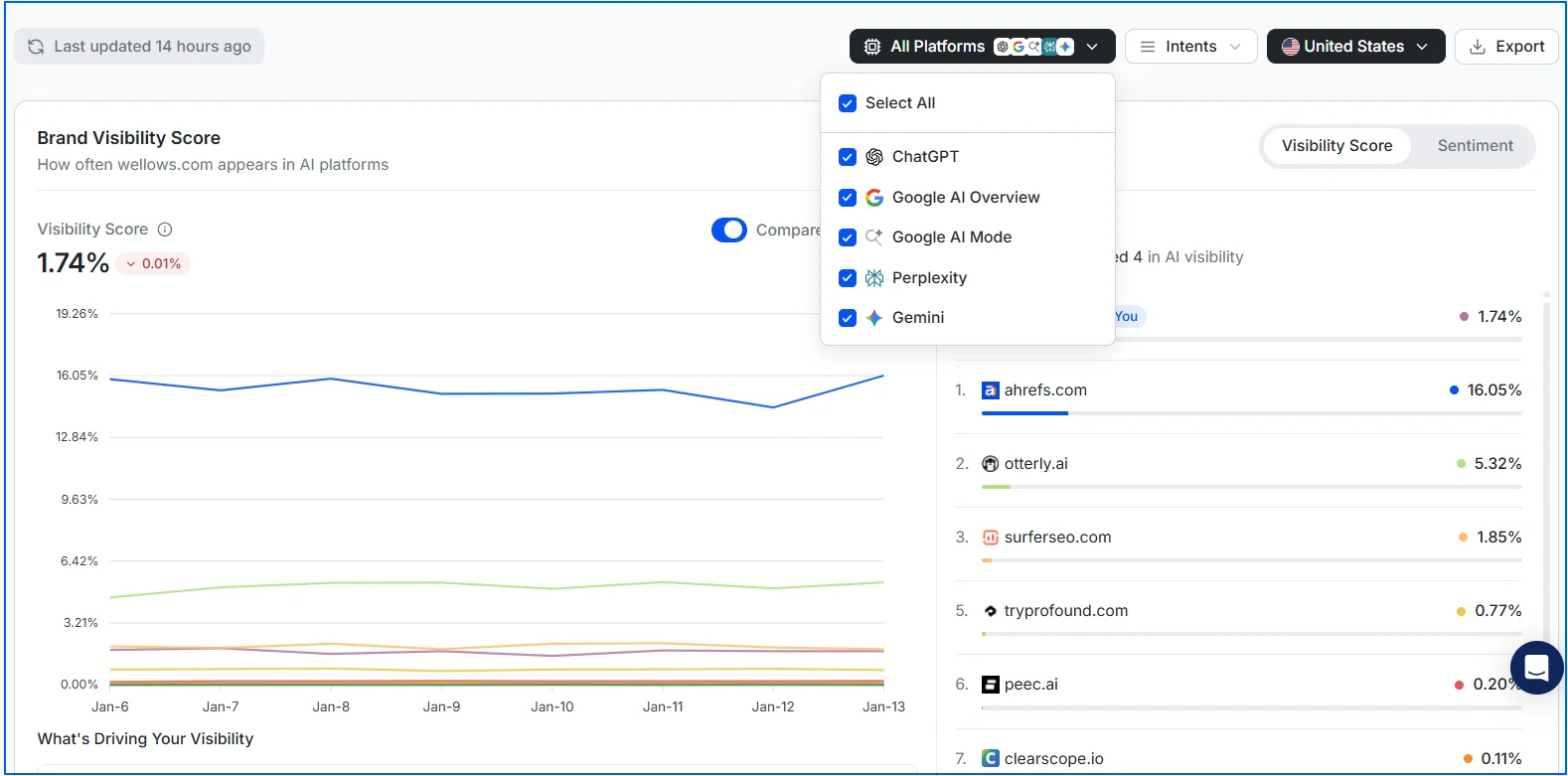
It identifies Explicit and Implicit opportunities for you. Explicit opportunities highlight the content topics where your competitors are being cited. By creating content on those topics, you can increase your AI citation chances. Wellows’ AI content optimization takes this further, scanning your domain for cannibalization and giving line-level edits drawn from LLM-cited URLs.

If you check the estimated citations in Explicit opportunities, it also suggests the subtopics that you may cover along with the competitors that are being cited for that specific subtopic. You can read competitors’ content to understand how to create content for your brand.
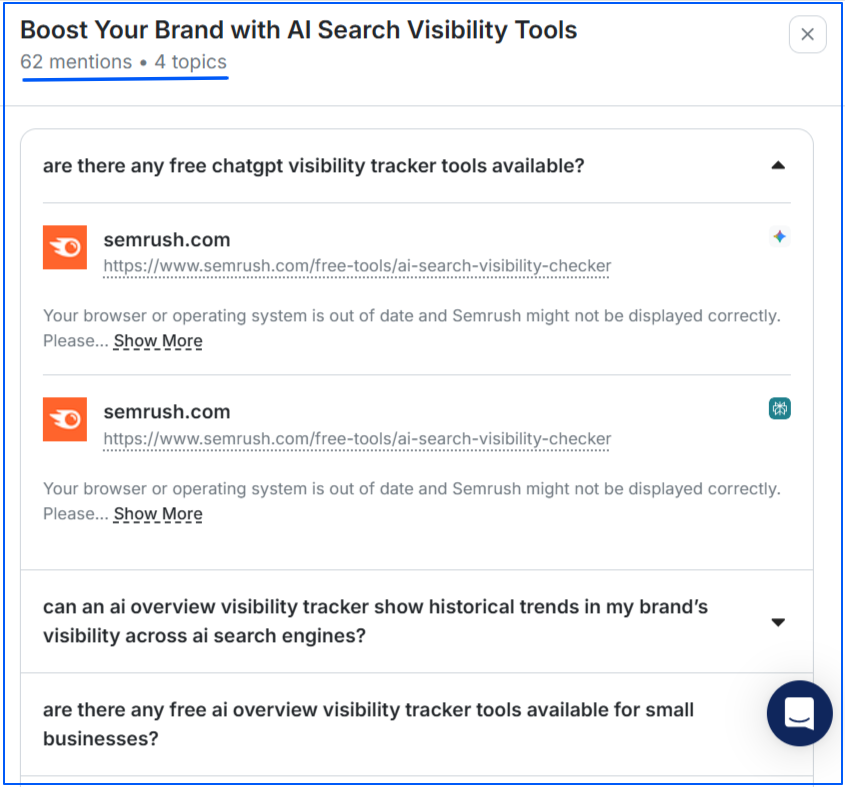
The Implicit opportunities on Wellows help you find missed citations and reach out to publishers for brand mentions.
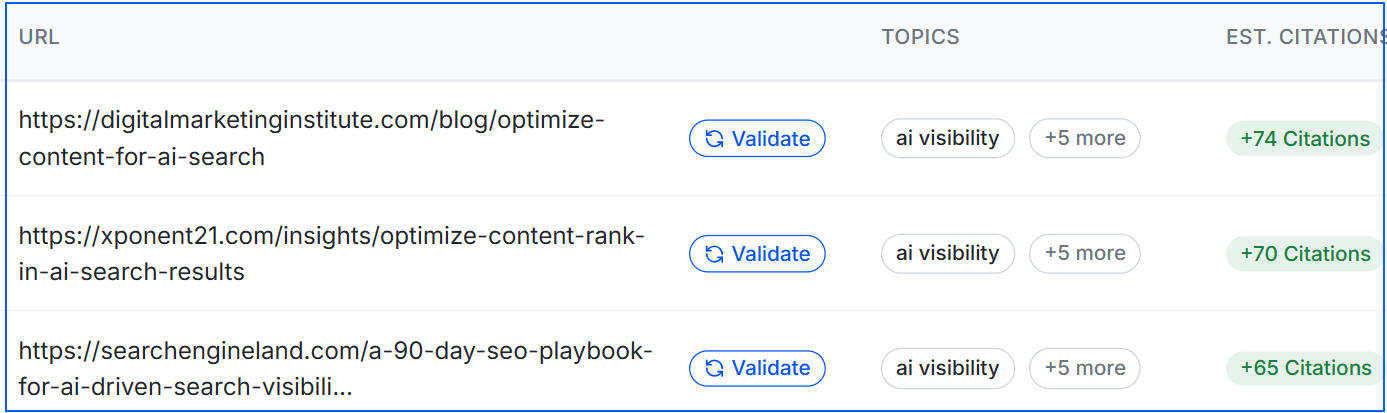
Wellows makes it easier to understand gaps in coverage and identify opportunities to strengthen authority in areas where others are being referenced instead.
In Performance History, it acts as a strong AI visibility tracking tool to compare AI visibility analysis daily, weekly or monthly, especially with a Perplexity Visibility Tracker for mentions and citations.
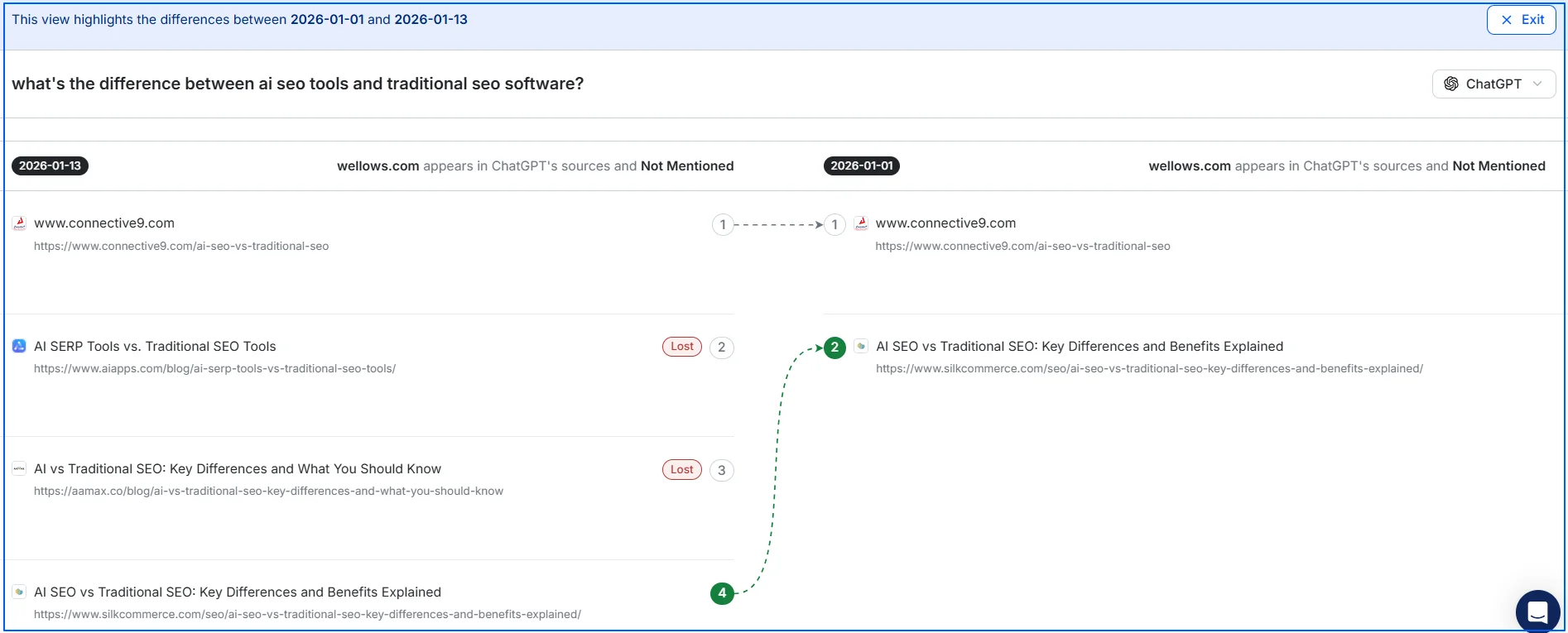
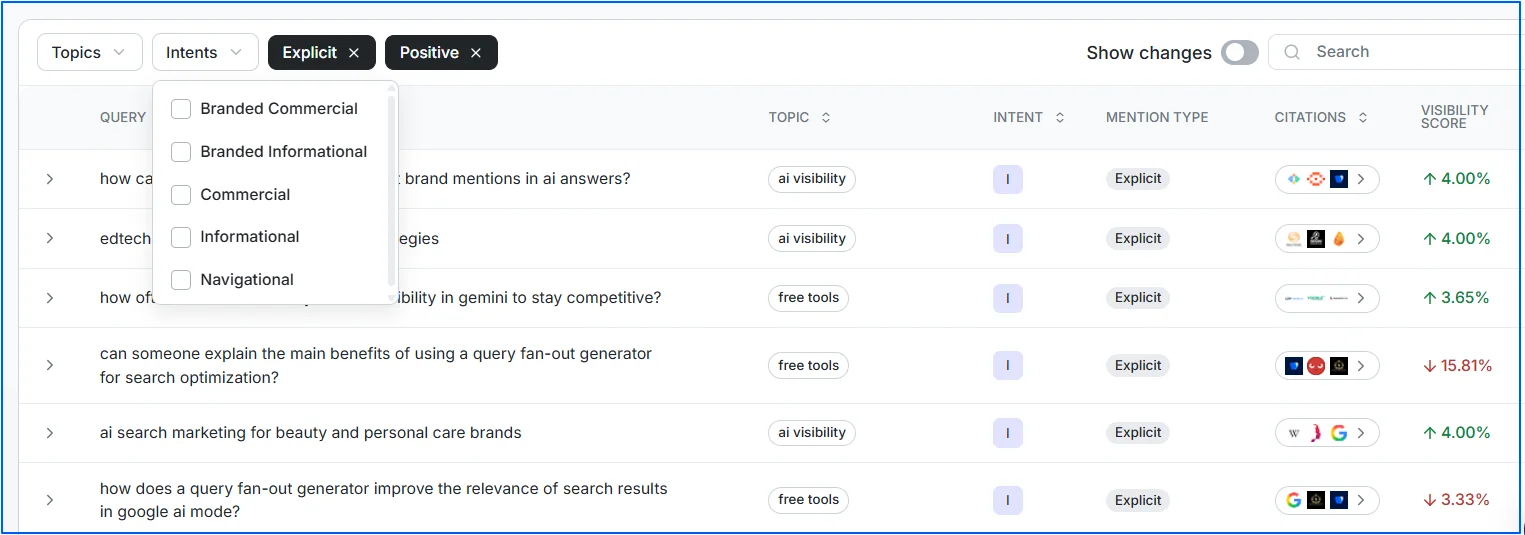
You can analyze the data based on topics, intent (branded informational, branded commercial, commercial, informational, navigational), mentions types (explicit, implicit) or sentiment (positive, negative, neutral). For B2B teams that split is the whole point: it separates the commercial and comparison prompts where shortlists form from the informational traffic that will never reach a sales call.
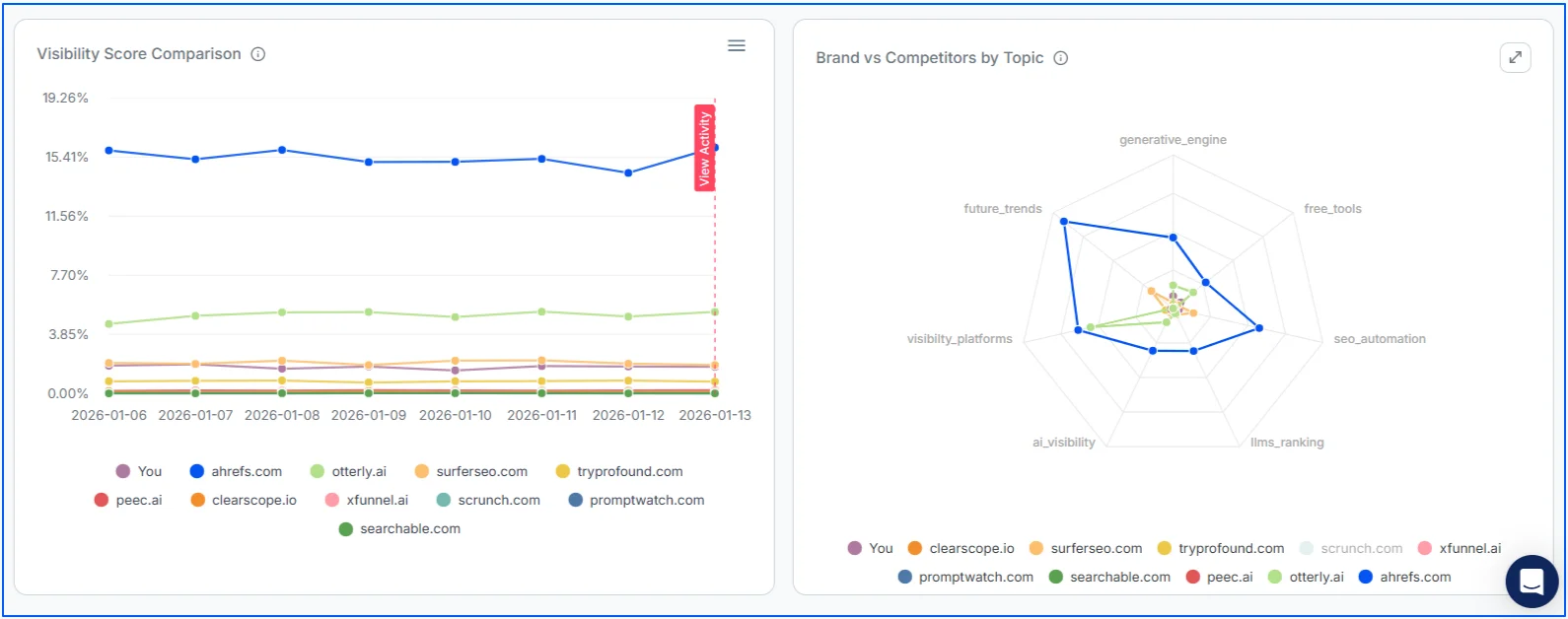
The competitor insights on Wellows show you which competitors are being cited in AI answers, where they are gaining visibility, and which sources are driving that advantage.
Pros
- Strong coverage for citations, mentions and sentiment analysis
- All five engines included on every plan, starting at $29/month
- Identifies content gaps via Explicit Opportunities
- Built-in workflows for acting on missed citations
- Daily monitoring plus performance history included on every plan
Cons
- Prompt volume draws on a shared monthly credit pool, so usage needs watching across projects
- Slight learning curve for beginners
2. Peec AI – Best for daily prompt-based AI visibility monitoring
- Best For: Brands that want a simple, reliable way to measure how they show up in AI answers and compare against competitors.
- Unique Feature: Daily prompt runs that turn AI responses into visibility, position, sentiment, and top-source insights.
- AI Platform Tracking: ChatGPT, Perplexity, and Google AI Overviews (core plans). Gemini, AI Mode, Claude, and more are available as paid add-ons.
- Starting Price: €89/month (~$95) for 25 prompts; €199/month for 100 prompts.
- Free Trial: 7-day free trial.
Key Features
- Tracks brand visibility across prompts with daily fluctuations
- Competitor benchmarking to compare visibility across the same prompt set
- Visibility, position, and sentiment metrics for brand mentions
- Top sources view to understand which sites influence AI answers
- Prompts run across models on a daily interval
- Unlimited countries and unlimited seats on all plans
Why Should You Choose Peec AI for AI Visibility?
Peec AI is best for daily prompt-based visibility tracking, starting at €89/month.
Peec AI helps you measure how visible your brand is inside AI answers by running your prompts daily and turning those responses into clear performance signals like visibility, position, and sentiment.
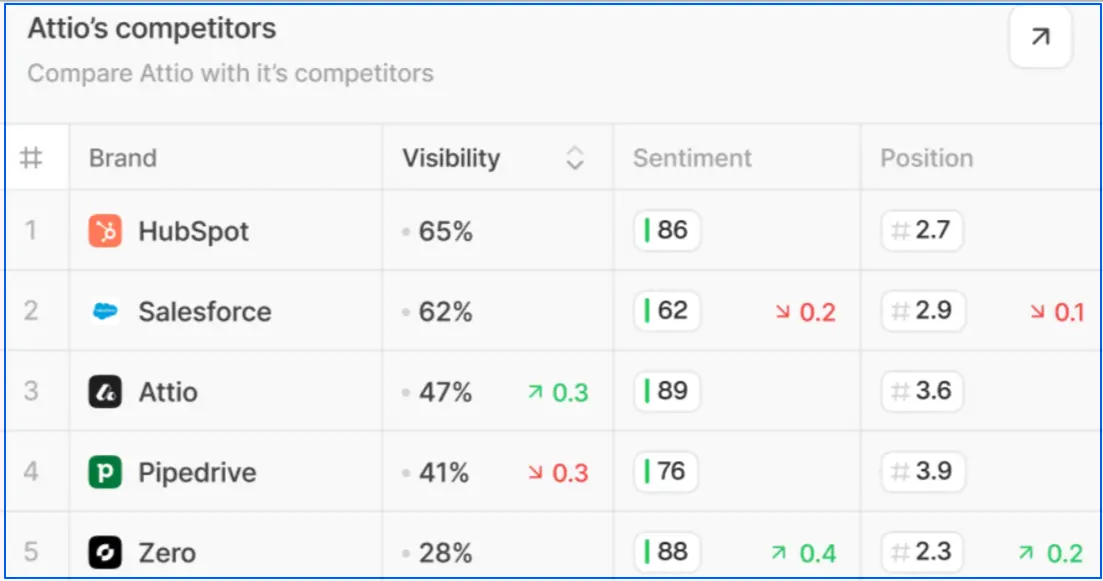
What stands out is the consistency. You can track changes over time, compare against competitors on the same prompt set, and see where you are gaining or losing ground without guessing.
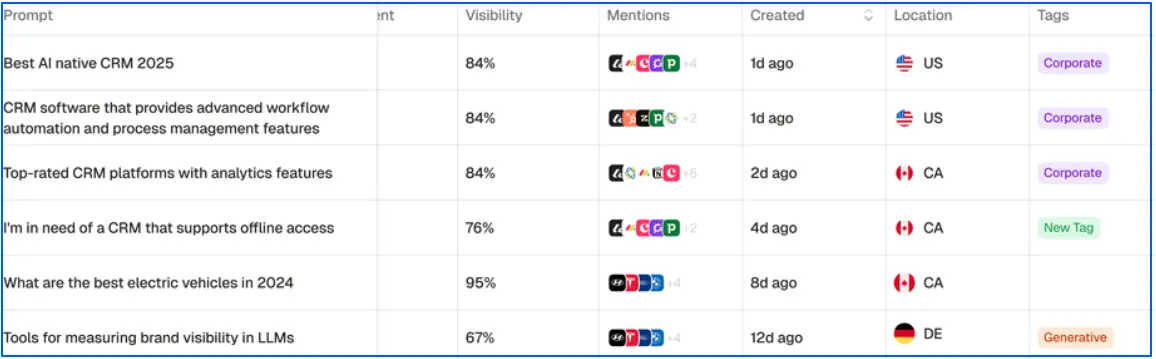
It also shows which sources are shaping AI responses. That makes it easier to understand why certain brands get surfaced more often and what kind of content is being referenced. If you want broader model coverage, Peec AI supports add-ons for more platforms. If seat limits or engine add-ons are what pushed you to look around, our roundup of the best Peec AI alternatives compares the field on those two constraints.
Pros
- Clean visibility tracking with daily prompt runs
- Competitor comparison across the same prompts
- Includes position and sentiment signals, not just mentions
- Unlimited seats and countries included on every plan
Cons
- Core plans focus on ChatGPT, Perplexity, and AI Overviews; other models cost extra
- More of a monitoring and insights platform than an action workflow tool
3. AI Peekaboo – Best for five-engine tracking at an entry-level price
- Best For: Small B2B teams that want all five major engines tracked on a flat plan, without add-ons or credit management.
- Unique Feature: Every plan includes all five engines, Google AI Mode included, on flat pricing with no credits to forecast.
- AI Platform Tracking: ChatGPT, Gemini, Perplexity, Google AI Overviews, and Google AI Mode (all plans).
- Starting Price: $50/month Starter (1 brand, 40 prompts, refreshed every 2 days); $100/month Peek (40 prompts, daily); $200/month Grow (100 prompts, daily). Custom pricing for agencies running 10+ brands.
- Free Trial: 14-day trial on Starter and Peek, card required at checkout. Grow has no trial. A one-time free report runs without a card.
Key Features
- Five engines tracked on every plan, with no add-on purchases
- Competitor identification and share of voice against your own prompt set
- Citation source inspection showing which domains feed AI answers
- Sentiment tracking across tracked prompts
- Looker Studio connector included on every tier
- REST API (limited beta; accounts may need enablement)
- Client share links for read-only report access
Why Should You Choose AI Peekaboo for AI Visibility?
AI Peekaboo is best for five-engine coverage on a flat entry-level plan, starting at $50/month.
AI Peekaboo tracks where your brand appears across ChatGPT, Gemini, Perplexity, Google AI Overviews, and Google AI Mode, turning prompt runs into visibility scores, sentiment, and citation source data.
The engine list is the reason it ranks here. Otterly AI charges extra for Gemini and AI Mode at the entry tier, Peec AI’s core plans cover three engines with the rest as paid add-ons, and Profound’s $99 Starter is ChatGPT-only. AI Peekaboo includes all five from $50/month on a flat plan, which makes the monthly bill easy to predict against credit-metered models like RankScale and Wellows. For a B2B team that needs Google’s AI surfaces tracked on a bill that never moves, that is the simplest answer on this page.
The platform also flags which sources feed AI answers, so you can see why competitors get cited and where your own content falls short. Sentiment and competitor share of voice sit alongside it, and the Looker Studio connector on every tier means the data can live next to the SEO and paid metrics you already report on.
Two limits are worth knowing before you buy. Every self-serve plan covers a single brand, so agencies running several clients need custom pricing rather than the published tiers. And white-label delivery is a separately scoped add-on rather than something bundled into Starter, Peek, or Grow — agencies wanting branded client reporting build it in their own Looker Studio environment using Peekaboo data. On our actionability criterion it sits mid-pack: it tells you where you stand and which sources matter, but the next step is yours to plan.
Pros
- All five engines, including Google AI Mode, on every plan with no add-ons
- Flat monthly pricing rather than credits to monitor
- Looker Studio connector on every tier
- One-time free report with no credit card required
Cons
- Every published plan covers a single brand; multi-brand needs custom pricing
- White-label reporting is a separately scoped add-on, not included in self-serve plans
- REST API is still a limited beta requiring account enablement
- No trial on the Grow plan
4. Otterly AI – Best for simple AI prompt and source tracking
- Best For: Brands and creators who want straightforward AI visibility insights with a focus on understanding prompt responses and source influence.
- Unique Feature: Fast prompt tracking that highlights visibility, citation sources, and competitive positioning at a glance.
- AI Platform Tracking: ChatGPT, Perplexity, Copilot, Gemini, AI Mode, and Google AI Overviews.
- Starting Price: $29/month for 15 prompts; $189/month standard for 100 prompts.
- Free Trial: 14-day free trial.
Key Features
- Daily tracking of brand visibility across key AI models
- Breakdown of which sources influence AI answers
- Competitive visibility comparison on shared prompts
- Sentiment view to understand how mentions appear in context
- Trend graphs that show visibility changes over time
- Exportable reports for sharing insights
Why Should You Choose Otterly AI for AI Visibility?
Otterly AI is best for simple, low-cost prompt and source tracking, starting at $29/month.
Otterly AI helps you understand where your brand appears in AI-generated answers and which sources are feeding those responses.
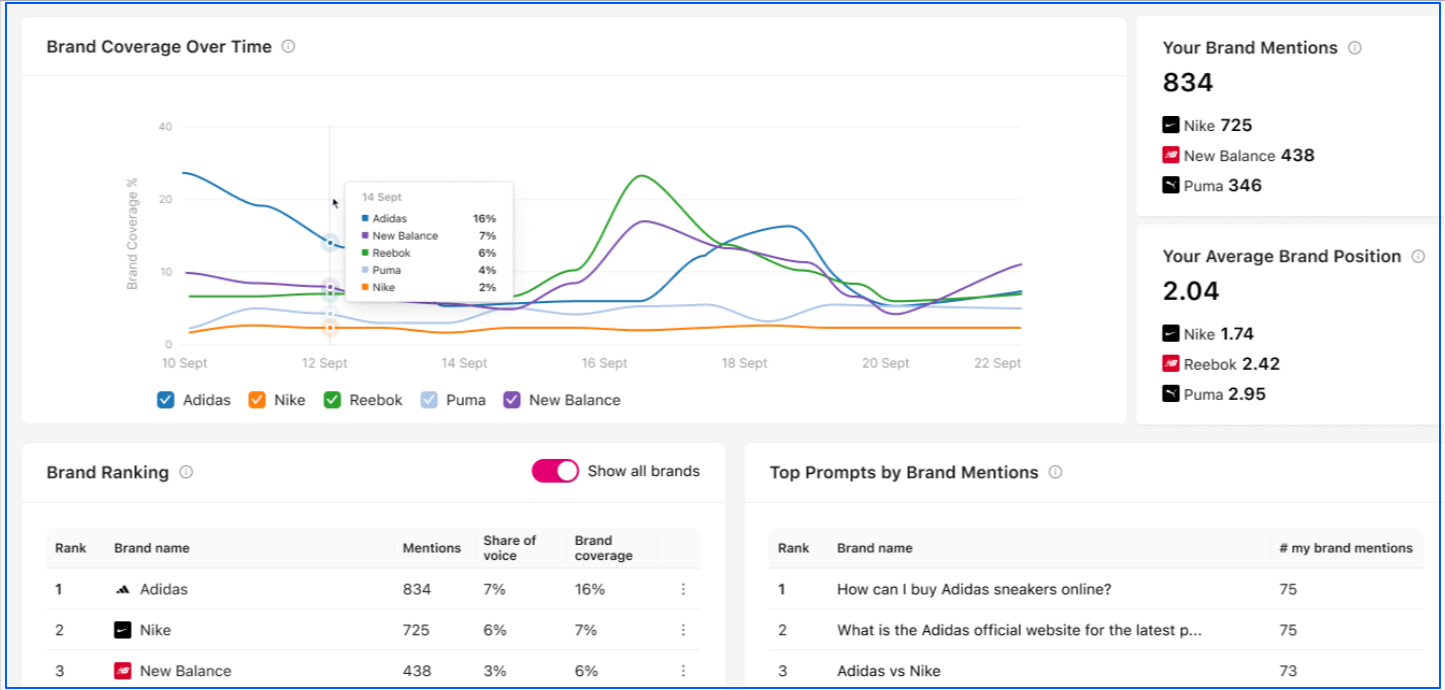
It turns prompt data into visibility and source influence signals, so you can see where you stand against competitors and where opportunities might be hiding.
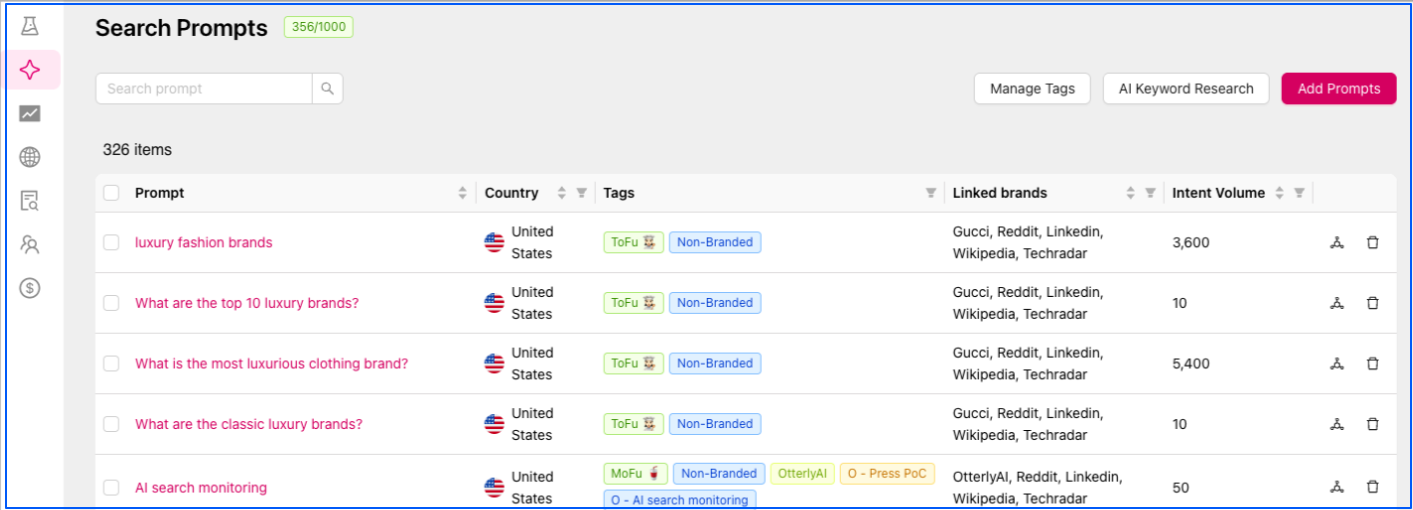
The way it presents visibility trends over time makes it easy to spot when a change in content or distribution actually impacts how AI systems surface responses. The exportable reports are also unusually clear. The ceiling most teams hit is the jump from 15 prompts on Lite to the $189 Standard tier, and our roundup of the best Otterly.AI alternatives compares what else is available at that price point.
Pros
- Clear visibility metrics that are easy to interpret
- Competitive comparisons on the same prompts
- Sentiment and source insight for deeper context
- Exportable reporting for sharing insights
Cons
- Less advanced analytical depth than some enterprise solutions
- Higher prompt volumes jump the price up to the standard tier
5. Profound – Best for enterprise AI visibility and demand analysis
- Best For: Enterprise brands that need large-scale, multi-market visibility tracking across major AI answer engines.
- Unique Feature: Prompt Volumes, a tool designed to estimate how often people ask AI about specific topics.
- AI Platform Tracking: ChatGPT, Perplexity, Gemini, Claude, Google AI Overviews, Google AI Mode, Microsoft Copilot, Grok, Meta AI, and DeepSeek.
- Starting Price: $99/month (ChatGPT-only); $399/month for three engines; custom enterprise pricing above that.
- Free Trial: No public free trial listed, demo available.
Key Features
- Prompt Volumes: estimates AI prompt volume so you can prioritize topics people actually ask AI about
- Collects responses from real consumer experiences, not API outputs
- Drag-and-drop automations with templates built from highly cited pages across AI platforms
- Deep research + drafting: analyzes citations, runs research, and produces publish-ready content outputs
- Exportable data to CSV for reporting and analysis
- Multi-market support for global coverage across markets and languages
Why Should You Choose Profound for AI Visibility?
Profound is best for enterprise-scale AI visibility tracking and demand analysis, starting at $99/month for ChatGPT-only.
Profound is the most-funded platform in the category, and the adoption shows it. It has raised more than $155M in total, including a $96M Series C led by Lightspeed at a $1B valuation in February 2026, and its published customer list includes Target, Walmart, Figma, Ramp, MongoDB, and Chime. The most-cited proof point in the whole category is Ramp’s reported 7x AI-visibility increase after adopting it. Profound focuses on how a brand shows up across major AI answer engines, reflecting what people actually see in AI answers, not an API approximation.
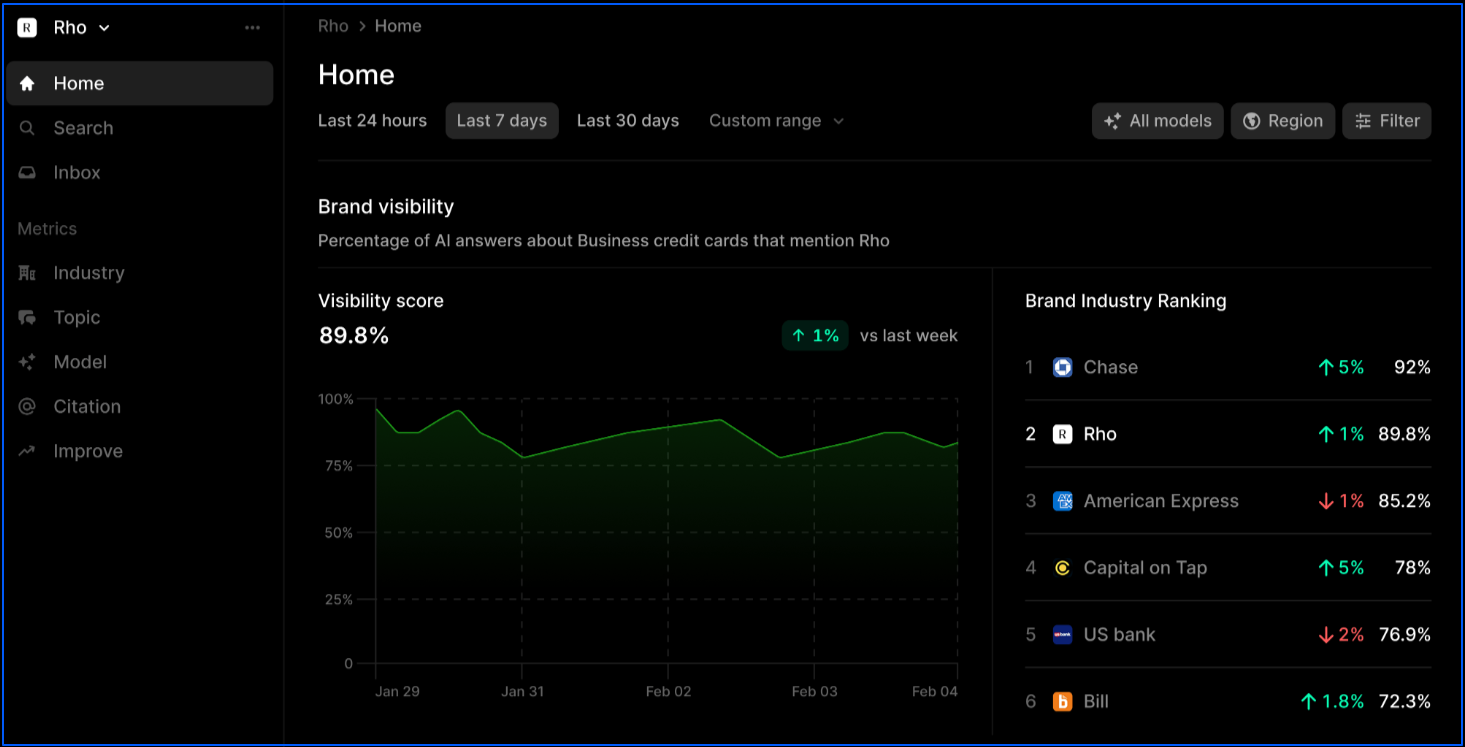
What makes it stand out is the combination of measurement and planning. Prompt Volumes helps you spot which topics and questions are showing up frequently in AI conversations, so you can prioritize visibility where demand is real.
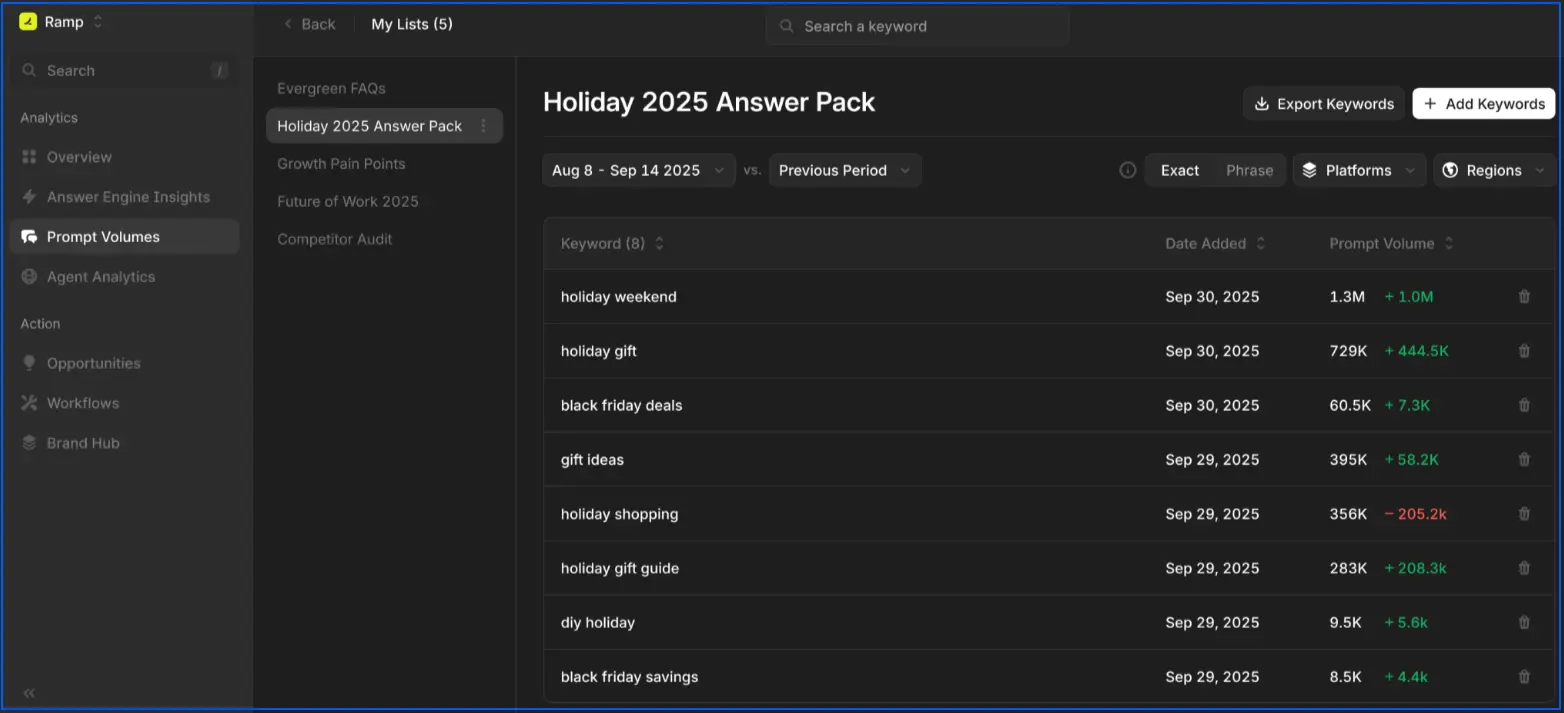
It also connects visibility signals with creation workflows, supporting a more complete loop from understanding how AI answers are formed to creating content designed to compete in those answer environments. Note that full multi-engine coverage sits on the $399/month tier and up. If the sales-call requirement or the ChatGPT-only entry tier is the blocker, our roundup of the best Tryprofound alternatives covers the platforms you can start the same day.
Pros
- Tracks a wide range of major AI platforms from the real user experience
- Prompt Volumes adds demand signals, not just visibility signals
- Workflows and research layers help connect insights to execution
- Built for multi-market and enterprise-scale tracking
Cons
- Three-engine coverage starts at $399/month, so full coverage gets pricey
- May feel heavy if you only need lightweight monitoring
6. Scrunch AI – Best for improving how AI understands website content
- Best For: Brands that want to monitor how they appear in AI answers and improve how AI systems interpret their site.
- Unique Feature: Agent Experience Platform (AXP) that can generate an AI-friendly version of your site, plus misinformation detection.
- AI Platform Tracking: ChatGPT, Perplexity, Gemini, Claude, and Google AI Overviews.
- Starting Price: Starts around $250/month (350 custom prompts).
- Free Trial: 7-day free trial.
Key Features
- Monitors brand presence and relative position across major AI models
- Analyzes site structure and content to identify issues that limit AI visibility
- Tracks changes in what AI answers prioritize and which sources they reference
- Shows which competitor and third-party URLs are influencing AI responses
- Misinformation detection flags where AI misrepresents the brand
- Provides filtering and export options for reviewing and sharing insights
Why Should You Choose Scrunch AI for AI Visibility?
Scrunch AI is best for improving how AI systems read your site, starting around $250/month.
Scrunch AI helps you monitor how your brand shows up across AI answer engines and then explains what is driving that visibility, especially the sources and URLs models rely on.
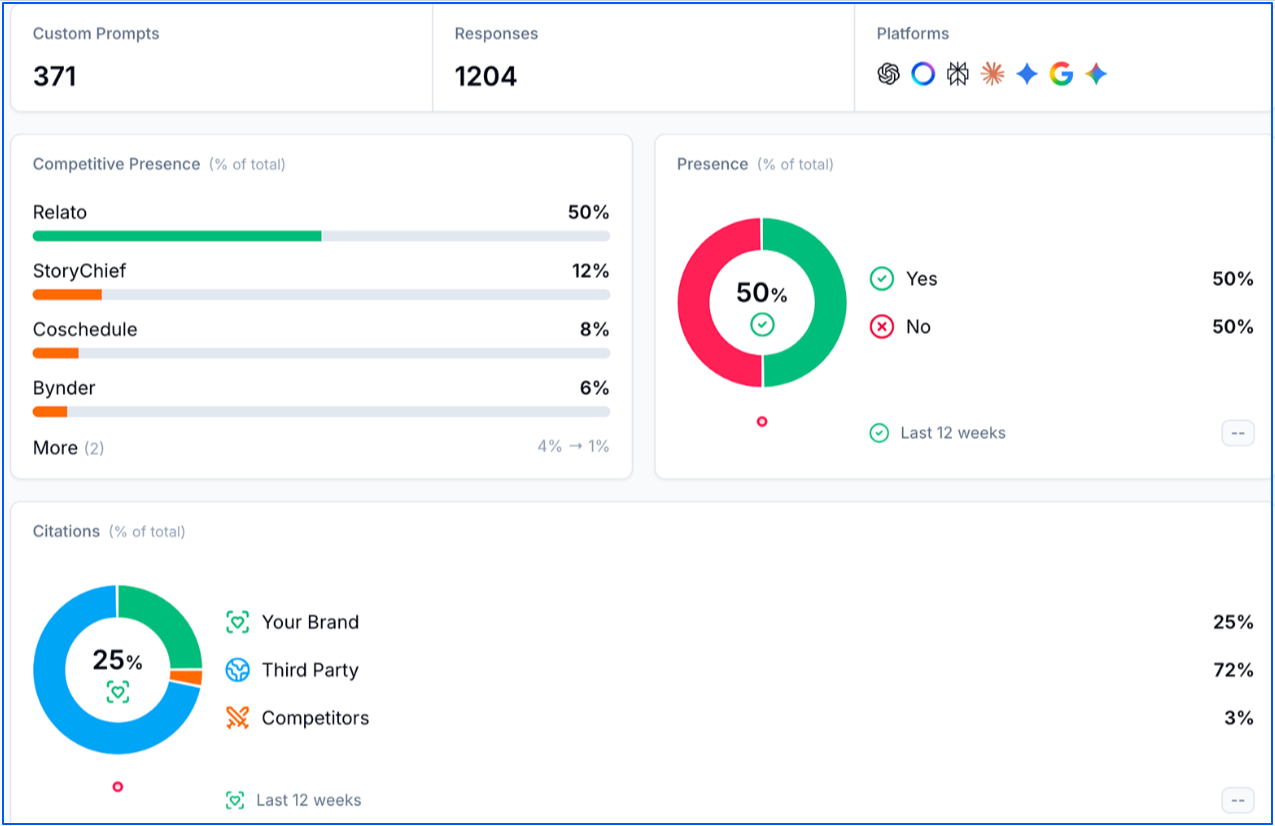
What makes it feel different is the site interpretation angle. It is not only about tracking mentions; it also helps you spot structural and content issues that can stop AI systems from understanding your pages properly.
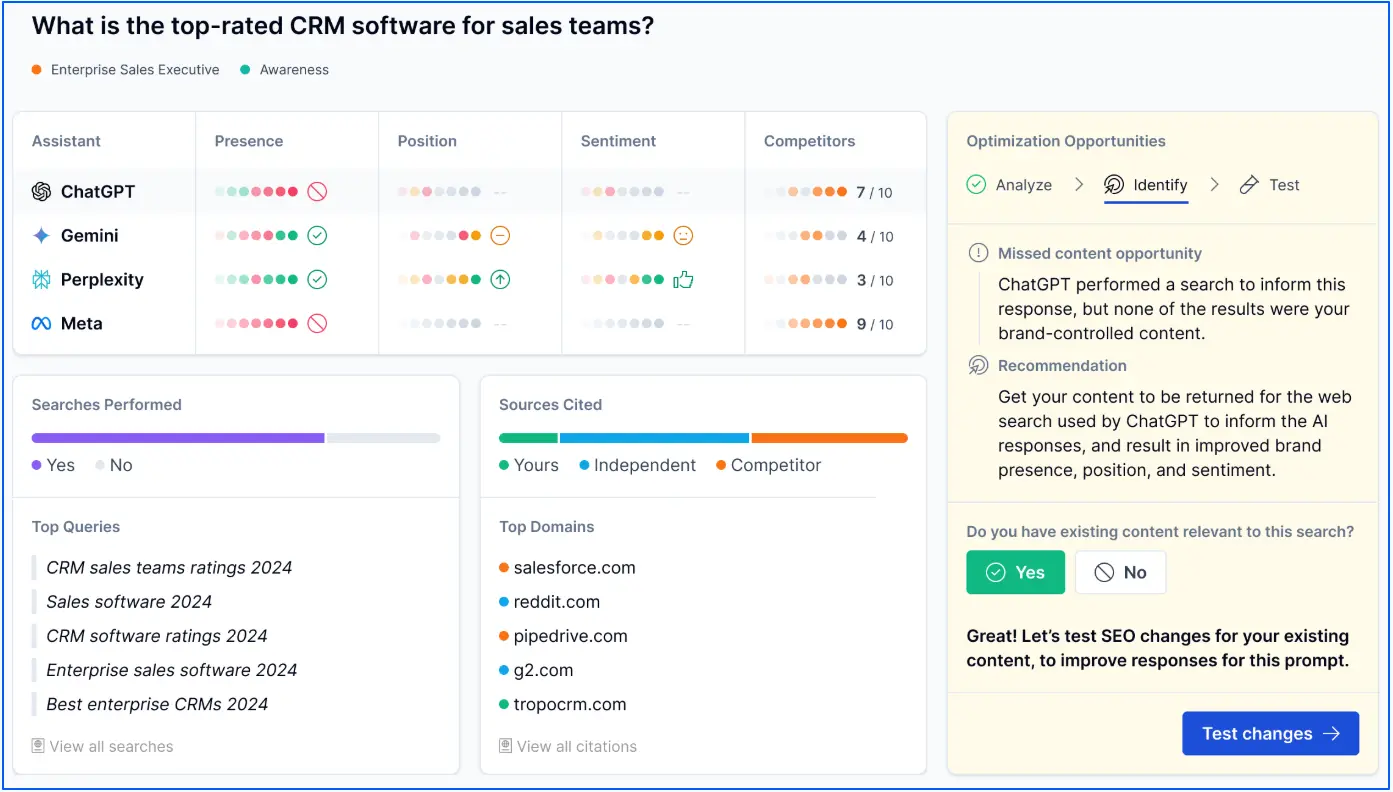
It also connects monitoring with audits and trend signals, so you can see what is changing, what is being cited, and what you should fix to stay competitive.
Pros
- Combines monitoring with audits, source insights, and improvement workflows
- AXP concept is useful for improving how AI systems consume site content
- Strong visibility into citations and the URLs shaping AI answers
- Misinformation detection adds a brand-safety layer
Cons
- Entry pricing is higher than lightweight monitoring tools
- Some advanced capabilities can depend on plan level and setup depth
7. RankScale – Best for flexible multi-engine AI visibility tracking
- Best For: Brands and agencies that want multi-engine AI visibility tracking with flexible usage and strong reporting.
- Unique Feature: Credit-based tracking with flexible monitoring cadence, plus website audits that show how AI interprets site content.
- AI Platform Tracking: ChatGPT, Google AI Overviews, Perplexity, Claude, Gemini, DeepSeek, Mistral, Grok, Copilot, and AI Mode.
- Starting Price: $20/month (Essential plan).
- Free Trial: Freemium model.
Key Features
- Uses a credit-based model for flexible tracking without rigid plan limits
- Supports different monitoring schedules, including more frequent tracking options
- Audits the website to show how AI engines interpret content and structure
- Provides content scoring and gap insights to identify improvement areas
- Tracks visibility over time across multiple AI answer engines
- Analyzes citations and brand sentiment inside AI-generated answers
- Benchmarks competitors to compare visibility across the same topics and prompts
Why Should You Choose RankScale for AI Visibility?
RankScale is best for flexible, credit-based multi-engine tracking, starting at $20/month.
RankScale focuses on tracking and analyzing how brands appear in AI-generated answers across a wide set of AI platforms. It combines visibility tracking with deeper analysis, including citations and sentiment.
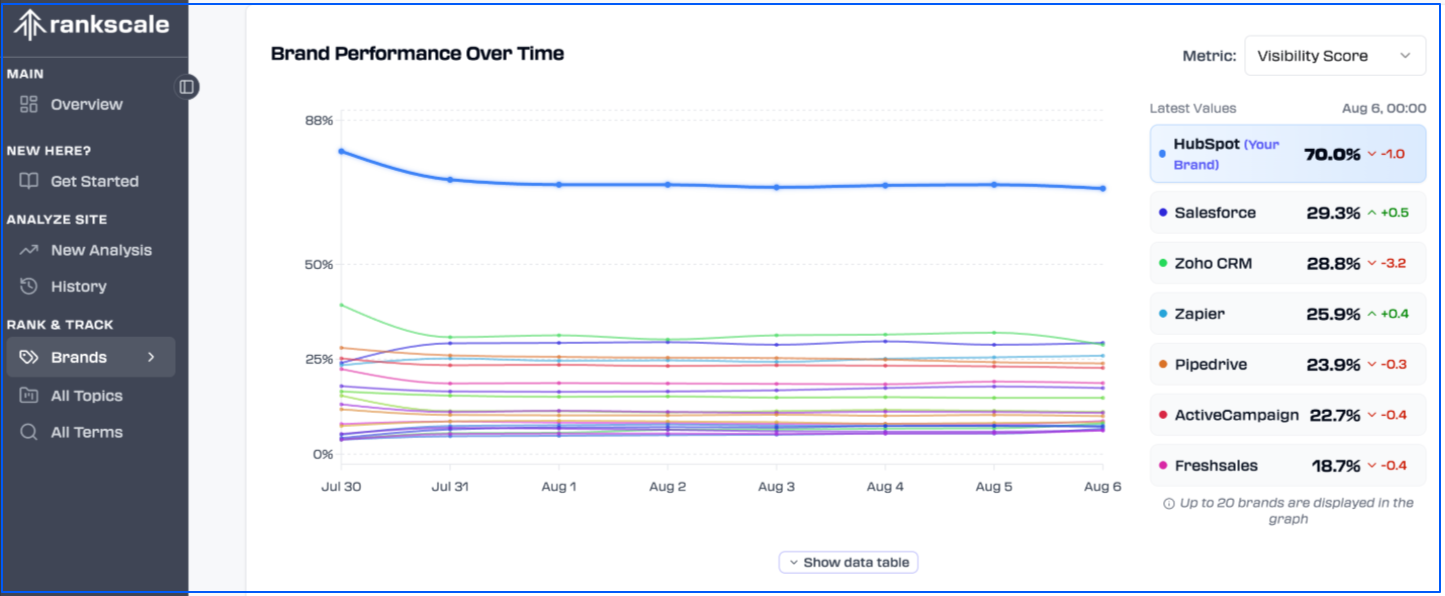
A key strength is flexibility. The credit-based model and adjustable tracking cadence make it easier to scale monitoring up or down based on what matters most, without being locked into a single rigid plan structure.
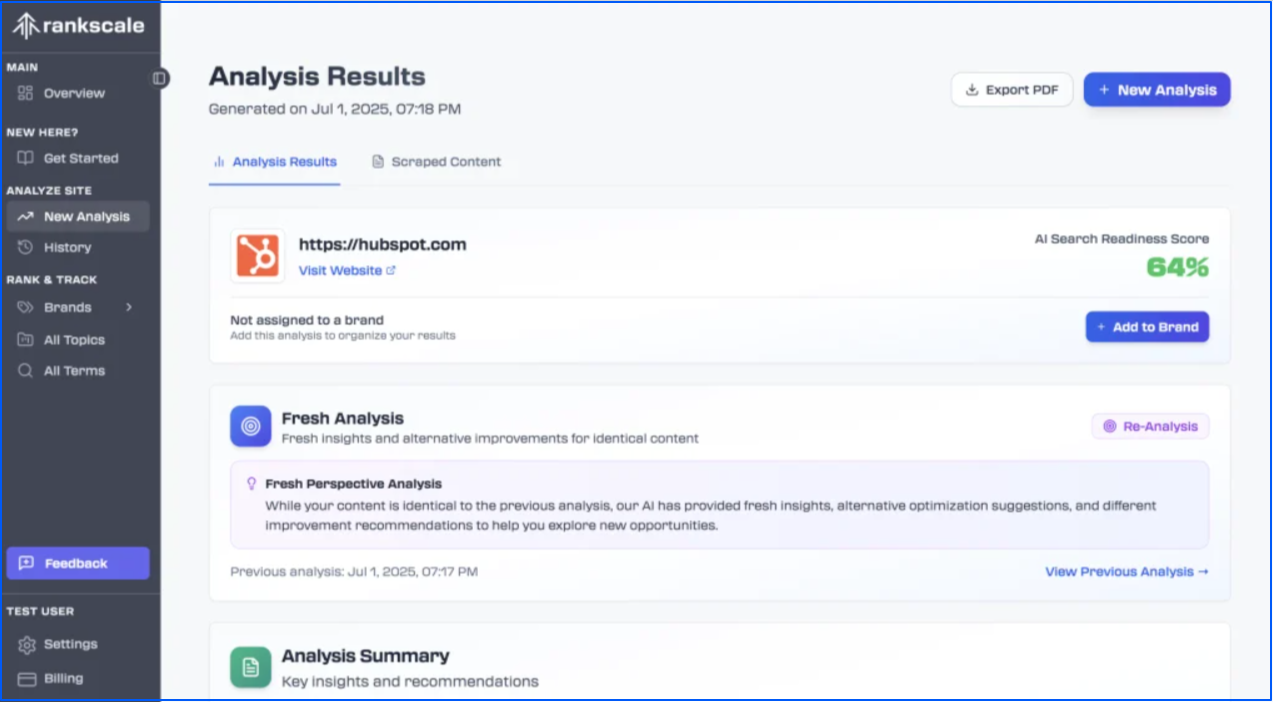
RankScale also adds a practical diagnostics layer with website audits and gap insights, which helps identify why a brand is not appearing for certain queries. Credit forecasting is the usual sticking point, and our roundup of the best Rankscale alternatives works through what predictable pricing looks like instead.
Pros
- Broad AI platform coverage across major answer engines
- Flexible credit-based model that can fit different tracking needs
- Strong citation and sentiment analysis for better context
- Website audits and gap insights help connect visibility to improvements
Cons
- Credit-based usage can require monitoring to avoid overuse at scale
- Some details and advanced options may require a demo or trial request
8. AthenaHQ – Best for controlling AI crawling and visibility gaps
- Best For: Businesses that want cross-platform AI visibility tracking plus tools to control how AI systems crawl and reference their site.
- Unique Feature: Dynamic AI crawling controls using smart robots.txt and llms.txt, plus “AI blindspot detection” to find missing or misunderstood site areas.
- AI Platform Tracking: ChatGPT, Perplexity, Google AI Overviews, AI Mode, Gemini, Claude, Copilot, and Grok (additional models available upon request).
- Starting Price: $295/month (Self-Serve), with a first month promo shown at $95/month.
- Free Trial: Free audit available (10 minutes) and a $300 free credit is listed on the Self-Serve plan.
Key Features
- Manages AI crawler access using smart robots.txt and llms.txt
- Detects AI blindspots and surfaces hidden or lost parts of the website
- Provides granular authority and citation intelligence
- Tracks visibility across up to 8 major AI platforms on the Self-Serve plan
- Monitors competitors and supports competitor “impersonation” analysis
- Analyzes on-page and off-page signals for AI search performance
- Integrates with GA4 and Google Search Console to connect visibility with site traffic
Why Should You Choose AthenaHQ for AI Visibility?
AthenaHQ is best for controlling AI crawling and finding visibility blindspots, starting at $295/month.
AthenaHQ focuses on controlling how AI search perceives a brand across major AI platforms.
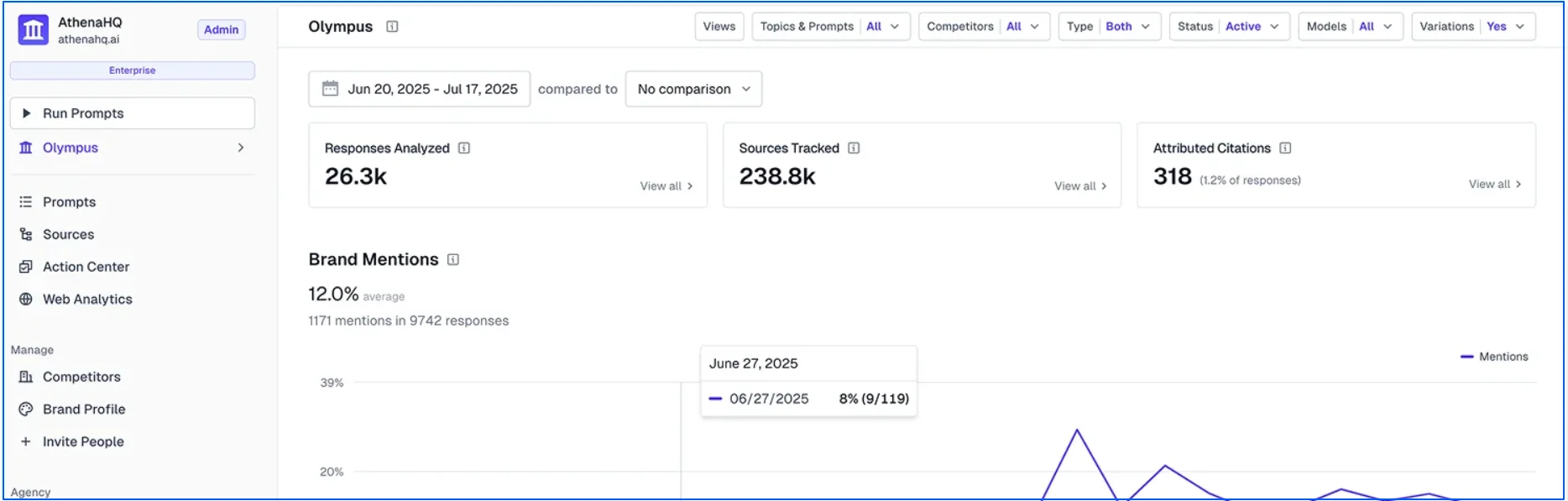
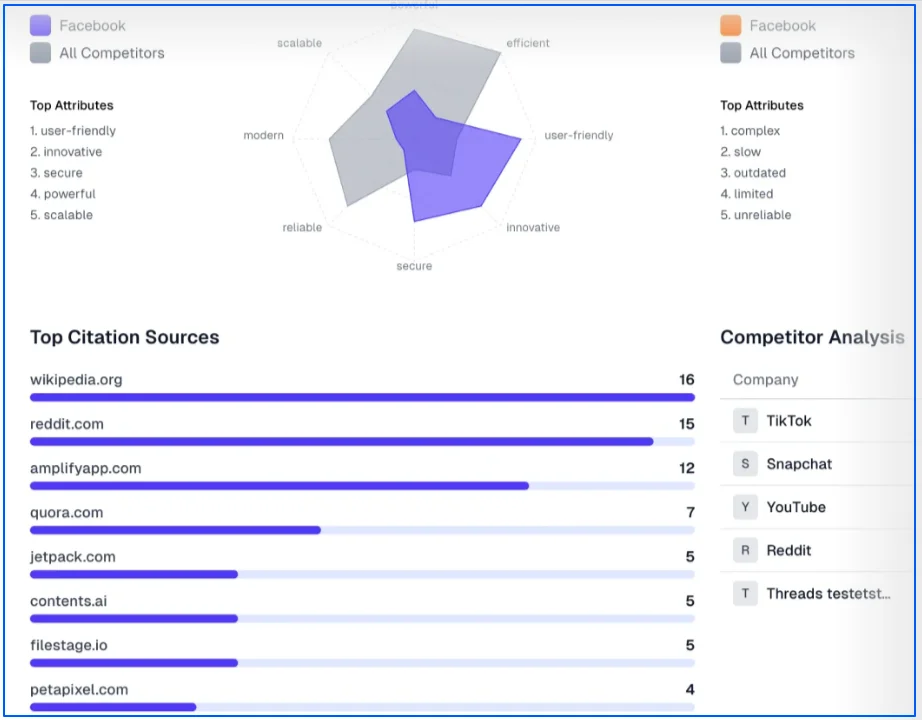
It combines cross-platform monitoring with citation intelligence, so it becomes clearer which sources are driving AI answers and where gaps exist.
A key differentiator is the website control layer. Smart robots.txt and llms.txt support, plus blindspot detection, helps reduce situations where AI systems miss important pages. AthenaHQ also connects visibility to performance through GA4 and Search Console integrations.
Pros
- Strong platform coverage including AI Overviews and AI Mode
- Dynamic AI crawling controls and blindspot detection are genuinely differentiating
- Citation and authority intelligence adds context beyond basic mentions
- GA4 and Search Console integrations help connect visibility to traffic signals
Cons
- Self-Serve pricing is higher than some lightweight monitoring tools
- Credits-based usage can require management for heavy tracking
9. Semrush – Best for AI visibility inside an all-in-one search platform
- Best For: Brands that want AI visibility tracking inside a broader all-in-one search and competitive research platform.
- Unique Feature: AI Visibility Toolkit that combines prompt tracking, AI share of voice, and competitor gaps in one dashboard.
- AI Platform Tracking: AI visibility tracking across major AI search experiences, including ChatGPT and Google AI surfaces (coverage is feature-dependent).
- Starting Price: $199/month (Starter, Semrush One). Lower effective rate is shown with annual billing.
- Free Trial: 7-day free trial for Semrush One; the AI Visibility Toolkit itself offers a free demo report rather than a trial.
Key Features
- AI Visibility Overview shows visibility score, share of voice, mentions, and growth priorities in one report
- Prompt tracking for daily monitoring of custom prompts across AI search experiences
- Competitor AI gaps identifies topics where competitors appear and the brand does not
- AI Search Health checks audits for issues that can block AI discovery and understanding
- Keyword and competitor research workflows that pair with AI visibility insights
- Reporting options and dashboards for sharing progress and trends
Why Should You Choose Semrush for AI Visibility?
Semrush is best for AI visibility inside a full SEO suite, starting at $199/month.
Semrush is built for tracking how a brand shows up across AI-driven search experiences while keeping everything connected to broader search and competitor intelligence.
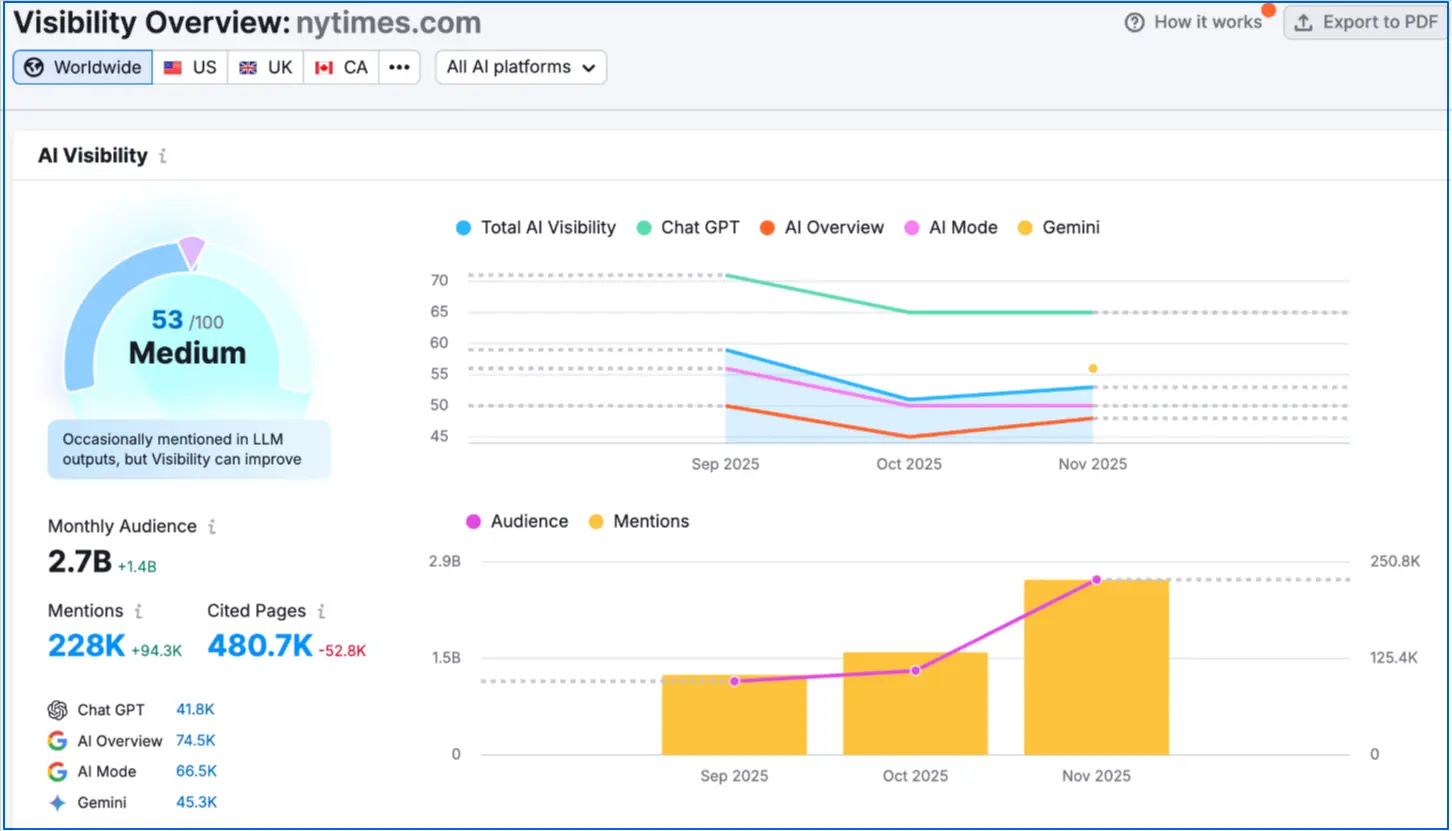
The AI Visibility Toolkit focuses on prompts, visibility trends, and competitor gaps, so it becomes clearer where the brand is missing and what topics drive AI exposure. It also adds a diagnostics layer through site auditing.
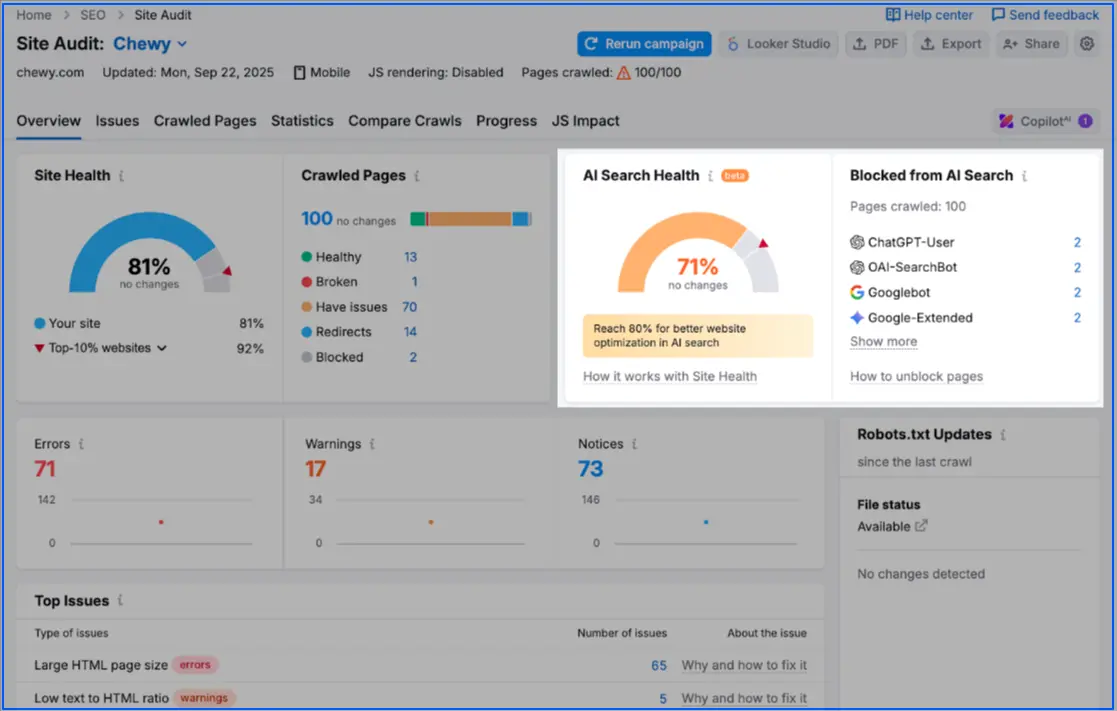
For teams that want one platform for AI visibility plus wider search intelligence, Semrush fits well because it keeps monitoring, competitive research, and reporting in the same environment.
Pros
- AI Visibility Toolkit brings prompt tracking, visibility trends, and competitor gaps together
- Pairs AI visibility insights with broader search and competitive research workflows
- Includes site auditing features to identify technical and content issues
- 7-day free trial available for Semrush One
Cons
- AI Visibility Toolkit trial is not listed as standard, only a demo report is offered
- Can feel heavy if only lightweight monitoring is needed
10. SE Visible (SE Ranking) – Best for agency-grade tracking with white-label reporting
- Best For: Agencies and SEO teams that want AI visibility captured from real AI responses, with white-label client reporting built in.
- Unique Feature: A dedicated AI visibility platform (SE Visible) that records answers from the live AI interfaces rather than API simulations, paired with SE Ranking’s full SEO suite.
- AI Platform Tracking: ChatGPT, Google AI Overviews, Google AI Mode, Perplexity, Gemini, and Copilot (coverage on the dedicated product is still expanding).
- Starting Price: SE Visible from around $189/month. SE Ranking’s in-suite AI Tracker is also available from ~$52/month core plus a $71-$276/month add-on, depending on plan.
- Free Trial: Yes (trial available).
Key Features
- Captures brand mentions and citations from real AI responses, not API outputs
- Tracks visibility across major AI engines plus Google’s AI surfaces
- White-label reporting and client portals included, which is unusual at this price
- Pairs AI visibility with a full SEO suite (rank tracking, audits, backlinks, keyword research)
- Competitor benchmarking on the same prompt set
- Prompt and brand limits that scale by plan
Why Should You Choose SE Visible for AI Visibility?
SE Visible is best for agencies that want real-response AI tracking inside a familiar SEO suite, starting around $189/month.
SE Ranking has long been the agency-friendly SEO platform, and SE Visible extends that into AI search. It records what the AI engines actually show rather than modeling it from an API, which matters when you’re reporting to a client who can check the answer themselves.
The agency ergonomics are the real draw. White-label reports and client portals come baked in rather than bolted on, and the AI visibility data sits next to the rank tracking, audits, and keyword research your team already runs.
Pros
- Records visibility from real AI responses, not simulations
- White-label reporting and client portals included
- AI visibility lives inside a full SEO suite
- Competitor benchmarking on shared prompts
Cons
- Data refreshes weekly rather than daily
- Engine coverage on the dedicated product is still growing
- Pricing scales by prompts and brands, so heavy use adds up
11. Ahrefs Brand Radar – Best for AI visibility beside your Ahrefs SEO data
- Best For: Teams already living in Ahrefs who want AI mention data sitting next to backlinks, keywords, and traffic, with historical depth.
- Unique Feature: One of the largest prompt databases in the category (200M+ search-backed prompts) and the ability to cross-reference AI mentions with web, YouTube, and Reddit visibility.
- AI Platform Tracking: ChatGPT, Gemini, Perplexity, Copilot, Google AI Overviews, and AI Mode.
- Starting Price: Base Ahrefs from $129/month; Brand Radar AI indexes at $199/month per platform or $699/month for all six (so roughly $828+/month all-in). A YouTube/TikTok/Reddit module adds another $199/month.
- Free Trial: Beta indexes are available to paid Ahrefs subscribers, worth testing before committing to the bundle.
Key Features
- 200M+ search-backed prompts drawn from real search behavior, not generated queries
- Share of voice across six AI engines
- Historical AI visibility trends that most dedicated tools lack
- Cross-references AI mentions with backlink and keyword data in the Ahrefs suite
- SERP AI Overview detection inside Rank Tracker on base plans
Why Should You Choose Ahrefs Brand Radar for AI Visibility?
Ahrefs Brand Radar is best for Ahrefs-native teams that want historical AI visibility data, at a premium price.
Brand Radar’s real strength is scale and history. The prompt database is among the largest published in this category, and being able to view AI citation trends next to backlink and keyword data is a genuine workflow advantage if your team already works in Ahrefs every day.
The honest caveats are cost and accuracy. Full deployment runs well past $800/month once you stack the indexes on a base plan, and third-party testing has flagged undercounting in its AI mention data: Writesonic’s January 2026 test, run against its own brand data, reported 3 ChatGPT mentions against an actual 123, and 6 Perplexity mentions against 212. Writesonic sells a competing product, so read that as a competitor’s test rather than a neutral audit — but the method is published and repeatable, and Ahrefs has not disputed the numbers. Brand Radar also uses a keyword-first methodology and caps prompt checks, so treat it as directional intelligence rather than precise citation tracking.
Pros
- Among the largest prompt databases in the category, drawn from real searches
- Historical AI visibility trends most tools don’t offer
- AI data sits beside Ahrefs’ backlink and keyword tools
- Six-engine coverage including AI Overviews and AI Mode
Cons
- Expensive: $828+/month all-in once indexes are added to a base plan
- Accuracy concerns documented in third-party testing
- Keyword-first methodology and a monthly check ceiling
Also Tested: 9 Tools That Did Not Make the Shortlist
These are real, working products. Each was cut against the five criteria above, and each entry below names the criterion it failed. Several are the right pick for a narrower job than this guide covers, so read the reason rather than the omission.
- Rank Prompt ($49/month) — Prompt tracking with a content generation agent and direct WordPress publishing. Cut on engine coverage: four engines, and the one-click multi-location tracking targets franchises more than the general case.
- Mentions ($49/month) — AI traffic analytics that attributes site visits to individual AI models, which is genuinely useful and rare. Cut on price against scope: platform coverage varies by plan and no free trial is published, so you cannot test before paying. If you’re weighing software against service support, compare this shortlist of top AI SEO agencies alongside the tools.
- BrandLight (custom pricing) — Citation-driver and narrative-accuracy analysis built for enterprise brand teams. Cut on two criteria: the engine list is not published and there is no public pricing, so you cannot evaluate it before a sales call.
- Nightwatch (from ~$32/month plus add-on) — Dual-layer tracking that captures both the AI answer and the web searches behind it, with strong local precision. Cut on engine coverage: the AI layer is newer and narrower than dedicated tools, and it costs extra on top of the rank-tracking base.
- Surfer SEO AI Tracker ($79/month base plus $95/month add-on) — AI visibility attached to Surfer’s content editor and optimization scoring. Cut on price against scope: the tracker is an add-on, so the real figure is $174/month, and it only makes sense if you already run Surfer for content.
- Writesonic ($199/month) — Visibility tracking paired with AI content generation, so spotting a gap and acting on it happen in one tool. Cut on price against scope: the AI search features sit on the Professional tier and it is less specialized than dedicated platforms.
- ZipTie AI ($69/month, 500 checks) — Screenshot evidence of brand appearances in AI answers, which is excellent for client reporting. Cut on actionability: it is check-based and stops at proof rather than a next step. See our roundup of the best ZipTie alternatives.
- Promptwatch (free tier, then $99/month) — Real-interface capture rather than API simulation, plus AI crawler alerts and a free 10-prompt tier worth testing. Cut on engine coverage: four models, narrower than the leaders. See our roundup of the best Promptwatch alternatives.
- Goodie AI (custom pricing) — Managed, full-service enterprise AI visibility with hands-on support. Cut on two criteria: no published engine list and no public pricing.
More AI Visibility Tools Worth Tracking
Beyond the 20 reviewed above, a few newer and more specialized tools are worth knowing, especially for tight budgets or specific jobs:
- LLMRankings.io — Free plan, with paid tiers from $10/month. Weekly monitoring of 10+ keywords or prompts plus competitors. A low-cost way to start.
- LLMRefs — $79/month. Tracks 50 keywords across 10+ AI engines, with a keyword-focused approach to visibility.
- AI Rank Checker — Pay-per-check pricing ($0.03-$0.18 per keyword check, varying by AI platform). Flexible for occasional checks with no subscription commitment.
- ReddGrow — From $79/month up to $319/month (Pro). Reddit-focused AI visibility that identifies the threads driving visibility and supports commenting, useful given how often AI engines cite Reddit.
- Canonry — Open-source and self-hosted, with no subscription. Runs locally with your own API keys so data stays local, and can feed citation data to coding agents.
How to Choose the Best AI Visibility Tool
Choosing the best AI visibility tool depends on how deeply your team wants to track AI-driven discovery and how actionable those insights need to be. These 8 factors below help evaluate which tools align best with your goals, workflows, and scale.
- AI platforms covered: Start by checking which AI systems a platform actually tracks. Some tools only monitor ChatGPT, while others include Gemini, Perplexity, Google AI Overviews, and AI Mode. The broader the coverage, the clearer the picture of where your brand appears across AI-driven search.
- Depth of tracking and insights: Not all tools measure visibility the same way, so the right platform is the one that matches how your team defines success. Some only show whether a brand is mentioned, while others track citations, prompt-level visibility, sentiment, and competitive gaps.
- Prompt control and measurement consistency: A strong platform allows you to define and reuse the same prompts over time. Consistent prompts make it easier to tell whether visibility is actually improving or just fluctuating.
- Competitive comparison and gap analysis: Visibility data for LLM SEO is more useful when it shows who appears instead of you. The strongest platforms highlight competitor mentions and citations, the cited sources behind them, and missing coverage — turning a visibility gap analysis into a clear picture of where authority is being lost or gained.
- Update frequency and data freshness: AI-generated answers change quickly. Platforms that refresh data daily or frequently help catch shifts early, while slower updates can hide important changes.
- Actionability of insights: Some tools only report; others surface opportunities, gaps, and recommendations. Consider whether your team prefers raw data or clearer direction on what to improve next.
- Ease of setup and daily use: Lightweight, easy-to-use platforms are faster to adopt and monitor regularly. More advanced tools often provide deeper insights but may require setup time, onboarding, or ongoing configuration.
- Pricing structure and scalability: Look closely at how pricing works. Some platforms charge by prompts, credits, or AI engines, while others use flat monthly plans. Choose one that can scale without becoming restrictive or unpredictable as usage grows.
Did you know?
Do the Five AI Platforms Cite the Same Sources? (Wellows Data)
Mostly, no, and that is the strongest argument for multi-engine tracking on this whole page. Our cross-engine AI citation overlap study covers 531,889 questions and 13,037,251 citations from Wellows’ internal citation dataset between January and June 2026, keeping only the questions all five engines answered. The engines rarely land on the same page, and agree far more often on which company to name:
| Overlap level | What it measures | How often two engines match |
|---|---|---|
| Page | The exact URL cited | 6.8% |
| Website | The domain that page sits on | 10.9% |
| Brand | The company named in the answer text | 30.3% |
Source: Wellows internal citation dataset, 531,889 questions, Jan-Jun 2026. Questions were asked in English across 27 markets, 84% of them in the United States.
Two findings matter most when you’re choosing a tool.
First, single-engine citation is the norm, not the exception. 79.6% of the website-and-question pairs in that dataset were cited by exactly one of the five engines, and only 0.31% were cited by all five. ChatGPT is the most isolated of the five: 76.3% of the websites it cites appear on no other engine, and 89.1% of what ChatGPT cites, Perplexity never touches. A tool that tracks one engine is measuring one of five mostly separate citation pools.
Second, the pair that agrees most is the pair that shares retrieval infrastructure. Google AI Overviews and Google AI Mode match on 24.5% of websites and 17.9% of pages. Every other pair lands between 6% and 12%. Brand agreement runs far ahead of page agreement across the board, which is exactly why criterion #2 in our ranking — tools that separate citations from mentions — matters. The two signals behave differently, and a tool that blends them into one score will mislead you on both.
One caveat we published alongside those numbers, because it cuts against our own headline: brand agreement looks larger partly because an answer has only a handful of plausible brands and a very large number of plausible pages. Measured against a random baseline, page agreement is the stronger signal at roughly 42x chance, and brand agreement the weaker one at roughly 17x. Brand is the easier route to multi-engine presence; page citation is the more meaningful one when it happens. Both are worth measuring separately.
Retrieval and citation are also two different decisions, and the gap between them varies by system. Dejan AI’s grounding analysis ran one identical query through Google, OpenAI, and Anthropic on the same day: Gemini cited all 7 pages it retrieved, GPT-5.5 retrieved 39 pages but cited only 2, and Claude cited 9 of 14. Same question, same day, three different citation realities.
What Gets Cited When You Ask AI for the Best AI Visibility Tools? (Wellows Data)
We turned our tracking on this exact buying decision. From Wellows’ internal citation dataset, we isolated every US-tracked prompt where someone asks an AI engine to recommend, compare, or choose an AI visibility tool: prompts like “best AI visibility tools 2026”, “best LLM visibility tracker”, and “which AI visibility platform is best for enterprise teams”. That came to 391 distinct buying prompts between January and June 2026, and the answers they produced contained 383,421 citations across 6,353 domains and all five engines.
Three findings decide how you should read every list on this page, including this one:
- Reddit is the single most-cited domain in this category. When people ask AI engines which AI visibility tool to use, reddit.com takes 4.85% of all citations, ahead of every vendor. On Google AI Mode its share rises to 7.33%. If your tool evaluation ignores what practitioners say on Reddit, the AI engines your buyers use do not.
- Citations concentrate hard. The top 10 domains absorb 25.3% of every citation in this category, and the top 100 absorb 67.7%. Roughly 6,250 other domains split the remaining third. Being a source AI engines trust is a winner-take-most game.
- Product feature pages out-earn comparison listicles. By content format, product feature descriptions take 28% of citations and reviews take 22%, while comparison content takes 14.4% and how-to guides 12.6%. Vendors’ own product pages, not third-party listicles, are the largest single citation source when AI recommends tools.
The most-cited domains for AI-visibility-tool prompts in our data:
| # | Domain | Citation share |
|---|---|---|
| 1 | reddit.com | 4.85% |
| 2 | seranking.com | 4.33% |
| 3 | semrush.com | 2.72% |
| 4 | zapier.com | 2.41% |
| 5 | wellows.com | 2.28% |
| 6 | tryprofound.com | 2.09% |
| 7 | rankability.com | 1.85% |
| 8 | aiclicks.io | 1.80% |
| 9 | therankmasters.com | 1.68% |
| 10 | google.com | 1.27% |
Source: Wellows internal citation dataset, 391 AI-visibility-tool prompts, 383,421 citations, US, Jan-Jun 2026. Methodology note: the prompt set comes from prompts tracked by Wellows and its customers, reviewed to remove off-category matches, so it reflects what teams in this space actually track rather than a random sample of all AI usage.
Wellows ranks fifth overall in that table, behind Reddit and three companies (SE Ranking, Semrush, Zapier) whose domains are orders of magnitude larger than ours. Among the AI visibility platforms reviewed on this page, only SE Ranking and Semrush sit above us, and both sell AI visibility from inside much older, much larger SEO domains. We publish that with the disclosure above because it is exactly the kind of claim a good AI visibility tool should let you verify: prompt set, date range, and engine coverage stated, so anyone tracking the same prompts can check the number.
Best AI Visibility Trackers and Tracking Tools
What an AI visibility tracking tool does
An AI visibility tracker records where and how often your brand appears in AI answers over time, so you can tell whether visibility is actually improving or just fluctuating. Tracking is about the running record, not the diagnosis.
The best AI visibility trackers in 2026 are Wellows, Peec AI, and SE Visible. If you’re coming from classic rank tracking, AI search tracking works the same way: fix a prompt set, record the answers on a schedule, and watch the trend, except the “rankings” are mentions and citations inside AI answers rather than positions on a results page.
- Wellows tracks mentions and citations across all five engines on every plan, with daily monitoring and performance history included throughout, then separates explicit from implicit citations so you know which pages are doing the work.
- Peec AI runs your prompts daily and turns the responses into visibility, position, and sentiment trends, which makes it a clean choice when consistent tracking is the whole job.
- SE Visible records tracking data from real AI responses with white-label reporting, which suits agencies tracking client domains.
Here is how the three best AI visibility trackers compare on the specifics that matter in 2026 — the engines covered, how often the data refreshes, and what the entry plan costs:
| Tracker | Engines Tracked | Data Refresh | Starting Price |
|---|---|---|---|
| Wellows | All five — ChatGPT, AI Overviews, AI Mode, Gemini, Perplexity — on every plan | Daily (every plan) | $29/month (Basic) |
| Peec AI | ChatGPT, Perplexity, AI Overviews (more via add-ons) | Daily | €89/month |
| SE Visible | ChatGPT, AI Overviews, AI Mode, Perplexity, Gemini, Copilot | Weekly | $189/month |
If you want tracking that ends in an action rather than a chart, start with the tool that separates citations from mentions.
Best AI Visibility Analysis Tools
Tracking vs analysis
Analysis tools go past the running record and explain why you are or aren’t cited, which sources AI relies on, where competitors win, and what to change. Tracking tells you the score; analysis tells you the reason.
The best AI visibility analysis tools in 2026 are Wellows, Profound, and Scrunch AI.
- Wellows breaks visibility into layers, mentions versus citations, sentiment shifts, and the explicit and implicit gaps where competitors are cited instead, so the analysis points to specific pages and topics.
- Profound adds demand signals through Prompt Volumes, so you can analyze which questions people actually ask AI, not just where you appear.
- Scrunch AI analyzes why your site is or isn’t being read correctly, pairing citation-source insight with structural audits and misinformation detection.
For a side-by-side on analytical depth against the cheaper all-in-one platforms, see our roundup of the best AIclicks alternatives.
Best AI Search Monitoring and Checking Tools
What monitoring and checking covers
AI search monitoring tools watch for day-to-day changes in how AI answers represent your brand and alert you when something shifts — a new competitor surfacing, a mention turning negative, a citation lost. The priority here is freshness and alerting, not deep analysis.
The best AI search monitoring tools in 2026 are Wellows, Otterly AI, and Peec AI.
- Wellows runs daily monitoring on every plan and keeps a performance history, so shifts in mentions, citations, and sentiment are caught as they happen.
- Otterly AI offers straightforward daily checking of brand visibility and the sources behind it, with trend graphs that make changes easy to spot.
- Peec AI reruns your full prompt set every day, which makes day-to-day movement easy to read against a fixed baseline.
For monitoring Google’s AI surfaces specifically, Wellows, SE Visible, AI Peekaboo, and Otterly AI all track AI Overviews and AI Mode, and the free Wellows AI Overviews Tracker gives you a baseline check of where you appear in AI Overviews before you commit to a paid plan.
Which AI Visibility Tool Has the Most Accurate Metrics?
Accuracy in AI visibility metrics comes down to three things: whether the tool captures answers from the real AI interfaces or simulates them through an API, whether it separates citations from mentions instead of blending them into one score, and whether it states its methodology clearly enough that you can verify a number yourself.
By those tests, the most accurate AI visibility metrics software in 2026 are Wellows and SE Visible. Wellows separates explicit citations from implicit mentions and publishes its methodology alongside its data, as in the citation study above. SE Visible records what the live AI interfaces actually show rather than modeling it. Promptwatch, in the also-tested list, takes the same real-interface approach with a free tier to test against.
The counter-example is worth naming: Ahrefs Brand Radar has documented accuracy concerns from third-party testing — a consequence of its keyword-first methodology and capped prompt checks. Whichever platform excels in AI visibility metrics for your use case, apply the same verification test we apply to ourselves: ask for the prompt set, the date range, and the engine list behind any number, and be skeptical of any tool that can’t show them.
Best LLM Visibility Tools
LLM visibility tools
LLM visibility is how often, and how favorably, large language models mention or cite your brand in their answers. LLM visibility tools are the same category as AI visibility tools: the name shifts the emphasis to model coverage, which LLMs the tool actually queries, and how many of them.
The best LLM visibility tools in 2026 are Wellows, RankScale, and Profound.
- Wellows tracks mentions and citations across the five LLM-driven surfaces most buyers use, ChatGPT, Gemini, Perplexity, Google AI Overviews, and AI Mode, on every plan, and separates explicit citations from implicit ones so you know which model surfaces are actually working for you.
- RankScale covers the widest model list at the lowest entry price: ten engines including Claude, DeepSeek, Mistral, and Grok, from $20/month on a credit-based plan.
- Profound queries ten platforms including Claude, Copilot, Meta AI, and DeepSeek, with the multi-market support enterprise teams need.
If your buyers ask Claude or DeepSeek as often as they ask ChatGPT, weight model coverage heavily — a tool that only tracks two engines will report a visibility picture that’s missing where your audience actually is.
Best AI Visibility Tools Under $100 a Month
These are the most affordable, cost-effective AI visibility platforms for startups, freelancers, and small B2B teams, all starting under $100 per month, and most with a free trial so you can test AI search before committing budget.
| Tool | Starting Price | Best For | Free Trial |
|---|---|---|---|
| Wellows (Basic) | $29 / month | All five engines, 12 prompts a day, citation tracking and outreach on a budget | Yes (7-day) |
| Wellows (Standard) | $97 / month | All five engines at 43 prompts a day, fits the 40-prompt default setup | Yes (7-day) |
| RankScale (Essentials) | $20 / month | Budget-friendly, credit-based AI monitoring | Freemium |
| Otterly AI (Lite) | $29 / month | Simple AI prompt and source tracking | Yes (14-day) |
| AI Peekaboo (Starter) | $50 / month | All five engines on a flat entry plan, no add-ons | Yes (14-day) |
| ZipTie AI | $69 / month | Screenshot-backed proof of AI appearances | Yes |
| Peec AI (Starter) | €89 / month | Daily prompt-based visibility tracking | Yes (7-day) |
| Rank Prompt | $49 / month | Prompt tracking with content and outreach execution | Yes |
| Profound (Starter) | $99 / month | Entry into enterprise-grade tracking (ChatGPT-only) | Demo |
| Promptwatch | Free / $99 / month | Real-interface tracking with a free entry point | Freemium |
| LLMRankings.io | Free / from $10 / month | Budget weekly monitoring | Free plan |
| LLMRefs | $79 / month | Keyword-focused tracking across 10+ engines | – |
Note: Pricing verified August 2026; verify current pricing before buying, because this category changes fast.
Best AI Visibility Tools From $100 to $200 a Month
The $100 to $200 band is where AI visibility tools stop being entry-level trackers and start bundling broader engine coverage, white-label reporting, or a full SEO suite around the visibility data:
| Tool | Price | Best For | Free Trial |
|---|---|---|---|
| AI Peekaboo (Peek) | $100 / month | Daily five-engine tracking on a flat plan | Yes (14-day) |
| SE Visible (SE Ranking) | From ~$189 / month | Agency-grade tracking from real AI responses with white-label reporting | Yes |
| Surfer SEO + AI Tracker | $174 / month combined ($79 base + $95 add-on) | Content teams already working in Surfer | Money-back |
| Semrush One (Starter) | $199 / month | AI visibility inside a full SEO and competitive research suite | Yes (7-day) |
| Writesonic (Professional) | $199 / month | Visibility tracking plus AI content execution in one tool | Yes |
| Otterly AI (Standard) | $189 / month | 100 prompts of simple daily tracking across six engines | Yes (14-day) |
Note: Pricing verified August 2026; verify current pricing before buying, because this category changes fast.
Best AI Visibility Tools From $201 to $300
If you’re comparing AI visibility software options by price range, this tier covers the advanced platforms for scaling brands and agencies that need high-volume monitoring and multi-LLM coverage.
| Tool Name | Price | Best For | Key Features | Ideal Users |
|---|---|---|---|---|
| Wellows (Growth Plan) | $249 / month | High-volume AI visibility tracking with unlimited explicit and implicit citation opportunities | All five engines; 18,000 credits a month; 120 prompts a day across five engines, or 600 at one; unlimited projects on one pool | Agencies with a small client roster, or one client tracked in depth |
| AI Peekaboo (Grow) | $200 / month | Higher prompt volume on five-engine daily tracking | 100 prompts, daily runs, five engines, Looker Studio connector, 15,000 data points/mo | Growing B2B teams on a flat monthly budget |
| Scrunch (Starter Plan) | $250-$300 / month | AI visibility and page-level insights | 350 custom prompts, 1,000 industry prompts, 5 page audits, multi-LLM coverage | Scaling marketing teams, agencies, SEO/content teams |
| AthenaHQ (Self-Serve) | $295+ / month | Broad AI visibility across platforms | Multi-platform AI monitoring, competitor tracking, sentiment intelligence, credits-based usage | SMBs, growth teams, agencies that want self-serve monitoring |
| BrandLight | Custom pricing (Contact Sales) | Enterprise-grade AI brand reputation monitoring | AI-driven brand visibility, attribution workflows, governance and compliance tools | Large enterprises, global agencies |
Note: Pricing verified August 2026; verify current pricing before buying, because this category changes fast.
Above $300 a Month
Wellows’ top self-serve tier, Scale, runs $497/month: 36,000 credits, 240 prompts a day across five engines or 1,200 at one, and twelve clients at 20 prompts a day. It sits alongside Profound’s $399/month three-engine tier and Ahrefs Brand Radar’s $828+/month all-in bundle as the platforms built for full agency rosters rather than a single brand.
Did you know?
Best Free AI Visibility Tools and Checkers
Free AI visibility tools fall into two groups: free checkers that give you a one-off snapshot of where you stand, and free tiers of paid platforms that run limited ongoing tracking. Neither replaces a paid platform, but they’re the right way to confirm you actually have a visibility problem before spending anything.
- Wellows Perplexity Visibility Tracker — free check of your brand’s mentions and citations inside Perplexity answers.
- Wellows AI Overviews Tracker — free tracking of where you appear inside Google’s AI Overviews.
- Promptwatch free tier — 10 prompts tracked on an ongoing basis, captured from real AI interfaces.
- LLMRankings.io free plan — weekly monitoring of 10+ keywords or prompts plus competitors.
- RankScale freemium — credit-based entry with no upfront payment, across ten engines.
- AI Peekaboo free report — a one-time five-engine snapshot with no credit card required.
- Canonry — open-source and self-hosted, runs locally with your own API keys so the data stays yours.
Start with a free checker to get your baseline. The moment you need daily tracking on a consistent prompt set, you’ve outgrown the free tier — that consistency is the thing the paid plans are actually selling.
Best AI Visibility Platform for Agencies
What agencies need from an AI visibility platform
For agencies, the best AI visibility platform is one that tracks several client domains at once, white-labels the reporting, and turns findings into client-ready actions, not just a dashboard you have to interpret on every call.
The best AI visibility platforms for agencies in 2026 are SE Visible, Wellows, and Profound. If your agency’s core deliverable is AI visibility tracking for clients, all three handle multi-domain tracking; the difference is what happens after the data lands.
- SE Visible brings white-label reporting and client portals inside a full SEO suite, which keeps AI visibility next to the rank tracking agencies already report on — the closest thing to a drop-in client deliverable.
- Wellows tracks mentions and citations per client project on unlimited projects drawn from one credit pool, surfaces the explicit and implicit opportunities for each, and includes outreach contacts and templates so the work ends in a deliverable, not a chart. Growth ($249/month) covers six clients at 20 prompts a day; Scale ($497/month) covers twelve.
- Profound fits larger agencies that need multi-market, enterprise-scale tracking.
One caution on the cheaper end: several entry-priced tools market themselves to agencies but cap the published plans at a single brand. AI Peekaboo is the clearest example — its self-serve tiers each cover one brand and white-label delivery is a separately scoped add-on, so multi-client agency use needs custom pricing rather than the $50 headline. Check the brand limit and the white-label line before you price a retainer against a published tier.
For the operational side, see how Wellows works as an AI search visibility platform for agencies, how agencies monitor mentions in AI search, and how agencies deliver AI search visibility using white-label models.
Which AI Visibility Tools Include Unlimited Seats?
Peec AI, Mentions, and Nightwatch include unlimited seats on all plans. Peec AI bundles unlimited seats and unlimited countries into every tier, Mentions includes unlimited seats across its plans, and Nightwatch pairs unlimited seats with white-label reports and API access. Most other platforms price by prompts, credits, or domains rather than by users, so check the seat policy against your team size before committing — an €89 plan with unlimited seats can work out cheaper than a $49 plan that charges per user once three people need access.
Which AI Visibility Tool Fits a B2B Sales Cycle?
What B2B changes about AI visibility
B2B buying runs on comparison and shortlist prompts, “best X for Y”, “X vs Y”, “alternatives to X”, asked by committees rather than individuals. A B2B-fit AI visibility tool has to track those commercial prompts, show which competitors get recommended instead of you, and turn that gap into something your content or outreach can fix.
The best AI visibility tools for B2B companies in 2026 are Wellows, Profound, and SE Visible. The same three picks hold for B2B SaaS companies specifically, where the shortlist prompts (“best AI visibility tools for B2B SaaS”) are exactly the commercial-intent queries these platforms track.
- Wellows fits B2B SaaS teams because it tracks the commercial and comparison prompts where shortlists form, breaks visibility down by intent (branded commercial, commercial, informational), and turns competitor-cited gaps into explicit content opportunities and publisher outreach.
- Profound suits large B2B enterprises that need multi-market tracking plus demand data on what buyers actually ask AI before they ever reach a sales call.
- SE Visible works for B2B-focused agencies reporting AI visibility to clients, with white-label reports built from real AI responses.
Here is how the three compare on the criteria that matter most for B2B teams:
| Tool | B2B Fit | Intent Breakdown | Starting Price |
|---|---|---|---|
| Wellows | B2B SaaS teams defending comparison and shortlist prompts | Branded commercial, commercial, informational, navigational | $29/month (Basic) |
| Profound | Large B2B enterprises with multi-market tracking needs | Prompt Volumes demand data by topic | $99/month (ChatGPT-only) |
| SE Visible | B2B-focused agencies reporting to clients | Real-response capture with white-label reports | $189/month |
What Should B2B Companies Look For in an AI Visibility Tool?
B2B narrows the criteria at the top of this page in three specific ways.
Commercial prompts over volume. The queries that decide B2B deals — “best AI visibility tools for B2B companies”, “X vs Y”, “alternatives to X” — carry low search volume and high purchase intent. A tool that reports an aggregate visibility score without splitting commercial intent from informational will show you a number that moves for reasons that don’t matter. Intent segmentation is the feature to check.
Competitor substitution, not just absence. In B2B the question is rarely “are we mentioned” and almost always “who got named instead”. Look for competitor share of voice on your own prompt set, plus the cited sources feeding those answers, so you can tell whether you lost to a rival’s product page, a review site, or a Reddit thread.
Long cycles need history. A B2B evaluation runs months. Daily snapshots without retained history can’t tell you whether a content push moved anything two quarters later. Check that the platform keeps performance history rather than a rolling window.
If you’re on the agency side of B2B, our playbook on AI visibility for B2B marketing agencies covers how to defend client shortlists prompt by prompt.
Best AI Visibility Tools With SEO Capabilities
Some teams want AI visibility next to their traditional SEO data rather than in a separate tool. The best AI visibility tools with SEO capabilities in 2026 are Semrush, SE Visible, Ahrefs Brand Radar, and Wellows.
- Semrush puts its AI Visibility Toolkit inside the full Semrush suite, so prompt tracking and AI share of voice sit beside keyword and competitor research.
- SE Visible pairs AI visibility with SE Ranking’s rank tracking, audits, and backlink tools.
- Ahrefs Brand Radar layers AI mention data on top of Ahrefs’ backlink and keyword database, with historical trends.
- Wellows integrates with Google Search Console, so your AI citation data lines up with the organic performance you already track.
If you are replacing a bundled SEO suite rather than a dedicated tracker, our roundup of the best Rankability alternatives separates the AI search layer from the content and rank-tracking layers.
How to Compare Top GEO Platforms for AI Visibility
When you compare top generative engine optimization platforms, the differences that matter are engine coverage, whether the tool tracks citations or only mentions, how often data refreshes, and whether it ends in an action. The fastest way to see those differences is to start from whichever platform you are already using or evaluating:
- Best Tryprofound alternatives – the platforms you can start without a sales call.
- Best Peec AI alternatives – engine coverage without add-on pricing.
- Best Rankscale alternatives – predictable billing against credit-metered tracking.
- Best Otterly.AI alternatives – what to do when you outgrow 15 prompts.
- Best ZipTie alternatives – moving past screenshot evidence to an action layer.
- Best Promptwatch alternatives – deeper citation records across more engines.
- Best AIclicks alternatives – avoiding the jump from an entry tier to an enterprise one.
What Advanced Features Do Top AI Visibility Platforms Offer?
Top AI visibility platforms, often the best AI visibility analysis tools, go beyond “are we mentioned” and add layers that help you diagnose why you’re visible, where you’re losing ground, and what to change. These are the 6 advanced features offered by the best AI visibility tools:
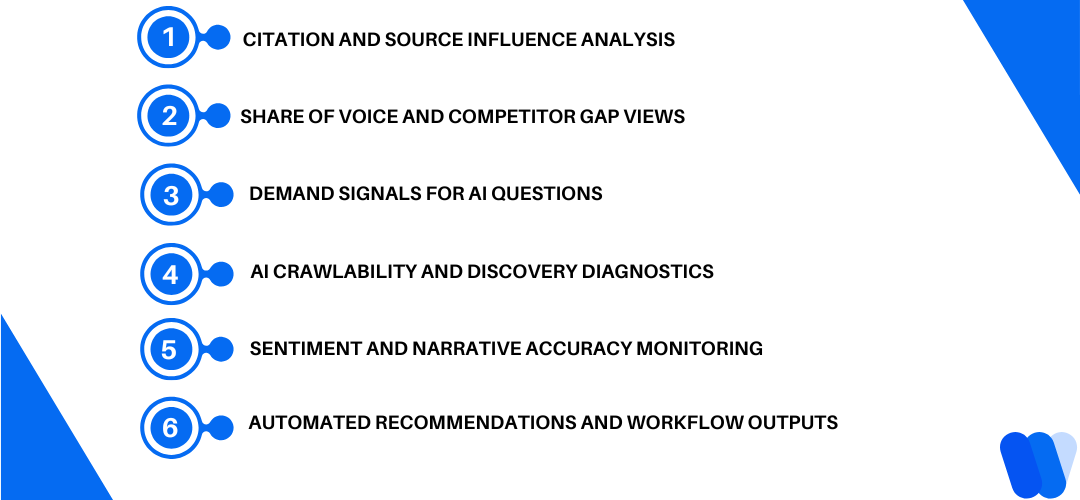
- Citation and source influence analysis: The best AI visibility tools show which pages, domains, or sources AI models rely on when answering, plus where competitors are being cited instead. That turns visibility into a content and authority roadmap.
- Share of voice and competitor gap views: A more advanced view shows how often you appear compared to competitors across a prompt set, plus the gaps where you’re missing entirely.
- Demand signals for AI questions: Some enterprise platforms add “what people are asking answer engines” data so you can prioritize topics based on real AI-driven demand, not legacy keyword volume.
- AI crawlability and discovery diagnostics: Higher-end toolkits add AI-specific site checks (crawlability, access, technical blockers) to help ensure AI systems can properly read and reuse your content.
- Sentiment and narrative accuracy monitoring: Beyond mentions, advanced tools track whether the brand is represented correctly, what tone appears in AI answers, and where misrepresentation risks exist.
- Automated recommendations and workflow outputs: Some platforms generate prioritized recommendations from visibility patterns (for example, “fix this page”, “cover this topic”, “competitor is cited here”), rather than leaving you with raw dashboards only.
Which AI Visibility Platform Has the Best Granular Analytics?
When it comes to granular analytics, not all AI visibility platforms go beyond surface-level metrics, and the difference often shows up only after you start tracking real citations and competitor gaps. The line worth watching is whether analytical depth changes a decision or just fills a dashboard.
Wellows stands out here because it breaks AI visibility into clear, actionable layers. Instead of showing a single score, it separates mentions from citations through LLM citation tracking, tracks sentiment changes, and highlights where competitors are being cited instead.
This level of detail makes it easier to diagnose what is actually influencing AI responses, rather than guessing based on aggregate numbers.
Another strength of Wellows is its focus on opportunity-driven analytics. The platform surfaces explicit and implicit visibility gaps, showing which pages, topics, or sources AI systems favor and where a brand is missing coverage.
Combined with daily monitoring and competitive benchmarking, this makes the analytics feel practical rather than purely descriptive.
Which AI Visibility Platform is Best for Enterprise Teams?
When enterprise teams look for AI visibility platforms, the bar is higher. They need scale, cross-platform coverage, deep analytics, and integration with workflows used across product, content, and competitive intelligence teams.
Profound is the strongest fit at true enterprise scale — ten platforms, multi-market coverage, and demand data — with Wellows the better choice when the priority is citation-level detail and acting on gaps rather than breadth of platform coverage.
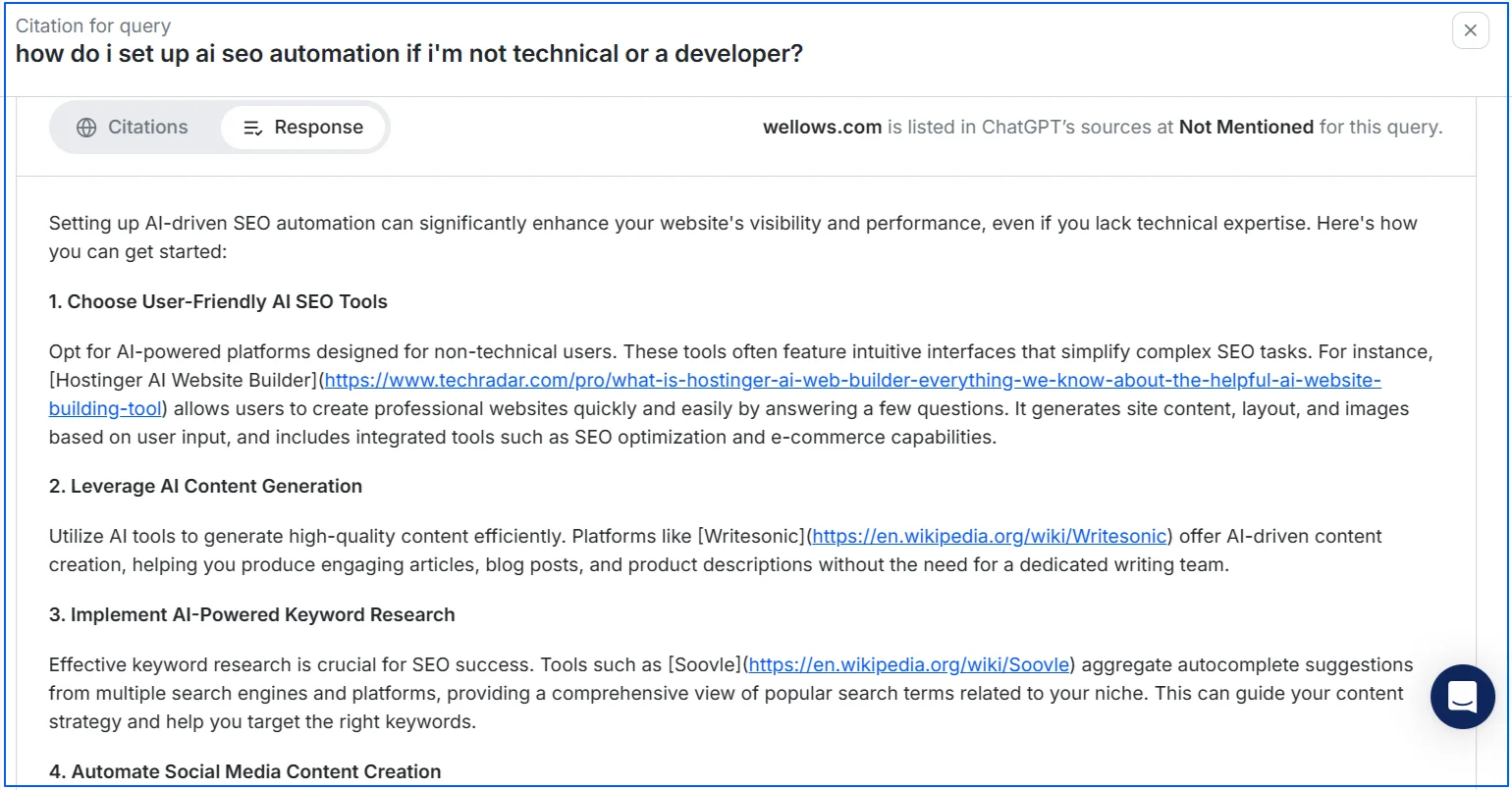
Wellows’ ability to separate mentions from citations, track sentiment shifts, and highlight competitor-cited sources gives large teams the detail they need to prioritize strategy and demonstrate impact across multiple stakeholders. The honest limit is platform breadth: Wellows covers five engines on every plan, and Profound tracks ten.
Using these insights, enterprises can optimize for AI overviews, AI mode, ChatGPT, Perplexity, Gemini, etc. Wellows also supports daily refreshes, multi-user access, and outreach workflows that help enterprises move from visibility data to action.
Why AI Visibility Matters for B2B Brands in 2026
AI-driven discovery is quickly becoming a primary way people research, compare, and make decisions — and in B2B that research happens long before anyone fills in a demo form.
Google has rolled out AI Overviews to 200+ countries and 40+ languages, and now puts them past 2.5 billion monthly users, with AI Mode past 1 billion. AI answers are a mainstream discovery surface, not an experiment.
AI systems are also sending measurable traffic. Adobe Analytics recorded a 1,200% increase in AI-sourced visits to U.S. retail sites between July 2024 and February 2025.
By the end of 2025, the scale was even clearer. Similarweb reported AI referrals grew from roughly 65 million in October 2024 to over 220 million by September 2025, showing sustained growth rather than a temporary spike.
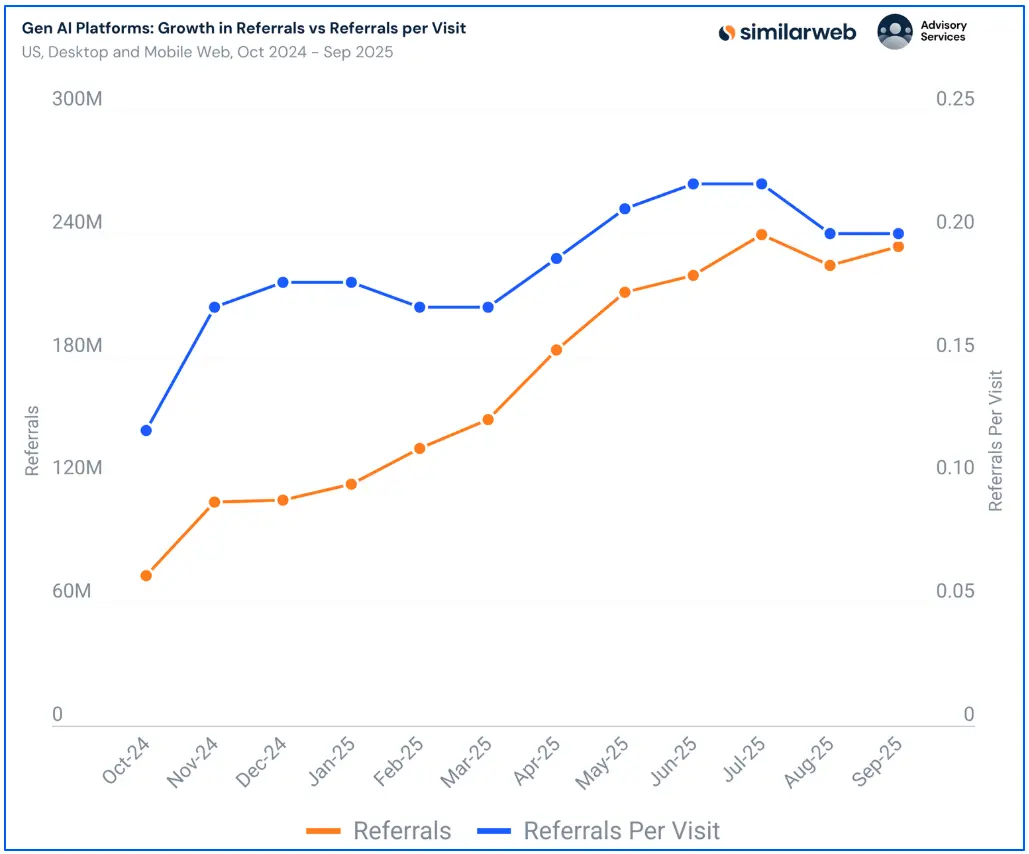
Because AI answers change by prompt, source trust, and freshness, visibility is both impactful and unstable, and that instability is a big part of why content optimization feels way harder than SEO. Once the underlying reasons are mapped out, the fixes stop feeling like guesswork and start feeling like priorities.
AI visibility platforms, including tools with an AI Overviews Tracker, help brands track where they appear inside Google’s AI summaries, understand why competitors are cited instead, and identify what needs to improve to stay visible in AI-driven search.
Did you know?
How Do I Optimize Content for Better AI Visibility Scores?
Here are 8 AI visibility optimization tips to improve your content’s AI visibility scores:
- Cover questions the way AI systems answer them: AI models prefer content that directly answers questions in a clear, structured way. Pages that explain concepts, compare options, or define topics step by step are more likely to be referenced than vague or promotional content.
- Strengthen topical depth, not just single pages: AI visibility improves when content shows authority across a topic, not just one URL. Supporting pages, related guides, and consistent coverage help AI systems understand the brand as a reliable source.
- Optimize for citations, not clicks: AI systems often pull short explanations, facts, or summaries. Content that includes clear definitions, concise explanations, and factual statements is easier for AI to cite accurately.
- Improve clarity and structure: Well-structured pages with clear headings, logical sections, and simple language are easier for AI systems to parse and reuse, coupled with an AI content optimization tool to surface gaps and structural improvements.
- Update content regularly: AI answers shift as new information appears. Keeping pages fresh, accurate, and aligned with current intent increases the chances of being referenced over outdated sources.
- Fix technical and access issues: If AI crawlers cannot easily read or understand a page, visibility suffers. Clean site structure, accessible content, and proper crawl controls help AI systems interpret pages correctly.
- Monitor competitors that appear instead: Visibility scores improve faster when optimization is guided by real comparisons. Understanding which competitors are cited and why helps prioritize what to improve or expand.
- Track prompts, not assumptions: Optimizing without prompt-level feedback is guesswork. Visibility platforms with prompt-level tracking help identify which questions trigger mentions and which do not, so content changes can be measured accurately.
What Content Factors Most Influence Brand Citations in AI Chatbots?
AI chatbots don’t cite brands randomly. Their answers consistently favor content that demonstrates depth, clarity, and structure rather than traditional ranking signals alone. The data below highlights how content depth factors like word count, sentence count, and readability correlate more strongly with brand citations across ChatGPT, AI Overviews, and Perplexity than backlinks, traffic, or keyword volume.
| Factor | ChatGPT | AI Overviews | Perplexity | AVG |
|---|---|---|---|---|
| Word Count | 0.047 | 0.153 | 0.191 | 0.130 |
| Sentence Count | 0.046 | 0.105 | 0.155 | 0.102 |
| Domain Rating | 0.161 | 0.034 | 0.074 | 0.090 |
| Flesch Score | 0.115 | -0.037 | 0.113 | 0.064 |
| URL Rating | 0.066 | -0.001 | 0.024 | 0.030 |
| Response Time | 0.048 | -0.021 | -0.006 | 0.007 |
| Domains | -0.037 | -0.032 | 0.005 | -0.021 |
| Total Backlinks | -0.030 | -0.021 | -0.024 | -0.025 |
| Total Keywords | -0.046 | -0.044 | 0.002 | -0.030 |
| Total Traffic | -0.026 | -0.041 | -0.023 | -0.030 |
Source. All values are correlation coefficients, so read them as weak associations rather than causes.
What Common Mistakes Do Brands Make with AI Visibility?
Many brands struggle with AI visibility because they use the tools incorrectly or focus on the wrong signals. The table below highlights the 8 common mistakes and how AI visibility platforms help avoid them.
| Common Mistake | What Goes Wrong | How the Best AI Visibility Tools Help Fix It |
|---|---|---|
| Tracking “mentions” only | Brands look visible on paper, but don’t know if AI is citing them as a source or just name-dropping. | Use tools that separate mentions vs citations and show which pages are referenced. |
| Using random prompts | Results swing wildly because prompts are inconsistent, so progress cannot be measured. | Build a prompt or query list and track the same sets daily or weekly to compare trends. |
| Ignoring competitor-cited sources | Brands see competitors winning AI answers but can’t identify what content drives that advantage. | Use competitive gap views and source influence tracking to see which URLs AI relies on. |
| Not monitoring source influence | Content updates feel “done,” but AI still cites other sources because it trusts them more. | Use citation/source reporting to map which sources shape AI answers, then prioritize coverage. |
| Assuming one platform equals all platforms | A brand may show up in one AI engine but be absent in another, creating blind spots. | Choose tools with multi-engine tracking across ChatGPT, Gemini, Perplexity, AI Overviews, and AI Mode. |
| Not tracking visibility by topic cluster | Brands optimize one page while AI visibility depends on broader topic authority. | Use platforms that organize prompts into topics or clusters and report visibility by intent. |
| Not validating whether AI claims are accurate | AI mentions may be incorrect or outdated, which hurts trust and conversion. | Use tools that flag misrepresentation and monitor narrative changes in brand sentiment. |
| Focusing on dashboards, not action | Visibility data accumulates, but nothing changes because it’s not connected to execution. | Pick tools that surface opportunities, gaps, and recommended next steps. |
FAQs
An AI visibility platform tracks how a brand appears inside AI-generated answers across tools like ChatGPT, Gemini, and AI Overviews. It measures mentions, citations, and competitor presence to help improve visibility in AI-driven discovery.
Several AI visibility tools offer entry-level plans under $100 per month, including Wellows ($29), RankScale ($20), Otterly AI ($29), AI Peekaboo ($50), ZipTie AI ($69), and Promptwatch (free to $99). These plans suit basic monitoring and testing AI visibility without enterprise-level complexity.
Traditional SEO focuses on rankings and clicks, while AI visibility measures how brands are mentioned and cited inside AI answers. AI visibility relies more on content clarity, topical depth, and source trust than page position.
Most brands focus on ChatGPT, Google AI Overviews, Gemini, and Perplexity, as these platforms influence research and decision-making. The exact mix depends on where the audience looks for answers.
AI answers can change frequently based on prompt wording, new sources, and model updates. In competitive topics, responses may shift daily, making regular monitoring important.
Early improvements can appear within a few weeks after content updates. Consistent visibility gains usually take a few months and depend on ongoing coverage and source trust.
The best AI visibility tool for agencies is one that tracks multiple client domains, white-labels reporting, and turns findings into client-ready actions. SE Visible, Wellows, and Profound are the strongest fits. See how Wellows works for agencies.
Under $100 a month, the strongest options are RankScale (from $20), Otterly AI (from $29), Wellows (Basic at $29 and Standard at $97, both with all five engines), and AI Peekaboo ($50, five engines on a flat plan). These cover most solo and small-team needs without enterprise complexity.
For most teams, daily monitoring on high-value prompts plus a monthly content review is the right cadence, because AI answers shift faster than traditional rankings. We break down the full approach in our guide on how often to update content for AI search visibility.
The best practices for ChatGPT visibility are answering questions directly and early on the page, covering a topic in depth rather than one URL, and structuring content so it’s easy to lift. See our full list of ChatGPT search visibility tips.
Competitive analysis in generative AI visibility means identifying which competitors are cited for your target prompts, which sources feed those citations, and where you’re missing. Our guide on using AI for competitor analysis walks through the method.
The best AI visibility tools for B2B companies are Wellows, Profound, and SE Visible. B2B visibility depends on comparison and shortlist prompts, so pick a tool that tracks commercial intent and shows which competitors AI recommends instead of you.
Three things: intent segmentation that separates commercial and comparison prompts from informational ones, competitor share of voice on your own prompt set so you can see who was named instead of you, and retained performance history long enough to measure a B2B sales cycle. Aggregate visibility scores without those three will move for reasons that don’t affect pipeline.
Yes. Wellows offers a free Perplexity Visibility Tracker and a free AI Overviews Tracker, Promptwatch has a free 10-prompt tier, LLMRankings.io has a free plan, AI Peekaboo runs a one-time free report with no card, and RankScale runs a freemium model. Free tools work for a baseline check; consistent daily tracking on a fixed prompt set requires a paid plan.
No, they are the same category. LLM visibility describes the same job from the model side: tracking how large language models like ChatGPT, Gemini, Claude, and Perplexity mention and cite your brand. When a tool markets itself as an LLM visibility tool, compare it on model coverage and data refresh frequency.
Nine of the 20 tools we reviewed were cut: Rank Prompt, Mentions, BrandLight, Nightwatch, Surfer SEO AI Tracker, Writesonic, ZipTie AI, Promptwatch, and Goodie AI. The most common reasons were narrow engine coverage, an add-on pricing structure that pushes the real cost well above the headline figure, or no published engine list and no public pricing. Each entry in the also-tested section names the specific criterion it failed.
Rarely at the page level. Across 531,889 questions in Wellows’ internal citation dataset, two engines land on the same exact URL 6.8% of the time, the same website 10.9% of the time, and name the same company 30.3% of the time. Our full cross-engine AI citation overlap study has the method and the per-pair breakdown.
Final Thoughts
AI-driven discovery is becoming a primary way B2B buyers research and make decisions, which makes visibility inside AI answers critical in 2026. As AI platforms reshape how information is surfaced, relying only on traditional search metrics is no longer enough.
The best AI visibility tools for B2B companies help you track where you appear, understand why competitors are cited, and identify what needs to improve to stay on the shortlist. Choosing the right tool now puts your brand in a stronger position as AI-driven search continues to evolve.