TL;DR
| Answer AI mention tracking records how often AI answers name your brand, per engine, on a fixed prompt set. |
Mention vs citation A mention is your name in the answer. A citation is a page the engine used as a source. |
| The gap In Wellows analysis, 90.4% of cited pages mentioned no brand at all. |
Free? Yes. Check by hand, or run the free AI Brand Report on one engine in one country. |
| Method Use unbranded prompts, several runs per prompt, and the same set every time. |
Cadence Track weekly for the trend and report monthly. One run proves nothing. |
AI mention tracking means recording how often AI engines name your brand in their answers, engine by engine, using a fixed set of prompts that you repeat over time. Yes, it is possible to track brand mentions in AI search, and you can start for free.
A mention is only half the picture. Engines also cite pages as sources, and the two often do not match. This guide explains the difference, shows how to measure mentions across ChatGPT, Gemini, Perplexity and Google, and says how often to check.
1What is AI mention tracking?
Definition: AI mention tracking
Repeatedly asking AI engines the same buyer prompts and recording whether each answer names your brand, how it describes you, and which pages it cites. It works per engine, because each engine answers differently.
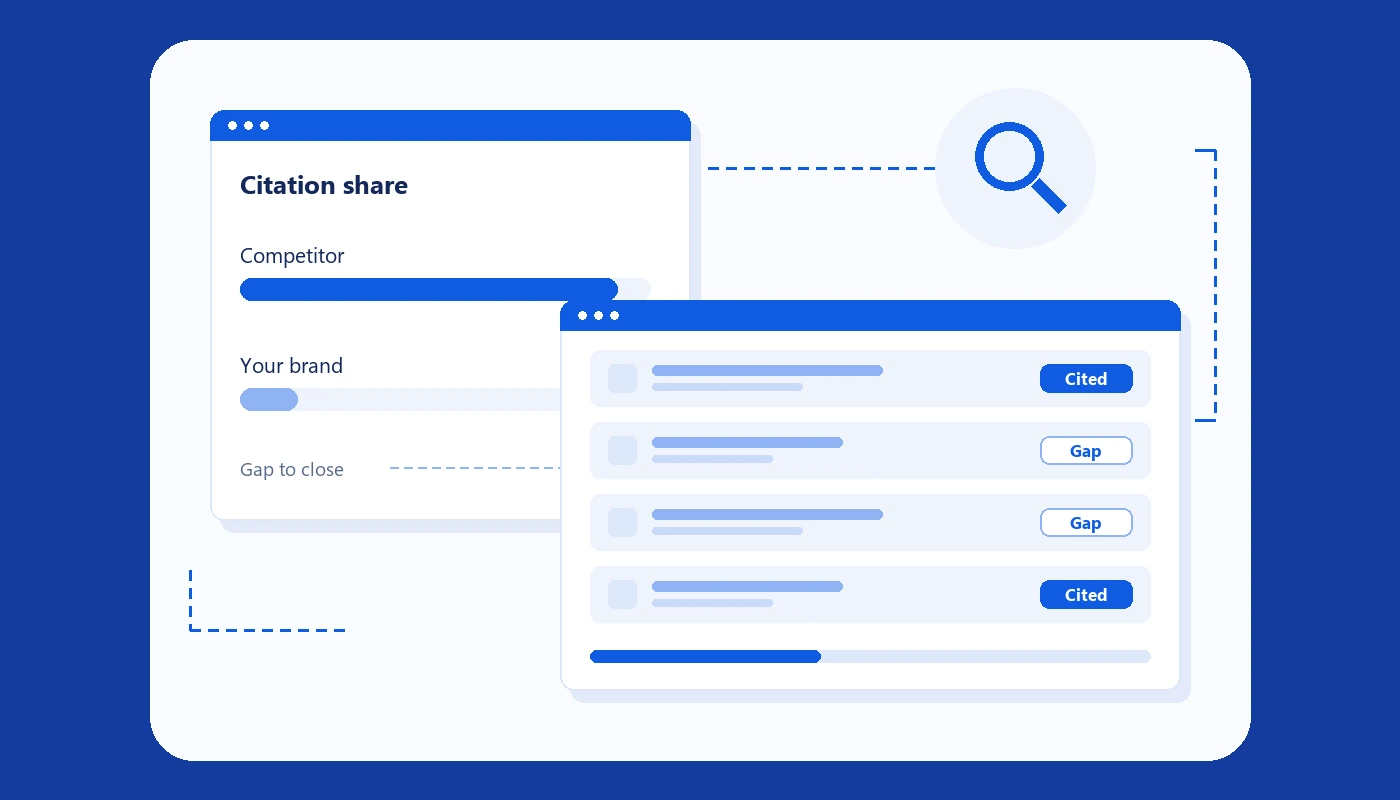
A mention is your name appearing in the answer text. It shows the model knows who you are. A citation is a page the engine used as a source, which explains why you were named and where the reader is sent next. Wellows scores citations and records mentions. Our guide to AI citations covers the citation side.
Citations come in two kinds. An explicit citation is your own URL used as a source. An implicit citation is a third-party page that names your brand. See the AI citation platform page for how Wellows separates them.
2What is AI mention rate and why does it matter?
AI mention rate is the share of answers that name your brand. It matters because it shows whether AI engines bring you up when a buyer asks about your category. Look it up in our glossary for the short definition.
Formula: AI mention rate
Mention rate % = answers that name your brand ÷ total answers run × 100, per engine, on the same prompt set.
Use the same formula with linked answers for a citation rate.
Here is an illustrative case. A brand runs 40 prompts five times each on one engine, which gives 200 answers. It is named in 54 of them, a mention rate of 27%. Its own domain is cited in 38, a citation rate of 19%. The 8-point gap is visibility that sends no one to the site. These numbers are illustrative, not Wellows data.
Mention rate is one input to share of voice. For the competitor view, see how to calculate share of voice and our guide to brand performance metrics in AI search.
3Why do so many AI citations miss your brand?
Because the page an engine cites and the brand it names are often different things. A Wellows analysis of 20.5 million AI citations found that 90.4% of the cited pages did not mention any brand. The page that received the citation and the brand that got a mention do not always match up. The Wellows analysis does not publish its method, so treat the figure as a signal, not a benchmark.
Two other 2026 studies point the same way, with different definitions. One looked at 3,981 domain appearances across 115 prompts, 14 countries and four engines, and found that about 61.7% were cited but not named (ghost citations study). Another analysed roughly 16 million brand appearances over 30 days and found that about 40% of citations did not name the source brand (Search Engine Land report). Both come from companies that sell AI visibility software, as Wellows does.
Cited, named or both
| What the answer did | Share of appearances | What it means |
|---|---|---|
| Cited, brand not named | 61.7% | A source link with no brand name in the answer |
| Cited and named | 13.2% | The ideal case, a name and a link |
| Named, not cited | 25.1% | A name drop with no source link |
Source: the study of 3,981 appearances above. The three rows sum to 100%.
It depends on the engine
The study of about 16 million appearances also split the rate by engine. The share of citations that did not name the source brand ranged from 25% to 52%.
| Engine | Citations that did not name the brand |
|---|---|
| Perplexity | 52% |
| Google AI Mode | 49% |
| Google AI Overviews | 41% |
| ChatGPT | 37% |
| Gemini | 25% |
The three studies measure different things, so do not compare their percentages directly. Wellows counts cited pages with no brand on them. The others count whether the cited brand was named in the answer. All three agree on the point that matters: a citation does not guarantee a name, and a name does not guarantee a link.
4Is it possible to track brand mentions in AI search?
Yes. There are three ways, and each has limits. All of them sample answers, which change from run to run.
| Method | Cost | Good for | Limit |
|---|---|---|---|
| Manual check | Free | A first look at one or two prompts | Slow, and one run is not reliable |
| Free AI Brand Report | Free | A fast snapshot on one engine in one country | A single-day sample, so rerun it |
| Citation tracker | Paid | Repeated runs across engines and rivals | Needs a fixed prompt set to be useful |
The Free AI Brand Report asks one engine six buyer questions, six times each, then shows how the engine describes your brand, which rivals it suggests and which pages it cites. You choose one engine and one country per report, so repeat it for each engine that matters.
5How do I track brand mentions across ChatGPT, Gemini and other engines?
Use one method for every engine, so the numbers can be compared.
| 1 | Write 30 to 50 unbranded prompts that a buyer would ask about your category. |
| 2 | Choose your engines, such as ChatGPT, Gemini, Perplexity, Google AI Overviews and Google AI Mode. |
| 3 | Run each prompt several times per engine, from the same country, in the same window. |
| 4 | Record whether the answer names you, how it describes you and which URLs it cites. |
| 5 | Separate mentions from citations, and your own pages from third-party pages. |
| 6 | Divide by the total answers to get a mention rate and a citation rate per engine. |
Keep the prompts unbranded. A prompt that names your brand makes you appear by design and inflates the rate. Keep the competitor set fixed as well, so a change in the number means something.
6How often should I check AI mentions of my brand?
Check on a fixed schedule and judge the trend, not one run. A 2026 University of St. Gallen study found that the sources an engine cited overlapped by only 34 to 42% from one day to the next, and recommended at least seven runs per prompt per day (Schulte, Bleeker and Kaufmann). A single check can show a spike or a dip that is only noise.
A practical rhythm is weekly runs for the trend and a monthly report for the team. Run more often during a launch or after a major content change. Keep prompts, countries and settings the same each time.
7Which tools track brand mentions in Google AI Overviews?
Search Console cannot do it. The Generative AI report just shows how many times links to your site were used within Google’s AI features. To see if your brand was mentioned or cited in an answer you will need to use a tool that can prompt searches and read through the answers.
| Tool type | Shows mentions? | Covers |
|---|---|---|
| Search Console Generative AI report | No, it counts links shown | AI Overviews and AI Mode, Google only |
| Web analytics | No, it counts visits | Visits that carry a referrer or tag |
| Prompt-based tracker | Yes | The engines it queries, from the prompts you set |
When you compare trackers, ask which engines each covers, how often it runs each prompt, whether it separates mentions from citations, and whether you can fix the prompt set. Enterprise teams should also ask about country coverage and exports.
What only Wellows adds
Wellows tracks mentions and citations side by side across ChatGPT, Gemini, Perplexity, Google AI Overviews and Google AI Mode, so you can see where an engine names you and where it only uses your page. Tracking runs on a daily or weekly schedule, depending on the project.
It also tracks implicit citations, the times you are not cited but another page about your topic is. This is your shadow reputation, and it is the narrative that AI engines create based on pages you have not written. A name-only check cannot see it.
Start with a free snapshot, then track it over time.
An AI mention tracking checklist
- Write 30 to 50 unbranded prompts.
- Pick the engines that matter to your buyers.
- Run each prompt several times per engine.
- Record mentions and citations separately.
- Work out a mention rate and a citation rate per engine.
- Repeat weekly with the same set, and report monthly.
Conclusion
AI mentions gives you an indication of how many times your name is mentioned by search engines. Citations give you real traffic to your website. These can often be very different. You should track both by search engine using the same prompts every time. Start with a free snapshot this week and then do it regularly.