Search is changing… and really fast.
People aren’t just typing keywords into Google anymore. They’re asking questions, having conversations, and trusting AI tools to give them direct answers. And here’s the big shift: AI doesn’t rank websites the way search engines used to, it recognizes brands.
This shift is already happening at scale—studies show that more than 60% of U.S. adults now use AI tools for information search, with adoption even higher among younger users (AP news, 2025)
I’ve noticed something interesting. A brand can show up in AI answers even when it doesn’t rank #1 on Google. Sometimes, it shows up without a link at all. That’s because AI search cares less about clicks and more about who it trusts, remembers, and mentions.
This is where brand performance metrics in AI search come in. Traditional SEO metrics like traffic, rankings, and CTR don’t tell the full story anymore. If your brand isn’t appearing in AI-generated answers, you’re invisible. No matter how strong your SEO looks on paper.
In this guide, I’ll break down what brand performance really means in AI search, which metrics actually matter, and how you can measure whether AI tools recognize your brand or ignore it. No jargon. No complexity. Just clear, practical insights for an AI-first world.
- AI search surfaces brands, not pages—rankings and clicks matter less.
- Your brand can appear in AI answers without ranking #1 or getting links.
- Brand performance in AI search = recognition, trust, and relevance.
- AI evaluates brands as entities, based on consistent mentions and context.
- Key metrics: AI citations, explicit & implicit mentions, share of AI voice, sentiment, and association accuracy.
- Tracking AI visibility requires prompt testing + AI visibility platforms.
- The future of search isn’t traffic—it’s being remembered and cited by AI.
What Is Brand Performance in AI Search?
Brand performance in AI search is about whether AI systems recognize, understand, and trust your brand, not how many clicks your website gets or where it ranks on Google.
In the past, success in search meant traffic and rankings. Today, AI tools often answer questions directly. Users may never visit a website at all. That’s why I see brand performance as something bigger: does AI mention your brand when it matters?
If your brand shows up naturally in AI-generated answers—explaining, recommending, or comparing—you’re performing well in AI search, even without a single click.
Beyond Clicks and Rankings
Traditional search visibility focuses on pages and positions. AI visibility focuses on brands and meaning.
Search engines rank URLs. AI systems surface entities, which is why entity-based content is becoming critical for brand visibility. Instead of deciding which page is best, AI decides which brand makes sense in a given context.
This creates a clear gap:
- You can rank well but never appear in AI answers
- Or appear often in AI answers without seeing traffic spikes
That’s why measuring only traffic no longer tells the full story.
How AI Understands Brands
Large Language Models don’t “read” your website the way humans do. They build understanding from patterns across the web. Your brand becomes an entity based on how consistently and accurately it’s mentioned, described, and associated with certain topics.
If AI can clearly answer:
- Who you are
- What you do
- When you’re relevant
then your brand has strong entity recognition.
What Actually Drives Brand Performance in AI Search
Three ideas shape how AI evaluates brands:
- Entity recognition: AI knows your brand exists and understands what it represents.
- Brand authority signals: AI sees your brand as credible, based on trusted mentions and references.
- Contextual relevance: AI includes your brand in the right conversations, not every conversation.
When these work together, your brand stops competing for clicks and starts earning presence inside AI-generated answers.
How AI Search Engines Evaluate Brands
AI search engines don’t think in keywords the way traditional search engines do. They think in meaning, relationships, and context. Instead of asking, “Which page matches this keyword?” AI asks, “Which brand fits this question best?”
This shift is significant—Google has confirmed that AI Overviews are now served to over 1.5 billion users every month, making AI-generated answers a primary discovery surface for brands. (The Verge, 2025)
I’ve seen this shift clearly. You can optimize for every keyword and still not show up in AI answers. That’s because AI search has moved beyond keywords and started understanding brands as entities, making prompts more important than keywords.
From Keywords to Brand Entities
In traditional SEO, keywords were everything. If a page matched the right terms, it had a chance to rank. AI search works differently.
AI systems group information around entities—real things like brands, tools, companies, and products. Your brand becomes an entity when AI sees it mentioned consistently, described clearly, and connected to specific topics.
What matters now isn’t just what keywords you target, but:
- How often your brand is mentioned across the web
- Which topics your brand appears alongside
- Which other brands and concepts are linked to you
This is called co-occurrence and works alongside pattern recognition to help AI understand brand relationships. When your brand keeps showing up near the same ideas, use cases, or competitors, AI starts to understand what space you belong in.
Over time, these repeated patterns create semantic associations. That’s how AI learns that your brand is not just relevant, but relevant for a specific reason.
Implicit vs Explicit Opportunities
Before we get into wins, it helps to understand Brand Mentions vs. Citations because AI can mention you without linking — and both signals affect visibility.
AI visibility grows through two opportunity types: Implicit Opportunities (Implicit Wins) and Explicit Opportunities (Explicit Wins).
Explicit Opportunities (Explicit Wins)
Explicit Wins focus on places where AI platforms already cite sources—and your competitors are being credited while your brand is missing.
Wellows surfaces these citation gaps across AI platforms (e.g., Gemini, Perplexity, Google AI Overview, AI Mode), so you can create content that earns direct citations and improves your visibility.
What this includes:
- Finding pages where competitors are cited but you aren’t
- Seeing the queries/topics driving those citations
- Using intent + AI-suggested titles to build content that wins citations
Implicit Opportunities (Implicit Wins)
Implicit Wins are missing AI citations—opportunities where your brand deserves recognition but isn’t mentioned or credited, often while competitors are.
Wellows finds the third-party pages influencing AI answers, traces them back to source domains and topics, and gives you a path to turn those missed mentions into earned citations through validation + outreach.
What this includes:
- Discovering third-party pages where competitors are cited and you’re absent
- Validating the domain, URL, and topic behind the opportunity
- Reaching out with verified contacts + email templates to secure inclusion
Why both matter
- Explicit Wins help you win direct credit in AI results through citations and content targeting.
- Implicit Wins help you uncover where you’re being left out—and convert those missed chances into measurable visibility gains via outreach and earned citations.
What KPIs Should You Track to Measure AI Search Visibility?
When it comes to AI search, brand performance is not a single number. It’s a set of signals that show how visible, trusted, and accurately understood your brand is inside AI-generated answers. I like to think of these metrics as answers to one big question: Does AI recognize my brand when people ask relevant questions?
This metric measures how often your brand is cited or referenced in AI-generated answers across different AI search tools and conversational platforms.
Unlike traditional rankings, an AI citation score focuses on presence, consistency, and authority, not a single query or keyword. A strong citation score means AI systems regularly pull your brand into answers when discussing relevant topics.
High AI citation coverage shows up across:
- Multiple prompts and question formats
- Different user intents and use cases
Key categories where your brand should be recognized.
With platforms like Wellows, brands can track where and how these citations appear across LLMs, helping them understand whether AI truly recognizes their brand or overlooks it.
Explicit mentions are simpler and more obvious. This is when AI directly uses your brand name in its answers.
These mentions help measure:
- Brand recall
- Authority recognition
- Trustworthiness in a specific context
When AI repeatedly names your brand in relevant answers, it shows your brand has become part of its learned knowledge, not just a one-time reference.
Implicit brand mentions are cases where your brand is mentioned by name in AI responses or content, but not linked or cited.
In these situations, AI clearly recognizes your brand, but does not attribute it as a source.
Implicit mentions show partial trust:
- AI knows who you are
- AI understands what you do
Wellows dashboard show us the exact explicit and implicit mentions count.
Visibility alone isn’t enough. Your brand also needs to be associated with the right topics.
Brand association accuracy measures whether AI understands what your brand is actually about. I always check this because incorrect associations can be just as damaging as invisibility.
Key signals to watch:
- Category mentions: are you placed in the correct industry or market?
- Feature-based associations: does AI describe what you actually offer?
- Use-case relevance: is your brand shown as a solution to the right problems?
If AI starts associating your brand with the wrong category or use case, that’s a misclassification risk—and it needs fixing.
This metric shows how often your brand appears compared to competitors in AI-generated answers.
It’s calculated by looking at:
- The total number of AI responses for a topic
- The percentage that include your brand
If competitors are showing up more often than you, they’re winning mindshare—even if their SEO traffic is lower. In AI search, presence equals influence.
How AI talks about your brand matters just as much as how often it talks about you.
Brand sentiment measures whether AI frames your brand in a:
- Positive
- Neutral
- Negative way
This metric also helps detect hallucinations and misinformation. If AI repeats outdated claims, incorrect features, or misleading descriptions, your brand reputation is at risk—even if the mention is frequent.
Using platforms like Wellows, brands can monitor how AI describes them over time and spot shifts in tone or accuracy.
Supporting Metrics That Influence AI Brand Performance
Some metrics don’t show up directly in AI answers, but they strongly influence whether your brand appears at all.
Entity Coverage Across the Web
AI learns from patterns across the internet. The broader and more consistent your presence, the stronger your entity becomes.
This includes:
- Mentions in authoritative articles
- Structured citations like profiles, listings, and databases
- Unstructured references in blogs, interviews, and discussions
The goal is not volume, but credible coverage based on what AI search engines actually cite.
Content Consistency & Brand Narratives
AI struggles with mixed messages. If your brand positioning changes across blogs, PR, documentation, and social content, AI may misunderstand you.
Consistent narratives help AI:
- Understand your core value
- Associate you with the right topics
- Describe your brand accurately in answers
Clarity beats creativity in AI search.
Co-Mention Strength
Co-mentions show who your brand is associated with.
When AI frequently sees your brand mentioned alongside:
- Certain competitors
- Industry leaders
- Tools in the same ecosystem
it starts placing you in that same space.
Strong co-mention patterns help define your competitive position and improve your chances of being included in AI answers for broader industry questions.
How Brand Performance Metrics Differ from Traditional SEO Metrics
Traditional SEO was built around one goal: getting clicks. AI search has changed that goal to earning presence.
In classic SEO, success looks like rankings, traffic, and backlinks. In AI search, success looks very different. What matters now is whether your brand appears inside answers, not whether someone clicks through to your site.
Here’s how the focus has shifted:
then
Traditional SEO Metrics
➡️ Rankings
➡️ Clicks
➡️ CTR
➡️ Rankings
➡️ Traffic
now
Brand Performance Metrics
➡️ AI inclusion
➡️ Brand recall
➡️ Answer presence
➡️ Entity authority
➡️ Visibility without clicks
I’ve seen brands with strong traffic disappear from AI answers, while lesser-known brands dominate conversations simply because AI understands and trusts them better. That’s the real difference.
How to Track Brand Performance in AI Search
Tracking AI brand performance requires a different mindset. You’re not measuring visits anymore—you’re measuring recognition and accuracy.
Manual Prompt Testing
The simplest way to start is by asking AI tools the same questions your audience would ask.
Test your brand across:
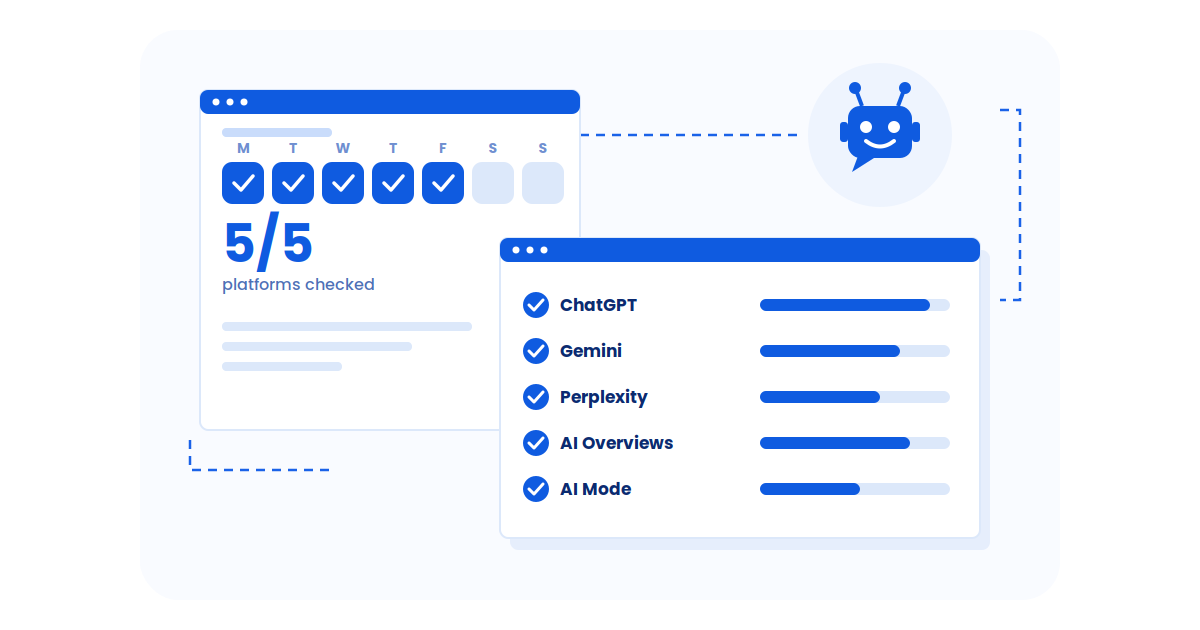
- ChatGPT
- Gemini
- Perplexity
- Other AI-powered search tools
I recommend grouping related prompts together. This prompt clustering helps you see whether your brand appears consistently or only in isolated cases. Consistency matters more than one-off mentions.
AI Visibility Platforms (e.g., Wellows)
Manual testing doesn’t scale which is why auditing brand visibility across LLMs becomes important. That’s where AI visibility platforms come in.
Wellows help track:
- Explicit brand mentions
- Implicit mentions
- Brand presence across categories
- Changes in visibility over time
Instead of guessing, you can clearly see whether AI recognition is growing or fading.
Common Mistakes When Measuring Brand Performance in AI Search
Measuring brand performance in AI search comes with challenges that don’t exist in traditional SEO. Many teams unknowingly apply old measurement habits to a completely new system. Below are the most common mistakes brands make—and why they matter.
- Relying Solely on Traditional SEO Metrics: Looking only at rankings, traffic, and clicks gives an incomplete picture in AI search. AI systems often surface brands without sending users to websites, so metrics like impressions, mentions, and inclusion in answers matter just as much—if not more.
- Overemphasis on Vanity Metrics: Seeing your brand name appear frequently in AI responses can feel like a win, but volume alone doesn’t equal success. If mentions are irrelevant, inaccurate, or poorly positioned, they don’t contribute to real brand authority.
- Neglecting Contextual Analysis: Where and how your brand appears in an AI answer is critical. Being mentioned as an example, a comparison, or a trusted solution carries very different weight. Ignoring context means missing how AI actually positions your brand.
- Short-Term Focus: AI brand visibility builds over time. Expecting instant results often leads teams to abandon strategies too early or chase quick wins that don’t strengthen long-term entity recognition.
- Ignoring Negative Signals: AI can repeat outdated or incorrect information just as easily as positive mentions. If negative framing or misinformation goes unnoticed, it can quietly damage brand trust at scale.
- Platform Silos: Evaluating AI visibility on just one platform doesn’t reflect real user behavior. People move between ChatGPT, Gemini, Perplexity, and other tools. Measuring each in isolation hides broader visibility trends.
- Over-Attribution: AI search is one part of a larger ecosystem. Attributing all growth in awareness or demand to AI mentions alone can distort decision-making and lead to flawed conclusions about performance.
- Ignoring E-E-A-T Signals: AI systems favor brands that demonstrate real-world experience, subject expertise, authority, and trustworthiness. Without clear signals in content, mentions, and citations, AI may hesitate to surface your brand.
- Inconsistent Measurement: Changing how often or how you measure AI brand performance makes it difficult to spot patterns. Without consistent tracking, it’s nearly impossible to know what’s actually improving visibility.
- Neglecting Qualitative Insights: Numbers alone don’t tell the full story. Understanding tone, sentiment, and positioning in AI responses adds depth that raw counts can’t provide. Without qualitative review, key insights get lost.
Avoiding these mistakes requires a balanced approach—combining quantitative metrics with qualitative analysis, maintaining consistent measurement practices, and focusing on long-term brand recognition, not short-term wins. Brands that treat AI search as a brand-building channel—not just a traffic source—are far better positioned for sustainable visibility.
How to Improve Brand Performance in AI Search
Improving brand performance in AI-powered search isn’t about chasing algorithms—it’s about helping AI clearly understand, trust, and reference your brand. As AI search continues to evolve, brands need strategies designed specifically for how AI systems read, interpret, and surface information.
Below are key approaches to strengthen your brand’s visibility and authority in AI search.
1. Optimize Content for AI Comprehension
Structure Content Clearly
AI models process information more easily when content is well organized. Clear headings, short paragraphs, bullet points, and logical sections make it easier for AI to extract meaning. Adding structured data, such as FAQs or how-to formats, further helps AI identify what your content is about and how it should be used.
Focus on Semantic Topics
Instead of building content around individual keywords, focus on covering complete topics. When your content explains concepts in depth and connects related ideas, AI gains a stronger understanding of relevance and context—making your brand more likely to appear in generated answers.
2. Enhance Brand Authority and Trustworthiness
Build Authoritative Profiles
AI systems rely on structured and widely trusted sources to validate brands. Maintaining accurate profiles on recognized platforms and databases helps reinforce your brand as a legitimate and established entity.
Invest in PR and Credible Partnerships
Mentions from respected publications, industry experts, and trusted voices increase confidence in your brand. AI models tend to favor brands that are consistently referenced by reliable sources, not just self-published content.
3. Create Content That Provides Direct Answers
Apply Answer-Focused Optimization
AI search favors content that responds clearly to real questions. Writing content that directly answers common user queries—using straightforward language—improves the chances of being included in AI responses.
Use FAQs and Structured Information
Well-written FAQ sections help AI quickly locate precise answers. When paired with structured formatting, this content becomes easier for AI to reuse when generating responses.
4. Leverage Multimedia and Visual Content
Use Clear, Informative Visuals
AI-generated results often include visuals alongside text. Charts, diagrams, and infographics that are well-labeled and easy to interpret increase the likelihood of your content being referenced or summarized by AI systems.
5. Monitor and Adapt to AI Search Trends
Track AI Visibility Over Time
AI search performance can’t be guessed—it needs monitoring. AI visibility tools help you see how often and where your brand appears across different AI platforms, making it easier to identify gaps and opportunities.
Keep Content Fresh and Accurate
AI systems prioritize current and reliable information. Regularly reviewing and updating content ensures your brand remains relevant and reduces the risk of outdated or incorrect information being repeated by AI.
6. Avoid Common AI Search Optimization Pitfalls
Avoid Low-Quality or Manipulative Tactics
Tactics like keyword stuffing, shallow content, or unreviewed AI-generated pages can weaken brand credibility. AI systems are increasingly sensitive to quality and trust, so human oversight and genuine value are essential.
By following these strategies, brands can improve how AI systems interpret and present them. The goal isn’t just to be discovered—but to be understood, trusted, and consistently referenced in AI-driven search experiences.
Future of Brand Performance Metrics in AI Search
Brand performance in AI search will no longer be about rankings or traffic. It will be about being present, remembered, and trusted.
As AI delivers answers directly, zero-click visibility will become standard. If AI doesn’t mention your brand, you don’t exist in that moment—no matter how strong your SEO is.
Brand recall will replace clicks as a key success metric, and analytics will shift toward tracking AI mentions, topic presence, and sentiment instead of page views.
The brands that win will be the ones AI understands and consistently includes. Measuring AI visibility early won’t be optional—it will be essential.
FAQs
Conclusion
Search is no longer just about being ranked—it’s about being recognized.
As AI search becomes the default way people discover information, brand performance can’t be measured by traffic and clicks alone. What matters now is whether AI understands your brand, trusts it, and chooses to mention it when users ask relevant questions.
Brand performance metrics in AI search shift the focus from pages to entities, from rankings to recall, and from visits to visibility inside AI-generated answers. Brands that continue to rely only on traditional SEO metrics risk becoming invisible in an AI-first world—even if their rankings look strong.
The opportunity is clear. By tracking the right metrics, fixing brand misclassification, and building consistent authority signals, you can influence how AI systems perceive and present your brand. Those who start measuring and improving AI visibility today won’t just adapt to the future of search—they’ll lead it.
In AI search, the brands that win aren’t the loudest. They’re the ones AI remembers, trusts, and confidently references.