Ask a B2B client one simple question: “do we show up when a buyer asks ChatGPT to compare vendors in our category?” Most agencies go quiet. Closing that gap is the entire job of AI visibility for B2B marketing agencies: tracking, growing, and proving how often a client’s brand gets cited, mentioned, and recommended inside answer engines like ChatGPT, Gemini, and Perplexity.
It matters more in B2B than anywhere else, because the buying committee now builds its shortlist inside AI before sales ever hears a word. A March 2026 G2 survey of 1,076 software buyers found 71% now use AI chatbots to research vendors, with head-to-head comparison the single most common use case. Forrester’s 2026 buyers’-journey research goes further, naming generative AI the most meaningful vendor-research source, ahead of vendor websites, analysts, and sales reps.
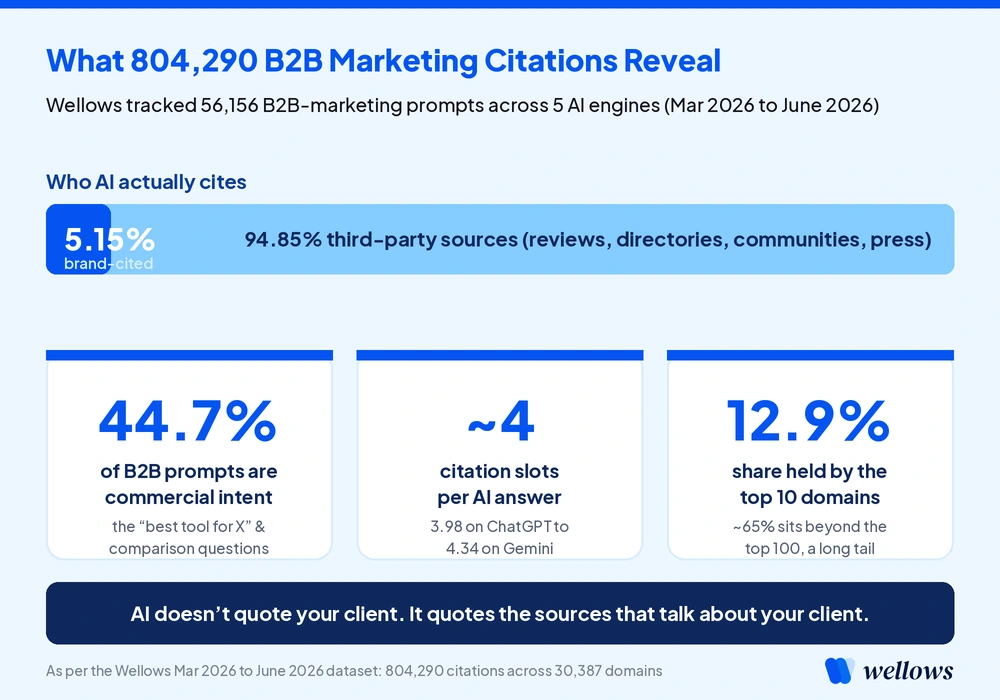
So we pulled our own numbers instead of borrowing someone else’s. Across 56,156 B2B-marketing prompts tracked from March 2026 to June 2026, spanning ChatGPT, Perplexity, Gemini, Google AI Mode, and Google AI Overviews, Wellows logged 804,290 citations drawn from 30,387 distinct domains.
Two findings reframe the work. First, only 5.15% of those citations actually mention the brand being researched; the other 94.85% are third-party sources. Second, 44.7% of B2B-marketing prompts carry commercial intent (the “best tool for X” and comparison questions where a shortlist is decided), noticeably higher than the roughly 36% we see across general marketing queries.
The takeaway is blunt: AI doesn’t quote your client. It quotes the sources that talk about your client.
of B2B-marketing AI citations actually mention the brand
The other 94.85% come from reviews, directories, communities, and press. Owned content alone cannot carry a client into the answer. The agency’s job is to win the third-party sources AI already trusts.
Source: Wellows Mar 2026 to June 2026 dataset- Track prompts, not keywords. Map the exact questions a client’s buyers ask AI, then track them across every engine.
- Win commercial-intent prompts first. 44.7% of B2B-marketing prompts in our data are commercial: the “best X” and comparison questions where deals are decided.
- Earn third-party citations. Only 5.15% of citations are the brand itself, so credible reviews, directories, and press do most of the work.
- Report citation share, not raw mentions. Set a baseline against named competitors, then show movement over time.
- Tie it to revenue. Connect visibility to shortlist inclusion, assisted conversions, and branded-search lift so the retainer defends itself.
- Run it in one workflow. A platform like Wellows handles discovery, gap analysis, and client reporting in one place.
What AI Visibility Means for a B2B Marketing Agency
AI visibility is how often a client’s brand gets cited, mentioned, or recommended inside AI answers when a buyer asks a question. For a B2B marketing agency, it is the citation-era version of rankings, except the goal is no longer to rank a page, but to be the source an LLM names when the buying committee asks “who’s the best fit for us?”
B2B is where this hits hardest, for three structural reasons. The purchase is committee-driven, so a single champion runs AI queries on behalf of four or five colleagues.
The cycle is long, so the shortlist forms weeks before anyone fills in a form. And the questions are overwhelmingly commercial: our data puts 44.7% of B2B-marketing prompts in the commercial bucket, the highest of any intent.
Put together, that means the agency’s real product isn’t traffic. It’s shortlist defense: making sure the client is in the answer at the exact moment a buyer asks AI to compare options.
Here is the reframe that makes it click. AI reads brands as entities, not pages. Before it cites anyone, it works out who solves the problem, who it’s for, and whether the source can be trusted.
That’s why this sits closer to generative engine optimization than to keyword SEO, and why agencies that treat it as “SEO with new words” tend to stall.
What Our B2B Citation Data Taught Us
We ran the numbers so you can walk into a client meeting with something nobody else has. The dataset covers 56,156 B2B-marketing prompts tracked from March 2026 to June 2026 across ChatGPT, Perplexity, Gemini, Google AI Mode, and Google AI Overviews, producing 804,290 citations. Four findings should reshape how you sell and deliver this work.
1. Almost everything AI cites is third-party, not the client’s site
Only 5.15% of citations in B2B-marketing answers mentioned the brand at all, and just 2.66% were explicit, linked brand citations. AI assembles its answers from review sites, comparison listicles, communities, and directories.
Agency angle: directory placement, listicle inclusion, and earned coverage aren’t “nice to have,” they are the core deliverable. If your client isn’t in the sources AI reads, owned blog posts won’t save them.
2. B2B prompts skew commercial, more than general marketing does
Of the B2B-marketing prompts we tracked, 44.7% were commercial, 35.9% informational, 14.9% navigational, and 4.4% transactional. That commercial share is meaningfully higher than the ~36% seen across general marketing queries.
Agency angle: the “best X for Y” and head-to-head comparison prompts are where the buying committee’s shortlist is actually written. Weight the tracked set there.
3. Every AI answer is about four citation slots
Across engines, a B2B-marketing answer carried roughly four citations: 3.98 on ChatGPT, 4.02 on AI Overviews, 4.04 on AI Mode, and up to 4.34 on Gemini.
Agency angle: those ~4 slots are the new page one. The job is to win one of them for a defined set of buyer prompts, per client, not to “rank” everywhere.
4. Citations are a long tail, so smaller clients can win
AI cited 30,387 distinct domains on these prompts. The top 10 domains captured just 12.9% of citations and the top 50 only 26.2%, meaning roughly 65% sits beyond the top 100.
Agency angle: there is no position-one monopoly in AI answers the way there is on Google. A mid-market B2B client without huge domain authority can still earn citations, which is the easiest “yes” you’ll ever pitch.
The pattern underneath all four: in B2B, AI decides the shortlist using third-party sources, on commercial questions, across ~4 slots, spread over a long tail. Every problem below, and every fix, comes back to that.
10 Problems B2B Marketing Agencies Face With AI Visibility
These are the ten failure modes we see most often when an agency tries to stand up an AI visibility service, and the product-led fix for each. None are exotic. The skill is doing them in order and proving each one.
The 10 problems, each paired with its fix
1. You can't score where clients stand
Most agencies can describe AI search but can’t score it, so without a baseline citation number per client, every later report is just vibes.
The fix: set a day-one baseline with an AI Visibility Score and track it across engines with LLM visibility.
2. You track keywords, not prompts
Buyers ask full questions like “best ABM platform for a 20-person SaaS team under $2k a month,” not keywords, so a keyword list optimizes for questions nobody actually asks.
The fix: build a prompt set from real buyer language and run it on a schedule with prompt tracking.
3. You optimize for one engine
ChatGPT, Perplexity, Gemini, and AI Overviews disagree on sources more than they agree, so a client strong in one engine can be absent from another.
The fix: track them together with the ChatGPT, Perplexity, and AI Overviews trackers side by side.
4. You lean on owned content
Only 5.15% of B2B-marketing citations mention the brand, so owned blog posts alone can’t carry a client into the answer.
The fix: see which third-party domains AI already trusts via LLM citations, then earn placement in exactly those sources.
5. The client's entity is too fuzzy
LLMs cite brands they can place, and “we unlock growth for ambitious teams” gives a model nothing to attach to a query.
The fix: sharpen the positioning and structure pages so a model can map the brand to a buyer question, using content optimization.
6. The client's pages cannibalize each other
Two near-identical “best X” pages on one domain split authority, and AI often cites neither.
The fix: content optimization scans the whole domain, catches the cannibalization, and routes the work to a single URL.
7. You confuse AEO and GEO
Answer Engine Optimization and Generative Engine Optimization are related but not identical, and B2B needs both working together.
The fix: get the distinction straight with AEO vs GEO, then read what AEO is and what GEO is.
8. You report raw mention counts
“We got 18 mentions this month” means nothing without a starting point and a named competitor.
The fix: report citation share against specific competitors over time with performance history.
9. You can't prove the work moved anything
AI answers wobble run to run, so a single screenshot proves nothing.
The fix: track each prompt repeatedly and show a before/after on the same prompt set using performance history and the AI Visibility Score delta.
10. You're stitching five tools together
Separate tools for tracking, gaps, outreach, and reporting eat the hours that should be profit.
The fix: run discovery, gap analysis, and reporting in one workflow, and compare the AI visibility tools against your actual agency workflow.
The B2B Citation Growth Loop
Tactics without a system don’t scale across a client roster. Run every B2B client through the same five-stage loop, with the platform powering each stage.
It’s a loop, not a line, because Stage 5 feeds the next Discover, so onboarding client number twelve looks like onboarding client number one.
| Stage | What happens | Powered by |
|---|---|---|
| 1. Discover | Drop in the client’s domain and scan AI answers across ChatGPT, Gemini, and Perplexity to produce a baseline AI Visibility Score and the competitor set. That first number is what makes every later report believable. | AI Visibility Score |
| 2. Diagnose | Split the gaps with prompt tracking. Explicit gaps are prompts where a competitor is cited and the client isn’t (a content gap). Implicit gaps are unlinked mentions (an outreach opportunity). | Prompt tracking |
| 3. Fix | Route explicit gaps into content optimization, which checks for cannibalization and decides whether to strengthen an existing page or create a new one, so authority stacks on one URL instead of splitting. | Content optimization |
| 4. Validate | Confirm the work moved something. The competitive view shows whether citation share is rising topic by topic, and whether implicit mentions converted into explicit citations. | LLM citations |
| 5. Report | Package it with performance history: citation share, sentiment, and competitor gaps moving month over month, with a timestamped record of every action. Then the report feeds the next Discover. | Performance history |
Pro tip: compare the client’s visibility score immediately before and after each campaign. That before/after delta is the cleanest proof of impact you’ll ever drop into a B2B report.
AEO vs GEO for B2B Citations
The two disciplines get blurred constantly, and in B2B you genuinely need both working together.
| Question | Answer Engine Optimization (AEO) | Generative Engine Optimization (GEO) |
|---|---|---|
| What are you trying to win? | Being the concise answer an engine lifts | Being a cited source across a generated response |
| Where it shows up | AI Overviews, featured-style direct answers | ChatGPT, Perplexity, Gemini multi-source answers |
| What moves the needle | Answer-first structure, FAQ schema, question headings | Third-party citations, entity clarity, topical authority |
| Why B2B needs it | Wins the quick “what is / which is best” lift | Wins the committee’s comparison and shortlist prompts |
If you only remember one thing: AEO gets you the lifted answer on a single question; GEO gets your client named across the comparison answers where the shortlist is decided. Start with AEO vs GEO if you’re mapping the two for a client.
How to Prove AI Visibility ROI to a B2B Client
Prove it with change against a baseline, then connect that change to money. Proof and ROI are two different jobs, and agencies that blur them lose the room.
The proof layer is movement over time: citation share climbing, mention rate up, sentiment improving, implicit mentions turning into explicit citations. Show the same prompt set at month zero and month three, with before/after answer screenshots.
The ROI layer ties that movement to things a B2B client books revenue against: shortlist inclusion on category prompts, assisted conversions, branded-search lift after AI exposure, and AI-referral traffic isolated in GA4. The old metrics don’t carry this; in an AI-first buying journey, citations are becoming the path to revenue.
| Manual approach | How Wellows handles it |
|---|---|
| Run prompts by hand across 4 engines, screenshot, paste into a deck | Scheduled multi-engine tracking with stored history |
| Eyeball “mentions” with no baseline | AI Visibility Score and citation share tracked from day one |
| Guess which gap to fix | Explicit vs implicit gaps flag the exact action |
| No record of work done | Performance history timestamps every action for reporting |
| Separate tools for tracking, gaps, and reporting | One workflow, one client view |
Conclusion
Back to the question we opened with: “Do we show up when a buyer asks AI about our category?” In B2B, the agencies that can answer it with a number, a trend, and a competitor benchmark are the ones that keep their clients.
The ones that can’t will watch those clients drift to someone who can, because the shortlist is now built in AI before sales is ever involved.
The good news is the data says it’s winnable. Citations spread across a long tail, third-party sources do most of the work, and there’s no position-one monopoly to break through.
Three things to do this week: pull 20 commercial-intent buyer prompts for your top B2B client and check who gets cited today; set a baseline AI Visibility Score before you touch anything; and turn one unlinked mention into a real citation.
Run every client through the loop with Wellows, and the question stops being one you dread.