AI visibility solutions for crypto marketing agencies help AI crypto marketing agencies and crypto GEO agencies make clients citable when users ask ChatGPT, Gemini, Perplexity, Claude, and Google AI Overviews which wallets, exchanges, DeFi protocols, or blockchain platforms they should trust. Unlike traditional SEO, success is not just ranking in search.
It is earning citations, improving recommendation share, and increasing behavior visibility in Web3: whether AI exposure turns into wallet connects, community growth, developer sign-ups, branded demand, and real protocol adoption.
Many crypto projects and Web3 brands are invisible to AI for a preventable reason. 96% of crypto websites block AI crawlers, limiting their visibility in AI-generated recommendations. As AI adoption grows, the same accessible projects continue to dominate citations.
Wellows analyzed 16,016 crypto-related prompts, generating 230,398 AI citations across 7,857 unique domains. The data shows that crypto follows different citation patterns than most industries, making dedicated AI visibility solutions essential for crypto marketing agencies.
AI visibility solutions (crypto marketing agencies)
Crypto marketing agencies use AI visibility solutions, known as Generative Engine Optimization (GEO) or Answer Engine Optimization (AEO), to track, audit, and improve how decentralized protocols, tokens, wallets, and Web3 exchanges are cited across LLMs like ChatGPT, Gemini, Perplexity, Claude, and Google AI Overviews.
Core AI Visibility Platforms for Crypto Agencies
- Wellows: Crypto-ready citation tracking platform measuring citation share of voice, sentiment, and prompt responses across five engines, with content optimization and outreach built into the same workflow, backed by a 230,398-citation crypto dataset.
- Profound: Enterprise platform ($99 to $399/mo) tracking citation share of voice, sentiment, and prompt responses across major generative engines.
- SE Ranking: Budget option pairing classic SEO rank tracking with AI citation monitoring across multiple engines.
- Ahrefs Brand Radar: Brand mention monitoring across major LLMs inside the broader Ahrefs suite.
Key Solutions and Tactical Implementation
- Crawler access and entity audits: Verifying AI bots can crawl the project and that token, audit, and trust data agree across the site, docs, GitHub, CoinGecko, CoinMarketCap, and DeFiLlama.
- Prompt and entity mapping: Aligning token utility and DeFi metrics with the semantic natural-language prompts users type into LLMs, like “best Solana wallet” or “safest staking platform.”
- AI-ready content restructuring: Rebuilding technical whitepapers, tokenomics pages, and FAQs into machine-parsable formats with bullet points and clear definitions, the structure chat engines favor for citations.
- Behavior visibility measurement: Connecting AI recommendations to wallet connects, developer adoption, community growth, and TVL momentum rather than pageviews.
What AI Visibility Solutions Actually Work for Crypto Marketing Agencies?
The best AI visibility solutions for crypto marketing agencies combine technical fixes, content optimization, citation tracking, and continuous monitoring across every major AI search engine.
Unlike traditional SEO, crypto AI visibility depends on whether an LLM trusts the project enough to recommend it inside the answer. That means agencies need systems that improve both discoverability and entity confidence.
1. Fix AI crawler access before doing anything else
Many crypto websites accidentally block AI crawlers through robots.txt. If ChatGPT, Gemini, or Perplexity cannot access the documentation, no amount of content marketing will generate citations. Checking crawler accessibility should be the first step in every crypto AI visibility audit.
2. Build content designed for AI citations
Crypto buyers ask AI comparison questions every day.
Examples include:
- Best Solana wallet
- Safest staking platform
- Top Ethereum RPC provider
- Best crypto tax software
- Best Layer 2 bridge
The pages most likely to earn citations include protocol documentation, comparison pages, developer documentation, API references, security documentation, and educational explainers.
3. Keep entity data consistent everywhere
AI models compare information across multiple trusted sources before recommending a project. Agencies should ensure protocol names, token information, audits, supported chains, documentation, GitHub repositories, CoinGecko, CoinMarketCap, and DeFiLlama listings all describe the same entity consistently.
4. Track AI visibility across every engine
Crypto AI visibility changes daily because every model cites different sources.
Instead of monitoring rankings, agencies should measure:
- AI brand mentions
- Citation rate
- Competitor share of voice
- Prompt coverage
- Recommendation consistency
- Sentiment
Tracking multiple engines matters because ChatGPT, Gemini, Perplexity, Claude, and Google AI Overviews rarely cite identical sources.
5. Benchmark competitors continuously
The most successful crypto agencies compare clients against the brands AI already recommends.
Questions worth tracking include:
- Which wallets appear most often?
- Which exchanges dominate AI answers?
- Which protocols receive the highest citation share?
- Which competitors are gaining AI visibility month over month?
This produces a measurable AI share of voice instead of isolated screenshots.
6. Connect AI visibility to Web3 growth
Unlike ecommerce, crypto success isn’t measured through purchases alone. Agencies should connect AI visibility to wallet connects, referral traffic, developer adoption, community growth, active wallets, TVL, and branded searches to demonstrate business impact.
In practice, the strongest AI visibility platforms for crypto companies combine AI citation tracking, brand mentions, citation rates, competitor share of voice, prompt monitoring, and reporting into a single workflow. That allows agencies to diagnose visibility gaps, prioritize improvements, and demonstrate ROI with measurable before-and-after benchmarks.
How Do You Choose an AI Crypto Marketing Agency or Crypto GEO Agency?
Choose the agency that can turn crypto complexity into something AI systems can understand, compare, and cite. In practice, that means three things have to be true at the same time: the agency knows which prompts shape the category, it knows how to clean up the entity across crypto data sources, and it can report share of voice in a way that connects to adoption rather than vanity traffic.
AI-Native vs AI-Integrated vs AI-Curious: The Gap That Actually Matters
The biggest divide in crypto marketing agencies in 2026 is not full-service versus niche. It is AI-native versus AI-integrated versus AI-curious execution. That distinction matters because AI visibility work depends on infrastructure, not just tool usage.
- AI-native agencies build production-grade AI workflows into content, targeting, reporting, and analytics. They treat AI as delivery infrastructure, not a bolt-on.
- AI-integrated agencies use AI in selected workflows such as drafting, research, or reporting, but the full operating model still depends on manual handoffs.
- AI-curious agencies use tools occasionally without changing how the work is actually delivered.
For crypto clients, that gap shows up fast. AI visibility depends on whether the agency can track prompts at scale, structure technical content for citations, benchmark competitors continuously, and turn those findings into repeatable fixes across docs, fact pages, comparison content, and reporting. Agencies without that infrastructure can still produce content, but they struggle to build a measurable AI visibility system.
What Should a Crypto GEO Agency Show You Before You Sign?
It should show you a baseline, a prompt map, clear proof of fit, and a delivery model strong enough to survive crypto’s complexity. Four checks matter most before you sign:
- Named clients and public case studies. If an agency cannot point to real crypto clients or concrete outcomes, the pitch is ahead of the proof.
- Web3-native understanding. A generalist agency that has touched one token launch is not the same as a team that understands wallets, DeFi, exchanges, infrastructure, tokenomics, audits, and trust-sensitive crypto discovery.
- AI-native execution. Ask how the agency actually runs AI visibility work. You are looking for a repeatable system for prompt tracking, entity cleanup, competitor benchmarking, and reporting, not scattered tool usage.
- Fit for the specific problem. The right agency for a DeFi lending protocol is not automatically the right one for an infrastructure company, wallet brand, exchange, or pre-launch token. Match the agency to the exact visibility bottleneck.
- Compliance posture. In crypto, compliance is not a polish layer added later. It shapes what can be said, how token utility is framed, and how aggressively an agency can push comparison or performance claims.
The baseline tells you where the brand is already cited and where it is invisible. The prompt map shows which category questions matter most for the client’s actual market. The proof of fit shows whether the agency has handled that kind of crypto visibility problem before. And the delivery model tells you whether the work will scale beyond one-off audits.
How Should a Crypto Marketing Agency Build an AI Visibility Strategy?
The most effective AI visibility strategy for crypto marketing agencies is built around a repeatable workflow rather than one-off tactics.
Many agencies now position themselves as a crypto GEO agency, combining Generative Engine Optimization (GEO), AI citation tracking, entity optimization, and content strategy to increase how often clients are recommended by AI search engines.
At Wellows, every Web3 client follows the Citation Growth Loop: Baseline, Diagnose, Fix, Validate, and Report.
Each stage is supported by the platform, and every reporting cycle becomes the starting point for the next, helping agencies continuously improve citations, AI share of voice, and overall visibility across AI search.
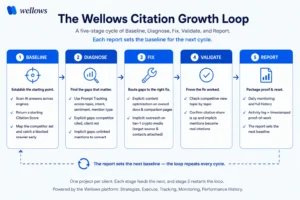
Stage 1, Baseline. Add the client’s domain and let it scan AI answers across the engines. It returns a starting Citation Score and maps the competitor set, and for crypto this is also the moment you catch a blocked crawler before it sinks the campaign.
Stage 2, Diagnose. Move through the tracked prompts with Prompt Tracking, filtering by topic, intent, sentiment, and mention type. Explicit gaps are prompts where a competitor’s page is cited and the client isn’t. Implicit gaps are unlinked mentions waiting to be converted.
Stage 3, Fix. Route each gap to its workflow. Explicit gaps go to content optimization on the project’s own docs and comparison pages, which is where crypto’s owned-content advantage pays off. Implicit gaps go to outreach on tier-1 crypto media, with the target source and contacts already attached.
Stage 4, Validate. Check the competitive view topic by topic to confirm citation share is rising and that implicit mentions converted into real citations, rather than assuming the fix worked.
Stage 5, Report. Package the proof with daily monitoring and full history, and let the activity log stand as the timestamped proof-of-work record. Then the report sets the next baseline.
Which AI Crypto Marketing Agencies and Crypto GEO Agencies Lead in 2026?
The AI crypto marketing agencies that come up most in 2026 are ICODA, RZLT, Coinbound, MarketAcross, Luna PR, EWR Digital, and NinjaPromo, each strongest at a different part of the AI visibility job.
- ICODA: Full-stack AI SEO for crypto. Answer engine optimization across ChatGPT, Perplexity, and Gemini paired with crypto PR, reputation management, and per-engine service lines.
- RZLT: AI-native Web3 growth. Machine-learning-driven campaigns and go-to-market work for protocols, with AI infrastructure built into the delivery stack rather than bolted on.
- Coinbound: Performance execution at scale. Paid, PR, and community for established crypto brands, with a heavy US-market client roster across exchanges and infrastructure.
- MarketAcross: Blockchain PR and earned media. Global media coordination and tier-1 placements, which feed the third-party citation trail AI engines follow.
- Luna PR: Web3 communications for enterprise projects. High-profile media coverage from Dubai, London, and New York for institutional-grade blockchain brands.
- EWR Digital: AI citation strategy. LLM visibility engineering and authority signals, applied to both crypto-native and traditional companies entering Web3.
- NinjaPromo: Subscription-based community scaling. Flexible community, paid, and technical delivery suited to volatile-market budgets.
Whichever agency runs the strategy, the tracking layer underneath decides whether the work is provable. A crypto GEO agency and its client need the same scoreboard: citation share per engine, competitor benchmarks, and a baseline set before the campaign starts, which is the layer Wellows provides to agencies and in-house teams alike.
How Do You Choose Between Them?
Match the agency to the bottleneck, then verify the claims the way you’d audit a protocol. A PR-strength agency is the wrong hire when the real problem is a blocked crawler, and an AI-native growth shop is wasted spend when what the project needs is tier-1 editorial coverage. Once the bottleneck is clear, run every candidate through the same five checks:
| What to verify | What good looks like | Red flag |
|---|---|---|
| Citation baseline | A day-one Citation Score across ChatGPT, Gemini, Perplexity, Claude, and Google AI Overviews before any work starts | Results promised with no starting number to measure against |
| Crypto-native depth | Can explain why Reddit underperforms in crypto and why owned docs and comparison pages win citations here | A generic GEO playbook applied to Web3 unchanged |
| Technical audit first | Crawler access and entity consistency checked before any content spend | A content retainer pitched with no robots.txt or entity audit |
| Engine-level reporting | Citation share read per engine, since the engines rarely cite the same sources | One blended “AI score” with no engine breakdown |
| Adoption-linked outcomes | Reports tied to wallet connects, developer sign-ups, community growth, and TVL momentum | Impressions and follower counts as the headline metrics |
Ask each shortlisted agency for one before-and-after: a named client, the prompt set tracked, the citation share at the start, and the share after the work. An agency doing real GEO has that report sitting in a deck. An agency that cannot produce it is selling crypto marketing with new vocabulary, and the retainer will prove it within a quarter.
What Content Earns LLM Citations for Crypto Clients?
The content that earns crypto citations is structured, factual, and published on the sources AI cross-references. Because owned content actually wins in crypto, the project’s own domain is the first place to invest, not the last. These are the content types that pull the most citation weight:
- Protocol docs and whitepapers. Clean structure, clear definitions, and one fact per claim make them easy for a model to lift.
- Comparison and “best X” pages. Built on the client’s own domain, these match how buyers phrase prompts and win the format AI cites most.
- GitHub repos and developer docs. Heavily referenced for technical and infrastructure queries, especially README files and API docs.
- Tier-1 editorial coverage. Feature pieces and authoritative roundups build the citation trail models follow.
- Consistent third-party listings. Matching token data across CoinGecko, CoinMarketCap, and DeFiLlama keeps the model confident.
That last point carries more weight in crypto than anywhere else. AI cross-references a project across these sources, and when they disagree it loses confidence and defaults to a competitor with cleaner signals.
1. Owned content, done two ways
❌ Bad: A DeFi client publishes a vague “the future of finance is here” blog post with no token specifics, no comparison, and a description that contradicts its CoinGecko listing.✅ Better: A structured “[Protocol] vs [Competitor] yield and risk” comparison page on the client’s own domain, with consistent token data matching CoinGecko, DeFiLlama, and the docs.
The second version gives the model a clean, corroborated entity to cite. This is entity-based content doing the heavy lifting, and in crypto it pays off directly because owned pages are so citable.
Which Prompts Should You Track for a Crypto Client?
Track the prompts tied to a client’s users and on-chain growth, then stop. A 300-prompt list looks thorough and reports on nothing. For crypto, five buckets cover almost everything that matters.
One reporting rule holds across all five. AI answers vary between runs, so a single screenshot proves nothing. Track each prompt repeatedly across engines and report the rate, because aggregate presence is measurable even when individual responses wobble. A tool with prompt tracking runs the schedule and keeps the history, and the LLM visibility view shows how each engine treats the project separately, which matters because the engines rarely agree.
How Do You Set an AI Visibility Baseline Before a Token Launch or Exchange Listing?
Capture a Citation Score and competitor benchmark before you change anything, ideally weeks ahead of the launch. Citations compound, and the late mover pays for it. Projects cited consistently build a compounding advantage, because every citation raises the odds of the next one, and authority gaps get hard to close once a competitor owns them.
The baseline has three parts. Run the tracked prompt set to capture day-zero citation share across all five engines, record which competitors get cited on each prompt, and check crawler access first, since a blocked bot makes everything else pointless.
2. The pre-launch baseline
❌ Bad: An agency starts a launch campaign, then tries to claim credit later with no starting numbers, so the client can’t tell the launch buzz from the AI work.✅ Better: Two weeks before the listing, the agency captures citation share on 40 category prompts, fixes the robots.txt blocking AI crawlers, and sets the benchmark every later report points back to.
That benchmark is what turns “we think it’s working” into a measurable before-and-after. The AI Visibility Score turns verified citations from every engine into one number you can baseline and defend.
How Do You Measure AI Visibility ROI for a Project With No Traditional Sales Funnel?
Reframe ROI around trust and adoption, since most crypto projects have no cart to attribute. A token or protocol wins on credibility, usage, and community, so the ROI story has to speak that language.
Anchor the report on four metrics, not revenue. AI share of voice against named competitors, citation rate on the prompts that matter, sentiment, and entity accuracy. Then tie each to an outcome the client books against: referral-to-wallet, developer sign-ups, community growth, and TVL momentum. The goal isn’t a fake revenue number, it’s a defensible line from “we got cited more” to “more qualified users arrived and stayed.”
The industry is converging on this metric set, which helps agencies standardize client reports. The AIMZER AI Visibility Framework tracks seven indicators that map closely to crypto needs, including mention frequency, citation rate, entity accuracy, recommendation consistency, and competitive AI share of voice. For crypto, entity accuracy matters most, since a wrong token detail isn’t an optics problem, it’s a safety one.
| Crypto KPI to report | What it proves | Where the number comes from |
|---|---|---|
| AI share of voice vs competitors | Whether the project is winning its category answers | Citation share across tracked prompts |
| Citation rate on safety and comparison prompts | Trust at the moment capital decisions get made | Per-prompt mention and citation data |
| Entity accuracy | The project’s facts are accurate, protecting users and brand | Sentiment and answer-accuracy checks |
| Referral-to-wallet and community growth | Visibility converted into real adoption | UTM-matched sessions plus on-chain proxies |
For the full metric framework, the GEO KPIs guide maps each number to what it tells the client, and performance history produces the date-versus-date comparison you drop straight into a client deck.
What Is Behavior Visibility in Web3?
Behavior visibility (Web3)
Behavior visibility in Web3 measures whether AI-generated recommendations lead to real user actions: wallet connects, protocol usage, developer sign-ups, community growth, and branded searches. Traditional analytics stop at sessions and pageviews. Behavior visibility follows the AI citation through to adoption, which is the metric a crypto project actually books against.
The concept matters because crypto has no checkout to attribute. A citation in ChatGPT that never becomes a wallet connect is a vanity number, and a report built on pageviews tells a DeFi client nothing about capital or usage.
Measuring behavior visibility means pairing citation share with the on-chain proxies in the table above: UTM-matched wallet connects, referral-to-dApp clicks, Discord and Telegram growth, and active-wallet share against named competitors.
When those move together, the AI visibility work is provably a growth channel. When citations rise and behavior stays flat, the gap itself is the diagnosis, usually pointing to entity errors or the wrong prompts being won.
This matters more in crypto than in most industries because many projects do not have a traditional sales funnel. A DeFi protocol, wallet, infrastructure company, token launch, or exchange rarely closes through a single clean checkout path. What matters is whether AI exposure increases trust and adoption.
If a project starts appearing more often in prompts like “best crypto wallets,” “top DeFi lending platforms,” or “lowest-fee bridge,” and wallet activity or branded search climbs alongside it, that is behavior visibility, and it is far more useful than pageviews alone.
The practical takeaway is simple. Citation tracking tells you whether the project is being surfaced. Behavior visibility tells you whether that surface area is turning into real Web3 adoption.
How Do You Tie AI Mentions to On-Chain Activity, Wallet Connects, and Community Growth?
Connect AI visibility to on-chain proxies, because crypto clients measure adoption, not checkout. The link is rarely a single clean attribution, so use a layered model that a client can verify.
Three connections do most of the work. AI-referral traffic to wallet connects, tracked with UTMs on links the project controls and matched against connect events. Branded-search and community growth after AI exposure, where Discord and Telegram joins and “[project] reviews” searches rise as citations rise. Citation share against on-chain momentum, plotting share over time next to active wallets or TVL.
The table below maps each AI signal to the on-chain proxy a crypto agency can actually report.
| AI visibility signal | On-chain / growth proxy to report |
|---|---|
| AI-referral sessions (Perplexity, ChatGPT) | Wallet-connect events from those sessions (UTM matched) |
| Citation share rising on category prompts | Branded-search lift and Discord/Telegram growth |
| New explicit citations on comparison prompts | Referral-to-dApp clicks and sign-ups |
| Competitor citation gap closing | Share of new active wallets vs competitor over the period |
A documented example shows the mechanism. One Web3 project ran sustained editorial PR across CoinDesk, Decrypt, and The Block over six months, went from zero AI citations to top-three in five high-intent queries, and saw Perplexity referral traffic grow from negligible to a top-five acquisition channel within a quarter. Source, action, result, and timeframe all line up.
Why Is Crypto Different From Every Other Vertical in AI Search?
Crypto is the rare vertical where a brand’s own content wins citations. The crypto prompts we studied produced 230,398 citations, and the pattern broke the usual rules that hold in marketing, SaaS, and most other categories.
Share of crypto citations going to vendor-owned domains
Nearly 1 in 5 crypto citations points to an exchange’s or tool’s own site. Koinly takes 3.3%, Zignaly 2.9%, Coinbase 1.4%, Kraken 1.2%, and Binance 0.95%. In the marketing vertical, brand-owned content barely registers. In crypto, docs and comparison pages on the client’s own domain are a citation engine.
Source: Wellows citation dataset, Q1 2026Reddit's share of crypto citations, vs 4.0% across all verticals
Community content does not dominate crypto answers. Reddit’s crypto share is roughly a fifth of its all-vertical average, so copying generic “go win Reddit” GEO advice wastes a crypto client’s budget.
Source: Wellows citation dataset, Q1 2026Two more findings shape strategy. AI leans on reference sources as a trust hedge in crypto, with arXiv at 1.67% (twice Reddit’s share) and Wikipedia around 1.8%. Crypto editorial media, the Coin Bureau and CoinDesk tier combined, sits at only about 3.5%.
The encouraging part for smaller projects is the long tail. The top 10 domains take just 17.7% of crypto citations, which leaves over 82% spread across thousands of sites. There is no position-one monopoly, so a focused project can win citation slots without outranking the giants everywhere.
What Mistakes Get Crypto Clients Left Out of AI Answers?
The fastest way to lose a crypto GEO retainer is to look busy without proving anything. These come up again and again.
5 mistakes that keep crypto projects out of AI answers
1. Blocking AI crawlers
2. Copying generic GEO advice into crypto
3. Ignoring entity correctness
4. Tracking one engine
5. Reporting mentions with no baseline
What Are the Best AI Visibility Platforms for Crypto Companies in 2026?
The best AI visibility platforms for crypto companies do three jobs at once: track citations across engines, show which prompts and competitors are winning, and surface the content or entity fixes most likely to increase recommendation share. The stack usually splits into four layers: citation tracking, competitor benchmarking, technical discoverability, and AI-ready content production. The mistake is buying content tools before you have a citation baseline.
| Platform | Best For | What It Helps Crypto Teams Measure or Fix |
|---|---|---|
| Wellows | AI citations, prompt tracking, competitor analysis, and reporting | Tracks citation rate, AI share of voice, brand mentions, competitor coverage, and the prompts where crypto clients are missing from AI answers |
| Gauge | Crypto and Web3 AI visibility monitoring | Monitors AI visibility and content opportunities for crypto-native teams that need more Web3-specific tracking |
| Peec AI | Prompt-level citation analysis | Shows which prompts cite which brands, helping agencies compare AI response patterns against named competitors |
| Scrunch AI | Technical AI discoverability | Helps identify crawler access and technical issues that reduce the odds of a crypto site being read and cited by AI systems |
| AIclicks.io | AI brand mention tracking | Monitors brand visibility and mention frequency across AI environments |
| Ahrefs Brand Radar | Brand visibility monitoring | Measures how often a brand appears in AI responses alongside broader search and brand-monitoring workflows |
| Jasper | AI-ready content drafting | Helps agencies scale comparison pages, FAQs, and explainers, with human review still required before publishing anything token- or compliance-sensitive |
For crypto marketing agencies, the right platform is the one that combines visibility measurement with actionability. You do not just need to know that a client was or was not mentioned. You need to know which prompt triggered the answer, which competitor got cited instead, which sources were trusted, and which docs, comparison pages, or fact pages need to change to close the gap.
That is why the order matters. Start with citation tracking and competitor benchmarking. Then fix crawler access and entity consistency. Then scale the AI-ready content the engines are most likely to cite.
Which AI Visibility Platform Fits Which Crypto Client Situation?
The best platform depends on the gap you are trying to close.
- For a DeFi protocol losing “best decentralized lending” or staking prompts: use a platform that tracks citation share, prompt coverage, and competitor sources across category and safety queries.
- For a crypto wallet brand competing on trust and comparison prompts: prioritize prompt-level citation analysis and competitor benchmarking across wallet, security, and beginner-intent questions.
- For an infrastructure company with strong docs but weak AI visibility: use a platform that combines monitoring with content and fact-page fixes, so the documentation becomes easier for AI systems to parse and cite.
- For a project entering the Web3 market before launch: start with competitor mention rates, pre-launch prompt baselining, and crawler-access checks so the project is measurable before the announcement wave begins.
- For an agency managing multiple crypto clients: choose a workflow that combines citation tracking, prompt monitoring, competitor analysis, and reporting in one place, so every client can be benchmarked from a defensible baseline.
FAQs for AI Visbility for Crypto Marketing Agencies
See how AI visibility plays out across other agency types and industries:
Conclusion
AI visibility solutions for crypto marketing agencies require a different playbook. In crypto, owned content earns citations, Reddit plays a much smaller role than generic GEO advice assumes, and many projects remain invisible simply because AI crawlers are blocked.
The agencies that fix these fundamentals early build a citation advantage that compounds over time, and the ones that pair strong prompt coverage with real behavior visibility in Web3 are the ones most likely to hold it.
The process is straightforward: establish a baseline, identify visibility gaps, optimize documentation and comparison content, earn authoritative citations, and measure progress against on-chain adoption instead of pageviews.
AI is rapidly becoming the crypto go-to-market engine for research, comparisons, and product discovery. Agencies that measure citations, recommendation share, and AI visibility today will have a significant competitive advantage as more buyers rely on AI to evaluate crypto products.
For most crypto clients, the next steps are simple: verify AI crawler access, track the highest-intent prompts in their category, benchmark competitor citations, and establish a baseline AI Visibility Score before making changes. From there, AI visibility becomes a measurable growth channel rather than a black box, and an AI crypto marketing agency or crypto GEO agency can prove its value in the metrics crypto teams actually care about.