A fintech founder watches paid acquisition costs rise every quarter. Then a buyer asks ChatGPT for the best business account, and the answer is already decided. It cites a few neobanks, NerdWallet, and Bankrate, while the founder’s product never makes the shortlist. The decision happened before any ad loaded.
That’s the challenge AI visibility solutions for fintech marketing agencies solves: helping clients get cited and recommended in ChatGPT, Gemini, and Perplexity. As AI increasingly shapes financial decisions, visibility inside the answer matters as much as visibility in search.
The opportunity in fintech ai visibility significant. AI-driven finance searches are growing rapidly, and visitors from AI citations convert at far higher rates than traditional search traffic. To understand what drives those recommendations, Wellows analyzed 1,148 fintech prompts, generating 15,688 citations across 2,209 domains. The findings reveal a unique pattern that changes how fintech brands should approach AI visibility.
- Prompt tracking over keywords. Fintech buyers ask AI complex questions about rates, fees, integrations, eligibility, and trust, so agencies need to track the real prompts buyers type into AI models rather than relying on traditional keyword rankings.
- Entity and schema optimization. AI systems need a clean, verifiable understanding of what the fintech brand does, who it serves, and how its product works, so brand identity, schema, and claims have to match across the site, product pages, listings, and trusted profiles.
- Third-party citation building. Fintech AI answers often rely on publishers, review sites, and peer-validation sources, so agencies need to earn mentions where AI systems already look for trust.
- Citation-share metrics. Success is measured by citation frequency, recommendation share, prompt coverage, and competitive AI share of voice rather than impressions or rankings alone for a fintech brand.
What AI Visibility Solutions Means for a Fintech Marketing Agency
AI visibility solutions (fintech)
AI visibility is how often, and how reliably, a fintech brand appears inside AI-generated answers when a buyer asks a category question like “best business bank account” or “lowest-fee transfer app.” The measurable unit is the citation, the source URL an engine pulled to build its answer. Rankings still feed the system, but the scoreboard is inclusion in the recommendation, not position on a results page.
The shift lands hard in fintech for two reasons. Buyers research money decisions inside the model, comparing fees, rates, and protections before they reach a website, so a brand absent from the answer is absent from the shortlist.
It also carries a risk other verticals don’t. Financial marketing is regulated, so when AI repeats an inaccurate rate or an unverifiable claim, that is a compliance exposure, not just an optics problem. Keeping a client’s claims accurate and consistent across the web becomes a safety deliverable.
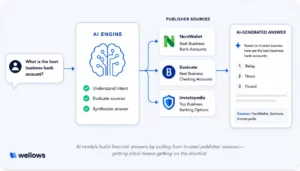
Here is the reframe that makes it click. AI reads a fintech brand as an entity, not a page. Before it cites anyone, it works out what the brand does, who it serves, and whether trusted sources corroborate it. That is why this sits closer to generative engine optimization than to keyword SEO.
Why AI Visibility for Fintech Is Different From Other Industries
In fintech, AI cites the marketing agencies themselves. The fintech prompts we studied produced 15,688 citations, and the domain ranking broke a rule that holds almost everywhere else.
Share of fintech citations going to agencies' own benchmark content
The #2 and #3 most-cited fintech domains are agency-owned content, FirstPageSage (2.5%) and Omnius (2.4%), together about 5% of all citations and beaten only by Wikipedia (2.9%). Agencies publishing benchmark data get cited above the fintech brands they would pitch. Original data is a citation asset.
Source: Wellows citation dataset, Q1 2026Share of fintech prompts with transactional intent, double the marketing vertical
Fintech AI queries skew closer to a buying decision, roughly 10% transactional plus 26% commercial. A citation here often sits one step from an application or a sign-up, which is why the channel converts.
Source: Wellows citation dataset, Q1 2026Two more findings shape the playbook. Broker-review sites like BrokerChooser, WallStreetZen, and Benzinga, plus brand domains like eToro and Airwallex, fill out the top 20, so the citation pool mixes publishers with a few strong brand pages. And the top 10 domains take only 16.5% of citations, leaving a long tail where a focused client can still win specific prompts.
The pattern underneath it all: in fintech, AI builds the shortlist from publisher sources, on high-intent questions, where the agencies that publish data get cited above the brands. Every problem below, and every fix, comes back to that.
How Do You Choose the Best AI Visibility Agency for Fintech?
The best AI visibility agency for fintech should show where your brand is cited across ChatGPT, Gemini, Perplexity, Claude, and Google AI Overviews, why competitors win those citations, and how visibility contributes to qualified pipeline.
Look for fintech AI visibility expertise spanning regulated claims, publisher inclusion, entity consistency, prompt tracking, and owned-page optimization.
Which Agency Specializes in AI Visibility for Fintech Companies?
The agencies best positioned for fintech AI visibility should offer:
- GEO and AI visibility strategy tailored to financial services.
- Financial-content compliance for regulated claims and sensitive topics.
- Publisher outreach to earn citations from trusted financial sources.
- Multi-model tracking across ChatGPT, Gemini, Perplexity, Claude, and Google AI Overviews.
- Per-client workspaces and exportable reporting for fintech marketing agencies managing multiple brands.
- Competitor and prompt benchmarking to identify why other fintech brands earn recommendations.
- Citation optimization across both owned pages and third-party publisher content.
For lenders, neobanks, brokerages, payments companies, and B2B fintech, the best agency is one that makes the brand legible, trustworthy, and consistently citable in AI search.
Which Agencies Are Publicly Recognized for Fintech GEO and AEO?
A 2026 First Page Sage ranking names First Page Sage, Focus Digital, Driven Metrics, NoGood, CSTMR, NinjaPromo, and Growth Gorilla among the top fintech GEO/AEO agencies. The right choice depends on the goal, whether you want qualified leads, brand awareness, startup growth, or B2B thought leadership and comparison visibility.
- First Page Sage: Best for fintech teams wanting GEO to generate qualified leads.
- Focus Digital: Best for fintech companies needing both organic visibility and near-term pipeline.
- Driven Metrics: Best for startups and mid-sized fintechs relying on thought leadership, educational content, and high-intent search traffic.
- NoGood: Best for fintech companies needing coordinated acquisition across multiple channels.
- CSTMR: Best for established fintech companies seeking a full-service, omnichannel marketing partner.
- NinjaPromo: Best for fintech companies that want customer acquisition support across multiple channels rather than relying on GEO alone.
- Growth Gorilla: Best for consumer fintechs and venture-backed startups trying to scale awareness and user growth quickly.
How Should a Fintech Team Evaluate an AI Visibility Agency?
Fintech teams should evaluate an AI visibility agency based on:
- AI visibility footprint: how visible the agency and its clients are across AI search.
- Notable fintech clients: proven experience with real financial services brands.
- GEO expertise: a purpose-built capability, not an SEO add-on.
- Leadership experience: expertise in both AI search and fintech marketing.
- Review score: evidence of client satisfaction and execution quality.
- Client retention rate: proof the agency delivers value beyond the initial engagement.
- Multi-model coverage: demonstrated visibility across ChatGPT, Perplexity, Claude, and Gemini.
For fintech buyers, the priority is proven fintech experience, measurable AI visibility, and sustained results.
7 Problems Fintech Marketing Agencies Face With AI Visibility
These are the failure modes we see most when an agency stands up an AI visibility service for a fintech client, each with the fix. None are exotic. The skill is doing them in order and proving each one.
✕ Problem 1: You can't put a number on where the client stands in AI
Most agencies can describe AI search but can’t score it. With no baseline citation number per client, every later report is just vibes.
✓ The fix
Set a day-one baseline with an AI Visibility Score and watch it across engines, so month three has something believable to measure against.
✕ Problem 2: You fight the publishers instead of joining them
Affiliate and publisher content fills 60% of financial AI answers, and a Gregory study of 201,233 citations found NerdWallet in 38% of wealth-management responses and Bankrate in 35.3%, with most banks absent. Trying to outrank them head-on burns budget.
✓ The fix
Earn inclusion inside the pages AI already pulls from. Claim every comparison-site listing, then pitch the client to publisher writers as a data source. Earned coverage like this is the same muscle as digital PR, aimed at the sources AI trusts.
✕ Problem 3: The client's facts contradict across the web
AI cross-references a fintech across its site, NerdWallet, app stores, and review sites. Any clash in fees, eligibility, or regulatory status lowers confidence and hands the slot to a competitor. YNAB wins “best budgeting app” in ChatGPT and Google AI Mode precisely because it reads consistently across Money, CNBC, NerdWallet, and Wirecutter.
✓ The fix
Keep a single approved-claims sheet per client, the exact rates, fees, regulatory status, and eligibility language legal has signed off, then mirror it word for word across the site, product schema, and every third-party profile. It removes the contradictions that make AI default away, and it keeps every AI-surfaced claim compliant before a regulated-claims problem can start.
✕ Problem 4: You publish content nobody cites, instead of data everyone quotes
Generic thought-leadership posts get ignored while agency benchmark pages sit in our top three fintech domains. The client keeps producing pages AI never lifts.
✓ The fix
Build a quarterly fintech benchmark asset for the client, real numbers on fees, approval rates, or payout speed, and pitch it to comparison-site and publisher writers as source data. You are not asking for a backlink, you are handing them a citable statistic, which is exactly how agency data domains climbed our rankings.
✕ Problem 5: You optimize for one engine and vanish on the others
The engines disagree on sources. Gemini leans on institutions’ own pages, while ChatGPT, Perplexity, and Copilot lean on publishers. A client strong in one can be invisible in another.
✓ The fix
Track every engine together with prompt tracking, and read each engine separately so you know whether to fix an owned page or earn a publisher citation.
✕ Problem 6: You skip human review on AI-assisted content
In a regulated vertical, an unreviewed AI claim is a liability. An auto-generated rate or eligibility line can surface in an answer and breach compliance.
✓ The fix
Keep a financial reviewer in the loop before anything publishes, and route every AI-drafted claim through the approved-claims sheet first.
✕ Problem 7: You report raw mentions with no baseline
“We got 14 mentions this month” means nothing without a starting point and a named competitor. The client can’t tell progress from noise.
✓ The fix
Report citation share against specific competitors over time, and show a before-and-after on the same prompt set so the report tells a story instead of a number.
Which Prompts Should You Track for a Fintech Client?
Track only the prompts that sit near a sign-up or an application, then stop. A 300-prompt list looks impressive and tells you nothing. Five groups capture where the money decisions happen.
One rule covers all five. AI answers shift between runs, so a single check proves nothing. Run each prompt repeatedly and report the rate it appears. An LLM citations view shows the exact URLs behind each answer, so you know which publisher to pitch next.
How Do You Show a Fintech Client They’re Being Recommended More in ChatGPT and Perplexity?
Show movement in citation share over time against named competitors, never a one-off screenshot. The client wants proof the recommendation rate is rising, not a lucky single answer.
Report three things on a fixed prompt set. Citation share, the percentage of tracked prompts where the client is cited. Share of voice, how that compares to two or three named competitors. And before-and-after answers on the same prompts at month zero and month three, so the change is visible, not asserted. Because the engines split on sources, break the report out by platform with daily monitoring, so the trend itself becomes the deliverable.
Which AI Engine Trusts Which Fintech Source?
The engines don’t agree on who to cite, so a single playbook leaves gaps. This is the split a fintech agency has to plan around, because the fix for a Gemini gap is not the fix for a Perplexity gap.
| Engine | What it leans on for fintech | The agency move that wins it |
|---|---|---|
| Gemini | Financial institutions’ own pages and structured data | Fix the client’s owned product and comparison pages, add product schema |
| ChatGPT | Publishers and comparison sites, via Bing | Earn NerdWallet-tier inclusion, confirm Bing indexing of trust pages |
| Perplexity | Live web and explicit publisher citations | Win fresh comparison-site and review placements |
| Copilot | Affiliate and publisher links most heavily | Prioritize affiliate-program presence and reviews |
If you only remember one thing: a fintech client can be strong in Gemini, which trusts its own pages, and invisible in Perplexity, which trusts publishers. Plan the work per engine, not per brand.
How Do I Get My Fintech Brand Cited by ChatGPT or Perplexity?
Focus on the four moves in the following order:
- Make the brand’s facts corroborate everywhere. Fees, rates, eligibility, licences, and integrations need to match across the site, schema, app stores, review profiles, and publisher listings. Contradictions are one of the fastest ways to make AI default to a competitor.
- Get inside the publisher pages AI already cites. In fintech, ChatGPT and Perplexity often lean on publishers and comparison sites first. That means inclusion on the pages AI already trusts is usually faster than trying to outrank them head-on.
- Publish benchmark data worth quoting. An original benchmark asset gives writers and AI models a statistic only the client owns. That is how agency data domains climbed into the top tier of fintech citations in the first place.
- Track the prompt set weekly. Weekly prompt tracking turns the whole process from faith into a rate you can report. It shows whether a claims fix, a publisher placement, or a benchmark asset actually increased citation share.
A fintech startup can often run this loop faster than an incumbent, because citations reward the clearest current answer, not the oldest domain.
What Are the Best AI Visibility Tools for Fintech Companies?
The best AI visibility platforms for fintech marketing agencies do three jobs at once: track citations per engine, benchmark competitor share of voice, and keep every client’s claims and prompts in a separate workspace with exportable reports. That last part is the agency-specific requirement, since managing GEO for multiple financial services clients without per-client workspaces turns into one blended, unreportable mess.
| Tool | Best for | Pricing signal |
|---|---|---|
| Wellows | AI citation tracking with per-client projects, multi-model coverage across ChatGPT, Gemini, Perplexity, and Google AI Overviews, plus content optimization and outreach in one loop | Agency-friendly per-project setup |
| Profound | Enterprise teams wanting prompt volume data and SOC2 compliance for regulated environments | From $99/mo |
| Otterly | Early-stage fintechs and geo for fintech startups needing a low-cost GEO entry and URL audits | From $29/mo |
| Ahrefs Brand Radar | Teams already in Ahrefs wanting unlinked-mention and AI citation-gap monitoring | Inside Ahrefs plans |
The order matters. Tracking comes first, because a fintech agency without a per-client citation baseline cannot tell which publisher placement or claims fix moved the number. In a regulated vertical, the platform also needs to double as the record: exportable, timestamped reports that show the client, and if needed a compliance reviewer, exactly what was claimed and when.
How Do You Pitch GEO to a Fintech Founder Focused on CAC and Paid Acquisition?
Frame it as the channel that lowers blended CAC while paid keeps inflating. A founder who lives in paid acquisition understands cost per qualified action, so speak that language rather than “visibility.”
The math does the persuading. AI-cited buyers convert at 5.1x traditional search, and ChatGPT and Perplexity referrals convert in the double digits while Google sits near 1.8%. A citation is effectively a recommendation, which arrives pre-qualified in a way a cold ad impression never does.
1. Pitching the CAC-focused founder
❌ Bad: “We’ll boost your AI visibility and get you mentioned in ChatGPT.” The founder hears a vanity metric and a vague promise.✅ Better: “Here are the 30 buying-intent prompts your category gets in ChatGPT and Perplexity. You appear in four, a competitor appears in nineteen, and AI-cited buyers convert at several times your paid rate. Closing that gap is a lower-CAC channel than your next paid scale-up.”
The second version reframes AI visibility for fintech marketing agencies as performance work, not PR. It compounds too, because each citation makes the next one likelier, so the channel gets cheaper over time while paid gets dearer.
The Fintech Citation Growth Loop
Tactics without a system don’t scale across a client roster. Run every fintech client through the same five-stage loop, with the platform powering each stage. It is a loop, not a line, because Stage 5 feeds the next Baseline, so onboarding client number twelve looks like client number one.
| Stage | What happens | Powered by |
|---|---|---|
| 1. Baseline | Drop in the client’s domain, scan AI answers across engines, and produce a starting Citation Score plus the competitor set and the publishers gatekeeping the category. | AI Visibility Score |
| 2. Diagnose | Sort the tracked prompts by intent and mention type. Explicit gaps are prompts where a rival’s own page is cited and the client isn’t. Implicit gaps are publisher pages to earn inclusion on. | Prompt tracking |
| 3. Fix | Route explicit gaps into content work on answer-first product pages, and implicit gaps into outreach to NerdWallet-tier publishers and broker-review sites. | Outreach |
| 4. Validate | Confirm the work landed. Check prompt by prompt whether citation share is climbing and whether publisher placements turned into real citations. | Monitoring |
| 5. Report | Package the proof with daily monitoring and full history, plus a timestamped record of every action. Then the report resets the baseline. | Monitoring |
How to Prove AI Visibility ROI on a Long, Regulated Sales Cycle
Tie citations to qualified pipeline stages, since a regulated fintech sale rarely closes in one session. Reframe ROI around the steps the client books against, not a same-day conversion.
Anchor the report on four metrics. AI share of voice against competitors, citation rate on buying-intent prompts, sentiment, and claim accuracy. Then map each to a pipeline signal: AI-referral sessions to demo or application starts, branded-search lift after AI exposure, and assisted conversions that touched an AI citation earlier.
The industry is converging on this metric set, which helps agencies standardize reports. The AIMZER AI Visibility Framework tracks seven indicators that map closely to fintech needs, including mention frequency, citation rate, entity accuracy, recommendation consistency, and competitive AI share of voice. For fintech, entity accuracy carries extra weight, since a wrong rate or status is a compliance problem, not an optics one.
| What to report to the client | Why it matters for a fintech brand | How you get the number |
|---|---|---|
| Where the client ranks vs rivals in AI answers | Shows if the brand is winning or losing its category | Compare citation share against named competitors |
| How often the client appears on “best app” and comparison prompts | These are the questions buyers ask right before they sign up | Count mentions and citations on buying-intent prompts |
| Whether fees, rates, and licence details match everywhere | Wrong or clashing numbers are a compliance risk, not just a ranking one | Check the brand’s facts across site, schema, and listings |
| How many AI visitors start an application or book a demo | Proves the visibility turned into real, qualified leads | Match AI-referral visits to sign-up steps in the CRM |
For the full framework, the GEO KPIs guide maps each number to what it tells the client.
What Counts as ROI Proof Content for a Fintech Client?
ROI proof content is any report asset that shows AI visibility moved closer to revenue, not just closer to impressions. In fintech, that usually means before-and-after citation share on buying-intent prompts, competitor comparisons, engine-specific visibility trends, and CRM-linked proof that AI-referral sessions started demos, applications, or assisted conversions.
A screenshot is not proof. A fixed prompt set, a named competitor group, and a date-versus-date report is proof.
FAQs for AI Visibility for Fintech Marketing Agencies
Explore more AI visibility playbooks for agencies
See how AI visibility plays out across other agency types:
Conclusion
AI visibility solutions for fintech marketing agencies rewards a different play than other verticals. The publishers are the gatekeepers, the agencies that publish data become the cited authority, and the buyers who arrive convert at rates paid acquisition can’t touch. The clients that get into the ecosystem first build a lead that compounds.
The job is the same loop every time. Baseline against the publisher landscape, diagnose the gaps, fix the owned pages and earn the publisher citations, then prove it against qualified pipeline rather than pageviews.
Three things worth doing for a fintech client this week. Pull their 20 highest-intent prompts and see who gets cited today. Audit whether their fees and regulatory status match across the site, schema, and comparison listings. Build one benchmark asset worth citing. From there, the question your fintech client asks about AI stops being one you dread.