A year ago, “AI SEO agency” often meant traditional SEO with a few AI tools sprinkled in. That shortcut no longer holds. Google AI Overviews and LLM-driven discovery change how people find, compare, and trust information, and they change what you should demand from an agency. Some firms are adapting with generative search optimization (GEO) workflows, stronger technical foundations, and clearer content systems.
AI Overviews now appear in 11%+ of Google queries, which means more searches include an AI-written summary before a user chooses what to click (BrightEdge). In practice, that raises the bar. It is not enough to rank. Your content also needs to be clear, well-structured, and credible enough to be selected as a source.
This directory ranks top AI SEO agencies for 2026 with a transparent rubric, “best for” fit notes, and proof links you can verify. Use it to shortlist partners, align on deliverables, and measure search engine visibility alongside traditional SEO outcomes.
This guide is itself a working example of the standard it recommends: in independent grounding research by Dejan AI, Gemini cited this Wellows guide as a grounding source for 5 of the 24 answer segments on the query “best ai seo agency 2026”, one of only 7 sources the model used.
Quick List: Top AI SEO Agencies (Ranked)
If you want the shortlist first, this table is the fastest way to compare options across specialized firms and broader Digital Marketing Agencies. The ranking is editorial and will be explained in the methodology section below, but the quick signal is fit: who is strongest on technical SEO and implementation, who is strongest on authority and digital PR, and who is explicitly building for AI Overviews and LLM discovery.
AI Overviews are increasingly common in Google results (reported at 11%+ of queries), and Google notes AI features can surface relevant links, which makes “being selected as a source” a real requirement, not a nice-to-have.
Disclosure: editorial ranking based on the scoring rubric in the next section.
| Rank | Agency | Best for | Strongest edge | Proof link |
|---|---|---|---|---|
| 1 | Respona | SaaS and B2B brands wanting AI visibility via authority building | AI visibility campaigns tied to citation-focused editorial placements | Website |
| 2 | iPullRank | Enterprise programs with high technical complexity | Strategy + technical rigor + strong SEO research footprint | Website |
| 3 | Onely | Technical SEO teams that want GEO-style playbooks | Clear positioning around technical foundations and implementation | Website |
| 4 | Avenue Z | Performance PR and enterprise AI search dominance | Narrative Intelligence™ + High-authority PR citations | Website |
| 5 | Embarque | SaaS brands prioritizing “get cited” outcomes | Explicit AI SEO positioning around citations and visibility | Website |
| 6 | Flow Agency | B2B SaaS teams that want process-heavy execution | Systems-oriented delivery and reporting discipline | Website |
| 7 | uSERP | Brands that need authority building and digital PR | Links and mentions that can support citation eligibility | Website |
| 8 | Omnius | Fintech or regulated niches needing domain fluency | Vertical fit and compliance-aware positioning | Website |
| 9 | Reboot Online | Teams that value experimentation and measurement | Test-driven approach and methodical SEO systems | Website |
| 10 | NP Digital | Organizations that want scale and cross-channel support | Large delivery capacity with integrated marketing services | Website |
| 11 | WebFX | SMB and mid-market teams needing operational execution | Production capacity and repeatable delivery workflows | Website |
| 12 | SEOProfy | SEO-heavy programs needing a technical + content mix | Balanced focus across technical fixes and content output | Website |
| 13 | Position Digital | B2B SaaS/startups needing GEO/AEO + Digital PR | GEO/AEO + PR-driven third-party citations | Website |
| 14 | Scandiweb | Ecommerce brands with complex catalogs | Ecommerce execution and structured optimization for discovery | Website |
| 15 | Victorious | Teams that want strong baseline SEO with clear process | Core SEO fundamentals and program management maturity | Website |
| 16 | NoGood | Growth-led teams blending content, SEO, and testing | Growth experimentation plus SEO strategy integration | Website |
| 17 | SayNine | Content-forward teams prioritizing messaging and visibility | Content and SEO positioning tailored to AI-era discovery | Website |
| 18 | Loopex Digital | Budget-sensitive buyers who still want AI SEO scope | Accessible service positioning (verify depth via proof) | Website |
Did you know?
How We Ranked These Top AI SEO Agencies
AI SEO can mean a lot of things, so we used a clear definition for this list. An agency scored well if it can deliver strong traditional SEO outcomes and also improve your odds of being selected as a source in AI-powered results, including Google AI Overviews and LLMs.
That includes strategy for Generative Engine Optimization (GEO), plus the technical and on-page SEO foundations that make pages easier to understand, trust, and cite.
To keep the ranking defensible, we prioritized verifiable proof over positioning claims. When agencies made AI visibility assertions, we treated them as signals, not facts, unless they were supported by public case studies, published frameworks, or repeatable methodologies you can evaluate. We also aligned the rubric with Google’s guidance on creating helpful, people-first content, since quality and usefulness still matter even when the interface changes.
Ties were broken based on two factors: strength of evidence (proof links, specificity, repeatability) and fit (whether the agency is a better match for a defined buyer type). That’s why “best for” matters. It is not a popularity contest, and it is not a one-size-fits-all score.
| Rubric category | Weight | What we looked for |
|---|---|---|
| AI Search Strategy (GEO/LLMO/AEO clarity) | 20% | Clear approach to AI Overviews + LLM discovery, plus practical workflows |
| Proof of execution | 20% | Case studies, frameworks, research, or repeatable playbooks |
| Technical SEO depth | 15% | Indexing, rendering, schema, performance, and site architecture competence |
| Content systems | 15% | Editorial QA, topical authority building, refresh processes, governance |
| Authority building | 15% | Digital PR, mentions, citation-eligible assets, trust signals |
| Measurement | 10% | Tracking, reporting cadence, testing discipline, outcome clarity |
| Transparency | 5% | Process clarity, communication expectations, pricing signals where available |
– proof links
– service specificity
– technical depth
– and a measurement approach that goes beyond rankings.
– private client performance claims we could not verify
– undisclosed pricing
– and “AI” tool usage that does not change outcomes.
Disclosure: this is an editorial ranking. Agencies are not ranked based on payments or sponsorships, and you should validate fit by reviewing proof links and asking for comparable case studies.
Top AI SEO Agencies: In-Depth Reviews (Use This Section to Make the Final Decision)
The quick list helps you shortlist fast, but you should make your final decision using the profiles below. Each agency review follows the same template so you can compare fit without getting distracted by positioning language.
As AI Overviews expand, CTR can decline even when rankings hold, which is why the right partner should be able to show proof, define deliverables clearly, and measure outcomes beyond clicks.
1) Respona: Best for AI visibility campaigns tied directly to authority building and editorial placements
Respona takes a different approach from most AI SEO agencies because it focuses heavily on the signals that influence AI-generated answers in the first place. Instead of treating AI visibility as only a tracking problem, the company focuses on helping brands earn placements on the articles and domains already cited by ChatGPT, Google AI Overviews, Perplexity, and other AI search systems.
Its campaigns feature helps teams identify the exact websites, listicles, and editorial pages influencing AI-generated recommendations for their category. That makes it easier to prioritize outreach toward the sources already shaping AI discovery instead of relying on generic backlink prospecting.
- Verdict: Strong fit for brands that want AI visibility tied directly to authority building, editorial mentions, and citation-focused placements.
- Best for: SaaS companies, B2B brands, and AI startups competing in crowded search environments where third-party mentions influence both rankings and AI-generated recommendations.
- Strengths: AI visibility campaigns, authority-focused outreach, contextual placements, and strong alignment between link building and AI citation opportunities.
- Watch-outs: Best suited for companies already investing in content and SEO foundations, since authority-building works best when paired with strong on-site content and technical SEO.
- What to ask: Which AI-cited domains should we prioritize first, how do you identify citation opportunities, and what types of placements historically influence AI visibility most in our category?
- Links: Website, OpusClip case study
2) iPullRank: Best for enterprise, technical depth, and AI-search-first strategies
iPullRank is a strong fit when your site is complex, your stakeholders are many, and you need an agency that can connect AI-era visibility to real technical and content decisions. Their positioning is explicit, “We offer Relevance Engineering”, and they publish detailed material on AI search mechanics that’s useful for evaluating how they think.
On their site, they also state they’ve “delivered $4B+ in organic search results” for clients, which you should treat as an on-site claim and validate with comparable case studies.
- Best for: Enterprise brands with complex sites, cross-functional SEO programs, and high stakes technical constraints.
- Strengths: Known for technical SEO precision and handling complex, data-driven sites with AI.
- Watch-outs: Usually better for teams that can support collaboration, data access, and implementation capacity.
- What to ask: What will you change in the first 60 days, what proof do you have in our category, and how will you measure AI visibility beyond rankings?
- Proof links: Website, AI Search Manual, Technical SEO
3) Onely: Best for technical SEO and GEO implementation playbooks
Onely is a practical option if you want a defined service line for generative visibility and a clear implementation narrative. Their GEO page frames the work as repeatable operations, including training and playbooks, with the positioning “Build your own internal AI advantage”.
They also list outcome markers on-page, including “3-5x increase in AI mentions,” which should be read as their claim and verified through examples relevant to your industry and site type.
- Best for: Teams that need technical fixes, structured data, and a step-by-step GEO implementation approach.
- Strengths: Clear implementation framing, schema and technical readiness emphasis, and playbook-style delivery.
- Watch-outs: Confirm what they’ll report monthly for AI visibility and how they separate AI gains from normal SEO lifts.
- What to ask: Which templates and page types will you prioritize, what experiments will you run, and how will you quantify “AI mentions”?
- Proof links: Website, GEO services page
4) Avenue Z: Best for Performance PR and Narrative Intelligence™ in AI Discovery
Avenue Z is a strategic communications powerhouse that sits at the unique intersection of digital PR and algorithmic science. They are the pioneers of the “Performance PR” model, which treats earned media as a technical engine for SEO and GEO.
By securing high-authority mentions in tier-one publications and leveraging their proprietary Narrative Intelligence™ platform, they ensure brands are not just seen, but are cited as the “source of truth” by LLMs like ChatGPT, Claude, and Google AIO.
- Fit: Enterprise tech and high-growth consumer brands that need to bridge the gap between national media influence and technical AI visibility.
- Strengths: Unrivaled authority building through PR-driven citations, proprietary AI monitoring (Narrative Intelligence™), and a focus on “source of truth” optimization for LLMs.
- Watch-outs: Their high-intensity, multi-channel approach is most effective for brands that have the budget to support integrated PR and performance marketing simultaneously.
- What to ask: How do you translate a Wall Street Journal mention into a GEO citation? What does your “Narrative Intelligence” report look like for our specific industry entities?
- Pricing range framing: Request a monthly retainer range, minimum term, and what’s included in reporting and technical implementation.
- Proof links: Website, Performance PR Case Studies
5) Embarque: Best for SaaS and “get cited” positioning across AI platforms and AI Overviews
Embarque is a fit for SaaS teams that want AI visibility framed around citations and recommendation-style discovery. Their AI SEO page states, “We built our methodology by reverse-engineering what makes AI platforms cite specific content over others”, and they outline a structured approach that includes audits, content optimization, technical elements, and reporting.
The main evaluation point is proof: ask to see comparable examples where citation visibility improved for queries like yours, not just general SEO wins.
- Fit: SaaS brands that want visibility in AI answers, alongside traditional SEO outcomes.
- Strengths: Clear “citation-first” positioning and a documented process you can interrogate.
- Watch-outs: Make sure technical ownership is explicit (schema, rendering, internal linking, and information architecture).
- What to ask: How will you track citations over time, what content formats move the needle in our category, and what does the first 90 days include?
- Pricing range framing: Request a monthly retainer range, minimum term, and what’s included in reporting and technical implementation.
- Proof links: Website, AI SEO agency page
6) Flow Agency: Best for B2B SaaS, GEO/LLM optimization, and process-heavy reporting
Flow Agency positions its work directly around generative visibility, with service messaging that leads with: “Scale visibility in LLMs with Generative Engine Optimization (GEO)”. For B2B SaaS buyers, the main fit signal is operating cadence: clear workflows, quarterly planning, and reporting that ties AI visibility to pipeline-relevant pages.
On their GEO services page, they also state they’ve helped “100+ B2B startups and service providers” improve SEO and GEO-influenced revenue, which you should treat as an agency claim and validate with comparable examples in your category.
- Best for: B2B SaaS teams that want structured GEO/LLM work with mature reporting and a repeatable operating rhythm.
- Strengths: Process-first delivery, clear service framing for GEO/LLM work, and emphasis on ongoing reporting.
- Watch-outs: Confirm exactly how “AI visibility” is measured and which pages and queries are in scope (not only broad “AI content” activity).
- Proof to verify: Service deliverables, reporting examples, and any published outcomes on their service pages (B2B GEO agency; AI SEO agency).
- What to ask:
- Which 10 to 20 “citation-eligible” pages will you prioritize first, and why?
- What does your monthly GEO/LLM report contain (examples welcome)?
- How do you track visibility in AI answers over time, separate from rankings?
- What technical changes do you need from our team in the first 30 days?
- Links: Website
If you want an independent way to verify where your brand is showing up, you can track where brands get cited across AI platforms.
7) uSERP: Best for authority building and digital PR that supports AI citations
uSERP is strongest when the bottleneck is authority, meaning you need reputable mentions and editorial links that can lift brand prominence. Their positioning emphasizes quality over volume: “uSERP’s link building services focus exclusively on high-authority backlinks with a white-hat, content-driven approach”.
For AI-era visibility, authority work can help, but it won’t replace weak technical foundations or thin content. The most useful evaluation move is to review the kinds of placements they produce, how they define quality, and whether they can align PR with the pages you actually want cited.
- Best for: Teams with an authority gap that need editorial mentions and digital PR to support visibility.
- Strengths: Authority-focused execution, content-driven outreach framing, and clear discussion of link quality criteria.
- Watch-outs: Ask how they avoid “busywork links,” and how campaigns map to citation-worthy pages and topics.
- Proof to verify: Case studies, example placements, and reporting format; they reference “575+ clients” as an agency claim.
- What to ask: What does a “good placement” look like for our niche, how do you choose targets, and what is the QA step before pitching?
- Link: Website
Fit filter: best if you already have solid technical SEO and content quality, but you’re not earning enough trusted mentions.
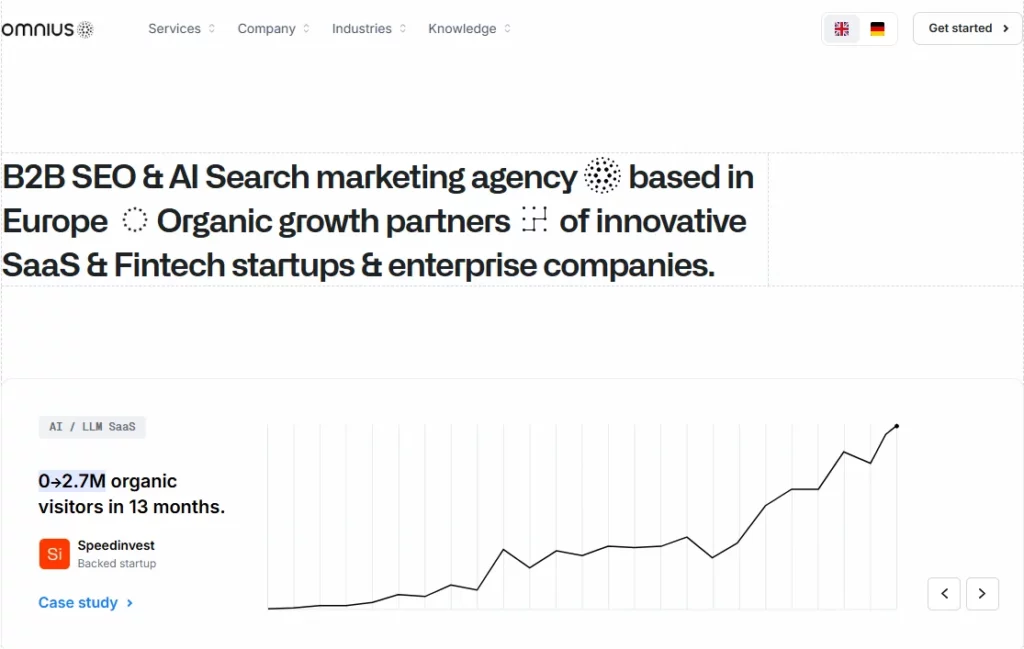
8) Omnius: Best for fintech and regulated niches where vertical fit matters
Omnius is worth considering if your category has compliance constraints, higher trust requirements, and slower approval cycles. Their service copy is explicit about AI-era outputs: “We implement a dedicated workflow to optimize your content for AI Overviews, Featured Snippets, and LLM-driven answers”.
The practical advantage of a regulated-niche partner is governance: careful claims, controlled templates, and repeatable review workflows. For proof, Omnius publishes detailed case studies, including a fintech example claiming “227.9%” signup growth in six months, which you should validate against your own funnel and constraints.
- Best for: Fintech and regulated B2B teams that need trust signals, careful content governance, and vertical fluency.
- Strengths: Category specialization, explicit GEO/AEO/LLM visibility workflows, and publicly documented case studies.
- Watch-outs: Confirm how they handle compliance review cycles and what happens if approvals slow publishing velocity.
- Best-for constraints: compliance approvals, brand safety checks, YMYL-style trust expectations, and stricter claim language.
- Proof to verify: Regulated-niche case studies and the exact workflow they use for AI visibility (Fintech case study; Service workflow).
- What to ask: Which pages will you optimize for citations first, what schema and content patterns you standardize, and how you report AI visibility alongside pipeline.
- Link: Website
When you compare regulated-niche partners, align on measurement upfront, including leading indicators. A simple reference is this guide to GEO KPIs.
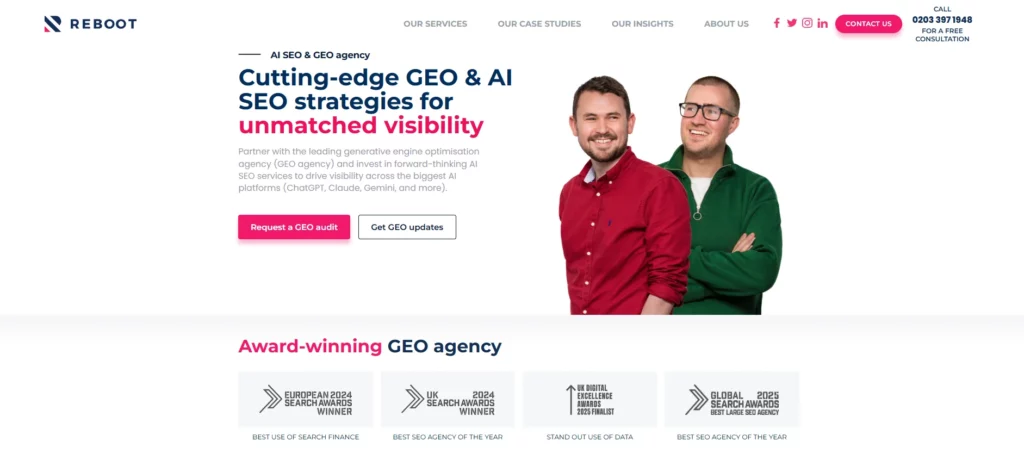
9) Reboot Online, best for experimentation, technical rigor, and measurement discipline
Reboot Online is a strong fit if you want SEO decisions to be backed by controlled tests and clearly explained measurement. Their positioning emphasizes experimentation, with the line “Our scientific and data-driven approach to SEO testing” on their experiments hub. For AI-search volatility, that mindset can translate well because you’re not relying on a single tactic, you’re building a repeatable learn and validate loop.
If you’re running SEO like a product team, consider pairing their testing cadence with your own documentation and governance, for example an internal operating manual that defines how hypotheses, QA, and reporting work.
- Verdict: Best when you want evidence-based iteration, not one-off deliverables.
- Best for: Teams with a testing culture, complex sites, or high stakes changes.
- Strengths: Experiment-led methodology and published research you can review.
- Watch-outs: Make sure experiments map to your KPIs, not only interesting findings.
- Proof to verify: Their experiments hub includes published counters like “8,943 Hours of research” (Agency claim), plus AI-related testing examples (Controlled GEO experiment).
- What to ask: Which hypotheses will you test first, what will “success” mean, and how will you document learnings for future sprints?
- Link: rebootonline.com
10) NP Digital, best for scale, integrated content, and performance marketing overlap
NP Digital is geared toward buyers who want capacity, cross-channel coordination, and repeatable execution at scale. Their SEO services page frames the model as process plus technology, saying “We leverage proprietary technologies and a proven process designed to scale”.
That can be useful if your SEO work needs to align with paid media, creative, and analytics, and you want one partner across those teams. The tradeoff is that you should validate who is doing the senior thinking, and what AI-search visibility deliverables look like beyond a standard SEO program.
- Verdict: Good fit when scale and coordination matter as much as strategy.
- Best for: Mid-market and enterprise teams with multiple channels and stakeholders.
- Strengths: Broad capability mix (SEO, content, analytics, paid) and operational resourcing.
- Watch-outs: Confirm how customized your plan is versus a standardized playbook.
- Proof to verify: Published footprint and results live on their site (for example “28 COUNTRIES” and “1000+ EMPLOYEES”, Agency claims) (NP Digital).
- What to ask: What AI-search outputs are included (AI Overviews, LLM visibility), who owns technical SEO, and how reporting ties to pipeline?
Who it’s not for: If you want a boutique, senior-only team with minimal layers, clarify staffing and escalation paths upfront.
11) WebFX, best for SMB and mid-market operational execution at scale
WebFX is positioned around “expert-led” SEO with AI used to strengthen analysis and speed up learning loops. Their AI SEO services page summarizes the approach as “We use AI to strengthen analysis and reduce guesswork”.
For SMB and mid-market buyers, the practical advantage is execution capacity paired with defined process. The key is to verify what you actually get for AI-era visibility, including whether deliverables cover AI Overviews and LLM discovery, and how results are reported when clicks are less reliable.
- Verdict: Strong operational partner if you want a structured program and consistent delivery.
- Best for: SMB and mid-market teams that need pace, reporting, and reliable execution.
- Strengths: Strong in enterprise-level AI SEO and predictive analytics.
- Watch-outs: “AI SEO” can mean different scopes, pin down specifics in the SOW.
- Proof to verify: Their AI SEO page lists scale counters like “24,859,684+ LEADS DRIVEN” (Agency claim).
- What to confirm:
- Which AI-search deliverables are included (AI Overviews, LLM citations, content format guidance)
- How measurement works (mentions/citations vs rankings/traffic, reporting cadence)
- Ownership of assets (content, schema, dashboards) and what happens if you switch vendors
- Links: webfx.com, AI SEO services
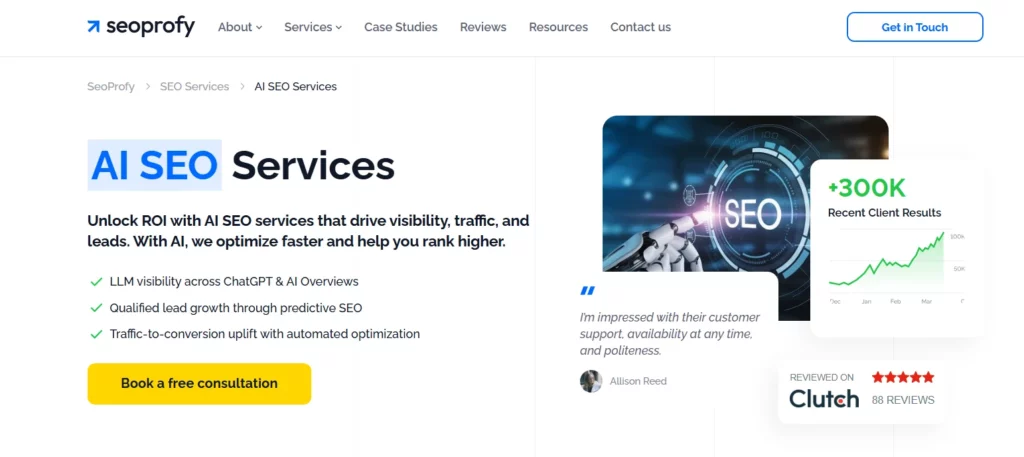
12) SEOProfy: Best for SEO-heavy programs with a technical and content mix
SEOProfy is a reasonable shortlist option if you want a clearly defined “AI SEO” offer but still need strong fundamentals across technical fixes and content execution. Their AI SEO page says, “Our agency doesn’t replace a person with an algorithm”, which is a useful framing if you’re wary of automation-first delivery.
The strict question to answer before you hire them is whether the AI layer changes outputs you care about, such as page-level improvements, visibility signals, and reporting artifacts you can review. If citation outcomes matter, ask how they track and explain changes, and how they separate AI visibility signals from normal SEO lift.
- Verdict: Consider if you want a defined AI SEO service but still prioritize core execution.
- Best for: SEO-heavy roadmaps that require steady technical work and content production.
- Strengths: Clear service framing, data-forward process language, and broad execution coverage.
- Watch-outs: Validate what “AI SEO” deliverables are, not just tools used.
- Proof to verify: They display “4.9/5” based on “126+ User Reviews” (Agency claim) on the AI SEO page.
- Links: Website, AI SEO services
If your evaluation is citation-led, align on how they will measure progress, including a baseline and a target citation score.
13) Position Digital: Best for B2B SaaS/startups needing GEO/AEO + Digital PR
Position Digital is a strong fit if you want an agency that explicitly blends classic SEO with generative visibility work (their service line is positioned around Generative AI SEO) and pairs it with Digital PR-style authority building. This combination is useful when your goal is not only to “rank,” but to earn repeatable third-party validation and citation-eligible coverage that can influence AI answers.
On their site, they position their offering around AI-driven discovery and visibility, which makes them worth shortlisting if you need an agency that can talk about outcomes beyond blue links. As always, treat any on-site performance statements as marketing claims and validate with proof links that match your category, your technical stack, and your implementation constraints.
- Verdict: A strong short-list option for B2B teams that want AI-era visibility work paired with authority-building (mentions/citations) rather than “SEO-only” execution.
- Strengths: Clear Generative AI SEO service positioning, plus a practical emphasis on credibility/mentions that supports citation-driven visibility.
- Best for: B2B SaaS and startup marketing teams that need GEO/AEO support plus authority building through Digital PR and credible mentions.
- Watch-outs: Confirm exactly how they measure AI visibility (citations/mentions/share-of-voice), what the monthly deliverables are, and who owns implementation vs ticketing vs QA.
- What to ask: What will you change in the first 60 days, which page types you’ll prioritize, what proof links you have in our category, and how you’ll separate “AI visibility lifts” from normal SEO movement.
- Proof links: Website, Generative AI SEO
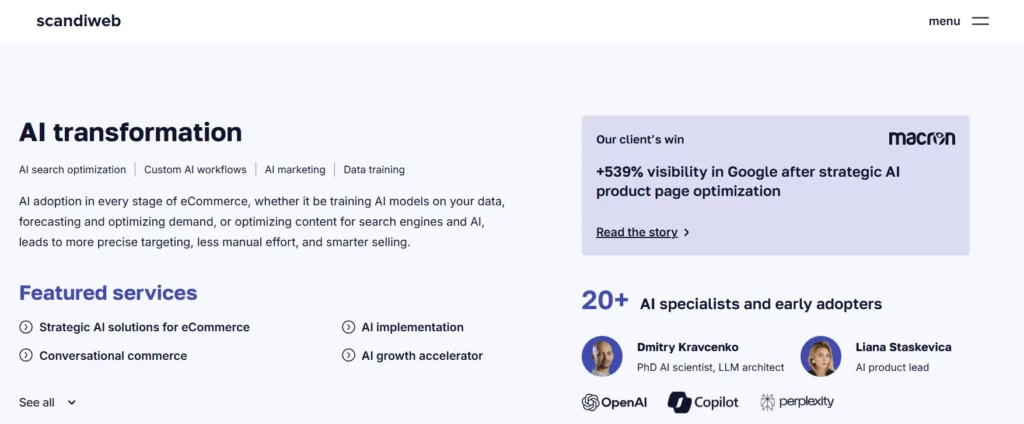
14) Scandiweb: Best for ecommerce teams that need AEO and AI search optimization
Scandiweb is a fit when ecommerce discovery is the core problem, meaning category architecture, product content, and structured data need to work at scale. Their AI search optimization page states, “AI SEO is rooted in traditional SEO”, and then lays out practical levers such as AI-friendly structured data and authority signals.
The evaluation focus should be on whether they can translate “AI search optimization” into concrete changes across templates, not just one-off content edits. Ask how they prioritize page types, handle faceted navigation, and report progress for product and category queries.
- Verdict: Strong shortlist option for ecommerce where scale and structure matter.
- Best for: Ecommerce brands managing category pages, product discovery, and structured product data.
- Strengths: Clear AEO framing, structured data emphasis, and practical ecommerce relevance.
- Watch-outs: Confirm how they measure AI search outcomes for category and product intents.
- Proof to verify: Their page cites “Traditional search traffic is predicted to drop by 25% by 2026” (Agency page claim, attributed to Gartner on-page) (source).
- Links: Website, AI search optimization
15) Victorious: Best for “core SEO done right” and teams validating an AI visibility layer
Victorious is a safe baseline pick if you want structured SEO delivery and a custom strategy model, then plan to validate AI-search-specific outputs during scoping. Their SEO services page says, “Our approach blends quality SEO services into custom strategies”. That’s useful, but it doesn’t automatically mean you’ll get AI Overviews or LLM visibility reporting.
If you shortlist them for AI-era work, the deciding factor is whether they define AI visibility deliverables clearly and can show how they’ll measure those outcomes separately from rankings and traffic.
- Verdict: Strong for fundamentals, then validate AI visibility scope and measurement.
- Best for: Teams that want dependable SEO execution with clear planning and program management.
- Strengths: Process-led delivery and custom strategy framing tied to business metrics.
- Watch-outs: “AI visibility” can be implied rather than operationalized, confirm specifics.
- What to ask:
- How do you measure AI visibility separately from classic SEO KPIs?
- Which page types will you optimize for AI Overviews and citation-style inclusion?
- What does your monthly reporting include, and can you share an example?
- Who owns schema, internal linking, and technical implementation in the engagement?
- Link: Website
16) NoGood: Best for growth plus a content and SEO blend with GEO awareness
NoGood is positioned for teams that want growth-style iteration — fast testing cycles, content velocity, and tight feedback loops — while still taking AI search seriously.
The harder question is how an agency proves that effort actually translates into AI visibility, which is exactly the gap the framework behind AI visibility solutions for growth marketing agencies is built to close
That framing maps well to growth-stage goals, but you should still validate the technical depth: who owns schema, indexing issues, internal linking systems, and measurement for AI visibility alongside classic SEO.
- Verdict: A fit if you want fast iteration and an AI-search-aware content program, with technical validation up front.
- Best for: Growth teams that care about pipeline outcomes and want SEO and content to run as an experimentation program.
- Strengths: Clear GEO/AEO framing, growth testing mindset, and practical “visibility beyond clicks” positioning.
- Watch-outs: If you have heavy technical debt, confirm the technical SEO ownership model before you sign.
- Proof to verify: They state, “we’ve spent the past two years testing how these models source, interpret, and surface content” (Agency claim).
- Fit filter: Best if you can move quickly on testing and content. Not for teams that need deep engineering-led SEO without internal support.
- Links: Website, GEO tooling overview
If you’re comparing agencies on delivery style, this breakdown of how agencies deliver AI search visibility can help you spot whether the approach is execution-led or strategy-only.
17) SayNine: Best for content plus SEO with AI-era visibility messaging
SayNine is a blend of SaaS-focused link building, full SEO services, and GEO optimization services. They offer AI-powered listicles, niche guest posting, and SaaS link building, all designed to help brands improve visibility across both conventional search and emerging AI contexts.
When it comes to improving your backlink profile, SayNine is a top choice, offering expert support in link building and listicle creation.
- Verdict: Worth considering for GEO-optimization, as the listicles and comparison-style guest posts feature your product/service, placed on relevant industry sites, which helps in the scope of SEO and GEO.
- Best for: Teams that need link building and SEO support, and want AI visibility to be part of the brief.
- Strengths: Clear positioning on AI SEO concepts and backlink strategy.
- Watch-outs: Confirm how technical work is handled and how AI visibility is tracked and reported.
- Proof to verify: Review their descriptions of AI-optimized listicles and guest post placements, and ask for examples showing how those assets performed in terms of AI search visibility and backlink authority.
- How to validate: Request sample deliverables, a guest post, an AI-SEO-oriented content piece, and a performance report showing outcomes for both search rankings and AI visibility.
- Links: Website, best AI SEO agencies
18) Loopex Digital: Best for budget-sensitive buyers who still want “AI SEO” scope
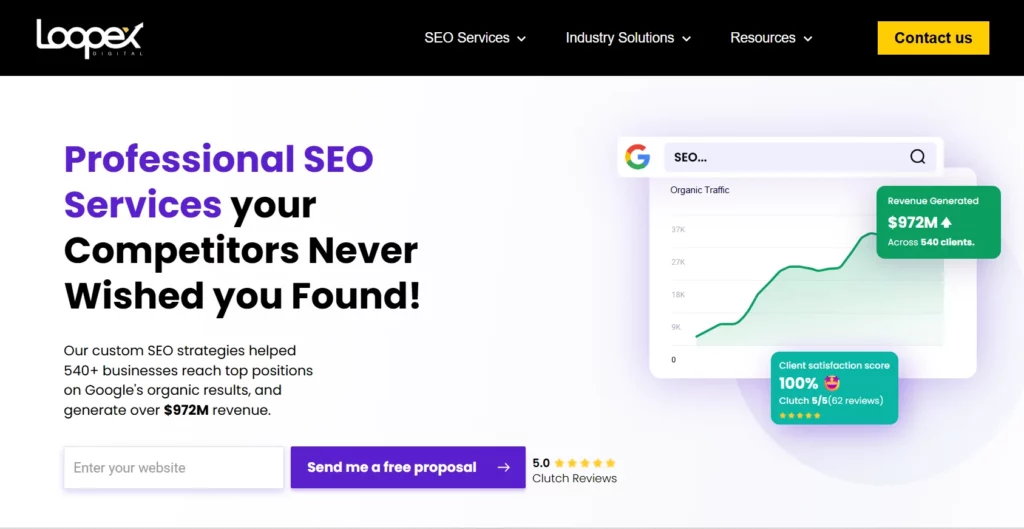
Loopex Digital can be a shortlist option when budget matters and you still want an agency that speaks to modern workflows, including automation and reporting. Their site claims, “Yes, we’ve built our own proprietary link-building software designed specifically for internal use”, which suggests they’ve invested in internal systems.
The main risk is expectation drift: “AI SEO” can mean anything from better content ops to actual AI visibility tracking. Treat this as a verification-led pick, and require a concrete scope, sample reporting, and clear ownership for technical fixes.
- Verdict: Consider if you want cost-conscious SEO execution, but keep the AI scope specific and testable.
- Best for: SMB and mid-market teams that need steady delivery and structured reporting at a tighter budget.
- Strengths: Process transparency signals, operational execution, and internal tooling claims.
- Watch-outs: Don’t assume AI visibility deliverables are included unless they’re written into the SOW.
- Verify proof: Ask for 1–2 relevant case studies, a sample monthly report, and a list of AI-specific deliverables (for example, AI Overviews readiness, schema plan, and visibility monitoring).
- Link: Website
How to Choose the Right Agency (A Practical Shortlisting Workflow)
Picking an AI SEO agency is easier when you treat it like vendor selection, not a branding exercise. Your goal is to confirm three things quickly: they understand how AI features affect discovery, they can show proof that maps to your situation, and they can measure outcomes beyond rankings. Google’s AI features documentation is a useful baseline because it clarifies how AI experiences can present information and links, which should influence how an agency defines “success”.
The workflow below is designed to reduce sales noise. It forces clarity on scope, ownership, proof, and reporting. If your category has complex entities, products, or integrations, add one extra check: how the agency uses structured knowledge about your business. This is where knowledge graphs for AI visibility can become a practical differentiator.
9-Step Shortlisting Workflow
- Define scope, constraints, and proof:
- Define the win: list 10–20 priority queries and 10–20 priority pages that should be cited or surfaced.
- Set constraints: note your CMS, engineering capacity, compliance needs, and publishing cadence.
- Require proof links: ask for 2–3 public examples that match your category and site complexity.
- Validate execution and measurement:
- Ask for first-60-days outputs: request a concrete plan with deliverables, owners, and timelines.
- Validate technical ownership: confirm who writes tickets, who implements, and how QA is handled.
- Test their measurement model: ask how they track AI visibility, citations, and business outcomes (Wellows is used by 6,232+ brands and agencies to measure AI visibility).
- Pressure-test fit before committing:
- Run a scenario question: give them one priority page and ask what they would change and why.
- Check fit and communication: confirm who you work with weekly and how decisions get made.
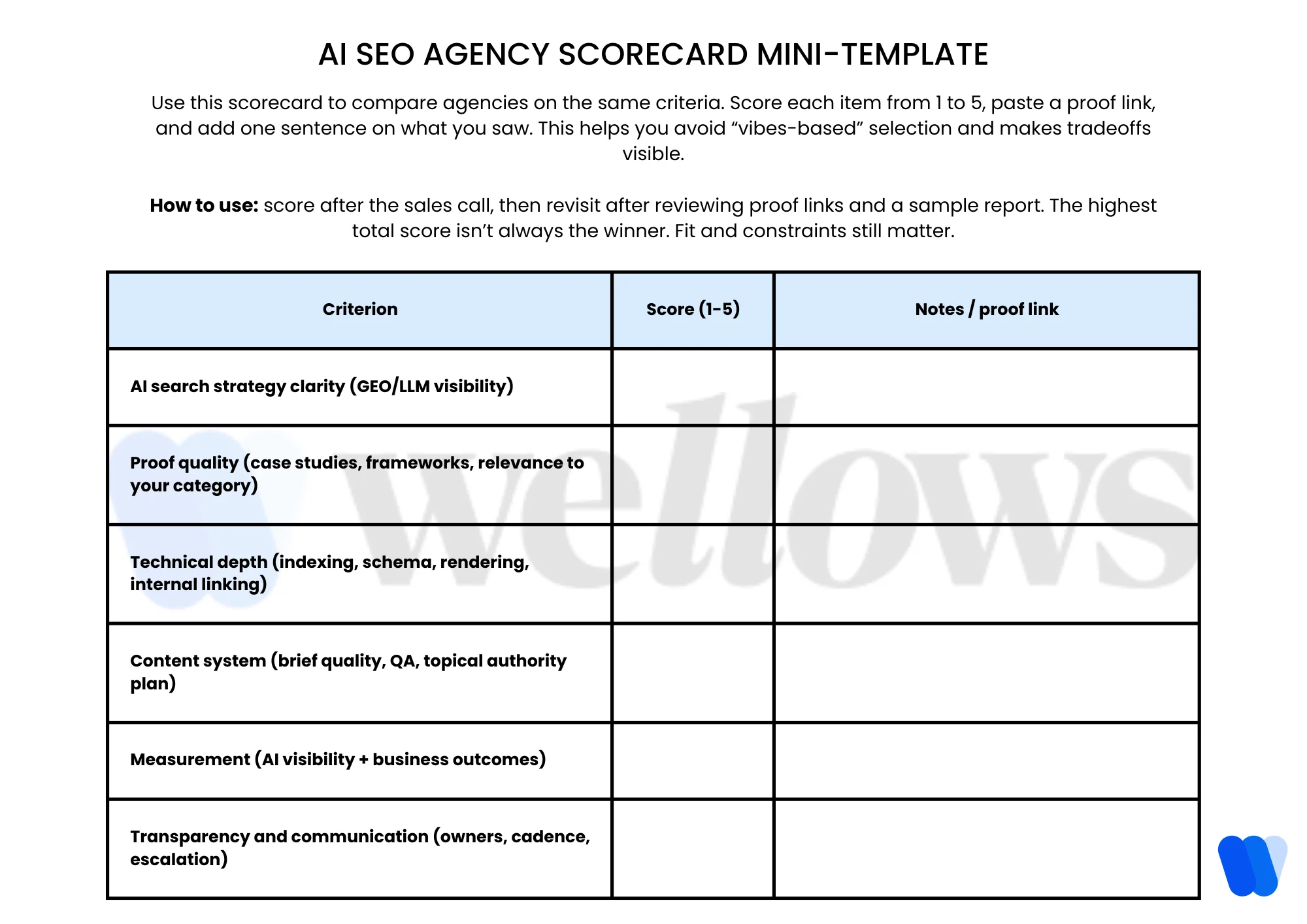
- Score, then negotiate scope: pick the best-fit team, then align on the minimum viable engagement.
What “AI SEO” Means in 2026 (And Why “SEO-Only” Isn’t Enough)
In 2026, “AI SEO” isn’t a separate channel. It’s the reality that search results increasingly include AI-generated answers, and those answers can influence what people trust and click. If your strategy only targets rankings, you may still miss visibility where decisions are being shaped.
The practical difference is this: ranking is about where your page appears in a list, while being cited is about whether your content is selected as a source inside an AI-generated response. Google’s documentation notes that AI features can “surface relevant links,” which changes what “winning” looks like for many queries.
That’s why modern programs combine classic SEO with GEO, LLM optimization, and answer-engine optimization. If you want a deeper breakdown and learning path, use this GEO learning platform. If you’re seeing good rankings but limited AI visibility, start with the rankings vs citations gap.
The table below simplifies the terms you’ll hear from agencies. They overlap, and a strong partner should be able to explain how each one maps to concrete deliverables and measurable outcomes.
| Term | What it focuses on | Primary goal | Where it shows up | Typical deliverables |
|---|---|---|---|---|
| SEO | Crawling, indexing, relevance, and authority in classic search | Rank and earn qualified organic traffic | Traditional organic results | Technical fixes, on-page optimization, content strategy, link and authority work |
| GEO | Optimizing for inclusion and visibility inside generative answers | Be selected as a source and surfaced in AI responses | AI Overviews, AI answer layers, generative summaries | Citation-ready content formats, entity coverage plans, structured answers, source-worthy pages |
| LLMO | How LLMs interpret, reference, and recommend brands and content | Increase mentions and citations across AI platforms | LLM chat interfaces and AI assistants | Brand and entity alignment, content clarity, topical authority, monitoring of citations/mentions |
| AEO | Answer-focused optimization for direct responses | Win answer placements and satisfy intent quickly | Featured snippets, FAQs, knowledge-style results, AI answers | FAQ hubs, concise definitions, schema where appropriate, intent-aligned formatting |
Services Checklist: What the Best AI SEO Agencies Actually Deliver
The easiest way to spot fluff is to ask for deliverables, not slogans. A strong AI SEO agency can explain what it will ship in the first 30 to 90 days, what changes on your site, and how results will be measured when AI summaries reduce click-based discovery. If the proposal only lists activities (“optimize content with AI”) without concrete outputs (audits, templates, reporting artifacts), treat it as a warning sign.
AI SEO still relies on fundamentals. Google’s guidance emphasizes creating helpful, people-first content and following Search Essentials, which means shortcuts and low-quality automation usually backfire over time (Google; Google Search Essentials). What changes in 2026 is the scope: you should expect technical readiness, content systems, authority building, and visibility measurement that includes AI surfaces.
Use this checklist to pressure-test a statement of work. You don’t need every item, but you should be able to see what’s included, what’s excluded, and how each item is verified.
AI visibility baseline: Initial benchmark for AI Overviews and LLM mentions, including which queries are triggering AI answers, which markets are covered, and the exact time window used for measurement.
Technical readiness audit: Assessment of indexing, rendering, internal linking, page speed, and schema opportunities tied specifically to priority pages rather than site-wide generalizations.
Content and entity plan: A documented topic map outlining entity coverage and citation-ready content formats such as definitions, comparisons, FAQs, and how-to guides aligned with key intents.
Page-level upgrades: A clear list of specific pages or templates to update, including what will change and why, instead of vague promises to “optimize content.”
Authority and mentions plan: A strategy for earning credible third-party mentions, citations, or digital PR coverage tied directly to the topics and entities you want AI systems to reference.
Governance and QA process: Editorial quality assurance, refresh cadence, and review workflows, especially important for regulated or high-risk categories where accuracy matters.
Experimentation framework: Defined tests, hypotheses, and success criteria, including how results are attributed and how learnings feed back into future optimization.
Reporting structure: Monthly reporting that combines rankings and traffic with AI visibility signals, explaining what changed, why it matters, and what action is next.
Measurement beyond rankings: Use of visibility, citation, and inclusion metrics to evaluate performance in AI-driven search, not just traditional SERP positions.
Clear scope and accountability: Explicit deliverables, timelines, and ownership so AI SEO work is measurable, auditable, and tied to real outcomes rather than abstract activity.
| Service | Outputs you should receive | How to verify |
|---|---|---|
| AI visibility baseline | Query set, market list, baseline snapshot, and a tracking plan | Ask to see the exact queries and a before/after view, not just a summary |
| Technical audit for AI readiness | Prioritized issue list, page/template map, and implementation tickets | Confirm every recommendation is tied to a URL type and an owner (agency vs your team) |
| Content systems + topical authority | Editorial plan, briefs, internal linking rules, QA checklist | Request two sample briefs and the QA checklist used before publishing |
| Citation-ready page upgrades | Updated pages with clearer structure, definitions, comparisons, and sources | Spot-check pages for scannable sections and source-worthy references |
| Authority building | Target list, outreach plan, asset plan, placement/reporting format | Review sample placements and ask how they map to priority topics and pages |
| Measurement + reporting | Monthly report, annotations of changes, and a learning log | Ask for an example report and confirm it includes AI visibility signals, not only traffic |
Pricing: What Top AI SEO Agencies Typically Cost (And What Drives the Price)
AI SEO pricing varies because the scope is wider than content creation. Strong programs blend technical SEO, content systems, authority work, and measurement across AI surfaces, and that mix changes the effort required. Your cost will also depend on what the agency is responsible for shipping versus what your internal team can implement.
Use the ranges below for budget planning, not as a quote. As a baseline, any engagement should still align with Google Search Essentials, since sustainable results depend on crawlability, quality, and compliance with core guidelines.
Typical AI SEO Pricing Ranges (USD)
Starter / SMB
Growth / SaaS
Enterprise
One-time audit or sprint
Did you know?
What affects cost
- Implementation ownership: done-for-you shipping costs more than recommendations-only.
- Technical complexity: large sites, rendering technical SEO issues, schema work, or migrations increase effort.
- Content velocity and QA: the volume of briefs, updates, and governance required each month.
- Authority scope: digital PR and placement work adds budget and lead time.
- Measurement requirements: dashboards, experiments, and AI visibility tracking depth.
Measurement: How to Track Results When Clicks Aren’t the Only Win
Clicks can drop even when your visibility improves, because AI answers intercept demand before a user reaches your site. That doesn’t mean SEO stopped working. It means your scoreboard needs to separate what happens before the click (visibility inside AI answers) from what happens after the click (engagement, conversions, pipeline). Click-through rates have fallen by about 30% year over year as AI Overviews expand.
In practice, you’ll want three layers of measurement: rankings and demand capture (classic SEO), citations and mentions (AI visibility), and business outcomes (pipeline). BrightEdge’s reporting on AI Overviews coverage is useful context here because it signals how often AI summaries appear across queries.
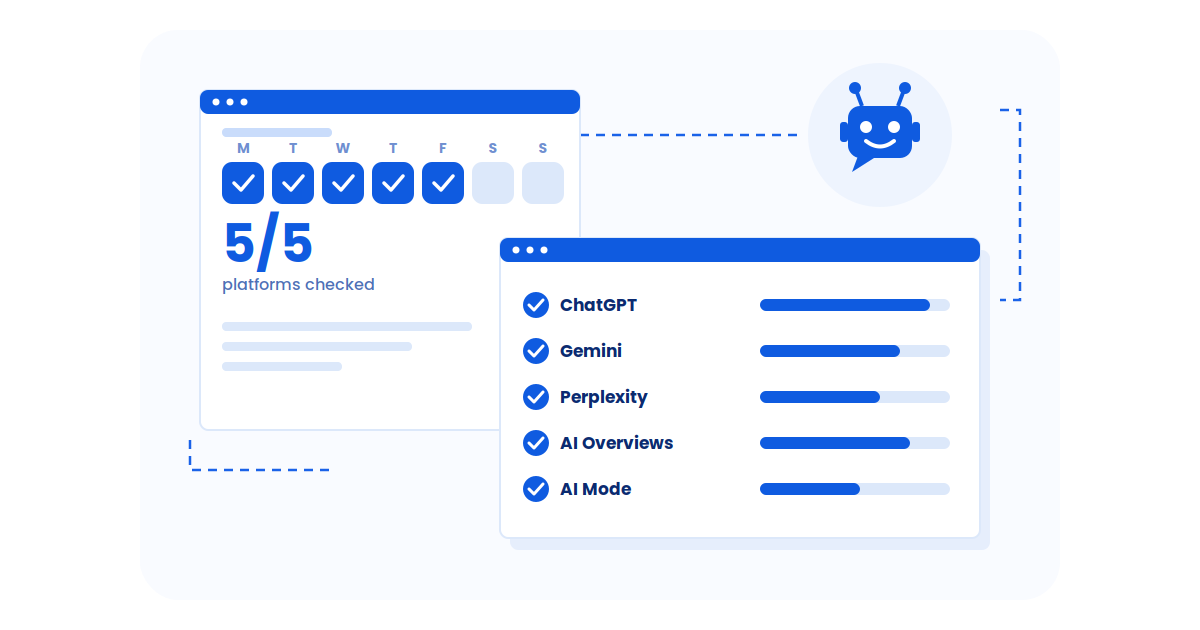
GA4 and Search Console tell you what happens after the click. Platforms like Wellows help you track where you’re being cited or mentioned in AI answers before the click, using an AI Overviews Tracker to connect visibility in Google’s AI summaries to demand and pipeline.
Performance History stores each day’s snapshot, so before/after comparisons for any reporting period are verifiable rather than reconstructed.
If you need tactics to improve citation outcomes, start with LLLM citation strategies. And if you’re comparing software before (or instead of) hiring an agency, our ranked guide to the best AI visibility tools compares 19 platforms by job, engine coverage, and price.
| KPI | What it indicates | Where to measure | How to act |
|---|---|---|---|
| Rankings + impressions | Demand capture and query coverage in classic search | Google Search Console | Fix indexing/technical blockers, align pages to intent, expand topic coverage |
| Clicks + CTR | Post-result engagement (can decline as AI answers expand) | Search Console | Improve titles/snippets, target higher-intent queries, strengthen brand query demand |
| AI citations / mentions | Pre-click visibility inside AI answers and summaries | AI visibility tracking (citation monitoring) | Make pages easier to cite: clear definitions, structured sections, source signals, entity coverage |
| Citation share of voice | How often you’re cited versus competitors on priority topics | AI visibility tracking + competitor set | Prioritize “citation-eligible” pages and topics where competitors dominate |
| Assisted conversions | Whether organic and AI-driven discovery supports conversions later | GA4 (assisted), CRM | Improve internal linking to conversion paths, tighten attribution hygiene |
| Pipeline influenced | Business impact beyond traffic | CRM (opportunities, source/assist) | Report by topic cluster and landing page groups, not “SEO tasks completed” |
Reporting cadence: do weekly health checks (indexing, visibility deltas), a monthly narrative report (what changed and why), and a quarterly strategy review (priorities, experiments, budget shifts).
FAQs
An AI SEO agency should do classic SEO well and also help you earn visibility inside AI-generated answers. Practically, that means improving the odds your pages are selected as sources and “surface relevant links” in AI experiences, not only ranking in a list.
Ranking is where your page appears in organic results. Being cited means your content is referenced or linked inside an AI-generated response. You can rank without being cited, and you can sometimes be cited even when you don’t hold the top position, depending on clarity and source-worthiness.
There isn’t one universal “best.” The best AI SEO agency is the one that matches your constraints (engineering support, CMS limits, compliance, budget) and can prove repeatable deliverables: technical fixes, citation-ready content formats, and reporting that tracks visibility in AI features, not just rankings.
An LLM SEO agency focuses on making your brand and pages easier for AI systems to interpret and cite: clear definitions, strong entity coverage, structured sections, verifiable sources, and authority signals, so your pages are more likely to be surfaced as links inside AI answers.
The best AI visibility optimization agencies in 2026 are those that combine strong technical SEO, citation-ready content, and measurable visibility in AI features like Google AI Overviews and LLM answers.
Top choices vary by fit, enterprise technical specialists, digital PR–driven agencies, and SaaS-focused GEO/LLM experts. The right agency depends on your industry, budget, and implementation needs.
Ask each agency for proof links, a first-60-days plan, and a sample report. Then score them on strategy clarity, technical depth, content systems, measurement, and communication. The best fit is the one that can explain what they’ll change, why it matters, and how it will be tracked.
Conclusion
The best AI SEO agencies in 2026 aren’t defined by tool stacks or buzzwords. They’re defined by proof you can verify, a delivery model that fits your constraints, and measurement that reflects how discovery now works. With AI Overviews appearing in 11%+ of Google queries, it’s reasonable to expect that more decisions will be influenced before a click happens.
Shortlist a few candidates, validate their proof links, and align on specific deliverables for technical readiness, content systems, and authority building. Then measure outcomes across rankings, citations, and business results so you can separate real progress from surface-level activity.