How Agencies Deliver AI Search Visibility is evolving as user discovery shifts from traditional blue-link results to AI-generated answers. In the United States, web referrals from generative AI platforms grew more than 10× between mid-2024 and early-2025, highlighting how quickly discovery patterns are changing.
Because AI systems now summarize information and cite sources directly inside search experiences, agencies increasingly deliver AI search visibility using white-label models.
These models allow agencies to operate visibility tracking, optimization, and reporting under their own brand while retaining strategic control, without building infrastructure from scratch. AI Search Visibility for Agencies supports this delivery approach by enabling agencies to manage brand presence across AI-driven search environments where recommendations now originate.
What Is AI Search Visibility?
AI search visibility means how often a brand or entity appears inside AI-generated answers instead of traditional search listings. It depends on whether AI systems can understand, trust, and cite a source when responding to queries. In the U.S., Google confirmed that AI-generated summaries are appearing across a growing share of search results as part of its AI Overviews rollout, changing how visibility is earned (Google Search Blog, 2024).
This is exactly what an AI visibility audit checks—whether your brand is eligible for reuse across AI Overviews and LLM answers, and what’s blocking selection.
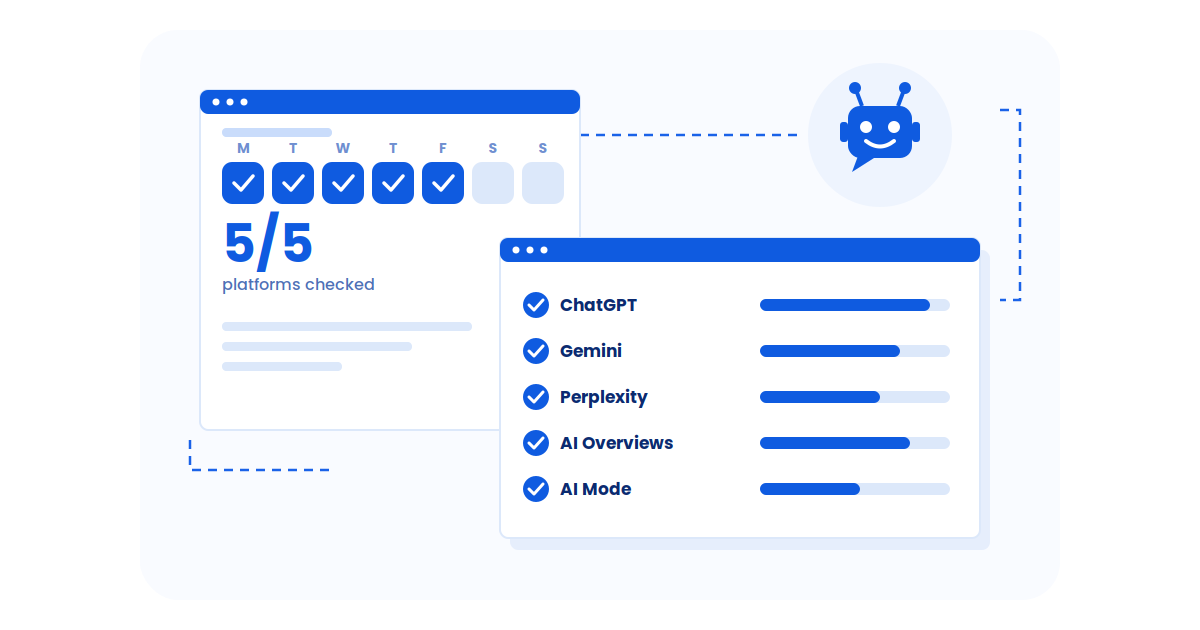
Google AI Overviews: AI-generated summaries shown directly on SERPs, where visibility is driven by structured, entity-focused content aligned with Generative Engine Optimization, not keyword rankings.
ChatGPT and LLM-based assistants: Conversational AI systems that generate direct, synthesized answers instead of ranked links. Visibility here depends on whether a brand’s content is contextually accurate, entity-aligned, and trusted enough to be reused inside AI-generated responses.
Perplexity and answer engines: AI platforms that combine live web retrieval with explicit citations, where AI search engine visibility depends on factual clarity, topical authority, and extractable content structure.
Why AI Search Visibility Is Now a Core Agency Offering
The shift from rankings to AI answers happened because search platforms increasingly resolve user intent directly within the interface. Instead of sending users to multiple websites, AI systems summarize, recommend, and cite information instantly. As a result, brands can be visible to users without earning a traditional click, changing what “being found” actually means.
Because of this change, agencies — including SEO teams, performance shops, and content marketing agencies adapting to AI-led discovery — moved beyond rankings as the primary success metric and began focusing on whether clients appear inside AI-generated summaries, citations, and recommendations instead.
This shift also introduces zero-click conversions, where users act on AI recommendations without visiting a website.
This behavior aligns with the Great Decoupling, where visibility and influence grow independently of traffic. Compared to traditional SEO practices that emphasize rankings and visits, AI search visibility prioritizes brand presence and reuse across AI-driven discovery environments.
How Agencies Enhance AI Search Visibility for Client Brands
- How do top AI SEO agencies align content with AI user intent?: Top AI SEO agencies analyze how AI systems interpret user intent beyond keywords. Content is structured to answer questions clearly and contextually. This improves alignment with intent patterns defined by user intent in generative engines.
- How do agencies expand AI query coverage?: Instead of targeting isolated terms, agencies cover related questions and follow-up prompts. This increases reuse across multiple AI-generated answers. Identifying GEO queries helps brands surface across broader AI conversations.
- How do agencies strengthen authority for AI systems?: AI models favor sources that demonstrate expertise and reliability. Agencies ensure content is factual, well-structured, and supported by credible references. This makes brands safer and more consistent for AI citation.
- How do agencies maintain entity consistency?: Consistent brand naming and descriptions reduce ambiguity. Agencies align entities across content, profiles, and web properties. This improves AI recognition and validation.
- How does content structure affect AI visibility?: Clear headings and logical information flow improve AI comprehension. Agencies format content so answers can be extracted accurately. This reduces distortion when AI summarizes or reuses information.
What Strategies Do Agencies Use for AI Search Visibility?
Agencies no longer treat traditional SEO and AI visibility as separate tracks. They align rankings, entities, and authority signals by combining SEO and GEO, ensuring brands stay visible across both SERPs and AI-generated answers.
Agencies’ Approach to AI Search Visibility in Practice
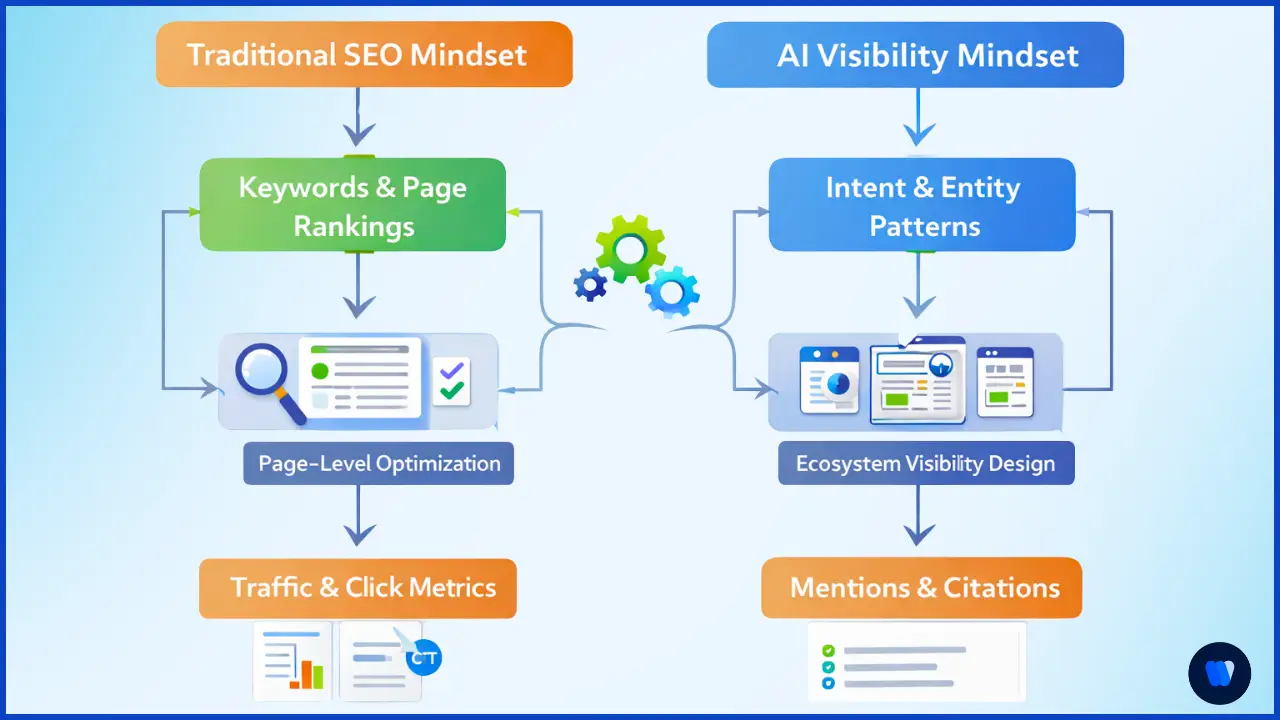
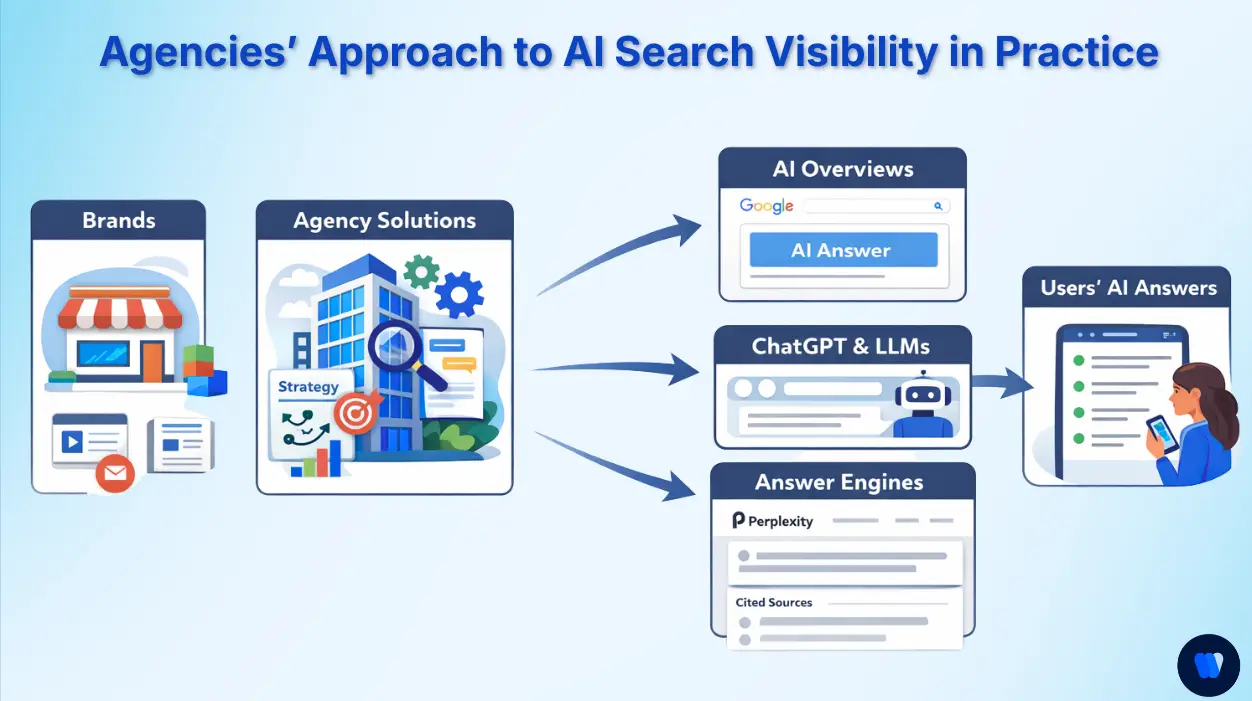 Instead of optimizing isolated pages, they design systems that help AI models recognize patterns, entities, and relationships at scale. This shift moves execution from page-level optimization to ecosystem-level visibility management.
- Focuses on individual keywords and page rankings.
- Optimization is driven by traffic and click-through metrics.
- Success depends on position in SERPs rather than reuse of content.
- Limited consideration of pattern recognition across queries.
- Centers on how AI systems understand and reuse information.
- Content is planned around intent patterns and entity relationships.
- Visibility is measured by mentions, summaries, and citations.
- Accounts for AI Mode query fan-out across primary and follow-up prompts.
How Agencies Deliver Search Visibility with AI Systems
Agencies deliver search visibility with AI systems by structuring content workflows that AI models can understand, trust, and reuse across answer-driven search environments.
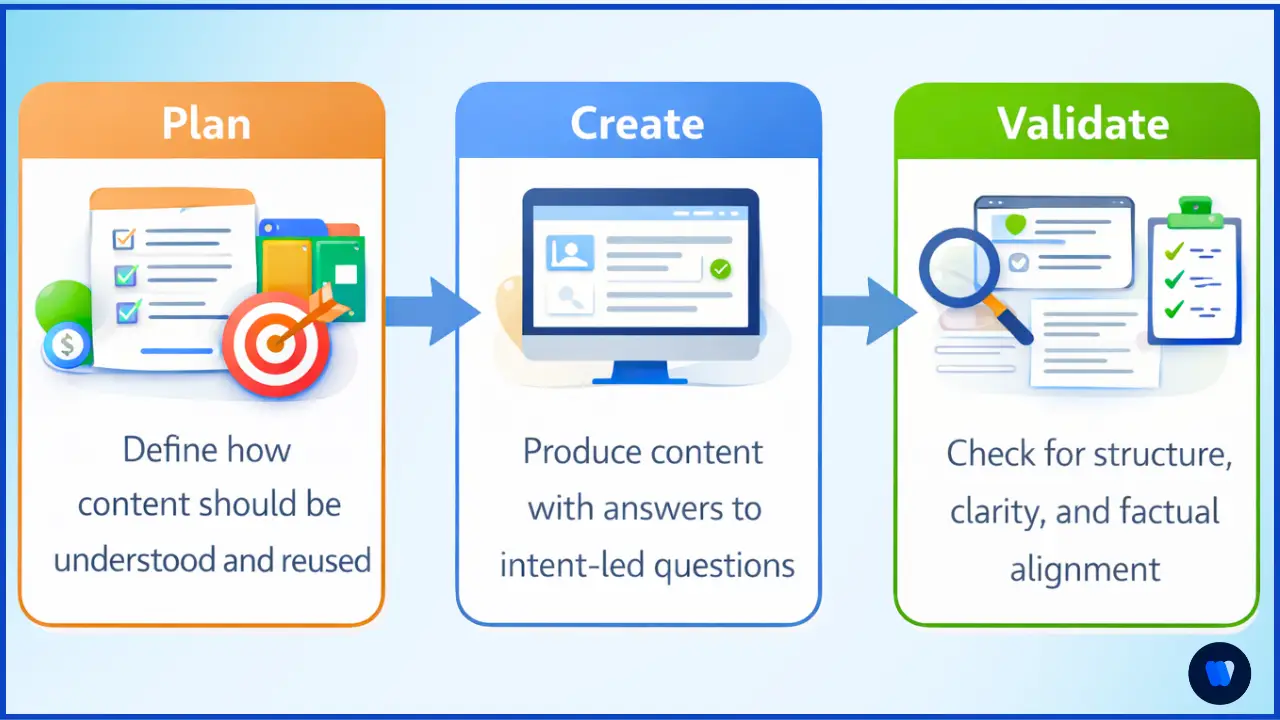
Agencies begin by defining how content should be understood and reused by AI systems, often grounding execution in a technical SEO checklist for agencies to keep implementation consistent across accounts.
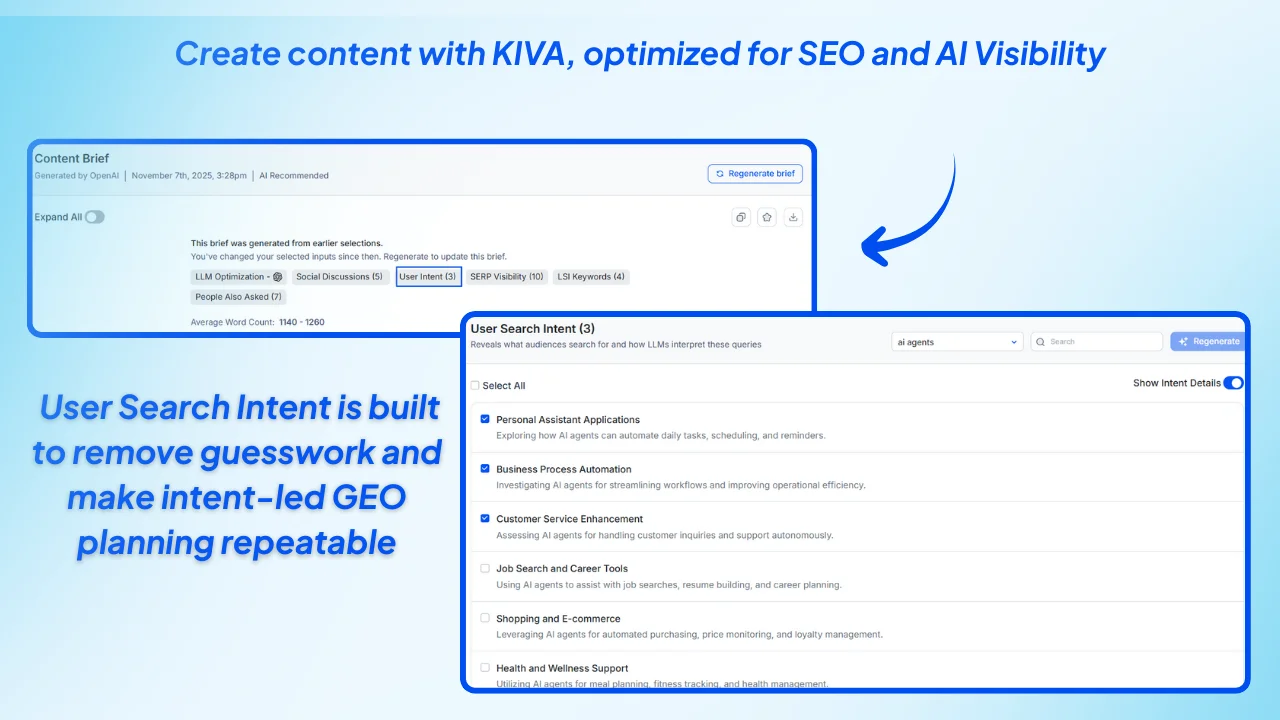
They rely on structured SEO briefs to align intent, entities, and coverage before creation.
Content is produced to answer intent-led questions clearly and consistently.
Using content briefs for GEO, agencies ensure information is accurate, extractable, and ready for AI summarization.
Before publishing, agencies validate structure, clarity, and factual alignment.
This step reduces ambiguity and increases the likelihood that AI systems reuse the content correctly in answers and citations.
Delivering AI Search Visibility Using White-Label Models
White-label models allow agencies to deliver AI search visibility while retaining full ownership of strategy, reporting, and client relationships. Instead of exposing tools or vendors, agencies operate a unified system where AI visibility work appears as an internal capability, reinforcing trust and long-term client dependency.
Did you know?
Did you know?
Did you know?
AI Search Visibility Strategies of Agencies vs Traditional SEO
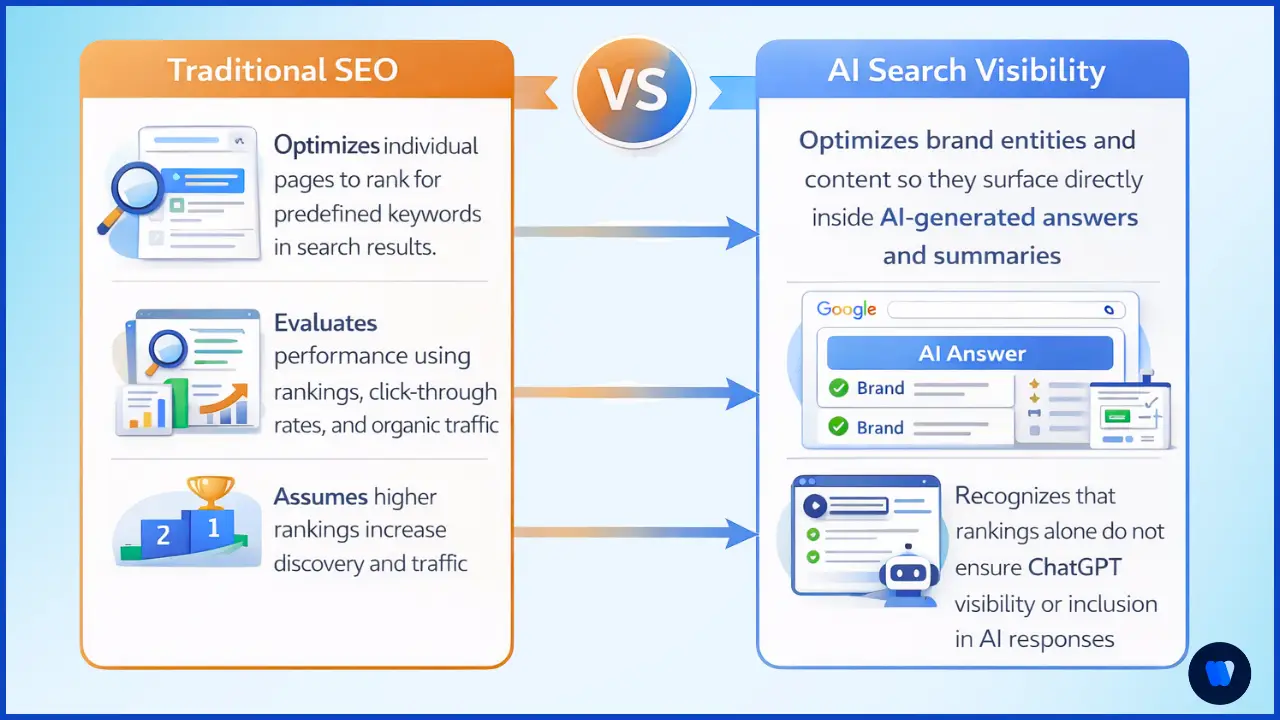
Agencies approach AI search visibility differently because discovery no longer depends only on rankings. The comparison below highlights how execution, measurement, and visibility models shift when AI systems generate answers instead of listing links.
| Traditional SEO | AI Search Visibility |
|---|---|
| Optimizes individual pages to rank for predefined keywords in search results. | Optimizes brand entities and content so they surface directly inside AI-generated answers and summaries. |
| Evaluates performance using rankings, click-through rates, and organic traffic. | Evaluates performance using mentions, citations, and content reuse across AI-driven interfaces. |
| Operates on ranking-based mechanics that differ from GEO vs SEO visibility models. | Accounts for AI-generated responses where users receive answers without clicking through to websites. |
| Assumes higher rankings increase discovery and traffic. | Recognizes that rankings alone do not ensure ChatGPT visibility or inclusion in AI responses. |
Techniques Agencies Employ for AI-Driven Search Visibility
Entity-focused structured data Agencies implement structured data to help AI systems clearly identify entities, relationships, and factual attributes, improving extraction and citation accuracy.
Schema aligned with language understanding Beyond markup basics, agencies apply schema in ways that support semantic interpretation, following Schema and NLP principles so AI models can process meaning, not just structure.
Answer-ready content formatting Content is written in clear, self-contained statements that AI systems can quote or summarize without losing context or accuracy.
Topical clustering at entity level Agencies organize content around complete topics rather than single pages, helping AI recognize sustained expertise across related questions.
Consistency across discovery surfaces Brand names, descriptions, and key facts are kept consistent across pages, directories, and third-party sources, because AI systems synthesize information from multiple Client agencies, not a single search engine.
Metrics for Measuring AI Search Visibility by Agencies
Agencies measure AI search visibility differently because rankings alone no longer reflect discovery. Measurement often reveals competitors appearing in AI-generated answers even when traditional rankings look strong.
The metrics below focus on how often brands appear, get cited, and stay visible inside AI-generated responses.
| Metric | What it measures | Why it matters |
|---|---|---|
| AI citation frequency | How often a brand or page is cited inside AI-generated answers. | Frequent citations signal trust and authority, aligning with GEO KPIs rather than keyword rankings. |
| Answer inclusion rate | The percentage of relevant AI responses where the brand appears. | Higher inclusion increases brand recall even when users do not click through. |
| Entity mention consistency | How consistently AI systems reference the same brand name, description, and attributes. | Consistency reduces ambiguity and improves reuse across AI answers. |
| AI referral engagement | Engagement quality of traffic coming from AI-powered tools. | Longer sessions and lower bounce rates indicate meaningful discovery. |
| Coverage gaps | Topics or questions where competitors appear but the brand does not. | Identifying gaps is a core outcome of an AI visibility audit. |
How Local Agencies Deliver AI Search Visibility Services
Local agencies connect AI search visibility with geographic relevance by ensuring brands appear inside location-aware AI answers, not just traditional map results. AI systems increasingly combine proximity, entity trust, and real-world signals when generating local recommendations.
Agencies optimize business data so brands surface inside AI-generated local answers influenced by AI Overviews & local SEO, where authority and distance are evaluated together.
Consistent business names, categories, and service descriptions across listings and content help AI systems validate the brand as a trusted local entity.
Local agencies monitor discussion platforms and social forums that generative engines reference, including Reddit signals, to reinforce real-world relevance.
Content is structured around local intent questions such as availability, comparisons, and services, making answers easy for AI systems to extract and present accurately.
Where Wellows Fits in an Agency AI Search Visibility Stack
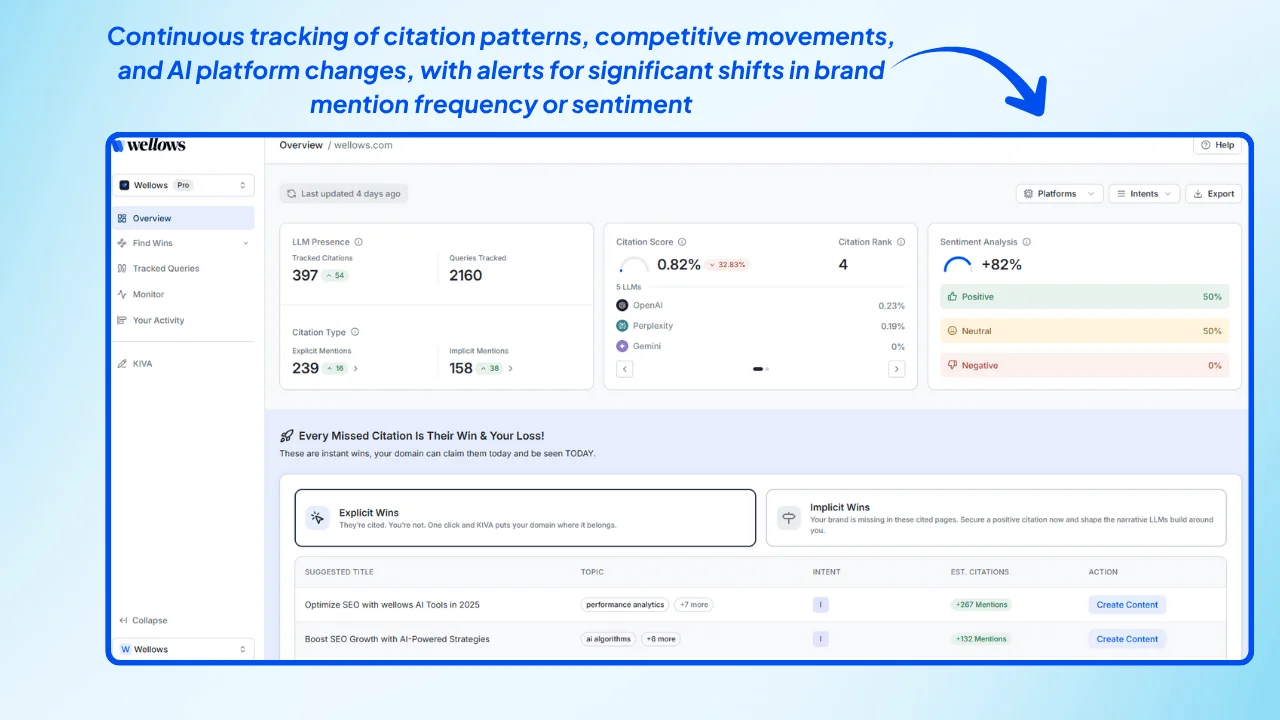
Wellows operates as an AI search visibility platform within an agency’s GenAI visibility stack, helping teams understand how brand entities are interpreted, cited, and reused across SERPs and LLMs. It supports agency-owned workflows without replacing strategy, execution, or client-facing delivery.
Did you know?
Did you know?
Did you know?
Did you know?
If you want to see how this fits into an agency-led AI visibility workflow, you can Start Your 7-Day Trial.
FAQs
Agencies track AI search visibility by monitoring brand mentions, citations, and inclusion within AI-generated answers across platforms like AI Overviews and LLMs. Visibility is measured through share-of-voice, citation frequency, and consistency across models rather than keyword positions.
Traditional SEO focuses on rankings and clicks, while AI search visibility focuses on whether a brand is referenced or cited inside generated answers. AI systems prioritize authority, clarity, and contextual relevance over link-based rankings.
Immediate improvements come from clarifying entity information, answering high-intent questions directly, and structuring content for easy extraction. Removing ambiguity in brand signals helps AI systems identify trusted sources faster.
Agencies report gains by showing changes in AI mentions, citation presence, and coverage across multiple AI responses. Visual summaries comparing before-and-after visibility provide clearer value than rank-based reports.
Agencies rely on AI visibility platforms that monitor SERP summaries, LLM responses, and citation behavior. These tools focus on how often brands are referenced and reused across generative search environments.
Yes. Brands can appear in AI-generated answers even when they do not rank first organically. AI systems often cite sources based on authority, context, and completeness rather than top ranking positions.
Key Takeaways
AI-driven search has changed how visibility is earned and measured, requiring agencies to adapt how they plan, deliver, and evaluate results.
- AI search visibility centers on being cited and referenced inside AI-generated answers rather than ranking positions.
- Agencies improve outcomes by aligning intent, authority, and entity signals across content and channels.
- White-label delivery models let agencies own client relationships while scaling AI visibility services.
- Success is measured through consistency and reuse across AI systems, not clicks or rankings alone.