For more than a decade, agency reporting followed a predictable loop. Rankings rose, traffic followed, and conversions provided clear proof of impact.
AI-powered search has changed that. Many users now get answers directly on the results page and never reach the websites agencies optimize.
SparkToro’s clickstream research found that only 360 out of every 1,000 Google searches in the U.S. result in a click to a non-Google, non-paid destination (Fishkin, 2024). Pew Research Center found users click a traditional result 8% of the time when an AI summary is shown, compared to 15% when it is not.
This creates a reporting gap. Clients still expect rankings, traffic, and attribution, while search is shifting toward visibility without clicks. As a result, agencies focused on demand generation and brand authority must now account for how influence develops inside AI answers through mentions and citations before a site visit ever occurs.
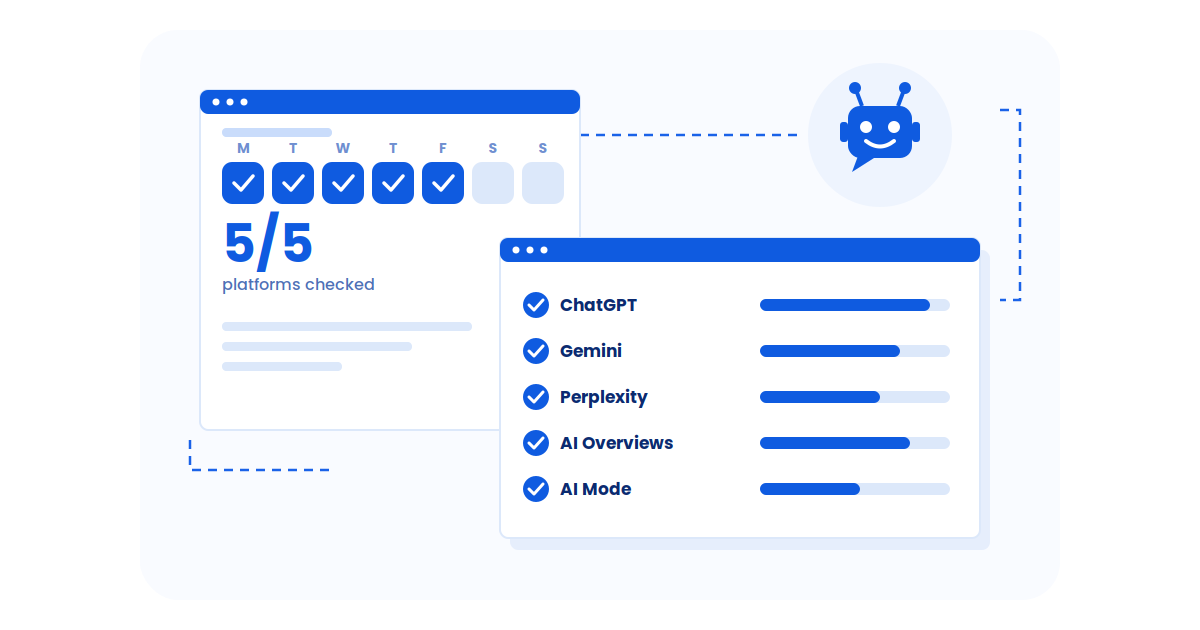
For agencies, this changes what reporting needs to capture. It’s no longer enough to show traffic and rankings when brand influence increasingly happens inside AI-generated answers across ChatGPT, Gemini, Perplexity, AI Mode, and Google’s AI results.
AI Search Visibility for Agencies is built for this exact shift, helping teams see how clients appear inside AI-generated results, track mentions and citations across platforms, and explain AI-driven visibility in terms clients actually understand\u2014without relying on clicks alone.
For the broader operating model behind this reporting shift, the AI visibility for digital marketing agencies playbook shows how to turn these signals into a citation-first client deliverable.
As a result, agency reporting can reflect real on-SERP influence, not just rankings, sessions, or last-click attribution.
This guide to Agency Reporting for AI Search explains how to use LLM citation tracking, AI visibility, and trust signals to create reports that clients understand and value.
- AI search has shifted visibility from clicks and rankings to inclusion, citations, and influence inside generated answers
- Traditional SEO metrics no longer explain performance when AI satisfies intent before a website visit
- Agency Reporting for AI Search focuses on how brands are represented, selected, and cited by AI systems
- New KPIs must measure AI visibility, entity inclusion, trust signals, and post-exposure outcomes
- Clear language matters as much as data, agencies must explain probability and influence instead of certainty and control
- E-E-A-T, AEO, and GEO are now reporting fundamentals because credibility drives AI selection behavior
- Agencies that adapt reporting models and vocabulary can protect trust, retain clients, and position themselves as strategic partners
What Is Agency Reporting For AI Search And Why Do They Need It?
AI-driven search is changing what “visibility” even means. Users are increasingly getting answers directly inside generative responses, often without clicking through to a website.
That shift creates a reporting problem for agencies: clients still expect proof in the old format, while search is behaving in a new way.
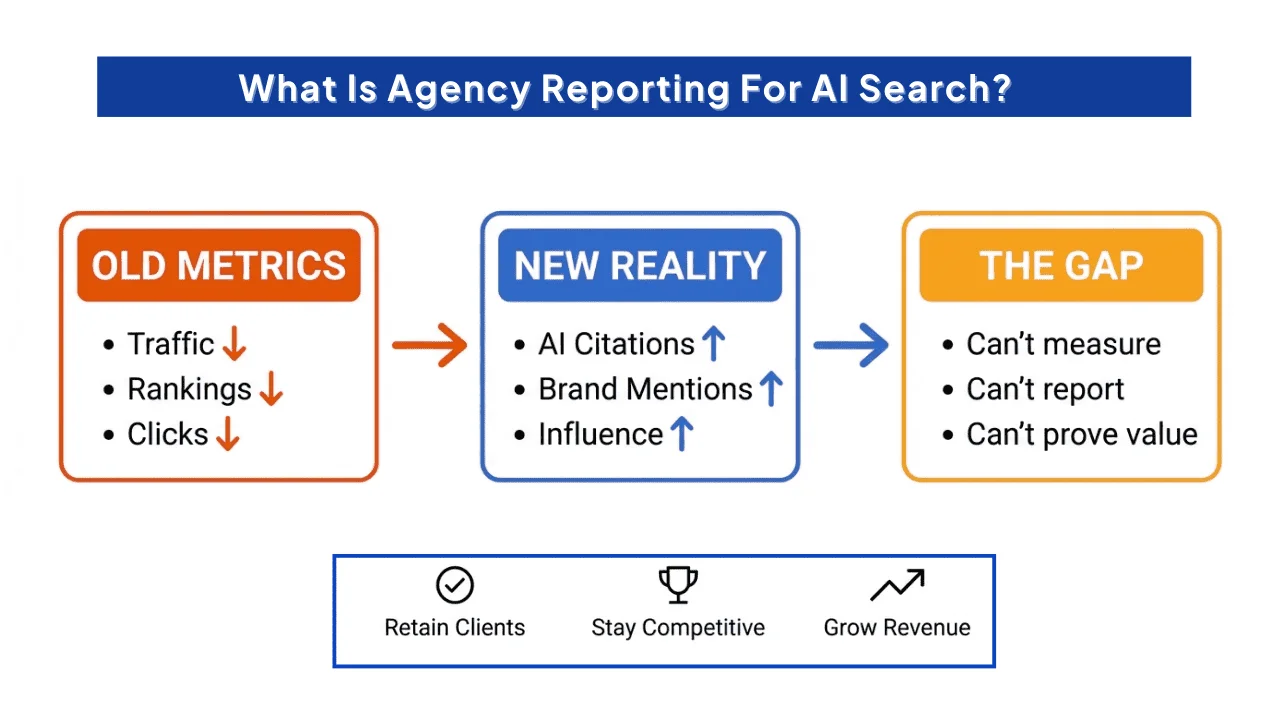
Agency reporting for AI search is the practice of monitoring, analyzing, and explaining how clients’ brands appear across AI-driven results, and translating how brands are represented, selected, and cited by AI systems into insights clients can understand and act on.
Many agencies including content marketing agencies focused on demand generation and brand authority now incorporate this visibility analysis when reporting client performance.
For teams that need specialist support, AI SEO agencies are increasingly evaluated on whether they can track citations, mentions, and competitive presence across AI-driven results.
Unlike traditional SEO reporting, AI search reporting isn’t about linear rankings or predictable click paths.
It reflects a world where search engines synthesize answers instead of listing results, visibility happens inside generated responses, and influence matters more than position. To prioritize tracking, use this overview of the best AI Search Engines people are turning to now.
Why Do Agencies Need It?
Once you accept that visibility can happen without a click, the “why” becomes obvious. Agencies need a way to prove, protect, and expand client presence inside AI answers without relying on legacy KPIs that no longer tell the full story.
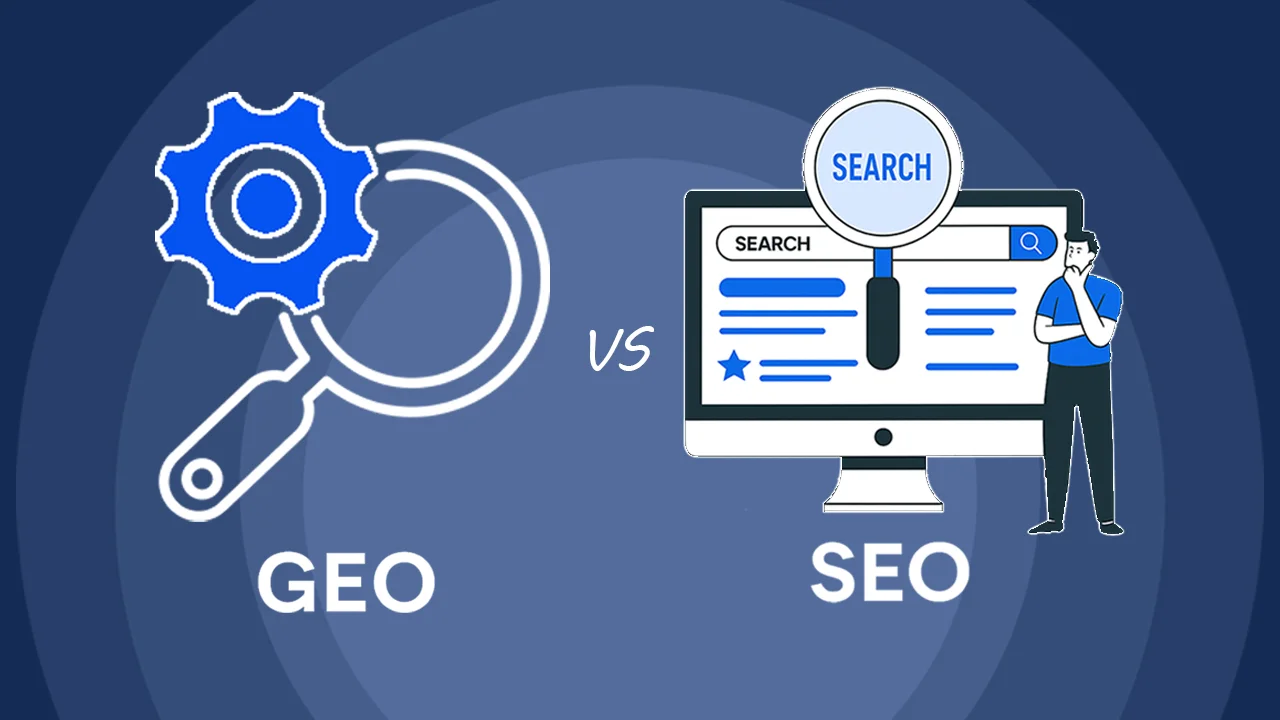
This is also why frameworks like GEO are becoming part of modern reporting conversations.
In other words, when clients ask “Where are we showing up now?” the answer increasingly depends on how well the brand is represented in generative systems, which is the core idea behind Generative Engine Optimization.
- Enhanced Client Visibility: AI answers may reduce clicks, but they can increase brand exposure. Agencies must track and optimize inclusion where decisions are being shaped.
- Competitive Advantage: Monitoring AI visibility shows where competitors are being mentioned or cited, so agencies can win more presence in the same query spaces.
- Data-Driven Decision Making: Tracking mentions, sentiment, and visibility trends helps agencies refine strategy based on how AI is interpreting the brand.
- Client Education And Trust: Transparent AI reporting reduces confusion in QBRs and positions the agency as a strategic guide, not just a vendor.
The Core Agency Pain Point
Here’s where agencies feel the pressure: you can be doing strong work and still look worse on paper.
Clients still ask questions like “What position are we ranking?” “Why is traffic down?” or “Where is the ROI?” But AI search changes how performance shows up. Success now looks like inclusion instead of ranking, exposure instead of clicks, and influence instead of control.
Without a way to measure and explain this shift, agencies can appear less effective even when they are aligned with how modern search actually works.
This is where Wellows helps agencies bridge the gap by tracking brand visibility, mentions, and competitive presence across AI search, giving teams concrete data to show how and where clients are being surfaced.
Did you know?
New Metrics Require New Language
This is why AI search reporting isn’t just a new dashboard, it’s a new vocabulary. If you keep using old language, clients keep judging you with old expectations.
- From “We ranked you #3” to “Your brand is being selected as a trusted source”
- From “Traffic decreased” to “AI absorbed informational demand upstream”
- From “We lost visibility” to “Visibility shifted into generative answers”
A simple way to keep this vocabulary consistent across account teams is to anchor reporting in an AI visibility reporting checklist for Agencies\u2014so everyone uses the same definitions, rules, and KPI framing client-to-client.
The shift is already showing up in real reporting workflows. Seer Interactive analyzed how Google AI Overviews were changing organic performance for a major client (a “leading digital solutions provider”).
Instead of treating AI visibility like a guessing game, they built a repeatable measurement approach for where AI Overviews were triggering and how often the brand was being surfaced in AI-driven answers.
In Seer’s GenAI tracking dashboard analysis of a curated set of 100 AI-generated queries, the client was recommended as a source in 60% of those queries (Griffin & Strauss, 2025).
The takeaway is simple: renewals are increasingly won by explaining AI visibility with credible, repeatable reporting, not by relying only on rankings and traffic trends.
How Can Agencies Prepare Client Reports For Google AI Overviews?
Google AI Overviews sit above organic results, synthesize multiple sources, and often reduce the need to click. That’s why classic “rankings-first” reporting breaks, clients expect a position, but AI Overviews aren’t a stable ranking layer.
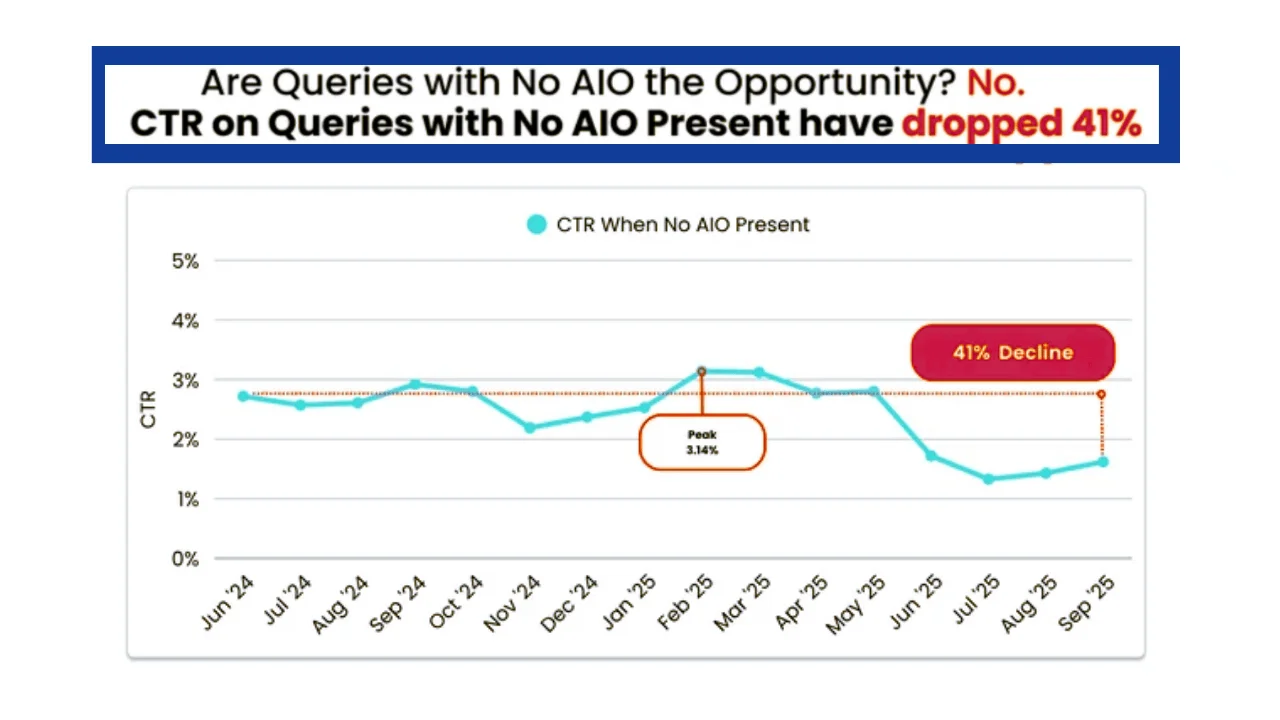
Click impact is real: Seer Interactive reported that for queries with AI Overviews, organic CTR fell from 1.41% to 0.64% year-over-year (Seer Interactive, 2025).
What Agencies Should Report (And How)
Visibility: Identify which query clusters trigger AI Overviews and track how often the client is included (use Google Search Console + consistent SERP sampling).
Engagement Shift: Compare CTR on queries with vs. without AI Overviews to quantify click suppression.
Traffic Quality: If clicks drop, focus on post-click outcomes (conversion rate, bounce rate, pages/session) to show whether remaining traffic is more qualified.
Content Sources: Document which pages AI Overviews pull from and what formats get reused (definitions, steps, comparisons, FAQs).
Optimization Actions: Report what you changed to improve selection, clear headings, concise answers, FAQ/How-To schema, and freshness updates.
Competitive Context: Track which competitors show up for the same prompt types and where the client has citation/inclusion gaps
Did you know?
Client-Safe Language
Instead of “You ranked in AI Overviews,” use: “Your content is being used as a reference source when Google generates answers for high-intent queries.”
The Fundamental Agency Pain: Explaining Value Clients Cannot See
Agency reporting for AI search requires a shift from traditional metrics like organic traffic and keyword rankings to new indicators that measure visibility, influence, and quality engagement within AI-driven results.
The goal is no longer limited to driving a click; it’s about winning presence inside the answer. That is why many agencies are expanding beyond SEO language into:
Did you know?
- AEO (Answer Engine Optimization): optimizing content to be selected for direct answers
- GEO (Generative Engine Optimization): optimizing brands and assets to be represented accurately and favorably in generative results
In practical terms, AEO and GEO matter because users often get what they need from the AI response and never visit the website. That doesn’t mean the agency work “didn’t work.” It means the value moved upstream.
- AI Visibility And Impression Share:
Tracks how often a brand’s content appears inside AI-driven SERP features such as AI Overviews, featured snippets, and knowledge panels. This measures brand presence even when no click happens, critical for reporting “visibility without visits.”
- AI Citations And Brand Mention Rate:
Measures how frequently a brand (or a specific page/asset) is cited as a source in an AI-generated answer. The reporting goal is to increase consistent, accurate mentions that build authority and preference over time.
- Share Of Model:
Estimates how often a client is selected and recommended by AI engines compared to competitors. This moves beyond simple inclusion and helps agencies report relative prominence (who AI “prefers” to reference for a topic).
- Topical Authority And Content Confidence Scores:
Tracks depth of topic coverage, factual accuracy, and alignment with authoritative sources, supporting E-E-A-T-driven selection behavior in AI systems. Useful for explaining why certain pages earn citations while others don’t.
- Zero Click Performance And Engagement Quality:
Measures value delivered directly on the SERP (visibility, mentions, citations) while also monitoring the quality of the traffic that does click through, conversion rate, bounce rate, pages per session, and assisted conversions.
- Semantic Density And Content Chunkability:
Evaluates how easily AI can interpret and extract content. Strong chunkability comes from clear headings, concise answers, FAQs, schema markup, and modular sections that can be reused in generated responses.
- User Intent Match And Engagement Rate:
Connects AI exposure to outcomes by measuring whether content satisfies intent. Indicators include stronger post-click engagement, higher conversion intent, and fewer follow-up queries (suggesting the AI answer resolved the need effectively).
- Predictive Signals And Conversion Modeling:
Replaces rigid last-click attribution with probabilistic measurement across the journey, capturing non-click influence such as AI mentions that contribute to later branded search, assisted conversions, and downstream pipeline impact.
Strategic Language Shifts Agencies Must Adopt
Clients don’t just need new dashboards. They need a new vocabulary that reflects how search is behaving.
- From Keyword Rankings → Topical Dominance and Entity Authority
- From Organic Traffic Volume → Qualified Visitor Intent and Conversion Value
- From SEO → AEO and GEO
- From Destination (visits) → Presence and influence inside the AI interface
This language shift is what prevents AI-era reporting from turning into apology calls.
What KPIs Should Agencies Use To Measure AI Search Performance And Visibility?
If your previous section introduced the “what” (new AI-era metrics), this section is about the how: how to turn those metrics into a client-ready KPI system that’s easy to understand, hard to argue with, and useful for decision-making.
The goal isn’t to create more dashboards. It’s to build a tiered KPI stack that answers three client questions in the right order:
- Are we being chosen? (AI selection and presence)
- Are we trusted? (credibility and consistency)
- Is it driving business outcomes? (pipeline, revenue, qualified actions)
Tier 1: Selection KPIs (Are We Being Chosen In AI Answers?)
These KPIs prove whether the brand is showing up inside AI results for the right kinds of prompts, especially the queries that shape preference before a click happens.
- AI Overview Coverage By Query Cluster: % of priority query clusters that trigger AI Overviews
- Brand Inclusion Rate: how often the client is included when those AI experiences appear
- Competitive Inclusion Gap: where competitors appear and the client doesn’t
Did you know?
Client-safe framing: “We’re increasing your chances of being included when customers ask high-intent questions.”
Tier 2: Credibility KPIs (Why Is AI Choosing Us Or Skipping Us?)
Selection alone isn’t enough. Clients also need to understand what’s driving inclusion so agencies can prioritize the right content and authority work.
- Citation Quality Mix: which assets get pulled into AI answers (product pages vs guides vs FAQs)
- Authority Consistency: whether AI repeatedly references the same trusted assets over time
- Entity And Expertise Clarity: signals that reduce ambiguity (authors, sources, structured info)
Did you know?
Client-safe framing: “We’re making it easier for AI systems to trust and reuse your content reliably.”
Tier 3: Outcome KPIs (What Business Value Are We Creating?)
AI search can reduce clicks, so outcome KPIs keep reporting grounded in impact, not vanity visibility. The key is to measure what happens after exposure, not only after a click.
- Conversion Quality: conversion rate, bounce rate, and pages/session for organic users who do click through
- Assisted Demand Signals: branded search lift, direct traffic lift, demo requests influenced by organic discovery
- Pipeline Outcomes: MQLs, SQLs, revenue influenced (where tracking is available)
Did you know?
Client-safe framing: “Even if AI reduces some clicks, we’re tracking whether the traffic we earn converts better and whether demand signals are strengthening.”
How To Present This In A Client Report (Without Confusion)
- Lead with Tier 1 (selection) to prove visibility inside AI answers
- Follow with Tier 2 (credibility) to explain causes and priorities
- Close with Tier 3 (outcomes) to anchor everything to business impact
This structure prevents KPI repetition and keeps the story clean: presence → trust → outcomes.
Why Is E-E-A-T Important For Agency Reporting In Generative AI Search?
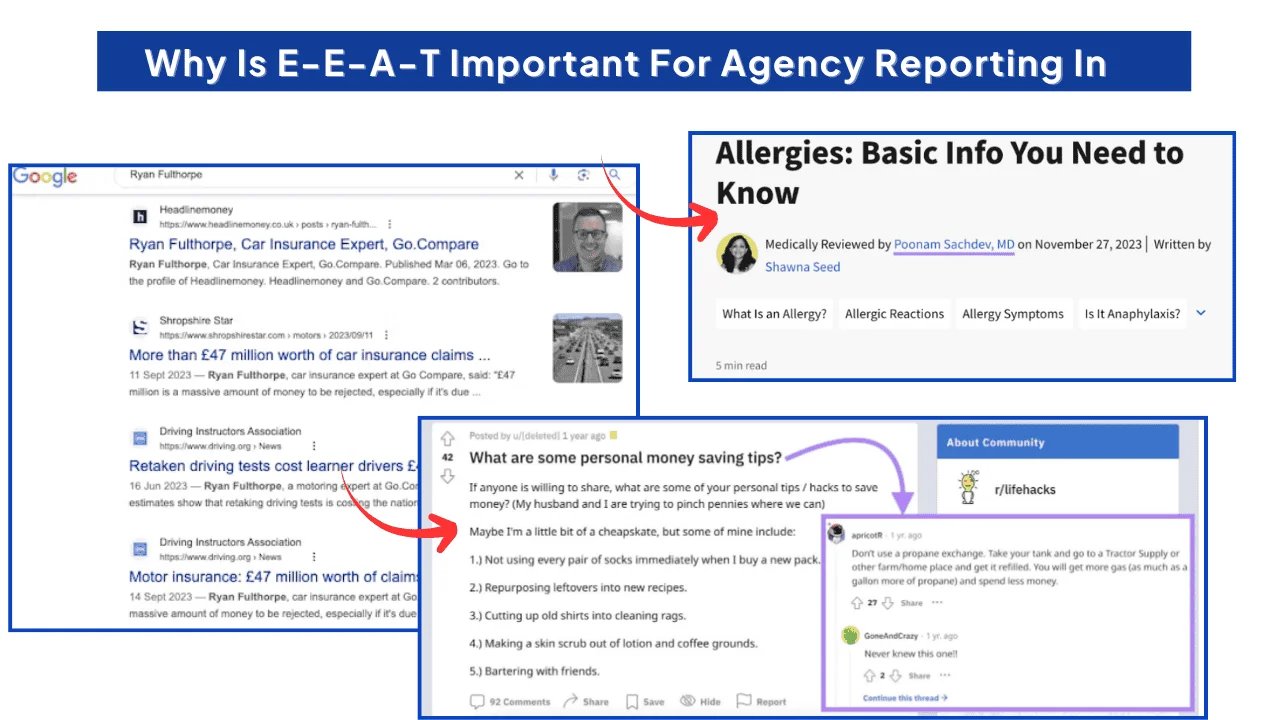
In generative AI search, E-E-A-T matters because it’s one of the clearest, reportable reasons a brand gets selected (or ignored) as a source.
When AI systems synthesize answers, they lean toward content that looks credible, accountable, and experience-backed, especially in high-risk categories.
What This Solves For Agencies
It Explains “Why Them, Not Us”: E-E-A-T gives you a client-friendly way to diagnose visibility gaps without blaming rankings or “algorithm mystery.”
It Improves Inclusion Odds: Strong experience, expertise, and authority signals increase the chance your client’s content is reused in AI-generated responses.
It Protects Trust: When clients see AI visibility fluctuate, E-E-A-T-based reporting keeps the story grounded in quality signals they can control.
It Future-Proofs Reporting: As generative systems evolve, credibility standards tend to tighten, not loosen, so E-E-A-T gives agencies a stable reporting anchor.
Did you know?
How To Report E-E-A-T Without Vague Claims
- Experience Proof: case examples, first-hand insights, original data, real-world process detail
- Expert Attribution: named authors, credentials, reviewer notes, editorial standards
- Entity Clarity: consistent brand/entity signals across site, authors, and references
Language upgrade: don’t report “We improved E-E-A-T.” Report “We reduced ambiguity around expertise, accountability, and evidence, so AI systems can trust and reuse this content.”
How Agencies Can Solve AI Search Reporting Gaps With The Right Platform
Understanding AI visibility is only half the challenge. The real agency problem is operationalizing AI metrics at scale, consistently, defensibly, and in a way clients trust during QBRs.
That’s where purpose-built AI visibility platforms matter. They turn scattered observations into repeatable reporting.
Where Agencies Struggle Without The Right Solution
Most agencies still rely on a patchwork approach:
- SEO tools that don’t capture AI citations or brand mentions
- Manual AI Overview screenshots and spot checks across LLMs
This leads to reporting that’s inconsistent, hard to validate, and tough to defend in client meetings.
How Wellows Solves This Agency Problem
Wellows is built for AI search visibility reporting, giving agencies a clearer way to track how brands show up across AI-driven experiences, without relying on screenshots or guesswork.
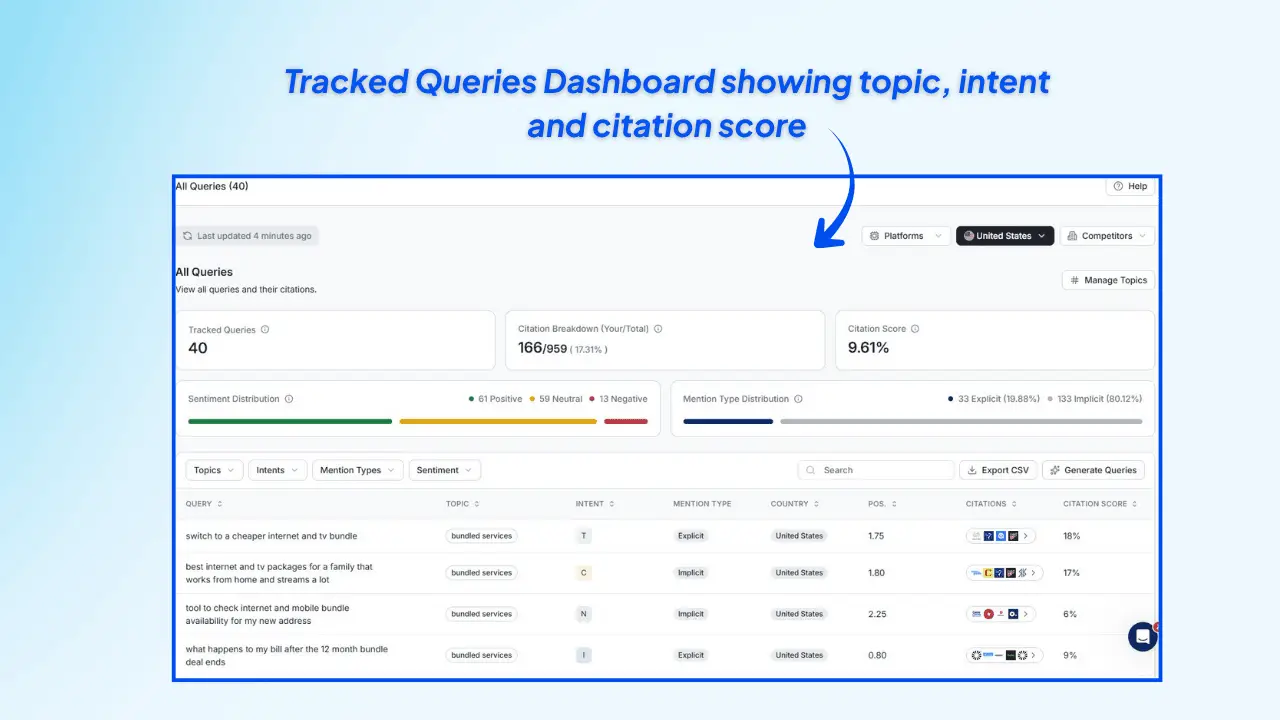
- Unified AI Visibility Tracking: Consolidates citations, mentions, sentiment, and visibility across Google AI Overviews, ChatGPT, Gemini, Perplexity, and AI Mode in one dashboard.
- Citation Score For Reporting: Replaces vague explanations with a defensible metric showing how often the brand is referenced by AI systems.
- Entity And Brand Mention Monitoring: Captures references even when there’s no explicit link, so agencies can quantify “invisible wins.”
- Competitor Benchmarking: Shows relative visibility, not just presence, so clients can see who AI is surfacing and why.
- Opportunity Identification: Highlights implicit and explicit citation gaps to convert missed visibility into actionable work.
Instead of defending outdated KPIs, agencies can anchor reporting in observable AI behavior and connect it to clear next steps.
Natural Fit For Agency Workflows
- Daily refreshes for proactive reporting
- Multi-LLM visibility tracking in one place
- Clear narratives account teams can reuse in QBRs and renewals
Integrated well, Wellows helps agencies move from reactive explanations to controlled, data-backed storytelling.
Industry Standard Tools For AI Search Visibility Reporting (For Agencies)
Agency-grade AI search reporting usually relies on a hybrid tool stack, not a single platform.
Traditional SEO tools still provide baseline context (queries, impressions, CTR), but they don’t show how brands appear inside AI-generated answers. Purpose-built AI visibility tools are required to track citations, mentions, entity inclusion, and competitive presence across systems like Google AI Overviews, ChatGPT, Gemini, and Perplexity.
The most effective agency setups combine both layers to explain what changed, where visibility shifted, and why influence may increase even when clicks decline.
The Reporting Trust Gap: When Metrics Change Faster Than Client Understanding
AI search creates one of the hardest problems agencies now face: invisible wins.
Clients benefit from AI exposure, brand inclusion, and early-stage influence, but they can’t easily see it. There’s no ranking chart to point to and no clean traffic graph to reassure them. As a result, reporting confidence erodes even when the work is effective.
This gap leads to predictable friction: progress is questioned, account teams become defensive, and reporting calls shift from strategy to justification.
Why Traditional Reporting Breaks In AI Search
Legacy SEO reporting relies on assumptions that no longer hold in generative search environments. AI systems often resolve intent before a click ever happens.
| Old Assumption | AI Search Reality |
|---|---|
| Visibility equals clicks | Visibility often happens without a visit |
| Rankings equal success | Selection and citation matter more than position |
| Traffic declines signal failure | AI can satisfy demand earlier in the journey |
In practice, clients may see fewer visits, ask fewer follow-up questions, and convert faster, because AI answered them before they clicked.
The Language Shift Agencies Must Make
To close the trust gap, agencies must stop presenting certainty where none exists and start explaining probability and influence.
| Legacy Language | AI-Ready Language |
|---|---|
| “We control rankings” | “We increase the likelihood of AI selection” |
| “This keyword dropped” | “Visibility shifted based on how AI interpreted the query” |
This language shift doesn’t weaken reporting, it strengthens credibility by aligning expectations with how AI search actually works.
How Can Agencies Prepare Client Reports For Google AI Overviews?
Google AI Overviews change what agencies can realistically report. They sit above organic results, synthesize multiple sources, and often satisfy intent without a click, making traditional ranking-based reporting unreliable.
That gap is measurable. Seer Interactive found that for queries with AI Overviews, organic CTR dropped from 1.41% to 0.64% year-over-year (Seer Interactive, 2025).
What Agencies Should Actually Report
Instead of chasing positions, agencies should anchor reports around patterns AI systems consistently expose.
AI Overview Presence: Which keyword clusters trigger AI Overviews and how frequently the client is included (tracked via GSC patterns and AI SERP sampling).
Source Usage: Which pages AI Overviews pull from and what content formats are reused (definitions, steps, FAQs, comparisons).
Engagement Shift: CTR differences on queries with vs. without AI Overviews to quantify click suppression.
Competitive Inclusion: Which competitors appear in AI Overviews for the same prompt types and where the client has inclusion gaps
Reporting Language That Prevents Confusion
Avoid positional claims that AI systems don’t support.
Did you know?
Instead of: “You ranked in AI Overviews”
Say: “Your content is being used as a reference source when Google generates answers for high-intent queries.”
iPullRank published a case study from the telecom industry showing how AI Overviews visibility can be measured and improved when reporting focuses on AI inclusion and exposure, not traditional rankings alone.
In the case study, the telecom brand increased AI Overviews visibility by 253% and earned 1.4M impressions after iPullRank’s content engineering approach (iPullRank).
The takeaway for agencies: when reporting tracks AI visibility outcomes (coverage, inclusion, and exposure), clients can see progress even when clicks and rankings don’t tell the full story.
What Is A 90-Day Rollout Plan For AI Search Optimization Reporting?
AI reporting doesn’t improve by adding one more dashboard. Agencies need a structured rollout that resets client expectations and replaces misleading metrics with AI-aligned KPIs.
- Days 1–30: Reset Expectations:
• Identify which query clusters trigger AI-driven results and where AI Overviews appear
• Establish a baseline of current AI visibility, citations, and inclusion patterns
• Communicate to clients what will change in reporting, why legacy KPIs fall short, and how success will be defined going forward
- Days 31–60: Replace Metrics:
• Introduce AI-aligned KPIs such as visibility, citations, entity coverage, and competitive inclusion
• Remove or de-emphasize legacy metrics that create confusion or false negatives
• Train account managers on new reporting language to ensure consistency across QBRs, updates, and renewals
- Days 61–90: Normalize The New Model:
• Update QBR formats, dashboards, and executive summaries to reflect AI-first reporting
• Align success definitions with influence, authority, and trust, not clicks alone
• Reframe renewals around visibility quality, AI inclusion, and downstream conversion impact
Read More Articles
- Top Content Marketing Statistics to Know This Year
- What Are SERPs? A Simple Guide for Marketers
- Meta Tags Explained: Titles, Descriptions, and SEO Basics
- Real-Time Alerts for Agency Clients
- How Agencies Find AI Visibility Gaps for Clients (2026)
- Agency Client Onboarding Using AI Search Visibility
- Multi-Client AI Visibility Reporting Checklist for Agencies 2026
- GEO Audit Checklist for Agencies 2026
FAQs
Focus on repeatable patterns such as prompt categories, query clusters, and entity inclusion. Avoid forcing AI visibility into traditional ranking charts, and instead track how often and where brands are selected within AI-generated responses.
Most agencies rely on a hybrid stack: traditional SEO platforms for baseline performance, combined with AI visibility tools and controlled manual sampling to track citations, mentions, and inclusion across AI platforms.
Agency Analytics can support hybrid reporting, but AI search visibility still requires additional interpretation layers and AI-specific KPIs that go beyond rankings and traffic alone.
Improve content chunkability by using clear headings, concise answers, FAQs, schema markup, and strong entity clarity so AI systems can reliably extract, interpret, and cite content.
Yes. Cross-functional collaboration between SEO, content, analytics, and client success teams reduces overpromising and ensures consistent AI-era reporting language across the agency.
No. AI search changes how visibility is measured, but traditional SEO metrics still provide context. The key is blending both into a single narrative that reflects how modern discovery actually works.
Focus on clarity and narrative over raw volume. Executive reporting should explain where AI visibility is increasing, how the brand is being represented in generated answers, and what that exposure means for demand and decision-making. Avoid technical detail unless it directly supports business impact.
The most useful KPIs show selection, trust, and influence. This includes AI inclusion rate, citation consistency, competitive presence, and downstream signals like branded demand or assisted conversions. Executives care less about rankings and more about whether the brand is being chosen and trusted.
Agencies should report AI search performance by connecting visibility to outcomes. That means explaining where AI exposure is happening, how it changes user behavior before a click, and why performance may improve even when traditional metrics fluctuate. Clear language prevents confusion and protects trust.
Conclusion: Agencies That Change Their Language Will Win
Agency Reporting for AI Search isn’t about chasing every new interface or metric, it’s about aligning reporting with how search actually behaves today.
AI search didn’t eliminate agency value. It eliminated outdated reporting models built on assumptions that no longer hold. Agencies that succeed will be those that replace certainty with clarity, rankings with relevance, and static metrics with honest, interpretable narratives.
New metrics need new language. Agencies that master this shift will move from execution partners to strategic interpreters, guiding clients confidently through the AI search era.