Client onboarding is where trust gets built, or quietly lost.
Agencies can walk in with strong case studies and proven execution and still struggle in the first 30 days. The issue usually isn’t the strategy. It’s the uncertainty clients feel while they wait for clear proof that things are moving in the right direction.
And search itself has changed. Decisions increasingly form before the click, inside AI summaries, zero-click results, and comparison-style answers. Traditional audits still matter, but they take time, and time is exactly what onboarding doesn’t have.
To reduce this uncertainty, agencies increasingly analyze how brands appear across AI-driven search environments during onboarding. This is where AI Search Visibility for Agencies becomes valuable, helping teams evaluate early visibility signals before traditional rankings begin to shift.
Platforms like Wellows help agencies show where a brand appears (or doesn’t) across Google AI Overviews, ChatGPT, and Perplexity, so the first conversations start with evidence, not assumptions.
This guide is for agency leaders who want onboarding confidence before rankings move. If you’re evaluating who should run this onboarding process, top AI SEO agencies explains what to look for in a partner.
- Agencies risk churn when onboarding lacks early proof, industry data cites 27% annual client churn for marketing agencies (Focus Digital, 2026).
- AI decisions increasingly happen “before the click,” and AI Overviews appeared in 13.14% of U.S. desktop searches in March 2025 (Search Engine Land, 2025).
- Traditional onboarding is slow: a Smartsheet survey found 70%+ of onboarding delivered late, 75%+ over budget, and teams spend 25% of weekly time on manual updates (Smartsheet).
- AI search visibility audits in the first 30 days create a fast baseline of brand vs competitor presence inside AI answers, so priorities align earlier.
- Realistic onboarding proof looks like “visible in 2/15 AI answers vs competitors in 9–11/15,” which clarifies what to fix first and prevents resets.
- Tools like Wellows make this process repeatable by tracking queries, mentions, citations, and competitor visibility across multiple AI platforms.
The Real Onboarding Problem: Slow Insight, Weak Confidence
Traditional client onboarding depends on signals that arrive too late to build confidence.
SEO audits take weeks to complete. Competitive analysis is often spread across multiple tools. Early reports focus on rankings, traffic, or conversions that simply haven’t had time to move. As a result, onboarding conversations fall into a familiar loop:
- “We’re still analyzing the data.”
- “We’ll have clearer answers next month.”
- “It’s too early to draw conclusions.”
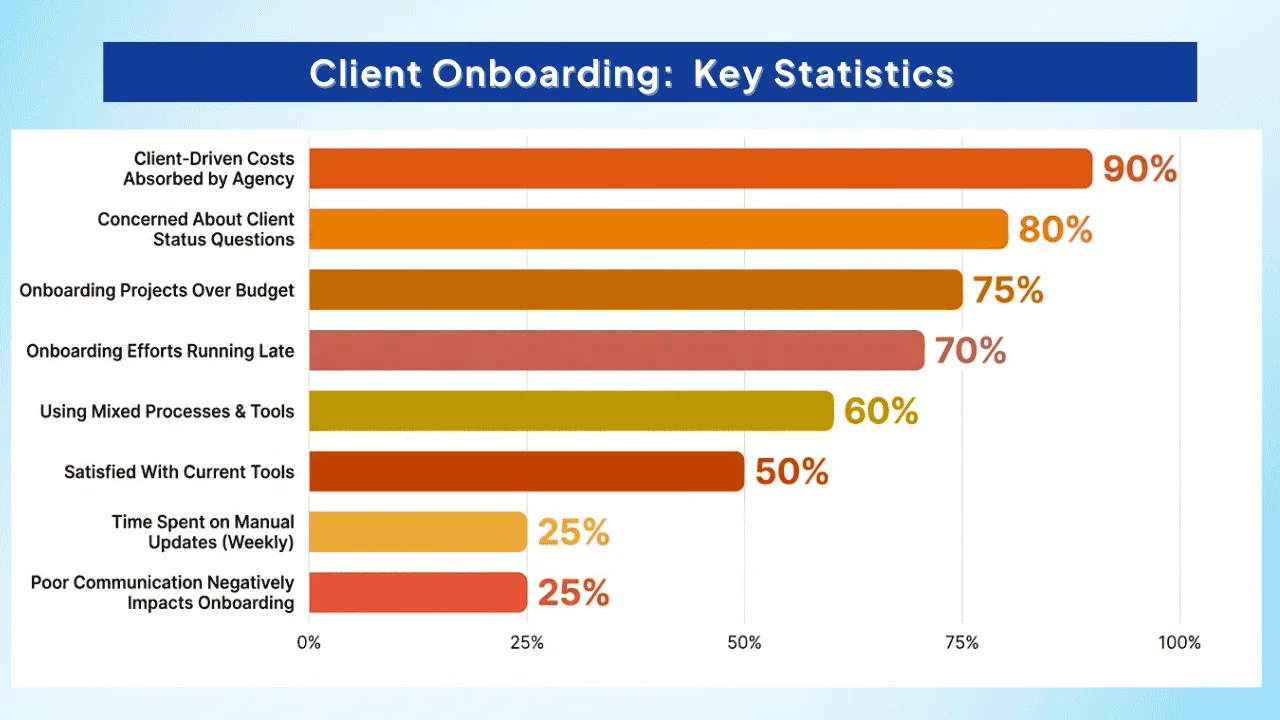
Poor onboarding doesn’t just slow momentum, it creates hidden costs. In a national survey commissioned by Smartsheet (n=247), 70%+ of onboarding efforts were delivered late and 75%+ went over budget. Teams also reported spending 25% of their weekly time on manual status/timeline updates, time that compounds delays and client uncertainty (Smartsheet).
Clients rarely leave because of one missed KPI; they leave because confidence erodes while waiting for clarity, a challenge many Digital Marketing Agencies face during onboarding. What clients want most in the first few weeks isn’t immediate results, it’s reassurance.
They want to understand where their brand stands, what’s working, what isn’t, and whether the agency truly sees the landscape they’re operating in, so defining GEO KPIs early helps set expectations around what “progress” looks like before rankings move.
This is where Search Engine Visibility changes the onboarding dynamic.
Instead of waiting for traffic or rankings to move, agencies can show influence early, how a brand appears (or doesn’t) inside AI summaries, comparison answers, and zero-click results. That visibility narrative builds confidence before execution even begins.
When insight arrives faster, confidence follows, and onboarding stops feeling like a holding period and starts matching a clear GEO strategy from day one.
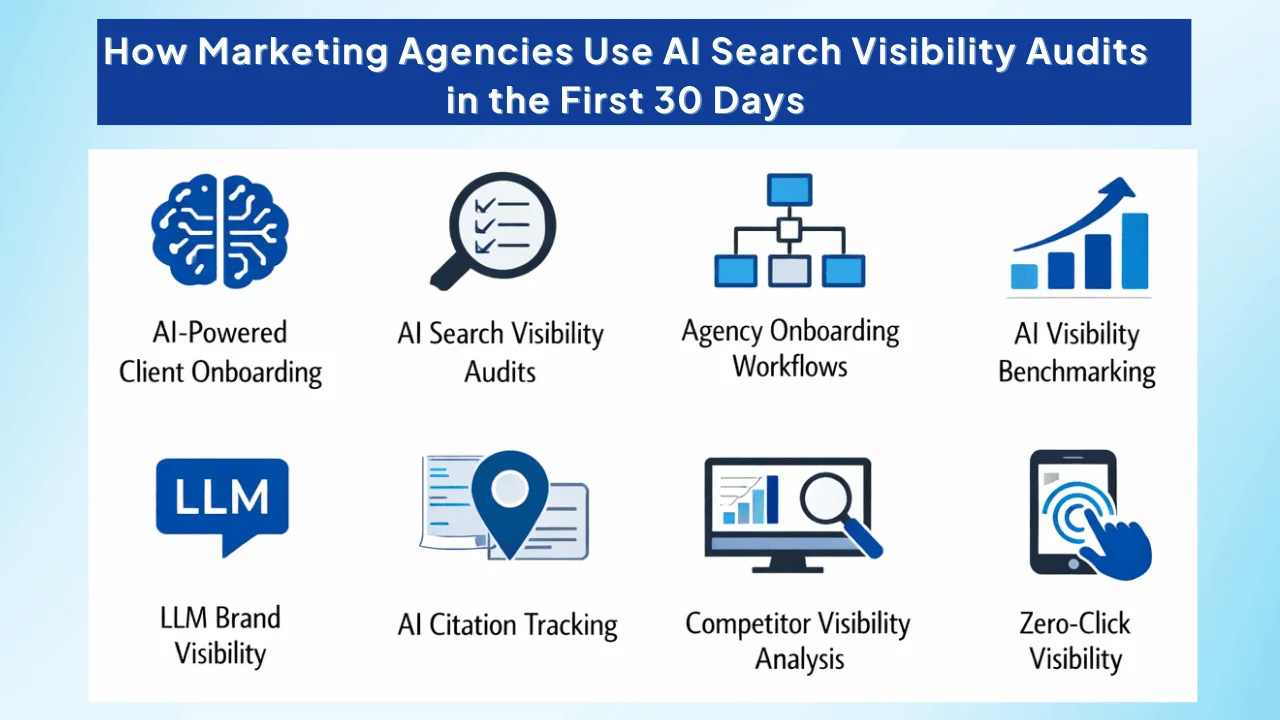
How Marketing Agencies Use AI Search Visibility Audits in the First 30 Days
In the first month of onboarding, agencies use AI search visibility audits to replace guesswork with a clear baseline: does the brand show up in AI answers, and if not, who does? This baseline works best when paired with a solid technical foundation, which is why many teams reference a technical SEO checklist for agencies to ensure crawlability, indexation, and structure aren’t limiting visibility before AI evaluation even begins.
This early clarity is what speeds onboarding, because you can explain the reality in week one instead of asking the client to wait for “SEO results,” which is exactly why agency client onboarding using AI search visibility works so well in the first 30 days.
- Week 1: establish an AI visibility baseline:
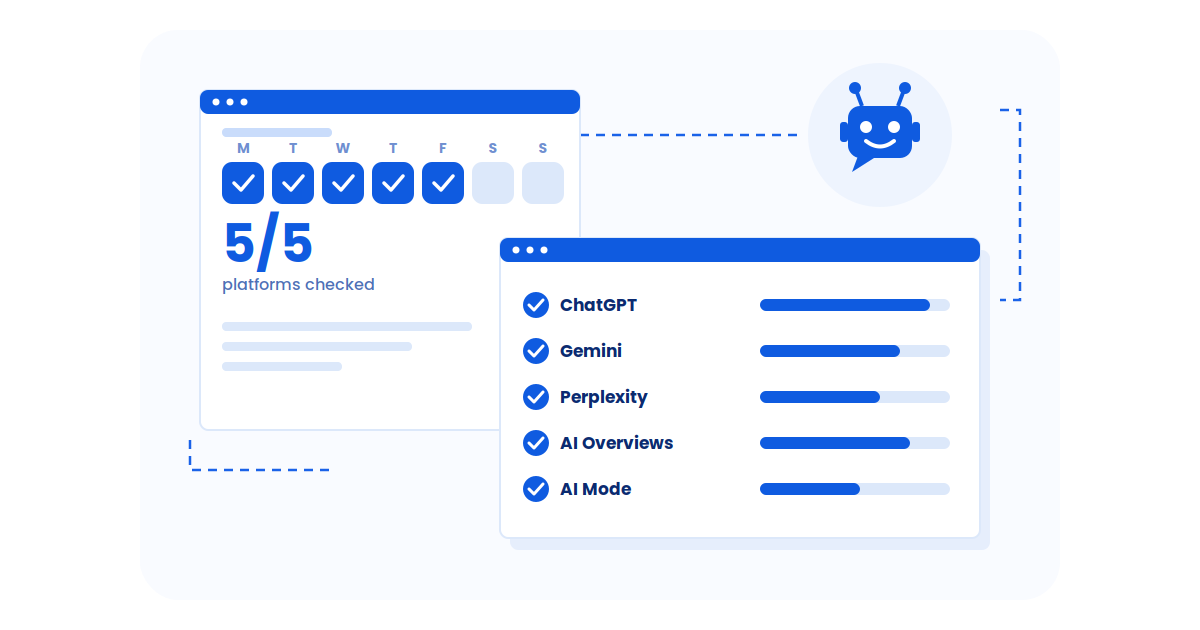
Test the client on Google AI Overviews, ChatGPT, Gemini, Perplexity, and Claude using a fixed query set. For each query, record two things: whether the brand is mentioned and whether it’s cited (linked/referenced).
This shows, fast, where the client is visible, where competitors show up, and where the client is missing.
Semrush + Datos analysis of 10M+ keywords found AI Overviews appearing in 13.14% of U.S. desktop searches (March) and rising quickly vs earlier measurements, with commercial and navigational queries increasing (Search Engine Land, 2025).
- Weeks 1–2: benchmark competitors and log the gaps:
Compare the client against 3–5 competitors that repeatedly appear in AI answers, especially on pricing, “best for,” and comparison queries. The gap is usually obvious: who gets cited and who gets skipped.
With Wellows, this step is easier to repeat because it tracks Citation Score, mentions, and competitor visibility across multiple AI platforms in one view.
- Weeks 2–4: build a kickoff roadmap + KPIs:
Turn the gaps into a short action plan: what to create/fix first, what queries to own, and how you’ll measure progress (coverage, mentions/citations, and competitor displacement.
Once the roadmap is live, the recurring report needs a defensible scoring layer — the agency monitoring methodology for AI search mentions explains why scoring on citation share (not just mention count) is what makes the monthly client review hold up.
What AI visibility audits replace during onboarding
| Traditional onboarding insight | AI visibility onboarding insight |
|---|---|
| Rankings snapshots | Presence inside AI answers |
| Traffic benchmarks | Citation & mention gaps |
| Assumptions about competitors | Proof of who AI trusts (and why) |
| “Wait and see” strategy | Immediate priority clarity for the roadmap |
Instead of debating what might work, agencies can show what’s already shaping decisions, and that’s what makes onboarding feel fast, confident, and grounded.
How Agencies Explain AI Search Visibility to Non-Technical Clients
Most onboarding friction comes from explanation, not execution.
Clients understand rankings. What’s new is that AI search often gives a direct answer, and only pulls from a small set of “trusted” sources. So the goal isn’t just “rank #1,” it’s get chosen to be mentioned or cited inside AI-generated responses.
Explain it with one simple analogy
Did you know?
- Traditional search: “You get a list of options.”
- AI search: “You get a summary + recommendations.”
- Our job: “Make sure your brand shows up in that summary.”
(Clients instantly get why this matters: if you’re not included, you’re not influencing the decision.)
Use a clear ‘shortlist’ framing
Did you know?
- AI answers act like a shortlist of recommended businesses
- Only a few brands are mentioned (and sometimes cited)
- If you’re missing, competitors get the attention by default
Show it, don’t over-metric it
Instead of drowning clients in dashboards, agencies build trust fast by showing:
Did you know?
- Screenshots of AI Overviews / AI Mode / assistants where the client is (or isn’t) mentioned
- Trends over time (appearing in more answers), not one-off numbers
- Who AI is recommending in their area and category
For agencies that want a repeatable way to document this beyond screenshots, a simple starting point is to audit brand visibility on LLMs using a fixed query set and consistent tracking.
What “success” looks like (in plain language)
Did you know?
- We show up more often in AI answers for the services you sell
- We show up in more locations (coverage improves)
- We’re mentioned alongside, or above, key competitors
- We can point to the sources AI is using and where you’re missing
When clients ask why they’re missing from AI answers, it helps to explain the difference between traditional search signals and AI sourcing, then use LLM citation tracking to identify where they’re being overlooked.
What drives AI visibility (the client-friendly version)
Did you know?
- Clarity: content that’s easy for AI to understand (clear services, locations, proof)
- Consistency: your business info matches across the web (trust signal)
- Reputation footprint: reviews, mentions, directories, third-party sites
- Structured data: Schema to label what your content is (business, service, FAQ, etc.)
A practical way to make this easier for both AI systems and clients is to improve how your content reads and scans, using a simple readability score in AI content approach.
Optional: a simple line that prevents confusion later
“SEO helps you rank. AI visibility helps you get summarized and recommended.”
Which AI Tools Agencies Use to Benchmark Visibility During Onboarding
During onboarding, agencies choose between manual testing and platform-based tracking.
Manual checks can work briefly, but they don’t scale. Results change, prompts vary, and documentation becomes inconsistent, especially during agency client onboarding using AI search visibility, where repeatable baselines and consistent reporting matter.
AI search visibility platforms solve this by providing:
- Consistent query tracking
- Brand vs competitor comparisons
- Visibility trends over time
- Centralized onboarding baselines
Benchmarking across multiple AI engines matters because visibility is fragmented. Presence in one tool does not guarantee presence elsewhere. Competitive context, not isolated appearance, is what shapes trust.
Where Wellows Fits
Wellows is designed specifically to help agencies monitor and benchmark brand visibility across AI and search environments. During onboarding, agencies use Wellows to:
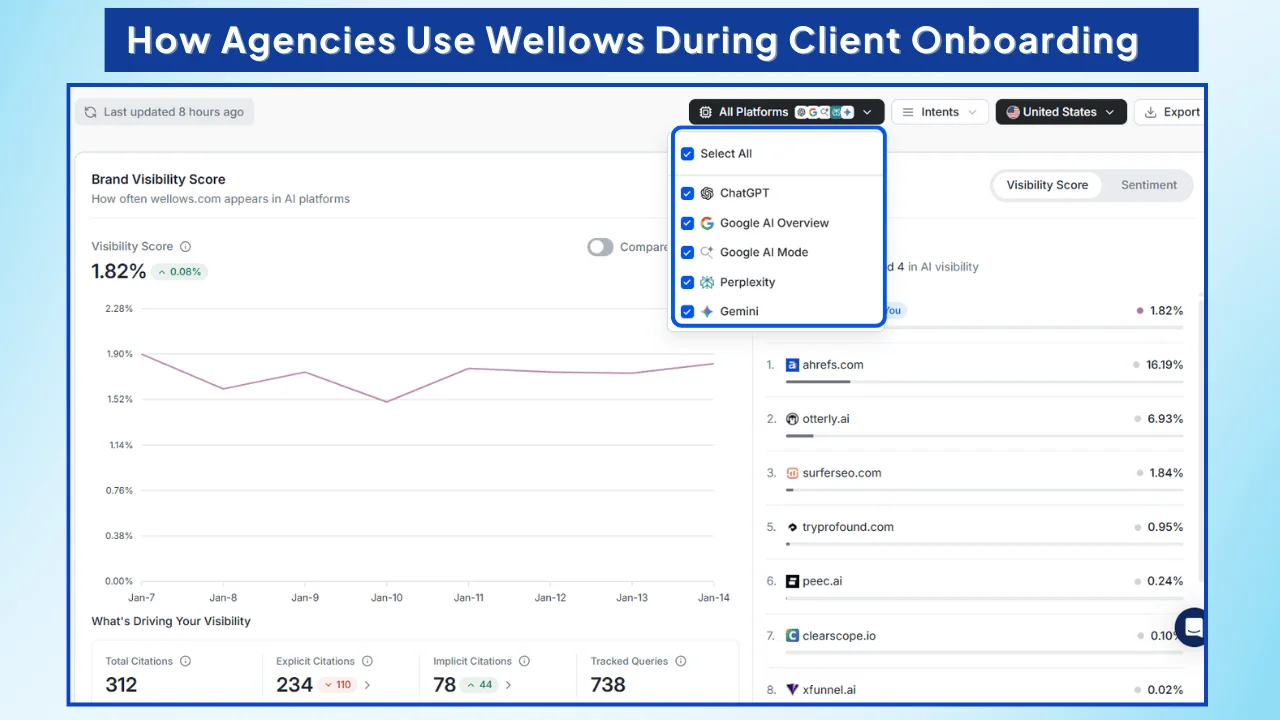
- Track a defined set of high-intent queries
- See brand vs competitor mentions and citations
- Monitor visibility trends over time
- Establish a repeatable onboarding baseline
Instead of screenshots and spreadsheets, agencies get a centralized view of AI visibility they can reuse for every client.
Profile: Indiana-based full-service marketing agency with 15+ team members serving 33 states
Challenge: Rapid expansion created operational strain; manual processes couldn’t scale without losing personal touch
AI Tools Used:
- Business App Pro for real-time reporting
- Automated Snapshot Reports
- AI-powered Web Chat and Reputation Management
- Vendasta platform integration
Results:
- ✅ 99% client retention rate
- ✅ $240K in marketplace revenue (upsells & efficient delivery)
- ✅ 105 active clients nationwide
- ✅ 13 high-value leads generated in weeks using AI Web Chat
Onboarding Impact: Automated reporting and client-facing dashboards enabled scale without sacrificing service quality; AI tools provided structure that empowered rapid national growth (Vendasta 2025).
How Agencies Present AI Visibility Findings in a Kickoff Call
Kickoff calls work best when data becomes a narrative.
High-performing agencies avoid dumping charts and instead use AI visibility findings to explain what buyers see, who AI trusts, and where the client is missing, especially since agencies can’t realistically guarantee AI results and need to set expectations with evidence.
Make it a narrative: Start with what buyers ask and how AI answers today, then relate that reality to the client’s brand.
Show competitor citations: Highlight where competitors are being mentioned or cited and which sources AI is trusting.
Expose high-intent gaps: Point out the key questions where the client is excluded and who AI recommends instead.
Explain buyer impact: Tie each visibility gap to real decision moments like pricing, comparisons, and “best option” searches.
Frame gaps as opportunities: Position missing visibility as clear opportunities to win influence, not performance failures.
End with clarity: Clients should leave the call knowing what’s missing, why it matters, and what gets fixed first, supported by a consistent agency reporting for AI search approach that tracks patterns over time.
How Agencies Build a Repeatable AI-Powered Onboarding Workflow
AI doesn’t change the onboarding structure, it removes manual friction. Agencies automate setup, auditing, follow-ups, and reporting so teams can focus on strategy and clear client communication.
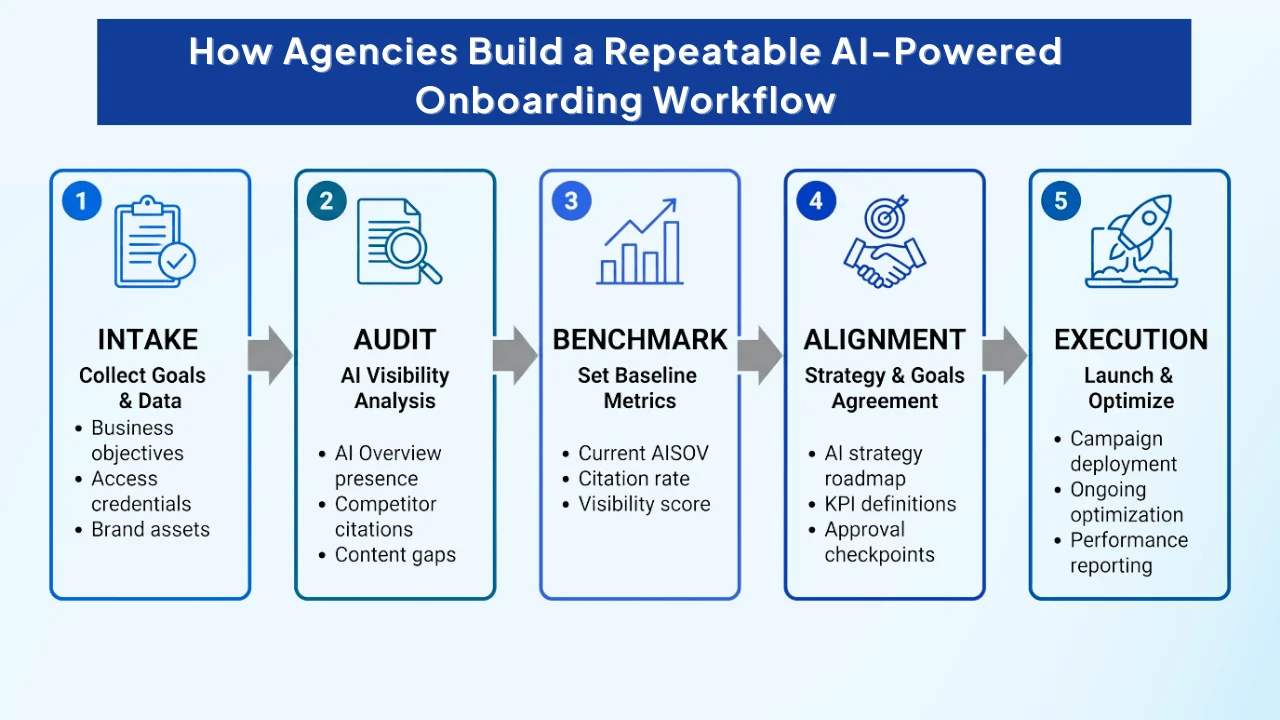
Standardize intake and task creation: Turn goals and inputs into a consistent checklist, auto-generate forms/access requests, and organize steps into clear stages, supported by automation for agency workflows.
Validate the workflow before launch: Simulate onboarding to catch missing steps or confusing prompts, fix once, then reuse the improved flow.
Automate reminders and status nudges: Send automatic follow-ups for pending access, files, and approvals so onboarding stays on track.
Use a single client portal for execution: Keep tasks, uploads, communication, and progress in one place to reduce back-and-forth.
Connect onboarding to your tool stack: Sync CRM, project tools, and messaging to avoid duplicate entry and auto-update milestones.
Improve with onboarding data: Spot where clients stall, learn why, and refine templates so each onboarding gets smoother, using the same approach agencies follow to deliver AI search visibility consistently across clients.
Why Honesty Builds Trust Faster Than Overpromising
Overpromising creates friction later. With AI answers changing by prompt and context, clients value clear gaps and clear limits more than confident guessing, especially when user intent can shift the type of AI answer a buyer sees.
AI visibility data supports transparency: “You’re not visible here yet, and here’s why” builds trust faster than optimism without evidence.
A 3-location plumbing business improved rankings for “emergency plumber,” but calls stayed flat. The agency tested 15 high-intent prompts; the brand appeared in 2/15 AI answers, while two competitors appeared in 9–11/15.
The takeaway: rankings improved, but AI was recommending other sources.
The agency showed the causes: unclear service separation (install vs repair), inconsistent listing details, and weaker third-party mentions, then prioritized fixes. No unrealistic promises, no reset later (Hunter, 2025).
How Wellows Supports Honest Onboarding
Wellows anchors onboarding in evidence by showing where you appear, where you don’t, and which competitors AI selects instead, so the roadmap starts with the highest-impact gaps and reinforces the brand signals that AI systems consistently trust.
What Faster, AI-Driven Onboarding Unlocks for Agencies
When agency client onboarding using AI search visibility is driven by clarity instead of delay:
Kickoff friction drops: Access requests, missing info, and “what happens next?” questions are resolved early, so projects start clean.
Priority alignment happens faster: AI-driven insights replace assumptions, helping teams agree quickly on what matters most.
Confidence increases in the first 30 days: Clients see real baselines and early signals of progress, not vague status updates, especially when onboarding content stays clear and client-friendly through a humanize AI content approach.
Retention improves: Fewer surprises and clearer expectations reduce second-guessing and early churn.
Strategy starts earlier: Less time spent collecting inputs means more time executing high-impact work from week one.
Read More Articles
- Content Marketing Agencies: A Complete Guide 2026
- Top Content Marketing Statistics to Know This Year
- AI Mistakes Marketers Should Avoid
- Readability Score in AI Content: Why It Matters
- What Is Generative Engine Optimization (GEO)?
- GEO vs SEO: What Are the Key Differences?
- How AI Selects Sites to Cite in Search
- AI Visibility Deliverables Checklist for Agencies
FAQs
Conclusion: Faster Onboarding Comes From Clarity, Not More Reports
Agency client onboarding using AI search visibility doesn’t replace expertise, it speeds up trust. When agencies can show reality early (where the brand appears, where it doesn’t, and who AI recommends instead), onboarding becomes decisive instead of delayed.
Grounding the first 30 days in evidence reduces kickoff friction, aligns priorities faster, and moves teams to strategy sooner, without cutting corners. Tools like Wellows make this repeatable, scalable, and honest across clients.
In an AI-shaped search world, agency client onboarding using AI search visibility becomes a strategic advantage, because clarity creates momentum.