AI citations are no longer simple references. How AI selects sites to cite is about grounding, which means AI systems use sources to confirm that answers are based on real, retrievable information, not to promote or endorse websites. Citations exist to support accuracy and trust in AI-generated answers rather than reward rankings.
That principle still leaves one key question: whether domain authority matters for AI citations as AI engines reuse sources at scale. Without that insight, teams often overoptimize content while overlooking authority’s impact on citation visibility.
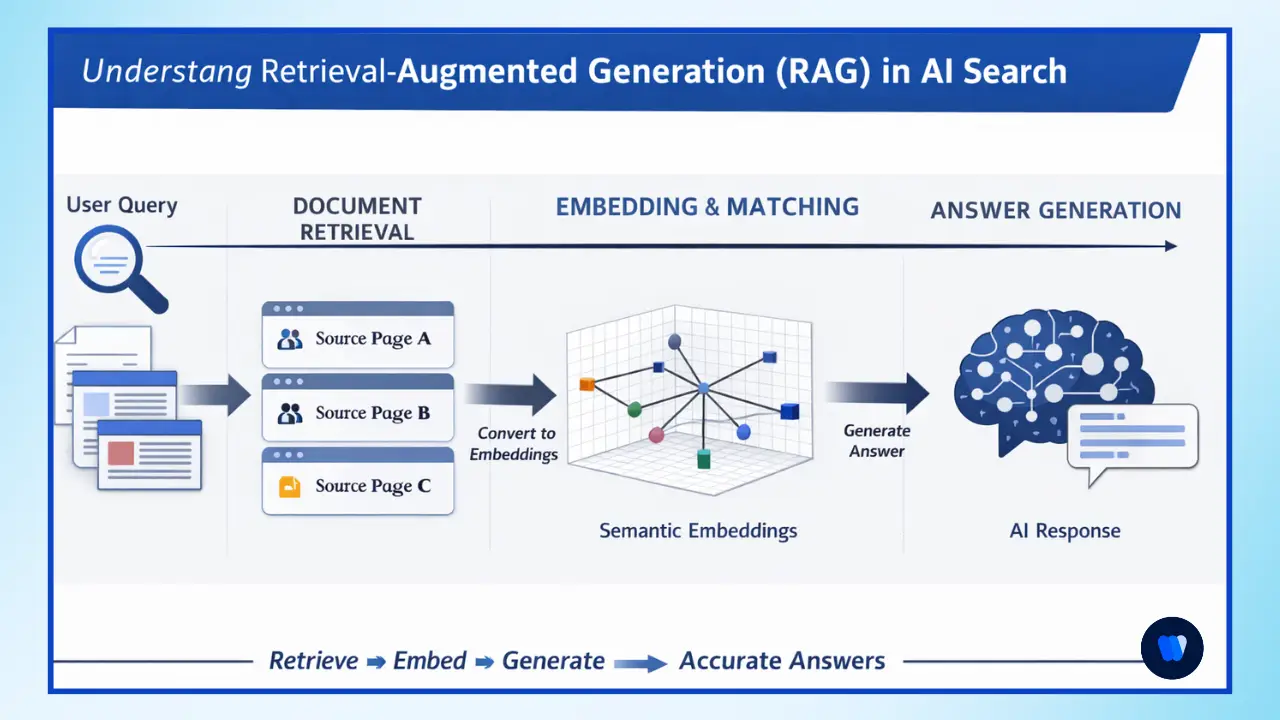
Modern generative systems rely on Retrieval-Augmented Generation (RAG). With RAG, AI models first retrieve relevant documents and then generate answers using those sources as evidence, which reduces hallucinations and improves factual reliability.
In 2025, AI-generated answers are changing how search visibility works. Google now shows AI Overviews on a large share of search results, and these answers often cite several external sources instead of ranking pages in a list.
Because of this shift, Generative Engine Optimization (GEO) and LLM citation tracking matter more than traditional ranking signals for measuring and improving visibility in AI-driven search.
What Does It Mean for AI to Select Sites to Cite?
When AI systems select sites to cite, they are not promoting brands or websites. A citation means the AI has chosen a specific page as evidence to support an answer. The purpose is validation and accuracy, not visibility. This selection happens at the page level, not at the domain level, which is a core reason understanding how to rank in chatgpt requires page-specific optimization rather than domain authority alone.
This differs from a mention or a recommendation. A mention appears without a source. A recommendation suggests preference. A citation points to a specific source used to support a fact. Knowing what AI search engines actually cite explains why some sites appear frequently in answers but are not always referenced as sources.
AI citation methods focus on clarity and usefulness, which is why how to rank in Perplexity often comes down to whether a page is easy to extract, verify, and reuse safely. Pages that explain one idea clearly, answer a specific question, and can be reused safely are more likely to be cited. As a result, two pages from the same website can perform very differently based on how well each page supports factual grounding.
How AI Chooses Sources to Reference Before Generating Answers
Before generating an answer, AI systems create a retrieval pool—a shortlist of pages that appear relevant based on topic match, clarity, and factual usefulness. At this stage, AI is only collecting possible references, which is why Agency Client Onboarding Using AI Search Visibility focuses on making your pages consistently eligible to be pulled into that pool.
The role of AI in information sourcing is to narrow down large volumes of content into sources that can safely support an answer. Being included in this pool does not mean a page will be cited.
Inclusion is not the same as citation. Many pages are scanned for context or comparison, but only a few are later selected as grounding references. This explains why visibility can change even when content remains unchanged and why earning mentions in AI search often happens before formal citation.
Retrieval decisions rely on repeated content patterns rather than authority alone. Pages that explain concepts consistently across contexts are easier for AI systems to reuse.
Pages enter the retrieval pool when repeated structural signals match known AI platform citation patterns, and when consistent phrasing reinforces semantic alignment through pattern recognition in AI-generated answers, which determines whether a source is usable during pre-answer retrieval.
Understanding Retrieval-Augmented Generation (RAG) in AI Search
Did you know?
Did you know?
Did you know?
Did you know?
Did you know?
Core Criteria AI Uses to Select Sites to Cite
This aligns with core generative engine visibility factors that favor grounded and reusable information.
Implementing a Content Update Cadence for AI Citation Eligibility
- Why Freshness Acts as a Hard Filter: Freshness functions as a strict filter in AI citation systems. When information becomes outdated, it is less likely to be retrieved during pre-answer sourcing, even if it was accurate in the past. AI models favor content that reflects current knowledge because outdated pages increase the risk of producing incorrect answers.
- How Content Decay Reduces Retrieval Eligibility: Content decay happens gradually. Pages that are not reviewed or refreshed can slip out of retrieval pools as newer sources better match evolving queries and language patterns. This retrieval drop-off often occurs before traffic declines, shaping how technology determines which sites remain eligible for citation.
- Why AI Systems Prefer Recently Updated Sources: AI-driven search increasingly prioritizes up-to-date sources as part of grounding logic rather than publishing frequency. Recent research shows that freshness acts as a credibility signal, reinforcing why updated content is more likely to stay retrievable and citable over time (GEO stats and trends, 2025).
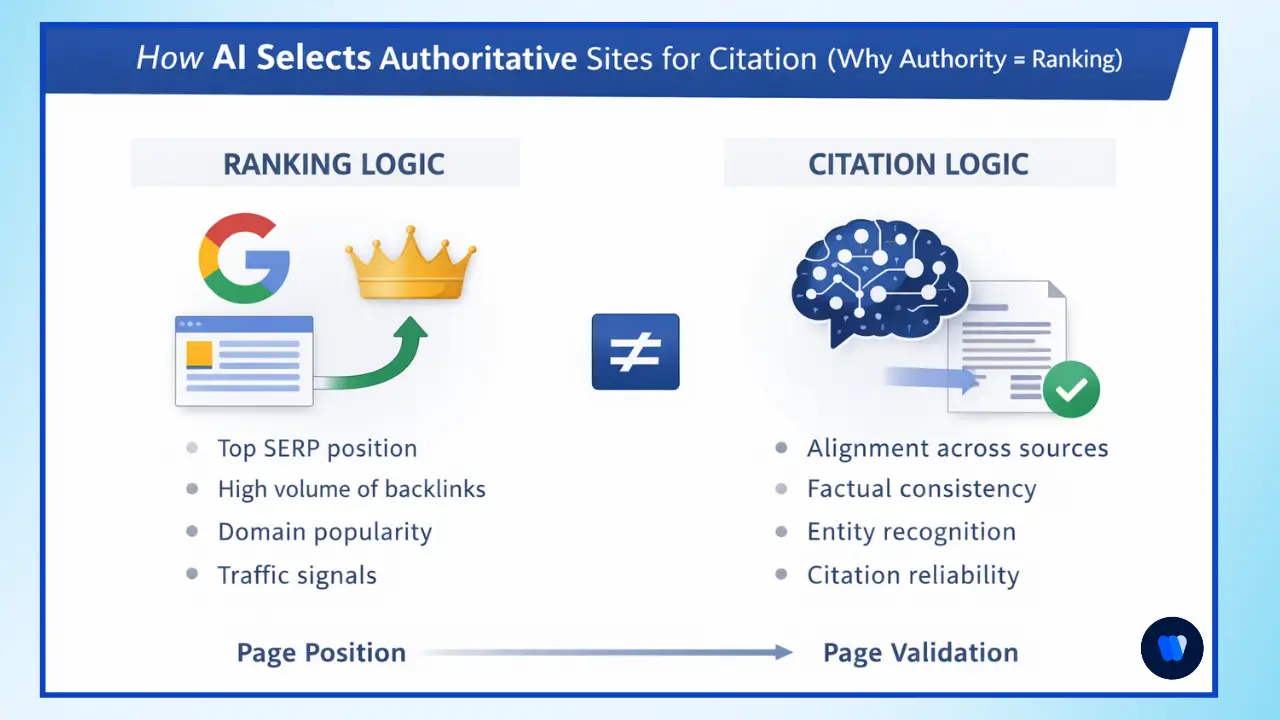
How AI Selects Authoritative Sites for Citation (Why Authority ≠ Ranking)
AI systems define authority through consistency and verification, not search position. A site becomes authoritative when its information aligns with multiple reliable sources and can be reused without risk.
This is why ranking high in Google does not guarantee citation. Authority in AI search depends on corroboration and clarity, not links or popularity—the same principle generative engine optimization agencies apply when optimizing content for citation eligibility rather than rankings.
Did you know?
| Traditional SEO Assumption | How AI Actually Evaluates Authority |
|---|---|
| Higher Google rankings mean higher authority | AI treats authority as corroboration, not position. A page is authoritative when its facts align with multiple independent and reliable sources. |
| More backlinks increase citation chances | AI does not count links. It checks whether claims can be verified and safely reused across different contexts. |
| Popular domains are cited more often | AI may skip popular sites if content is opinion-heavy, unclear, or hard to validate, even when rankings are strong. |
| Ranking well guarantees AI visibility | Ranking strength does not translate directly into citation eligibility, which becomes clear when examining the Google rankings and LLM citations gap. |
| SEO success transfers directly to ChatGPT | High rankings alone do not ensure reuse in generative answers, which is why Google ranking does not guarantee visibility in ChatGPT. |
Knowledge Graph Presence and Ongoing Citation Likelihood
In the AI context, “sites to cite” refers to pages that AI systems can reliably recognize, verify, and reuse over time. When a brand or topic is clearly defined as an entity within systems like the Knowledge Graph, Wikipedia, or Wikidata, AI models can resolve meaning faster and reduce ambiguity during retrieval. This is why entity-based content tends to appear more consistently in citations.
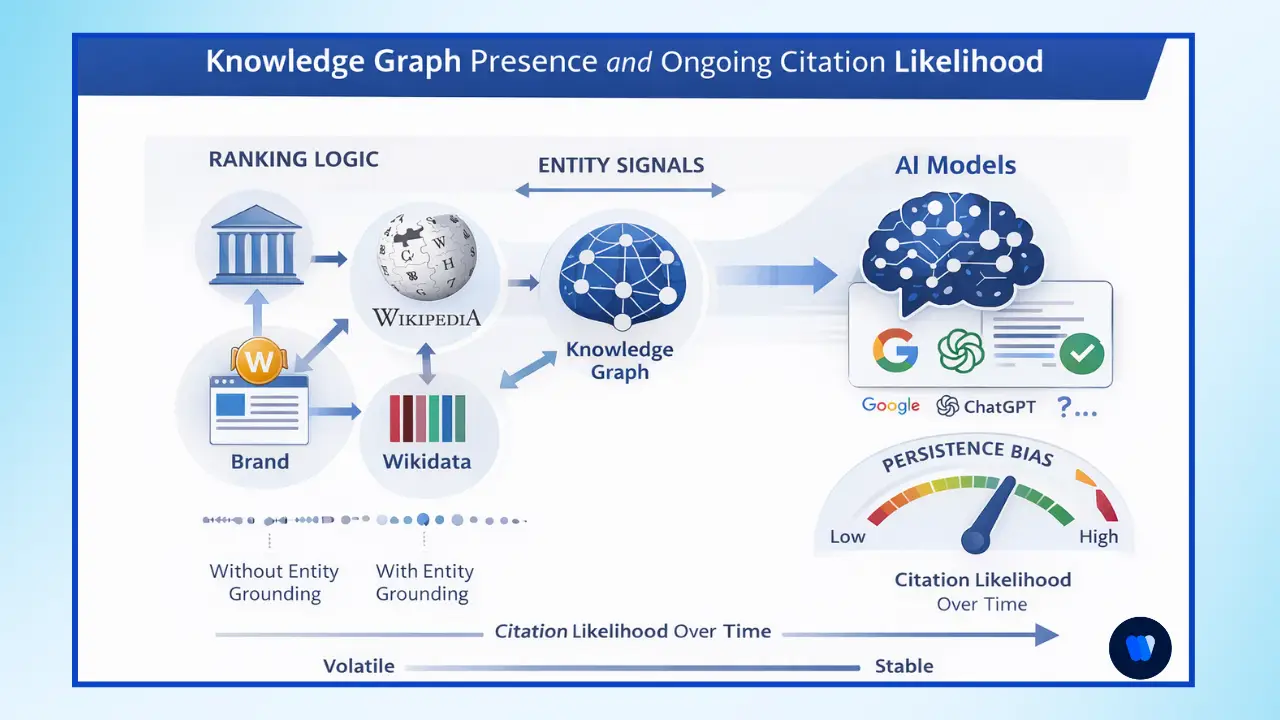
Knowledge Graph-backed entities benefit from persistence bias. AI systems prefer sources that remain stable across updates, which leads to long-term citation patterns rather than short-lived visibility. Pages without entity grounding may still be cited, but their inclusion is more volatile and sensitive to content decay or model updates.
Clear entity signals also depend on how machines are allowed to access and interpret content. Files like llms.txt help guide AI systems toward authoritative pages, reinforcing which sources remain eligible for ongoing citation instead of fluctuating with each retrieval cycle.
Comparing AI Platforms: How Top Models Choose Sources
AI citation algorithms are not fully transparent, but their behavior shows clear differences across platforms. Each system uses its own retrieval logic, source preferences, and grounding rules, which affects how often pages are cited and how stable those citations remain over time.
Some platforms favor conversational clarity, others prioritize verifiable sourcing or recency. This is why the same page may be cited in one AI system but ignored in another, even when the question is identical.
Expanding Reach via Aggregators and Roundups
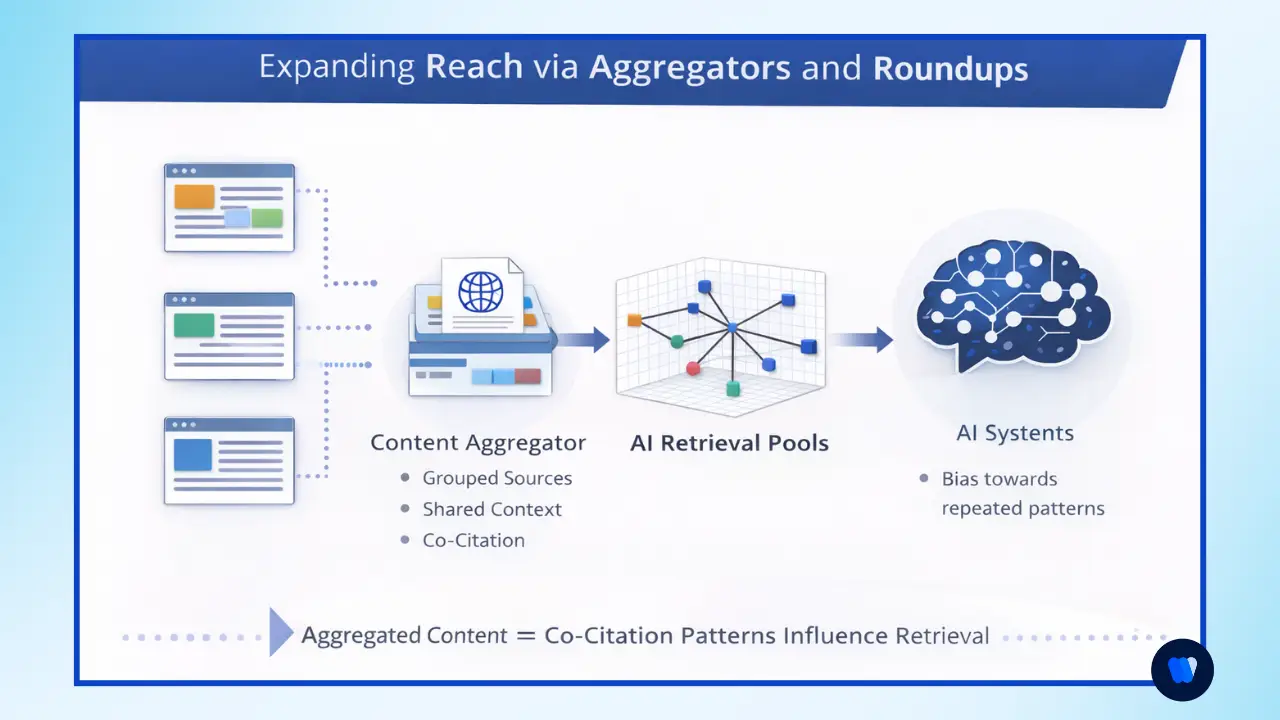
| What Aggregators Do | How AI Interprets Them |
|---|---|
| Group multiple sources in one place | AI observes how information appears together and forms co-citation patterns that influence retrieval decisions. |
| Surface content alongside other reliable pages | When content appears next to trusted sources, AI can validate information faster and reuse it with greater confidence. |
| Increase exposure without changing credibility | Aggregators amplify retrieval chances through context, not endorsement, which is why they are not shortcuts to authority. |
| Host community-driven discussions and comparisons | Community environments influence how content is referenced, which explains why generative engines love Reddit as a consistent retrieval surface. |
| Create repeated contextual associations | AI uses these associations to understand how information connects across sources without altering the underlying credibility of the content. |
How AI Selects Sites to Cite in Technical and Research Content
Technical and research-focused pages are easier for AI to cite because they prioritize precision over persuasion. Clear definitions, scoped explanations, and explicit assumptions reduce ambiguity during retrieval and grounding.
AI evaluates research content by checking whether claims can be traced, reused, and validated across similar documents. Pages that separate facts from interpretation are more likely to be cited than narrative-style blogs.
Documentation often outperforms blogs because it maintains consistent terminology and stable structure. This consistency improves semantic matching when AI selects sites to cite in technical writing.
Context framing plays a critical role in research citation. When a page clearly defines scope, limitations, and intent, AI can reuse it more safely, which aligns with why context matters in the age of LLMs.
As a result, technical pages with explicit purpose, controlled language, and stable updates tend to show stronger citation persistence than opinion-led or promotional content.
How AI Selects Academic Sources to Cite (And Why It Matters for SEO)
- Why Academic Sources Are Preferred for Grounding: AI selects academic sources when high-confidence validation is required. Peer-reviewed papers, institutional studies, and structured research reports reduce risk because claims are clearly sourced, dated, and scoped.
- How Academic Logic Extends Into AI Search: Academic sources are often used for definitions, frameworks, and long-term patterns. This trust logic carries into AI search, where pages that resemble academic structure are more likely to be cited than opinion-driven content.
- What This Means for SEO and Content Strategy: AI citation behavior increasingly separates authority from traffic signals. This reflects the great decoupling, where rankings and clicks matter less than citation reliability and reuse.
- How Academic Referencing Is Expected to Evolve: As AI systems mature, academic-style citation is expanding beyond journals into industry research and documentation, increasing the value of neutral, well-scoped content in SEO-driven visibility.
Addressing Mixed-Intent Queries and Source Credibility
The significance of AI site selection becomes clearer when queries carry mixed intent. Some questions blend informational, commercial, and research signals, forcing AI systems to choose sources that can safely serve multiple interpretations without misleading the user.
In these cases, AI prioritizes sources that clearly signal intent through structure, language, and scope. Pages that separate explanation from opinion and define who the content is for are easier to retrieve and cite, which aligns with how user intent is interpreted in generative engines and how brands get recommended in AI search engines.
Credibility depends on alignment. When content matches the dominant intent behind a query and avoids crossing intent boundaries, it remains eligible across more retrieval scenarios. This is why mapping intent correctly, as explained in finding the right GEO queries, directly affects citation stability.
Content Features That Enhance AI Citation Opportunities
When AI determines which sites to cite in blogs or marketing content, it looks for pages that are easy to extract from and reuse. Clear headings, focused sections, and direct explanations help AI isolate specific facts without pulling in unnecessary context.
Citation-ready content avoids persuasive framing and instead explains concepts, use cases, or processes in a neutral way. This structure allows AI systems to reference marketing content without introducing bias or misinterpretation.
Pages built from well-defined briefs tend to perform better in citation scenarios because they maintain clarity from the start. This consistency is reinforced through structured SEO briefs, which help marketing content remain easier for AI systems to retrieve and reuse.
Actionable Steps to Optimize Content for AI Citations
Measuring and Adapting to Citation Changes in AI
Monitoring citation changes with an AI Overviews Tracker helps identify when pages lose eligibility or when competitors replace previously cited sources but the depth of that signal depends entirely on the platform behind it. A direct Wellows vs AIClicks comparison shows which one actually catches citation losses early enough to recover them, and which one simply reports them after the fact
Regular audits reveal whether drops are caused by content decay, intent mismatch, or structural issues. Processes like auditing brand visibility on LLMs make citation movement observable rather than assumed.
Iteration depends on comparison over time. Using structured checks such as the AI search visibility audit checklist helps teams adapt content based on real citation behavior instead of traffic signals.
Leveraging the Competitive Landscape and Co-Citation Analysis
AI systems often surface groups of sources together rather than evaluating pages in isolation. Co-citation analysis shows which competitors are repeatedly retrieved alongside your content and which sources dominate shared retrieval pools. Most AI visibility platforms surface this overlap automatically, which is faster than reconstructing it prompt by prompt.
By identifying overlap patterns, teams can understand which narratives, structures, or formats AI associates with a topic. Frameworks like the LLM pattern analysis checklist help isolate why certain competitors are cited more consistently.
Anticipating the Future of AI Citation and Search
AI citation logic is moving away from static ranking signals toward dynamic grounding and reuse. Changes in how AI modes retrieve and assemble answers are already reshaping visibility across search ecosystems.
As AI interfaces expand, understanding how Google’s AI mode transforms traditional SEO becomes essential for predicting citation behavior rather than reacting to it.
Long term, citation-based visibility will continue to separate from classic SEO metrics. This shift reflects ongoing debate around whether GEO is making traditional SEO practices obsolete, especially as AI systems rely more on structured knowledge than ranked pages.
FAQs
To get your website content cited in Google AI Overviews for competitive keywords in your niche, your pages must function as grounding sources rather than ranking assets. This means publishing page-level content that is precise, neutral, and easy for AI systems to verify against other reliable sources. In competitive niches, AI favors tightly scoped explanations, clear definitions, and corroborated facts that can be safely reused inside generated answers.
There is no fixed timeline for updated content to appear in AI Overviews citations. AI systems refresh retrieval pools as models update and sources change. Pages that improve structure, accuracy, and intent alignment can regain or gain citation eligibility before traffic or rankings visibly change.
Key Takeaways: How AI Selects Sites to Cite
AI citation decisions are based on how well individual pages support factual grounding, not on brand authority or search rankings. The goal is reliable reuse, not visibility or promotion.
Did you know?
- AI selects pages, not domains, which is why citation eligibility varies within the same website.
- Citations function as grounding references, not endorsements or recommendations.
- Clear structure, neutral language, and precise explanations improve reuse during retrieval.
- Authority comes from corroboration across sources, not backlinks or popularity.
- Freshness and context influence how long a page remains eligible for citation.
- Technical, research, and documentation-style content is cited more consistently than narrative blogs.