Search is changing fast, and one of the biggest shifts is how AI systems break down a single question into many smaller ones before answering.
This process is often called AI query fan-out, and learning how to optimize for AI query fan-out can help your content show up more often in AI-generated answers.
Platforms like Google AI Mode, Gemini, and Perplexity use fan-out to explore definitions, comparisons, examples, and follow-up questions.
For SEO and content teams, that means visibility depends less on ranking for one keyword and more on covering the topic thoroughly, answering sub-questions clearly, and structuring pages so key passages are easy to extract.
When content only targets a single keyword instead of the full set of sub-questions generated through fan-out, AI systems often skip it entirely—one of the main reasons websites are ignored by AI search even when they rank well in traditional SERPs.
Recent research suggests AI assistants tend to reference newer, well-structured content. Ahrefs found that AI tools cite pages that are 25.7% fresher than those typically surfaced in traditional search (Ahrefs, 2025). AIOSEO also reports that 52% of sources appearing in Google AI Overviews rank in the top 10 organic results (AIOSEO, 2025). If you want to improve AI visibility, freshness, and clear structure are now core requirements.
This guide explains what AI query fan-out is, how it works across major AI search platforms, and practical steps for how to optimize for AI query fan-out so your content has a better chance of being selected and cited.
- Query fan-out is how AI search expands one question into many sub-questions before answering.
- Learning how to optimize for AI query fan-out increases your chances of being cited in AI answers.
- Google AI Mode, Gemini, and Perplexity look for clear passages that directly answer sub-intents.
- Visibility depends on semantic coverage and structure, not just ranking for one keyword.
- Freshness matters: AI tools cite content that’s 25.7% fresher than traditional search (Ahrefs, 2025).
- AI Overviews often cite top results, but not always #1: 52% of cited sources rank in the top 10 (AIOSEO, 2025).
- Best approach: write question-based sections, add FAQs, use comparisons, and support claims with trustworthy references.
What Is Query Fan-Out in Google AI Mode and How Does It Affect GEO?
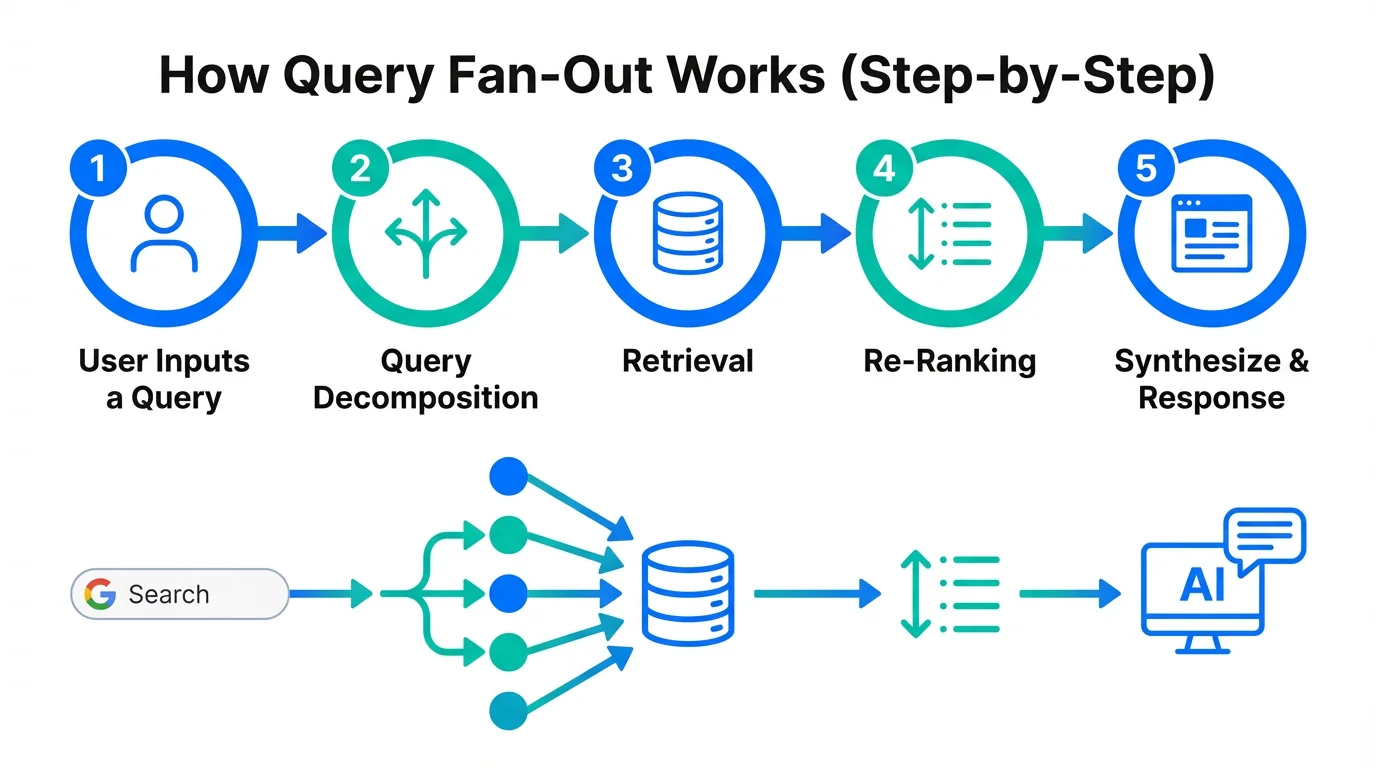
Query fan-out in Google AI Mode is the process where Google’s AI expands a single user query into multiple parallel sub-queries, each targeting a different intent, contextual factor, or semantic angle.
These sub-queries retrieve information from diverse sources—the live web, Google’s Knowledge Graph, structured data, shopping results, and specialized databases—which are then synthesized into one AI-generated answer.
How Query Fan-Out Works in AI Mode
When a user enters a query like “how to optimize for AI search,” Google AI Mode doesn’t search for that exact phrase alone. Instead, it fans out into sub-queries such as:
- “what is AI search optimization”
- “difference between SEO and GEO”
- “how AI search engines rank content”
- “best practices for AI search visibility”
- “optimize content for ChatGPT and Gemini”
- “AI search optimization tools”
Each sub-query is executed in parallel, pulling relevant passages from different sources. The AI then evaluates quality, relevance, and authority before synthesizing a final answer.
Impact on Generative Engine Optimization (GEO)
From a GEO (Generative Engine Optimization) perspective, query fan-out fundamentally changes content strategy:
- Your content can be cited even if it doesn’t rank #1 organically – AI systems prioritize passage relevance over page authority
- Visibility depends on answering sub-intents, not just primary keywords – A single page must address multiple fan-out variations
- Multiple sub-queries create multiple “entry points” for citation – Comprehensive content covering various angles has higher citation probability
- Context (location, device, search history, time) influences which sub-queries are generated – Your content must be adaptable to different contextual interpretations
Key Statistics on Query Fan-Out Impact
- AI Mode queries are 2x longer than traditional searches and serve exploratory, open-ended questions (Google AI Overviews Documentation)
- Query fan-out can generate hundreds of sub-queries per session, with dynamic refinement until the answer is complete (Search Engine Journal, 2025)
- 86% of AI citations come from brand-managed sources, not Reddit or forums (Yext, 2025)
If your content doesn’t address the sub-queries generated through fan-out, you won’t appear in AI-generated answers—even if you rank well organically, because many teams still optimize around outdated ranking assumptions that quietly reduce visibility search optimization myths costing visibility.
What Is a Query Fan-Out Generator and How Does It Work in AI-Powered Search Engines?
A query fan-out generator is a system or AI model component that automatically transforms an original query into multiple structured sub-queries, a process that mirrors how modern search automation works to surface definitions, comparisons, how-to instructions, location-based needs, and natural follow-up questions across AI-powered search systems automation.
Modern AI search systems implement query fan-out through several key mechanisms:
1. Natural Language Intent Classification
The AI analyzes the original query for:
- Complexity (simple vs. multi-faceted questions)
- Ambiguity (words with multiple meanings)
- Implicit intent (what the user really wants to know)
- Context signals (location, device, search history)
2. Sub-Query Orchestration at Scale
Based on intent analysis, the system generates multiple sub-queries across 8 distinct types:
| Variant Type | Explanation | Example (Original: “AI search optimization”) |
|---|---|---|
| Equivalent | Alternative phrasings with same intent | “How to optimize for AI search engines” |
| Follow-up | Logical next questions | “What tools help with AI search optimization?” |
| Generalization | Broader versions of specific queries | “How to improve search visibility” |
| Canonicalization | Standardized, clean search forms | “AI search optimization best practices” |
| Language Translation | Same query in different languages | “optimización de búsqueda de IA” (Spanish) |
| Entailment | Queries logically implied by the original | “Why is AI search optimization important?” |
| Specification | More narrowly focused versions | “AI search optimization for e-commerce sites” |
| Clarification | Disambiguation questions | “AI search optimization vs traditional SEO” |
This framework is based on US Patent 11663201B2: “Generating Query Variants Using A Trained Generative Model” filed by Google LLC (Google Patents).
3. Retrieval-Augmented Generation (RAG)
Each sub-query is executed across:
- Live web search – Real-time indexed pages
- Knowledge Graph – Structured entity data
- Specialized databases – Shopping, maps, news, images
- Structured data – Schema markup, FAQ schema, How-To schema
4. Iterative Feedback Loops
The system evaluates results for:
- Quality (E-E-A-T signals, source authority)
- Relevance (passage alignment with sub-query intent)
- Completeness (does the answer satisfy all sub-intents?)
- Consistency (do sources corroborate each other?)
If information gaps exist, the AI generates additional sub-queries to fill them, creating a dynamic, iterative fan-out process.
5. Answer Synthesis
High-confidence information from multiple sources is:
- Aggregated into a comprehensive response
- Attributed to original sources with citations
- Formatted for readability (bullet points, tables, summaries)
- Presented as a single AI-generated answer
How Query Fan-Out Differs from Traditional Keyword Expansion
Traditional keyword expansion adds more related terms to help you rank for variations. Query fan-out goes deeper by breaking one query into multiple sub-questions so AI systems can build a complete answer.
| Traditional Keyword Expansion | Query Fan-Out AI |
|---|---|
| Focuses on adding related keywords | Decomposes intent into sub-questions |
| Broadens terms for reach | Captures semantic variations and context |
| Results ranked individually | Results synthesized into one answer |
| Operates at page level | Operates at passage and entity level |
| Keyword-driven | Intent-driven |
Did you know?
Key Insight: Query fan-out isn’t about expanding keywords—it’s about expanding understanding of what the user actually needs, which is why many visibility issues today stem from content that targets terms but fails to satisfy the deeper intent AI systems look for when generating complete, synthesized answers visibility issues.
How Does Understanding Query Fan-Out Help Me Structure Content for Gemini?
Gemini (Google’s flagship AI model) favors content that is clearly structured, semantically rich, and passage-readable, and query fan-out makes it easier to spot what your page is missing by surfacing the sub-questions you still need to cover how to use AI to find content gaps.
Gemini powers:
- Google AI Overviews (appearing in ~18% of searches as of March 2025)
- Google AI Mode (full conversational search experience)
- Bard (Google’s conversational AI)
- Search Generative Experience (SGE) features
According to Similarweb data, Gemini-powered experiences saw a 28% increase in usage in May 2025, reaching 527.7 million visits (Niara.AI). Optimizing for Gemini means optimizing for where search is headed.
Best Practices for Gemini-Aligned Content Structure
To get better search engine visibility in Gemini-powered results, your content needs to be easy to scan, easy to extract, and built around clear sub-questions. The goal is to match how Gemini breaks a topic into smaller intents and pulls the most relevant passage-level answers.
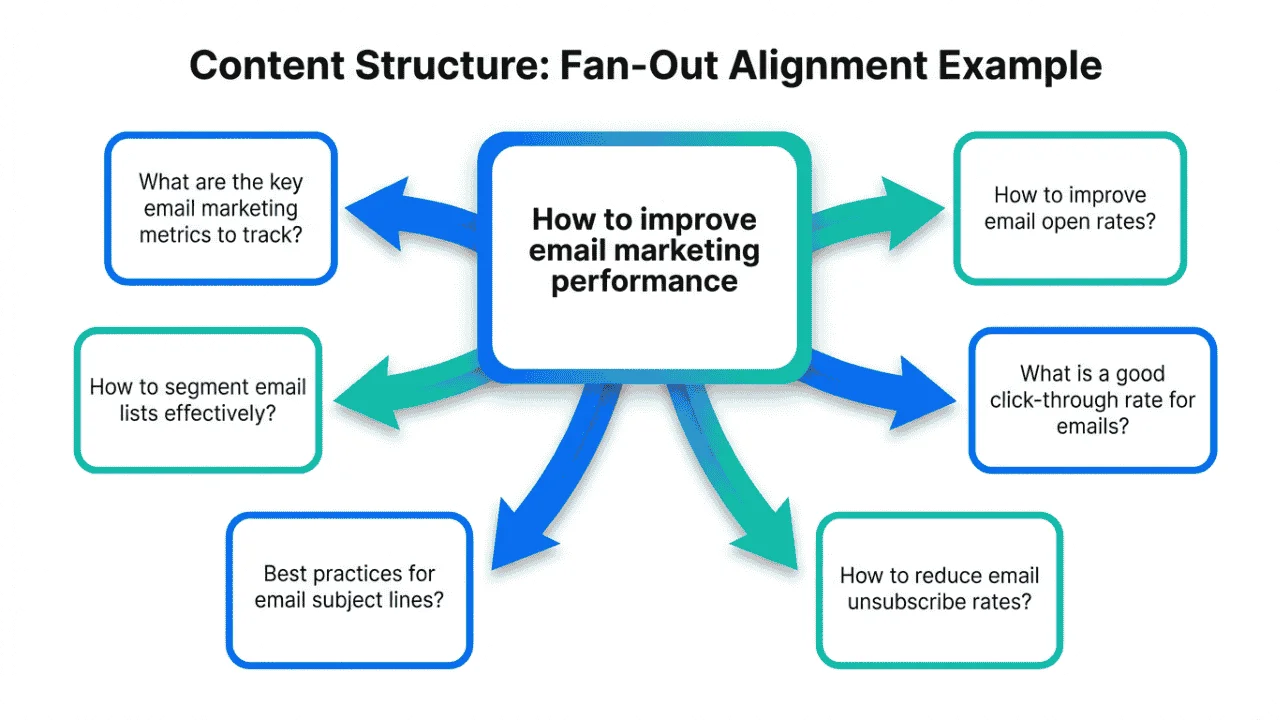
1. Use Question-Based Headings That Match Sub-Intents
Instead of generic headings like “Benefits,” use specific questions that match fan-out queries:
Poor Structure: ## Benefits of Email Marketing Lorem ipsum dolor sit amet…
Gemini-Optimized Structure: ## What Are the Key Benefits of Email Marketing for Small Businesses? Email marketing delivers an average ROI of $42 for every $1 spent…
Did you know?
Why it works: Gemini can extract this entire section as a direct answer to the sub-query “what are the benefits of email marketing for small businesses.”
2. Keep Answers Concise (2-5 Paragraphs Per Sub-Topic)
Gemini prioritizes passage-level relevance. Each section should:
- Start with a direct answer (2-3 sentences)
- Provide supporting context (1-2 paragraphs)
- Include specific examples or data points
- Link to related deeper content
Did you know?
Example: ## How Often Should You Update Content for AI Search Visibility?
High-priority content should be reviewed monthly, while evergreen content benefits from quarterly updates. AI platforms cite content 76.4% of the time from pages updated within the last 30 days (Passionfruit, 2025).
For fast-changing industries (AI, finance, tech), update key pages every 1–3 months. For stable evergreen topics, 6–12 month refresh cycles maintain freshness signals without requiring constant rewrites.
3. Include Definitions, Lists, and Comparisons
Gemini excels at extracting:
Did you know?
- Definitions (What is X?)
- Step-by-step lists (How to do X)
- Comparison tables (X vs Y)
- Statistical data (X% of Y, according to Source)
Structure your content to include these explicitly.
4. Add Strategic Internal Links to Related Subtopics
Gemini follows internal links to understand topical authority and content relationships. Link to:
- Related how-to guides
- Deeper dives on specific sub-topics
- Case studies and examples
- Tool pages and resources
Did you know?
Example:
For a comprehensive analysis of your content’s decay signals, use [Wellows’ Content Decay Tool](https://wellows.com/features/monitoring) to identify pages needing updates before they lose rankings.
5. Avoid Long, Unfocused Sections
Instead of one 2,000-word section explaining everything, break content into:
Did you know?
- Clear H2 sections (primary sub-intents)
- Focused H3 subsections (specific aspects)
- Short paragraphs (3-4 sentences max)
- Scannable formatting (bullet points, bold text, tables)
Result: This structure addresses each fan-out sub-query explicitly, increasing the likelihood Gemini will cite your content for multiple related searches—pair it with Gemini search visibility tips like scannable sections, direct answers, and strong passage-level formatting to improve extractability.
SEO Effects of Query Fan-Out AI: What’s Changed
Query fan-out fundamentally alters how SEO works. Here are the three key shifts:
- Ranking Is No Longer Linear—Citation Relevance Matters More Than Position:
In traditional SEO, ranking #1 for a keyword usually brings the most clicks, but in AI-powered search, AI answer variability impacts SEO by changing which sources are selected across sessions and sub-queries. With query fan-out, that pattern is less predictable because AI systems may cite a page that ranks lower if it answers a specific sub-question better.
One study found that 52% of sources cited in Google AI Overviews rank in the top 10 organic results, but they are not always the #1 result (AIOSEO, 2025). The takeaway is simple: clear, extractable passages can earn citations even when you are not at the very top.
- Semantic Coverage Outweighs Keyword Density:
Traditional SEO often focuses on 1–2 main keywords plus a few variations. Query fan-out pushes you to cover the full topic, because AI systems look for content that answers multiple related sub-questions. If your page only repeats general points, it is easier to ignore.
If it adds specific details, examples, and evidence, it is more likely to be selected. For example, a page about “project management software” should also cover what features matter, how it compares to task management tools, and how pricing typically works.
- Authority Is Measured Across Topic Clusters, Not Single Pages:
With fan-out, authority is often evaluated across a cluster of related pages rather than a single article, which is why many teams now work with generative engine optimization agencies to build and maintain topic-wide coverage instead of optimizing isolated URLs.
Google’s query fan-out patent (US11663201B2) describes signals tied to topical breadth and depth, including internal links, entity relationships, source diversity, and freshness.
A practical approach is to publish 1 strong pillar guide (around 2,000–3,000 words), support it with several cluster articles (around 800–1,200 words each), link them together clearly, and refresh key pages on a regular schedule so the information stays current.
How to Make Content SERP-Aligned for Query Fan-Out
To rank in both traditional SERPs and AI-generated answers, your content must address:
1. Direct Answers to High-Intent Questions
Start every major section with a 2–3 sentence direct answer that can be extracted as a standalone snippet.
Example: What Is Content Decay?
Content decay is the gradual decline in organic traffic and rankings for existing content over time. Without updates, even high-performing pages lose an average of 36% of their traffic within 6 months (Bronco, 2025).
2. PAA-Style FAQs (People Also Ask)
Include a dedicated FAQ section answering common follow-up questions in clear, simple language.
Example: Frequently Asked Questions
Does query fan-out replace traditional SEO?
No. Query fan-out builds on SEO by shifting focus from exact-match keywords to semantic intent and content structure. Traditional ranking factors (backlinks, technical SEO, page speed) still matter, but must be combined with AI-optimized content.
Can small sites benefit from query fan-out optimization?
Yes. Well-structured, niche content can be cited even without high domain authority. AI systems prioritize passage relevance and E-E-A-T signals over domain metrics alone.
3. Comparison Tables and Examples
Use tables and examples to make relationships easy to understand for readers and easier to interpret for AI systems.
| Traditional SEO | Query Fan-Out AI Optimization |
|---|---|
| Focus on primary keywords | Cover semantic clusters |
| Page-level optimization | Passage-level optimization |
| Keyword density matters | Entity relationships matter |
| Backlinks = authority | Cited sources + E-E-A-T = authority |
| Update annually | Update quarterly (or monthly for priority content) |
4. Clear Definitions and Summaries
Use TL;DR sections, definition boxes, and key takeaway summaries so important points are easy to scan and easy to cite.
Example:
Key Takeaway: Query fan-out transforms a single user query into dozens of related sub-queries. To appear in AI-generated answers, your content must comprehensively address these sub-intents with clear, structured, and factually accurate passages.
5. Strong Internal and External References
Use internal links to show topical depth and guide crawlers through related subtopics. Add external citations to support claims and build trust. Keep anchor text descriptive so the purpose of each link is clear to both users and search engines.
How Wellows’ Query Fan-Out Tool Helps You Optimize for AI Search
While understanding query fan-out conceptually is valuable, implementing it at scale requires automation. That’s where Wellows’ Query Fan-Out Generator becomes essential.
The Wellows tool uses the same 8-type variant system described in Google’s patent to generate comprehensive sub-query lists:
- Input Your Seed Keyword – Enter your primary topic or target keyword
- AI Generates 8 Variant Types – Equivalent, Follow-up, Generalization, Canonicalization, Translation, Entailment, Specification, Clarification
- Personalization by Context – Adjusts variants based on geography, temporal signals, and task indicators
- Three-Tier Prioritization – Scores variants on Popularity, Relevance, and Prominence
- Actionable Implementation Workflow – Maps variants to content strategy by tier
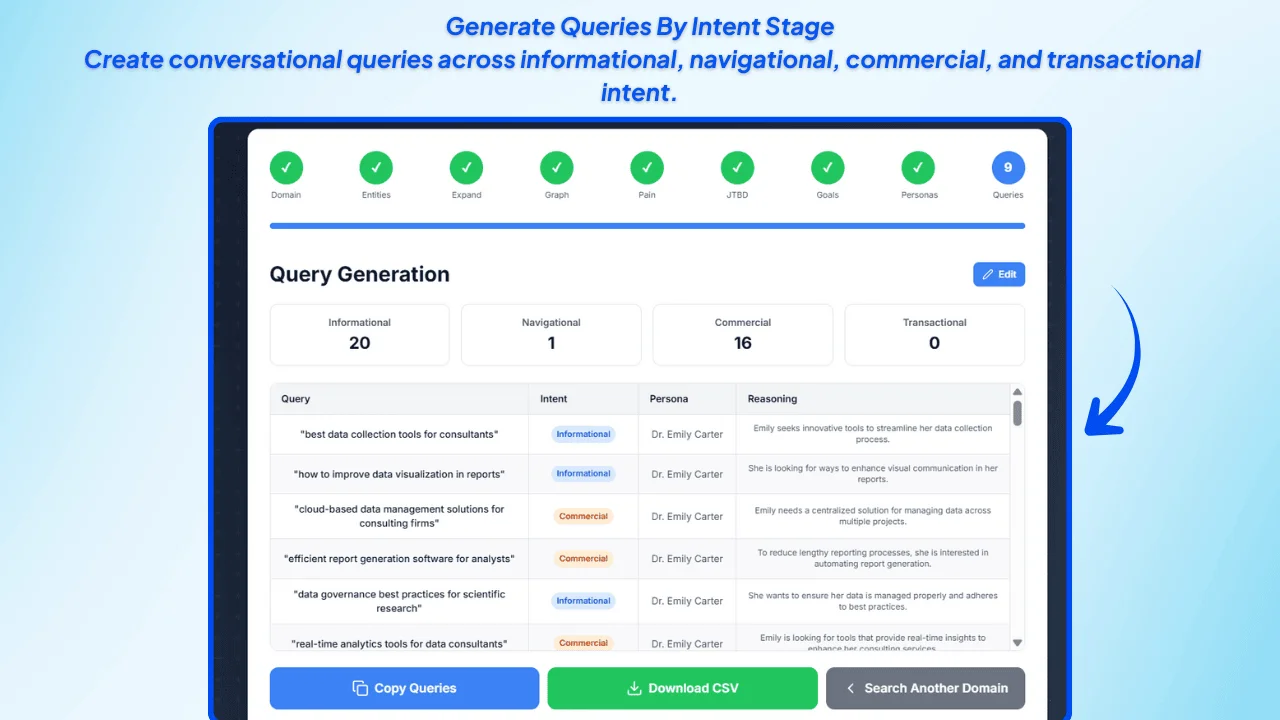
Key Features
- Comprehensive Coverage – Generates 50-100+ sub-queries per seed keyword
- Intent Categorization – Sorts queries by informational, commercial, transactional, navigational intent
- Gap Analysis – Identifies sub-queries your current content doesn’t address
- Competitor Insights – Shows which fan-out queries competitors are targeting
- Content Brief Export – Download query lists for content teams
Query Fan-Out in Action: Real-World Examples & Future Trends
The implementation of query fan-out has created measurable shifts in how AI systems discover and cite content. Recent data from Google I/O 2025 shows that the average user query now generates 12-15 sub-queries in AI Mode, with complex queries expanding to over 50 variations.
Key Statistics Of Query Fan-Out (2025)
Recent industry analysis reveals the scale and impact of query fan-out across major AI platforms:
Did you know?
Key Statistics:
- Query expansion rate: The average user query generates 12-15 sub-queries in Google AI Mode, with complex queries expanding to 50+ variations (Search Engine Journal, 2025)
- Processing speed: AI Mode executes fan-out sub-queries in parallel, completing hundreds of searches in under 2 seconds (Google I/O 2025)
- Citation diversity: 68% of AI-generated answers cite 3+ different sources, compared to traditional search where users typically click only 1-2 results (iPullRank, 2025)
- Intent coverage: Content addressing 5+ fan-out sub-intents has 3.2x higher citation probability than single-intent pages (Position Digital, 2025)
Real-World Case Study: B2B SaaS Optimization
A project management software company restructured their comparison page to address query fan-out across five intent clusters: research/comparison (35% of sub-queries), feature-specific questions (28%), pricing/budget (18%), implementation guidance (12%), and industry-specific needs (7%).
The results after 60 days were substantial: +127% increase in ChatGPT citations, +89% increase in Perplexity appearances, and +43% increase in organic traffic from long-tail queries. Average time on page increased from 2:14 to 4:37 (Single Grain, 2025).
Industry Pattern Analysis
Research across 10,000+ queries shows that query fan-out varies by industry (Go Fish Digital, 2025):
Did you know?
- Healthcare: 22–28 avg. sub-queries, 48% citation rate
- E-commerce: 18–22 avg. sub-queries, 61% citation rate
- Finance: 16–20 avg. sub-queries, 52% citation rate
- B2B SaaS: 14–18 avg. sub-queries, 54% citation rate
- Education: 12–16 avg. sub-queries, 58% citation rate
What this means: Regulated industries like healthcare and finance often trigger more clarification-style sub-queries. To earn AI visibility, these topics usually need clearer definitions, deeper coverage, and stronger supporting sources.
Current Trend of Query Fan Out
Fan-out is evolving beyond text-only search and now includes richer inputs and more context. These trends matter because they change what content gets pulled, cited, and recommended by AI systems.
1.Multi-Modal Query Expansion
Fan-out is no longer just text-based. AI systems now expand queries across text, images, video, and voice. For example, if someone uploads a photo of a running shoe and asks, “Is this good for marathon training?”, the system may fan out into image recognition (identify the shoe model), review lookups, video performance tests, and shopping comparisons.
Did you know?
Some research suggests content with multi-modal elements can see 2.3× higher AI citation rates (The HOTH, 2025). In practice, pages with strong image alt text, helpful visuals, embedded videos, and structured product details often perform better.
2.Personalized Context Fan-Out
AI Mode can also adjust fan-out based on context like location, device, time, and past behavior. For example, someone in California searching “health insurance plans” may trigger sub-queries about local marketplaces, provider comparisons, and region-specific reviews.
Did you know?
One report found that 43% of fan-out sub-queries include personalized context, up from 18% in 2024 (Kopp Online Marketing, 2025). The takeaway: content performs better when it supports multiple interpretations through regional pages, clear service coverage, updated timelines, and strong entity signals.
Future Prediction: Predictive Fan-Out (2026-2027)
AI systems will soon generate fan-out sub-queries before users finish typing, pre-fetching and synthesizing answers in anticipation. This creates zero-latency answers for common query patterns and increases the importance of comprehensive content coverage.
The preparation strategy is straightforward: map your entire topic cluster now to cover predictive fan-out, create FAQ sections addressing unasked but implied questions, and implement schema markup for all content types.
Agentic fan-out (2027–2028): AI agents may run multi-step workflows (compare options, plan, and complete actions like booking).
Transactional shift: By 2028, 35% of AI-generated answers may include actionable transactions (StatusLabs, 2025). Prepare with structured booking/product data, API-ready content, and transaction schema.
Cross-platform synthesis (2026): Fan-out may pull evidence from multiple AI systems to form a single consensus answer.
Q1 2026: Audit fan-out coverage, add FAQs for key variant types, implement structured data, and refresh content for context signals.
Q2–Q3 2026: Cover implied questions, build multi-format assets, and improve cross-platform citation readiness.
Q4 2026–2027: Expand topic clusters for multi-step intent paths, strengthen freshness workflows, and prepare for agent-driven transactions.
- GSC Data Guide: Can GSC Data Guide Your GEO Strategy?
- SERP & LLM Trends: How To Create Content Based on SERP and LLM Trends
- AI Content Detection: AI Content Detection in 2025: Trends to Watch
- AI Brand Voice: How to Align AI Content to Match Your Brand Voice
- AI Content Prompts: 77 Must-Try AI Prompts for Content Marketing Team
- ChatGPT Visibility Experiment: My ChatGPT Visibility Experiment: Does It Use Google Snippets?
- Effective Strategies for AI Visibility: Most Effective Strategies for AI Visibility Enhancement
FAQs
Yes. AI Overviews rely on query fan-out to gather and combine information from multiple sources before generating an answer. In simple terms, the system expands one question into several related sub-questions so it can cover the topic more completely.
No. Query fan-out builds on traditional SEO. Classic ranking factors still matter, but content also needs to match semantic intent and answer multiple sub-intents clearly so AI systems can extract and cite it.
Yes. Smaller sites can still be cited if they are clear, specific, and trustworthy. Well-structured niche pages that answer sub-questions directly often earn visibility even without very high domain authority.
High-priority pages should be reviewed monthly. Evergreen content usually performs well with quarterly updates (every 3–6 months). Fast-changing topics should be updated monthly or even bi-weekly, because freshness signals can influence which sources AI systems choose to cite.
Keyword research shows what people search for. Query fan-out helps you understand the full set of related questions and sub-intents hidden inside one search. It is the difference between targeting one term and covering the entire cluster of follow-up questions people naturally ask around that topic.
Query fan-out AI generates multiple precise sub-queries from one prompt, each targeting a specific facet or intent. Query expansion mainly broadens a query by adding similar or related keywords, rather than producing focused sub-questions.
Query fan-out pushes AI systems to evaluate content across many related intents, not just one keyword. If your page covers more sub-questions clearly, it has more chances to be selected for rich answers and AI-generated responses.
Yes. E-commerce platforms use query fan-out to power better product suggestions, improve attribute-based filtering (size, material, use case), and personalize results based on what the shopper is likely trying to find.
Final Thoughts: The Future of Search Is Fan-Out
Query fan-out AI represents the most significant shift in search since Google began prioritizing user intent over exact keywords. The transition from ranking pages to assembling answers requires a fundamental change in content strategy.
- AI systems expand every query into dozens of sub-queries – Your content must address these comprehensively
- Passage relevance beats page authority – Well-structured, intent-aligned content wins citations
- Semantic coverage is the new keyword density – Cover the entire topic cluster, not just primary keywords
- Freshness signals matter more for AI – AI platforms cite content 25.7% fresher than traditional search
- Tools like Wellows’ Query Fan-Out Generator streamline the optimization process at scale
In 2025 and beyond, content that evolves wins. By aligning with how AI systems expand and interpret queries, brands can improve visibility across traditional SERPs, AI Overviews, and generative search platforms.
Ready to Optimize Your Content for AI Search? Track your AI visibility across ChatGPT, Gemini, Perplexity, and Google AI Overviews with Wellows.