For content marketers, few things are more frustrating than staring at a blank page when ideas just won’t flow. The need to deliver consistent, engaging content across blogs, emails, and social media keeps growing while expectations for quality remain high.
To meet this challenge, marketers are finding smarter ways to boost creativity and save time without compromising their personal touch.
One effective approach is to use AI prompts in content marketing to guide brainstorming, draft content outlines, and even refine tone and messaging.
Instead of starting from scratch, teams can rely on carefully crafted prompts to spark new ideas and advance projects. This simple yet effective technique is helping marketers focus less on what to say and more on how to connect with their audience.
How to Write Good AI Prompts for Content Marketing?
When it comes to content marketing, the quality of your output depends heavily on the quality of your prompt. Poorly written prompts lead to vague, generic results.
On the other hand, clear and specific prompts save time, improve relevance, and ensure your content reflects your brand’s voice.
Structured vs. Vague AI PromptsThink of your AI prompt like an instruction manual. Vague prompts leave too much room for misinterpretation.
Structured prompts, on the other hand, act like schema markup for your content brief — clearly labeling intent, tone, format, and audience so the AI can generate content that actually works for your use case.
- “Write about email marketing.”
- “Explain SEO .”
- “Write a caption for our product.”
- “Write a 500-word blog post for beginner marketers about email welcome sequences, in a friendly tone.”
- “Create a beginner’s guide to SEO in list format, with examples and no jargon.”
- “Write an Instagram caption for a summer skincare kit launch, using a playful and youthful tone.”
Why Prompt Quality Matters
AI is like a fast but literal assistant — it takes your words at face value. In content marketing, you need your prompts to carry enough context so the tool can generate results aligned with your goals and audience—this is also the core of how to use AI for summarizing articles without stripping away intent, evidence, or nuance.
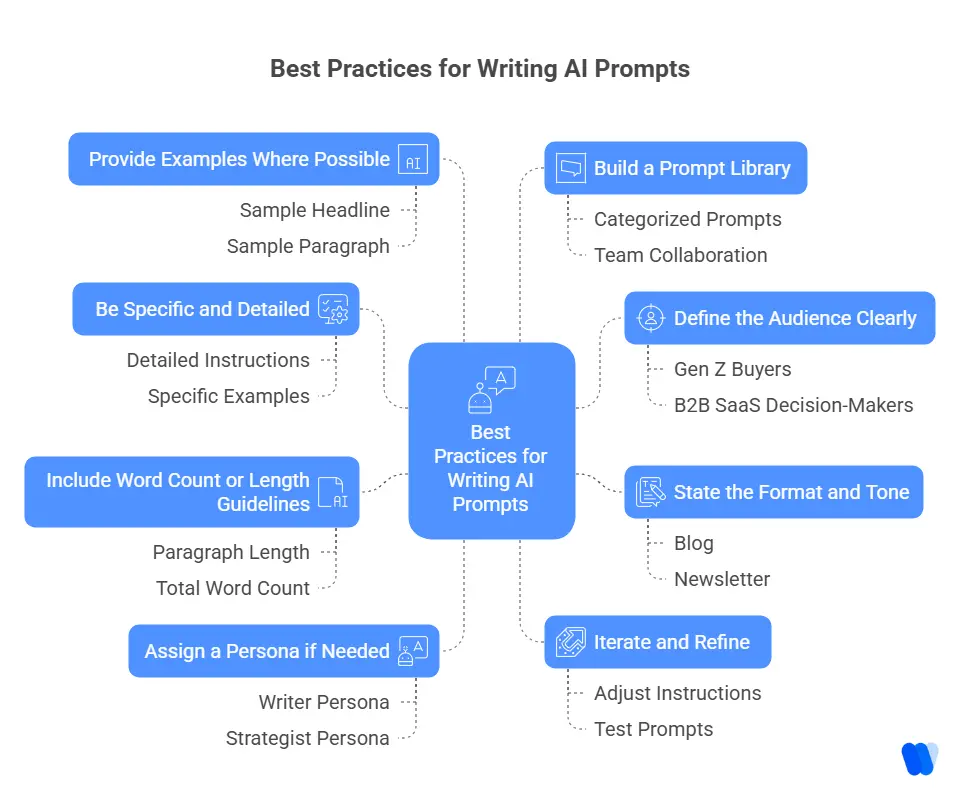
Here are the principles to follow:
Best Practices for Writing AI Prompts for Content Marketing
By following these best practices, you can craft prompts that help AI assist you more effectively and creatively. Use this as a checklist whenever you brief your AI tool.
1. Be Specific and Detailed
Instead of saying “Write about email marketing”, say “Write a 500-word blog post for beginner marketers about email welcome sequences, with examples, in a conversational tone”.
2. Define the Audience Clearly
Mention who you’re speaking to — e.g., Gen Z buyers, B2B SaaS decision-makers, small business owners.
3. State the Format and Tone
Clarify whether you want a blog, listicle, newsletter, caption, etc., and specify tone: friendly, formal, persuasive, etc.
4. Include Word Count or Length Guidelines
Keep the AI on track by adding desired length: Keep paragraphs under 50 words and total word count around 600.
5. Assign a Persona if Needed
Ask the AI to “act as” a specific type of writer, strategist, or audience member to shape its response.
6. Iterate and Refine
Don’t hesitate to adjust and test your prompt if the first output isn’t perfect. Tweak instructions and try again.
7. Provide Examples Where Possible
If you have a sample headline, paragraph, or CTA you like, include it as a style guide in your prompt.
8. Build a Prompt Library
Save successful prompts categorized by content type (blogs, emails, social posts) so your team can reuse and adapt them.
By applying these best practices alongside AI content optimization strategies, you’ll not only save editing time but also produce content that performs better across search and AI-driven discovery.
As Neil Patel puts it in his blog, “The right prompt can make the difference between dull and draining, or crisp and engaging AI copy.”
That’s why learning how to craft effective, clear, and specific prompts is essential for content marketers who want to get the most out of AI tools.
If your team struggles to keep up, explore these 5 Signs Your Content Team Needs AI Now to know when it’s time to scale smart.
75+ Best AI-generated prompts for marketing content every team should try
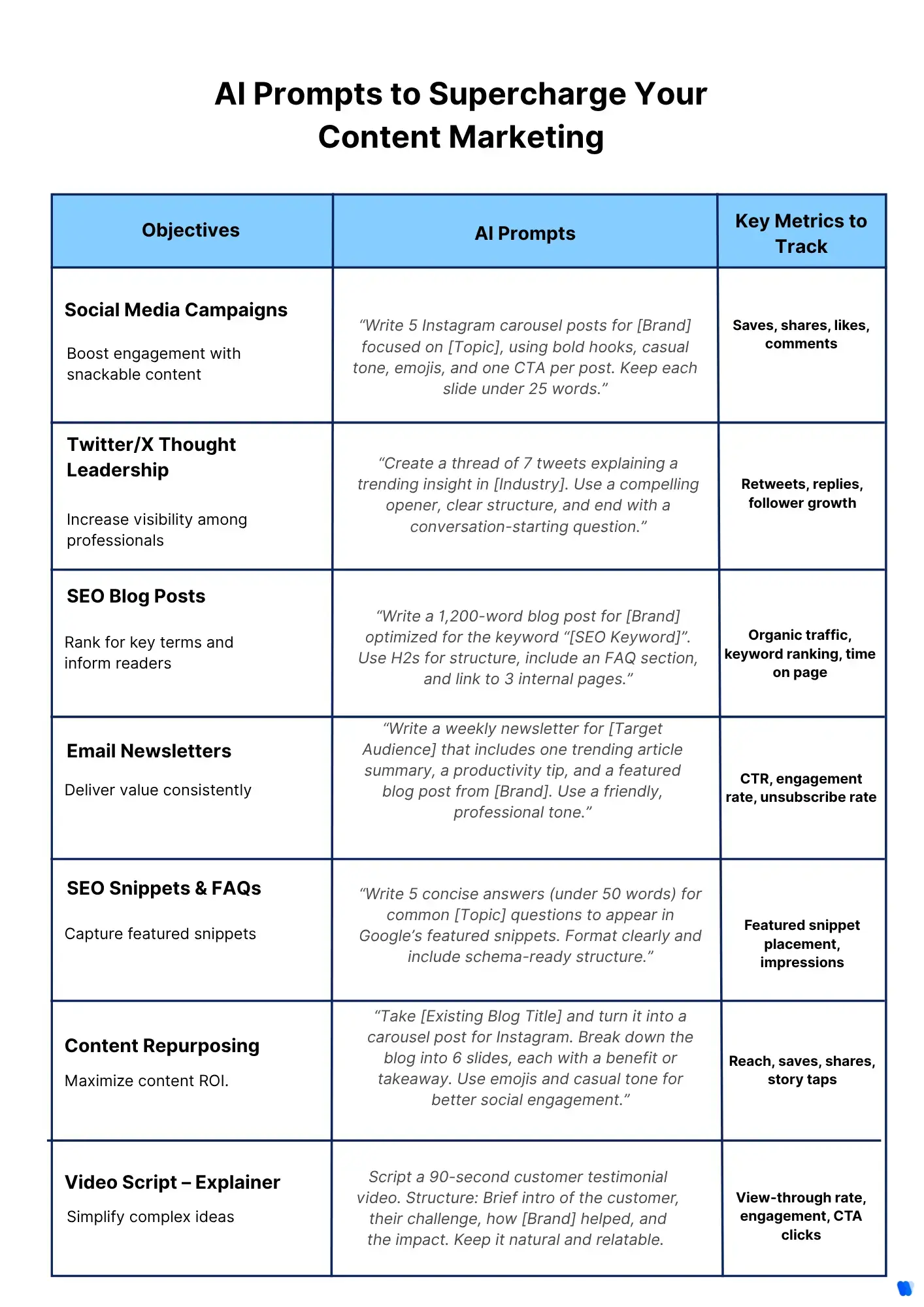
Content marketers today need to generate ideas quickly, produce high-quality drafts, and personalize content — all while staying on brand. Using content marketing AI prompts, you can guide AI tools to help at every stage of your workflow.
This actionable roundup shares AI content marketing prompt ideas and content generation prompts, organized into categories you can plug directly into your processes. Each category highlights key tasks like ideation, drafting, research, and visuals, making it easy to navigate and apply.
Instead of wasting time rewriting vague outputs, these AI suggestions for marketing content give you precise starting points, helping your team save hours while keeping content relevant and creative. Use this as your team’s go-to library of ideas to elevate your workflow.
Here are the most effective AI prompts for content marketing every team should try, organized by use case.
AI Prompts for Content Marketing Creation
Well-crafted content creation prompts help generate high-volume content without sacrificing quality.
From long-form articles to short-form social posts, these AI content ideas can help you move faster and keep your audience engaged.
Use these ready-to-go prompts to get started:
- Draft a 600-word blog post on [topic] with subheadings and examples for beginners.
- Write three LinkedIn posts promoting [product or event] with a professional but friendly tone.
- Create an email newsletter introducing [new feature] with a clear call-to-action.
- Suggest five Instagram captions for [campaign] aimed at young professionals.
- Write a YouTube video script outline for a 3-minute explainer about [concept].
- Generate a Pinterest pin description optimized for [keyword].
- Draft a Facebook carousel post copy with a focus on [audience pain point].
- Suggest three alternative subject lines for an upcoming newsletter about [topic].
To streamline your workflow even further, learn how to create an AI content brief that guides consistent, high-quality output.
AI-based blog content marketing prompts
These blog post idea prompts help uncover topics your audience actually cares about. Use them to fill your editorial calendar faster.
- List 10 blog topics on [theme] for small business owners.
- Suggest five evergreen blog ideas about [industry trend].
- Generate a blog series outline about [customer pain point].
- Recommend blog angles that position [brand] as a thought leader in [niche].
- Propose blog topics based on frequently asked questions about [topic].
- Suggest seasonal blog themes for [month or quarter].
End-to-End Content Drafting Prompts
These content drafting prompts make it easier to produce finished articles, posts, and emails ready for review.
- Draft a complete LinkedIn article on [topic] in an informative tone.
- Write a newsletter promoting [webinar] with a sense of urgency.
- Create a detailed blog post draft with subheadings and bullet lists about [concept].
- Draft a case study about [customer], highlighting measurable results.
Prompts for Content Pitches & Outreach
- Write a guest pitch email for a top marketing blog featuring a data-focused content idea.
- Draft a partnership proposal email with a clear mutual value for outreach.
- Generate a LinkedIn InMail template to contact event speakers.
- Write an influencer brief for a TikTok product introduction collaboration.
- Compose a press release for a new small business automation solution.
- Develop a follow-up email for sharing a new whitepaper with media contacts.
Market and Audience Research Prompts
These market research AI prompts help gather insights quickly and support smarter decision-making.
AI can summarize competitor activity, identify customer pain points, and suggest audience profiles. This data-driven approach saves time while improving strategy.
AI prompts for Market research
- Analyze customer reviews of [competitor] to find common complaints and suggestions.
- Suggest three audience personas for [brand], including demographics and interests.
- Summarize the latest trends in [industry] relevant to [audience segment].
Customer Feedback Analysis Prompts
These customer feedback analysis AI examples help distill insights from surveys and reviews.
- Summarize positive themes from recent customer reviews of [product].
- Identify recurring complaints in support tickets about [service].
- Suggest ways to address negative sentiment found in reviews.
- Highlight areas customers love most about [brand].
- Provide a sentiment breakdown of feedback from [campaign].
Audience Segmentation and Persona Prompts
These customer profiling AI and audience segmentation prompts help you create detailed audience maps.
- Describe a persona for a Gen Z buyer of [product].
- Define three micro-segments of [industry] customers based on intent.
- Suggest buyer journey stages for [audience].
- Identify key triggers that influence purchase decisions for [customer type].
- Outline motivations and objections for [persona] considering [service].
AI Prompts for Personalized Content
Personalization builds stronger connections with your audience. These personalized AI prompts and personalized content prompts help tailor your messaging effectively.
Best AI Prompts for Personalized Content
Using these can increase engagement and conversion rates by making content feel unique to each reader.
- Rewrite this email to sound more personal for first-time buyers.
- Draft three calls-to-action for [landing page] tailored to different buyer personas.
- Adjust this blog intro to appeal more to senior decision-makers.
- Write three subject line variations that sound more personal and engaging.
Behavior-Based Email Content Prompts
- Create cart abandonment emails with dynamic displays of left-behind items.
- Send reactivation email content to users who haven’t engaged in 90 days.
- Thank event registrants with emails referencing their chosen sessions.
- Draft upsell emails are activated by user behaviors or specific achievements in an app.
For more ideas on tailoring content at scale, see how small brands are using AI to create personalized experiences.
AI Visuals: Prompts for Content Graphics & Infographics
These AI visual content and AI infographic prompts make it easier to create shareable, visually appealing assets.
AI Visuals Prompts
Visual content draws attention and improves message retention. These prompts guide tools to deliver polished graphics.
- Suggest three infographic topics for visualizing [data or concept].
- Draft a creative brief for a hero image design for [landing page].
- Generate social media post visuals that align with [campaign theme].
- Create a chart explaining [process] in a clear, branded style.
Infographic Creation Prompts
These AI infographic prompts and content visualization examples improve storytelling with visuals.
- Create an infographic outline that explains the customer journey for [persona].
- Suggest data points to visualize in a bar chart about [topic].
- Draft a headline and labels for a pie chart showing [statistic].
- Propose a timeline infographic to illustrate [historical trend].
Graphic Design Brief Prompts
These design brief AI prompt examples save time when preparing instructions for creative teams.
- Draft a brief for a social ad campaign graphic highlighting [offer].
- Outline design specs for a whitepaper cover about [topic].
- Suggest typography and color themes for a blog graphic series.
- Write a short brief for designing an email banner about [promotion].
- Create a checklist for a product launch hero image.
AI Prompts for SEO
Search visibility depends on optimized headlines, meta descriptions, and keyword targeting. These prompts help align your content with what audiences actually search for.
Keyword Research Prompts
- Suggest 10 long-tail keywords related to [topic] with low competition.
- Generate a keyword cluster for [pillar topic] with supporting subtopics.
On-Page SEO Prompts
- Write a meta description for [page title] that stays under 155 characters and drives clicks.
- Suggest 5 SEO-friendly blog titles for a post about [topic].
Content Gap and Audit Prompts
- Analyze [competitor site] and recommend topics missing from our content library.
Want to learn how to make your SEO content easier to read and rank better? Don’t miss our guide on Content Readability in SEO.
AI prompts for social media content marketing
Your audience scrolls quickly, and these prompts help you craft posts that make them pause and pay attention.
Social Post Creation
- Write 5 tweet options that spark discussion around [topic].
- Draft Instagram captions for a carousel about [product feature].
- Suggest LinkedIn post ideas that position us as thought leaders in [niche].
Engagement and Community
- Suggest 3 poll questions to ask on LinkedIn about [topic].
- Draft a response to a customer’s positive comment on Facebook.
AI Prompts for Content Promotion
Creating content is only half the job, and promoting it properly is what allows your audience to actually see it.
Email and Outreach
- Try these AI-generated email marketing prompts, like drafting a promotional email announcing our latest blog post on [topic].
- Write a LinkedIn InMail promoting our new whitepaper on [topic].
Paid Promotion:
- Suggest 3 ad copy options for a Google Ads campaign driving traffic to [content piece].
Content Teasers:
- Draft 2 subject lines for an email teasing our upcoming webinar about [topic].
AI Prompts for Content Repurposing
Repurposing gives your content a longer life and helps you connect with new audiences.
From Long-Form to Short-Form:
- Turn this blog post into a LinkedIn thread.
- Rewrite this case study as a 3-slide Instagram carousel.
From Webinar to Written
- Create a blog outline from this webinar transcript about [topic].
- Summarize webinar highlights into an email for attendees and non-attendees.
Refreshing Old Content
- Suggest updates to make this 2022 blog post relevant in 2025.
For more practical examples, check out How to Repurpose Content With AI to turn one idea into multiple formats efficiently.
As someone who writes across channels, I rely on a few core prompts almost daily. These have saved me hours and delivered consistently usable drafts.
- “Write a 3-paragraph LinkedIn post for B2B marketers introducing a new feature, in a casual but informative tone.”
- “Create a newsletter summary of this blog for early-stage founders, keeping it under 200 words and linking to 2 relevant posts.”
- “Suggest 5 SEO blog titles around the keyword ‘AI for small businesses’, using curiosity-based phrasing.”
- “Act as a senior content strategist and outline a case study structure for a SaaS product that reduced churn.”
- “Rewrite this blog intro to feel more personal, using second-person voice and a problem-solution format.”
- Identify repetitive tasks where AI can save time—such as drafting, research, or ideation.
- Train your team to craft effective prompts that reflect brand tone, audience, and goals.
- Create a shared prompt library so your team can reuse and customize successful prompts.
- Regularly review performance with ai prompt tracking and engagement data to improve prompt quality and application across AI engines.
- Refine and adapt AI use over time to ensure your workflow stays efficient, relevant, and aligned with evolving content needs.
How can teams implement AI prompts into their workflows effectively?
For AI to have a lasting impact, you need to embed it thoughtfully into your workflow—one of the proven ways AI is transforming content strategies.
Read More Articles
- Write Content for People First, Not Search Engines
- Top Content Marketing Statistics to Know in 2025 (Including AI Trends)
- 10 AI Content Mistakes Marketers Should Avoid
- Marketing With Agentic AI: What It Means
- AI and E-E-A-T: What Content Marketers Should Know
- 7 Ways AI Improves B2B Content Marketing
- How to Build a Content Update Strategy Guide 2026
- How to Optimize for AI Query Fan-Out
- How to Humanize AI Content for SEO
FAQs
To use AI prompts effectively in content marketing, always be specific about your audience, tone, and format. Structured instructions guide the AI toward outputs that match your goals. Building a prompt library helps ensure consistency and makes content creation faster across campaigns.
AI prompts enhance strategies by speeding up ideation and drafting, giving marketers a head start. They add relevance by aligning messaging with audience needs and brand voice. Over time, structured use of prompts helps scale content production without compromising quality.
Focus on clear, role-specific prompts like “Draft a blog intro for [topic] in a persuasive tone” or “Summarize customer feedback into 3 insights.” Specificity and context produce the best results.
Use prompts that define audience, format, and tone. For example, “Write a 3-tweet thread explaining [concept] for beginners” helps scale output without sacrificing quality.
Include audience, intent, desired length, and tone in your prompt. Test and refine regularly to match output with your goals.
Yes. Start with structured prompts that specify each element, such as “Write a newsletter highlighting [offer] with a CTA and benefit-driven intro.”
Group prompts by workflow, such as ideation, drafting, editing, and research. Store them in a shared library or template bank for team-wide access.
Final Thought: Turn Better Prompts Into Better Content
At the heart of great content is a clear idea and the right words to bring it to life. The way you write your prompts can completely shape the output and help you create work that truly connects with your audience.
Small changes, like adding context or defining who you’re speaking to, can turn vague drafts into meaningful, polished pieces. When your prompts are thoughtful and specific, your content becomes easier to produce and stays consistent with your brand’s voice.
Keep practicing, refining, and experimenting as you go. The more intentional you are with your prompts, the more creative and effective your content marketing will become over time.
Key Takeaways
- Use specific, contextual prompts to improve output quality and save editing time.
- Organize prompts by workflow — ideation, drafting, SEO, and personalization — for efficiency.
- Test and iterate on prompts to align AI output with your brand voice and audience needs.
- Build a shared library of high-performing prompts to scale your team’s content efforts.
- Apply prompts thoughtfully to all stages: creation, optimization, promotion, and repurposing.