Content marketing isn’t standing still. Each year brings shifts in how teams create, distribute, and measure content, with 70% of marketers saying content creation is their top marketing priority (Semrush, 2025). If you’ve ever wondered where to find statistics on content marketing performance, this is the right place.
I’ve gathered the most up-to-date content marketing statistics for 2026 to help you get a clear picture of what’s changing and what still works in content marketing. Along with these insights, knowing the latest content marketing facts can really help you grasp how strategies are shifting.
Whether you’re planning campaigns, adjusting your budget, or just figuring out what to prioritize, the numbers speak for themselves—especially with content marketing generating 3x as many leads as paid advertising and costing 62% less (Trustar Marketing).
Let’s get into it. These statistics reveal patterns that align with broader digital transformation trends, where content marketing adapts to AI-driven consumer behaviors and search engine algorithm changes.
Content Marketing Statistics – Top Picks
Here are some standout statistics about content marketing worth knowing for 2025:
- 2% of businesses plan to either maintain or increase their content marketing budget this year. Source: Siege Media 2025 Report
- Companies that publish 11+ blog posts per month get over 5x more leads than those publishing once a week or less. Source: HubSpot
- 53% of all website traffic comes from organic search, making SEO a key pillar of content success. Source: Backlinko
- Short-form video is now the #1 most-used format across B2B and B2C content teams. Source: HubSpot 2024 Marketing Trends
- 70% of marketers say content creation is their top marketing priority. (Source: Semrush statistics 2025)
- Articles that include an image every 75–100 words receive nearly twice as many social shares as those with fewer visuals. (source: Content Marketing Institute)
What Are Content Marketing Statistics 2024 -2025?
Many marketers have embraced AI tools for their content workflows. Here’s how AI adoption is influencing Key Content Marketing Stats results.
- 74% of marketers now use OpenAI’s ChatGPT, Google’s Gemini, and Anthropic’s Claude AI tools in their roles, a significant increase from 21% in the previous year. Source: HubSpot State of AI report
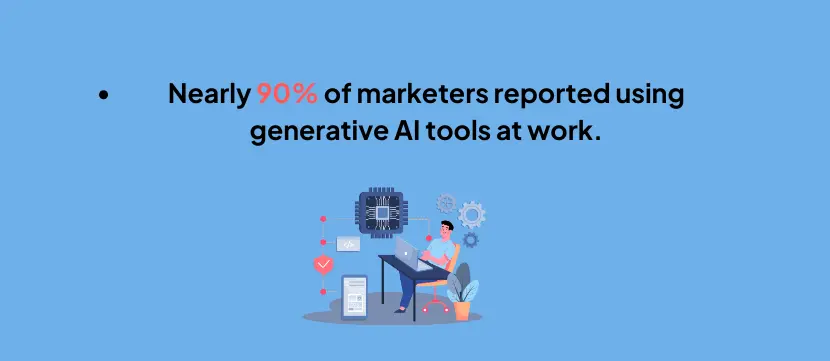
- 90% of marketers reported using generative AI tools at work. (Source: A survey by the American Marketing Association in September 2024.)
- Around 48% of marketers use generative AI for tasks like market research, dataset discovery, and summarizing articles. (Source: HubSpot State of AI report)
- 88% of marketers now use AI tools daily, with 93% utilizing them to accelerate content creation. (Source: Allaboutai.com)
- 7% of marketers have integrated AI tools into their workflows, with nearly half using them multiple times a week. (Source: Artsmart AI in Marketing Statistics)
- Marketers mainly use AI for tasks like creating outlines (92%), generating content ideas and keyword research (88%), research support (80%), drafting basic content sections (73%), and writing full blog posts for human editing (52%). (Source: Flying Cat 2024)
- According to 85% of marketers, 58% plan to increase investments in generative AI tools in 2024. At the same time, 60% of AI-using marketers express concerns about issues like bias or brand voice misalignment, so there’s caution with the optimism. (Source: AI Insights from Hubspot’s 2024)
How are Content Marketing Statistics Gathered?
Most content marketing statistics are collected through surveys, platform analytics, and market research reports. Common sources include tools like Google Analytics, social media dashboards, and independent research studies.
To ensure accuracy, many verified statistics combine self-reported business data with third-party validation, giving a more reliable and complete picture of industry performance.
Takeaways:
- The use of AI-generated content in marketing has surged year over year.
- Most marketers now use AI tools daily.
- Popular tasks include research, outlines, and ideation.
- AI speeds up content creation significantly so that writers can triple content output using AI writing assistants without compromising quality or originality.
- Many still prefer human editing for final drafts.
- Concerns remain around tone, bias, and accuracy.
- Marketers are planning to invest more in AI tools.
Beyond AI adoption, content strategy fundamentals determine long-term success, as evidenced by documentation and team structure statistics.
Content Strategy Production Improves Marketing Results
Throwing content out into the world and hoping it sticks isn’t a strategy, and most marketers know it. To close that gap, many teams are adopting AI content optimization strategies that turn planning into clearer, more targeted updates guided by search demand and audience intent.
These stats highlight where content teams are focusing their energy and where some are still catching up.
- 40% of B2B marketers have a documented content marketing strategy, while 33% have a strategy but don’t document it, and 27% have no strategy at all. (Source: Fliki.ai)
- Among the most successful B2B marketers, 64% have a documented content marketing strategy. (Source: alibaba.com)
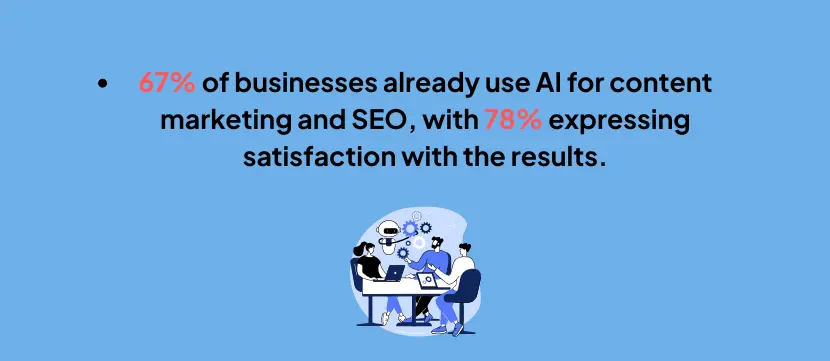
- 67% of businesses already use AI for content marketing and SEO, with 78% expressing satisfaction with the results. (Source: SEMrush)
- 42% of companies have brand content initiative teams comprising one to three specialists, whereas 21% lack a dedicated content marketing person or team entirely. (Source SEOwind)
- 54% of B2B organizations have small content marketing teams with just two to five members. (Source: Typeface.ai)
- In 2019, 40% of marketers outsourced parts of their content marketing, but this figure dropped to 30% in 2020. (Source: Exploding Topics)
- 61% of content marketers selected ‘brainstorming content concepts’ as the top way they plan to use AI in 2024. (Source: Studio ID)
- 86% of marketers reported that AI saved them over an hour each day in coming up with creative ideas for content. (Source: Typeface.ai)
How to Use Content Marketing Statistics for Strategy?
Marketers use content marketing statistics to identify emerging trends, benchmark performance against industry standards, and prioritize formats that deliver results. By analyzing data, teams can spot which channels or content types generate the most engagement and ROI.
Closing that gap becomes easier when teams leverage AI SEO content optimization to identify update opportunities, expand high-performing content, and boost visibility without producing excess content.
For example, if statistics show that short-form video drives higher conversions, a brand can shift resources toward creating platform-optimized video content.
Similarly, benchmarks on blogging, email, or SEO—especially when supported by an AI search visibility platform for freelancers can help refine strategy, allocate budgets effectively, and ensure efforts are focused on what works best.
Takeaways:
- Many teams still lack a documented strategy, despite knowing its value.
- Small content teams and outsourcing are common ways to scale efforts.
- AI is being widely adopted to boost creativity, save time, and support content planning.
- The top outsourced content marketing tasks include writing, graphic design, video design, and animation.
Lock the plan into execution by running each draft through a blog post creation checklist before publish.
Content Distribution Channels Determine Marketing Success
Creating content is only half the job, but getting it in front of the right audience is where the real challenge begins. How and where marketers are distributing content in 2025 reveals a lot about what’s working across different channels.
Content Marketing Facts and Figures
- 89% of marketers distribute content through LinkedIn, Instagram, TikTok, and YouTube organic social media platforms. (Source: Semrush, State of Content Marketing 2024)
- 72% of marketers say their content performs best on owned channels (blogs, newsletters) rather than third-party platforms. (Source: Siege Media, 2025 Report)
- 48% of all branded content published in 2025 is short-form video. (Source: Zebracat.ai)
- 69% of companies post videos on Google’s YouTube, Microsoft’s LinkedIn, and Meta’s Instagram platforms. (Source: Wistia State of Video Marketing 2024)
- 73% of B2B companies report consistent monthly content output across at least three channels, such as blogs, email, YouTube, and LinkedIn. (Source: Zebracat.ai)
- Marketers experience conversion rates up to 2x higher on LinkedIn compared to other social platforms. (Source:poweredbysearch.com )
Takeaways:
- Social and email still lead for reach, but owned content like blogs and newsletters drives long-term traffic and conversions.
- Multichannel distribution isn’t optional anymore; it’s the baseline.
These distribution insights connect directly to measurable outcomes, where channel selection directly impacts return on investment and lead generation effectiveness.
Content Marketing ROI Exceeds Traditional Advertising
Content isn’t just about engagement but about outcomes. Whether it’s leads, traffic, or revenue, the numbers show that content marketing continues to punch above its weight in terms of cost-efficiency and impact.
- 68% of businesses say using AI in content marketing has led to a higher return on investment. (source: DemandSage)
-
- 89% of marketers say strategic content planning has helped them generate demand or leads. (Source: Content Marketing Institute, B2B Report 2024)
- 74% report that it helps nurture and convert leads over time. (Source: Content Marketing Institute, B2B Report 2024)
- Content-driven marketing generates 3x as many leads as paid advertising, and costs 62% less. (Source: Trustar Marketing)
- Businesses that maintain a blog see 126% more lead growth than those that don’t. (Source: HubSpot)
- 60% of marketers say consistent content production helps them build brand authority, which improves conversion rates over time. (Source: Semrush 2024 Report)
- Brands that update old content regularly see a 111% increase in traffic compared to those that don’t.
How Can Content Marketing Statistics Improve ROI?
Content marketing statistics help improve ROI by providing evidence-based insights into what’s working and what isn’t. By tracking performance data across channels, formats, and campaigns, marketers can identify ineffective tactics to cut, spot early signs of content decay, and reinvest in high-performing content before traffic and rankings decline.
For example, if data shows blog posts with visuals outperform text-only articles, budgets can shift toward richer media. This alignment between resources, proven tactics, and audience behavior ensures that spend directly supports measurable growth, from lead generation to conversions.
Takeaways:
- Quality content compounds. One blog post might bring in 100 visits this month, but keep delivering traffic for years.
- Unlike ad spend, content’s ROI grows over time if optimized and maintained properly.
Content Marketing Careers Expand with AI Skills
Content roles aren’t just growing—they’re diversifying. As brands produce more, the demand for writers, strategists, editors, video specialists, and marketing freelancers is rising across full-time, freelance, and contract roles.
Here’s what the job market looks like in 2025:
-
- 82% of marketing departments have at least one dedicated content marketing role, up from 70% in 2022. (Source: Content Marketing Institute, Career Outlook 2024). This shift aligns with content marketing statistics 2022, which highlighted the growing importance of content teams within organizations.
-
- The role of “Content Marketing Manager” saw a 23% increase in job postings from 2023 to 2024 on LinkedIn.
- Nearly half (48%) of content marketers list mastering new technologies, including AI, as their top upskilling goal for 2024. (source: Content Marketing Institute)
- 47% of content marketers say their job responsibilities now include AI prompt writing or managing AI tools. (Source: Semrush State of Content Marketing 2024)
- The two most common job titles in content marketing are: Content Marketing Manager (50%) and Content Marketing Specialist (26%). (source: proprietary research 2024 by Semrush)
- Content marketers in the U.S. earn an average salary of $112,000 per year. (source: Content Marketing Institute)
- Only 16% of marketers are concerned about AI replacing their roles. (source: HubSpot)
Most In-Demand Roles
- Content Marketer (15% of job postings)
- SEO Specialist (15% of job postings)
- Social Media Strategist (13.8% of job postings)
- Digital Marketing Specialist (high demand)
- Brand Manager (4.2% of job postings)
Source: Content Marketing Institute
Most Common AI Uses for :
- 62% use AI to brainstorm topics
- 53% use AI to summarize content
- 44% use AI to write drafts
- 32% use to repurpose content
Takeaways:
Content careers are shifting beyond writing—strategy, AI oversight, repurposing content, and analytics are becoming core skills.
Brands are looking for hybrid creators who can work across formats, collaborate across teams, and think beyond traffic. Career evolution mirrors technological advancement. AI augmentation creates hybrid roles requiring creative strategy and technical skills.
SEO Organic Search Generates Quality Traffic
Search isn’t just a traffic source, it’s a foundation for sustainable growth. Ranking well means more visibility, more leads, and better long-term ROI without relying on ad spend.
Let’s look at how SEO and content marketing stats are changing organic content outcomes in 2025.
Authoritative Content Marketing Statistics
- 68% of online experiences start with a search engine. (Source: Brightedge)
- 96% of global traffic originates from Google Search, Google Images, and Google Maps. (Source: Ahrefs)
- SEO drives over 1,000% more traffic than organic social media. (Source: Ahrefs)
- 60% of marketers identify inbound strategies, including SEO and blog content, as their highest quality source of leads. (Source: Ahrefs)
- 83% of marketers believe AI will have a positive effect on their SEO efforts. (Source: Conductor)
- SEO leads have a 6% close rate, compared to 1.7% for outbound leads. (Source: Ahrefs)
- The average top-ranking result on Google has a click-through rate (CTR) of 28%, with positions two and three at 5.82% and 3.11%, respectively. (Source: Ahrefs)
- Moving from position 2 to position 1 can result in a 50% increase in organic traffic. (Source: Semrush)
- The URL in the #1 spot of search engine results pages (SERPs) has an average CTR of 6%, while the page in position #10 has a CTR of only 2.6%. (Source: Semrush)
- 76% of businesses have had their AI-generated content rank at least once in search engines. (Source: Semrush)
- With AI Overviews and PAA gaining real estate on SERPs, the CTR for first-position results dropped from 7.3% to 2.6% between March 2024 and March 2025 (Source: Search Atlas)
Takeaways:
- Organic search still drives the bulk of inbound traffic, but expectations have shifted.
- AI is not replacing SEO, it’s reinforcing it. From keyword clustering to SERP analysis and brief generation, AI tools and agents help teams move faster and make more data-driven decisions.
- High-ranking content still depends on fundamentals: quality, freshness, and search intent alignment.
- Leveraging SERP features like “People Also Ask” (PAA) has become essential; learning how to use PAA data strategically can significantly enhance content visibility and audience engagement.
For agencies managing fast-paced campaigns, KIVA serves as an AI SEO Agent that turns SERP formats and LLM visibility patterns into clear, repeatable briefs, helping teams scale output without sacrificing strategy. SEO metrics now connect to AI search patterns. Traditional ranking factors adapt to generative AI algorithms.
Blogging Statistics Reveal Long-Form Content Success
Blogging remains a foundation for inbound marketing. The more you blog, the more momentum you build. These stats show it’s far from outdated.
- The average blog post is about 1,427 words long—a 77% increase since 2014. (Source: Orbit Media)
- It now takes 3 hours and 51 minutes to write a robust blog post, up 60% over the last decade. (Source: Orbit Media Survey 2023)
- Blogs that take 6+ hours to create tend to perform significantly better. (Source: Content Marketing Institute)

- Only 3% of bloggers consistently publish ultra long-form content (3,000+ words), yet 53% of those report “strong results.” (Source: Orbit Media)
- Spending 6+ hours on a single post significantly increases the chances of earning strong returns—20% of these longer-form posts outperform faster builds. (Source: Orbit Media)
Takeaways:
- Blogging remains a strong long-term marketing strategy.
- Use AI to assist—not replace—human writers.
- Focus on creating practical, in-depth content.
- Don’t expect instant ROI; watch for SEO and brand awareness gains.
- Success comes from consistency and value over time.
And if you’re using AI to speed up drafting, make sure the final output still reads naturally. A free AI Humanizer tool can help transform robotic or overly structured AI text into a more human, engaging writing style without losing meaning.
To turn these takeaways into action, refer to the Blog Post Checklist for a step-by-step guide that ensures every post is optimized for clarity, structure, and SEO success.
B2B Content Marketing Statistics Show Customer Retention
B2B content marketing stats in 2025 are less about churning out whitepapers and more about precision targeting, nurturing, and aligning content with actual buyer journeys. The data shows that B2B teams are leaning into content that builds trust and supports long-term sales cycles.
What the Stats Say
- 78% of B2B marketers say content marketing helps improve customer retention and loyalty. (Source: Demand Metric)
- 62% of B2B marketers report that gated content like whitepapers and case studies is their highest-converting format. (Source: Semrush, 2024)
- Among B2B marketers using generative AI, 51% report a reduction in repetitive tasks. Additionally, 45% have observed more streamlined workflows, 42% note better content optimization, and 38% say it has enhanced their creativity. (Source: Content Marketing Institute)
- AI adoption among B2B organizations is projected to rise from 62% in 2023 to 81.5% in 2024, with forecasts indicating it will reach 90.1% by 2025. (Source: Siege Media, 2025)
➡️Most of these Semrush and industry-reported statistics reflect global trends, though U.S. adoption rates are often similar given the scale of American B2B markets.
- 68% of businesses report a higher ROI on content marketing and SEO efforts thanks to AI integration. Source: Semrush)
- 70% of B2B marketers believe SEO brings in more qualified leads than PPC in long-term sales cycles. (Source: Siege Media, 2025)
- 58% of B2B marketers reported increased sales and revenue in 2023 thanks to content marketing. (Source: Semrush)
Takeaways:
- B2B buyers are more informed and expect content that answers specific problems.
- Long-form blog content, webinars, case studies, and product explainers are among the most valued formats.
- AI agents are also being introduced to speed up B2B content marketing workflows, from brief creation to lead scoring and persona mapping.
These shifts are clearly highlighted in Content Marketing statistics 2023, offering a look at how strategies are changing to meet the needs of today’s buyers.
B2C Content Marketing Stats Highlight Video Growth
B2C marketers know one thing for sure, and that is good content still works. Whether it’s short videos, blog posts, or a smart email, content is how brands stay connected with their audience and get results. As consumer habits shift, so do the tactics.
Here’s a look at the latest B2C content marketing statistics showing what’s working right now.
- Only 37% of B2C marketers have a documented strategy. (source: Content Marketing Institute)
- 45% of B2C marketers plan to increase their content marketing budget in the coming year. Source: Content Marketing Institute
- On average, B2C companies allocate 26% of their total marketing budget to content marketing. Source: Content Marketing Institute
- 83% of B2C marketers create short articles or posts, typically under 900 words. Source: Content Marketing Institute
- 61% of content marketers have utilized video content in their strategies. Source: Content Marketing Institute
- 75% of B2C marketers use email marketing as their top content strategy implementation. (Source: Content Marketing Institute)
- Content marketing generates over 3 times as many leads as outbound marketing and costs 62% less. Source: Ahrefs
- 52% of B2C marketers rate their content marketing efforts as ‘moderately successful’. Source: Content Marketing Institute
Takeaways:
B2C marketers are doubling down on content that drives engagement, like blogs, emails, and video. Budgets are growing, and AI is helping boost ROI. Content still outperforms outbound for leads and cost-effectiveness.
Video Content Statistics Confirm Engagement Dominance
Video continues to dominate as the most powerful and engaging content format, consistently topping the charts in both creation and performance. Whether you’re a B2B or B2C brand, integrating video into your strategy is no longer optional; it’s essential.
- 78% of marketers plan to increase video content production in 2024. (source: Wistia)
- 70% of Instagram users are likely to follow brands that are mentioned in Instagram Stories. (Source: SocialPilot – 2024)
- 62% of consumers discover new brands or products by watching video content like demos, reviews, unboxings, or FAQs. (Source: HubSpot – 2024)
- 70% of viewers have bought a product or service after encountering a brand on YouTube. (Source: DashApp – 2025)
- 91% of marketers already use video as part of their content strategy. (source: Wyzowl)
- 68% of marketers who didn’t use video in 2023 intend to adopt it this year. (source: Wyzowl)
- 31% use it to create short-form videos, and 18% use it for long-form. (source: Semrush statistics 2025)
- 52% of businesses plan to experiment with AI-powered video generators in 2024; 53% are also exploring AI image tools. (source: Semrush)
- 56% of TikTok-focused marketers are increasing their video budgets. (source: HubSpot)
- 90% of video marketers say video content improves brand awareness. (source: Wyzowl)
- 39% of marketers created video testimonials in 2023 to build trust and credibility. (source: Wyzowl)
- 34% of marketers use social media videos as a core part of their content strategy. (source: Wyzowl)
Takeaways:
Video remains one of the most influential content formats, and its popularity is accelerating.
From brand storytelling and testimonials to AI-enhanced production, video is helping marketers boost engagement, visibility, and trust across every stage of the funnel.
Podcast Audio Content Statistics Show Listener Growth
Podcasts have firmly planted themselves in the marketing mix. Whether your audience commutes, works out, or multitasks, audio content offers a strong way to connect. Here’s what matters:
- Podcast listenership is on the rise, reaching over 450 million global listeners in 2023, with projections estimating growth to 619 million by 2026. (source: Siege Media.com)
- 61% of Gen Z consumers say they’ve visited a brand’s website after hearing a podcast ad. (Source: Edison Research)
- Together, Spotify, iHeartRadio, and Apple Podcasts make up 77.4% of the podcast listening audience in the U.S. (Source: Backlinko)
- 91% of marketers say they plan to either maintain or boost their investment in podcasts and audio content in 2025. (Source: HubSpot State of Marketing Report, 2025)
- 73% of listeners say they’re open to audio ads on streaming platforms—so long as the tone aligns with what they’re doing at the moment. (Source: Spotify, 2025)
Takeaways:
Podcasting remains an untapped opportunity for most marketers.
With listener numbers climbing and AI tools cutting costs and improving discoverability, brands have a chance to leverage podcasts for engagement, traffic, and SEO value.
AI Content Marketing Challenges Impact Implementation
As AI tools become more common in marketing workflows, they bring new challenges, especially around strategy, creativity, and brand consistency.
- 70% of marketers report facing technical hurdles, like integration issues, compatibility conflicts, and steep learning curves when implementing AI marketing tools. (Source: Martech)
- 16% of marketers say generating fresh content ideas remains a significant challenge. (Source: HubSpot)
- Although 85% of marketers use AI writing tools, 43% worry it may hamper creativity, fearing generic or overused ideas. (Source: HubSpot)
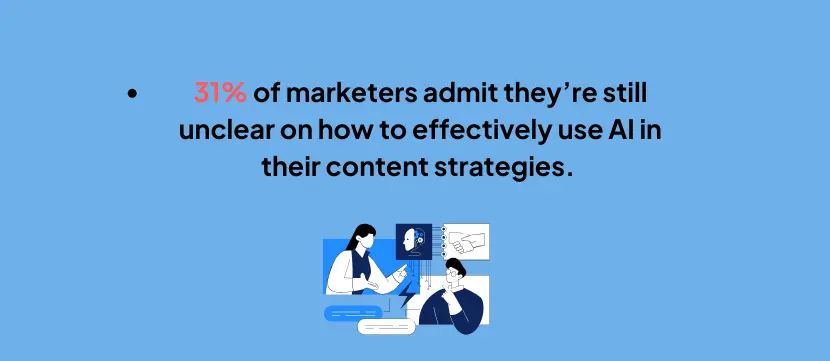
- 31% of marketers admit they’re still unclear on how to effectively use AI in their content strategies. (Source: Semrush)
- 42% of businesses are concerned that AI-generated content lacks originality, and 36% struggle to maintain a consistent brand voice. (Source: Semrush statistics 2025)
- 60% of marketers who use generative AI worry it could negatively affect their brand’s reputation. (Source: HubSpot)
- This concern is growing as awareness increases around AI poisoning and malicious manipulation risks that can distort messaging, introduce misinformation, or damage trust when AI is used without proper safeguards.
- 84% of B2B marketers find it difficult to gather and measure content performance data across different platforms. (Source: Content Marketing Institute)
Takeaways:
AI is rapidly becoming part of everyday content marketing, but it’s not without growing pains. To overcome challenges like a lack of originality or brand misalignment, marketers should pair AI tools with thoughtful human oversight.
Upskilling in AI usage will be essential for staying competitive and maintaining content quality.
If these challenges sound familiar, it might be time to explore these 5 signs your content team needs AI now and start solving them proactively.
Read More Articles
- Content Marketing Agencies: A Complete Guide 2026
- Write Content for People First, Not Search Engines
- What GEO Means for Future SEO Workflows
- What Are GEO KPIs?
- Readability Score in AI Content: Why It Matters?
- LLM Content Creation Strategy
- AI Content Mistakes Marketers Should Avoid
- Humanize AI Content
- AI Content Detection Trends in 2025
- 10 Reasons Why Writers Are Turning to AI Agents
- Can GSC Data Guide Your GEO Strategy?
- Why Agencies Can’t Guarantee AI Results
- Agency Reporting for AI Search: New Metrics and Language Agencies Need
- How to Rank in Gemini: SEO for AI Search Visibility
- Real-Time Alerts for Agency Clients
- How Agencies Find AI Visibility Gaps for Clients (2026)
- Agency Client Onboarding Using AI Search Visibility
FAQs
Between 2023 and 2025, content marketing trends focus on AI-driven personalization, voice and visual search optimization, and the rise of generative content tools. Short-form video remains dominant, while interactive content and data-backed storytelling are becoming essential to capture attention and build trust in both SERPs and AI-driven engines.
- HubSpot shares annual marketing reports with benchmarks on blogging, video, and AI adoption.
- Content Marketing Institute (CMI) provides in-depth B2B and B2C content marketing research, including strategy documentation and ROI trends.
- Statista offers verified global statistics, covering traffic, budgets, and performance benchmarks across industries.
- SEMrush compiles data on SEO, content trends, and AI-driven marketing workflows.
- Backlinko regularly analyzes search and traffic studies that connect content marketing with organic performance.
These sources deliver reliable, research-backed insights you can use to refine strategy, allocate budgets, and measure ROI effectively.
Most statistics come from surveys, platform analytics (Google Analytics, social dashboards), and market research reports. Verified content marketing metrics often combine self-reported business data with independent third-party studies, giving a clearer view of industry performance.
Marketers use statistics to identify trends, benchmark performance, and prioritize formats that drive engagement. For instance, if data shows video content leads to higher ROI, your strategy should shift toward creating short-form, platform-optimized videos.
Content marketing statistics reveal what formats, channels, and campaigns deliver the best return. By analyzing these numbers, brands can cut ineffective tactics, double down on high-performing assets, and align spend with what drives measurable growth.
Accurate content marketing stats help businesses prove value to stakeholders, forecast trends, and align content with customer expectations. Strong data-backed strategies accelerate lead generation, brand authority, and ultimately, business growth.
Final Thoughts
Marketing performance metrics aren’t just numbers—they’re signals. They show us where attention is shifting, which formats deliver, and how AI is changing the way we work. As a content strategist or marketer, your edge lies in interpreting this data to make smarter, faster decisions. Whether it’s video, SEO, or long-form blogs, the research findings reveal what drives real impact in 2025.
And while AI is accelerating output, human insight still leads the way. Use these industry data points not just to benchmark, but to build. The future of content belongs to those who act on what the numbers are saying.