“Content is king, but only if it actually reaches the right people and makes an impact.”
If you’re a B2B content creator, you already know how challenging that can be. Buyers today are smarter, pickier, and expect every interaction to feel personalized and relevant.
At the same time, you’re under constant pressure to produce more content, keep it high quality, and somehow do it all without burning out.
You’re not alone. According to CMI report 2025, just 29% of B2B marketers say their content marketing is very or extremely successful, while 58% struggle with creating content that appeals to different stages of the buyer’s journey.
AI is already part of most marketers’ workflows, whether for drafting, ideation, or analysis, but the real advantage comes from using AI for B2B content marketing to improve content performance.
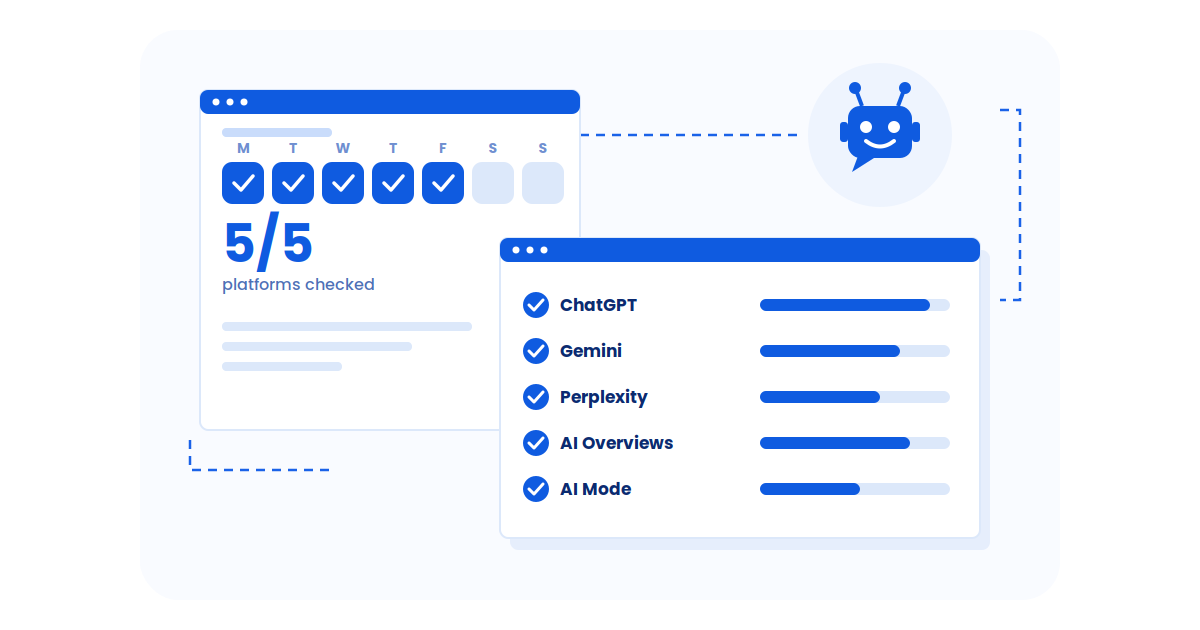
As discovery shifts from rankings to AI citations, optimizing the right page becomes critical. Wellows simplifies this by scanning your site, selecting the best page for a query, and showing exactly what to update, helping you avoid overlap and increase citation potential.
In this guide, you’ll learn 7 practical ways to put AI to work for your B2B content strategy, with specific examples and tips to help you scale smarter, personalize better, and see measurable results.
Why is AI Important for B2B content creators?
AI is a game-changer for B2B content creators because it helps you meet growing demands for more personalized, data-driven, and scalable content without adding more hours to your day or more people to your team.
Instead of guessing what your audience wants or struggling to keep up with production, AI gives you the tools to plan smarter, execute faster, and measure more effectively.
Here’s why so many marketers are making AI part of their everyday content strategy.
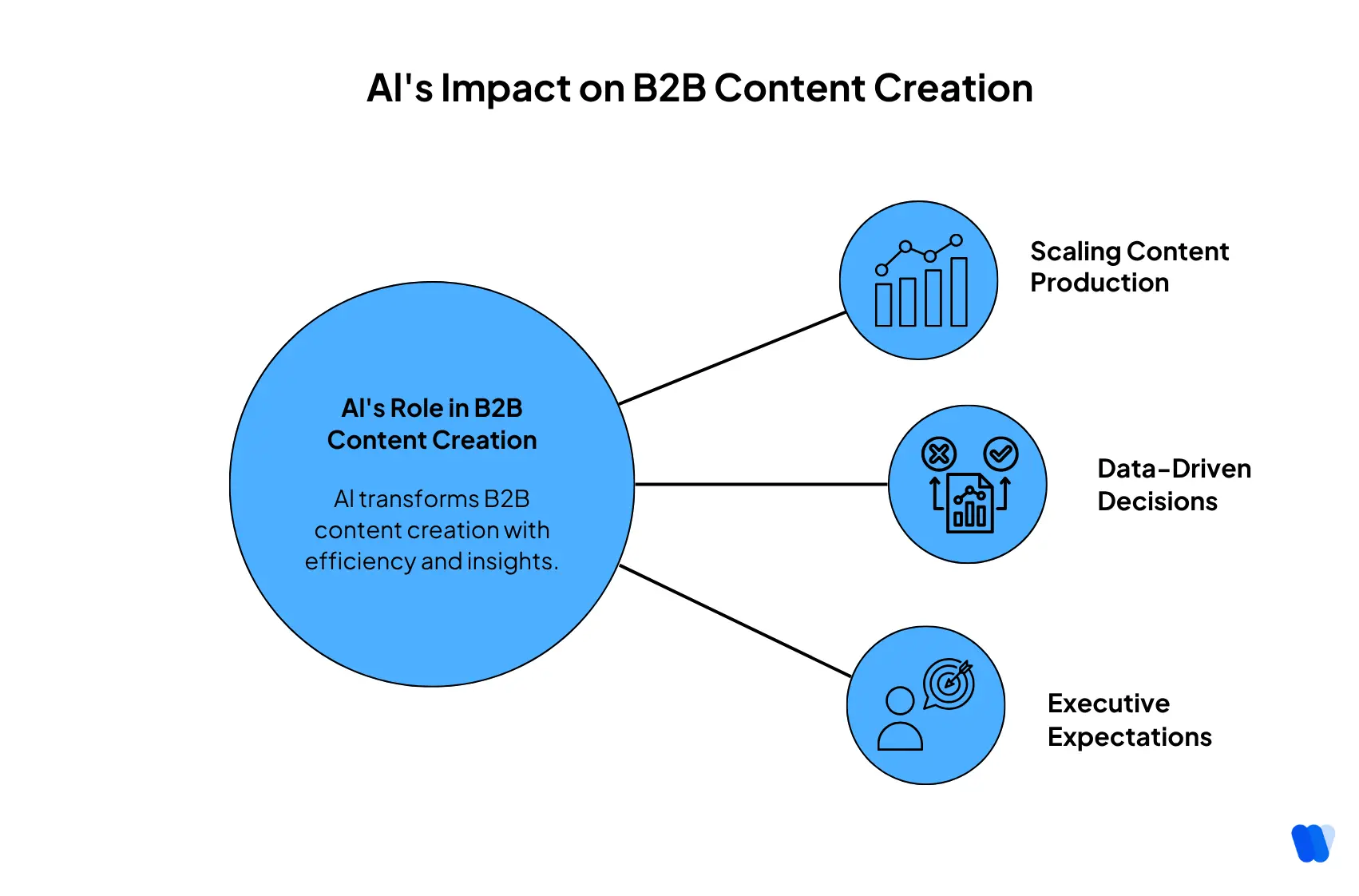
The pressure to scale content production
Buyers now expect multiple personalized touchpoints before making a decision. They read blogs, attend webinars, download guides, and watch videos, and they want it all to feel relevant to them.
This puts enormous pressure on content teams to create high volumes of targeted content quickly. AI helps you keep up by automating time-consuming parts of the process like research, drafting, and even repurposing, freeing up time for creative strategy.
So, if your team’s feeling stretched thin, these 5 signs your content team needs AI now can help you evaluate whether it’s time to introduce automation.
Data-driven decisions over guesswork
One of the biggest advantages of AI is how it transforms raw data into actionable insights. Instead of relying on hunches or historical performance alone, AI analyzes real-time behavior, intent signals, and engagement patterns to tell you:
- What topics are trending in your audience’s niche
- Which formats perform best at each stage of the funnel
- How your audience segments are actually engaging with your content
This means every decision you make is backed by data, not guesswork, which leads to better results.
Executive-level expectations
AI is no longer just a “nice to have.” According to ON24, more than 70% of executives now ask their marketing teams how they plan to use AI to improve results.
Leaders want to see smarter spending, more measurable impact, and innovation. AI gives you the ability to deliver all three.
This is why forward-thinking marketers see AI not as a replacement for creativity but as a powerful partner in achieving their goals.
Top Use Cases of AI in B2B Marketing
AI makes it easier for B2B marketers to create, manage, and scale their content. From research to repurposing and AI content creation for B2B, it helps deliver more impactful campaigns while maintaining consistency and quality.
Instead of starting everything from scratch, you can use AI to accelerate production, automate B2B content creation at scale, and focus on strategy and creativity.
Here are some of the most effective ways B2B teams are using AI today:
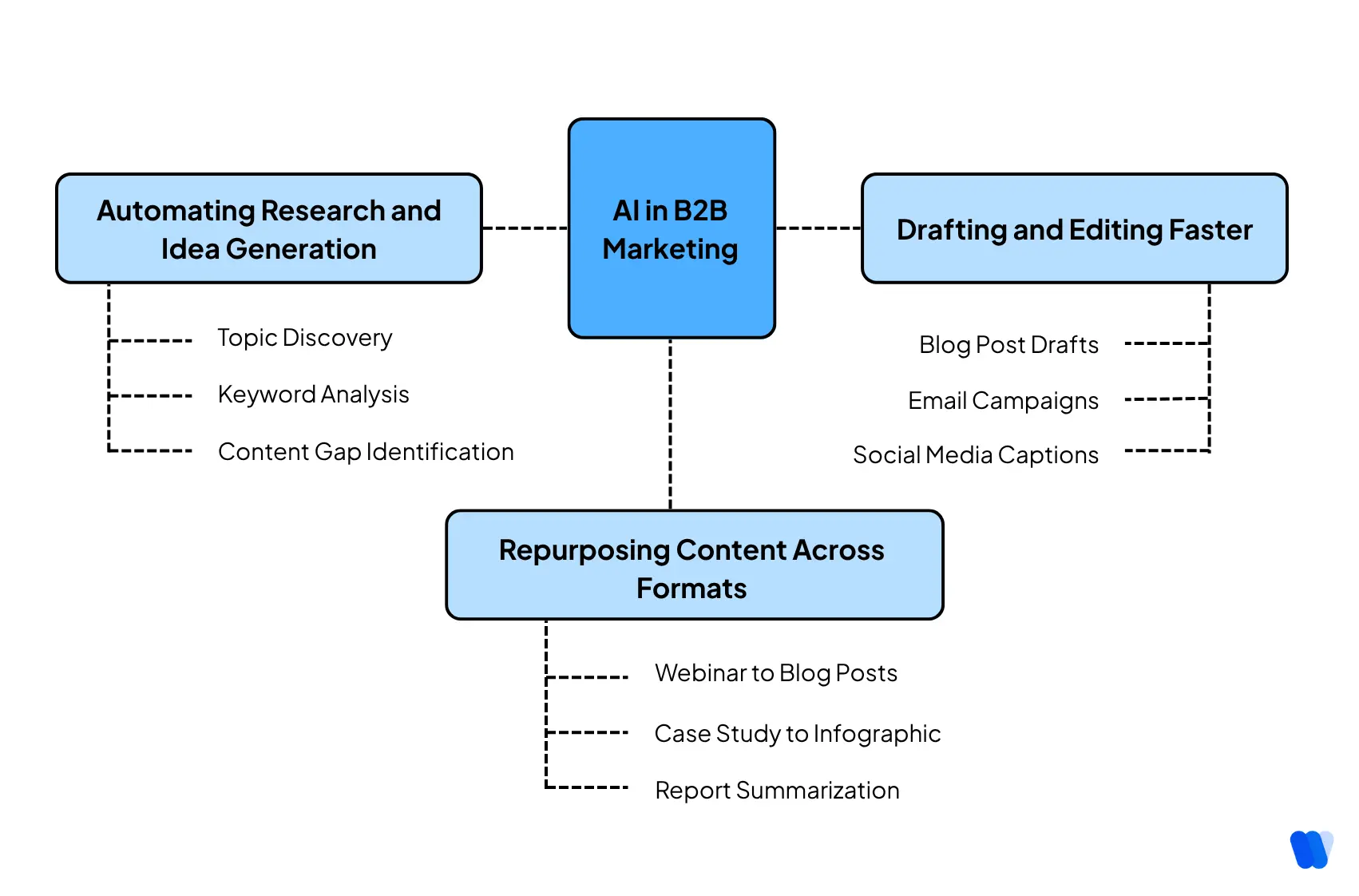
1. Automating Research and Idea Generation
AI tools scan large datasets, analyze search trends, and review competitor content to help you uncover:
- What topics are resonating in your industry right now
- Which keywords have the best potential for your audience
- Content gaps you can fill to stand out
Wellows, MarketMuse, Frase, and Jasper are a few platforms that suggest topic clusters, and even draft outlines to guide your work. This saves time and ensures your content aligns with what your audience is looking for.
2. Drafting and Editing Faster
One of the most common use cases is speeding up content production. AI tools can generate:
- Blog post drafts
- Email campaigns
- Landing page copy
- Social media captions
You can then review and refine to add your unique voice. AI also helps with editing for grammar, readability, and tone, delivering professional results while meeting tight deadlines.
3. Repurposing Content Across Formats
AI helps you adapt one piece of content into multiple formats, extending its reach. This is particularly valuable for Social Media Marketing Agencies that need to turn long-form assets into platform-specific posts, short videos, and engagement-driven campaigns.For example:
- Turn a webinar into blog posts, social posts, and email sequences
- Convert a case study into an infographic or video script
- Summarize long-form reports into short, digestible insights
Repurposing content with AI lets you maximise your efforts, saves time while expanding your reach, and transforms your single idea into multi-channel impact.
Alongside creation and repurposing, AI also plays a key role in content optimization.
Instead of manually auditing pages, you can rely on workflows that Wellows provide to identify the best page to improve, surface content gaps, and strengthen internal linking, so each update compounds results rather than competing with existing content.
- Identify the right page: Scan your site and select the strongest page for each query to avoid overlap.
- Uncover gaps: Compare against top-performing content to see what’s missing.
- Prioritize impact: Focus on updates with the highest potential visibility gains.
- Optimize precisely: Get clear, section-level improvements instead of vague suggestions.
- Strengthen clusters: Use internal linking to reinforce topical authority.
7 Ways AI Improves B2B Content Marketing
AI improves B2B content marketing by helping marketers and creators deliver smarter, faster, and more impactful campaigns. From planning and creation to personalization and measurement, AI enhances every stage of the content lifecycle.
Below are the seven most effective ways AI transforms how B2B marketers engage their audiences.
1. Speeds up content research and ideation
AI helps you generate ideas and plan your content calendar quickly by analyzing:
- What your audience is searching for
- Trending topics in your industry
- Competitor content gaps you can fill
2. Automates drafting and editing
AI writing tools draft blog posts, emails, social captions, and even video scripts in minutes. They help maintain clarity, structure, and grammar so your team spends less time on first drafts and more on strategic storytelling. Platforms like Jasper and Grammarly also improve readability and tone to fit your audience.
3. Personalizes content at scale
One of AI’s biggest advantages is its ability to deliver personalized content to specific audience segments.
- It groups audiences based on behavior and intent.
- Creates dynamic emails, ads, and landing pages tailored to each segment.
- Adapts in real-time based on engagement signals to keep messaging relevant.
This level of personalization increases engagement and conversions without manual effort.
Small teams often struggle to personalize content across multiple segments. To see how it’s done effectively, explore how small brands personalized AI content without sacrificing authenticity.
4. Improves SEO and content optimization
One of AI’s most impactful roles in B2B marketing is improving SEO and optimizing content performance across search and AI-driven platforms.
- Identifies high-impact keywords and aligns them with audience intent.
- Structures metadata properly and highlights on-page SEO improvements.
- Analyzes competitor strategies and identifies opportunities to outperform.
- Wellows helps ai-led b2b marketing by generating optimized content that helps earn AI citations.
Earning citations is one half of the workflow; tracking them is the other — the agency methodology for monitoring AI search mentions shows B2B teams which URLs LLMs pull from and how to separate citation movement from mention noise.
This level of automation and insight ensures your content stays relevant, aligned with trends, and reaches the right audience more effectively.
5. Measures and improves performance
AI provides deeper insights into how your content performs across channels.
- It tracks KPIs like engagement, conversions, and time on page.
- Highlights what works and what doesn’t so you can adjust quickly.
- Runs A/B tests efficiently to find the most effective headlines, CTAs, and layouts.
6. Enables predictive planning and smarter campaigns
AI doesn’t just measure what has worked — it predicts what will work next. Using patterns in historical and real-time data, AI recommends:
- The best times to publish
- Which formats resonate most at each stage of the funnel
- How to align your content strategy to sales goals
This ensures your campaigns are proactive, not reactive.
7. Supports creative experimentation
Finally, AI opens the door to trying new formats and approaches by lowering production barriers.
- Create AI-assisted videos, podcasts, and interactive experiences.
- Test innovative messaging without committing massive resources.
- Repurpose existing content into fresh formats to reach new audiences.
This helps keep your content strategy innovative and competitive while maintaining efficiency.
Common Mistakes to Avoid with AI in Content Marketing
AI can be a powerful ally in your content marketing strategy, but only if used thoughtfully. Many B2B marketers jump into AI, expecting it to do everything or overlooking its limitations, which can hurt both results and credibility.
Understanding the common mistakes to avoid ensures you get the most out of AI without compromising quality or trust.
Did you know?
The section ran across syndicated publications including the Philadelphia Inquirer, compounding the reputational damage. The author later admitted the mistake publicly. It was a clear reminder that AI does not verify; it generates. Every output still needs a human in the loop.
1. Over-relying on automation
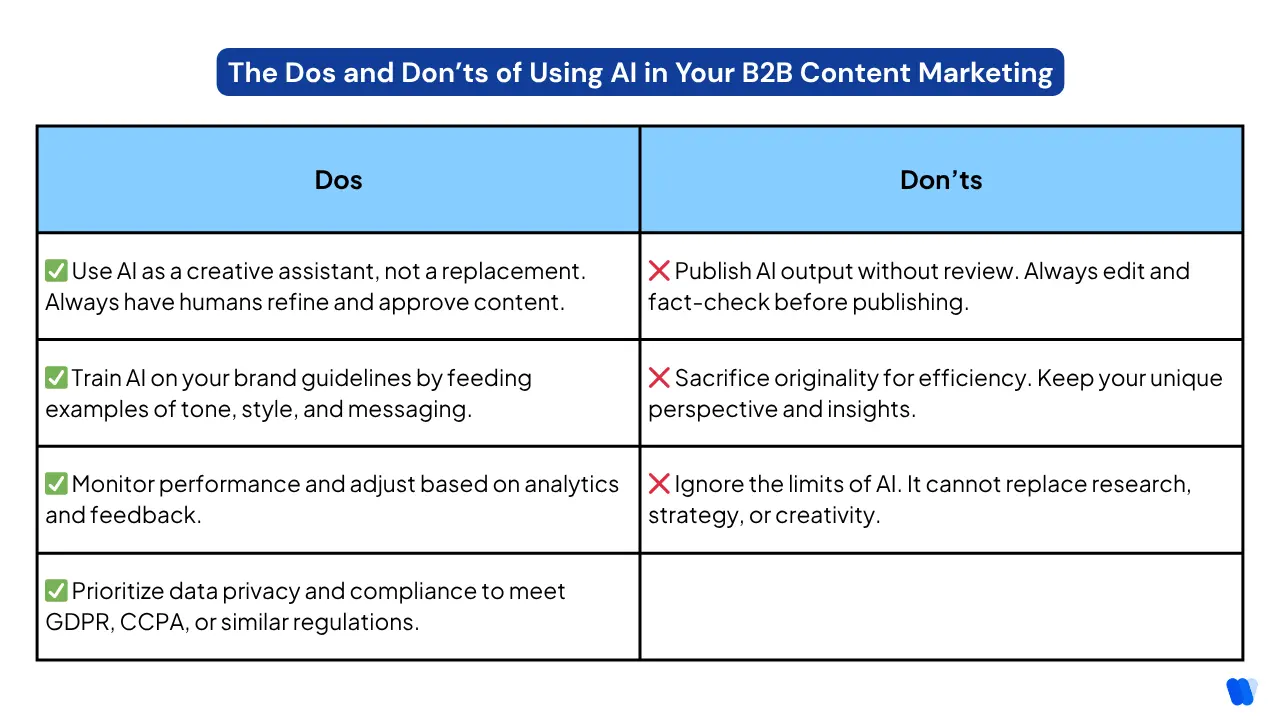
AI can draft, edit, and even recommend content ideas, but it lacks true creative judgment and empathy. One common mistake is publishing AI-generated content without human review. This can lead to bland, generic, or even inaccurate messaging that damages your brand.
Best practice: Use AI for the heavy lifting but always refine with a human touch to ensure authenticity and relevance.
2. Neglecting brand voice and originality
Another pitfall is allowing AI to dilute your unique tone. Many tools generate content in a neutral or overly formal voice that doesn’t reflect your brand personality. Over time, this can make your content feel impersonal or inconsistent.
Best practice: Train your team to edit for voice, and where possible, fine-tune your AI tools to understand your style guidelines.
3. Ignoring ethical and legal risks
AI tools often rely on large datasets that may carry biases or use content scraped without proper permissions. Failing to account for data privacy, copyright issues, or unintended bias can expose your company to legal and reputational risk.
Best practice: Understand how your tools source data, be transparent with your audience and follow privacy regulations like GDPR or CCPA.
Best Practices for B2B Content Teams Adopting AI
AI works best when you approach it strategically. Instead of trying to overhaul your entire workflow overnight or letting tools run on autopilot, B2B content teams should adopt AI in ways that complement their strengths and align with their goals.
Did you know?
Here are proven best practices to help your team get the most from AI without losing sight of what makes your content unique.
1. 1. Start small and test
It’s tempting to adopt AI across every part of your content process at once, but that often leads to confusion and wasted effort. Best practice: Pick one or two workflows, such as blog ideation or email personalization, and pilot AI there first. Measure results, refine your process, and expand to other areas once you’re confident.
1. 2. Train your team to collaborate with AI
AI is a tool, not a replacement for skilled creators. Teams that treat it as a replacement often end up with uninspired or off-brand work. Best practice: Upskill your team members so they know how to:
- Write better prompts to guide AI output
- Review and refine drafts for tone, accuracy, and compliance
- Spot when AI output introduces bias or errors
This helps keep your team in control of the final product.
1. 3. Choose the right tools for your needs
Not all AI platforms are created equal, and choosing the wrong one can waste time and money. Best practice: Evaluate tools based on:
- Ease of integration with your current systems
- How well they support your specific goals (SEO, personalization, analytics, etc.)
- Their data security and compliance standards
Where possible, test several tools before making a long-term commitment.
What are the Top AI Tools for B2B Content Marketing?
Not every AI tool solves the same problem. Some help you create content faster, others help you find the right accounts, and a growing category. The strongest B2B content stacks in 2026 cover all three layers.
Below is a breakdown of the most relevant AI tools for B2B content marketing teams, organized by what they actually do.
| Tool | Category | Why It Matters for B2B Content |
|---|---|---|
| Wellows | AI Search Visibility, Citation Tracking, Content Creation & Optimization | Tracks where your brand is and isn’t being cited across ChatGPT, Gemini, Perplexity, and Google AI Overviews. Runs line-level gap analysis against 20–50 cited competitor URLs per prompt, performs a site-wide cannibalization check before recommending any change, and turns those insights into publish-ready briefs and drafts through its built-in KIVA writing agent — all in one workflow. |
| Jasper | AI Content Creation | Helps B2B teams scale content output across blogs, emails, ads, and landing pages while maintaining brand voice. Supports structured content pipelines from first draft to final copy across multiple formats and channels. Used by over 70,000 paying customers and widely adopted across B2B content teams. |
| Copy.ai | Content Creation & GTM Automation | Combines AI content generation with go-to-market workflow automation. Useful for B2B teams that need to connect content production directly to sales sequences, outreach, and campaign distribution without switching tools. |
| Writer | Enterprise Content Governance | Built for organizations where content accuracy and brand consistency carry legal or compliance risk. AI guardrails prevent off-brand language, unapproved claims, and policy violations — making it essential for regulated B2B industries like finance, healthcare, and legal. |
| SurferSEO | On-Page SEO Optimization | Analyzes top-ranking competitor pages for a given keyword and produces a content score based on structure, keyword usage, and readability — helping writers optimize pages against what search engines currently reward. |
| MarketMuse | Content Strategy & Topical Authority | Crawls your entire domain, maps topical coverage, and scores each page by depth and semantic completeness. Particularly useful for identifying content clusters that are underserving your audience or leaving authority gaps competitors are filling. |
| HubSpot AI (Breeze) | CRM-Integrated Marketing Automation | Connects content, outreach, and lead data in one platform. Breeze Agents handle prospecting, content drafting, and social media management directly inside the CRM — reducing the number of tools teams need to manage campaigns end-to-end. |
| Demandbase | Account-Based Marketing & Intent Data | Uses AI predictive scoring to rank accounts by likelihood to convert, then aligns content and outreach to those accounts across multiple touchpoints. Strong fit for B2B teams running full-funnel ABM programs where content needs to reach the right decision-makers, not just generate traffic. |
| 6sense | Predictive Intelligence & Account Identification | Identifies accounts showing in-market buying behavior before they raise their hand. Helps B2B content teams prioritize which accounts to target with specific content, so production effort is directed at the highest-value opportunities rather than broad audiences. |
| Gong | Revenue Intelligence & Conversation Analytics | Analyzes sales calls and customer conversations to surface the objections, questions, and language patterns buyers actually use. B2B content teams use this data to build content that directly addresses real buyer concerns — making messaging more accurate and conversion-focused. |
| Drift | Conversational AI & Lead Qualification | Engages high-intent site visitors in real time using AI chatbots, qualifies leads without manual intervention, and routes conversations into sales workflows. Particularly effective at converting content-driven traffic into pipeline by engaging buyers at the moment of intent. |
| Lavender AI | Email Optimization for Outreach | Scores outbound emails in real time and recommends changes to subject lines, tone, and structure to improve reply rates. Useful for SDR and content teams running high-volume personalized outreach where small wording changes have measurable impact on engagement. |
Read More Articles:
- Write Content for People First, Not Search Engines: Write content that connects with people, not just algorithms.
- What Is AI Content: Understand how AI content works and where to use it.
- How Marketers Use AI Content in Their Workflow: See how marketers use AI to scale content workflows.
- Why Should we use AI Agents for writing: Learn why writers rely on AI agents to boost productivity.
- Top Content Marketing Statistics: Key stats shaping today’s content marketing landscape.
- Must-try AI prompts for content marketing teams: Use proven prompts to speed up content creation.
- LLM Content Creation Strategy: Create content optimized for AI and LLM visibility.
FAQs
AI segments B2B audiences using firmographics, purchase intent, and behavioral data from CRM and digital footprints. It then delivers personalized messages, offers, and recommendations tailored to each segment. Campaigns dynamically adapt content, timing, and channels in real time to maximize engagement.
Many firms struggle with fragmented and low-quality data that hinders AI accuracy and insights. Lack of skilled talent and internal resistance to change make adoption slow and inconsistent. Additionally, compliance with data privacy regulations and ethical concerns remain major hurdles.
AI identifies high-value accounts by analyzing propensity-to-buy and firm-level engagement signals. It enables hyper-personalized outreach at scale with tailored campaigns for each account. Ongoing insights into account behavior help optimize targeting and improve sales alignment.
AI predicts optimal send times, subject lines, and content based on recipient behavior and preferences. It enables dynamic personalization of email content to improve open, click-through, and conversion rates. Marketers can also test and optimize campaigns faster using AI insights.
B2B marketers need to understand data analytics, customer journeys, and how to craft effective AI prompts. Skills in interpreting AI outputs and aligning them with creative strategy are essential. Familiarity with AI tools and ethical considerations also enhances impact.
AI automates repetitive tasks like audience segmentation, bid optimization, and budget distribution across channels. It monitors campaign performance in real time and adjusts strategies for better ROI. Teams can focus more on strategy and creative work while AI handles execution.
Generative AI creates tailored content such as articles, emails, ads, and sales decks faster than manual efforts. It drafts chatbot responses and customer FAQs to improve support and engagement. Marketers also use it to generate creative visuals and personalize web experiences.
Founders are using AI to handle the repeatable parts of content production such as research, drafting, repurposing, and distribution. One brief becomes a blog, a LinkedIn post, an email, and a video script, all without adding headcount. The real constraint is not the tools. It is maintaining human review at every stage so output stays accurate and on-brand rather than just high-volume.
AI is changing B2B content marketing by enabling data-driven decisions, automating content creation at scale, and optimizing content for AI-driven platforms where citations matter more than rankings.
Final Thoughts
AI in B2B content marketing has already begun to transform how marketers plan, create, and deliver content. From streamlining workflows and improving SEO to enabling true personalization and smarter measurement, AI gives you the edge you need to stay relevant and competitive.
But technology alone isn’t enough. How you integrate AI into your strategy is what determines your success. Start by identifying where you can get the most impact, experiment thoughtfully, and always keep your audience at the center of your decisions.
Now is the time to take a closer look at your current approach and ask yourself: where could AI help you save time, improve quality, and connect more meaningfully with your buyers? The sooner you start, the sooner you can unlock the full potential of your team and your content.