LLM Content Creation Strategy is a structured methodology that uses Large Language Models (LLMs) to plan, draft, optimize, and repurpose content at scale. According to Semrush, 79% of businesses report an increase in content quality thanks to AI, and 68% achieve higher ROI when they adopt AI-enabled content workflows.
This guide explains how a Large Language Model Content Creation Strategy works, why it has become essential for visibility across both SERPs and AI-driven platforms, and the challenges and benefits of adopting such systems.
It also outlines a practical Strategy for Creating Content with LLM, showing how startups, content marketing agencies, and enterprise teams can combine automation with human oversight for scalability, credibility, and efficiency.
By integrating an AI-based Content Strategy into their operations, organizations can align publishing systems with semantic SEO signals, entity optimization, and user-intent-driven workflows to improve both discoverability and authority.
This article covers the core principles of modern content systems, including structured workflows, prompt engineering, governance, limitations, and measurement—while also addressing how teams can monitor performance over time and prevent issues like content decay providing a comprehensive playbook for teams adopting LLMs as co-creators rather than replacements.
LLM Content Creation Strategy Guide
This practical guide shows the workflows, tools, and reviews that make LLMs reliable in production—not just in demos.
You’ve seen the headlines: “How I used ChatGPT to 10x my blog output.” But what those threads skip is the hard truth: LLMs are only as good as your system.
Without clear prompts, editorial guidelines, and structured workflows, AI turns into a content-clutter machine, flooding your CMS with misaligned drafts.
This playbook solves that. It’s built on a proven LLM Content Creation Strategy—a framework that applies real-world systems, not just theory. We’ve distilled workflows, tools, and prompt tests into a structured approach you can actually deploy in production.
Whether you’re scaling an SEO cluster or launching a content engine from scratch, this guide provides a comprehensive LLM Content Creation Strategy that helps you build faster, smarter, and more human-grade content, with AI as your co-pilot.
Here’s what you’ll walk away with:
- LLM Content Creation Workflows: Build repeatable workflows from idea to publish.
- Understanding LLM Behavior: Know where they shine—and where they still fail.
- Prompt Engineering: Write instructions that guide output, tone, and structure.
- Humanizing AI Content: Add voice, credibility, and story without losing speed.
- SEO + LLM Integration: Align with search intent and Google’s evolving standards.
- Multimedia + Repurposing: Expand one post into multiple assets across platforms.
- Future-Proofing Strategy: Stay adaptive as AI, content tools, and ecosystems evolve.
1.Large Language Model Content Creation Strategy
An LLM Content Creation Strategy is a system for planning, drafting, editing, and repurposing content with large language models—fast, consistent, and human-approved.
This approach powers AI-driven content generation for blogs, long-form guides, and reports, making it easier to scale output while maintaining quality—and it improves even further when teams operationalize how to use AI for summarizing articles to turn research into accurate, context-rich briefs.
From brainstorming and drafting to editing and repurposing, LLMs now play a central role in how content is planned, created, and distributed. This shift represents a more structured Content Creation Strategy using AI, where automation is combined with human oversight to ensure brand credibility and trust.
But before we get into how to use them effectively, it’s essential to understand what they are and why they’ve become so pivotal.
1.1 What is LLM?
LLMs, Large Language Models, are deep-learning systems trained on massive datasets like books, articles, support docs, forums, and websites.
These models don’t actually “understand” language the way people do. Instead, they recognize patterns in words and phrases well enough to produce text that sounds fluent and relevant.
An LLM works by predicting the next most likely word in a sentence, based on billions of examples it has seen during training. This makes them the foundation of any modern LLM Content Development Strategy, enabling teams to generate first drafts, refine tone, and create multi-format assets more quickly than traditional methods.
The big breakthrough came in 2017 with the Transformer architecture, described in the paper Attention Is All You Need (Vaswani et al., arXiv). This allowed models to process entire sequences of words at once, dramatically improving how well they handle long, complex, and nuanced text.
Today, LLMs are the backbone of many LLM-powered content generation tools, which help businesses and creators draft, edit, and scale content more efficiently. Platforms such as an AI Search Visibility Platform for Startups further extend these capabilities by helping emerging brands align AI-driven workflows with stronger search performance and audience targeting.
When applied with the right LLM Content Generation Approach, these tools don’t just accelerate workflows—they ensure consistency, adaptability, and scalability, especially when paired with AI content optimization strategies that keep each page sharper across channels.
- KIVA— optimized for SEO-focused content clusters and briefs
- GPT-4 (ChatGPT) — general-purpose content drafting and ideation
- Claude — known for long-form, thoughtful writing
- Gemini — Google’s model designed for multimodal tasks
- Jasper — tailored for marketers and brand-safe content
- Writer.com — designed for enforcing brand voice and tone consistency
These tools shine within AI content creation strategies when your pages lead with concise, extractable answers—a core tactic in AI Overviews optimization.
1.2 Evolution of Content Creation
Here’s how modern strategies for content creation with AI evolved—from manual drafts to agentic workflows
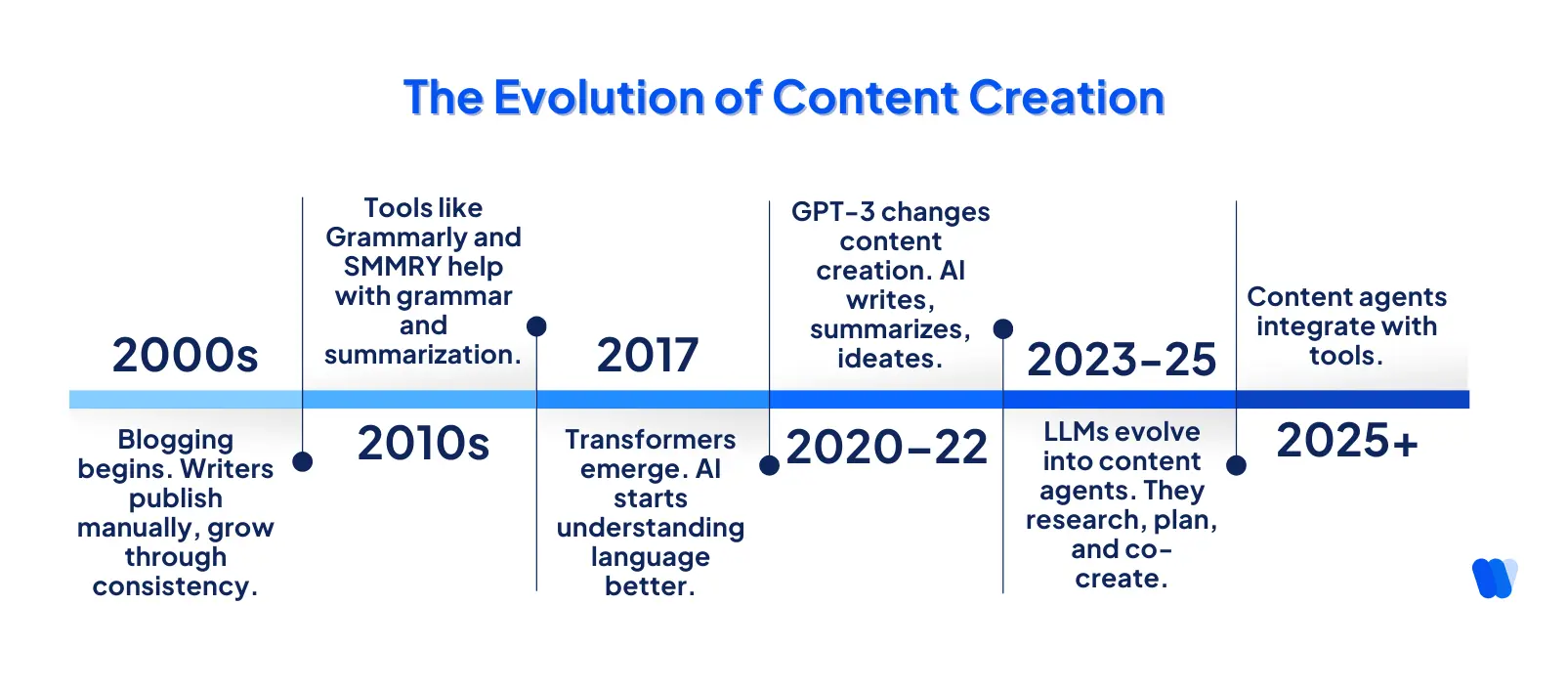
Before LLMs, content creation pipeline was slow and manual, built around blank-page brainstorming, static outlines, and line-by-line writing.
Automation tools brought some relief with templates and keyword-based structures, but these often sacrificed originality and voice.
The shift came when LLMs began co-creating with humans.
Instead of replacing the writer, they removed the bottlenecks: rapid ideation, structured outlining, and early drafts now happen in minutes.
Content operations evolved from a linear process to a systemized engine, where writers guide the strategy, and LLMs produce high-quality AI-generated content at scale.
This wasn’t just a productivity shift. It was a creative one…. strategy became modular. Production became iterative. Content creation became less about writing in isolation and more about orchestrating systems.
AI doesn’t remove the writer. It removes the blank page— a line every founder using AI should pin to their wall.
2. What are the Challenges of using LLMs for Content Creation?
Buzzwords are easy. Strategic use? That’s where the real work begins.
These models—GPT-4, Claude, Gemini, DeepSeek—aren’t just tools for speed. They’re shaping ideation, structure, and delivery across industries.
But with power comes risk.
Knowing how to prompt is useful. But knowing where AI breaks? Effective use of AI in content creation starts with great prompts—and a plan for where LLMs fail.
One major hurdle is that Google traffic patterns are evolving, partly due to ChatGPT changing how people look for answers online.
That’s why understanding their limitations and the ethical considerations behind their usage is essential before embedding them deeply into your workflow.
2.1 Limitations of LLMs
Despite their fluency, LLMs are still predictive engines, not reasoning agents. They don’t “know”—they guess, based on patterns in data. And when those patterns are flawed, outdated, or sparse, the results can mislead, misinform, or misalign with brand tone.
It’s not a bug—it’s how these models work.
But if you’re relying on AI for serious content, these missteps can break trust, dilute your voice, or worse, misinform your audience.
Here are the four pitfalls that derail an LLM-driven content creation strategy:
a. Hallucinations: Confident but False
LLMs often produce content that sounds accurate, but isn’t. This happens when the model “fills in the blank” with plausible, yet fabricated information.
Why it happens: It’s guessing, not recalling. The input was vague, or the answer isn’t well represented in its training data.
To avoid hallucinations…
- Be specific in prompts
- Use RAG (Retrieval-Augmented Generation)
- ALWAYS add human oversight
- ALWAYS verify AI-generated facts, especially in regulated, medical, legal, or financial content.
b. Repetition & Redundancy
Left unchecked, LLMs can loop phrases or echo the same structure, especially in long-form content.
This affects readability, professionalism, and brand authority, especially in long-form or batch outputs. You may see loops or robotic phrasing.
To avoid rrepetition and redundancy…
- N-gram blocking/repetition penalties
- Diverse prompts
- Context-rich input
c. Inconsistent Tone or Style
One sentence reads like academia. The next sounds like a tweet.
Yes, with LLMs, one minute, the copy feels like a textbook. Next, it’s channeling your social media intern. Without guidance, LLMs mix styles based on training data inconsistencies—an issue every LLM Content Creation Strategy must address to keep tone consistent across formats.
Why? Training data includes everything, from Reddit slang to legal docs.
To maintain the consistency in tone and style…
- Set tone in prompt
- Provide examples
- Edit for voice alignment post-output
If every blog starts to feel like a copy-paste formula—you’re not alone.
LLMs generate fast, but they also default to patterns.
Why It Matters: Google flags pages with similar structure and tone. Readers bounce from boring, repetitive copy.
To Fix:
- Vary prompts by tone, CTA, POV.
- Add real examples, metaphors, or insider stats.
- Humanize every output before you hit “publish.”
And pair that editorial review with the top AI content optimization tools to make sure structure, depth, and intent are sharpened along with the tone.
Think of AI as scaffolding—you still need to shape the building.
d. Off-Brand Output
Your LLM sounds good, but not like you.
Even with high-quality phrasing, LLMs might sound generic or unbranded. That’s dangerous in thought leadership, product copy, and brand voice-sensitive material.
To fix…
- Use tools like Writer.com
- Feed anchor content as examples
- Human QA for brand consistency
These are the most effective strategies to address common LLM issues—from hallucinations to off-brand tone.
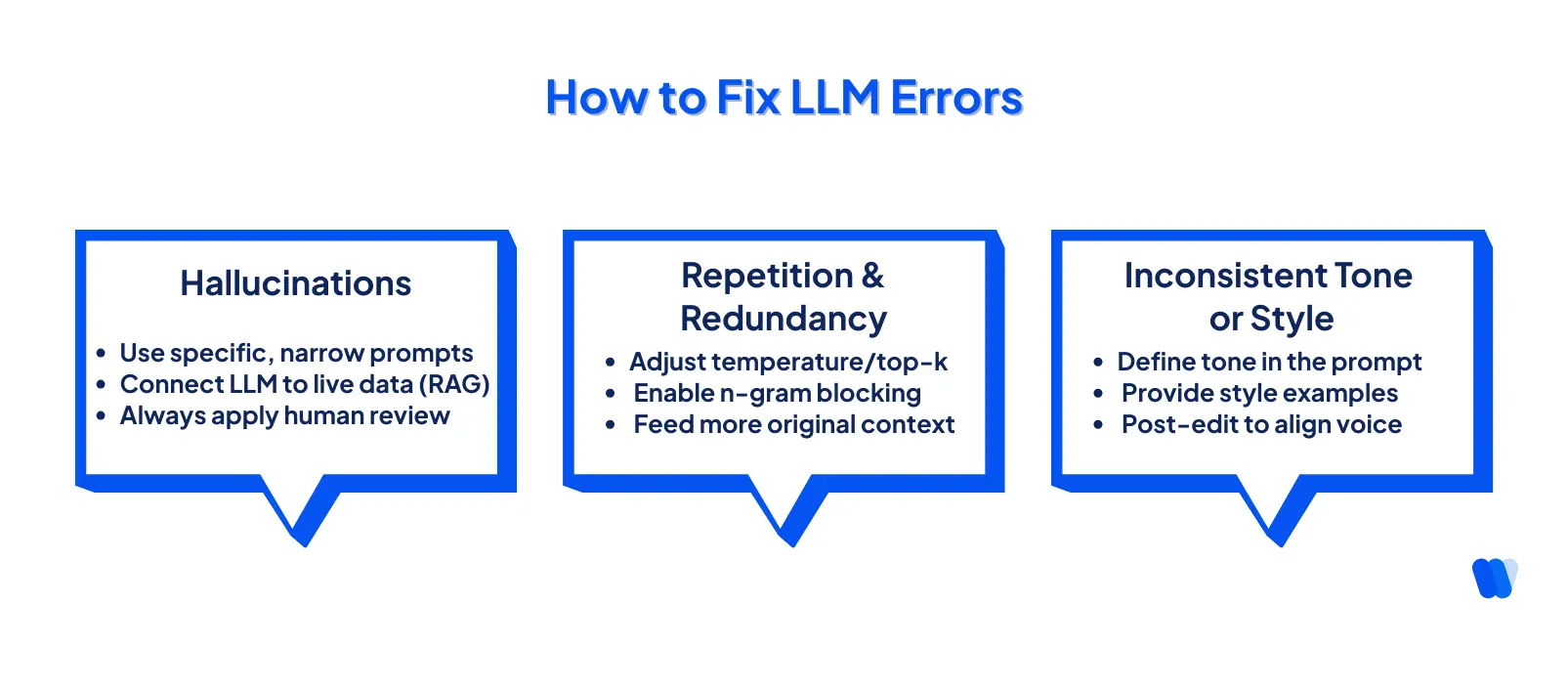
This creates a natural transition from technical limitations into risk management, and visually reinforces actionability—great for content retention.
2.2 Ethical Considerations when using LLMs for Content Creation
Let’s be honest—LLMs can move fast. Sometimes too fast.
And when you’re scaling content through AI, the biggest risk isn’t speed—it’s oversight.
Here are the three most urgent risk zones:
1. Bias in Representation
LLMs reflect the biases in the data they’re trained on. That means they can unintentionally reinforce harmful stereotypes or underrepresent marginalized voices.
Example: Assigning leadership roles to white males, and caregiving or assistant roles to women or people of color.
To avoid biases…
- Diverse reviewers
- Filtering tools like IBM’s AI Fairness 360
- Bias audits
2. Misinformation at Scale
A single hallucinated fact in a 500-word blog is bad. But the same error duplicated across landing pages, ebooks, and email sequences can damage brand integrity at scale.
LLMs can sound right and still be wrong, especially on topics like health, finance, or law
During the COVID-19 pandemic, some LLMs confidently generated unsafe or incorrect health advice when asked open-ended medical questions.
To avoid misinformation
- Prompt for sources
- Use live data APIs
- Mandatory human fact-checking
3. The “Black Box” Problem
LLMs can’t explain their decisions. Even developers struggle to decode why a specific output occurred, which limits accountability in regulated industries.
Example: You might ask: “Why did the model say this?”—and not find a clear answer.
That’s because LLMs work as opaque neural networks with millions (sometimes billions) of parameters. Even engineers can’t always pinpoint the reasoning behind a response.
Why? Transformer models are powerful but not interpretable.
To fix black box problem…
- Use explainability plugins
- Document prompts + decisions
- Keep humans in QA loop
Scale wisely. Review diligently. And always edit with intent.
It’s not just about what LLMs say—it’s about what we allow them to say on our behalf.
3. Building an LLM Content Creation Strategy: From Ideation to Execution
First, clarify what an LLM Content Creation Strategy is: a plan for using advanced text-generation tools to create and manage content more intelligently.
It helps you determine:
- What content your audience truly needs
- Where AI can save time without hurting quality
- How to preserve voice and credibility while using AI to draft, edit, or repurpose
Instead of writing everything yourself or hiring more headcount, you design a system where AI drafts the basics and you guide, refine, and approve—so the final output sounds human, fits the brand, and serves user needs.
A good LLM strategy increases output without sacrificing trust or thoughtfulness. By the end of 2025, using AI for content creation won’t be a competitive edge—it’ll be table stakes. Crucially, this isn’t about replacing creativity; it’s about scaling it and removing execution bottlenecks through human-AI collaboration—and validating what’s working with a ChatGPT Visibility Tracker as AI-driven discovery reshapes how content is surfaced.
Done well, lean teams can ship long-form content, microcopy, and social snippets faster—without diluting tone, accuracy, or nuance.
Ready to embed LLMs across the content lifecycle—from brainstorming to structure, SEO, editing automation, and measurement?
Before you scale this workflow, make sure your drafts don’t sound robotic or overly formal. Tools like a free AI Humanizer can lightly polish LLM outputs, making them more natural and conversational before you move into editing, optimization, or repurposing.
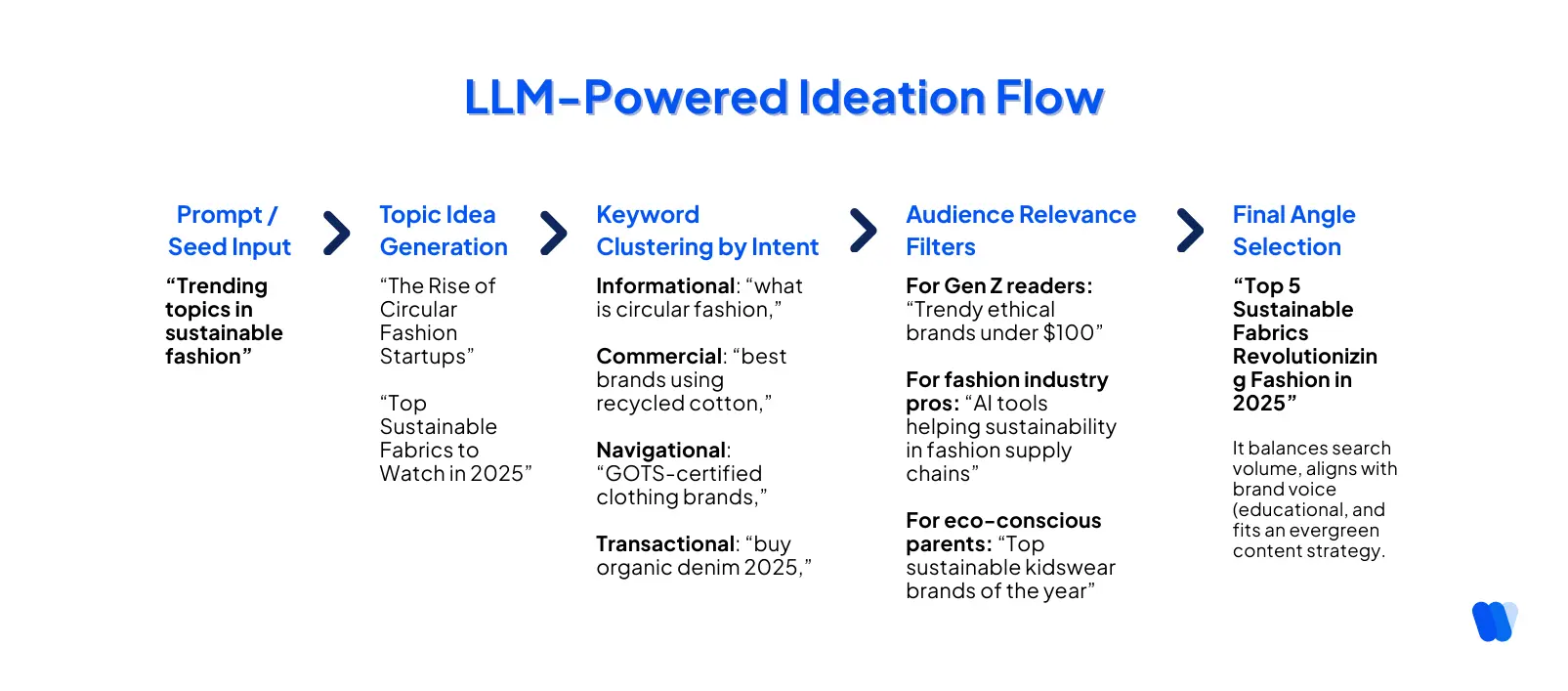
3.1 LLMs Across the Modern Content Creation Lifecycle
If idea droughts, rushed outlines, or half-polished drafts feel familiar, you’re not alone. LLMs now underpin content strategy from research to distribution.
At the research stage, combining LLMs with content research with AI methods ensures your topic selection, keyword targeting, and SERP clustering are grounded in real data rather than assumptions.
Use LLMs to power an end-to-end workflow:
- Ideate topics, angles, and clusters
- Plan briefs and outlines
- Create first drafts quickly
- Edit tone, grammar, and clarity
- Repurpose one piece into many
- Measure results with clear KPIs
Pair LLMs with SurferSEO or AnswerThePublic for data-enriched planning. Remember: AI can’t replace audience intuition.
3.2 Building an AI-Enabled Workflow: From Brief to Publish
Most teams bolt AI onto old processes; few design around it. That’s why many creators are moving toward AI agents. A smart LLM workflow uses fewer tools—better.
Planning & Outlining: Use ChatGPT or KIVA to scaffold outlines and briefs. Align SERP fit with Frase or SurferSEO.
Drafting: Generate first drafts with GPT-4, Claude, Jasper, or KIVA. Then humanize with your own insights, voice, and brand storytelling.
Editing & Voice Alignment: Apply GrammarlyGO, Writer.com, or Humanize AI to enforce tone, rhythm, and brand alignment.
3.3 Repurposing Without Burnout
Publishing once and moving on wastes potential. Repurpose strategically—turn one asset into many.
LLMs multiply reach, converting a single blog into 5–10 touchpoints:
- Blog → LinkedIn post / newsletter
- Video → Snippets, captions, email highlights
- Transcript → Summary article
Tools That Scale: Claude for transcripts, Copy.ai for carousels, Descript + Recast Studio for audio/visual reformatting. With the right prompt + tool pairing, one post can become 8+ high-performing assets.
- ChatGPT (GPT-4): Generalist powerhouse—fast, structured, adaptable
- Claude: Long-form whisperer—summaries, transcripts, nuance
- Jasper: Marketer’s muse—ideation and tone consistency
- GrammarlyGO: Lightweight editor—rephrase, clarify
- Writer / Acrolinx: Brand guardian—tone at scale
- Zapier + GPT: Ops automation—no-touch workflows
- KIVA: SEO brain-in-a-box—clustering, SERP structure, fast iteration
The best tool is the one that fits how your team thinks and creates.
What I Actually Create with LLM Workflows
LLMs help me produce and refine multiple content types:
• Photos & Graphics → Edited visuals, infographics, brand assets
• Videos → Short clips, explainers, repurposed snippets
• Social posts → LinkedIn carousels, X threads, captions
• Blogs & Guides → SEO clusters, long-form articles, reports
• Email & Newsletters → Campaign copy, nurture flows, roundups
• Web Copy → Landing pages, product FAQs
• PDFs & Lead Magnets → Checklists, ebooks, one-pagers
Each asset ties back to real projects—SEO campaigns, social launches, email sequences, or multimedia rollouts—so nothing stays as “just a blog.”
3.4 Using LLMs in Digital Marketing Content Generation Strategies
Imagine you’re the head of a digital marketing company, exploring ways to generate unique and engaging content for your clients. How could generative AI, specifically Large Language Models (LLMs) like GPT-3.5, be leveraged to achieve this goal? Here’s how:
1. Scaling Content Production
GPT-3.5 makes it easy to generate blogs, social posts, emails, and product descriptions at scale. This efficiency allows your team to handle high-volume demands without losing quality.
2. Maintaining Brand Consistency
By aligning outputs with brand style guides, GPT-3.5 ensures content across every channel reflects the right tone and identity, building stronger recognition and trust.
3. Personalizing Content
With access to customer insights, GPT-3.5 can adapt messaging for different audience segments, delivering relevant content that improves engagement and conversions.
4. Generating Creative Ideas
It acts as a brainstorming partner, suggesting campaign angles, headlines, and fresh themes to keep marketing strategies innovative and engaging.
5. Enhancing SEO Strategies
GPT-3.5 supports keyword research, clustering, and optimized drafting, helping content gain visibility and attract more organic traffic.
6. Automating Customer Interactions
Integrated into chat systems, GPT-3.5 can handle FAQs, offer product guidance, and provide quick support, improving customer satisfaction while reducing workload.
7. Analyzing Customer Sentiment
The model can sift through reviews and social conversations, highlighting trends and feedback that inform smarter content strategies.
8. Streamlining Multilingual Content Creation
With its advanced language abilities, GPT-3.5 enables content creation in multiple languages, helping brands reach a global audience without heavy translation costs.
3.5 Prompt Engineering: Inputs That Win
Great output starts with great prompts—and a clear plan for newsletters, blogs, and social.
Prompt Structure Framework:
- Role: Who should the AI emulate? (“You are a SaaS content strategist.”)
- Goal: What should it create? (“Write a 5-paragraph blog post.”)
- Tone: How should it sound? (“Witty, helpful.”)
- Format: What structure to follow? (“Use a bullet list + CTA.”)
You’re not just “talking to a tool”—you’re training a content copilot that can write, revise, and repurpose faster than any assistant. It’s the same rigor you’d use to brief a junior copywriter.
Why Direct Instructions Matter
Explicit prompts aren’t just about clarity—they shape outcomes.
• Precision → Keeps drafts on-topic and brand-safe
• Scalability → One clear ask fuels many outputs
• Accuracy → Reduces misinterpretation and guesswork
• Performance → Models respond sharper when guided
• Efficiency → Saves edits, retraining, and extra costs
Directives are your steering wheel—the sharper your map, the smoother the drive.
4. How Do You Ensure Quality When Using LLM-Generated Content?
LLMs can speed up content creation, but they can’t replace the human touch.
Many AI-generated blogs feel “fine”—but something’s always missing. As LLMs become standard, the real question is: How do we keep content human, insightful, and brand-aligned?
Because here’s the reality: speed without substance breaks trust.
And even the most fluent AI draft needs a human pass to add credibility, voice, and emotional resonance.
This section is your quality safeguard for the effective use of AI in content creation. We’ll explore where LLMs fall short, how human editors elevate the final product, and how to structure workflows that balance scale with soul.
4.1 Human Oversight in Practice
You’ve probably seen it: an AI draft that sounds perfectly polished—but misses the point entirely.
Fluency isn’t accuracy.
LLMs can write smoothly—but they also fabricate facts, misquote data, or miss nuance.
Google’s March 2024 update made this more urgent than ever. Designed to fight AI-generated “copycat content,” it led to a 40% reduction in mass-produced, low-value material in search results.
And beyond facts, AI lacks emotion. It can mimic tone, but authenticity and empathy still need humans.
Similar prompts = similar outputs = competing pages.
Avoid This By:
Assigning a unique focus to every blog
Adjusting your prompts by angle
Using tools like KIVA to detect cannibalization risk
Don’t publish more. Publish smarter.
They bring:
- Hallucination detection → Fact-checking exaggerated or fabricated claims
- Voice alignment → Rewriting flat text in your unique tone
- Cultural sensitivity → Avoiding tone-deaf phrasing or assumptions
- Creative judgment → Knowing when to reframe, cut, or challenge the content
In short: AI gets you to a draft. Humans get you to a final.
4.2 Transform AI Drafts Into Human-Grade Content
You’ve got a first draft from ChatGPT, KIVA, or Claude. It’s structured, relevant, and on-topic—but something’s missing.
It doesn’t sound like you. It lacks warmth, insight, and that polished flow readers recognize.
This section is about four areas where editorial refinement turns AI content into audience-ready assets—with strategies to elevate clarity, credibility, and connection.
Voice Alignment
AI often sounds neutral or robotic, rarely on-brand.
To fix, try…
- Example-based training → Feed the AI 2–3 pieces of brand content
- Tone-specific prompting → e.g., “Use a bold, witty tone like our Spring campaign”
- Line-by-line editing → Ask: “Would we actually say this?”
Personality = performance. Without it, even a grammatically perfect post falls flat.
Fact-Checking
AI guesses. That’s why hallucinated stats and fake sources are common.
To fix, do…
- Independent verification of all data and citations
- Zero trust in auto-linked sources
- A curated internal fact bank to keep outputs aligned
Remember the lawyers who cited fake cases? AI hallucinations can cost real credibility.
Structural Editing
Even when the facts check out, AI often jumbles the flow. You’ll see points repeated, logic skipped, or buried insights.
To fix, try…
- Clear narrative shaping → Hook → Build → Payoff
- Transitional phrasing to guide the reader
- Scannability tweaks → Bullets, bolds, short paragraphs
AI can’t fake lived experience—and Google’s Helpful Content System is watching.
Fix It With:
- First-person insight, author bios
- Real customer proof or SME quotes
- Credible sources, internal data
E-E-A-T isn’t optional. It’s the new bar for trust.
Emotional and Creative Depth
AI doesn’t feel. That’s your job.
To fix, try…
- Brand POV → Add opinion, perspective, or challenge
- Metaphors, analogies → Make abstract points relatable
- Emotional framing → “Save time” → “Focus on what matters most”
Quick Note: Tuning Gemini-in-Gmail to My Voice
When I use Gemini inside Gmail, I do three things:
• Prompt tone up front: “Warm, concise, first-person. One-line opener.”
• Seed examples: paste 2–3 of my past replies so Gemini mirrors cadence.
• Swap generic phrasing: “Kindly revert back” → “Could you let me know?”;
“As per our discussion” → “As we discussed”; “Please find attached” → “I’ve attached”.
If a draft feels off, I nudge with: “Tighter. Lose fluff. Keep my sign-off: ‘—Rameesha’.”
4.3 Building Human-in-the-Loop Systems
Even the most advanced LLMs need guardrails. That’s where Human-in-the-Loop (HITL) comes in—a workflow where AI drafts, and humans refine.
This isn’t about slowing things down. It’s about scaling content with integrity.
Whether you’re producing blogs, product pages, or thought leadership, a HITL model ensures that content remains accurate, on-brand, and emotionally intelligent.
Why HITL Matters More Than Ever
LLMs are fast, not flawless.
Without human oversight, AI can output content that’s:
- Incorrect (hallucinated stats or broken logic)
- Off-brand (neutral tone or missed messaging)
- Insensitive (unintended bias or tone-deaf phrasing)
Humans add empathy, nuance, and strategic judgment—the things machines can’t fake.
Where HITL Adds Value
- Accuracy → Spot fake stats, verify sources, clean up logic
- Tone & Voice → Align to your brand’s personality
- Inclusivity → Prevent bias, stereotyping, or microaggressions
- Editorial Clarity → Improve structure, flow, and audience fit
An AI SEO agent for startups, makes this seamless, offering AI-generated scaffolds that are ready for strategic human upgrades. Think of it as a shared canvas, where machines build the base and humans sculpt the final form.
AI drafts fast—but only you can make it trustworthy.
Spot the fakes, fix the tone, and bring your voice to the table. Whether it’s catching made-up stats, adding empathy, or ensuring brand alignment, your edit is the upgrade.
With you in the loop, content earns trust, not just clicks.
5. SEO Optimization with LLMs
We’re now living in a world where search isn’t limited to ten blue links on Google, as ChatGPT SEO increasingly shapes how users discover, evaluate, and trust information across AI-driven interfaces. People are turning to ChatGPT, Gemini, and Perplexity to research, compare tools, and make decisions—often without ever visiting Google.
This is where LLM SEO comes in.
In this new landscape, the most successful strategy is to write content for people first. Google’s 2026 algorithms and AI discovery engines are specifically designed to reward material that answers real human frustrations and offers “information gain”—insights that go beyond what a robot can summarize from existing web data.
This isn’t a side strategy anymore. It’s a visibility layer that can influence buyer decisions without a single search query. LLMs are already shaping how content is discovered, cited, and trusted.
In this section, I’ll map what that means for your content operations—and how to shift your mindset before you fall behind.
5.1 Rethinking SEO Workflows in an LLM-First Era
Old SEO workflows assumed that visibility meant optimizing for SERP and watching the CTR. That model is incomplete now.
Understanding how to use PAA data can bridge this content gap by helping you anticipate conversational questions and topics LLMs frequently highlight, guiding your content toward greater visibility in AI-driven interactions.
LLMs don’t crawl the web like Googlebot. They either retrieve content from trusted sources (via RAG) or rely on pre-trained data. That means your content needs to be:
- Structured clearly (homepages, product pages, FAQ)
- Distributed across platforms LLMs index and cite (e.g., Reddit, Medium, YouTube)
- Referenced and linked by other trusted domains
The shift means your content strategy must now prioritize:
- Entity consistency across platforms
- Simplicity and clarity in messaging
- Cross-channel distribution, not just on your own blog
5.2 Common Pitfalls to Avoid in LLM Optimization
Mindset Mistake: “LLM SEO is a cherry on top.”
It’s not. It’s now a part of your main SEO engine.
Avoid these typical missteps:
- Publishing content without ensuring it gets indexed or cited across UGC or authority platforms
- Writing vague pages that LLMs can’t ground (e.g., “We redefine digital transformation”)
- Ignoring Wikipedia, G2, Capterra, or places where LLMs source data
This reverse-engineering process can directly fuel your next content piece or page update.
By 2025, 90% of web content could be AI-generated (Europol).
That means:
• Volume isn’t an advantage anymore
• Sameness kills performance
What to Do:
• Inject lived experience, internal data, or team stories
• Use KIVA’s ChatRadar or Social Insight modules for real-time POVs
Don’t settle for “SEO-optimized.” Aim for story-driven content only you can tell. The real value of AI content optimization lies in turning generic drafts into stronger, story-driven, citation-worthy pages shaped by real gaps and clearer intent.
5.3 What LLM-Focused SEO Success Actually Looks Like
There’s no universal LLM score (yet), but here’s how you can benchmark progress:
| Success Indicator | What It Means |
| Your brand appears in LLM answers | Mentioned in “best tools” or definition prompts |
| High citation volume from UGC/third-party sources | LLMs are learning from trusted mentions |
| Branded queries trending upward | More people discover you via LLM-first journeys |
Document the tone, citations, and gaps—it’s your LLM visibility baseline.
If you’re a startup or lean team, check out How Startups Can Build AI-Visible Marketing Strategies for the Generative Era — a practical playbook to complement the strategy here.
6. Is Your AI Content Designed to Engage Humans?
Even the smartest LLM draft can feel like a wall of text—technically sound, yet draining to read.
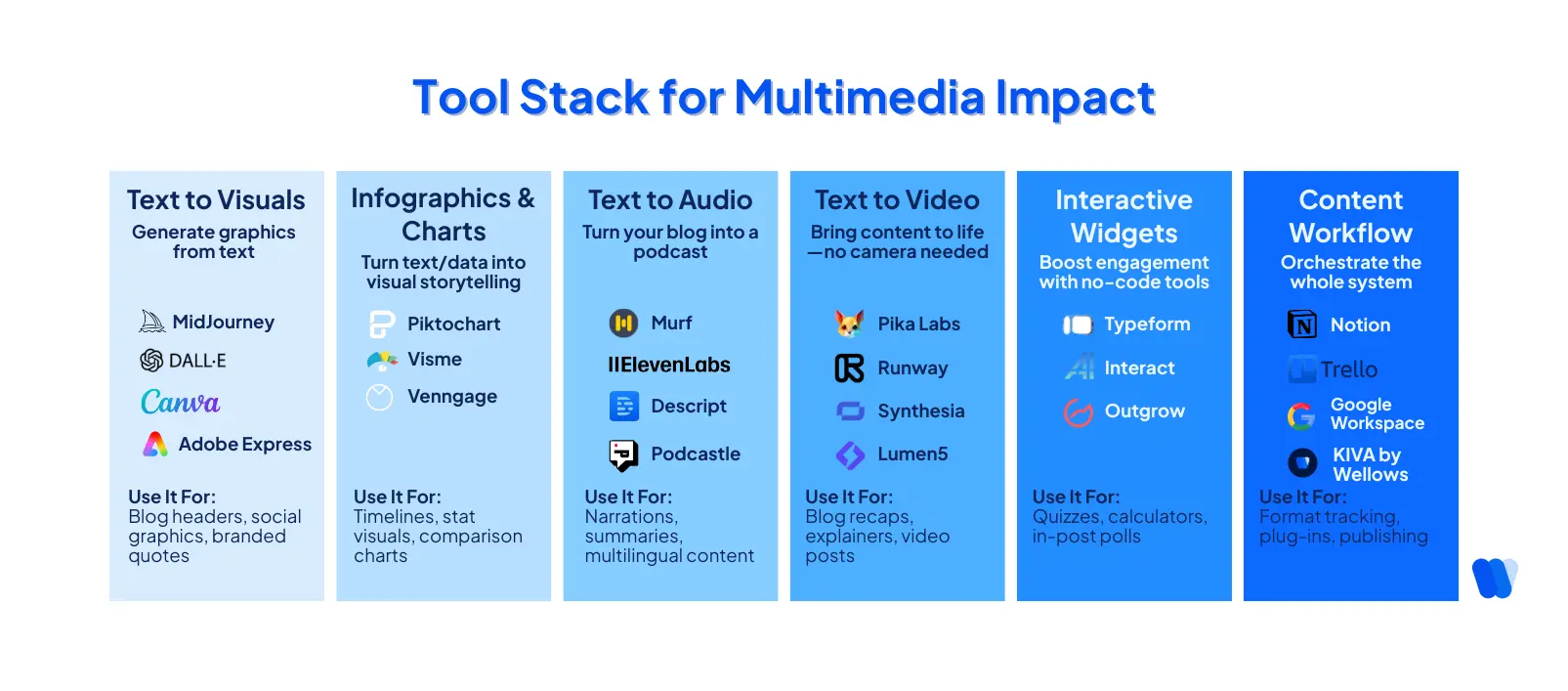
That’s where multimedia comes in. In 2025, content isn’t just about writing well—it’s about delivering the message visually, interactively, and memorably.
From infographics to audio snippets, explainer videos to dynamic CTAs—multimedia makes your AI content feel real, not robotic.
This section shows how to use visuals, sound, video, and interactivity to turn LLM output into experiences your audience actually stays for.
6.1 Improve UX
If you’ve ever clicked out of a long blog halfway through—despite good writing—it probably wasn’t the words. It was the wall of text.
Multimedia isn’t a “nice to have” anymore. It’s essential for turning AI content into something humans actually read, watch, share, and remember.
LLMs tend to output dense paragraphs. Without visual breaks, readers burn out.
Adding structure—headers, quote cards, icons, white space—transforms cognitive load into clarity. It’s not design fluff. It’s usability.
| Without Visual Support | With Visual Breakers |
| Wall of text, 500+ words with no breaks. | Divided sections, quote cards, CTA banners, infographics |
| Low time-on-page | Increased scroll depth, click engagement |
6.2 Use Interactivity to Turn Readers Into Participants
When your readers do something—not just read—they stay longer, remember more, and convert better.
That’s where interactive content outperforms static formats. Whether it’s a quiz, a survey, or a calculator, these tools turn passive scanning into active participation.
Add these elements:
- Polls mid-article (e.g., “Which LLM use case do you rely on most?”)
- Inline quizzes to test topic understanding
- Mini ROI or “LLM Readiness” calculators for product-led content
- Interactive infographics that respond to user clicks
However, with the rise of zero-click searches, users often find answers directly on the results page without clicking anything, making it even more important to optimize for visibility, not just rankings.
Bonus: LLMs can help generate quiz questions, calculator logic, and CTAs—all tailored to your reader’s journey.
6.3 Add Emotion, Tone, and Humanity with Multimedia
Let’s be honest—AI is smart, but it can still feel sterile. What’s often missing is the warmth, tone, and emotional connection that only human-centered design can deliver.
That’s where multimedia plays a transformative role. A friendly face, a relatable voice, or a tailored illustration can turn information into emotion and information retention.
Make your AI content feel personal with:
- Testimonial clips or voiceovers from your team
- Founder videos to build authority
- Custom illustrations for complex ideas
Multimedia isn’t just visual dressing. It’s what helps your reader feel something.
6.4 Repurpose AI Content Across Formats (Fast)
Tomorrow’s content won’t just be repurposed. It’ll be user-adapted.
Think tools like BuzzSumo or Curata adjusting content format based on consumption habits:
- Visual learner? You see a chart.
- Commuter? You get a narrated snippet.
- Researcher? You get a shareable infographic.
Smart teams don’t just write—they reformat. One LLM draft can fuel multiple assets in 2 days or less.
From One AI Draft to a Full-Funnel Multimedia Campaign
One article, six formats, five channels—executed in two days:
- Blog → Video: RunwayML + Synthesia → 2-min avatar video
- Stats → Carousel: Pulled quotes + Canva → LinkedIn carousel
- Tips → X Thread: Emojis, CTA, high-scroll post
- Text → Audio Clip: ElevenLabs + Mubert → Podcast
- Tips → PDF Guide: Formatted checklist → Lead magnet
One LLM = Maximum reach × Minimum lift.
7. What’s Next for LLM Content Creation Strategy in 2025 and Beyond?
AI is no longer just a writing tool. It’s a strategic co-pilot, shaping how content is planned, produced, optimized, and even governed.
By 2025, nearly 50% of all digital content tasks will be AI-assisted, but with speed comes responsibility. The brands that’ll lead aren’t just using LLMs—they’re integrating them into smart systems that blend human strategy with machine execution.
This section examines the next wave of LLM evolution, exploring its implications for content creators, strategists, and marketers alike.
7.1 From Tool to Teammate: The New Role of LLM
From prompt-based helpers to embedded collaborators—LLMs are moving upstream.
Gone are the days when you’d type a prompt and wait. Now, LLMs live inside your CMS, email editor, analytics stack, and design suite—offering proactive help, context-aware drafts, and real-time optimization.
Let’s look at the biggest shifts:
Real-Time, Context-Aware Generation
Thanks to Retrieval-Augmented Generation (RAG), LLMs now pull from your internal docs, live data, and product wikis.
No more hallucinated answers. No outdated references.
→ RAG-enabled LLM pulls the latest copy, not guesses from public web data.
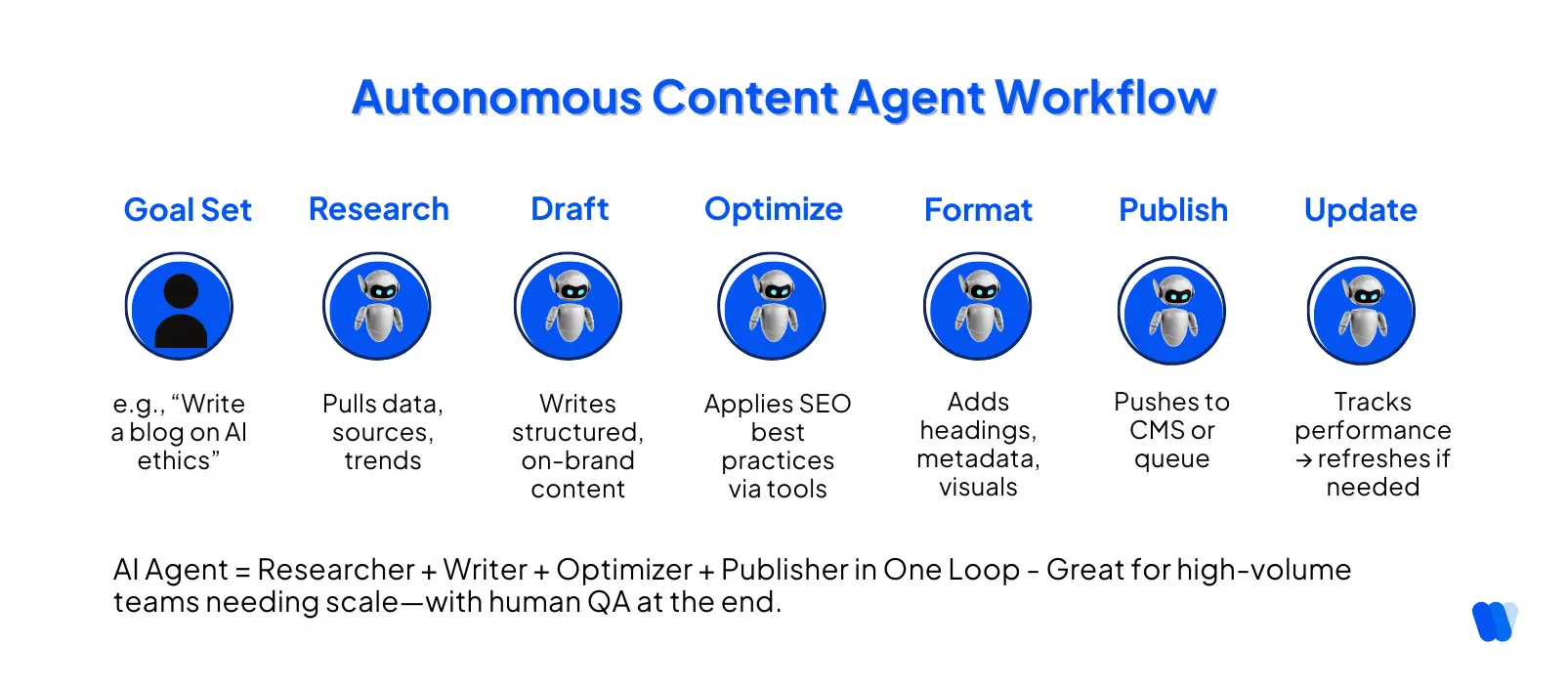
Rise of Autonomous Content Agents
These aren’t bots. They’re mini strategists.
Once briefed, they can:
- Analyze performance
- Generate multi-format drafts
- Optimize for SEO
- Auto-schedule and tag content
LLMs don’t just write—they plan, execute, and learn.
Built Into Your Tools, Not Outside Them
Why switch tabs? AI now lives inside your daily stack:
The best AI isn’t another tab—it’s where your team already works.
- WordPress (GPT Plugin): Suggests H1s, meta tags, and readability edits in real time.
- Canva Magic Write: Auto-generates captions for each graphic
- Notion AI: Turns notes into ready-to-publish content
- KIVA: Creates briefs, keyword clusters, and SEO-ready outlines, right where your team works.
This isn’t future-facing tech—it’s already running inside your ops.
LLMs are no longer tools. They’re teammates—shaping, not just supporting your workflow.
7.2 What’s Changing in the Ecosystem
The AI shift isn’t just about how content is made—it’s about how it’s found, cited, trusted, and governed.
From search behavior and AI summaries to rising regulation, here are four ecosystem shifts redefining the future.
Declining Trust
As generative content floods timelines, reader skepticism is skyrocketing. A 2024 Deloitte survey found:
- 70% say AI makes it harder to trust what they read online
- 84% support mandatory labels for AI-generated content
In a world where anyone can hit “generate,” credibility is your real differentiator.
What to Do?
- Add “Reviewed by [editor name] with GPT-4/KIVA assistance” style labels
- Include author bios with credentials and links to real-world experience
- Reinforce your brand voice so every post feels distinctly human
Transparency builds trust. The more open you are about your process, the more reliable your content becomes.
Search is Becoming Conversational & Contextual
With Project Astra, Google is moving even closer to dialogue-based, multimodal search, where visual, audio, and contextual input reshape how results are generated and ranked.
With the rise of platforms like Perplexity AI, You.com, and Google’s Search Generative Experience (SGE), users are getting summarized answers instead of traditional SERPs.
This means the homepage or blog isn’t always the destination—the AI’s summary box is.
To win visibility, you now need to create content that’s clear, structured, and referenceable—content thatAI tools choose to cite when constructing their answers.
SGE Is Redefining SEO Success
The days of optimizing purely for featured snippets are fading. With Google’s SGE rolling out, AI-generated summaries appear before any organic link, and often replace the need to click through.
Being cited by AI models—not just indexed—is now the highest form of visibility.
- Use Schema Markup – Help AI understand your content’s structure.
- Write Definitive Answers – Summarize clearly within the content (think mini-explainers).
- Use Structured Q&As – AI tools pull answers from FAQ-style formatting.
- Avoid Keyword Stuffing – Prioritize clarity, context, and topical depth.
- Use Semantically Related Terms – This reinforces content authority across related concepts.
Rise of Agentic Workflows
The future of content marketing isn’t just AI-assisted—it’s AI-managed.
Agentic workflows refer to AI systems that don’t just wait for commands—they act proactively. These LLM-based systems analyze, plan, draft, and distribute content with minimal human input.
Think of them as your new execution layer—while you set strategy, AI handles the “doing.”
Example Workflow:
- AI reviews analytics → Identifies top-performing and underperforming posts.
- It drafts content to fill topical gaps or build on successful pieces.
- Publishes to your CMS, schedules promotion, and notifies the team in Slack or ClickUp.
- Monitors performance and suggests future updates.
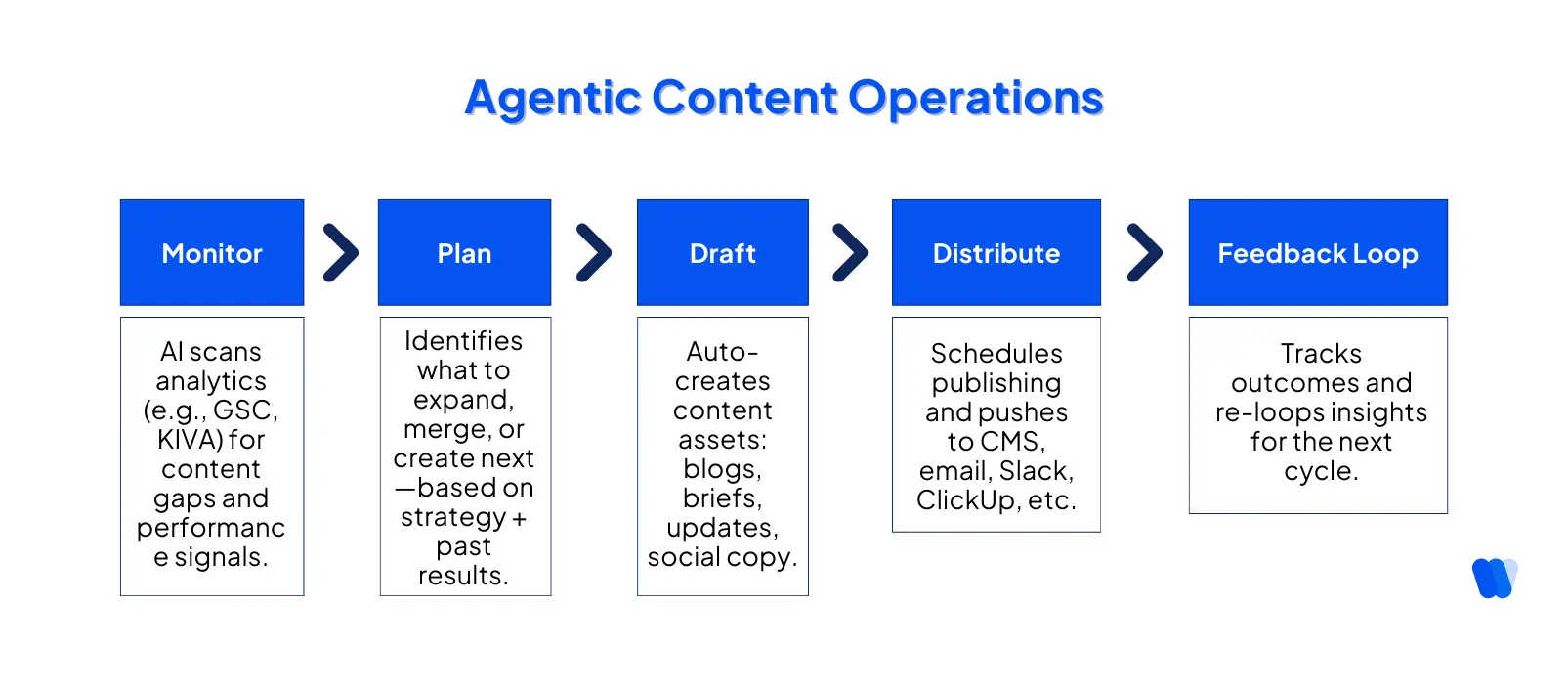
Strategic Takeaway: This isn’t a prediction—it’s already happening. And brands that build agentic workflows today will gain speed, scale, and strategic lift.
The Legal Landscape Is Tightening
Gone are the days when AI could operate in the shadows—transparency, labeling, and accountability are quickly becoming legal requirements. Governments ar responding to rising concerns about misinformation, plagiarism, and authorship ambiguity by introducing policies that reshape how content teams must use LLMs.
With laws like the EU AI Act and California’s AI Transparency Act (2025):
- You must label AI-generated content
- Watermarking may become mandatory
- Full automation without edits? Risks copyright issues
That means if you’re publishing raw LLM output without edits, you could be forfeiting ownership.
- Label outputs (e.g., “Drafted with GPT-4, edited by Julia”)
- Use human-in-the-loop (HITL) for all public-facing content
- Track prompt logs & training datasets
- Train team on legal/IP boundaries.
7.3 Future-Proof Your Content Strategy
To thrive in the AI-powered future, you need more than productivity hacks. You need new roles, smarter tech, stronger governance, and a creative culture that learns fast and iterates often.
Tools come and go. Workflows evolve. But what endures is your ability to blend speed with trust, scale with insight, and automation with human nuance.
Hybrid Teams (AI + Human Roles)
The future of content isn’t a human-only or AI-only process—it’s a hybrid system where humans drive the voice and insight, and AI accelerates the execution.
New Roles You’ll Start Seeing More Often:
- Prompt Strategist: Engineers precision prompts that deliver better AI outputs
- AI Content Editor: Specializes in revising LLM drafts for tone, structure, and accuracy
- Knowledge Trainer: Maintains your proprietary data sources and feeds contextual inputs to the AI
- AI handles the heavy lift: brainstorming, outlining, summarizing, repurposing
- Humans refine the voice, point of view, emotional depth, and final structure
AI SEO agent, like KIVA, supports this model by offering pre-scored outlines, branded tones, and intent-aligned keyword briefs—giving teams a smarter starting point every time.
Proprietary Intelligence
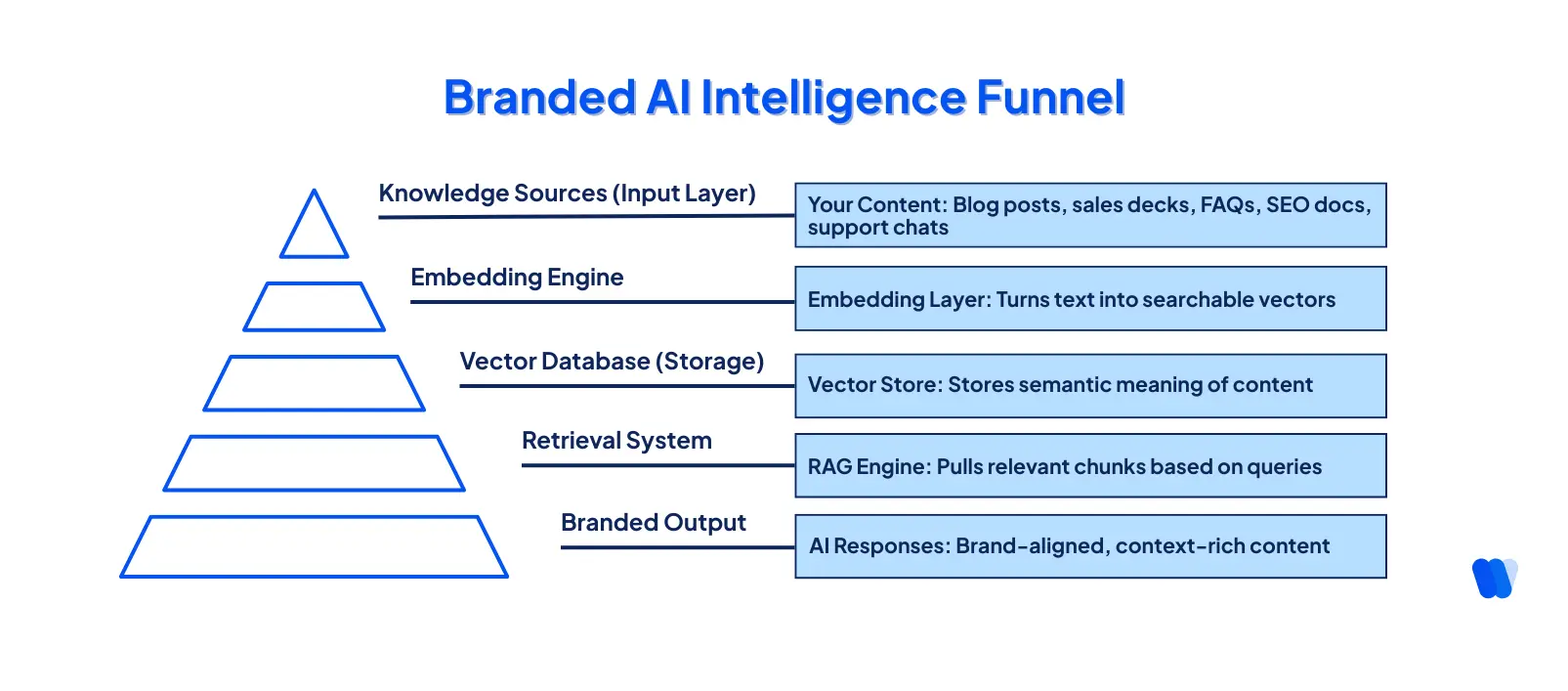
Most marketers use open models like ChatGPT or Claude, but these tools don’t know your brand, your products, or your audience. That’s where training ChatGPT on your SaaS product knowledge comes in. Done well, you move from generic outputs to content that sounds fluent and brand-aligned.
Here are the main paths:
1. Custom GPTs (fastest)
- Inside ChatGPT Plus → “Create GPT.”
- Upload product docs, FAQs, and style notes.
- Define tone + rules, test on real tasks.
⚡ Best for: Quick setup, marketing + support drafts.
2. Fine-Tuning (best for patterns + style)
- Train on JSONL prompt→answer pairs (50–500).
- Capture tone, structure, CTA patterns.
- Requires CLI + API access.
⚡ Best for: Consistent brand voice in FAQs, microcopy, support macros.
3. Retrieval-Augmented Generation (RAG)
- Connect live docs, wikis, changelogs.
- Model retrieves fresh data at answer time.
- Index with vector DBs, enforce citations.
⚡ Best for: Fast-moving products, real-time support, SEO content.
4. Third-Party Platforms
Tools like Pickaxe or Chatbase let you upload docs or scrape sites to create custom AI assistants.
⚡ Best for: Low-code teams, quick pilots, embedding chatbots in SaaS workflows.
Guardrails to Add:
- • “If uncertain, ask or cite.”
- • Never auto-generate pricing promises.
- • Always prefer product docs over memory.
- • Flag outdated features.
You can also structure this knowledge into well-defined content blocks, see how in our guide on Improving Your Content Through Chunk Optimisation for Search Visibility.
Governance Without Bottlenecks
AI content creation is fast. But with speed comes risk. That’s why future-ready brands are developing lightweight but strong content governance systems—ones that ensure quality, consistency, and compliance without killing creativity.
Governance Framework Essentials
- Human-in-the-loop policy: All AI content must be reviewed before publishing
- Content labeling: Add lines like “Drafted with GPT-4, Edited by [Team Member Name]” to blog footers
- Style & tone filters: Tools like Writer.com or Grammarly Business let you enforce brand-safe rules, banned terms, and tonal guidance
- Editorial checklists: Use collaborative QA templates to vet factuality, links, tone, and formatting
Culture of Experimentation
Adopting AI tools isn’t enough. The teams that lead in content innovation will be the ones who experiment often, learn quickly, and share what works.
This means building a low-friction, high-learning environment where anyone—from interns to CMOs—can explore, prompt, and improve AI usage daily.
Ways to Encourage Internal AI Fluency:
- Launch “Prompt Playgrounds” → Dedicated sessions to test prompt variations, tones, or formats
- Share wins and weirdness → A Slack or Notion board for “Best Prompts” and “Unexpected AI Fails”
- Host AI Sprints → Set 48-hour experiments (e.g., “Repurpose this blog into 3 formats using different tools”)
- An active #ai-chat or #prompt-lab Slack channel
- Saved prompt templates for blogs, briefs, and video scripts
- Weekly shout-outs for creative AI wins
FAQs
Speed, consistency, and scale—plus stronger briefs and easier repurposing—when paired with human QA.
LLM strategy is system-first and prompt-driven. It measures velocity and quality, not just calendar output.
Map audience jobs → cluster topics → generate briefs → set HITL review → iterate on KPIs like time-to-publish and engagement.
LLMs (Large Language Models) use deep learning to co-create content, accelerating ideation, drafting, editing, and repurposing across formats.
Common challenges include hallucinations (false but confident outputs), inconsistent tone, bias in training data, lack of governance, and difficulty measuring ROI. These can be solved with Human-in-the-Loop (HITL) reviews, clear prompt frameworks, and strong editorial oversight.
LLMs support every stage: brainstorming ideas, drafting outlines, generating first drafts, repurposing formats, and assisting in SEO optimization.
Yes, with the right prompts, LLMs tailor tone, structure, and message based on audience, funnel stage, or content format.
LLMs can help with a wide range of content creation tasks, such as drafting blog posts, social media captions, email campaigns, website copy, product descriptions, and video scripts. They can also assist with editing, summarizing, repurposing, and brainstorming creative ideas.
Conclusion
AI didn’t just speed up content—it transformed how teams create. Prompts replaced brainstorms, and drafts now arrive in seconds. However, speed without strategy quickly loses value.
This is why an LLM Content Creation Strategy matters. It organizes workflows, ensures consistency, and scales production, while humans maintain trust, tone, and truth. Together, AI and human input create a balanced system that delivers credibility and performance.
Furthermore, the real advantage lies not in producing more content, but in building intent-driven systems that connect with audiences, strengthen visibility across SERPs, and adapt to AI-driven platforms.
In addition, tools like KIVA extend your team’s capabilities. They amplify editors, empower strategists, and align your brand voice across every channel while reducing execution bottlenecks.
Therefore, build smarter and lead bravely. Let AI handle repetitive tasks while your team focuses on content that resonates, earns trust, and drives measurable impact.
Fast is easy. Real is rare. Choose real—with a structured LLM Content Creation Strategy guiding every step of your workflow.