To use AI to find content gaps, you simply let it compare what you’ve already published with what your audience is still searching for but not finding on your site.
If you’ve ever noticed that some posts pull steady traffic while others get ignored, gaps are often the reason. These are missing topics, questions, or formats that people expect you to cover, but your content library skips.
Before AI, spotting those gaps meant digging through keywords, competitor pages, and forums by hand. Now AI can scan all of that in minutes, surface what you’re missing, and help you plan the next best pieces with way less effort.
Uncover your missed opportunities and start closing citation gaps.
See how leading teams analyze missed opportunities and surface untapped visibility insights.
In this post, I will break down what content gaps are, why they matter for SEO, and how you can use AI to uncover and close them with purpose. Whether you are improving old content or planning something new, this guide will help you turn insight into action.
- Content gaps are topics or questions your audience expects, but your content does not cover yet.
- AI helps uncover these gaps faster by analyzing your pages, competitors, and keyword data.
- Types of gaps include keyword, topical, format, and intent gaps.
- AI tools like ChatGPT or integrated SEO platforms simplify discovery and prioritization.
- Closing gaps improves SEO, engagement, and authority while reducing manual effort.
- Pair AI insights with your content strategy and editorial judgment for best results.
What Is Content Gap Analysis And How AI Helps?
Content gap analysis is the process of finding important topics, keywords, or questions your audience is searching for, but your site does not cover well yet. These gaps show where you are losing potential visibility to competitors.
It matters for SEO because filling gaps improves topical coverage and intent match and when you detect SEO content decay, you can protect the visibility you already earned. When your content answers the full set of questions users expect, Google is more likely to surface your pages across search results, snippets, and related queries.
Today, the easiest way to spot those blind spots is to use AI content optimization strategies to find content gaps. AI can scan your existing pages and competitor content in minutes, then cluster missed themes into clear opportunities you can act on.
In 2025, about 75% of marketers use AI to reduce manual SEO work like keyword research and on page optimization, which shows how standard AI driven gap discovery has become (SeoProfy, 2025).
What Are Content Gaps In SEO?
A content gap is a topic, keyword, or question your audience is searching for, but your website does not cover at all or does not cover well enough. Because the gap exists, Google shows competitor pages instead of yours.
Short example: If people search “low impact cardio workouts” and your fitness blog has no page for it, that missing topic is a content gap.
Why Content Gaps Matter For Search Growth
- SEO value: Filling gaps helps you show up for more relevant queries and expand your organic reach.
- User value: You answer the exact questions people still have, which keeps them engaged and moving through your site.
- Authority value: Complete topic coverage builds topical depth, so Google sees you as a stronger source.
- Conversion value: When you cover real pain points fully, readers trust you more and are more likely to take action.
In short, content gaps are lost search space. Fixing them improves visibility and performance across your topic cluster.
4 Types Of Content Gaps
Here are 4 types of content gaps:
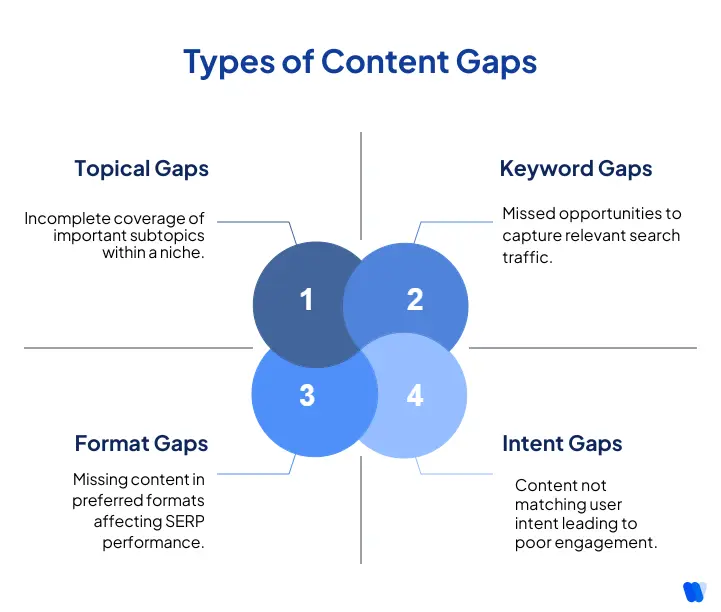
- Keyword gaps
These are search terms your competitors rank for, but you do not. They are missed keyword opportunities.
Example: A fitness blog doesn’t rank for “low-impact cardio workouts” while competitors do.
- Topical gaps
These happen when your content covers a topic but skips important subtopics users expect.
Example: Writing about email marketing but never covering “email segmentation.”
- Format gaps
You are missing content formats that users and Google prefer, such as videos, checklists, FAQs, or infographics. This affects how well you match SERP expectations.
Example: Your guide ranks lower because competitors use a how-to video with step-by-step visuals.
- Intent gaps
Your page does not match what users are actually trying to do, so they bounce or ignore your result.
Example: Targeting “how to start a podcast” but offering only product reviews, not actual setup guidance.
Can AI Help Me Discover What Topics I’m Missing In My Content Library?
Yes. When you use AI to find content gaps, it scans what you’ve already published, compares it with real search demand and AI visibility signals, and then surfaces the topics and questions your audience still can’t find on your site. These “missing topics” are often your fastest visibility wins because they show exactly what you should cover next.
In real audits, missing topics usually look like this:
- Competitor-only coverage: competitors are visible for subtopics you have not published yet.
- Unanswered follow-up questions: your page covers the main query but skips the next questions people ask.
- Format gaps: others win space with FAQs, comparisons, or step-by-step sections you do not include.
- Intent gaps: your content stays informational while searchers want solutions, tools, or best-option pages.
Wellows makes this discovery product-led and practical. It unifies your Google search data and AI visibility signals, so you can see where your brand is not showing up across both traditional SERPs and AI-driven search surfaces.
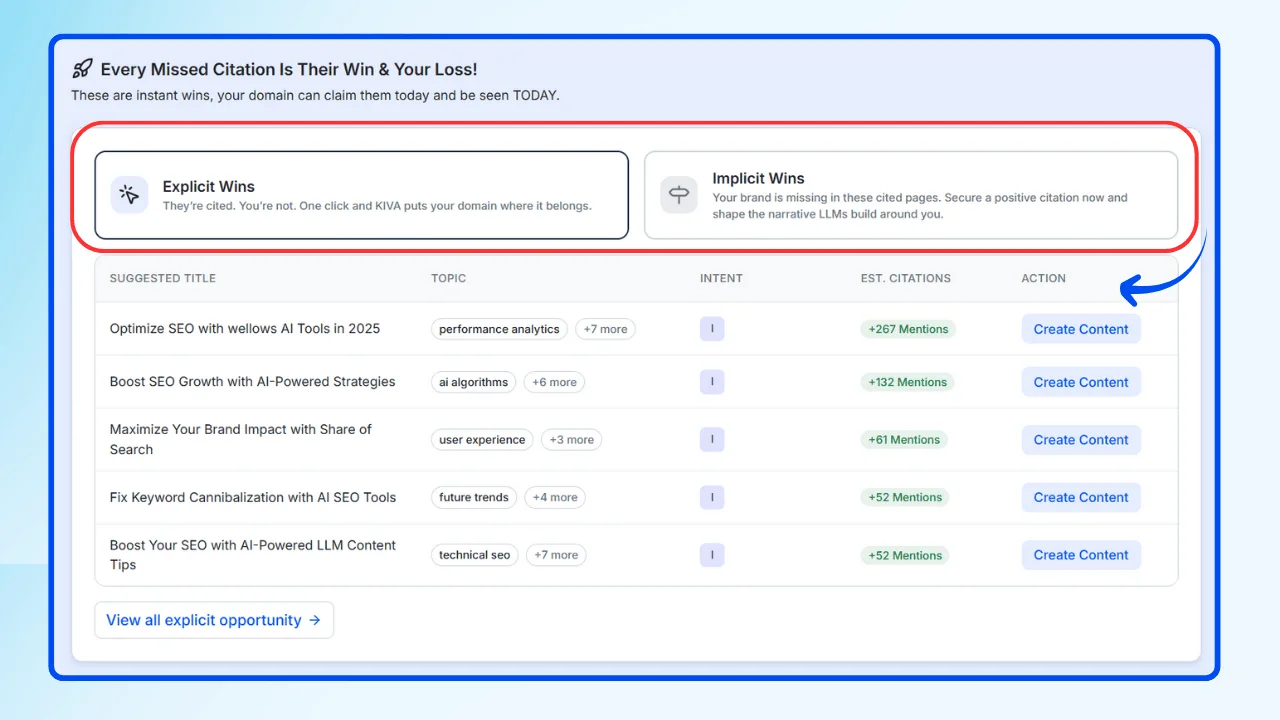
Here is how topic discovery works inside Wellows:
- Uses your real GSC signals: Wellows pulls your actual queries, impressions, and top pages to reveal what you already cover and where visibility is slipping.
- Expands missing demand with PAA and LSIs: It surfaces unanswered People Also Ask questions and related semantic themes that competitors are covering and AI engines are citing.
- Shows visibility gaps across LLMs: With LLMs Visibility, Explicit Wins, and Implicit Wins, you spot topics where AI engines mention competitors or your category but do not cite you.
- Prioritizes what to fix first: Citation Score, SERP Visibility, and User Intent Analysis help you focus on gaps tied to real demand and high-impact intent, not random keyword lists.
So yes, AI can find your missing topics. The real win is turning that insight into a clear content plan, especially when startup leads dropped and the reason isn’t immediately visible. Wellows gives you the gap discovery, the priority order, and the visibility context needed to close those gaps without guesswork.
Why Use AI For Content Gap Discovery?
Manual content gap analysis takes hours of keyword exports, competitor reviews, and spreadsheet sorting. AI compresses that work into minutes and surfaces cleaner opportunities.
1. Key Advantages Of AI Gap Analysis
- Speed and scale: AI scans your site and competitors quickly, even across large libraries.
- Better intent mapping: It detects when your pages miss what searchers actually want.
- Stronger topic clustering: AI groups missed keywords into real themes, not scattered lists.
- Less manual work: You avoid repetitive exports, tabs, and slow audits.
- Tool integration: Many SEO platforms now include AI-powered gap analysis as a built-in feature.
2. How AI Helps You Find Gaps Faster?
AI uses semantic analysis to understand meaning and relationships between topics. Instead of matching exact words, it finds what your audience expects next, then highlights what your site has not answered yet.
If you want these gap insights tied directly to modern visibility signals, Wellows helps you spot where your brand is missing in both Google and AI search surfaces.
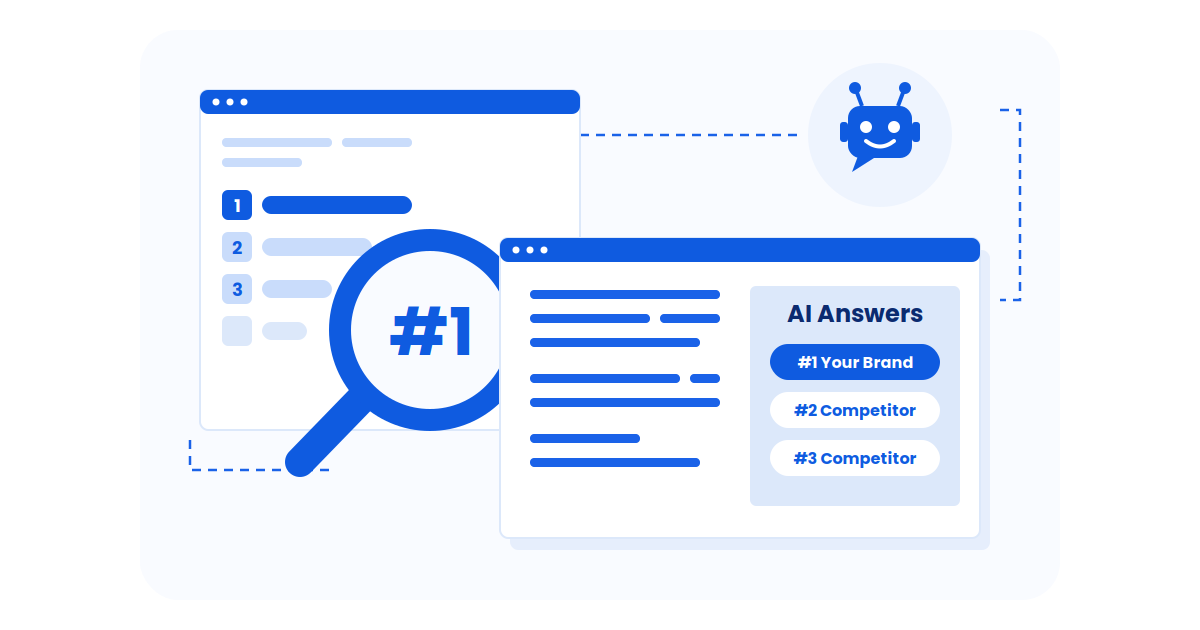
It tracks citations, mentions, and topic-level visibility, so you can see which gaps are costing you reach and fix them before competitors take that space. This ties into the bigger shift explained in AI Search Visibility, where coverage and recognition matter as much as classic rankings.
How Do I Find Content Gaps Using Semantic Analysis And AI?
Semantic analysis means finding gaps based on meaning, not just exact keywords.
Instead of asking “what words am I missing?”, you ask “what ideas, subtopics, and follow-up questions are missing from my coverage?” AI helps by reading your content like a human would, grouping it into themes, and spotting where the topic chain breaks.
Inside Wellows, this happens through its unified visibility workflow. Wellows combines your real search signals (via GSC Support), SERP patterns (SERP Visibility), and AI interpretation signals (LLMs Visibility plus Citation Score).
When those layers are compared against competitors (Explicit Wins and competitor tracking), Wellows surfaces the semantic gaps: the related concepts, intents, and question paths that competitors cover and AI engines cite, but your site does not.
This is the same idea behind building connected topic understanding through Semantic Knowledge Integration, where meaning and entity connections guide what you should cover next.
Practical Example:
Let’s say you have a blog on “content gap analysis.” Your page covers the definition and keyword gaps. Wellows may show that competitors are getting cited for related semantic angles like “semantic analysis for content gaps,” “intent gaps vs topical gaps,” and “People Also Ask based gaps.”
That’s a semantic gap: the audience expects those connected ideas, AI engines reward them, but your library skips them. You then add those missing sections or create supporting posts, and your visibility improves across both Google and AI search surfaces.
Other tools that do semantic gap discovery exist (InfraNodus, Klipster AI, DeepRankAI), but Wellows is built to connect this discovery directly to modern AI search visibility signals, so you know what to fix and why.
Traditional Vs AI Gap Analysis
Traditional and AI-driven content gap analysis both aim to find what your site is missing. The difference is how they get there. Traditional methods rely on manual checks across multiple tools, while AI systems scan, compare, and cluster gaps much faster and at a broader level.
Here is a quick side-by-side view.
| Feature | Traditional Gap Analysis | AI-Powered Gap Analysis |
|---|---|---|
| Tools Required | Multiple (manual) | Unified (all-in-one AI tools) |
| Speed | Slow and time-consuming | Fast and scalable |
| Scope | Limited to keywords or pages | Broader: topics, questions, formats, intent |
| Expertise Required | High (SEO knowledge needed) | Moderate (guided AI insights) |
| Frequency | Quarterly or ad hoc | Continuous or real-time |
| Output | Raw keyword lists and content maps | Structured content briefs with clear actions |
In short, traditional gap analysis is useful but slow, while AI gap analysis is built for speed, scale, and intent-level discovery.
What Are The Top AI Powered Content Gap Analysis Tools Available In 2025?
Here are a few reliable tools teams use for AI content gap discovery today. I’m keeping this list short and practical, so you can pick fast and move.
Wellows
Wellows AI Search Visibility Platform helps you find content gaps by showing where your brand is missing across Google and major AI engines. Inside Wellows, you can also use KIVA, its built-in content creation feature, to turn those gaps into intent-aligned briefs and publish-ready drafts without leaving the platform.
Ahrefs Content Gap
A solid competitor-based gap tool. It highlights keywords and subtopics competitors cover that your site does not, so you can prioritize what to add next.
Semrush Keyword Gap
Helpful for spotting keyword overlaps and missed topic areas. It works well when you want a quick comparison against multiple competitors.
InfraNodus
Useful for semantic gap discovery through topic clustering. It helps you see which related concepts are missing from your content structure.
Why Wellows wins for workflow: most tools only tell you what is missing. Wellows shows the gap across AI and search visibility, then lets you close it using KIVA’s integrated brief-to-draft flow in the same workspace.
How To Find Content Gaps With AI Step By Step
Using AI to uncover content gaps is most effective when you approach it methodically. The goal is not to have AI guess at gaps blindly, but to feed it meaningful input and ask the right questions.
Did you know?
Pro tip: Pair the steps below with this practical blog post checklist to turn gap insights into publish-ready content faster.
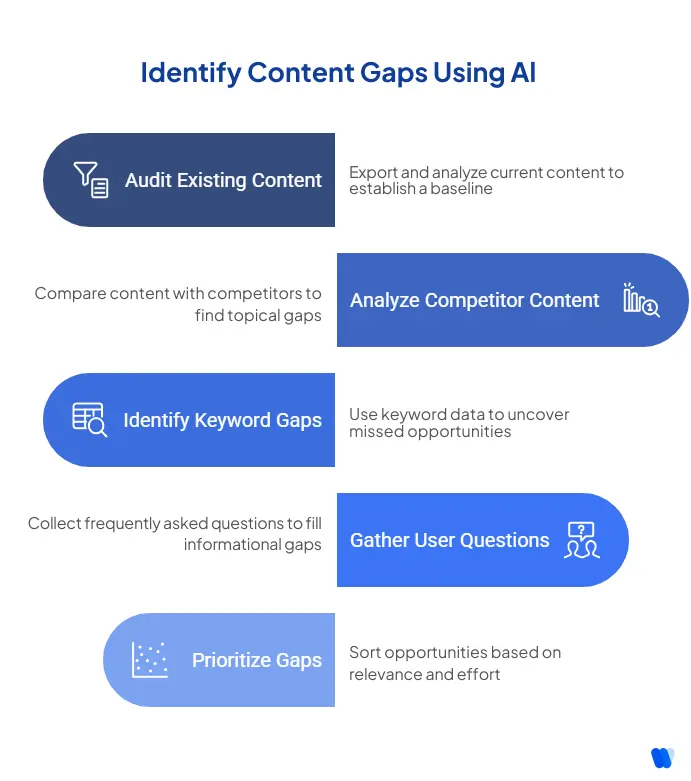
Below is a practical, step-by-step process.
1. Audit Your Existing Content
Before using AI, get clear on what you have already published.
Export your blog titles, main headings, or topic summaries into one file. Upload this into an AI tool (or Wellows) and ask it to group your content into themes. This shows what you cover well and what is thin.
Did you know?
2. Compare Your Content With Competitors
Once your library is mapped, compare it against competitors to see what they are covering that you are missing.
In Wellows, this step is automated through visibility and competitor comparisons. You can see which topics competitors are earning visibility for across search and AI engines while your site stays absent.
What AI comparison usually reveals:
- Competitor-owned subtopics: they cover supporting angles you skipped.
- Follow-up intent gaps: your page answers the main query, but not the next questions users ask.
- Format gaps: they win with FAQs, comparisons, or step lists you do not include.
- Visibility gaps across AI search: they are being cited in AI answers while you are not.
3. Identify Keyword And Topic Gaps
Now pair AI with real keyword data.
Pull keyword lists from Google Search Console, Ahrefs, or Semrush. Feed them into AI (or Wellows GSC + SERP visibility views) and ask it to cluster missed terms into a few clear topic themes.
Did you know?
4. Gather Common User Questions
Ask AI to surface the real questions people keep searching around your topic.
Pull questions from People Also Ask, forums, and Search Console. Then let AI cluster them into missing sub-topics you can add into existing pages or new posts.
Did you know?
5. Prioritize Gaps By Impact
Not every gap matters. Sort opportunities by:
- Search demand: impressions and trend strength.
- Intent value: how close it is to your product or conversion goal.
- Effort: whether it is a quick upgrade or a full new page.
Wellows makes this easier by tying gaps to real visibility signals, so you are not guessing which missing topic will move the needle first.
Did you know?
How Can I Use Artificial Intelligence To Analyze My Content Against Competitors?
Competitor comparison matters because content gaps rarely show up in isolation.
You might think your coverage is strong, but if competitors answer the same topic more completely or match intent better, Google and AI engines will prefer them. AI makes this comparison fast and structured, so you can see exactly what to improve instead of guessing.
Compare Your Coverage With Competitors
Start by giving AI your website and 2–5 competitor websites.
- Input your URLs + competitor URLs: Add your main domain and the competitor domains you want to benchmark.
- What AI checks: It scans topics, headings, content depth, and intent match across all sites.
- What you get: A clear view of which subtopics they cover that you do not, and where their structure answers the query better.
Wellows helps here by showing side-by-side visibility comparisons, so you see which competitor pages are being surfaced and cited across search and AI results while yours are missing.
Extract And Group Keyword Opportunities
Next, focus on keyword gaps.
- Pull “they rank, you don’t” terms: Export competitor ranking keywords from your tools or Search Console comparisons.
- Cluster into themes: Ask AI to group those terms into a few topic buckets, not a long keyword list.
This step turns raw gaps into content ideas you can actually build.
Pull Missing Questions From Real Searches
Keyword gaps are only half the picture. Many visibility losses happen because competitors answer follow-up questions you skip.
- Collect real questions: Use People Also Ask, forums, Reddit threads, and SERP patterns around your topic.
- Let AI group them: AI will cluster repeated questions into missing subtopics and sections.
These question clusters often become the fastest upgrades to existing pages.
Prioritize Gaps By Impact And Effort
Finally, choose what to fix first.
- Relevance: Does the gap support your product, audience, or funnel stage?
- Difficulty: Is it a low competition gap you can win quickly, or a harder topic that needs depth and links?
- Business value: Will it bring buyers, leads, or high quality traffic?
- Quick wins vs long term: Patch small missing sections now, then plan bigger pillar gaps next.
Wellows makes prioritization easier by tying gaps to real visibility and competitor movement, so you act on what will move reach first.
How Wellows Automates Content Gap Analysis?
Manual content gap analysis usually breaks because data sits in different tools and spreadsheets. Wellows removes that mess by unifying visibility signals and turning gaps into clear, next-step actions.
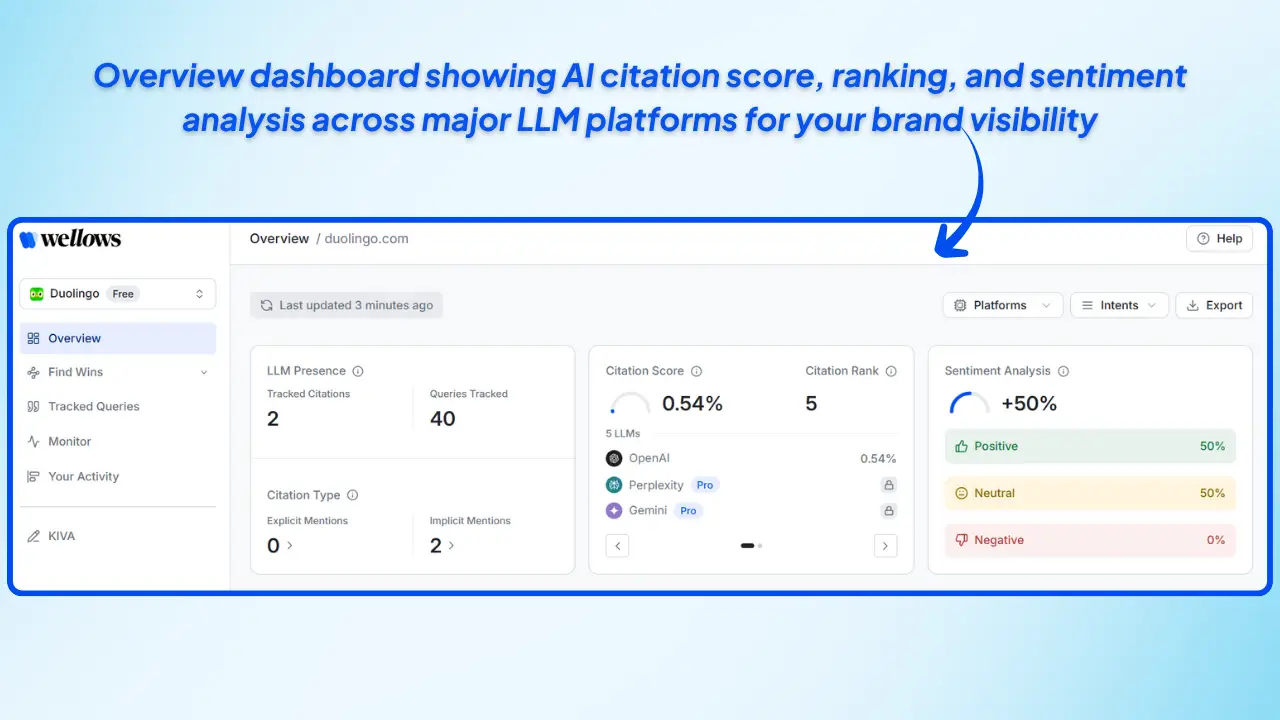
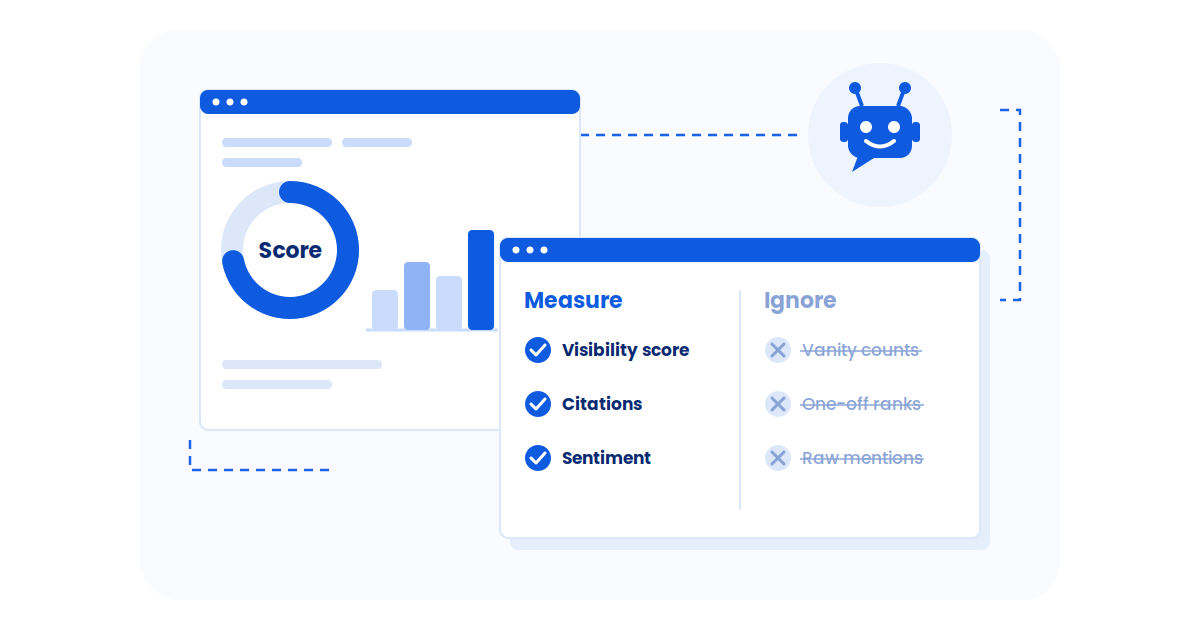
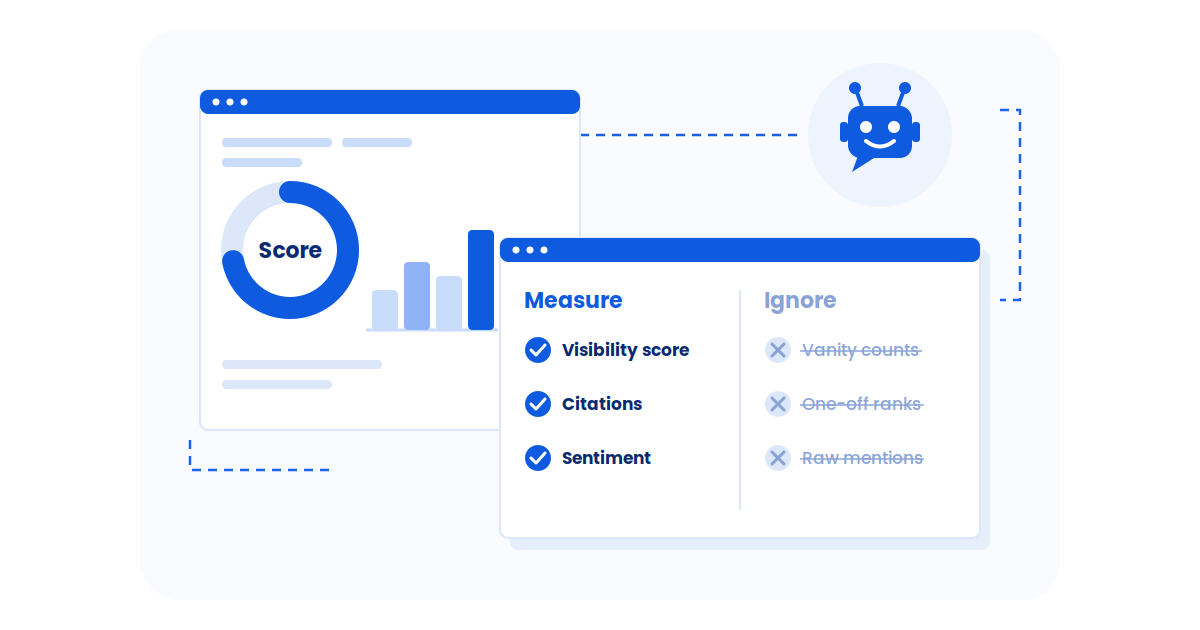
- Unified visibility view: Wellows brings citations, mentions, sentiment, and competitor visibility into one platform, so you can see where your brand is showing up and where it is missing across AI and search.
- Competitor and topic gap detection: It compares your coverage with real competitors and highlights missing topics, subtopics, and citation opportunities instead of giving you a raw keyword dump.
- Execution inside the same workflow: Once gaps are identified, Wellows’ legacy execution layer KIVA helps you move into briefs and drafts quickly, and you can refine the final copy using the free AI humanizer tool by Wellows before publishing.
In short, it automates gap discovery and prioritization, then supports fast content execution in one connected system.
How Closing Content Gaps Improves SEO Visibility
Closing content gaps does more than “complete” your blog. It directly improves how often and where your pages show up in search.
Covering all relevant subtopics signals depth to search engines, increasing your chances of winning visibility across a whole topic cluster.
By answering overlooked questions and variations, you reach low-competition, high-intent searches competitors are already taking.
Content that fully satisfies intent lowers bounce rates and increases time on page, both signals that help visibility hold.
Filling gaps with structured answers and semantic coverage improves your chances of showing up in featured snippets, People Also Ask, and rich results.
Bottom line: The more completely you cover what people are searching for, the more visibility your site earns across both classic and AI-driven search surfaces.
Common Challenges in Finding and Filling Content Gaps Using AI
When you learn How to Use AI to Find Content Gaps, it helps you move faster and spot opportunities you might miss manually, but AI is not perfect. It still depends on clean data, correct intent mapping, and your strategy. Here are the common issues users face:
1. Overreliance on Keyword Volume Alone
Many AI tools prioritize keywords with high search volume, but ignore search intent or business relevance. This can lead to content that ranks but doesn’t convert or satisfy user needs.
2. Lack of Contextual Understanding
AI may miss nuance, tone, or industry-specific insights. It can suggest obvious or overused topics unless you feed it tailored inputs like audience profiles, brand goals, or prior content themes.
3. Incomplete or Outdated Competitor Data
Tools relying on SERP snapshots or limited data sets may miss newer content or emerging competitors. This leads to an inaccurate picture of what gaps actually matter today.
4. Repetition and Redundancy
Some tools suggest topics that slightly rephrase what you’ve already published. Without proper filters, you may end up duplicating ideas instead of expanding coverage.
5. Manual Cleanup Still Required
AI outputs often need editing, fact-checking, and alignment with brand voice. Relying entirely on automation risks publishing generic or inaccurate content.
6. Missed Strategic Alignment
AI can tell you what’s missing, but not always why it matters to your content goals. Without strategic guidance, teams may chase gaps that don’t support funnel progression or conversions.
Helpful Guides to Strengthen Your AI Content Strategy
How To Optimize Content for Featured Snippets – Learn how to structure and format your content to capture top SERP visibility.
How To Optimize Content for Voice Search – Discover voice-first SEO strategies that improve accessibility and conversational ranking.
Best Tips for Creating Content That Actually Converts – Practical tactics to turn readers into loyal customers through AI-optimized storytelling.
How To Manage the AI Content Lifecycle and Keep It Evergreen – A step-by-step framework to sustain, refresh, and scale your AI-driven content performance.
FAQs
A content gap is a topic or keyword your audience is searching for that your site doesn’t cover yet. Identifying these gaps helps you create content that meets user needs and improves your SEO.
AI analyzes your existing content and compares it with competitors to find missing topics or keywords. It streamlines the process, saving time and uncovering opportunities you might miss manually.
Not necessarily. Many AI-powered SEO agents, including KIVA, are designed to be user-friendly for marketers and bloggers with no technical background.
It’s a good idea to run a gap analysis quarterly or when you notice a drop in organic traffic. Regular analysis helps you stay aligned with evolving search trends.
Start by auditing your existing content—list your published pages, topics, and target keywords. Then compare that against what your competitors cover and what users are searching for.
Use AI SEO tools to identify missing keywords, unanswered questions, or underrepresented subtopics. Organize those findings by priority, and create a plan to fill the gaps with content that aligns with user intent.
Wellows is the best fit if you want competitor gaps tied to real visibility. It compares your coverage with true competitors, shows the topics you are missing, and prioritizes them using search + AI visibility signals so you know what to fix first.
Final Thoughts
How to Use AI to Find Content Gaps gives you a faster, clearer way to grow visibility without relying on guesswork or scattered tools.
Instead of stitching together keyword lists and manual audits, AI helps you spot missing topics, compare coverage, and turn real search demand into a clean content plan. You save time and you see gaps that are easy to miss by hand.
Whether you are improving old pages or planning new ones, using AI to find content gaps keeps your content relevant and competitive. Treat AI as a smart research assistant, then apply your own strategy before you publish.
Read More Articles!
- Content Marketing Agencies: A Complete Guide 2026
- Write Content for People First, Not Search Engines
- LLM Content Creation Strategy
- How To Use People Also Ask Data
- Content Readability In SEO
- Top Content Marketing Statistics To Know In 2025 (Including AI Trends)
- Why Your Website Traffic Is Dropping (Causes & Fixes)