

TL;DR
Answer first, add something original, back every claim with a source, and keep the page indexable.
Optimizing for generative AI search is still SEO, with no special markup and no need to chunk content.
In one benchmark, adding quotations raised visibility about 41%, statistics 31% and cited sources 27%. Keyword stuffing fell 8%.
Google says it has no preferred word count. Match length to the question.
Update the facts, sources and answer block on pages that are losing visibility.
Rerun a fixed prompt set before and after each change, per page.
To optimize website content for AI citation, answer the question in the first paragraph, add original facts, data or expert input that others cannot copy, back each claim with a source, and keep the page indexable. Google says this is still SEO, so the work is clear, credible, well-structured pages, not special files or tricks.
This guide explains what influences AI citations, how to structure a page, what the research says works, how long a page should be, how to avoid sounding generated, how to refresh an old post and how to measure the result. It builds on our guide to generative engine optimization.
1What factors influence which content AI engines cite?
No engine publishes its full source-selection method, so any list of factors is partly inference. The table separates what Google states, what research found and what is practice.
Source tags: Google comes from Google documentation, Research from a published study, Practice is good working practice.
| Factor | What is known | Source |
|---|---|---|
| Indexed and snippet-eligible | Pages must be indexed and eligible to appear in Search with a snippet to qualify for Google’s AI features | |
| Original, valuable content | Google says content should add substantial value, and that giving credit to other sources does not replace original effort (Google Search Central) | |
| Quotes, statistics and sources | In a lab benchmark these raised visibility the most (GEO paper) | Research |
| Relevance to the query | Engines search with their own queries and cite pages that match, so cover the questions buyers ask | Practice |
| Credible third-party coverage | Pages about you elsewhere give engines more to cite. Google says artificial mentions are not helpful |
2How should I structure content for AI visibility?
Structure each page so a reader, or an engine, can find the answer to one question in one place. Google says you do not need to split content into chunks or add special schema for its AI features (Google guidance), so the aim is clarity, not formatting tricks.
| Element | What to do | Why |
|---|---|---|
| Answer block | Open each page and each major section with the direct answer in one or two sentences | The answer is easy to find and reuse |
| Question headings | Write H2s as the questions buyers ask | Matches how people prompt |
| One idea per section | Keep each section to one question and its support | Sections stand alone when quoted |
| Tables and lists | Use tables for comparisons and numbered lists for steps | Compact, scannable facts |
| Defined terms | Define a term in one plain sentence the first time you use it | Reduces ambiguity |
| Consistent names | Use the same brand, product and category names everywhere | Helps engines connect pages to you |
| Accurate structured data | Add markup only where it matches the visible page | None is required for AI features |
Quotable stat
In the GEO benchmark, adding quotations raised visibility about 41%, statistics about 31% and cited sources about 27%, while keyword stuffing lowered it about 8% (source).
Read that with care. The result comes from a lab benchmark that used a simulated engine, and the test on Perplexity used a 200 query subset. It supports adding evidence to your content. It does not promise the same lift on your site.
3What does a cited passage look like?
A passage that tends to get used states the answer, gives a fact and names its source. The pair below is an illustration of the difference and is not Wellows data.
Less likely to be used
“Our platform helps teams in many ways to improve how they show up when people look for answers, and we believe it is a better way to work.”
More likely to be used
“Share of voice is your citations divided by all tracked brands’ citations, times 100. Run each prompt at least seven times per day, because a University of St. Gallen study found only 34 to 42% source overlap between days.”
The second passage answers a question, gives a formula, states a number and credits the source. It also reads fine on its own, which matters if an engine quotes only that part.
4What is the optimal content length for AI citations?
There is no verified ideal length. Google says it has no preferred word count, and answers “no” to whether you should write to a particular one (Google Search Central). I found no study that sets a length for AI citations either.
Let the question set the length. A definition needs a paragraph. A comparison needs a table and a few paragraphs. A full guide needs several sections. Cut anything that does not help the reader, because padding dilutes the passages you want cited.
5How do I optimize content for AEO without sounding AI-generated?
Write from real experience, state specifics and have a person edit the result. Google asks that it be clear who created content and how, and says automation used to manipulate rankings breaks its spam policies (Google Search Central).
| Sounds generated | Fix |
|---|---|
| Broad claims with no detail | Add a number, an example or a first-hand observation |
| Stacked adjectives and filler openers | Cut them and start with the point |
| Every section has the same shape | Vary the structure to fit the content |
| No sources | Name the source and link it |
| No author | Add a real byline and reviewer details |
| Hundreds of near-identical pages | Publish fewer pages, each with real value |
6How do I run a content refresh for AEO on a high-traffic post?
| 1 | Find pages whose visibility is falling. The free Content Decay Tool reads your Search Console data and flags them. |
| 2 | Check what engines cite for the page’s prompts, and which pages beat yours. |
| 3 | Update facts, figures and screenshots, and replace broken or weak sources. |
| 4 | Add an answer block, original data or a first-hand example where the page lacks one. |
| 5 | Republish the same URL, and keep its internal links intact. |
| 6 | Rerun the same prompts and compare with the earlier results. |
Try the Content Decay Tool to build your refresh queue. It reads Google search data, not AI citations, so confirm the effect with prompt tracking.
7What tools help optimize content for AI citations?
You need four kinds of tool, and one product may cover more than one. I have not named tools, because they change and I could not verify a current comparison.
| Tool type | What it does |
|---|---|
| Crawler and indexing check | Confirms pages are indexed and readable |
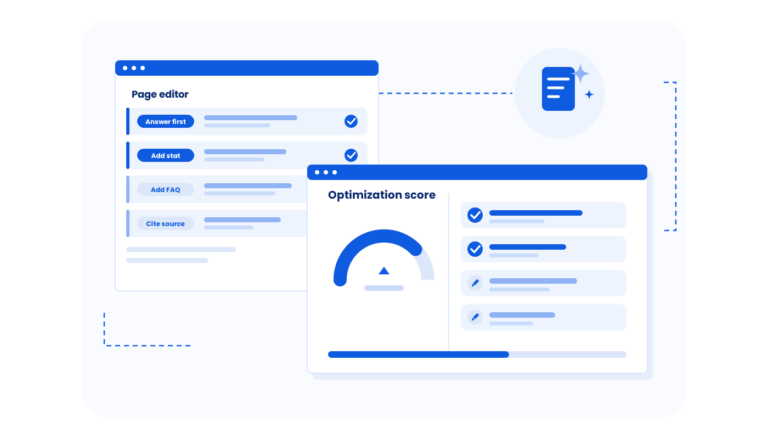
| Content editor | Helps with structure, readability and sourcing |
| Citation tracker | Shows which pages engines cite for your prompts |
| Brand fact sheet | Keeps names, claims and pricing consistent |
8How do I measure AI citation performance?
Measure per page and per prompt. Keep a fixed prompt set, run each prompt several times per engine, and record whether each target page is cited before and after your change. A University of St. Gallen study found only 34 to 42% source overlap from one day to the next and recommends at least seven runs per prompt per day (arXiv study). See AI mention tracking and how to calculate share of voice for the formulas.
A content checklist for AI citations
- The page is indexed and not blocked from snippets.
- The first paragraph answers the main question.
- Headings are written as questions buyers ask.
- Each section covers one idea and stands alone.
- Every statistic has a named, linked source.
- The page adds data, experience or expert input others lack.
- Names and facts match your other pages and profiles.
- A real author and reviewer are shown.
- Structured data, if used, matches the visible text.
- Prompts are rerun after every change.
What only Wellows adds
Most guides list tips and stop. The Wellows AI citation platform shows which of your pages ChatGPT, Gemini, Perplexity, Google AI Overviews and Google AI Mode actually cite, with the sentiment of each cited source, so you can compare the pages that win with the ones that do not. It also tracks implicit citations, the times you are not cited but another page about your topic is. This is your shadow reputation, and it is the narrative that AI engines create based on pages you have not written.
To see which of your pages an engine cites today, start with a free snapshot. The Free AI Brand Report runs one engine in one country, asks six buyer questions six times each, and lists the pages it cites.
Conclusion
Optimizing content for AI citation means writing pages that answer first, add something original, show their sources and stay clear and indexable. Use the lab evidence as a guide, test every change against your own prompts and refresh the pages that are slipping. Start with your highest value page this week.