Voice search content optimization is the process of structuring digital content to match natural language queries from assistants like Google Assistant, Siri, and Alexa. Unlike typed searches, voice queries are longer, conversational, and framed as direct questions.
In 2025, over 20.5% of global internet users rely on voice search and more than 8.4 billion devices are voice-enabled, surpassing the world’s population DemandSage.
This guide explains how voice queries differ from typed searches and covers long-tail strategy, featured snippets, local SEO, schema markup, mobile-first indexing, and essential tools for optimization.
What is Voice Search Content Optimization?
Voice search optimization goes beyond keyword targeting. It structures content for semantic systems that interpret intent, context, and entities within spoken queries. Voice assistants rely on these signals to retrieve precise, conversational answers.
Unlike traditional SEO, where keywords dominate, voice search emphasizes query intent interpretation. Search engines analyze how questions connect such as follow-ups referencing “he,” “there,” or “near me.” This shift requires entity mapping, schema markup, and context-rich answers to secure visibility.
1- Use Natural Language Write content that reflects everyday speech. Conversational phrasing allows voice assistants to interpret and deliver your answers more accurately. Maintaining a balanced readability score and ensuring responses align with your brand voice keeps answers both user-friendly and consistent across channels.
2- Target Long-Tail Keywords Prioritize longer, intent-based queries. For example, replace “best restaurants” with “What are the best restaurants near me?” to mirror natural voice patterns. Voice queries frequently overlap with People Also Ask data, making it essential to analyze and structure answers around these conversational patterns.
3- Optimize for Featured Snippets Format answers in short, direct statements or lists. Concise responses increase Position Zero eligibility, which assistants frequently read aloud. Applying chunk optimization techniques ensures each section is self-contained and eligible for both snippets and voice delivery.
4- Enhance Local SEO Because many voice queries are location-driven, keep your Google Business Profile accurate. Update categories, hours, and reviews to strengthen “near me” visibility.
5- Implement Schema Markup Add structured data such as FAQPage, HowTo, or LocalBusiness. Schema clarifies context and improves eligibility for voice-driven results. Pairing schema with an LLM content creation strategy ensures your answers are optimized for both traditional SERPs and AI assistants.
6- Optimize for Mobile and Speed Most voice searches happen on mobile. Ensure responsive design and fast load times so pages qualify under mobile-first indexing and performance thresholds.
Applying these strategies aligns content with voice-first behaviors, boosting findability and meeting expectations of users who depend on voice-activated devices.
Why is Voice Search Optimization Important for SEO?
Adoption is rising as voice technologies reshape behavior. According toYoung Urban Project in 2025, 35% of U.S. adults own smart speakers, and 31% of global smartphone users use voice search weekly.
This usage pattern demands SEO that aligns with conversational and context-driven queries—an area where Content Marketing Agencies often help brands translate behavioral data into scalable, voice-ready content strategies.
Conversational Query Structure Users ask full questions rather than fragments. Optimizing for natural language improves intent alignment and visibility.
Local Search Emphasis A large share of voice queries are local. 72% of smart speaker owners use voice to find local business information Young Urban Project. Accurate Google Business Profile data and consistent NAP increase “near me” visibility.
Featured Snippets and Position Zero Assistants often read answers from featured snippets. Clear, 30–40 word responses and Q&A formatting increase selection likelihood.
Mobile Optimization With most searches occurring on mobile, fast, mobile-friendly pages influence voice rankings. Responsive design and speed improvements are essential.
Structured Data Implementation Schema markup such as FAQPage, LocalBusiness, and HowTo helps search engines interpret context and power spoken results.
Focusing on conversational queries, clear answers, mobile readiness, and structured data helps brands remain visible as voice-first search grows.
Google’s growing emphasis on E-E-A-T reinforces the importance of building trustworthy, authoritative answers for spoken results.
How Do I Optimize My Website for Voice Search?
Use a stepwise workflow that maps spoken intents to structured, fast, and easily retrievable answers. Focus on how users ask questions, how search systems parse them, and how your pages are crawled, rendered, and selected for rich results.
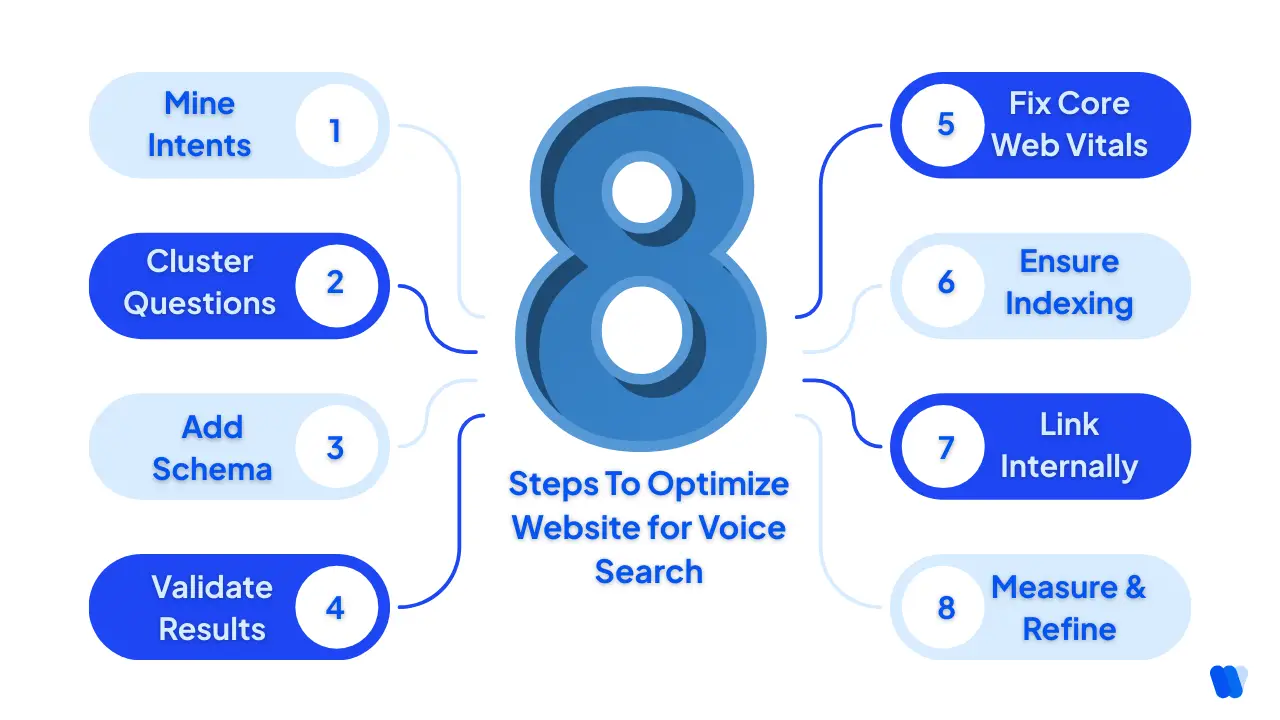
- Mine conversational intents
Export queries from Search Console → Performance and segment by question patterns (who/what/where/when/why/how) and device. This reveals real questions and follow-ups to target. - Build question clusters and page models
Group related questions under a pillar page. For each question, add a 30–40 word direct answer, then brief context. Use the question as an H2/H3 so assistants can map query to section reliably. - Instrument structured data
Mark up Q&A sections with supported types such as FAQPage or procedural content withHowTo. Follow Google’s guidelines to stay eligible for rich results. - Validate rich results
Test representative URLs in Google’s Rich Results Test to confirm eligibility and fix errors or warnings before publishing (Rich Results Test). - Meet Core Web Vitals on mobile
Voice answers favor fast, stable pages. Improve LCP, INP, and CLS with image optimization, efficient caching, and critical-path CSS. Monitor with Search Console and web.dev resources (Core Web Vitals). - Ensure clean crawl and indexing
Keep a valid XML sitemap, consistent canonicals, and accessible content (no blocked resources required for rendering). Use Search Console to verify coverage, fetch/render, and submit important URLs. - Strengthen internal linking
Link from pillar pages to each answer section with descriptive anchors. Add cross-links between related questions to help assistants follow conversation paths and improve section-level relevance. - Measure and iterate
Track impressions, clicks, and queries for your Q&A sections. Compare desktop vs. mobile, monitor rich result appearances, and refine answers based on rising question variants.
This workflow avoids duplication from prior sections by focusing on implementation: intent mining, Q&A architecture, structured data, validation, performance, crawlability, and iteration.
What Are the Best Practices for Voice Search SEO?
Prioritize content that assistants can retrieve and read aloud quickly. Focus on concise answers, snippet-ready formatting, schema, and strong local signals.
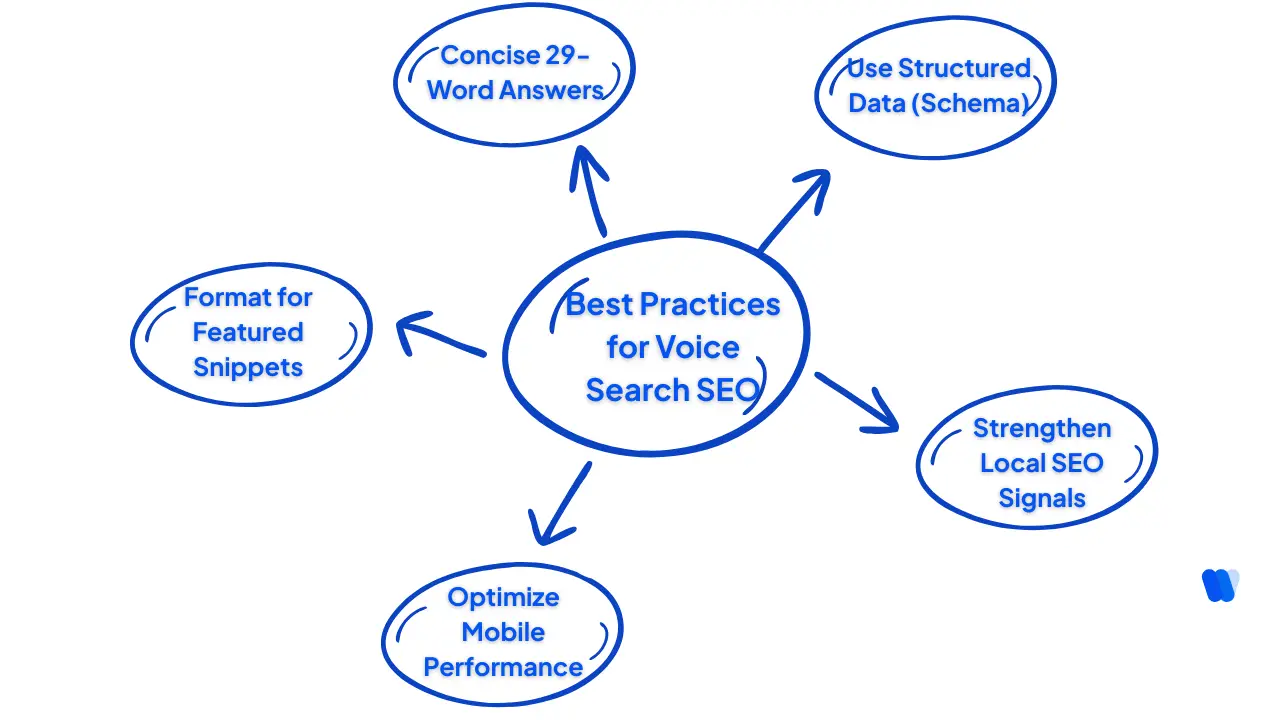
Write concise, direct answers
Aim for ~29 words. Backlinko’s study of 10,000 Google Home results found the typical spoken answer is about 29 words. Source: Search Endurance
Format for Featured Snippets
Use question headings, a one-sentence answer immediately below, then brief context or a list. Keep wording specific and self-contained to improve Position Zero eligibility.
Implement structured data
Add FAQPage and HowTo where eligible; use LocalBusiness for entities with locations. Validate with Google’s Rich Results Test before publishing to reduce errors and ensure eligibility.
Strengthen local signals
Maintain a complete Google Business Profile with consistent NAP, accurate hours, relevant categories, and recent reviews. Add city and neighborhood terms on key pages to support “near me” relevance.
Optimize mobile performance
Meet Core Web Vitals on mobile. Improve LCP, INP, and CLS with image compression, efficient caching, and responsive layouts to raise the likelihood of selection for voice answers.
Q: How long should a voice answer be?
A: A voice-friendly answer should be about twenty-nine words. Keep it clear, specific, and self-contained, so assistants can read it aloud without extra context or follow-ups, and still feel complete.
Q: How do I optimize for “near me” searches?
A: Keep Google Business Profile complete, ensure consistent NAP, update hours, select accurate categories, and encourage reviews. Add localized terms on core pages and embed a map to reinforce proximity relevance.
Q: What markup helps voice results?
A: Use FAQPage for Q&A blocks and HowTo for stepwise tasks; add LocalBusiness for locations. Test with Google’s Rich Results Test to confirm parsing and eligibility before you publish.
How Does Voice Search Affect Keyword Strategy?
Voice search changes keyword targeting by shifting focus from short phrases to natural, conversational language. Typed searches are often two to three words long, while spoken queries resemble complete sentences or direct questions.
This evolution also drives query fan-out, where one typed keyword produces several semantic branches in voice. For instance, “best Thai restaurant” may expand into: “Where’s the best Thai restaurant near me?”, “Which Thai restaurant is open now?”, or “What’s the top-rated Thai restaurant nearby?”
Optimizing for voice therefore requires mapping keyword clusters to multiple user intents. Instead of chasing single keywords, content should anticipate related conversational variants and embed them naturally within Q&A sections, headings, and schema markup.
What Role Do Long-Tail Keywords Play in Voice Search Optimization?
Long-tail keywords are natural language phrases of five words or more. They closely mirror how people speak when interacting with Google Assistant, Siri, or Alexa, making them crucial for voice search optimization.
These longer phrases offer higher specificity and stronger conversion potential. Instead of targeting broad terms, long-tail keywords align with user intent, helping businesses capture ready-to-act searchers.
“Where’s the nearest Starbucks open right now?” “Best Italian restaurant in Brooklyn with delivery” “How do I renew a driver’s license online in Texas?”
How Can I Improve My Local SEO for Voice Search?
Improving local SEO is essential because many voice searches are location-specific. Start by optimizing your Google Business Profile with accurate NAP (name, address, phone), correct categories, business hours, and updated reviews. This consistency signals reliability to both users and search engines.
Adding LocalBusiness schema further enhances search engines’ ability to understand your location and services. Structured data increases eligibility for rich results, which often power voice answers.
“Pharmacy near me that’s open 24 hours” “Best dentist near me with good reviews”
What is the Impact of Mobile Optimization on Voice Search?
Mobile optimization plays a central role in voice search because most queries are made on smartphones. With mobile-first indexing, Google primarily evaluates the mobile version of a site for ranking. A slow or poorly optimized mobile site risks exclusion from voice results.
Responsive design and accessibility ensure seamless experiences across devices. According to Google’s mobile speed update, page speed is a ranking factor for mobile search, making fast load times critical.
How Do Featured Snippets Relate to Voice Search Results?
Featured snippets, also called Position Zero, are the most common source of answers for voice assistants. When users ask a question, Google often reads aloud the content from the snippet, making this placement essential for voice search visibility.
To improve eligibility, structure content with 30–40 word direct answers, use question-based headings, and format responses with lists or tables when appropriate. Clear formatting increases the chance of being selected as a snippet.
Query: “What is voice search optimization?” Snippet Answer: “Voice search optimization is the process of structuring digital content to align with conversational queries made through assistants like Google Assistant, Siri, or Alexa.”
What Tools Can Help With Voice Search Optimization?
KIVA: AI SEO Agent streamlines voice search optimization by clustering long-tail queries, analyzing “People Also Ask” data, and formatting content for both SERPs and large language models. Its Quick Wins feature generates data-driven content plans aligned with conversational search patterns.
Question Mining: Tools like AnswerThePublic, AlsoAsked, and Google Search Console reveal natural language queries users commonly ask.
Keyword & SEO Tracking: Platforms such as SEMrush, Ahrefs, and Surfer support ongoing performance tracking and competitor insights.
Technical Optimization: Schema.org validators and Google PageSpeed Insights ensure structured data accuracy and performance benchmarks.
Local SEO: Google Business Profile and Moz Local help maintain NAP consistency, reviews, and visibility in “near me” searches.
FAQs
Conclusion
Voice search SEO brings together conversational queries, long-tail keyword strategies, featured snippets, schema markup, local SEO, and strong technical foundations. These elements ensure content aligns with how users naturally ask questions on voice-enabled devices.
It’s important to recognize that voice optimization is not a separate channel but the next stage in semantic search. Adapting your content to this evolution strengthens both traditional rankings and AI-driven visibility.
The next step is clear: audit your existing content, identify gaps in conversational targeting, and systematically implement these strategies to future-proof your SEO.