When you align AI content to brand voice, you give automation a soul and your message a signature. By aligning AI to brand voice, content isn’t just words anymore; it becomes a reflection of who you are as a brand.
The challenge? AI-generated content often lacks emotional tone, brand relevance, and consistency. This disconnect undermines brand identity and leads to messaging fatigue across channels. In an era where speed matters, sacrificing voice for velocity is a costly mistake.
The solution lies in letting AI understand not just what to say, but how to say it in your tone, with your values.
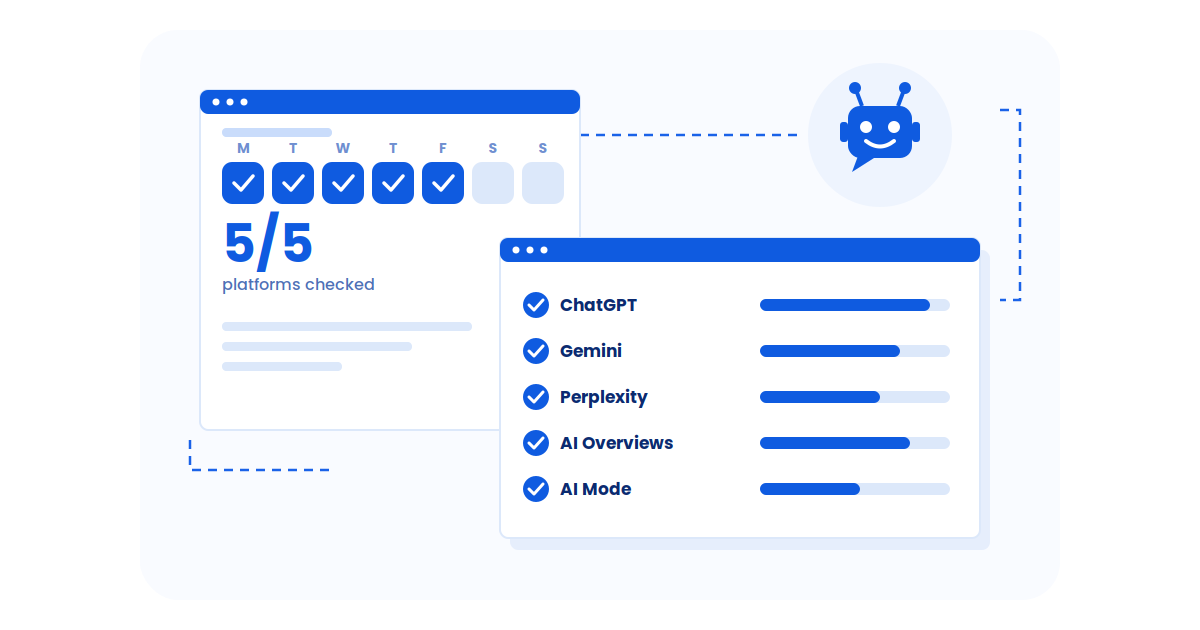
Wellows helps marketing teams analyze how their brand voice appears across ChatGPT, Gemini, and other AI engines, revealing tone alignment and visibility gaps that affect audience perception.
To explore how this tracking works in practice, start with a free trial.
.These gaps directly affect trust, conversion, and long-term growth.
When your AI speaks like your brand, your message resonates, converts, and scales without losing its soul.
Did you know?
Yes. If your content is not aligned with modern search intent and brand voice clarity, your visibility may already be declining. Search engines now favor content that demonstrates brand consistency, topical depth, and user-aligned tone.
As AI transforms how users find and evaluate information, outdated SEO metrics or strategies and inconsistent messaging can push your site further down the results page.
To stay discoverable, your content must reflect both search intent and your brand’s unique voice, clearly, consistently, and across every format.
This is the moment to revisit your brand voice strategy and optimize it for today’s AI-first search environment.
What Does “Brand Voice” Mean in the AI Era?
Brand voice is the consistent personality your content communicates with. In the age of AI, maintaining that voice is more important than ever.
It shapes how your brand sounds across every blog post, email, landing page, and caption.
When AI creates your content, it needs clear guidance to represent that voice accurately. Otherwise, the result often feels bland or robotic.
Without structure, most AI systems default to neutral tones that lack character. However, your audience wants to hear your unique voice, not just read content designed to satisfy SEO algorithms.
This makes brand voice a strategic asset that supports both recognition and trust.
Align AI to Brand Voice Across Channels
Your brand voice isn’t just what you say—it’s how you say it.
- It reflects your tone: casual, formal, quirky, authoritative
- It shows up in vocabulary, sentence rhythm, and emotional depth
- It stays consistent across channels and teams
Think of it as the personality behind your words. Whether you’re writing a product update or a welcome email, your tone should feel familiar.
AI Lacks Voice Unless You Teach It
Left on its own, AI writes in a neutral, generic tone. That might work for general information, but it won’t build brand trust.
Here’s why AI struggles with voice by default:
- It pulls from general internet data, not your brand materials
- It doesn’t know your values, tone, or preferred style
- It treats every brand the same unless told otherwise
Did you know?
I read this blog on LinkedIn, and it says that 71% of marketers say AI content feels generic, lacking tone alignment.
That’s why it’s critical to humanize AI content, ensuring it resonates emotionally while staying aligned with brand tone. That’s why it’s critical to use the free AI humanizer tool by Wellows , ensuring it resonates emotionally while staying aligned with brand tone.
A Consistent Voice Builds Recognition and Loyalty
Consistency across content isn’t just about aesthetics—it builds real business value.
- Recognizable voice increases trust, especially in saturated digital markets
- When AI supports consistency, you scale without sacrificing your identity
Did you know?
In short: if your AI content doesn’t sound like you, it works against your brand.
How to Train AI for Brand Voice and SEO Optimization
Teaching AI to create content that reflects your brand voice and ranks well in search requires a structured approach—one that blends clear guidelines, strong examples, and continuous refinement. Here’s how you can do it step by step:
Step 1 – Define and Document Your Brand Voice
How do you define and document your brand voice so AI can mimic it accurately? Use a clear framework that describes tone, personality, and language preferences.
Documenting these elements helps AI systems generate content that consistently reflects your unique brand identity.
Before drafting those guidelines, use content research with AI to uncover the linguistic tone, phrasing, and audience keywords that best represent your brand online.
Identify Core Voice Attributes
Begin by listing 3–5 adjectives that capture your brand’s personality.
Examples include:
- Friendly, authoritative, witty, or empathetic
- Tone preferences: conversational vs. formal, expressive vs. reserved
- Guiding principles: direct phrasing or inclusive language
Create a Voice Guideline Document
Compile everything into a living document:
- Define voice adjectives and tone spectrum.
- Include do’s and don’ts showing acceptable vs. off-brand phrasing.
- Document vocabulary preferences and voice patterns (sentence length, formality).
This guide becomes the reference for human writers and AI prompt training.
Did you know?
Use Examples to Illustrate Voice in Action
Examples help both humans and AI internalize the voice:
- Compare two versions of sample text side by side.
- Highlight key differences: phrasing, tone, emotional impact.
- Reinforce learning and reduce misalignment now and over time.
Did you know?
Step 2 – Train AI to Understand Your Voice
How can you train AI to understand your brand voice so it writes consistently and authentically? You must supply voice context, not rely on default models.
Structured input allows AI to generate content that reflects your tone, phrasing, and messaging intent.
Supply Brand-Level Examples and Writing Samples
- Provide representative content: blog posts, emails, landing page copy.
- Ensure diversity: include formal, conversational, and emotional messaging examples.
- AI learns context and pattern recognition from your actual branded text.
Use Templates, Style Guidelines, and Prompt Examples
- Create prompt formats that include tone cues and style rules.
- Include specific vocabulary rules and guardrails.
- Use structured instructions to guide AI toward brand-aligned output.
Ensure AI Remains Contextually Aligned Over Time
- Continuously update input samples as voice evolves.
- Monitor AI-generated drafts for misalignment and correct promptly.
- Keep a revision feedback loop to refine AI understanding.
How do I ensure AI is aligning with my brand voice in outreach?
Making sure AI-generated outreach—such as emails, campaigns, or customer communications—stays true to your brand voice requires clear rules, the right tools, and ongoing oversight. Here’s how you can achieve it:
1. Define and Document Your Brand Voice
Start by clearly outlining your brand’s personality, tone, and language preferences. Capture these in a structured guideline document that serves as the baseline for all outreach efforts. This ensures AI has a consistent reference point when generating customer-facing content.
2. Use AI Tools with Brand Voice Controls
Select platforms that embed your brand guidelines directly into content generation. Tools like HighLevel’s Content AI let you set tone, audience, and value propositions so every outreach draft reflects your identity.
3. Train AI on Branded Examples
Provide AI systems with samples of your existing outreach content—emails, ad copy, support replies—that demonstrate your tone and style. These examples teach AI how to reflect your voice in practical outreach contexts.
4. Monitor and Refine Regularly
Don’t let AI outputs run unchecked. Use QA checklists and feedback loops to review tone consistency, customer reactions, and message clarity. Ongoing evaluation allows you to refine prompts or guidelines, keeping outreach authentic and aligned.
5. Adapt by Context and Audience
Consistency matters, but so does flexibility. Adjust your outreach tone for specific contexts—warm and empathetic for support emails, bold and energetic for campaigns—while keeping the underlying brand personality intact.
By combining these practices, you can confidently scale outreach with AI while maintaining a voice that is both recognizable and trustworthy.
What Platforms highlight gaps between brand intent and ai interpretation of tone?
Several platforms help brands detect and close the gap between their intended messaging and how AI interprets tone. These tools analyze content for consistency, provide real-time feedback, and ensure that your brand voice stays intact across all channels. Here are some leading options:
1. KIVA (by Wellows)
KIVA goes beyond basic tone-checking by embedding your brand guidelines directly into the content creation workflow. Once you upload your voice documentation, KIVA applies those rules across every draft—blogs, product pages—ensuring that AI outputs reflect your brand’s unique tone. It also highlights areas where AI misinterprets your intent, reducing rewrites and keeping your messaging authentic.
2. Sprout Social
Sprout Social provides AI-powered sentiment analysis across social media and review platforms. By categorizing mentions as positive, negative, neutral, or unclassified, it helps brands monitor how their tone is being received and identify where adjustments are needed.
3. Writer.com
Writer.com delivers real-time tone and style suggestions, enabling teams to build brand tone rules and apply them consistently across content. It integrates with tools like Google Docs and Slack, making it easier to maintain alignment in everyday workflows.
4. Brand24
Brand24 offers media monitoring with AI-driven sentiment analysis. It tracks brand mentions across the web and social platforms, surfacing real-time insights into how audiences interpret your messaging. This helps brands adjust quickly to maintain voice consistency.
5. Mention
Mention excels at real-time monitoring, scanning social channels, news outlets, and review sites for brand mentions. Its AI sentiment analysis provides instant feedback on tone perception, giving brands a quick read on how their communications land.
6. FuseBase
FuseBase combines collaboration with AI-powered tone control. Its Assistant detects tonal inconsistencies in real time and allows teams to create custom tone presets aligned with brand voice. This ensures communication remains on-brand across shared projects.
By using these platforms, brands can gain a clearer picture of how AI interprets their tone, close alignment gaps, and refine messaging for stronger resonance and trust.
Step 3 – Generate Content with Brand Consistency
How do you ensure AI‑generated content stays true to your brand voice across all formats? You use structured prompts, real examples, and review workflows. Together, they help maintain authenticity in every piece of content.
Use Structured Prompts and Brand Templates
- Create prompt frameworks that specify tone, style, and voice cues.
- Use templates for blogs, product pages, emails with built‑in voice instructions.
- Include examples of preferred vocabulary or typical phrasing to reinforce brand identity.
Blend AI Drafts with Human Editing
- Treat AI drafts as starting points, not final versions.
- Editors refine tone, clarify messaging, and ensure emotional alignment.
- This human-in-the-loop process preserves brand integrity while scaling quickly.
Monitor Voice Consistency Across Content Types
- Regularly audit outputs by channel—blog posts, emails, social, landing pages.
- Use checklists: tone, consistency, vocabulary, emotional intent.
- Collect feedback and refine prompts and templates over time.
For a real-world breakdown of how marketing teams implement these brand-aligned prompts and templates in everyday workflows, see How Marketers Use AI Content in Their Workflow.
Scaling Social Media Campaigns Without Losing Brand Voice
Leveraging AI in social media content creation allows brands to scale campaigns faster while maintaining a consistent and authentic tone. Here’s how AI can support your team:
1. Efficient Content Generation
AI-powered platforms can quickly draft captions, ads, and post variations aligned with your brand’s messaging. Tools like Writesonic generate high-quality, SEO-friendly social content at scale, reducing time spent on repetitive drafting.
2. Maintaining Brand Consistency
Modern AI tools include built-in voice controls to keep content on-brand. Jasper, for example, offers a brand control center with style guides and tone presets, ensuring every post reflects your voice across channels.
3. Scaling Visual Content
Social campaigns rely heavily on visuals. AI design tools like Canva’s Magic Studio enable quick production of branded graphics. Features such as Magic Resize adapt designs for multiple platforms without losing consistency.
4. Personalized Audience Engagement
AI can analyze audience data and adapt tone to resonate with different segments. Platforms like SoMin.ai combine personality profiling with content generation, helping brands craft more relevant and engaging posts.
5. Streamlined Workflow and Collaboration
AI doesn’t just generate content—it also helps teams manage campaigns more effectively. Tools like Pressmaster.ai provide multiple workspaces and access controls, allowing marketing teams to scale outputs without mixing brand identities.
By integrating these AI tools into your social media strategy, you can increase campaign output while preserving the authenticity, emotional tone, and consistency of your brand voice.
Step 4 – Review, Edit, and Improve Your AI Outputs
How can you ensure AI-generated content truly reflects your brand voice? It requires structured review, editorial feedback, and iterative improvement.
This process safeguards tone, accuracy, and authenticity by helping you align AI to brand voice at every stage of content creation.
Establish a Brand Voice QA Checklist
- Create a checklist covering tone, phrasing, vocabulary, sentence structure, and emotional nuance.
- Highlight red‑flag elements: off-brand language, robotic phrasing, inappropriate tone.
- Use examples to guide reviewers—dos and don’ts side by side.
Human-in-the-Loop Editing for Authenticity
- AI-produced drafts serve as first versions only. Editors should refine voice, clarity, and style.
- Editing ensures messaging fits brand personality and avoids generic phrasing.
- This human touch prevents robotic or tone‑deaf content.
And while refining your AI drafts, be sure to fact-check AI content to preserve credibility and brand integrity.
Use Feedback to Improve AI Prompts Continuously
- Review flagged content to identify prompt or template issues.
- Adjust prompts, voice rules, or template structure accordingly.
- Re-test updated AI outputs with new iterations.
Don’t forget to optimize for clarity—as this guide. readability scores in AI content can help assess tone and structure quickly.
Step 5 – Monitor & Evolve Brand Voice Across Channels
How can you keep your brand voice coherent as it scales across platforms and over time? The answer lies in ongoing audits, localization strategy, and iterative improvement.
These actions protect voice integrity and maintain brand impact even as your content library grows.
Conduct Regular Brand Voice Audits
- Review content by channel (blogs, emails, social media, product pages).
- Use a voice-check checklist covering tone, vocabulary, and emotional resonance.
- Schedule audits quarterly to catch drift early.
Beyond tone audits, teams should also monitor whether key pages are quietly losing impressions and AI visibility over time, a common sign of content decay in AI-first search.
Adapt Voice Locally Without Losing Its Essence
- Tailor tone for audience demographics or languages while preserving core personality.
- Use approved vocabulary and phrasing wherever local variations apply.
- Ensure global teams have access to the same brand voice playbook.
Update and Refine Voice Guidelines Over Time
- Incorporate feedback from audits and real-world usage.
- Add new writing samples as your tone evolves or expands.
- Refresh guidelines and retrain your AI as your brand grows or shifts direction.
Leading Framework for Training Writing Agents on Brand Guidelines?
Training AI writing agents to follow brand guidelines is critical for ensuring consistency, authenticity, and trust in automated content. Several frameworks and platforms have been developed to bridge the gap between brand intent and AI execution. Here are some notable approaches:
1. Agent Lightning Framework
Agent Lightning is a reinforcement learning–based framework for training large language model (LLM) agents. It separates agent execution from training, allowing smooth integration with LangChain, AutoGen, or custom-built workflows. Using a hierarchical RL algorithm called LightningRL, it handles complex interaction logic such as multi-agent coordination or dynamic workflows.
Experiments show steady improvements in tasks like retrieval-augmented generation, tool use, and text-to-SQL, highlighting its adaptability for advanced agent training.
2. AgentInstruct Framework
AgentInstruct specializes in Generative Teaching—creating high-quality synthetic data to teach new skills to models. It generates prompts and responses from raw sources like documents or code, then uses them for post-training. This framework has been applied to train LLMs in text editing, creative writing, coding, and comprehension, with measurable benchmark improvements.
For brands, AgentInstruct offers a scalable method to refine AI tone and style through synthetic but brand-aligned examples.
3. Pearl Framework
Pearl personalizes LLM writing by augmenting prompts with user-authored documents. Its retriever selects the most relevant historical materials to calibrate tone, knowledge, and style. By ensuring content reflects user preferences and values, Pearl improves long-form outputs such as blogs and reports.
This makes it well-suited for tailoring AI agents to align closely with brand-specific communication.
4. Agents’ Room Framework
Agents’ Room applies narrative theory to collaborative agent writing. It divides storytelling into subtasks—plot, character, and language—handled by specialized agents.
While primarily aimed at fiction, this approach demonstrates how decomposition and specialization can enhance writing quality and consistency. It offers inspiration for structuring branded content workflows across multi-agent systems.
Beyond these frameworks, organizations should strengthen AI brand adherence with:
- Comprehensive style guides covering tone, vocabulary, and inclusivity.
- Governance kits for policy validation (tone, spelling, compliance).
- Ongoing audits and retraining using approved brand examples.
By combining research-driven frameworks with internal governance, brands can build AI writing agents that reliably reflect their identity while scaling content creation.
Explore the top 10 reasons why writers are turning to AI agents to support brand-aligned scalability.
7 AI Tone Styles That Help Match Your Brand Voice
Your brand voice isn’t one-size-fits-all. Depending on your audience, content type, and campaign goals, your tone may shift—but it should never feel off-brand. AI can adapt to these variations, but only if you define them clearly.
Here are seven tone styles you can train AI to use, along with simple examples to help guide consistent voice across your blogs, emails, and support content.
- Friendly
- Welcoming, upbeat, and encouraging
- Great for brands that focus on accessibility, approachability, or community
Q: “Can I have a discount code?”
AI: “Absolutely! Here’s 10% off—just because you asked. Enjoy!”
- Direct and Brief
- Short, clear, and to the point
- Ideal for busy readers or B2B brands focused on speed and clarity
Q: “How can I return my order?”
AI: “Visit our returns page to get started. Everything you need is listed there.”
- Professional and Polished
- Formal, respectful, and reassuring
- Best for enterprise, legal, healthcare, or finance brands
- Fun and Lighthearted
- Casual, playful, and emoji-friendly
- Perfect for lifestyle brands, Gen Z audiences, or social campaigns
- Empathetic and Supportive
- Warm, understanding, and reassuring
- Ideal for customer support or sensitive topics
- Sophisticated and Expert
- Detailed, thoughtful, and knowledge-rich
- Works well for thought leadership, SaaS, or industry-specific content
- Custom Tone
- A unique blend of traits—defined by you
- Combine strict vocabulary rules, restricted words, emojis, or even sign-offs
Real-World Example: KIVA AI Aligns AI to Brand Voice
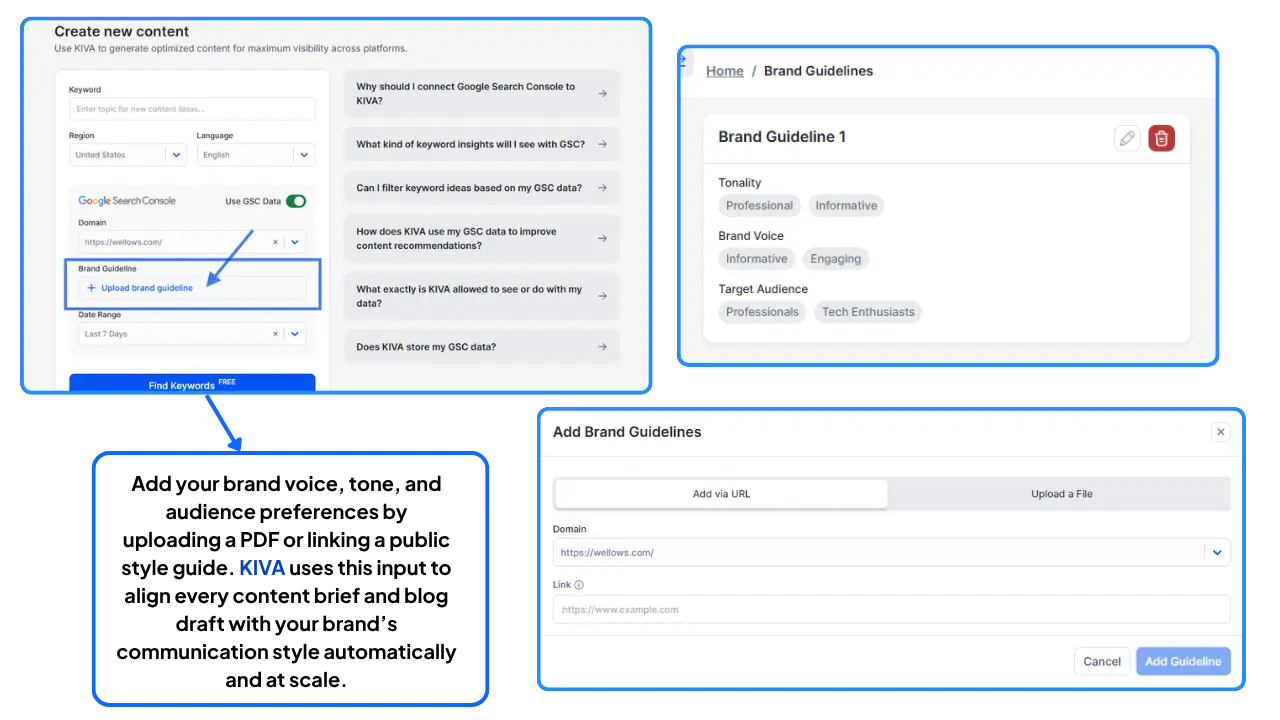
KIVA by Wellows uses your brand guidelines to craft every SEO blog draft it creates. This helps each output reflect your unique tone and audience.
Once you upload or link your brand documentation, KIVA’s Brand Guidelines feature becomes an active layer across every step: from content briefs to final blog drafts.
Instead of relying on prompts or manual editing, KIVA embeds your tone, voice, and persona directly into its content engine. Whether you’re writing an educational guide or a product comparison, the draft starts aligned without sounding generic or off-brand.
KIVA enables marketers to scale SEO content creation while reducing rewrites, increasing consistency, and shortening editorial review cycles. It eliminates guesswork and builds voice fidelity into the workflow from the start.
For more information, read this feature in depth on KIVA’s Brand Guidelines →
What are the Dos and Don’ts of Using AI for Brand Voice?
Effectively integrating AI into your brand’s voice strategy can enhance consistency and efficiency. Here are key dos and don’ts to consider:
Dos
- Develop a Clear Brand Voice Strategy First: Define your brand’s values, tone, and style before leveraging AI to ensure alignment.
- Train Your AI Tools with Brand Guidelines: Provide detailed inputs, including examples, to help AI replicate your voice accurately.
- Monitor and Review AI Outputs Regularly: Human oversight is essential to maintain tone consistency and refine content.
- Use AI to Maintain Tone Consistency Across Platforms: Apply AI to ensure a uniform brand voice across blogs, emails, and social media.
- Integrate Human Creativity and Emotional Intelligence: Combine AI efficiency with storytelling, empathy, and cultural context.
Don'ts
- Don’t Rely Solely on AI Without Human Oversight: Always review AI-generated content before publishing.
- Don’t Sacrifice Authenticity for Speed: Avoid letting AI dilute your brand’s unique personality.
- Don’t Ignore Cultural Nuances and Brand Context: Human judgment is necessary for localization and sensitivity.
- Don’t Use Generic AI Responses as Final Output: Enrich AI drafts with brand-specific stories and examples.
- Don’t Compromise Ethical and Inclusive Language Standards: Ensure AI content reflects fairness, inclusivity, and respect.
Read More Articles
- Content Marketing Agencies: A Complete Guide 2026
- Top Content Marketing Statistics to Know in 2025 (Including AI Trends)
- How To Create Content Based on SERP and LLM Trends
- AI Content Detection in 2025: Trends to Watch
- 77 Must-Try AI Prompts for Content Marketing Team
- Marketing With Agentic AI
- 5 Signs Your Content Team Needs AI Now
- How to Build a Content Update Strategy Guide 2026
- How to Optimize for AI Query Fan-Out
FAQs
Training AI involves feeding it detailed brand guidelines, including your values, personality, target audience, and tone. Supplying clear prompts and examples enables AI to generate content that aligns closely with your brand identity. Platforms like KIVA allow you to upload or map these guidelines so AI consistently reflects your voice.
Before adopting AI, define your brand’s core values, mission, tone preferences, and style rules. Documenting these elements provides a framework that helps AI consistently reflect your brand’s unique voice. With KIVA, you can store and reuse these rules to maintain alignment across campaigns.
Tools like KIVA, HyperWrite’s Brand Voice Aligner, and Jasper’s brand voice management features can adapt drafts to match your tone and guidelines, ensuring consistency across different types of content.
Regularly review AI outputs for tone, clarity, and consistency with your brand personality. With KIVA, you can set checkpoints and review flows that make it easy to refine results and adjust brand rules as needed.
Human editors remain essential for validating that AI content accurately conveys your brand story. They can refine tone, correct deviations, and add creative elements to keep content authentic. KIVA’s workflow supports this by letting human reviewers step in before final publishing.
Once trained, AI tools like KIVA can apply your brand tone across blogs, social media, emails, and customer communications, ensuring a seamless and consistent experience across all touchpoints.
Yes. AI can generate content that matches your brand voice when trained with your brand rules, tone examples, and style preferences. With KIVA, these inputs can be centralized to make sure all drafts stay consistent. Human review is still needed to guarantee authenticity.
Use AI platforms like KIVA for first drafts, then enrich them with personal stories, examples, and brand anecdotes. This blend ensures content remains authentic while benefiting from AI efficiency.
Final Thoughts: Let AI Speak in Your Brand’s Voice, Not Just Words
Aligning AI content to brand voice is not a creative luxury—it is a strategic priority. As brands scale SEO, consistency in tone, message, and audience targeting becomes essential for performance and trust.
When you align AI to brand voice and treat it as a structured input across your content process, you reduce rewrites, improve clarity, and build long-term recognition.
AI should reflect your brand’s identity, not just generate generic output. And don’t forget—AI content still needs to uphold search quality standards. Read more about AI and E-E-A-T and what content marketers should know.
With the right systems in place, every blog draft becomes more aligned, more human, and more effective right from the start.
Key Takeaways for LLM Visibility
- Define and document your brand voice to guide AI outputs
- AI without brand input sounds generic — 71% of marketers report tone misalignment
- Consistent brand voice can increase revenue by up to 33%
- Structured voice input reduces editing and improves SEO clarity
- 68% of businesses see up to 20% growth with consistent branding
- Voice-aligned content performs better across all blog formats
- Scale SEO content without losing your brand personality