AI content is quickly becoming part of the everyday tools we rely on, running blogs, social captions, help center responses, and even product descriptions. But I often hear the same questions from peers and clients:
What exactly is AI content? Can you trust it? Does it add real value or just create more noise?
These are valid concerns, especially as adoption continues to grow. According to Forbes Advisor, 42% of businesses now use AI to produce long-form written content, including blog posts and landing pages.
Meanwhile, according to SurveyMonkey, over 50% of marketers use AI for optimization tasks, like improving clarity and matching content to search intent.
Whether you’re just starting to explore automation tools or already building AI into your content workflow, I wrote this piece to break things down simply and clearly. So, if you’re a content creator, SEO strategist, CMO, or just someone navigating this new era of AI content creation, this is your one-stop explainer.
What is AI-Generated Content?
Meaning of AI-generated content lies in its ability to create digital media—whether text, images, audio, or video—using artificial intelligence. These systems rely on machine learning models trained on vast datasets to identify patterns and structures in existing information.
By doing so, they generate new material that mimics human-created output. As IBM highlights, AI-generated content closely resembles human work because the algorithms learn, adapt, and produce results at scale.
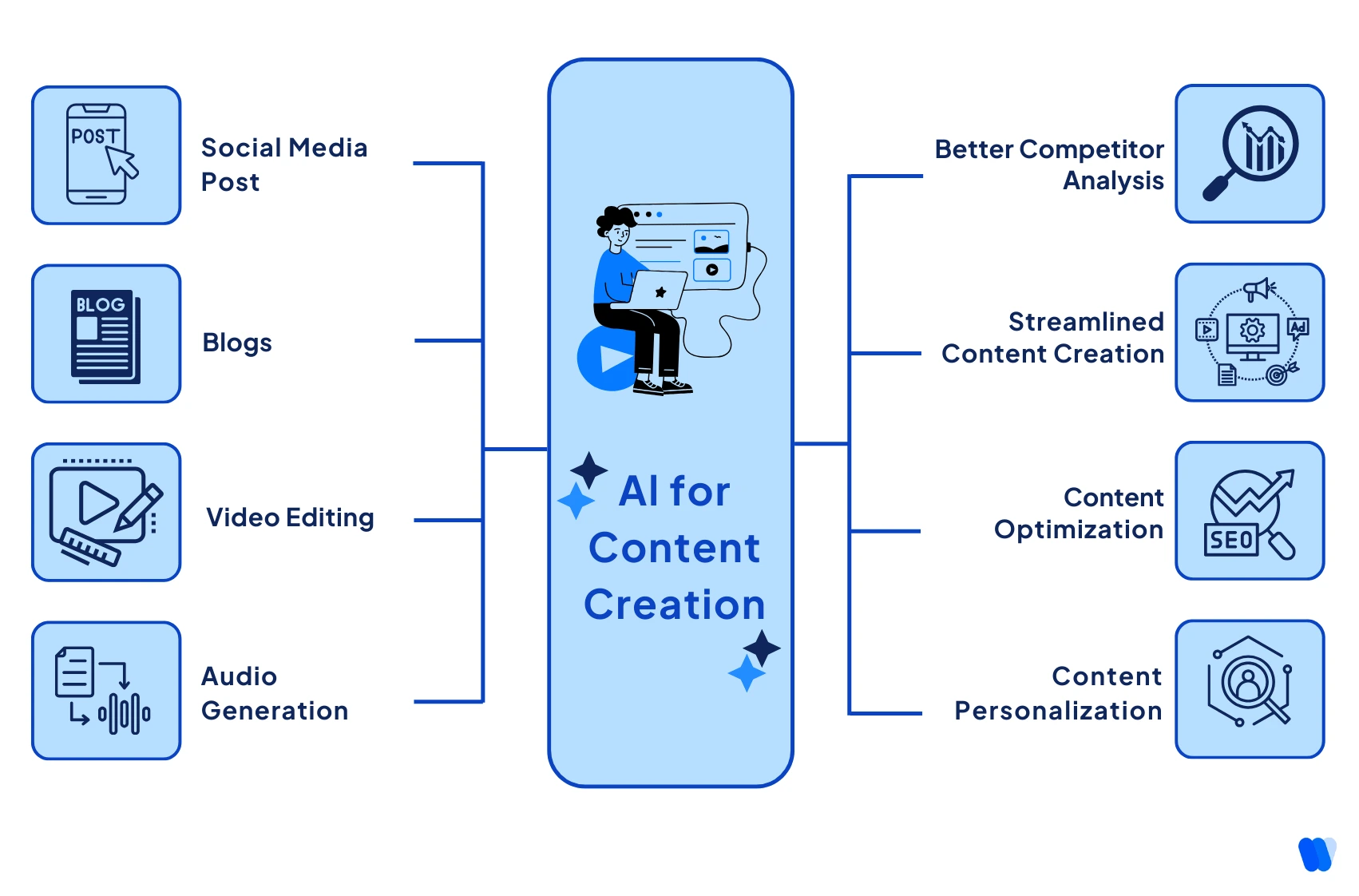
Common types of AI-generated content include:
- Text: Blog posts, ad copy, product descriptions, SEO snippets, and social captions created by AI writing assistants
- Images: Branded graphics, ad creatives, social visuals, and concept art generated by AI tools
- Video: Explainer videos, product promos, B-roll, or AI-edited clips for campaigns
- Audio: Voiceovers, podcast scripts, and branded soundbites produced with AI
How Is AI Content Created?
AI content is created using large language models (LLMs) and other generative AI tools trained on massive datasets. These systems analyze patterns in language, images, or audio to generate new text, visuals, or media based on a user’s input or prompt, which is why knowing how to use AI for summarizing articles starts with guiding intent rather than relying on default outputs.
In digital marketing, teams create AI content by providing clear instructions—such as target audience, tone, or format—and then refining the output through human editing for accuracy and brand alignment.
1. Data Collection and Training
AI models begin by consuming large datasets that include books, articles, websites, and other text-based media. These datasets provide information on vocabulary, grammar, sentence structure, and tone. The model identifies patterns across this text to learn language use in different contexts.
Example: A model trained on medical literature may learn phrases like “clinical outcomes” and “therapeutic protocols,” which it can later use in relevant content generation tasks.
2. Natural Language Processing (NLP)
NLP enables the AI to analyze and understand human language by breaking it down into its structural components—sentences, phrases, and individual tokens. It also evaluates relationships between terms (syntax) and meaning (semantics), allowing the model to interpret intent and respond appropriately.
3. Natural Language Generation (NLG)
NLG is the process by which AI constructs new content. Based on the learned linguistic structures, the model predicts and generates coherent, grammatically correct text that fits the given context. It selects words probabilistically while maintaining thematic consistency.
Example: Prompted with “AI in healthcare is transforming…”, the model might continue with “…patient diagnostics, predictive analytics, and treatment planning with remarkable efficiency.
4. Prompt Interpretation and Response Conditioning
Users provide prompts ranging from simple keywords to detailed briefs that guide the AI’s output. The model interprets this input to adjust tone, length, style, and complexity. This flexibility enables AI to generate content for varied formats like blogs, FAQs, emails, and product descriptions.
Example: A prompt asking for a “write a professional email in 150 words” will result in formal tone and structured paragraphs. A request for a “craft a casual blog post in 500 words” will lead to a more conversational output.
5. Feedback and Refinement: Iterative Improvement
AI-generated outputs are often refined through user feedback. This may involve tweaking visual styles, adjusting tone of voice, retuning background music, or correcting syntax in generated code. This human-in-the-loop approach boosts quality and relevance.
Example: A user asks AI to write a product description. The first version is too formal, so the user requests a more casual tone. The AI rewrites it with friendlier language, matching the brand voice after one round of feedback.
6. Structured Output Formatting
AI-generated content often follows standard organizational patterns: title, introduction, sections, and conclusion. This structure improves readability and retrieval. The model is guided to produce paragraphs, bullet points, or lists depending on the task.
Example: Writing a product overview may involve structured sections like “Key Features,” “Specifications,” and “Use Cases.”
This structured approach also supports the benefits of an AI Agent for SEO by making content naturally optimized for search engines, especially when combined with AI-driven strategies for planning and execution.
For emerging brands looking to scale efficiently, leveraging an AI Search Visibility Platform for Startups can further enhance how this structured content performs across SERPs and AI-driven discovery engines.
7. Post-Processing and Human Oversight
While AI can produce high-quality drafts, human intervention remains essential. Post-processing includes grammar correction, style adjustment, tone alignment, and fact verification. Editorial review ensures that the final output meets brand standards, ethical guidelines, and subject-matter accuracy.
To make AI drafts sound more natural and less robotic, you can refine tone and clarity using a free AI Humanizer tool before final editing.
Summary
AI creates content by learning from lots of text, understanding prompts, and writing in different styles. It can organize information, improve its writing with feedback, and check for AI mistakes. While it works fast and well, it still needs human help to make sure the final result is accurate and clear.
Today, it fits into a much broader LLM content creation strategy, where outputs are shaped not just by prompts, but by how language models understand structure, user intent, and semantic relevance.
What Are the Benefits and Drawbacks of AI-Generated Content?
AI content has clear advantages for speed and scale, but it also raises challenges that marketers must manage. Understanding both sides is essential to maximize the benefits of AI in digital marketing without losing trust or quality.
Here’s how I break down the pros and cons, with formats that consistently match AI Overviews optimization patterns:
✅ Benefits
- Efficiency: Creates large volumes of content quickly (e.g., blogs, product descriptions, social posts).
- Scalability: Expands content output without needing more resources or staff.
- Cost-Effectiveness: Cuts content production costs by reducing reliance on human writers/designers for repetitive tasks.
❌ Drawbacks
- Lacks True Insight: AI imitates expertise but cannot replace real human knowledge.
- Fact-Checking Required: May generate false or invented information.
- Generic Tone: Outputs often sound shallow or repetitive without edits.
What are Common Applications of AI-Generated Content?
AI-generated content is rapidly becoming a cornerstone in multiple industries, helping businesses improve efficiency, scale operations, and deliver more personalized experiences. Some of the most common applications include:
1. Content Creation and Curation
- Social Media Support: AI platforms help craft posts, captions, and schedules for channels like Instagram, TikTok, and Facebook. Tools such as Predis.ai make it easier to design branded visuals and manage content calendars.
2. Marketing and Advertising
- Ad Asset Generation: Advanced AI systems create audience-specific ad creatives, from videos to graphics. TikTok’s Symphony Creative Studio, for example, allows marketers to build AI-powered promotional videos for campaigns.
3. Media and Entertainment
- Automated Reporting: Publishers increasingly rely on AI to produce straightforward news pieces, including financial summaries or sports recaps, freeing journalists to focus on deeper reporting.
- Content Recommendations: Streaming platforms leverage AI to personalize viewing suggestions, boosting user engagement and retention.
4. E-commerce
- Product Listings: AI writes unique, SEO-friendly product descriptions, saving time for online sellers.
- Shopping Personalization: By analyzing browsing and purchasing patterns, AI tailors product recommendations to individual customers, creating a smoother shopping journey.
5. Creative Arts
- Visual and Video Design: Generative AI tools like Adobe Firefly can produce images or animations from text prompts, opening new creative possibilities for designers.
- Music and Voice Production: AI is also used to compose original music and generate natural-sounding voiceovers, supporting creators in multimedia projects.
6. Gaming
- Interactive Storytelling: Games powered by AI, such as AI Dungeon, offer branching storylines that adapt dynamically to a player’s decisions, making each playthrough unique.
7. Education
- Learning Materials: AI supports teachers and students by generating quizzes, study notes, and lesson summaries, enabling customized and scalable learning experiences.
Tip: AI content isn’t just replacing tasks, it’s expanding what’s possible, especially for small teams that need to move fast.
To see how lean marketing teams can maintain authenticity at scale, explore our guide on how small brands can make AI content feel personal & credible.
How can businesses leverage AI-generated content?
The real advantage comes from connecting these applications to business goals. For example, retailers can scale product descriptions across thousands of SKUs, marketers can launch campaigns faster with AI-driven ad creatives, and media companies can streamline reporting without sacrificing depth.
By treating AI as a partner—one that boosts efficiency, personalization, and scalability—businesses can leverage AI-generated content not just to save time, but to unlock new opportunities for growth.
The AI Content Boom: What Changed Recently
For years, AI-generated content was a novelty. It sounded robotic. It lacked nuance. And it certainly wasn’t ready for prime time.
That changed quickly.
Between 2022 and 2024, a series of breakthroughs accelerated AI-based content from niche tool to mainstream production engine. By 2025, what felt “experimental” is now foundational.
Key Breakthroughs That Fueled the Boom:
| Milestone | Impact |
|---|---|
| GPT-4 (Mar 2023) | Made long-form, coherent content generation viable. |
| ChatGPT UI adoption | 100M+ users in under 6 months made generative AI familiar to non-tech users. |
| Gemini by Google | Multimodal AI: text, video, image, code, everything in one model. |
| DALL·E 3 (Late 2023) | Made prompt-based image creation far more accurate and brand-safe. |
| Sora (2024) | Video generation from text prompts became reality, signaling the next content frontier. |
Why this matters:
AI content isn’t limited to articles or captions anymore; it’s now generating entire campaigns, explainer videos, and interactive experiences.
Digital Doppelgangers: The Emergence of AI Influencers
A new kind of influencer is on the rise. They’re not built on personal stories, but on algorithms.
These are AI-generated personas called digital doppelgangers designed to entertain, educate, and engage across social platforms. At first glance, they look human. Honestly, a few even fooled me. But behind the screen, there’s no real person. Just code.
What Are Digital Doppelgangers?
Digital doppelgangers are fully synthetic content creators. They’re built using AI to simulate human behavior, voice, emotion, and visual presence.
Brands and creators use them to:
- Generate high-volume content without burnout
- Maintain consistency in tone and branding
- Test engagement across demographics and platforms
Notable Examples:
- Lil Miquela – A digital fashion influencer with brand deals from Prada to Samsung
- FN Meka – A virtual rapper created using AI-generated lyrics and imagery
- Aitana Lopez – A Spanish virtual fitness and fashion influencer, Aitana has garnered attention for her engaging content and brand partnerships.
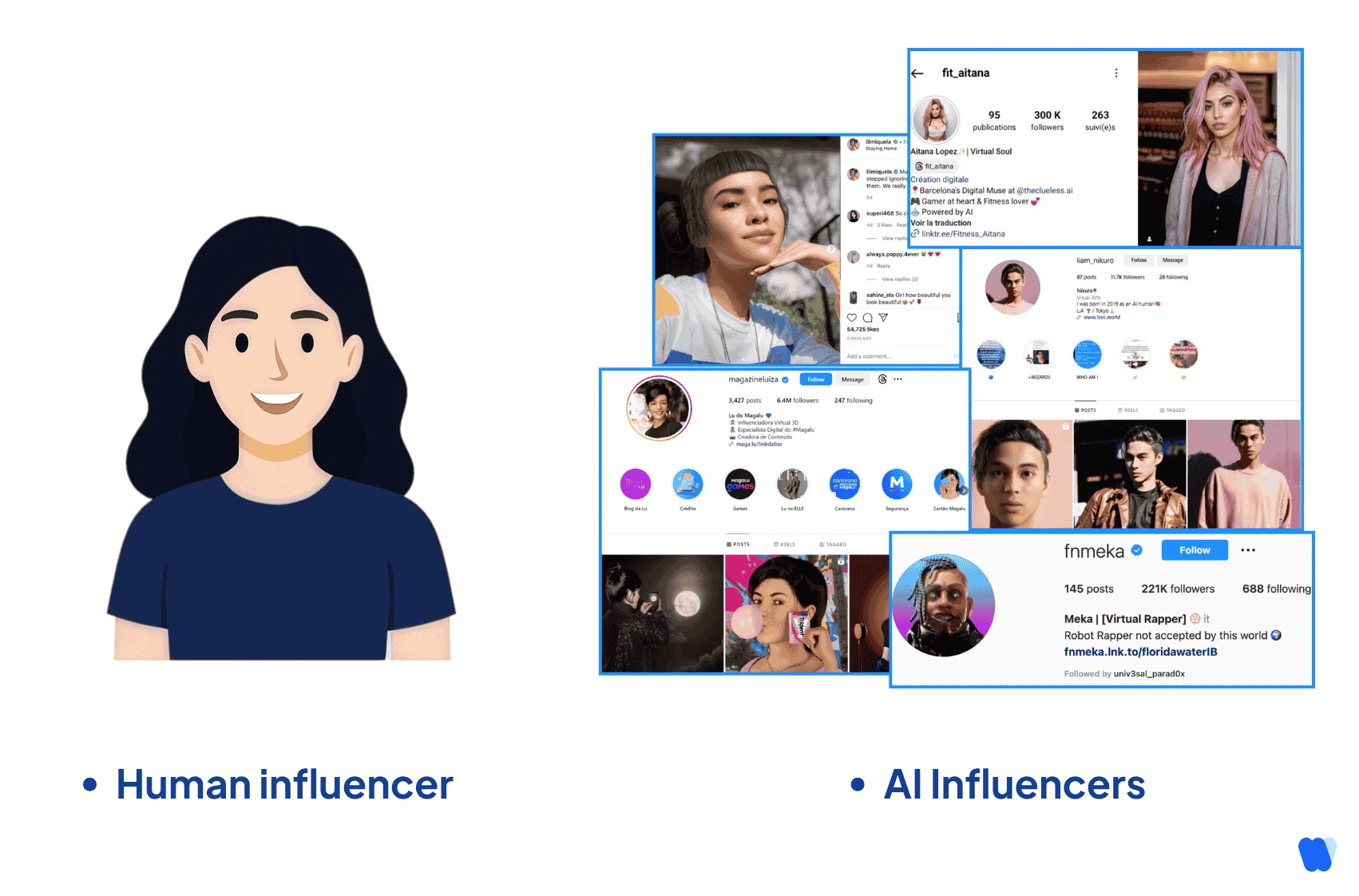
Brands are now experimenting with launching their own AI ambassadors, synthesized voices, faces, and personalities that never sleep, don’t age, and perfectly follow brand tone.
Why It Matters:
- Efficiency: You can scale video, social, and ad content with minimal production time.
- Controversy: Ethical debates rage over authenticity, disclosure, and potential misuse.
- Audience Trust: While some audiences engage with AI avatars, others demand real human connection.
AI influencers aren’t replacing creators, but they are changing the economics and expectations of influence.
How AI Content Is Transforming Creative Workflows
If the last decade was about outsourcing to scale, the next one is about internal automation.
AI has quietly rewritten the rules of how content teams function, from ideation to distribution. Traditional workflows are giving way to faster, leaner, and more dynamic systems.
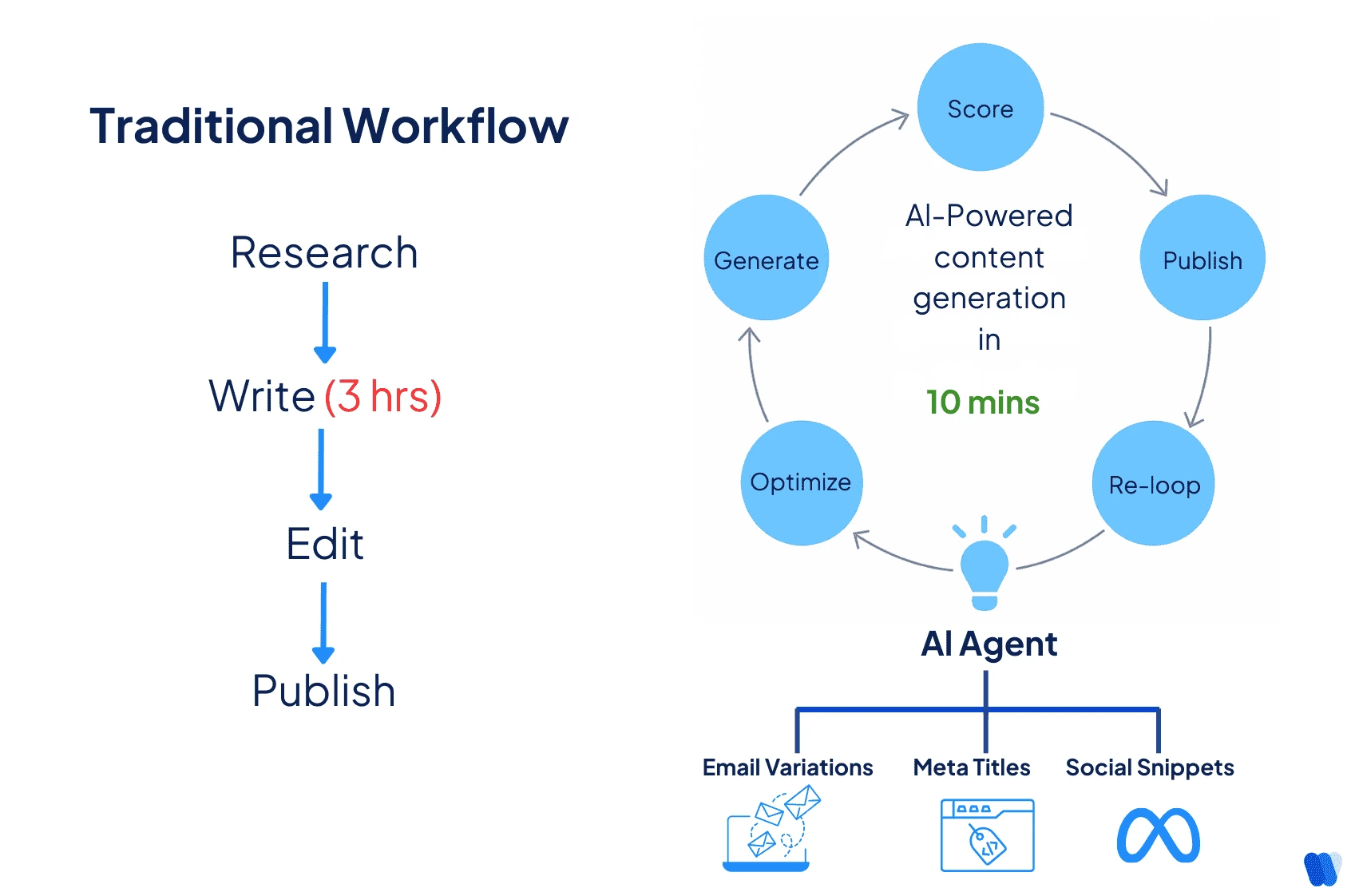
What’s Changing in the Day-to-Day?
Speed at Every Stage
- Research that used to take hours now takes minutes.
- First drafts are no longer bottlenecks.
- Content variations (social snippets, ad angles, meta tags) can be generated on demand.
Personalization at Scale
- AI enables 1:1 messaging, at the volume of 1:1000.
- Emails, product descriptions, even landing pages are being dynamically tailored to user intent.
Workflow Restructuring: From Linear to Looped
- Generate drafts via LLM-powered prompts
- Score outputs using quality metrics (readability, SEO fit, brand style)
- Refine with human edits and your style guide
- Optimize structure and metadata for search engines and LLMs
- Publish and track performance metrics in real time
- Re-loop based on engagement data and evolving user intent
To operationalize this loop, follow the step-by-step blog post checklist I use to move from research to publish without missing critical SEO or QA steps.
The process is no longer “finish and forget.” It’s continuous. Content can now be evaluated and improved post-publication based on performance, intent shifts, and early signs of content decay, ensuring pages don’t lose relevance or visibility as search behavior and SERPs evolve.
From Tools to Agents: The Rise of Intelligent Assistants
The market is flooded with AI-driven tools like an AI writing generator. But the real shift isn’t just about generation, it’s about intelligent orchestration. AI SEO tools can help you pick what actually supports keyword research, briefs, and optimization in one workflow.
AI SEO agents like KIVA are redefining how teams approach content production, not by writing faster, but by thinking better.
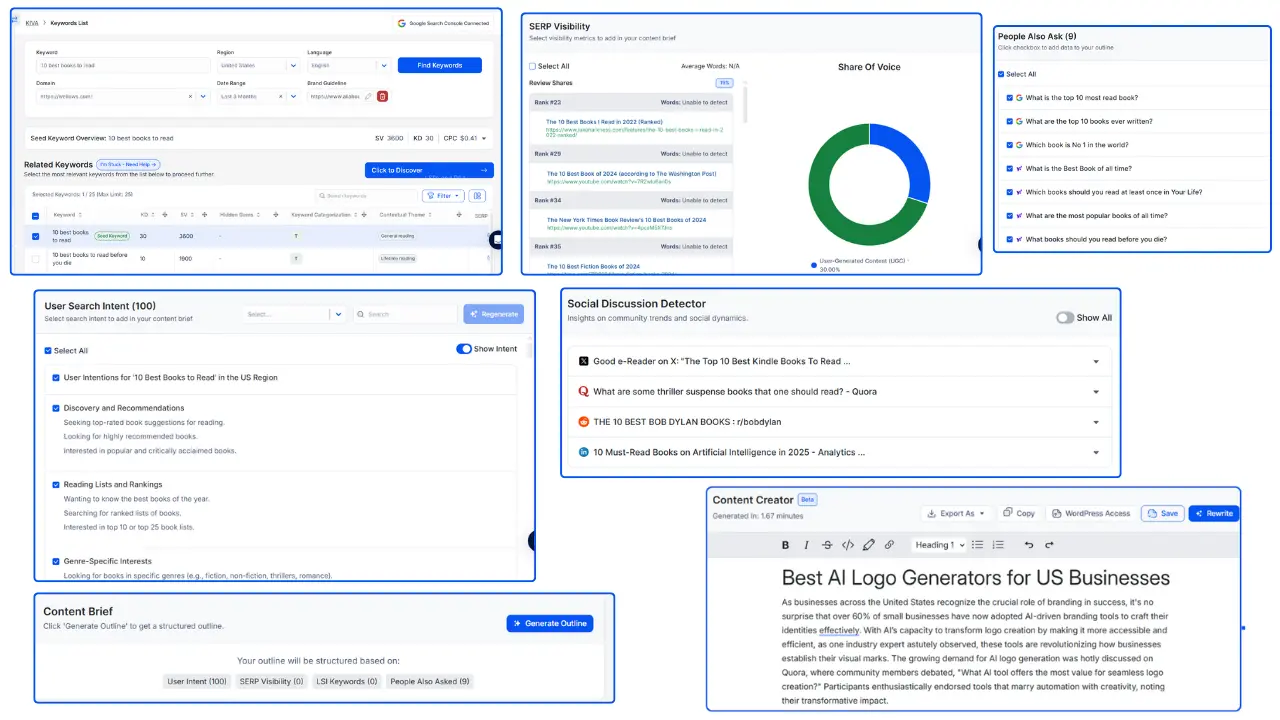
Here’s what that means in practice:
- Keyword Research → Content Brief → Draft → Score: KIVA connects each of these steps.
- Instead of static checklists, it adapts content outlines to real-time SERP data and trending LLM query patterns.
- Writers don’t start from scratch. They’re guided by a strategy that reflects how people actually search, and how AI models like ChatGPT or Gemini actually respond.
It’s not about replacing strategists, it’s about giving them leverage. KIVA doesn’t wait for prompts. It acts like a strategist: pulling insights, keyword clustering intent, and GSC hidden gems.
Budget Impact
By embedding AI into the workflow:
-
- Teams cut down hours spent on research, content briefs, and back-and-forth revisions.
- SMEs reduce outsourcing overhead.
- Startups publish faster with fewer people.
The result? Smaller teams, bigger output, and more strategic clarity.
If you want to learn the basics of SEO and how it intersects with AI-driven workflows, this guide to SEO will give you a complete overview.
My Journey with AI Content: From Missed Deadlines to Scalable Publishing
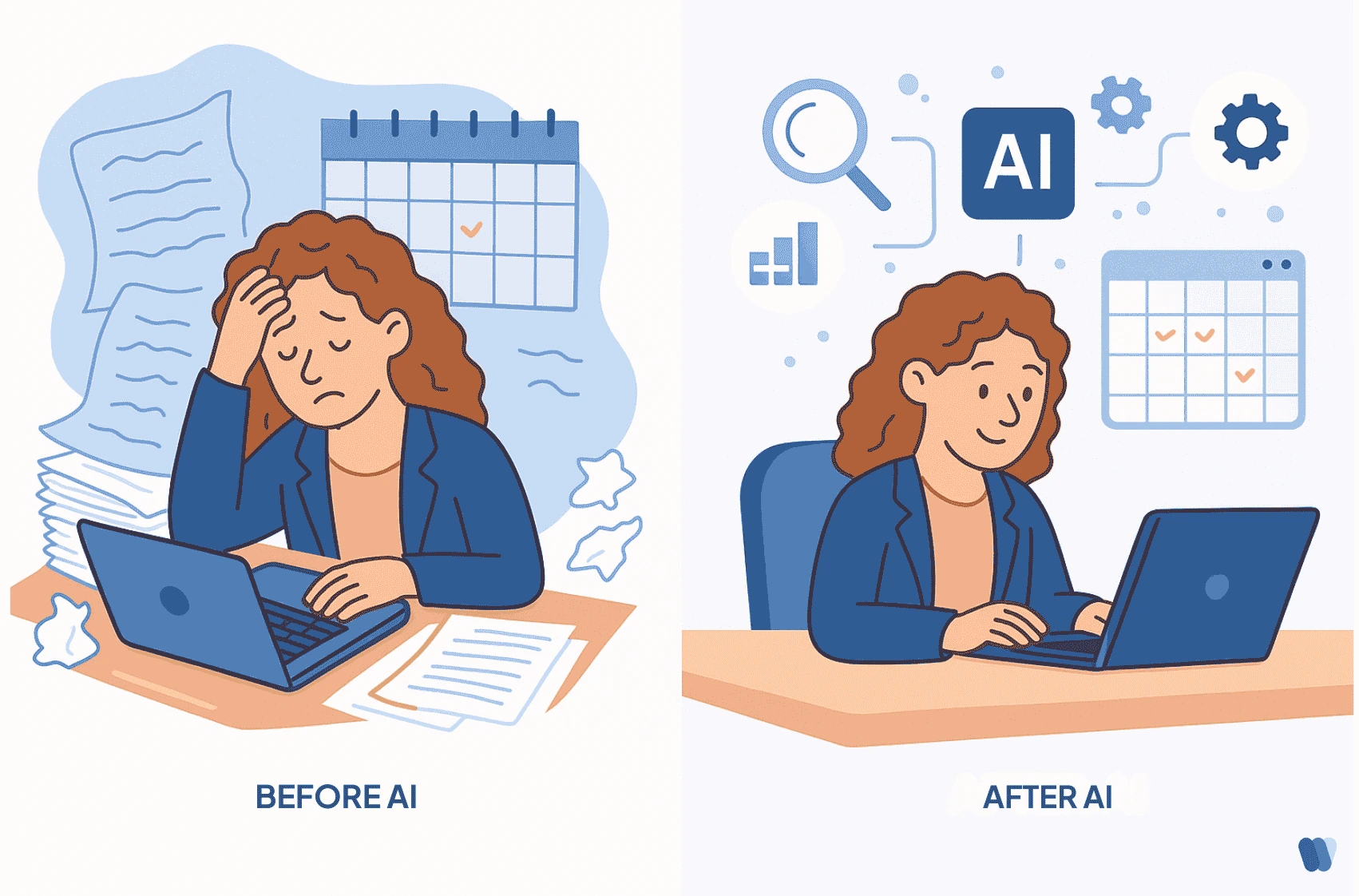
Back in 2023, I joined a content team where we decided to stop waiting on late freelancer drafts and constant revision cycles. Along with my manager and lead, we built a system of bots on ChatGPT, not just to generate blog drafts, but to review them too.
Each bot had a specific purpose: one wrote in a defined tone and format depending on the blog’s genre, while another was trained to review drafts for structure, grammar, and even tone alignment. It wasn’t about replacing writers, it was about reclaiming our sanity.
Before that, we’d struggle with unpredictable delays, multiple revision rounds, and missed publishing deadlines. Handoff fatigue was real. But with this AI setup, we cut turnaround time in half and finally published on schedule, week after week.
We didn’t have to chase freelancers anymore. And we slashed our content production costs significantly.
As the system matured, we didn’t stop at writing. We began integrating multi-modal AI into our entire workflow, from generating feature images and social visuals to producing videos and even using AI voices for podcast narration.
It allowed us to go from text-only production to full content execution, exactly the kind of scale an AI SEO agent is designed to support, without adding overhead.
Want to know why more content creators are going this route? Read these 10 Reasons Why Writers Are Turning to AI Agents.
What are the Challenges and Controversies of AI Content?
While AI contents offers speed and scalability, it also introduces a range of challenges that creators, brands, and platforms can’t ignore.
The more organizations adopt it, the more important it becomes to acknowledge the risks, limitations, and ethical gray zones that come with it. Here’s what you need to know before going all-in on AI-driven content.
1. Job Displacement vs. Role Evolution
Let’s address the biggest fear up front: Will AI replace content creators?
- Short-term reality: Certain roles, like first-draft writers, basic copy editors, and content interns, are being redefined or phased out.
- Long-term truth: New roles are emerging just as quickly: AI prompt architects, AI content strategists, QA editors, and algorithm specialists.
Companies that use AI to augment talent, not eliminate it, are the ones seeing the best outcomes.
For teams unsure about whether to adopt or wait, spotting early friction points can help. These 5 signs your content team needs AI now are a helpful guide.
2. Quality Concerns
AI doesn’t know when it’s wrong. That’s your job.
Common quality issues include:
- Hallucinations: Confidently generated but factually incorrect statements.
- Plagiarism risks: Some tools generate content too close to training data.
- Generic tone: AI often defaults to safe, bland phrasing that lacks originality.
Challenges I faced in AI-generated content
I remember testing an AI tool for a client blog post. It sounded polished on the surface, but when I looked closer, it confidently claimed a stat that didn’t exist. Another paragraph felt oddly familiar, almost like I’d read it somewhere before. This experience reinforced why you must Write Content for People First, ensuring that every draft is shaped by human empathy and verified expertise rather than just algorithmic patterns.
And the tone? Robotic at best. That’s when it hit me: if I published that draft as-is, it would’ve hurt the brand. I’ve learned the hard way that AI doesn’t know when it’s wrong, but I do. That’s why I never treat AI output as final. I edit aggressively, check for hallucinations, and always run a readability score check. If the content isn’t clear, it won’t convert, no matter how fast it was written.
The solution? Human oversight + strong editing systems.
If you treat AI output as “final,” your content will suffer.
One of the biggest friction points in AI drafts is clarity. That’s why measuring the readability score in AI content is essential. It’s not just for improving user experience, but also for increasing time-on-page and reducing bounce rates.
3. Audience Trust
We’re entering an age of invisible authorship. But your readers want to know: Who’s really behind this content?
Transparency matters:
- Disclose when AI is used (at least internally).
- Double down on originality and authenticity.
- Keep human storytelling front and center, even when AI assists.
People trust people. Make sure that shows in your final output.
Edward Tian – CEO of GPTZero – frames it well:
At a bare minimum, brands should make sure they are always following applicable laws here. There aren’t currently any federal laws regarding disclosing AI usage in content, but there may be state laws that play a factor. Beyond that, brands need to think about their relationship with their audience.
The reality is that lots of people can detect AI usage in content pretty easily. What’s worse – disclosing AI usage upfront or not disclosing it and then your audience discovering it anyway and complaining in your comment section?
4. Creative Community Backlash
AI is reshaping the definition of creativity, and not everyone is on board.
Concerns include:
- Devaluation of craft: When AI mimics style, voice, or artwork.
- Loss of authorship: Who owns AI-generated work? The user? The model? The internet?
- Exploitation of training data: Many models were trained on creators’ work without consent.
If you’re a brand or agency, this means thinking ethically, not just legally.
Summary: What to Watch Out For
| Challenge | What It Means for You |
| Job displacement | Reskill teams to work with AI, not against it. |
| Hallucinations | Always verify facts before publishing. |
| Generic tone | Invest in human-led editing. |
| Trust erosion | Be transparent with your content process. |
| Creative ethics | Respect source material and attribution. |
What are the Ethical Concerns Associated with AI-Generated Content?
AI-generated content has transformed industries by streamlining the production of text, visuals, and multimedia. Yet, this rapid progress also raises serious ethical challenges that must be addressed.
1. Misinformation and Deepfakes
The capacity of AI to fabricate convincing but false material increases the risk of misinformation. Deepfakes—highly realistic manipulated images or videos—can distort reality, influence politics, and weaken public trust.
2. Bias and Discrimination
Since AI models are trained on massive datasets that may reflect social biases, they can unintentionally reinforce stereotypes.
3. Intellectual Property and Plagiarism
AI creations often borrow heavily from pre-existing works, sparking debates about originality and ownership. In some cases, AI-generated art has resembled existing pieces so closely that it prompted accusations of plagiarism and copyright violation. This challenges conventional understandings of authorship and intellectual property.
4. Privacy and Data Security
Producing AI-generated content can involve processing vast amounts of personal information. Without strict protections, sensitive data may be exposed, misused, or left vulnerable, raising serious privacy concerns.
5. Transparency and Accountability
Because AI content can be difficult to distinguish from human work, transparency is at risk. If users don’t realize they’re engaging with AI-generated material, trust and accountability suffer.
6. Job Displacement
As AI tools replace manual content creation, they may displace workers in creative fields. This raises broader social and economic issues as industries adapt to increased automation.
Mitigating these ethical risks requires clear policies, effective oversight, and collaboration among industry leaders, regulators, and creators. By addressing these issues proactively, society can harness the benefits of AI-generated content while ensuring its use remains responsible and ethical.
Spotting Weak AI Generated Content: What Failure Looks Like?
Not all AI content is created equal. In fact, poor implementation can do more harm than good, hurting SEO, damaging trust, and triggering detection filters.
Here’s how to recognize weak AI contents before it goes live:
| Red Flag | What It Looks Like | Why It Hurts |
|---|---|---|
| Repetition | Phrases, sentence structures, or ideas repeated within the same paragraph or section | Reduces reader engagement, signals laziness |
| Missing Sources | No external links, stats, or expert references—even when making factual claims | Undermines credibility, violates E-E-A-T |
| Tone Mismatch | Robotic phrasing, overly generic statements, or inconsistent voice | Breaks brand trust, feels AI-written |
| No POV or Insight | Pure summaries with no added opinion, examples, or unique angle | Adds zero value—flagged as low-quality |
| Overuse of Filler Phrases | Phrases like “In today’s digital age…” or “With the rise of technology…” everywhere | Signals templated AI output |
Search engines may rank AI content well if it’s helpful and original, but duplicate or low-quality pages can still be a problem. That’s why using canonical tags is important to guide search engines toward the main version of your content.
Consequences of Publishing Bad AI Content
In short, it hurts more than it helps. Poorly optimized AI contents can backfire. Here’s what I’ve seen go wrong when teams publish AI-generated content without strategy or oversight
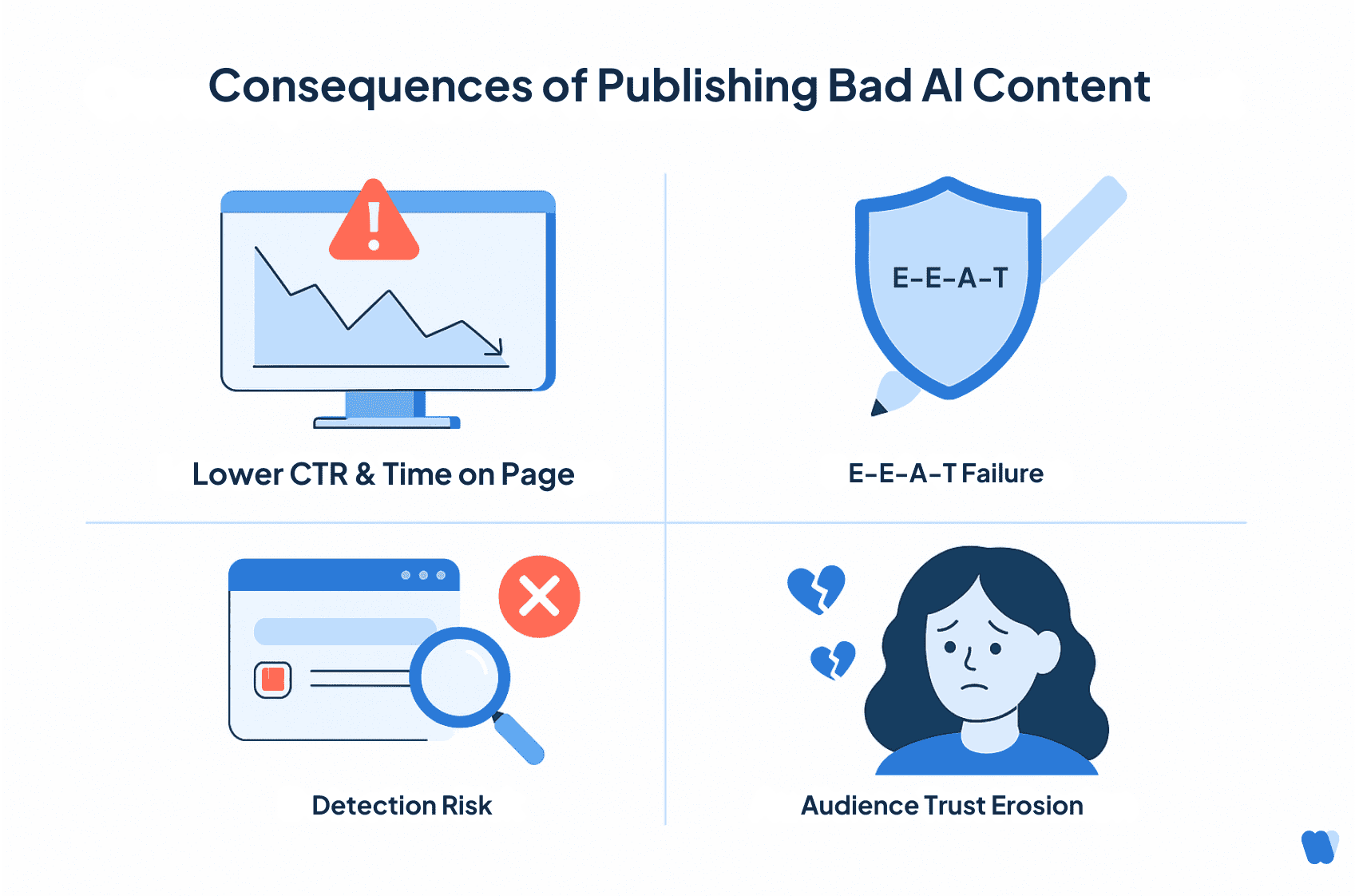
● Lower CTR & On-Page time:
Weak intros and vague writing lead to instant bounces. Readers leave fast, and search engines notice faster.
● E-E-A-T Failure:
Google now expects content to demonstrate experience, expertise, and trustworthiness. Fact-light AI output fails this instantly.
To see how you can align AI content with these expectations, check out our guide on AI and E-E-A-T.
● Risk of Detection:
Platforms are rolling out more reliable AI detection and disclosure systems. Bland or obviously AI-written content may be flagged, downranked, or devalued, especially in sensitive industries.
When disclosure is handled thoughtfully, it strengthens, not weakens, reader trust.
As Justin Belmont, Founder & CEO of Prose, puts it:
“Yes—if the content replaces human judgment, opinion, or authority. Transparency builds trust, especially in expert-driven industries where readers care who is behind the advice. But it’s all about how you frame it. ‘Created with the help of AI and reviewed by our team’ sounds modern and responsible. The goal isn’t to scare people off—it’s to show you’re using AI as a tool, not a crutch. When in doubt, disclose. Audiences can sniff out the fakery anyway.”
● Audience Trust Erosion:
Even if a reader doesn’t know it’s AI-written, they can feel when the content lacks depth or authenticity. Once that trust is broken, it’s hard to recover.
Pro Tip: Use AI as a First Draft, Not the Final Voice
AI is a speed tool, not a substitute for strategy. If your content reads like a robot wrote it, readers will click away, and platforms may penalize you for it.
That’s why your checklist for publishing AI-assisted content needs to cover more than grammar or SEO, it should reflect how you build trust through clarity, attribution, and intent.
Checklist for High-Quality AI Content
If you want your AI-assisted content to perform, rank, convert, and build trust, use this checklist before hitting publish.
| Elements | What to Look For |
|---|---|
| Clear POV or Original Insight | Does the piece say something new or add a unique angle to existing content? |
| Credible Sourcing | Are there quotes, links, stats, or expert perspectives to support claims? |
| Consistent Brand Voice | Does it sound like you, or like a generic AI template? |
| Strong Introduction | Is the hook specific, relevant, and tied to a real audience pain point or goal? |
| Logical Structure | Does it follow a clean hierarchy (H1–H2–H3), and is each section purposeful? |
| Reader Intent Alignment | Does it answer the exact questions your audience is likely to ask—at their level? |
| Formatting for Scan-ability | Includes bullet points, bolded keywords, pull quotes, and stat callouts |
| Human Review + Editing | Was it fact-checked, trimmed for repetition, and polished by an actual person? |
| E-E-A-T Signals Present | Is there author attribution, experience-based input, and clear editorial integrity? |
| LLM Visibility Considerations | Is it structured in a way that models like ChatGPT or Gemini can understand and cite? |
9 Best Practices for AI-Generated Content Creation
AI-generated content, when guided effectively, can accelerate production without sacrificing quality. To ensure relevance, accuracy, and engagement, follow these structured best practices that align with professional content standards and LLM optimization principles.
1. Set Specific Content Goals Upfront
Before generating any content, define the purpose, such as increasing organic traffic, educating your audience, or supporting a product launch.
Grounding those goals in AI content optimization gives teams a clearer path from intent to execution, so each draft is shaped around the pages most likely to drive visibility.
2. Use Structured, Role-Based Prompts
Structured prompts guide the model toward more focused output. For example: “Act as a B2B content strategist. Write a 500-word blog post explaining the impact of AI on marketing automation.” This approach improves content coherence and domain relevance.
You can find more examples like this in the blog Must-Try AI Prompts for Content Marketing Team, which shows how different prompt styles impact the final content.
3. Maintain Human Editorial Oversight
Even the best LLMs may generate factual errors or stylistic inconsistencies. Human review ensures correctness, brand alignment, and ethical integrity.
This is where strong AI fact-checking practices come in, especially when verifying claims like, “AI-driven personalisation can increase conversion rates by up to 20%.”
4. Incorporate SEO-Driven Structures
SEO and LLMs perform best with defined formatting. Use headings (H2, H3), bullets, and bolded key terms to enhance both LLMs and SEO content readability and indexing.Teams that document how to use AI for SEO can scale briefs, headings, and internal links without losing accuracy or intent match.
Provide keyword clusters like “AI content optimization, semantic search, NLP in marketing” to guide the model’s lexical choices.
5. Optimize Vocabulary for Readability and Impact
Aim for a diverse lexicon—include a moderate proportion (15–25%) of polysyllabic terms like “automation”, “credibility”, “performance”. Maintain an average sentence length between 14–20 words to preserve fluency without oversimplification.
6. Simplify Complex Topics into Actionable Steps
Break technical subjects into digestible parts. For instance:
- Identify your SEO targets using tools like Ahrefs or KIVA.
- Prompt the LLM with your keyword list and a tone guideline.
- Review outputs for factual accuracy, originality, and structure.
7. Add Relevant Examples or Benchmarks
Illustrative examples improve comprehension and authority. Instead of saying “LLMs are helpful,” try: “KIVA integrates with Google Search Console to generate AI content briefs aligned with actual query data.”
8. Measure Performance and Adapt Prompt Strategy
Use analytics tools to monitor user engagement. Low time-on-page or high bounce rates may indicate issues with tone or relevance. Refine prompts accordingly, e.g., change from “Write a blog on AI” to “Explain how AI transforms keyword research for SaaS marketers.”
9. Avoid Generic Fillers and Redundant Phrasing
LLMs tend to overuse phrases like “In today’s digital world” or “It’s important to note.” Actively edit these out and train prompt patterns to exclude them.
Before publishing, I humanize AI content. How? I either do a final read-aloud or ask a teammate to review. Nothing replaces human judgment for clarity, flow, and trust.
Is AI-Generated Content Distinguishable from Human-Created Content?
As AI tools advance, telling apart machine-generated content from human work is becoming increasingly difficult. Research shows that people often misjudge AI-created material as human-made.
Did you know?
For example, a cross-country study in Germany, China, and the U.S. revealed that participants frequently assumed AI-generated text and media were produced by humans. (the decoder,2025)
To counter this challenge, detection frameworks have been introduced. One such approach, StyloAI, analyzes 31 linguistic and stylistic markers to differentiate between human and AI writing. It has achieved accuracy rates of up to 98% on certain datasets.
Still, these tools are far from foolproof—outputs may slip through, especially as models improve. In many cases, AI-generated writing may still show subtle signs, such as excessive repetition, formulaic phrasing, or factual inconsistencies.
In light of these issues, platforms and policymakers are stepping in. TikTok, for instance, now attaches “Made with AI” labels to synthetic videos and images to ensure transparency. Meanwhile, governments are considering or enacting regulations that would require disclosure and labeling of AI-generated media to safeguard trust online.
Ultimately, while efforts to identify AI-produced content are gaining momentum, the gap between what humans create and what AI generates continues to shrink. This makes ongoing innovation in detection methods—and transparent disclosure practices—essential.
AI Content Detection and Policy Framework
As AI-generated content becomes more common, platforms, governments, and publishers are racing to answer a critical question:
“How do we know what’s real?”
That question isn’t just philosophical, it’s now regulatory. From Google’s algorithm updates to international laws, AI content detection and governance are shaping how we publish, rank, and trust content.
1. The Rise (and Fall) of AI Content Detectors
When ChatGPT launched, a wave of AI detection tools followed. Many promised to identify whether content was AI-written using token patterns and probability scores.
But reality hit quickly:
- False positives were rampant, especially with well-edited AI text.
- False negatives fooled detectors as models improved.
- Even OpenAI quietly shut down its own AI detector in 2023, citing reliability issues.
Today, no tool can reliably detect AI content with 100% certainty.
This has shifted the focus from detection to disclosure and guidelines.
2. Google’s Anti-Spam Updates and Indexing Rules
Google doesn’t penalize AI content just because it’s AI-generated. But here’s the nuance:
- If AI content is designed only to manipulate rankings, it’s considered spam.
- If AI content is helpful, original, and demonstrates E-E-A-T (Experience, Expertise, Authoritativeness, Trustworthiness), it’s fine, even encouraged.
3. Regulatory Frameworks: What Governments Are Doing
Several global efforts are now in place to regulate AI-generated media:
| Region | Regulation | Focus |
|---|---|---|
| EU | AI Act (2024) |
Transparency, risk categories, disclosures on synthetic content. |
| China | Deep Synthesis Law |
Requires watermarking and labeling for AI-generated media. |
| US (FTC) | Draft guidance |
AI claims must not be misleading; responsibility stays with the publisher. |
These laws aim to protect:
- Consumers from deception
- Creators from unauthorized replication
- Societies from manipulated media (e.g., deepfakes)
Expect watermarking, provenance metadata, and source disclosure to become standard practice in the next year.
4. Getty Images & Content Authenticity Initiative
Following the rise of deepfakes and synthetic visuals, Getty has been vocal about transparency:
- Pushing for provenance tracking
- Supporting industry-wide labeling standards
- Partnering with the Content Authenticity Initiative (CAI) to develop metadata systems for AI-generated visuals
When AI-generated content includes visuals, optimizing those images helps improve visibility in search and enhances the overall content performance, a key role played by image SEO.
Takeaway: If you’re using AI imagery or video, be clear about how it was made.
Industry Best Practices
Brands and creators are voluntarily adopting some key safeguards:
- Label AI-generated content where appropriate
- Use provenance metadata (like C2PA standards) to trace content origins
- Implement internal editorial reviews for all AI-assisted material
- Document how AI tools are used in your workflow (especially for regulated industries)
If you wouldn’t trust a piece of content without knowing how it was made, your audience probably won’t either.
Sources: The Verge and Deep-image.ai
How does AI-generated Content Impact SEO and Google rankings?
AI-generated content can help or hurt your SEO, depending entirely on how it’s used. If it’s well-written, helpful, and tailored to what people actually search for, it can improve rankings. But if it’s spammy, repetitive, or designed to trick search engines, it may get penalized.
Here’s how AI content affects Google and SERP visibility:
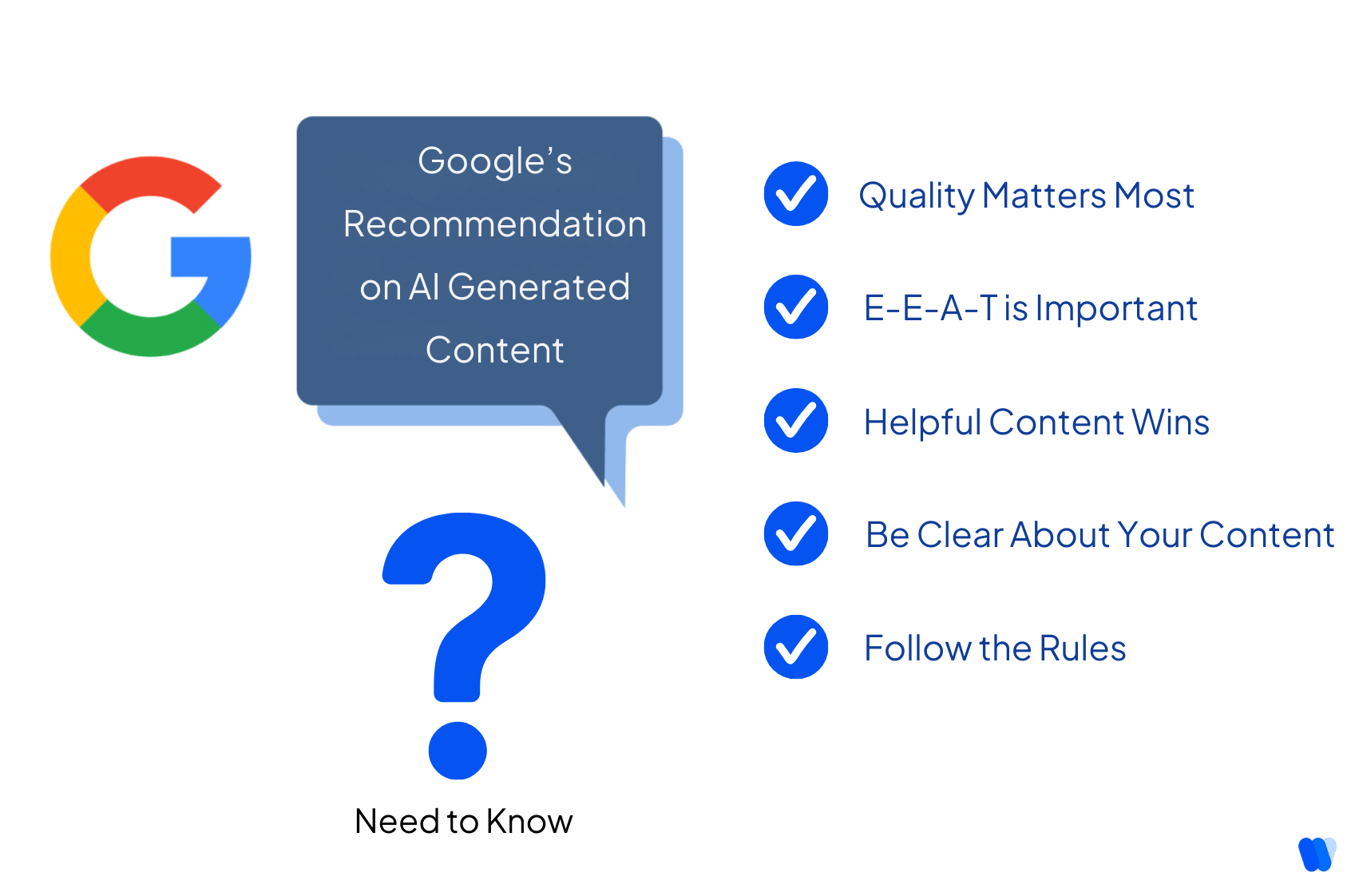
1. Google Ranks Helpful Content, Not Who Wrote It
Google’s official stance (as of its 2023 guidance) is that AI-generated content is not inherently bad. What matters is whether the content is helpful, original, and written for people, not just search engines.
Google: “Using AI doesn’t violate our guidelines. What matters is the quality.”
That means AI content can rank, but only if:
- It meets search intent.
- It’s accurate and trustworthy.
- It offers real value beyond surface-level answers.
2. Low-Quality AI Content Can Hurt Rankings
Auto-generated content that’s:
- Keyword-stuffed,
- Factually incorrect,
- Or lacks human refinement
…is more likely to be flagged by Google’s Helpful Content System, introduced in 2022. This system automatically downranks sites with high volumes of unhelpful content.
So if your blog sounds robotic or repeats the same fluff everyone else is publishing, don’t expect to rank.
For a full breakdown of how AI content influences search performance and what to avoid, read the guide on Does AI Content Hurt Google Rankings.
3. AI Can Boost SEO When Used Strategically
When paired with SEO tools and editorial oversight, AI helps:
- Speed up content research and topic clustering (e.g., with KIVA or SurferSEO).
- Generate outlines aligned with search demand.
- Expand or rephrase existing content to match semantic variations.
- Improve clarity and readability at scale.
Used right, AI becomes an efficiency layer, not a replacement for expertise.
4. Human Input Still Wins in Competitive SERPs
If you’re targeting competitive keywords, the content must:
- Demonstrate E-E-A-T (Experience, Expertise, Authoritativeness, Trust)
- Be written with a clear POV or real-world examples
- Include well-structured headers, meta tags, and internal linking
AI might help you get started, but human strategy, editing, and subject knowledge are still essential to outperform other sites.
As AI-generated content becomes more common, how it’s surfaced in search is also changing. Google I/O 2025 highlighted new AI-driven search experiences that impact how this content gets discovered.
If you’re publishing AI content to add real value, Google’s algorithms are increasingly equipped to recognize that.
But if you’re generating hundreds of pages just to manipulate rankings?
That’s a different story.
Source: Developers.google.com and PPC.land
How Things in Social Media Platforms Changed after AI Content?
Across platforms, the trend is label, don’t ban. AI content, especially synthetic media, must now be disclosed, not hidden.
Meta (Facebook, Instagram, Threads)
● “Made with AI” Labels: Rolled out in May 2024. Applies to images, videos, and audio identified via creator disclosure or detection tools.
● High-Risk Media: Deepfakes or political content may receive more prominent labels.
● Policy Shift: Meta no longer removes content just for being AI-generated. It focuses on transparency unless other violations (hate, misinformation) apply.
● Data Use Disclosure: As of April 2025, Meta can use public user content to train its AI models under a “legitimate interest” clause. Users had until late May 2025 to opt out of past data use.
Meta is also experimenting with AI-generated influencer profiles—a potential game-changer for brand storytelling.
TikTok
● Mandatory AI Labels: Creators must label AI-generated content that appears realistic (visuals, voices, etc.).
● Automatic Labeling: TikTok may auto-detect and apply “AI-generated” labels, especially for effects used in-app.
● Prohibited Content: Some synthetic media is outright banned, like fake authority figures, deepfakes of minors, or harmful impersonations.
● Policy Update: In April 2023, TikTok revised its rules to tighten control over synthetic content and protect authenticity.
X (formerly Twitter)
● TOS Update (Nov 2024): X now claims the right to use all public posts to train its AI systems, including Grok.
● Opt-out Limitations: Users can opt out of Grok-specific conversations, but not public posts (unless under GDPR in the EU).
● AI-Powered Ads: New features like “Prefill with Grok” and “Analyze Campaign with Grok” automate ad creation and reporting.
● Labeling Gap: X doesn’t yet enforce strong labeling standards like Meta or TikTok, though discussions around AI detection tools are increasing.
The Big Picture: Label, Don’t Ban
AI content isn’t going away and platforms know that. Instead of outlawing it, the approach is to require transparency and protect users from harm:
- Labels are becoming standardized
- Detection tools are improving
- Community Guidelines now include AI-specific clauses
Authenticity remains the goal. In 2025, AI content is welcome, as long as it’s clear, fair, and responsibly used.
Who’s Leading the AI Content Space
The AI content ecosystem in 2025 is broad, fast-moving, and crowded. Dozens of tools have emerged, each claiming to transform how we write, design, or publish. But the reality is more nuanced.
Some platforms specialize in text generation. Others focus on media creation. And a select few are beginning to connect content with strategy, something marketing consultants increasingly need.
While these companies lead in AI innovation, fast-moving teams still need scalable execution. That’s where the AI search visibility platform for consultants bridges the gap—turning strategy into measurable visibility.
Let’s break it down.
1. The Major Players
These companies dominate the generative AI landscape, often through foundational models or large-scale integrations:
- OpenAI
Creator of GPT-4, ChatGPT, and DALL·E. Powers many third-party tools via its API.
- Google (Gemini)
Offers a robust multimodal model that integrates tightly with Search, Docs, YouTube, and Ads.
- Microsoft
Embedded OpenAI tech into Microsoft 365 (Word, Outlook) and Azure cloud infrastructure.
- Meta
Released LLaMA models and introduced AI image/video tools in WhatsApp and Instagram.
When it comes to executing content at scale, especially for fast-moving teams, the AI search visibility platform for agencies fills the gap with smarter, scalable visibility workflows.
What are the Best AI Assistance & Tools for Content Creation And Content Detection
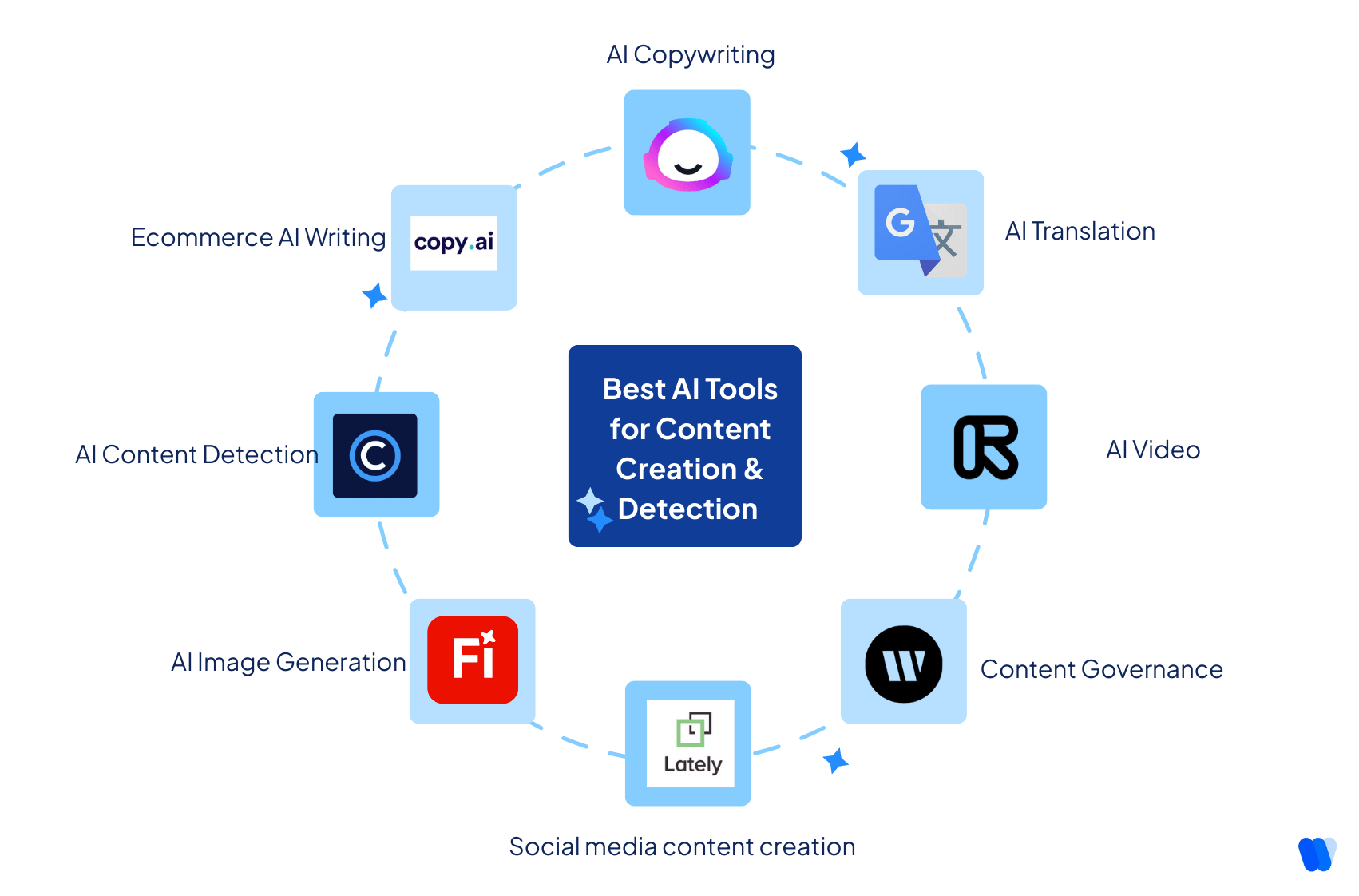
If you’re building or scaling your content workflow, chances are you’re already leaning on a few go-to tools. Here are some of the most trusted ones that marketers (myself included) turn to every day.
| Tool | Category | What Makes It Unique |
|---|---|---|
| KIVA | AI SEO Agent | Automates keyword research, generates SEO briefs, and optimizes content using LLMs for enhanced search visibility |
| Writer | Content Governance | AI writing tool with built-in compliance, fact-checking, and brand safety layers |
| Runway | AI Video | Enables video generation, editing, and VFX with AI—used in film and social media |
| ElevenLabs | AI Voices | Realistic voice cloning and AI-generated speech in multiple styles and languages |
| Synthesia | AI Avatars | Create training videos and explainer clips using digital presenters |
| Adobe Firefly | AI Image Generation | Image and video generation with commercial-use safe models |
| Copyleaks | AI Content Detection | AI content checker and ChatGPT checker with reliable AI detection and plagiarism scanning for websites, documents, and academic use. |
| Jasper | AI Copywriting | Enterprise-focused with templates, brand voice control, and campaign automation |
What Expert Says About AI Content?
While tools and technology evolve rapidly, the most valuable lessons often come from those who’ve spent years building, writing, and navigating the content trenches.
In 2025, leading voices in marketing and media aren’t asking “should we use AI?”, they’re asking “how do we use it well?”
Here’s what some of the most respected experts are saying about the future of AI content, and what you can take from it.
- Cathy McPhillips – Embracing AI as a Creative Ally
Cathy McPhillips of the Marketing AI Institute emphasizes that AI should augment, not replace, human creativity. In her session at the MarketingProfs AI for Content Creators event, she states:
“AI can be your ally, augmenting your creativity and helping you stay relevant and reach new heights in content creation.” MarketingProfs
She encourages content creators to use AI tools to enhance storytelling skills without fearing job displacement.
- Robert Rose – AI as a Strategic Tool
Robert Rose, Chief Strategy Advisor at the Content Marketing Agency, views AI as a means to enhance productivity rather than a content generator. In an interview with Contently, he remarks:
“Generating content is the least interesting thing that ChatGPT and other generative AI tools do.” The Freelance Creative
Rose suggests using AI for tasks like brainstorming, organizing thoughts, and repurposing content, allowing creators to focus on strategic and creative endeavors.
- Tom Fishburne – Cautioning Against Overreliance on AI
Cartoonist Tom Fishburne, known as the Marketoonist, uses humor to highlight the pitfalls of overusing AI in marketing. In his cartoon “AI is a Tool”, he illustrates the tendency to treat AI as a solution for all problems, warning:
“AI may be the solution you need. But it should be what you try after traditional programming fails. When you have something to automate, but you aren’t able to do it with your existing bag of tricks. When the need is so critical that you’re willing to add complexity and the reduction of control that comes with it…” marketoonist.com
Fishburne advocates for a balanced approach, recognizing AI’s capabilities while maintaining human creativity and judgment.
What Future Trends and Innovations are Predicted for AI Content Generation
AI content has already transformed how we create. But the next few years will redefine what we create, how we distribute it, and what skills we value most in the content marketing field.
As these shifts unfold, reviewing the Top Content Marketing Statistics can offer data-backed insights into how AI is influencing performance metrics, audience behavior, and content ROI across industries.
Here’s a breakdown of the key shifts to watch, and how they’ll impact creators, brands, and the industry at large.
- Advancements in Generative AI Models
- Evolving Impact on Creative Industries, Media, and Marketing
- The Future of Work and Skill Requirements
- Navigating the Evolving Legal and Information Ecosystem
- Industry News and Transformation (2025)
Future of AI in Content Industries
AI is no longer just a support tool—it’s becoming the backbone of content industries, driving efficiency, personalization, and scalability. According to McKinsey, generative AI could contribute $2.6–$4.4 trillion annually to the global economy across 63 use cases.
Meanwhile, Gartner predicts that by 2026, 80% of senior creative roles will be directly responsible for harnessing generative AI, reshaping budgets and strategic priorities.
These projections highlight how AI isn’t just changing workflows—it’s redefining what counts as creative leadership, what roles are in demand, and how value is created in the content economy.
A. Advancements in Generative AI Models
The next wave of AI models is moving toward:
- Multimodal fluency – Models like Gemini and Sora process and generate content across text, video, code, image, and audio in a single workflow.
- Contextual memory – Long-term memory in models will allow for content that builds on previous conversations, campaigns, or brand guidelines.
- Real-time integration – AI that adapts to changing data, user behavior, or live events.
These upgrades will produce content that is:
- More interactive
- More adaptable
- More brand-specific, without retraining
B. Evolving Impact on Creative Industries, Media, and Marketing
Entire business models are already shifting:
| Sector | How It’s Changing |
|---|---|
| Publishing | AI-generated news summaries, voiceovers, AI eBook generator and formatting at scale |
| Video Production | Script-to-video workflows eliminating the need for filming B-roll or actors |
| Performance Marketing | AI-personalized ad variations tested in real time across demographics |
| Social Media | Auto-generated stories, influencer scripts, and daily engagement loops |
Even entertainment IPs (movies, games, books) are starting to experiment with AI in concept art, narrative arcs, and audience feedback loops.
C. The Future of Work and Skill Requirements
What roles will thrive in this new AI-native environment?
In-demand content roles by 2026:
- AI Content Strategist
- Prompt Engineer for Brand Voice
- LLM SEO Specialist
- AI Video Director
- Ethics and Compliance Editor
What’s declining:
- Generic SEO writers
- Unstructured freelance copywriting
- Manual briefing and QA roles
The winning teams won’t just “use AI”, they’ll design processes where AI works alongside humans at every level of the funnel.
D. Navigating the Evolving Legal and Information Ecosystem
Expect more scrutiny around:
- Attribution: Who owns AI-generated content?
- Consent: Was this content trained on copyrighted or user-generated material?
- Misuse: Are synthetic images being used to impersonate, mislead, or defame?
Nations and platforms alike will introduce stricter disclosure rules, enforceable watermarking, and certification systems to flag content origin.
Marketers will need a policy, not just a prompt.
E. Market Growth Projections and Expert Predictions
- $2.6–$4.4 Trillion: Estimated annual global economic value that generative AI could add across 63 use cases. (McKinsey & Company)
- By 2025, AI will generate 30% of the marketing messages sent out by large companies, indicating a significant shift towards AI-assisted branded content. (Gartner)
- 64% of content marketers regularly use AI in their processes, indicating its widespread integration in content strategies. (Forbes)
But beyond the numbers lies the real shift:
AI isn’t replacing content strategy.
It’s making strategy a competitive advantage again.
F. Industry News and Transformation (2025)
Here’s how AI are shaping the overall market right now:
1. AI Content Governance Becomes Normalized
- Getty Images now auto-tags all uploaded visuals for AI use provenance.
- TikTok and Instagram require AI-labeled disclosures on paid posts that use synthetic voice, video, or avatars.
- Google’s Search Generative Experience (SGE) now prefers content with structured data, author bylines, and source-backed claims, even when AI-assisted.
2. LLM Visibility Is the New SEO
- Tools like ChatGPT, Claude, and Gemini are now primary content discovery channels, not just supplements to Google. That shift is why understanding how to rank in chatgpt has become part of modern SEO strategy rather than a separate tactic.
- Brands are tracking brand mentions and content citations inside AI outputs, not just on SERPs.
This shift has given rise to Generative Engine Optimization (GEO), a new discipline focused on making content structured, context-rich, and prompt-resonant so it surfaces inside LLM responses.
As generative engines become gateways to content discovery, marketers are shifting from traditional SEO metrics to newer frameworks, prompting questions like What are GEO KPIs? and How should we track performance across LLMs like Gemini or Claude?
As Forbes puts it, GEO is not about ranking; it’s about being recalled by the model when it matters most.
And once you publish at scale, measuring where that content gets cited matters; the best AI visibility tools in 2026 can help you track inclusion across major AI assistants.
3. Publishing Platforms Are Integrating AI Natively
- Notion and Webflow now offer AI content assistants by default.
- Substack supports AI-assisted newsletter drafts tailored to past engagement data.
- Medium introduced “AI origin badges” to maintain editorial trust while embracing AI workflows.
FAQs
AI content quality improves with clear prompts, human editing, readability checks, and plagiarism scans.
Best practices include setting clear goals, structuring prompts, adding examples, fact-checking, and maintaining brand voice.
AI-only content isn’t copyrightable, but human edits, originality, and meaningful contributions can make it eligible.
Yes, AI content can support SEO if it is original, intent-driven, and optimized with headings, links, and schema.
Yes, AI content can pass plagiarism checks if edited for uniqueness and verified with detection tools.
Yes, AI can generate outlines and drafts, but human input is needed for depth, accuracy, and originality.
Yes, AI can draft or summarize articles, but human verification ensures accuracy, context, and journalistic standards.
Popular platforms include ChatGPT, Claude, Gemini, Jasper, Copy.ai, and Writer.
Yes, AI can generate captions, hooks, and variations, but final review ensures tone, cultural fit, and engagement.
Final Thoughts
AI content is no longer a differentiator—it has become the baseline for modern marketing. The transition from experimenting with tools to building structured systems is already here.
Success will depend on designing strategies that balance automation with human oversight. Marketers who create clear policies, apply strong editorial standards, and focus on audience intent will unlock the real value of AI.
The future of content isn’t about faster output alone. It’s about building trust, maintaining authenticity, and using AI to strengthen—not replace—human creativity.