AI-generated content doesn’t harm Google rankings if it’s original, helpful, and meets quality guidelines.
The rise of AI writing tools has sparked widespread debate about their influence on search visibility and website performance.
Some marketers worry that automated text risks penalties, while others view it as a powerful, time-saving ally.
The reality is more nuanced. Google does not penalize content just because it’s AI-generated. Instead, it evaluates pages based on quality, originality, and how well they serve the user’s intent.
Did you know?
Websites that flood their pages with thin, generic paragraphs often see rankings drop. Such output fails to meet user needs and violates key E-E-A-T (Experience, Expertise, Authoritativeness, and Trustworthiness) principles.
Proper editing and human input remain critical to avoid Google devaluing your pages. So, before adopting these tools, remember that AI Content impact on SEO depends entirely on how responsibly and strategically you deploy it.
Moreover, a strong 93% of AI users review generated drafts before publishing, underscoring the importance of human oversight in avoiding quality pitfalls.
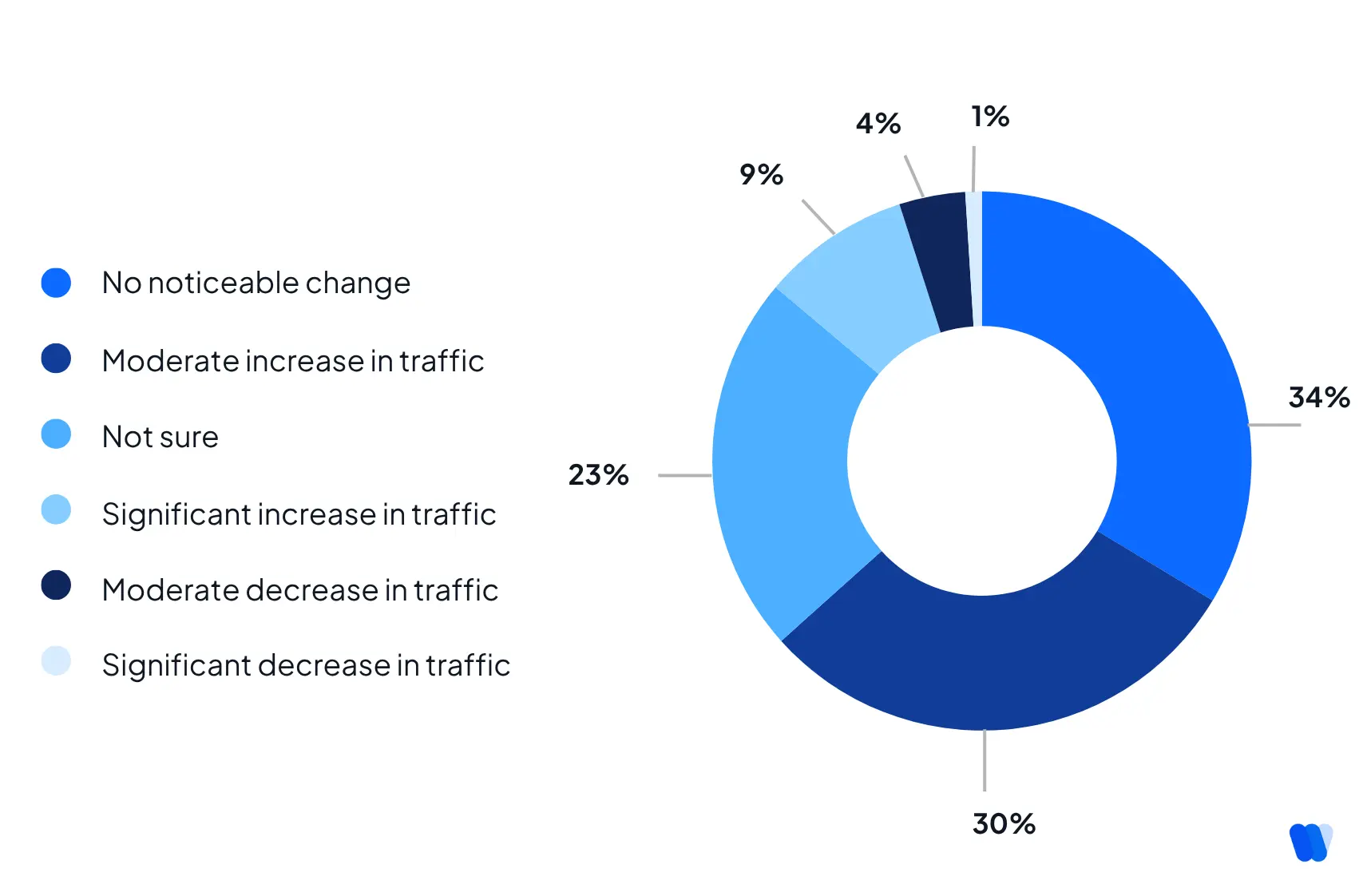
Survey results on how AI-written blog posts impact website traffic, showing most see no change or moderate gains.
Does Google Penalize AI Content in 2025?
Google does not penalize content simply for being created with AI. However, it does penalize low-quality, unhelpful, and spammy content, regardless of how it’s produced.
In 2025, Google’s updated guidelines reaffirm this principle, emphasizing helpfulness and originality over production method.
Below, we break down what Google actually evaluates and why human oversight still matters.
- Google’s Helpful Content System explicitly states: “Content is judged on its value to the user, not how it’s made.”
- Pages that demonstrate clear experience, expertise, authoritativeness, and trust (E-E-A-T) are favored in search results.
- Content that fails to meet these expectations—whether human-written or machine-generated—can be downgraded or excluded from rankings.
What Are Google’s Guidelines for AI Content?
Google’s 2025 stance is not about banning AI, but banning manipulative use. Helpful, accurate, AI-assisted content is fully allowed. Pages created solely to trick rankings are treated as spam and can be downgraded.
When AI Content Can Trigger Penalties
AI content can harm rankings if it:
- Appears thin, generic, or lacks depth.
- Fails to provide unique insight or value to the user.
- Shows factual inaccuracies, particularly on Your Money or Your Life (YMYL)
- Appears spammy, keyword-stuffed, or written only for search engines.
How Does Google Detect AI-Generated Content?
Google doesn’t rely on AI detectors. Instead, it evaluates quality signals such as originality, depth, factual accuracy, and user engagement. Thin, repetitive, or unhelpful pages are devalued, while human-reviewed AI content is treated like any other high-quality work.
Why Human Input Still Matters
Even the best AI tools lack human judgment and contextual understanding.
Adding editorial review ensures:
- Content accuracy and factual verification.
- Unique brand voice and perspective.
- Compliance with user intent and niche-specific expertise.
A hybrid approach—AI for drafts, humans for strategy and editing—is the most effective way to stay compliant.
Google’s Position on AI Content (2025)
| Criteria | Penalized? | Notes |
|---|---|---|
| High-quality AI content | No | As long as it’s helpful |
| Thin, spammy AI content | Yes | Fails Helpful Content standards |
| Humanized AI content | No | Reviewed and optimized |
| Automated YMYL content | Risky | Must meet very high standards |
How Can AI Content Hurt Google Rankings If Misused?
AI-generated content can hurt your Google rankings if it’s misapplied or left unchecked. Another common concern is how AI content affects organic search traffic. Low-value AI pages tend to drive poor engagement, high bounce rates, and weaker visibility overall.
In 2025, Google’s algorithms are increasingly adept at identifying unhelpful, low-value pages.
Understanding the specific risks helps avoid costly mistakes. Below are the most common ways AI content damages SEO performance.
Thin and Generic Content Dilutes Quality Signals
AI tools often produce text that looks polished but lacks substance.
Pages stuffed with generic paragraphs or surface-level information are:
- Less engaging for users, leading to high bounce rates.
- Flagged by Google’s Helpful Content System as unhelpful.
- Prone to being outranked by competitors with deeper, original insights.
Example: A site that churns out hundreds of AI-written blog posts with no unique data or perspective often sees traffic plummet.
Does AI-Written Blog Content Affect Google Rankings?
AI-written blog posts can rank well if they are edited, accurate, and provide unique insights. However, sites that publish large volumes of thin or generic AI blogs often see visibility drop because they fail Google’s Helpful Content standards.
Duplicate and Unoriginal Content Harms Authority
AI tools trained on public data can produce output that is too similar to existing web content.
This duplication can trigger:
- Lower authority signals in Google’s index.
- Missed opportunities to showcase your unique voice and expertise.
- Cannibalization of your own content, if not properly managed.
Tip: Always run AI drafts through a plagiarism checker and add fresh, proprietary insights.
Factual Errors and E-E-A-T Violations Damage Trust
AI sometimes hallucinates facts, invents numbers, or cites outdated information.
On YMYL pages (Your Money or Your Life), even minor errors can:
- Undermine user trust.
- Causes Google to devalue the page in search results.
- Open the door to legal or reputational risks in sensitive industries.
Editorial review and subject-matter expert oversight are vital, especially in regulated niches.
Quick Checklist: Avoid These Common AI Misuse Pitfalls
- Drafts Without Editing: Publishing drafts without human editing.
- AI-Only Research: Relying solely on AI for research or statistics.
- Ignoring User Intent: Ignoring user intent and keyword alignment.
- Overproducing Low-Value Content: Overproducing low-value content at scale.
How to Avoid SEO Penalties When Using AI Content
AI tools can help scale long form content creation, but without proper oversight, they expose you to SEO risks. Google’s focus remains on quality, originality, and usefulness, not on how content is produced. Here’s how to avoid penalties and ensure AI works for your rankings, not against them.
Edit and Humanize Every Piece Before Publishing
AI output should always be treated as a draft.
Human editing brings:
- Clarity, nuance, and tone consistent with your brand voice.
- Removal of irrelevant, repetitive, or awkward phrasing.
- Added insights, examples, or data unique to your expertise.
Best practice: Run each piece through an editorial checklist before publishing, even if AI-generated.
Focus on E-E-A-T to Strengthen Credibility
Google prioritizes content that reflects E-E-A-T.
To meet these standards:
- Attribute authorship to real experts where possible.
- Include personal anecdotes, data from your own research, or case studies.
- Use citations from reputable sources to back up claims.
For a deeper look at how AI-generated content can still align with these trust signals, check out our guide on AI and E‑E‑A‑T.
Balance Scale With Quality Control
AI makes it easy to produce hundreds of articles, but volume should never come at the expense of quality.
Instead:
- Start with fewer, higher-quality posts.
- Monitor engagement metrics like time on page, bounce rate, and SERP performance.
- Refine your prompts and processes based on what performs best.
Also monitor whether older URLs are quietly losing impressions and CTR over time — that’s often content decay, and it can happen even when you’re following Google’s rules.
Do’s of Using AI Content
AI content works best when treated as a draft and improved with human expertise. Focus on adding originality, credibility, and ongoing optimization.
- Edit and fact-check drafts
- Add original insights
- Optimize for E-E-A-T
- Monitor SEO performance
Don’ts of Using AI Content
Avoid common pitfalls that make AI content appear spammy or low-value. These mistakes can trigger penalties or reduce trust.
- Publish raw AI output
- Rely solely on AI research
- Ignore author attribution
- Overproduce low-value content
Why Can AI Content Strengthen SEO (When Done Right)?
AI-generated content improves SEO when it is strategically deployed and enhanced by human expertise.
Far from being a liability, AI writing tools can accelerate production, improve topic coverage, and support scalable SEO strategies if you avoid common missteps. Below are the main benefits of responsible AI long form content creation.
Scales Content Production Without Sacrificing Quality
- Speeds up drafting by automating outlines, intros, and structural suggestions.
- Enables covering more topics within your niche, building topical authority.
- Reduces bottlenecks in publishing schedules.
A Small SEO Studio study found that by late 2025, 55% of top-ranking pages will use AI-generated content—but only when combined with human review and semantic optimization.
Improves Keyword and Topic Cluster Coverage
- AI tools help identify secondary keywords and semantically related terms.
- Drafting around clusters boosts content depth and relevance, strengthening your site’s authority.
- Better internal linking suggestions improve crawlability and user experience.
Supports On-Page Optimization and Engagement
if you want that same content to perform in AI answer engines too, use the framework in how to rank on ChatGPT to improve citation-ready structure.
- AI can suggest optimized titles, meta descriptions, and H1–H3 structures.
- Helps generate FAQ sections aligned with People Also Ask queries.
- Enhances internal link placement and call-to-action clarity.
Did you know?
Best Practices for Using AI Content Without Hurting SEO
AI content can harm SEO if misused. Following structured best practices ensures your output meets search quality and user expectations.
AI tools are most effective when paired with a well-defined editorial strategy and ongoing oversight. Below is a step-by-step checklist to safely integrate AI into your content production without compromising search performance.
Plan With User Intent and Search Goals in Mind
- Define the target audience, search intent, and primary keywords before drafting.
- Map content to topic clusters and identify related queries for semantic coverage.
- Avoid chasing volume over value—prioritize topics that add unique expertise.
Blend Automation With Human Expertise
- Use AI for ideation, outlines, and draft creation—not final copy.
- Add human-written elements like examples, personal stories, and expert analysis.
- Edit for tone, clarity, and factual accuracy.
Optimize for Search Engines and Users
- Structure your content with a clear H1–H3 hierarchy and descriptive headings.
- Add schema markup for better AI and SERP visibility.
- Incorporate internal links and actionable CTAs.
- Test readability and engagement metrics regularly to refine the approach.
What Does the Future Hold for AI Content and SEO?
AI content will continue to shape SEO, especially as zero-click searches and AI Overviews redefine search behaviour, making it critical to understand how to optimize for Google AI Overviews with structured, citation-ready content.
Search engines are evolving to display answers directly on results pages. This shift increases the importance of structured, concise, and trustworthy content optimized for both users and AI systems.
Below are key trends shaping the future of AI content in SEO.
Rise of Zero-Click and AI Summaries
- Featured snippets and AI Overviews deliver instant answers, reducing click-throughs.
- Only pages with clear, structured answers appear in these prime SERP spots.
- Sites that fail to adapt risk losing visibility even if rankings remain stable.
- Approximately 15% of Google search results now feature AI-generated overviews, up from under 1% in early 2023.
- Early findings suggest these overviews can reduce organic clicks by 18–64%, depending on query type (Source: Exploding Topics).
Rising Shift Toward Answer Engine Optimization (AEO)
- SEO experts forecast a 20–40% drop in traffic for sites relying solely on traditional SEO, due to the rise of AEO and AI-driven search.
- Brands now invest in content designed to be “answerable”—structured, concise, and conversational—so they’re featured in AI and chatbot responses. (Source: Business Insider)
Structured Data Becomes a Must-Have
- Use schema markup to signal page intent and structure to search engines.
- Mark up FAQs, How-Tos, and Articles to appear in rich results and AI-generated answers.
- Maintain semantic hierarchy in headings and lists for better machine parsing.
Structured, machine-readable content helps LLMs and SERP algorithms feature your page in AI-generated summaries.
Emphasis on Unique Insights and Brand Trust
- AI systems increasingly favor content that demonstrates originality and expertise.
- Firsthand data, proprietary research, and a distinct brand voice will stand out.
- Transparency about AI use and human review builds trust with users and search engines.
- Content Marketing Stats: Top Content Marketing Statistics to Know in 2025 (Including AI Trends)
- SERP LLM Trends: How To Create Content Based on SERP and LLM Trends
- AI Content Detection: AI Content Detection in 2025: Trends to Watch
- AI Brand Voice: How to Align AI Content to Match Your Brand Voice
- AI Content Prompts: 77 Must-Try AI Prompts for Content Marketing Team
FAQs
My Verdict: AI Content Helps If You Respect the Rules
Google rewards quality, not the method of creation. Whether content is AI-assisted or human-written, what matters is originality, depth, and usefulness. Misuse—not the tool—determines if rankings improve or collapse.
When applied thoughtfully, AI writing tools enhance SEO by scaling production, building topical authority, and meeting search intent effectively.
The key is to blend automation with human oversight. Always ensure originality, depth, and trustworthiness are present in every piece.
Treat AI as an assistant and align all content with E‑E‑A‑T and Helpful Content guidelines from Google.
When executed properly, AI improves visibility in both traditional rankings and AI‑driven summaries. Misused, it risks spam detection and credibility loss.
In 2025, a smart strategy determines success regardless of who creates the words.
Key Takeaways
- Google does not penalize AI content by default—quality matters.
- Poorly edited, thin, or spammy AI pages can hurt rankings.
- E‑E‑A‑T applies equally to AI-assisted and human-written content.
- Blend human insights with AI for originality and trust.
- Structure content for AI Overviews and semantic SEO visibility.