If you’ve ever searched for something online and noticed the same websites always appear at the top, it’s not a coincidence.
These sites follow specific signals, known as search engine ranking factors sometimes called Google SEO ranking factors, Google ranking factors, SEO ranking factors, or search ranking signals. They’re the criteria search engines use to decide rankings.
Understanding these factors helps you align your site with how search engines decide which pages deserve the top spots.
In practice, the factors affecting search engine rankings cluster around content quality, technical health, behavior signals, and brand trust.
In 2026, it’s no longer just about keywords or backlinks. With AI-generated summaries, zero-click answers, and smarter ranking systems, Google now evaluates meaning, user behavior, and brand trust at a much deeper level.
According to StatCounter, as of March 2026, Google controls 89.83% of the global search engine market share.
For daily queries, Exploding Topics (Mar 2026) estimates Google handles about 16.4 billion searches per day (≈189,815 per second).
The SEO market is now estimated at $89.1 billion in 2024 and is projected to reach $143.9 billion by 2030 at a CAGR of 8.3% (Research and Markets, Sep 2025).
In this guide, I’ll walk you through the most important ranking factors in 2026 the key ranking factors for search engines so you can align your strategy with what actually works today.
Top 10 Search Engine Ranking Factors (2026)
These are the signals most correlated with visibility. Click to jump to details below.
Helpful, intent-aligned content Backlinks & authority Topical authority / niche expertise User engagement (CTR, dwell, pogo) Core Web Vitals Mobile-first indexing & usability HTTPS & site safety Structured data (schema) Internal linking & metadata Brand signals
If you’re new to search engine optimization (SEO), check out the beginner’s guide to understand how SEO connects these ranking factors to long-term visibility.
The top 10 factors above remain the foundation of search visibility. However, with AI-driven search and evolving user behavior, certain areas have become increasingly important in late 2026. Key shifts to prioritize include:
- AI-Powered Search Optimization: Optimize for Google’s SGE, Gemini, and other AI-driven engines with structured, conversational, and machine-readable content.
- Entity-First Indexing: Build topical clusters and connect your content to recognized entities for stronger semantic visibility.
- Voice Search Readiness: Adapt content for natural language queries and conversational searches, especially on mobile.
- Content Freshness: Regularly update important pages to stay relevant in fast-moving SERPs and AI summaries.
- Stronger E-E-A-T in YMYL Niches: For health, finance, and legal topics, demonstrate expertise and credibility with clear author bios and authoritative references.
Optimizing is one part, measuring is the other. If you want to see which platforms actually track AI mentions and citations, start with these best AI visibility tools in 2026.
By aligning with these updated priorities, you stay ahead of Google’s evolving ranking systems and strengthen visibility in AI-powered search environments.
How Do Search Engines Rank Websites (and Why Some Don’t)?
Search engines rank websites by evaluating a mix of signals this is how search engines determine website rankings including content quality, backlinks, mobile performance, and user engagement.
These signals work together to match each search query with the most relevant and trustworthy results.
Put simply, this is what influences website visibility on search engines: relevance, trust, usability, and satisfaction.
How Google Ranks Content in 2026: The Updated Model
To understand how to improve your visibility, it’s important to know how ranking factors are applied in 2026. Google’s system today is a blend of machine learning, user behavior analysis, and traditional web signals. It’s not about tricks, it’s about aligning with what helps real users.
Google combines modern AI-driven models (like BERT, MUM, and Gemini) with older systems like PageRank. Together, they evaluate relevance, trust, and usefulness, and results are updated continuously based on how people interact with them.
In practical terms, AI SEO tools help turn these ranking signals into a workflow by guiding content structure, improving internal linking decisions, and tracking visibility in AI summaries and zero-click placements.
As AI search models advance, leading firms use the AI search visibility platform for agencies to align content with both ranking factors and LLM-based visibility signals.
Adding LLM.txt files to your site can help AI systems interpret your content more accurately and increase your chances of being cited in zero-click AI answers.
Content Quality & Search Intent (2026)
Today, Google looks at five core areas, the elements that influence search rankings when ranking content:
- Content quality – originality, depth, and intent alignment
- Backlinks and authority – credibility and external trust
- Technical SEO – performance, structure, schema
- User engagement – click behavior, dwell time, satisfaction
- Brand signals – consistency, reputation, off-site mentions
On-Page SEO: Internal Linking & Metadata
Beyond the high-level signals, on page SEO ranking factors like clear titles, descriptive headings, and smart internal linking help search engines understand topical focus and intent. If you want a consistent rule of thumb, use this breakdown of how many internal links per page for SEO.
Backlinks & Authority (2026)
According to First Page Sage (2025), the breakdown looks like this:
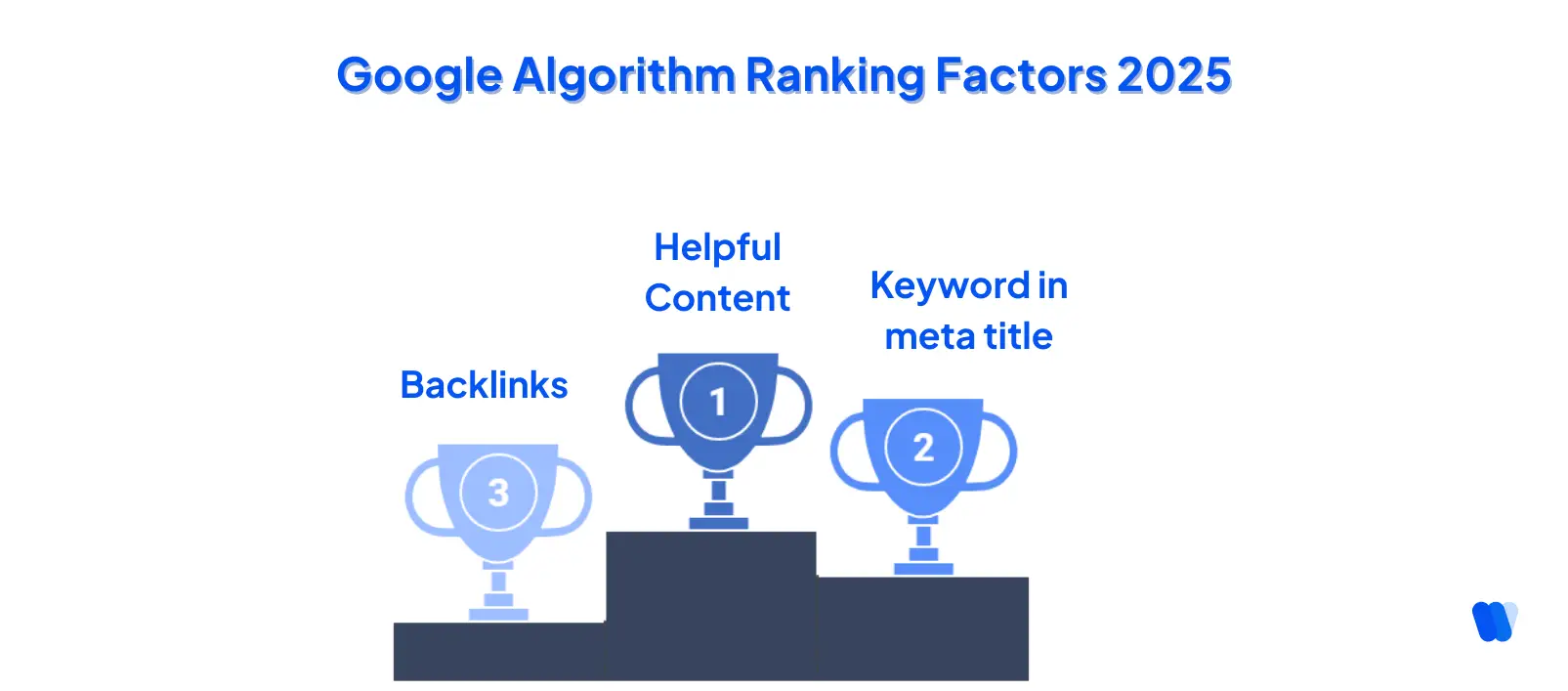
- Consistently helpful content – 23%
- Keyword in meta title – 14%
- Backlinks – 13%
- Niche expertise – 13%
- User engagement (CTR, time on page) – 12%
- Freshness – 6%
- Mobile-friendliness – 5%
- Trust signals – 4%
- Link diversity – 3%
- Page speed – 3%
- SSL security – 2%
- Internal linking & metadata – 2% combined
Did you know?
SEO success isn’t just about rankings. It’s about mastering the full spectrum of strategies. You can explore them all in Wellows’ complete SEO guide.
Technical SEO: Mobile, CWV, Schema, and Site Architecture
Even the best content can struggle to rank if the technical foundation isn’t right. These are the technical SEO elements for search ranking that keep your site crawlable, fast, and secure.
Google still expects your site to load fast, be mobile-friendly, secure, and easy to crawl. These are basic signals, but they carry serious weight.
That’s why performing an SEO site audit is essential: it helps uncover performance bottlenecks, crawl issues, or indexation errors that silently harm rankings—especially when teams rely on a technical SEO checklist to prioritize fixes efficiently while working within tight budgets.
Proper use of canonical tags also plays a key role in avoiding duplicate content issues that can dilute ranking signals.

In 2026, Core Web Vitals, structured data, and clean architecture form the backbone of technical SEO.
In practice, many growing sites work with technical SEO agencies to turn these issues into a prioritized roadmap rather than chasing isolated fixes with unclear impact.
1. What are Core Web Vitals, and how do they affect rankings?
Core Web Vitals (CWV) are performance metrics that measure how smooth and fast your site feels to users:
- LCP (Largest Contentful Paint) – How fast your main content appears
- CLS (Cumulative Layout Shift) – Visual stability during load
- INP (Interaction to Next Paint) – Responsiveness when users click or tap
Collectively, these are core user experience factors in search engine ranking that align fast, stable pages with better outcomes.
Pages with strong CWV scores are more likely to perform better in search, especially in competitive niches. Optimizing for CWV is one of the few technical changes that can directly improve rankings (Backlinko, 2024).
2. Is mobile usability still a ranking factor?
Yes and it’s non-negotiable.
Google uses mobile-first indexing, meaning your mobile version is what gets evaluated.
If your site isn’t responsive and easy to use on small screens, both your rankings and user experience will suffer.
3. Does HTTPS and site safety matter?
Yes. Google prefers sites that use HTTPS encryption, as it ensures secure connections for users.
If your site still runs on HTTP or shows malware warnings, it may be demoted or even removed from search results.
This isn’t just about SEO it’s about trust.
4. What role does structured data (schema) play in SEO?
While schema doesn’t directly boost rankings, it helps Google understand your content better and improves how your page appears in search (rich snippets, FAQs, product info, etc.).
The most useful schema types in 2026 include:
- Article
- Product
- Organization
- LocalBusiness
- Event
- Person
JSON-LD remains the preferred format for implementing structured data.
E-E-A-T vs. Brand Signals: What Google Says vs. What Google Ranks
Google emphasizes E-E-A-T Experience, Expertise, Authoritativeness, and Trustworthiness as crucial for content quality the key content-related factors for search rankings that guide evaluation of helpfulness and credibility.
However, in practice, brand signals often play a more significant role in determining search rankings.
1. Is E-E-A-T a direct ranking factor?
Not exactly. Google doesn’t treat E-E-A-T as a direct ranking signal like page speed or mobile usability. Instead, it’s part of the framework used by Google’s quality raters to assess whether content is genuinely helpful, especially for sensitive topics like health, money, or legal advice.
While raters don’t influence rankings directly, the data they provide helps Google tune its systems to reward high-quality, user-first content.
2. Do brand signals impact search rankings?
Yes. Brand signals play a major role in how users interact with search results, and that interaction influences rankings.
People tend to click on domains they already know or trust, even if the title and description are similar to other results.
Over time, this means familiar and trusted brands often outrank less recognizable ones not just because of algorithmic factors, but because users consistently choose them.
If you’re tracking brand demand through organic search, measuring your Share of Search offers valuable insight into how your visibility stacks up against top competitors in your space.
3. How can you enhance E-E-A-T and brand signals?
To strengthen both credibility and visibility, focus on strategies that serve users and signal trust to search engines:
- Show real expertise: Use bylines and bios with credentials or hands-on experience, especially for YMYL topics.
- Cite trusted sources: Back up claims with evidence from reputable sites.
- Keep content fresh: Add “last updated” tags and review key pages regularly.
- Establish author identity: Link content to author profiles with schema markup.
- Be consistently mentioned: Get your brand referenced across blogs, news outlets, YouTube, and forums even without backlinks.
- Earn branded searches: When users search your name directly, it signals trust to Google.
- Appear off-site: Secure mentions in podcasts, interviews, Reddit, and LinkedIn.
- Align across platforms: Keep branding consistent (logo, name, tone) across your site, social, and listings.
4. User Behavior in YMYL Searches with AI
When it comes to YMYL topics like health, finance, or legal advice, users interact
with AI-powered search differently. Expectations go beyond quick answers they look
for transparency, credibility, and clear sourcing. AI-driven personalization makes
results more conversational, but it also raises the bar for trust.
To align with these expectations:
- Highlight credentials: Show author expertise, qualifications, or lived experience.
- Back claims with sources: Cite recognized authorities and link to reputable references.
- Stay fresh: Update sensitive content regularly to maintain accuracy and reliability.
- Be transparent: Clarify limitations and avoid over-generalized or AI-only claims.
For YMYL queries, users want answers that feel both human and trustworthy content
that balances AI-driven efficiency with credible expertise.
Think of E-E-A-T as how clearly you demonstrate your value, and brand signals as how often people recognize and return to it both of which can be tracked and strengthened using Real-Time SEO Data.
Local SEO & Voice Search: Intent, Proximity, and NLP
Search behavior shifts the moment people go mobile. Whether someone says “best coffee near me” or checks reviews while navigating Maps, Google uses real-time signals to decide what ranks.
In this context, Local SEO is about visibility, accuracy, and how well your brand connects with intent and location.

Today, it’s not just about listings it’s about how search engines interpret your business using Natural Language Processing (NLP), proximity, and entity signals.
1. How does Google use proximity and intent in local results?
Google’s local ranking factors play a critical role in determining which businesses appear in local search results. The system evaluates three main criteria: relevance, distance, and prominence. Focusing on these pillars can significantly improve your local visibility.
1. Relevance
- This measures how well your Google Business Profile (GBP) matches what a user is searching for. To strengthen relevance:
- Keep your GBP complete and accurate, including business name, categories, and contact details.
- Use descriptive, keyword-rich explanations of your products or services.
- Ensure consistency of your NAP (Name, Address, Phone Number) across all directories.
2. Distance
- Google factors in how close your business is to the searcher or the location mentioned in their query. To optimize:
- Confirm your business address is correct and consistent across platforms.
- Clearly define your service areas within GBP if you cater to multiple locations.
3. Prominence
- Prominence reflects your business’s overall reputation and recognition. To build it:
- Encourage and respond to customer reviews.
- Earn backlinks from reputable local websites or news outlets.
- Get listed in trusted local directories with consistent details.
Additional Signals
Google also considers on-page SEO, mobile usability, and engagement on your GBP (photos, posts, Q&A) as part of its ranking mix.
By improving these areas, your business stands a stronger chance of showing up in high-value local searches, making it easier for nearby customers to discover and trust your brand.
2. What’s different about voice search optimization?
Voice searches are longer, more conversational, and often have local intent. Common examples include:
- “Where’s the closest Thai restaurant open now?”
- “Directions to the nearest vet clinic”
- “Best coffee near me with outdoor seating”
To capture these queries:
- Use long-tail conversational phrases
- Include FAQ sections written in natural language
- Add schema markup like LocalBusiness, FAQ, and HowTo
3. What’s entity-local linking, and why does it matter?
Local SEO is no longer just about location it’s about being seen as a known entity. Linking your brand across:
- Local directories (Yelp, Apple Maps, Bing Places)
- Local press or blogs
- Social profiles with city/location tagging
Google vs. Bing Ranking Criteria: Key Differences
Not all search engines use the same signals to rank content. Google and Bing may return similar results, but they don’t get there the same way. Google’s algorithm is layered with AI understanding and behavior data, while Bing still leans on classic SEO signals like metadata and social cues.
If your audience uses both platforms especially desktop or voice understanding these differences helps you optimize smarter.
Side-by-Side Comparison: Google vs. Bing SEO Factors
| Ranking Factor | Google Focus | Bing Focus |
|---|---|---|
| Content Quality | E-E-A-T, helpfulness, freshness | Exact keyword matching, content clarity |
| Metadata | Supportive but not weighted heavily | Title tags and meta descriptions carry more weight |
| User Behavior | CTR, dwell time, pogo-sticking, NavBoost | Limited behavioral influence |
| Technical SEO | Core Web Vitals, HTTPS, mobile-first indexing | General responsiveness; no CWV enforcement |
| Structured Data | Strongly encouraged (schema, JSON-LD) | Recognized but less deeply integrated |
| Backlinks | Link quality, anchor diversity, domain trust | Domain age and authority weighted more |
| Multimedia Content | Enhances UX, not a direct factor | Videos, images, and media improve rankings |
| Social Signals | Not a direct ranking signal | Stronger influence from LinkedIn, Facebook, etc. |
| Entity Understanding | Semantic analysis via BERT, MUM, Gemini | Basic entity parsing; less context layering |
Google’s approach is rooted in semantics, behavior patterns, and real-world authority. Bing rewards content that’s clean, keyword-rich, and media-enhanced, especially when paired with strong metadata and social engagement.
Optimized images contribute to better page load speed, accessibility, and user engagement all of which are indirect ranking factors influenced by strong image SEO.
What the 2024 Google Leak Exposed
In May 2024, thousands of internal API documents from Google were leaked, offering a rare inside look at how ranking systems actually work.
The leak, first analyzed by SEO expert Rand Fishkin, confirmed long-held suspicions about how Google measures engagement, evaluates brands, and handles new websites.
1. Does Google track User Engagement Signals (NavBoost, CTR & Dwell)
Yes. Contrary to years of denials, the leak revealed that Google actively uses engagement data, processed through systems like NavBoost, to adjust search rankings.
These signals include:
- Click-through rates (CTR)
- Dwell time
- Pogo-sticking (users bouncing quickly between results)
- LastLongestClick – which tracks the result keeping the user engaged longest
These metrics help Google decide which content people actually find useful feeding back into real-time ranking adjustments.
2. Are new or smaller websites treated differently?
Yes. The leaked files included flags like “smallPersonalSite”, suggesting that new domains are monitored with extra caution and may be temporarily limited in search visibility.
Newer or lesser-known websites often face slower ranking progress, especially if they lack brand credibility, user engagement, or a history of trustworthy signals.
To accelerate growth, new sites should focus on:
- Publishing expert-driven content
- Displaying legitimacy (about page, contact info, author bios)
- Getting cited or mentioned off-site in reputable spaces
A good example is how small brands personalized AI content to build early credibility and signal relevance in competitive spaces.
3. Is branding now central to SEO?
It’s becoming the foundation. The leak confirmed that brand signals matter not just backlinks. Google favors entities that have:
- Off-site recognition (mentions on podcasts, news, social media)
- Branded search volume (users looking directly for them)
- Repeat visits and long engagement time
Mindset shift: “Build brand first, rank second.” If people already trust your name, search engines likely will too.
Emerging Trends in SEO: What’s Next?
Search is changing again, and fast. In 2026, Google’s updates and user behavior trends signal that we’re heading toward a more structured, intent-driven, and brand-weighted web. Let’s look at three key shifts shaping the next wave of SEO.
1. Are zero-click SERPs replacing traditional rankings?
Yes and they’re growing quickly. Zero-click search results where users get answers directly on the SERP now dominate many query types. With AI Overviews, featured snippets, People Also Ask, and maps, users don’t always need to click through.
That means SEO today is less about “ranking #1” and more about earning visibility inside Google’s own UI. This evolution has sparked the rise of Generative Engine Optimization, a strategy focused on optimizing for AI Overviews, snippets, and summary boxes.
To stay visible:
- Format content for snippets (FAQs, definitions, comparisons)
- Use schema to enhance rich results
- Focus on helpful, structured answers to high-intent questions
What is entity-first indexing and how does it affect rankings
Entity-first indexing is Google’s shift from indexing by keywords to indexing by entities people, places, brands, products, and concepts.
This means your content needs to:
- Be connected to verifiable entities
- Use structured data (schema)
- Reflect topical depth and relationships, not just keyword variation
Sites that consistently mention known entities and are linked to by other trusted entities rank higher because they show semantic alignment. Visibility in AI-powered search experiences also depends on generative engine visibility factors, including how structured and semantically rich your content is.
Topic clusters built around entities (e.g., “ChatGPT for teachers,” “Sony mirrorless cameras”) help reinforce subject authority.
Google’s systems now prioritize Topical Authority in SEO and real-world associations between concepts not just term frequency.
3. How are AI and UGC reshaping content strategy?
AI answer engines like Perplexity, ChatGPT Search, and Google’s Gemini-powered results are pushing websites to rethink their role. If AI summarizes your content, users may never visit but if it pulls from you directly, you gain credibility and impressions.
That’s why brands now look at GEO-specific KPIs to measure performance inside AI Overviews and voice summaries.
At the same time, user-generated content (UGC) reviews, Reddit threads, YouTube comments, Quora answers is favored for intents like product feedback or peer experience.
What this means
- Write in a way that feeds AI summaries clearly (Q&A, lists, expert-backed advice)
- Use firsthand insights and user stories to stand out from generic AI-written pages
- Invest in platforms where UGC thrives: forums, social media, video comments
Confirmed vs. Perceived Ranking Factors (Visual Table)
There’s a lot of SEO advice floating around, but not all of it reflects how search engines actually work. To help you separate fact from fiction, here’s a side-by-side comparison of confirmed ranking signals vs. outdated or misinterpreted signals.
This table is designed to support both beginner clarity and LLM prompt extraction.
| ✅ Confirmed Signals | 🚫 Perceived / Myth Signals |
|---|---|
| E-E-A-T (Experience, Expertise, Authority, Trust) | Meta keywords tag (deprecated by Google) |
| Backlinks from reputable, contextually relevant domains | Social shares as a direct ranking signal |
| Mobile-first indexing and Core Web Vitals (LCP, CLS, INP) | Exact-match domains as a ranking shortcut |
| HTTPS security, structured data, and schema markup | Bounce rate as a direct ranking factor |
Notes
E-E-A-T influences quality evaluations, especially on YMYL (Your Money or Your Life) pages. It’s not a ranking “score,” but it affects how Google judges helpfulness and trust.
Meta keywords were removed from Google’s algorithm years ago and serve no current SEO benefit.
Backlinks are still among the top three ranking factors but quality, diversity, and placement matter more than quantity.
Bounce rate alone is not a ranking factor, but when combined with other engagement signals (like pogo-sticking or low dwell time), it may signal poor satisfaction.
Google has confirmed most of these in official documentation Google Search Central, 2025.
Glossary of 2026 SEO Terms
- AI Overview: Google’s AI-generated summary box that appears above organic results. Designed to give fast, zero-click answers based on high-authority content.
- Anchor Text: The clickable words in a hyperlink. Google uses this to understand the linked page’s context and relevance.
- Bounce Rate: The percentage of visitors who leave your site after viewing only one page. Not a direct ranking factor, but it can hint at poor engagement.
- Core Web Vitals (CWV): A set of metrics measuring page speed and usability:
- LCP (Largest Contentful Paint) how fast the main content appears
- CLS (Cumulative Layout Shift) visual stability during load
- INP (Interaction to Next Paint) responsiveness to user input
Read More Articles
FAQs
Optimizing for search engines involves several key factors that influence your website’s visibility and ranking. Here are the primary considerations:
- High-Quality Content: Create comprehensive, original, and intent-driven content (2,250–2,500 words tends to perform well).
- Keyword Optimization: Research and integrate target terms naturally into content, titles, and meta descriptions.
- User Experience (UX): Improve navigation, responsiveness, and site speed to boost engagement metrics like dwell time.
- Mobile-Friendliness: Ensure responsive design and fast mobile load times.
- Page Speed: Optimize images, caching, and code for faster load performance.
- Backlinks: Earn links from reputable, relevant sources to build authority.
- Technical SEO: Maintain crawlability, clear structure, and no duplicate content.
- Secure Website: Use HTTPS for secure connections and user trust.
- Local SEO: Optimize Google Business Profile and NAP consistency for local visibility.
- Social Signals: Engage users on social platforms to increase reach and mentions (indirect ranking factor).
By focusing on these factors, you can improve search engine performance and provide a better user experience.
Google evaluates blog posts using a mix of quality, authority, and user signals. The most important factors include:
- High-Quality, Consistently Published Content: Fresh, original, and valuable posts signal relevance.
- Keyword Optimization in Titles & Metadata: Helps Google understand topic focus.
- Backlinks: Links from credible sources boost authority.
- Niche Expertise: Covering topics in depth builds topical authority.
- User Engagement: CTR, dwell time, and scroll depth show user satisfaction.
- Content Freshness: Updating older posts keeps them competitive.
- Mobile Usability: Blogs must load well across devices.
- Trust & Security: HTTPS and accurate info increase credibility.
- Page Speed: Faster blogs rank better.
- Internal Linking: Clear structure helps Google connect related content.
By aligning posts with these signals, you increase both search visibility and long-term blog growth.
The Bottom Line
SEO in 2026 isn’t about tricks, it’s about trust. Google now rewards content that aligns with core ranking factors: helpfulness, semantic depth, technical strength, and real user engagement.
Ranking is no longer a game of keywords or backlinks alone; it reflects how well your content satisfies intent and builds long-term credibility.
If you focus on creating genuinely useful content structured clearly, internally linked smartly, and optimized for both users and search engines Google will follow.
The future of ranking factors is simple: prove your value, earn trust, and be understood. Everything else is just noise.