SEO is no longer about simply ranking on Google. The modern SERP is a crowded stage where multiple players such as organic listings, featured snippets, People Also Ask (PAA) questions, videos, local packs, and now AI-powered overviews all compete for user attention.
In this dynamic environment, knowing that your page ranks tells you very little about how much visibility your brand truly has.
This is where SERP visibility analysis enters the picture. Unlike traditional ranking reports, visibility analysis shows how much space you actually occupy on a results page and how that coverage compares to your competitors.
Think of it as moving from a two-dimensional snapshot to a full map of the battlefield.
And here’s the secret when used correctly, SERP visibility analysis doesn’t just measure performance, it uncovers competitor gaps. These are the blind spots where rivals are failing to optimize, leaving opportunities open for your brand to step in. In today’s AI-driven search landscape, this type of insight is no longer optional.
It is the difference between being present in a fragmented SERP and being invisible.
- Rankings ≠ visibility. Visibility = total SERP real estate you control.
- SERP features (snippets, PAA, video, AI Overviews) decide who gets seen.
- Visibility analysis reveals true SEO competitors and their weak spots.
- Competitor gaps become clear when you compare feature coverage + citations.
- The best workflow: see what wins → filter patterns → create to fit SERPs.
- Tracking visibility regularly keeps you ahead as SERPs shift.
What Is SERP Visibility And Why Does It Matter For My Website’s SEO?
At its core, SERP Visibility Analysis answers one simple but powerful question how visible is my brand across the search results that users actually see?
Many businesses still depend on rankings as their primary measure of success. They’ll say things like we are number two for this keyword or we finally reached page one.
While these statements look good on a report, they can be misleading when viewed in practice.
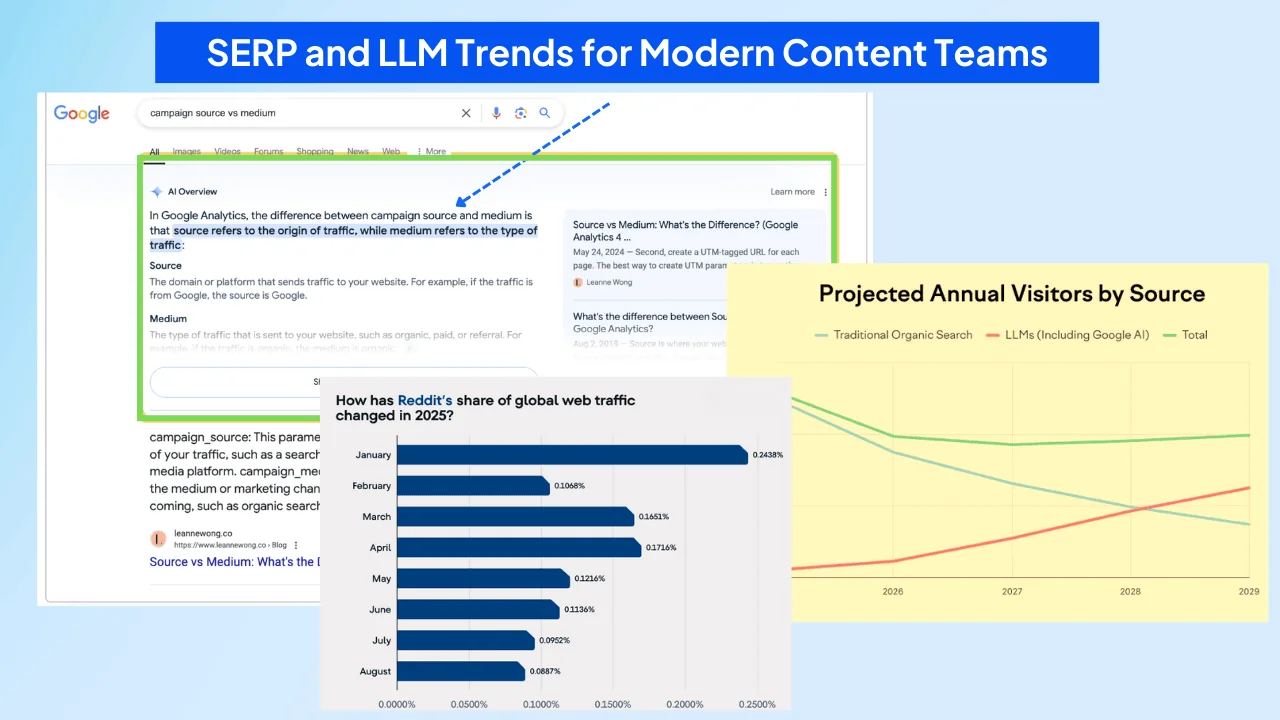
For example your website holds the second position for a competitive keyword, but a rival controls the featured snippet and several People Also Ask results.
Another competitor is listed fifth, but they appear with eye-catching video thumbnails and review stars that draw attention instantly.
In both cases, the competitor with broader visibility captures more user attention, even though their “ranking” is technically lower.
This shows why visibility and ranking cannot be treated as the same thing. Ranking only measures position, but visibility measures true influence across the search page.
Modern SERPs are highly fragmented. They now include snippets, carousels, maps, AI overviews, and more—and unresolved Technical SEO Issues can quietly prevent your pages from qualifying for many of these visibility-driving features.
In practical terms, SERP Visibility Analysis is just as important as other key SEO metrics such as bounce rate, impressions, and conversions.
It also highlights the role of search engine ranking factors, since real visibility depends on far more than placing keywords on a page.
Why is SERP Visibility Analysis Important For Competitor Research?
Every marketer has been told to know their competitors. In SEO, however, the rivals who limit your growth are often not the ones you expect.
A direct business competitor may barely appear in search results, while an affiliate blog or a news outlet dominates the page.
SERP visibility analysis uncovers who your real SEO competitors are and reveals how they capture attention across the results page.
For example, a SaaS startup may think its main competitor is another SaaS brand. But after running visibility analysis, it discovers that most impressions are being captured by niche bloggers, YouTube reviews, and comparison sites.
Without this insight, the startup would waste resources competing in the wrong direction.
Even more powerful is how visibility analysis highlights competitor gaps:
- A rival may rank well organically but fail to appear in snippets or PAAs.
- Another may publish strong content but skip structured data, missing out on rich results.
- Some may invest in rankings but neglect AI-driven SERP features like Overviews, where AI-Driven SEO vs Traditional SEO makes all the difference.
For your brand, these blind spots are opportunities. If your competitor has not optimized for schema, your SEO site audit can identify those weaknesses and allow you to leapfrog them with structured content.
If they ignore low competition keywords, you can step in with content topic clusters and claim the visibility they’re overlooking.
With Wellows’ competitor-driven insights and citation analysis, these gaps become easy to spot.
By combining Google Search Console keyword analysis with live SERP and LLM visibility signals, Wellows highlights missed citations and emerging opportunities across competitors, showing exactly where visibility gaps exist.
How is SERP Visibility Analysis Different From Ranking, CTR, and PageRank?
This is one of the most common points of confusion. To clarify:
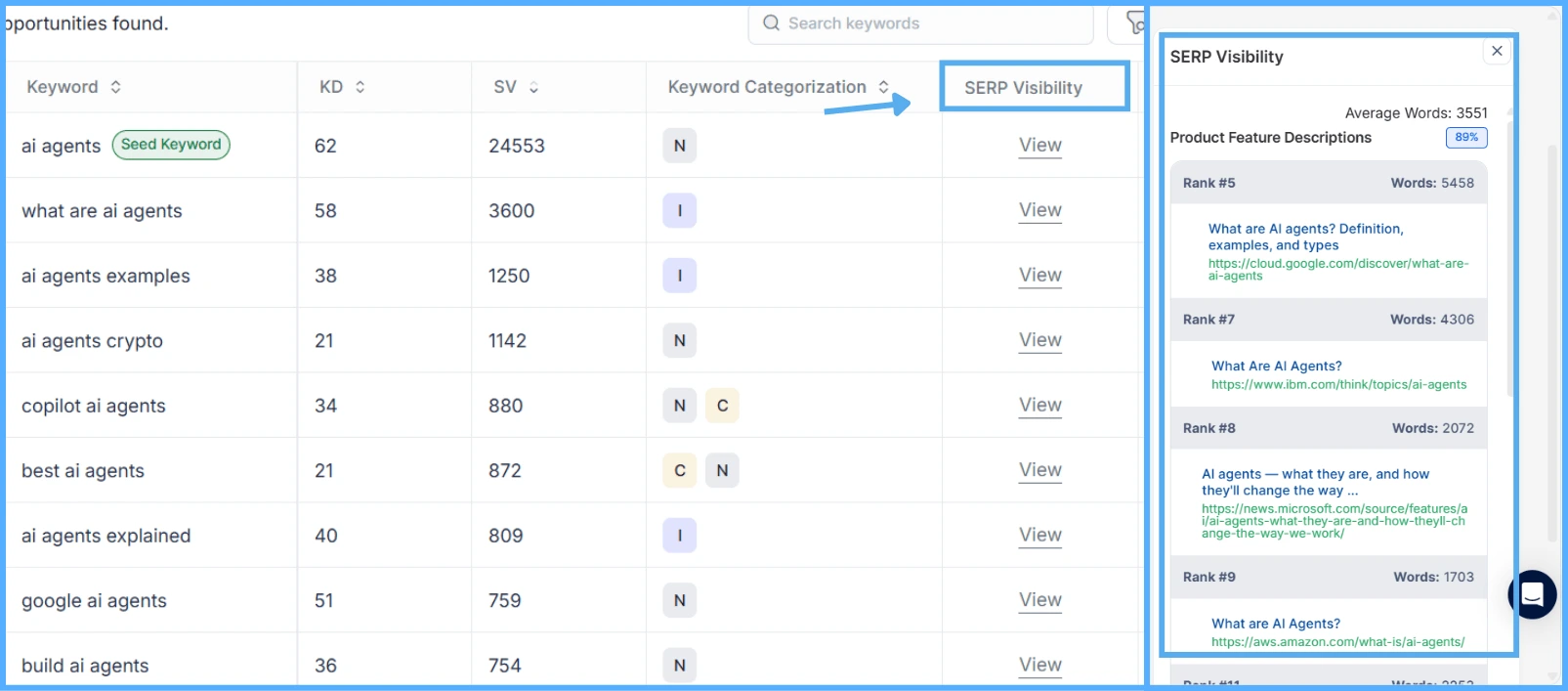
Is SERP visibility the same as search ranking? No. Ranking tells you your placement; visibility shows how much attention you capture across all SERP elements.
SERP visibility vs SEO ranking: Ranking is one dimensional. Visibility reflects multiple placements such as snippets, People Also Ask boxes, images, and videos that together shape brand presence.
How does SERP visibility differ from CTR? CTR measures clicks on your listings. Visibility measures impressions and presence, even when users don’t click. You may have high visibility but lower CTR if your result is less engaging.
Differences between SERP visibility and PageRank: PageRank is an algorithmic authority score. Visibility is an observable, real-time measurement of SERP presence.
Why does this matter? Because in modern SEO, you can’t rely on a single indicator. A page ranked #3 with low CTR and no snippets might generate less business impact than a page ranked 6 with high visibility across SERP features.
This is why a platform like Wellows brings visibility together through its LLM Visibility feature. The goal isn’t just to understand your presence in SERPs, but also how AI systems interpret your brand across models like ChatGPT, Gemini, Perplexity, and Google AI Overview.
What Factors Affect SERP Visibility?
Several factors determine whether your content shows up broadly across a SERP. These include:
Content relevance and depth: Search engines reward content that answers queries comprehensively. Thin content may rank briefly but rarely gains snippet placement or sustained visibility.
Technical optimization: A clean site passes an SEO site audit, loads quickly, and is mobile-friendly. Technical errors often mean you’re ineligible for rich results.
Structured data and schema: Without schema, you’re invisible to many SERP features. Rich snippets (reviews, FAQs, recipes, events) depend on proper markup.
Authority signals: Backlinks, branded searches, and topical authority all influence how often your content is surfaced.
Semantic coverage: Using related terms and LSI keywords ensures that your page is semantically rich, making it easier for search engines to match multiple query variations.
Internal linking in SEO: Proper internal linking improves crawl efficiency and reinforces topical relationships, giving you higher chances of ranking across a cluster.
Freshness and recency: Outdated content loses visibility. Competitors with fresher examples, updated stats, and new case studies often win back SERP space.
Visibility is not a single lever but a combination of technical, content, and authority factors. Working through an on-page SEO checklist can help teams tighten the page-level elements they control most directly, while brands that consistently optimize across all fronts tend to dominate multiple SERP features simultaneously.
What Tools Should I Use to Track and Analyze My SERP Visibility?
To track SERP visibility properly, you need more than a ranking tracker. You need to see how much space your brand actually owns across real results pages — organic listings, featured snippets, People Also Ask (PAA), videos, local packs, and now AI Overviews.
Wellows SERP Visibility is built for this exact job. It gives you a unified view of where your pages show up, which SERP features you are winning, and where competitors are taking attention you could reclaim.
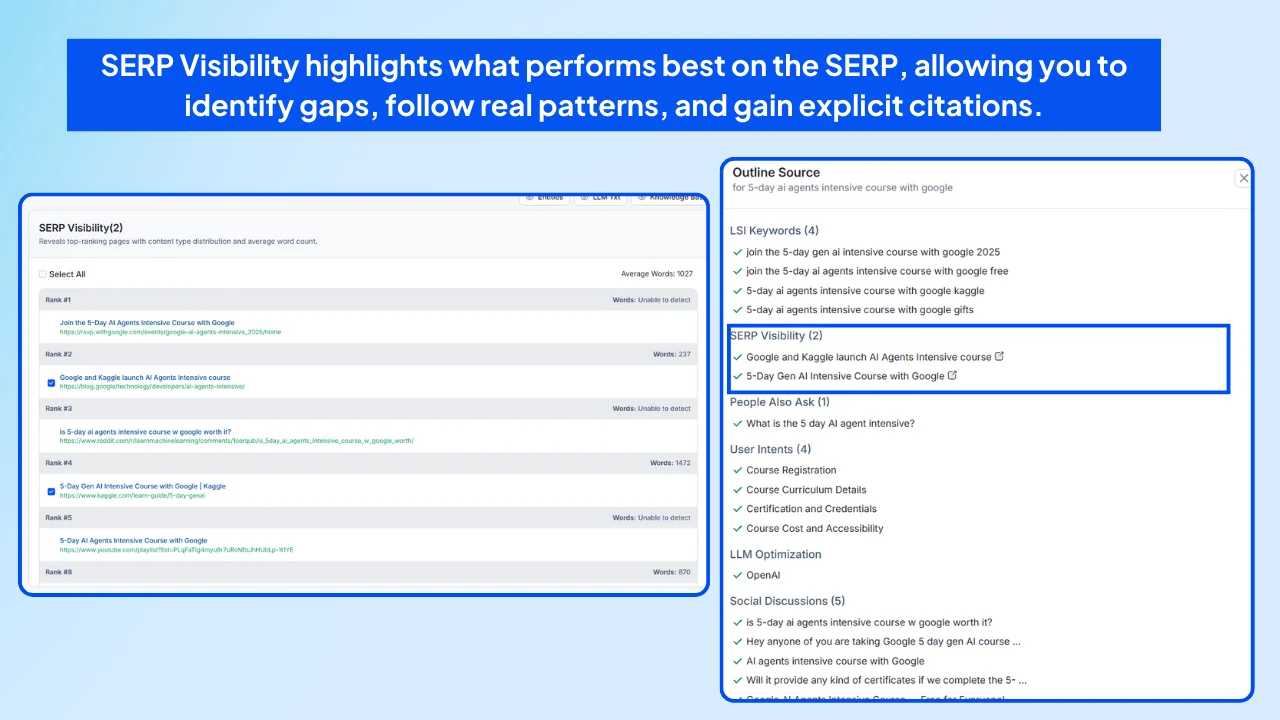
Inside Wellows, SERP visibility is measured through signals like:
Google Search Console keyword analysis: Wellows connects your GSC data to pull real impressions and clicks, so you can see where you’re showing up even when you’re not getting clicks yet.
SERP feature tracking: It highlights whether you appear in snippets, PAAs, video blocks, or local packs — and shows how those features expand (or shrink) your footprint.
AI and LLM citations: Visibility now includes AI Overviews and LLM answers. Wellows tracks when your pages are cited or when competitors get referenced instead.
SERP Visibility Factor: A combined visibility view showing how your brand performs across Google plus AI surfaces like AI Overviews, AI Mode, ChatGPT, Gemini, and Perplexity.
Traditional tools like Semrush or Ahrefs still help for rankings and basic feature checks. But if you want visibility across both classic SERPs and AI search, Wellows gives you one connected visibility map you can actually act on.
To see your real SERP visibility, don’t look at rankings alone. Visibility means how much space your brand takes up across the results page — organic links, featured snippets, People Also Ask, video blocks, local packs, and AI Overviews. A site can rank #3 and still lose attention if competitors own more SERP features.
The simplest way to check this inside Wellows is using SERP Visibility. It shows where your pages appear, which SERP features you’re winning, and where competitors are taking visibility you could reclaim.
Here’s a clean way to check your current visibility:
- Step 1: Open SERP Visibility in Wellows. You’ll see the top-performing pages and formats for your tracked topics, plus where your domain shows up.
- Step 2: Review feature coverage. Check if you’re showing in snippets, PAA, video, local, or AI panels — not just organic listings.
- Step 3: Compare against real SERP competitors. Wellows highlights who is capturing the most SERP space for the same queries so you know where you’re behind.
- Step 4: Track changes over time. Visibility shifts fast, so watch weekly or monthly trends to spot drops or new openings early.
If you want a manual cross-check, Google Search Console still helps for impressions and average positions, while tools like Ahrefs or Semrush can show keyword-level rankings. But for a true visibility view across both classic SERPs and AI-driven results, Wellows keeps it in one place and turns it into clear next actions.
How Does SERP Visibility Analysis Uncover Competitor Gaps?
The real value of visibility analysis is not just tracking performance — it’s spotting missed citation opportunities competitors are winning right now.
Wellows automates this through two built-in gap views:
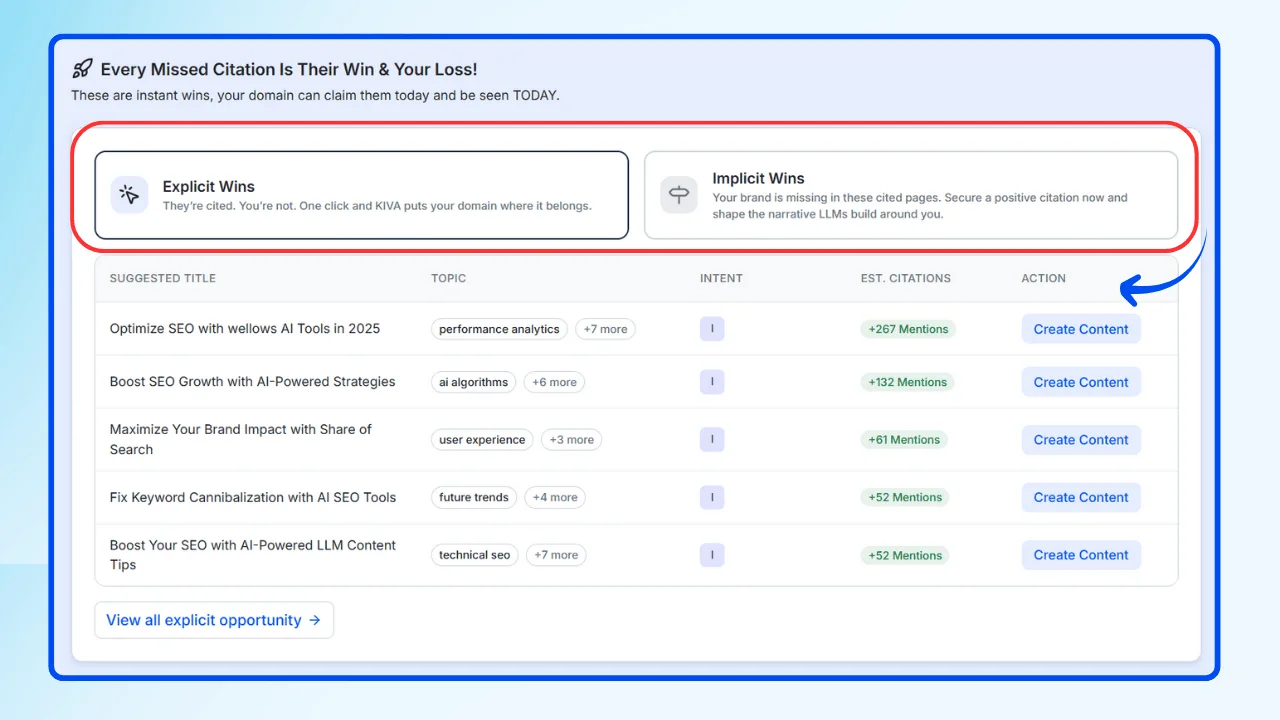
Explicit Opportunities: Pages where competitors are cited and you’re not. Wellows flags these as instant gaps you can claim.
Implicit Opportunities: Queries where your category is cited but your brand is missing, meaning you can earn a new citation by filling the gap.
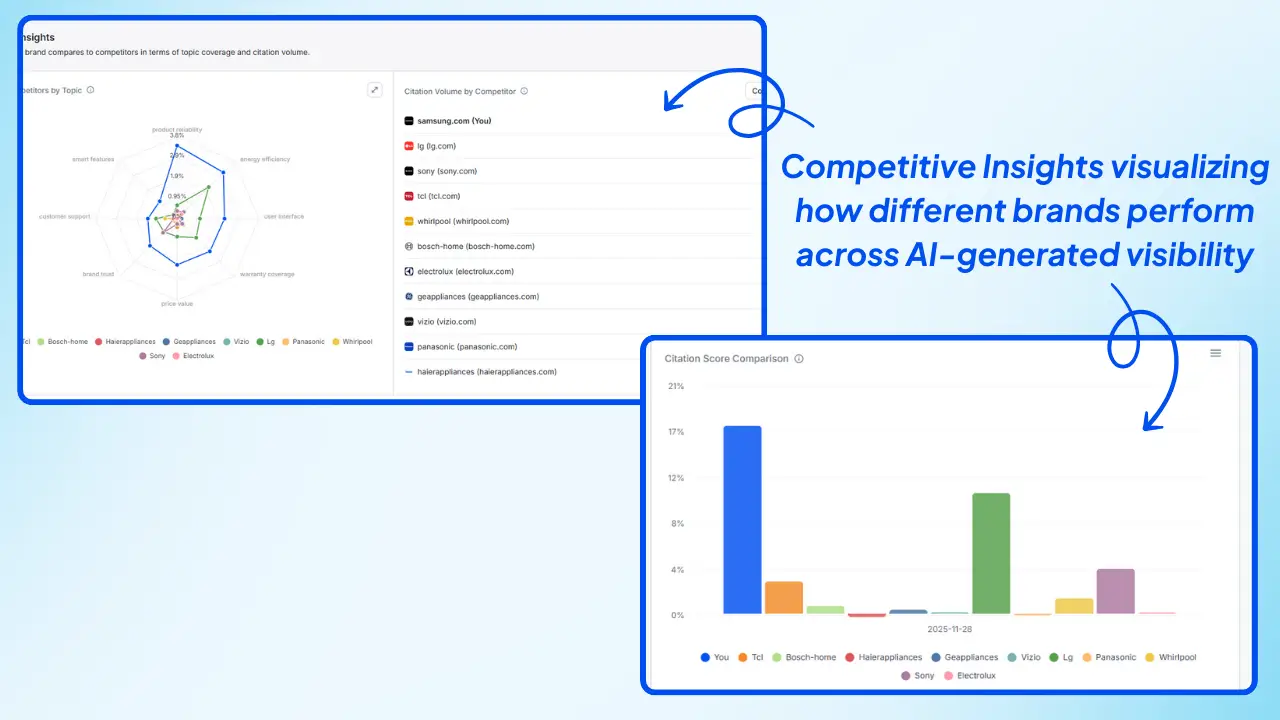
Then, in Insights, Wellows shows how your citation volume compares by competitor and topic. That’s how you find:
Topics you lead (like “AI visibility”) vs topics where competitors still hold space.
Competitors earning more citations overall in certain clusters.
Areas where one new piece could flip the visibility gap quickly.
So instead of guessing where rivals are beating you, Wellows shows the exact topics and queries where they’re visible and you are not. Wellows supports this through its competitor-driven strategy.
It combines SERP analysis, User Search Intent, LLM Visibility, and citation insights to show where competitors gain visibility and where your brand can outperform them.
Thus, it can reveal these competitor gaps in minutes through its How To Cut Blog Research Time workflow, eliminating weeks of manual analysis.
What Are the Steps to Conduct SERP Visibility Analysis Effectively?
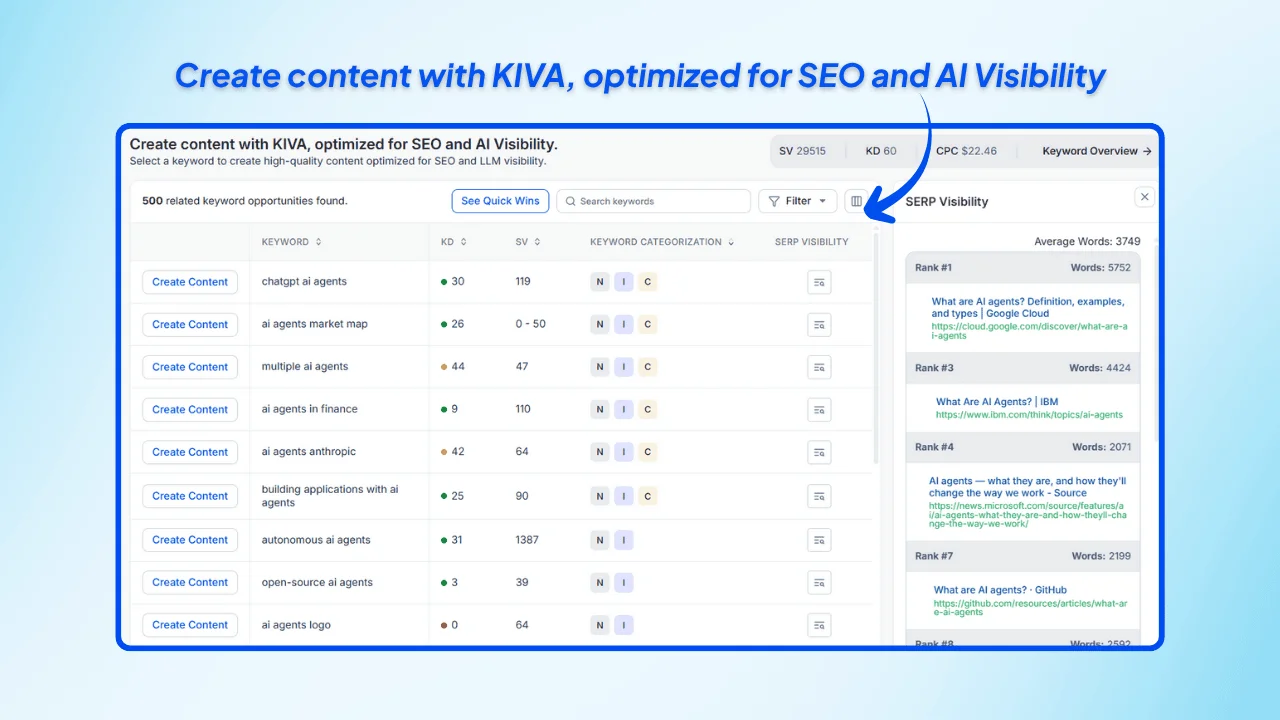
SERP visibility analysis works best when you follow a simple loop: understand what’s winning → find gaps → build for those patterns. This is the same sequence Wellows supports inside SERP Visibility:
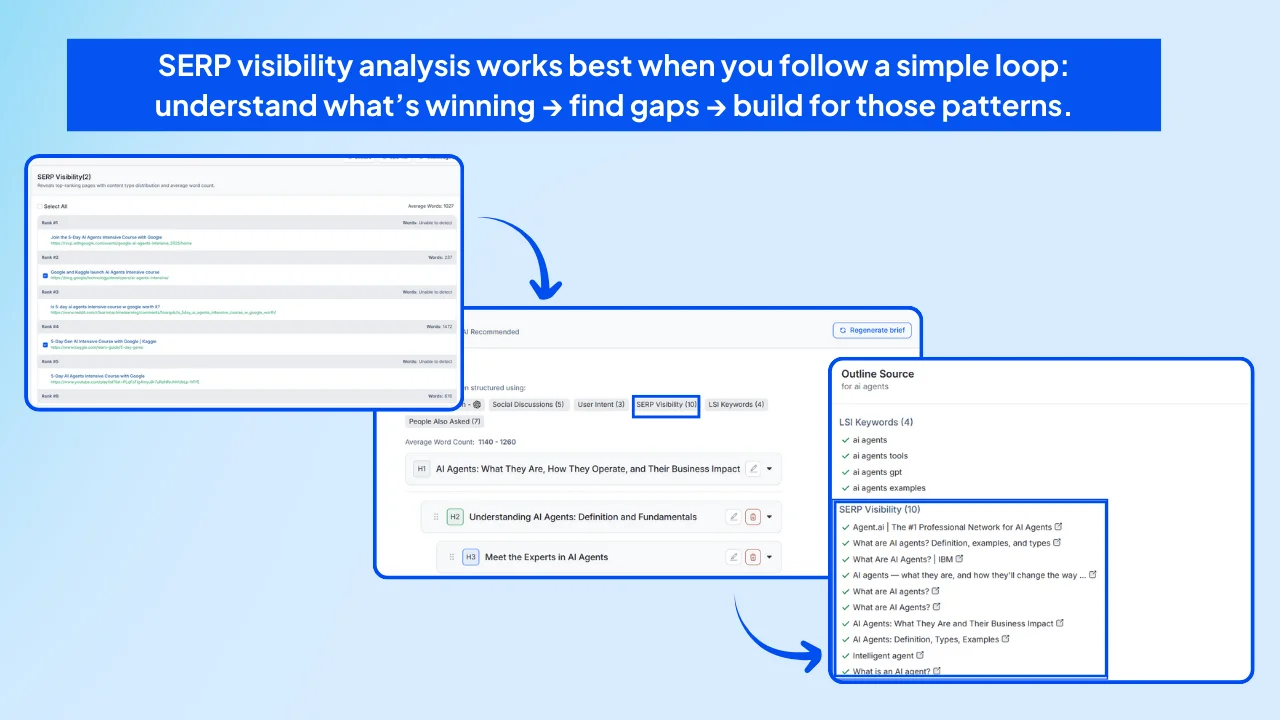
Review what already wins on the SERP: Start by looking at the pages and formats that consistently show up first for your target topics. This is your visibility benchmark.
Filter for opportunities that match your goal: Narrow by intent, content type, and depth so you only focus on the visibility patterns that matter for your strategy — and instantly spot gaps.
Turn those patterns into content that stays visible: Use what you learn to shape briefs and updates that align with real SERP expectations, helping you earn explicit placements and hold them longer.
Wellows AI SEO Automation keeps this repeatable. SERP Visibility shows you what performs, where competitors dominate, and what structure the SERP rewards — so every update you make is grounded in real visibility patterns, not guesswork.
Wellows compresses days of work into minutes. As an autonomous marketing platform built for AI search visibility, its Quick Wins workflow analyzes visibility signals, surfaces competitor gaps, and delivers a focused content plan using citation data, SERP patterns, and intent insights.
How to Improve SERP Visibility in 2025?
Improving visibility requires more than chasing rankings. Some strategies include:
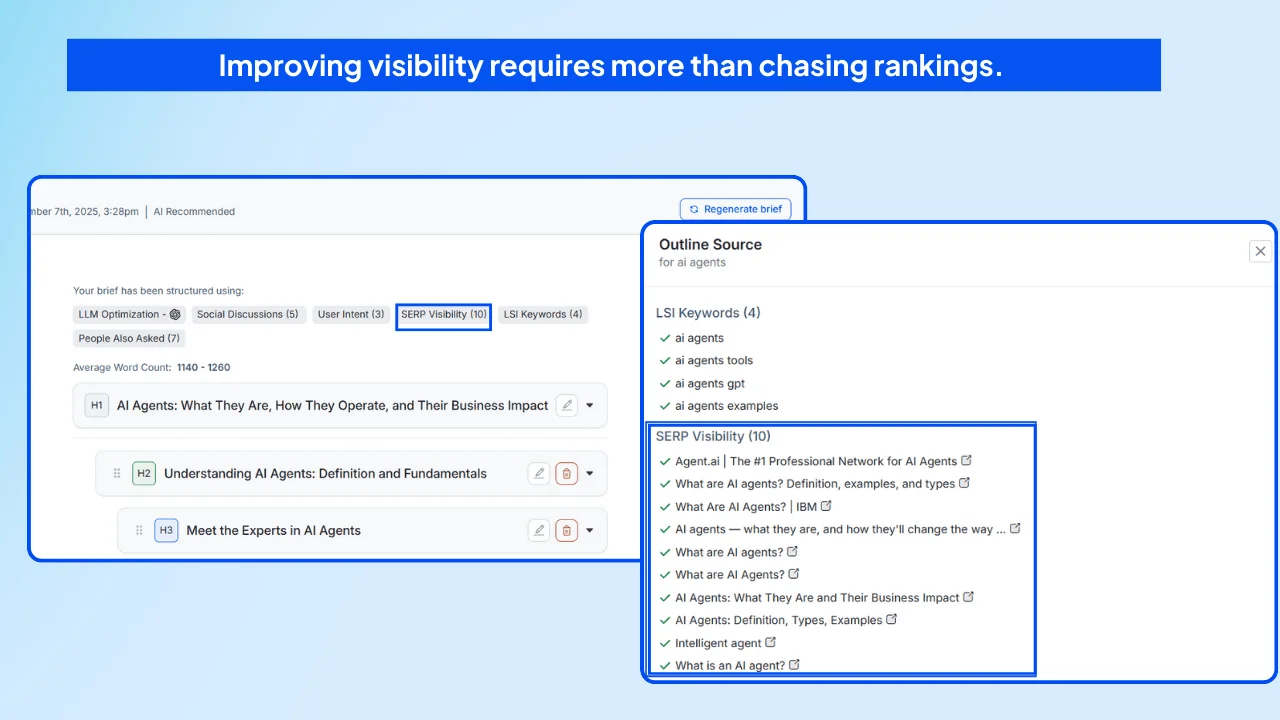
Optimize for snippets and PAAs: Structure content with clear questions and answers.
Leverage structured data: Add schema for reviews, FAQs, and products.
Build topical authority: Use clusters and internal linking in SEO to reinforce subject depth.
Refresh old content: Update statistics and examples to reclaim lost visibility.
Adopt SEO automation: Use tools to scale research and analysis, cutting hours off the process.
Balance automation with authenticity: free AI humanizer tool by Wellows refines machine-generated drafts so they sound natural, clear, and aligned with your brand voice.
This dual approach — technical precision plus humanized presentation is the formula for long-term SERP visibility.
What Role Does AI-driven SEO Play in Visibility Analysis?
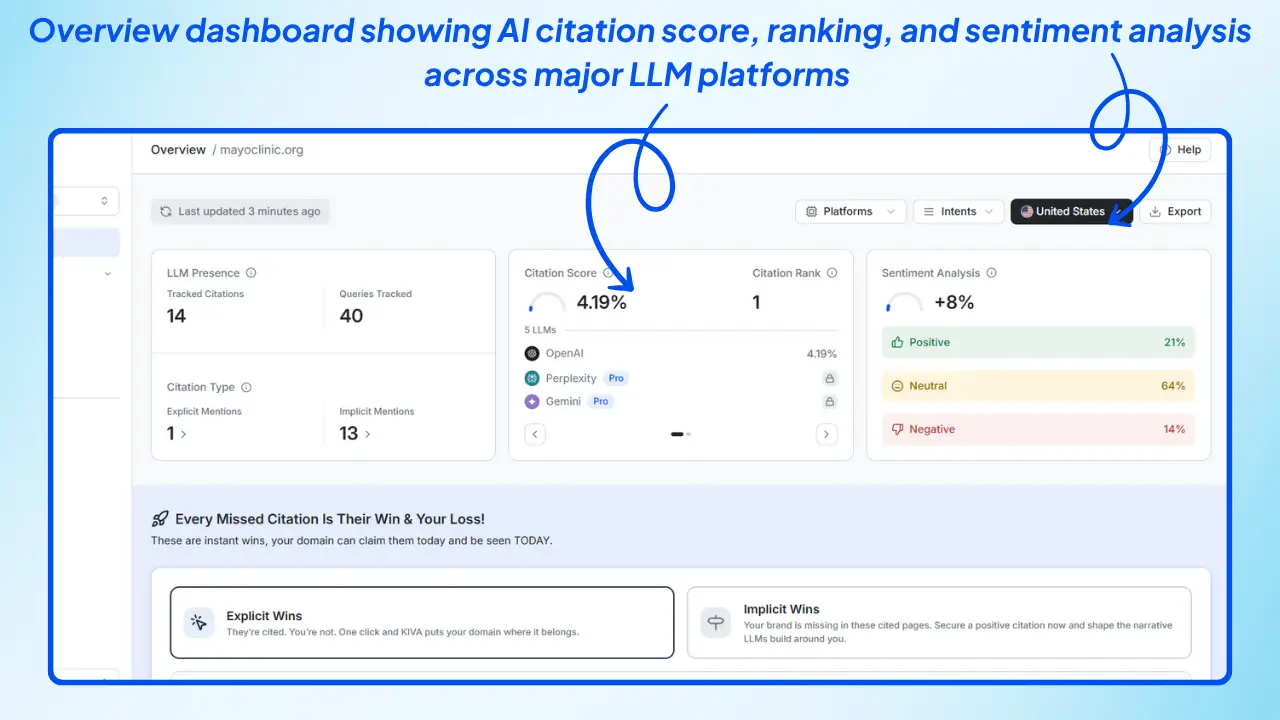
The rise of generative AI has changed the visibility game. Google’s AI Overviews, ChatGPT responses, and tools like Perplexity now act as alternative SERPs where content can be cited without a click.
This creates a new battleground: AI-Driven SEO vs Traditional SEO. Traditional methods focus on ranking pages; AI SEO also requires structuring content so it is reused in conversational answers.
Visibility analysis therefore must extend to these new environments. It’s not just about where you rank on Google it’s about whether your content is being cited by AI models.
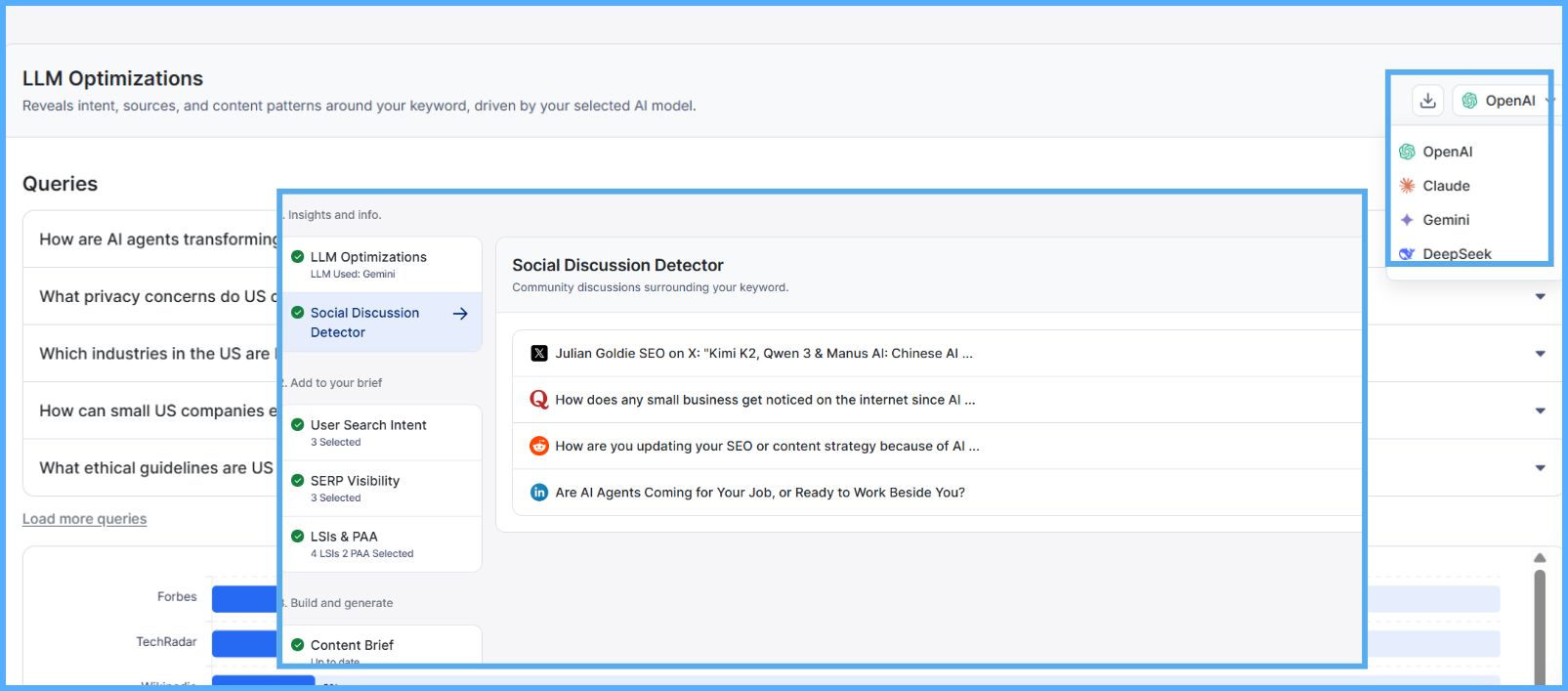
With features like LLM Visibility and Social Discussion Detector, Wellows tracks not only Google SERPs but also which queries and discussions shape AI-driven results.
Combined with How to Maintain Brand Voice, it ensures your brand appears consistently across both search and AI platforms.
How Often Should I Monitor My SERP Visibility To Stay Competitive?
SERP visibility changes faster than most people expect. Competitor publish new pages, Google reshuffles features, and AI Overviews keep evolving. To stay competitive, you need a monitoring rhythm that catches drops early without creating busywork.
Roadmap to Monitor SERP Visibility and Stay Competitive
What Should I Monitor Weekly?
- Track visibility movement, not just ranks: Review how your pages appear across organic listings, featured snippets, PAA blocks, video results, local packs, and AI Overviews.
- Watch competitor jumps early: If a rival suddenly owns a snippet or multiple PAA slots, that’s a visibility gap you can reclaim fast.
- Use Wellows for a quick scan: In Wellows Monitoring, check weekly visibility swings and missed placements without manual SERP digging.
What Should I Review Monthly?
- Compare topic-level visibility: See which clusters are growing and which are losing SERP space, so priorities stay aligned to real demand.
- Audit live SERP patterns: Spot shifts in dominant features (snippets, AI Overviews, video packs, shopping blocks) for your key queries.
- Refresh slipping pages: Update structure, depth, and schema based on what SERPs are rewarding now.
What Should I Audit Quarterly?
- Run a full competitor gap audit: Identify unclaimed snippets, weak PAA coverage, or formats competitors dominate but you don’t.
- Reset visibility priorities: Some topics become easier wins over time, others get crowded — quarterly reviews keep your plan realistic.
- Turn gaps into action: Use Wellows SERP Visibility insights with Quick Wins to build briefs and updates that match current SERP expectations.
This roadmap helps you protect visibility weekly, optimize it monthly, and expand it quarterly — so you stay ahead in both classic SERPs and AI-driven results.
FAQs
Yes. You can win visibility by owning more SERP features even if you are not #1. Featured snippets, People Also Ask answers, video blocks, local packs, and AI Overviews can put your brand in multiple spots on the page. That extra coverage often drives more attention and clicks than a single top ranking.
Conclusion
Rankings may still have a place in SEO reporting, but they are no longer the final measure of success. Modern SERPs are fragmented, AI-assisted, and saturated with features that make ranking position only part of the picture.
SERP Visibility Analysis gives you the whole truth. It shows not just where you appear, but how much space you control, how you compare against competitors, and where gaps exist for you to exploit.
For SEO teams and marketers, this is the secret weapon for growth. By shifting focus from rankings to visibility, you uncover opportunities that rivals overlook, build competitor-driven strategies, and establish a presence that resonates across both Google and AI-powered engines.
And while much of this work can be done manually, the smarter path is to use tools that combine automation with intelligence.
Wellows brings together Quick Wins, SERP Visibility, LLM Visibility, Content Briefs, and Tracking into one unified workflow, turning complex analysis into clear, actionable strategy.
Visibility, not ranking, is the new scoreboard. And those who master SERP Visibility Analysis will always find the competitor gaps that lead to real wins.