AI content scoring makes content reviews simple and measurable—so you don’t have to rely on guesswork. If you want better results without constantly publishing new pages, scoring helps you focus on the existing content that can move the needle.
It shows you how to use AI content scoring in real terms: what’s working, what needs a quick refresh, and what should be rewritten or removed.
According to industry research, 78% of marketers say AI-based scoring tools have improved content quality, largely by helping teams identify what to update, improve, or remove (Digital Silk, 2025).
Today, content success isn’t about publishing more pages—it’s about making sure your existing pages match what people are actually searching for and support your business goals.
Especially for Content Marketing Agencies managing large content libraries and performance targets.
And because scoring turns quality into a consistent system, you can spot the biggest opportunities fast and prioritize updates with confidence.
While only 6% of marketers use AI to fully generate content, most teams use it to guide edits, decide what to fix first, and improve performance faster (HubSpot State of Marketing, 2024). That’s the real value of scoring: it turns “I think this page needs work” into clear, repeatable, data-backed updates.
In this guide, we’ll break down a practical scoring workflow—how to evaluate your existing content, improve SEO performance, and make smarter update decisions.
You’ll learn what content scoring is, why it matters for search visibility and AI results, and how to apply scoring models across different content types and funnel stages—without adding more content to your workload.
- Learn how to use AI content scoring to review content using data—not guesswork.
- Spot what to update, refresh, rewrite, consolidate, or remove across your content library.
- Prioritize pages with the biggest SEO and business impact instead of updating everything.
- Use scoring methods (rule-based, ML, engagement, predictive) to build a repeatable workflow.
- Score content by funnel stage so the right metrics match the right goal (reach vs. conversions).
- Improve readability, structure, and intent-match to boost engagement and search engine visibility.
- Track results after updates (rankings, impressions, CTR, conversions) and refine your scoring model over time.
What Is AI Content Scoring?
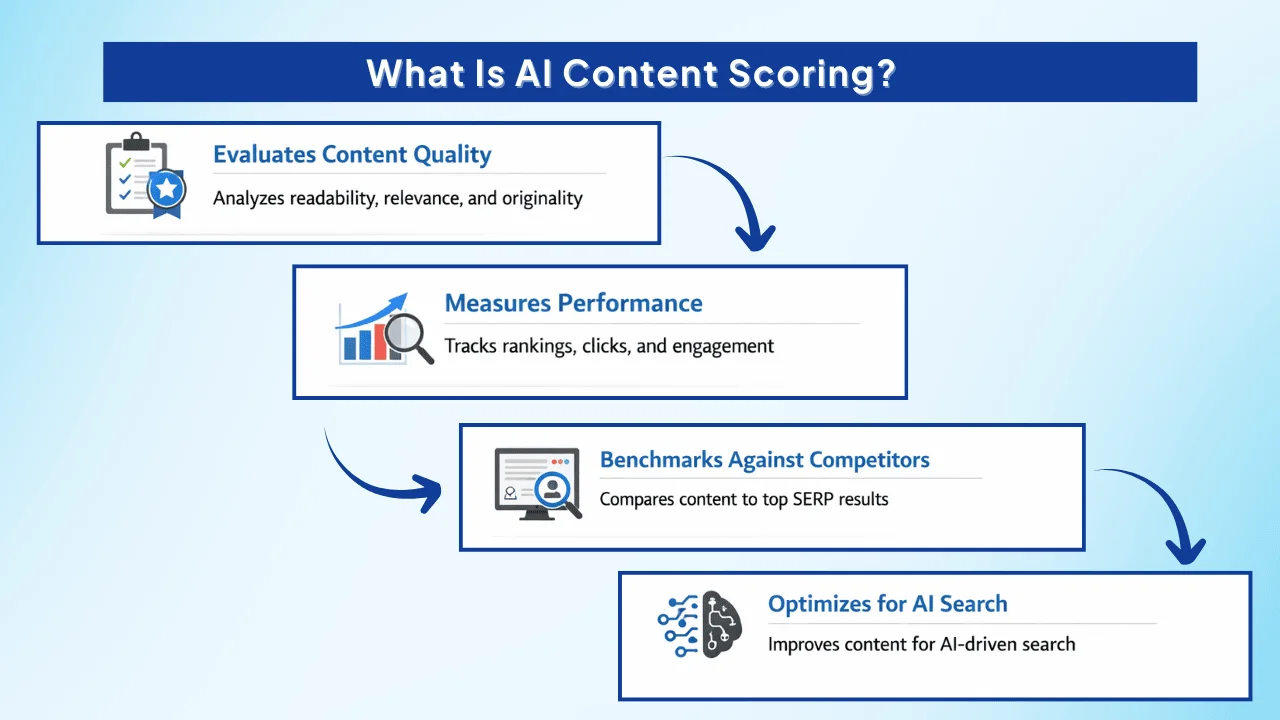
AI content scoring is a data-driven way to evaluate each page against clear criteria—like relevance, performance, structure, and conversion impact—so you can see what’s helping (and what’s hurting) your SEO. Instead of relying on opinion, AI assigns a score that shows how well a piece of content supports search engine visibility and business goals.
Unlike manual reviews, scoring keeps evaluations consistent across large content libraries. It helps you quickly identify which pages need a full refresh, a light update, or no changes at all.
Why Content Scoring Matters for SEO and Search Performance
- Prioritizes updates based on performance data, not assumptions
- Improves alignment with search intent across content types
- Highlights underperforming assets before traffic declines accelerate
- Supports smarter resource allocation by focusing on high-impact pages
- Creates a repeatable update framework for ongoing optimization
Industry benchmark: B2B content marketing delivers an average 3:1 ROI. When teams pair content scoring with structured update workflows, reported returns can exceed 700% by concentrating effort on pages that already show demand (Genesys Growth, 2025).
Common Methods Used in AI-Based Content Scoring
- Rule-based scoring: Evaluates content using fixed criteria like freshness, structure, and keyword coverage
- Machine learning models: Identify performance patterns across large datasets
- Engagement-based scoring: Uses signals such as CTR, dwell time, and conversions
- Predictive scoring: Estimates future performance using historical trends
How Do You Score Content by Funnel Stage?
Effective scoring systems account for where content fits in the buyer journey. Educational pages are typically scored on visibility and engagement, while product pages, case studies, and pricing content are evaluated on conversion signals.
Assigning weighted scores by funnel stage helps teams prioritize content updates that influence revenue while maintaining top-of-funnel visibility. This approach keeps content aligned with both search demand and business outcomes.
- Blog posts for awareness, scored by reach and engagement rates
- Whitepapers and webinars for consideration, using lead generation scores
- Product or demo pages for decision stage, scored by conversions and user actions
- Case studies for trust-building, focusing on direct impact to lead qualification
- Email and nurture content, scored via open, reply, and click rates
- Video content evaluated by watch time and completion percentages
- Interactive tools, scored by repeated use and outcome achievement
Sample Content Scoring Matrix by Funnel Stage
| Content Type | Funnel Stage | Suggested Score Criteria |
|---|---|---|
| Blog Post | Awareness | Traffic, engagement, dwell time |
| Whitepaper | Consideration | Downloads, shares, qualified leads |
| Case Study | Decision | Conversion, referrals, reader feedback |
| Demo Page | Conversion | Leads, demo requests, CTA clicks |
| Podcast / Video | Awareness / Engagement | Subscribers, watch rate, amplification |
Did you know?
Pro Tip: Weight criteria based on buyer journey, apply unique metrics for each content type, use score thresholds to prioritize improvement, benchmark against historical and competitor data, and update models as business goals evolve.
How Do You Improve Content Readability for AI Search?
Readable content performs better in both traditional and AI-driven search because it helps users understand answers quickly and signals clarity to AI systems. Improving readability starts with simplifying how information is presented.
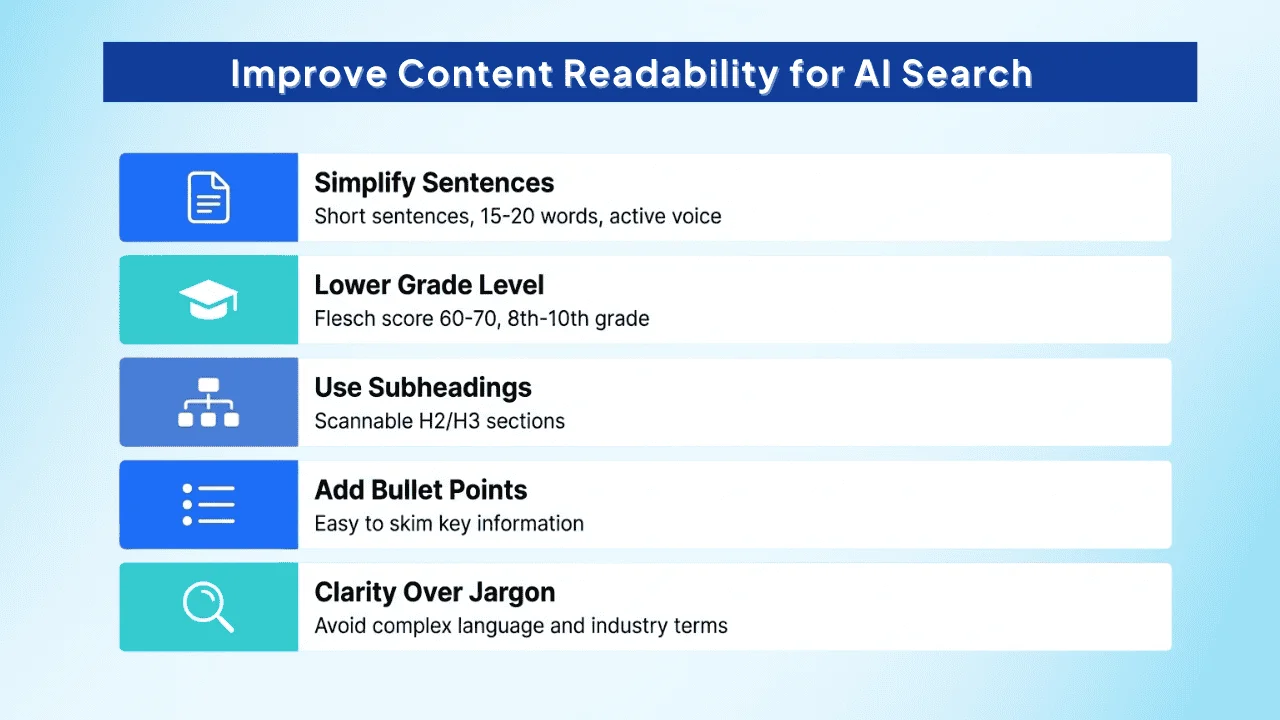
Write short, clear sentences and keep paragraphs brief for easy skimming.
Use simple, accessible words and remove unnecessary jargon.
Add clear headings and subheadings so key points are easy to find.
Run a readability check (e.g., Hemingway) and fix grammar, spelling, and flow.
Use active voice to make your writing direct and easier to understand.
How Wellows supports readability:
Wellows AI search visibility platform, helps you measure readability instead of guessing. Within its Content Score, the Readability pillar evaluates your draft using established formulas and allows you to compare scores against selected SERPs—so you can see where your content is too complex and what to simplify before publishing.
Wellows analyzes readability using metrics such as Flesch Reading Ease, Flesch-Kincaid Grade, Gunning Fog, SMOG Index, Coleman-Liau Index, and the Automated Readability Index, giving you clear insight into sentence complexity, reading level, and overall clarity.
How Do You Optimize Content Scores for SEO and AI Search?
Optimizing content scores for SEO and AI search requires aligning on-page elements, structure, and depth with what users and search systems expect. A balanced mix of AI-driven analysis and manual review produces the most reliable results.
Did you know?
- Ensure keyword usage aligns naturally with topic clusters and user intent.
- Optimize title tags and meta descriptions to clearly reflect the query being answered.
- Strengthen internal and external linking to improve context and discoverability.
- Match content length and depth to top-performing SERP results.
- Improve semantic relevance by including related entities, examples, and supporting details.
- Add multimedia elements where helpful to increase engagement and comprehension.
- Review schema markup, page speed, and technical signals that influence search visibility.
Once you know which pages are underperforming, AI content optimization makes the next move clearer by revealing what needs to be expanded, rewritten, or internally supported
How Can AI Content Scoring Improve SEO Strategies?
AI content scoring shifts SEO from reactive fixes to proactive decisions by showing what will (and won’t) perform before you publish. Here’s how How to Use AI Content Scoring strengthens your SEO approach:
1. Identify Content Gaps Before Publishing
AI scoring tools compare your draft to top-ranking pages and surface:
- Missing semantic keywords and entities
- Insufficient depth vs. SERP leaders
- Internal linking opportunities
- Schema gaps that reduce rich result eligibility
Did you know?
Result: 92% of AI Overview citations come from top-10 ranking pages (Onely, November 2025)—scoring helps you reach that threshold before launch.
2. Optimize for User Intent Signals
AI scoring evaluates intent-fit by checking:
- Readability alignment with your target audience
- Topic coverage completeness for informational vs. commercial queries
- Engagement predictions based on structure, formatting, and media usage
3. Prioritize Updates for Maximum ROI
Instead of refreshing content blindly, scoring helps you focus on pages most likely to improve:
- Pages with slipping rankings but strong authority
- Content scoring 70–79 (close to the improvement threshold)
- High-traffic pages with weak engagement
Did you know?
Impact: Brands using AI scoring to prioritize updates report 45% higher organic traffic growth (DemandSage, 2025).
4. Scale Quality Across Large Content Libraries
For teams managing hundreds (or thousands) of pages, scoring enables:
- Automated bulk scoring to identify underperformers fast
- Consistent benchmarks to keep quality uniform
- Alerts for content decay before rankings drop
Did you know?
ROI Multiplier: With strong execution, content marketing ROI can reach 748% (Genesys Growth, 2025).
5. Improve AI Search Visibility
With AI Overviews appearing on 15.69% of Google queries (Semrush, December 2025), scoring helps you optimize for:
- Factual accuracy (verified claims are easier to cite)
- Citation-ready structure (clear headings, data points, expert inputs)
- Freshness signals (76.4% of ChatGPT citations updated in the last 30 days) (Passionfruit, 2025)
6. Reduce SEO Guesswork With Predictive Insights
Modern scoring tools can forecast:
- Ranking potential before publishing
- Expected engagement based on historical patterns
- More accurate length/structure targets for your niche
Did you know?
Strategic Advantage: You move from generic “best practices” to data-backed decisions tailored to your audience and category.
What Is the Best AI Content Scoring Tool Available for Marketers?
Choosing the right AI content scoring tool depends on your budget, technical expertise, content volume, and specific goals (SEO, AI visibility, readability, or all three).
If your priority is improving performance in AI-driven search, Wellows stands out as an AI search visibility platform that combines scoring, benchmarking, and quality validation in one workflow.
Wellows Content Scoring Features is designed to help you publish content that’s clear, original, and trustworthy—three signals that directly influence both SEO performance and AI visibility.
Instead of relying on one “score,” it breaks evaluation into three pillars and allows you to benchmark your content against selected SERPs. Thus, it is the best Content Scoring platforms for improved AI Search results
Three-Pillar Scoring System
1. Readability Analysis
This pillar shows how easy your content is to read and understand. Wellows uses established readability formulas and benchmarks so you can quickly identify when writing is too dense and needs simplification.
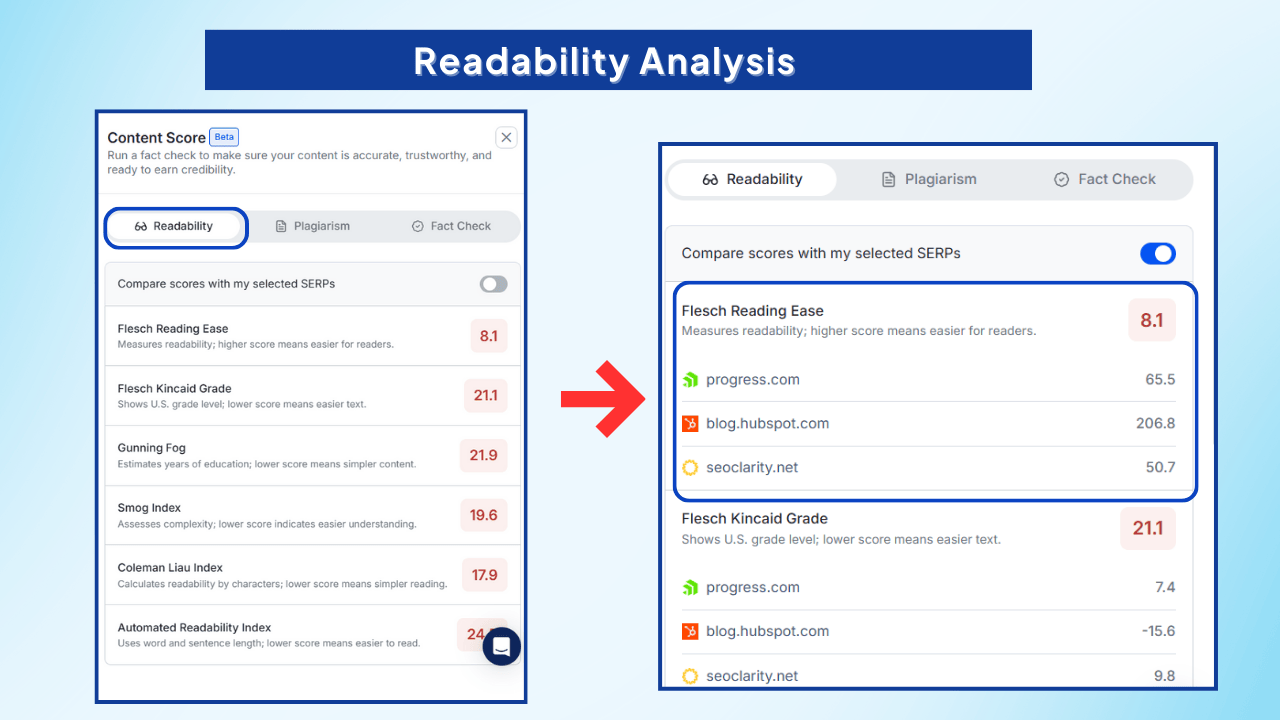
- Flesch Reading Ease: How easy text is to read (based on sentence length + word complexity). Higher = easier. Benchmarks: 90–100 very easy, 60–70 plain English, 0–30 very difficult.
- Flesch-Kincaid Grade: Estimated U.S. grade level needed to understand the text. Lower = easier. Benchmarks: 6–8 general, 9–12 high school, 13+ college+.
- Gunning Fog Index: Years of education needed to understand the text easily (focuses on long sentences + complex words). Lower = clearer. Benchmarks: 7–8 easy, 9–12 standard, 13–17 difficult, 18+ very difficult.
- SMOG Index: Complexity score based mostly on polysyllabic words. Lower = easier. Benchmarks: 7–9 easy, 10–12 standard, 13–16 hard, 17+ very hard.
- Coleman–Liau Index: Grade-level estimate using characters per word + sentence length (not syllables). Lower = simpler. Benchmarks: 6–8 general, 9–12 high school, 13+ college+.
- Automated Readability Index (ARI): Grade-level estimate using word length + sentence length. Lower = easier. Benchmarks: 6–8 general, 9–12 high school, 13–16 college, 17+ very difficult.
Additional Readability Signal: It also tracks Total Words to help you balance depth with clarity—so long-form content stays readable instead of bloated.
Note: In SERP benchmarking, Wellows compares readability directly against selected top-ranking pages, helping you spot where your content is harder to read than what’s already ranking.
2. Plagiarism & Originality Detection
This pillar plagiarism protects rankings and credibility by checking whether content is original and properly attributed.
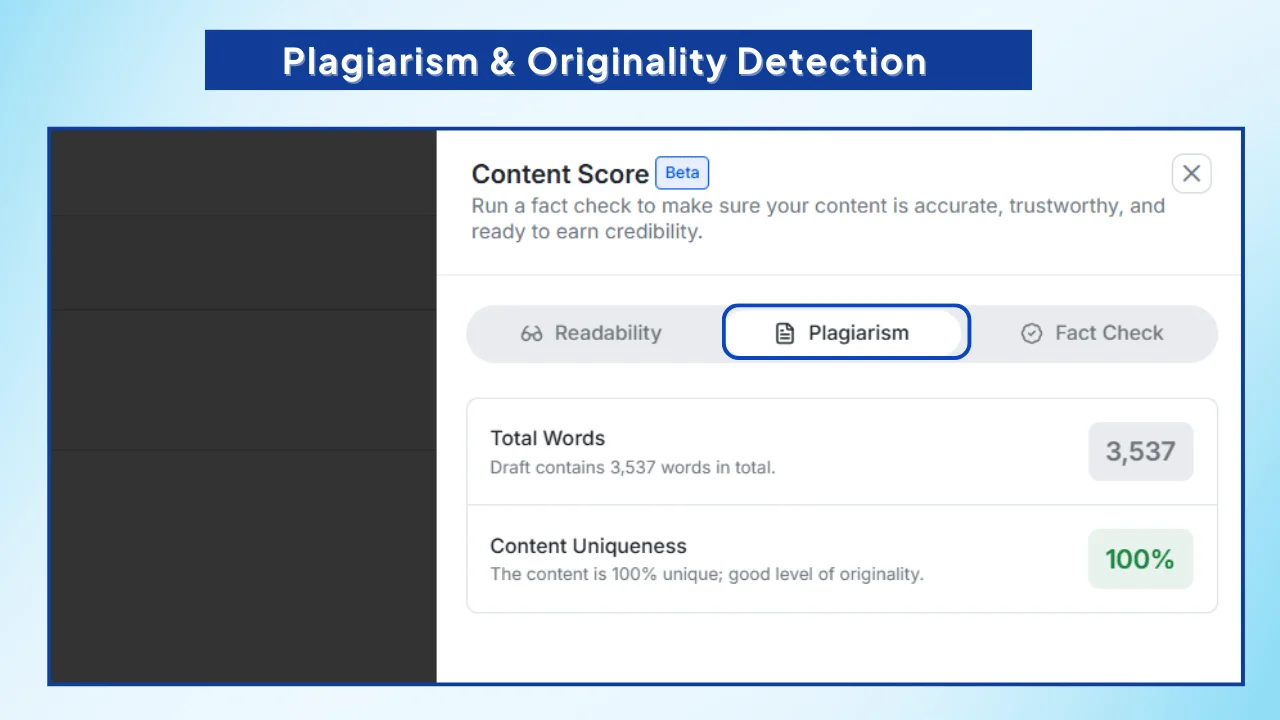
- Content Uniqueness: Flags duplicated or reused sections that weaken differentiation
- Duplicate Content Detection: Surfaces redundancy that can dilute topical focus
- Citation Validation: Helps confirm sources are attributed and accessible
3. Fact Check & Accuracy Verification
This pillar helps strengthen trust by verifying claims, highlighting unsupported statements, and improving accuracy—especially important for AI systems that prefer cite-worthy, reliable information.
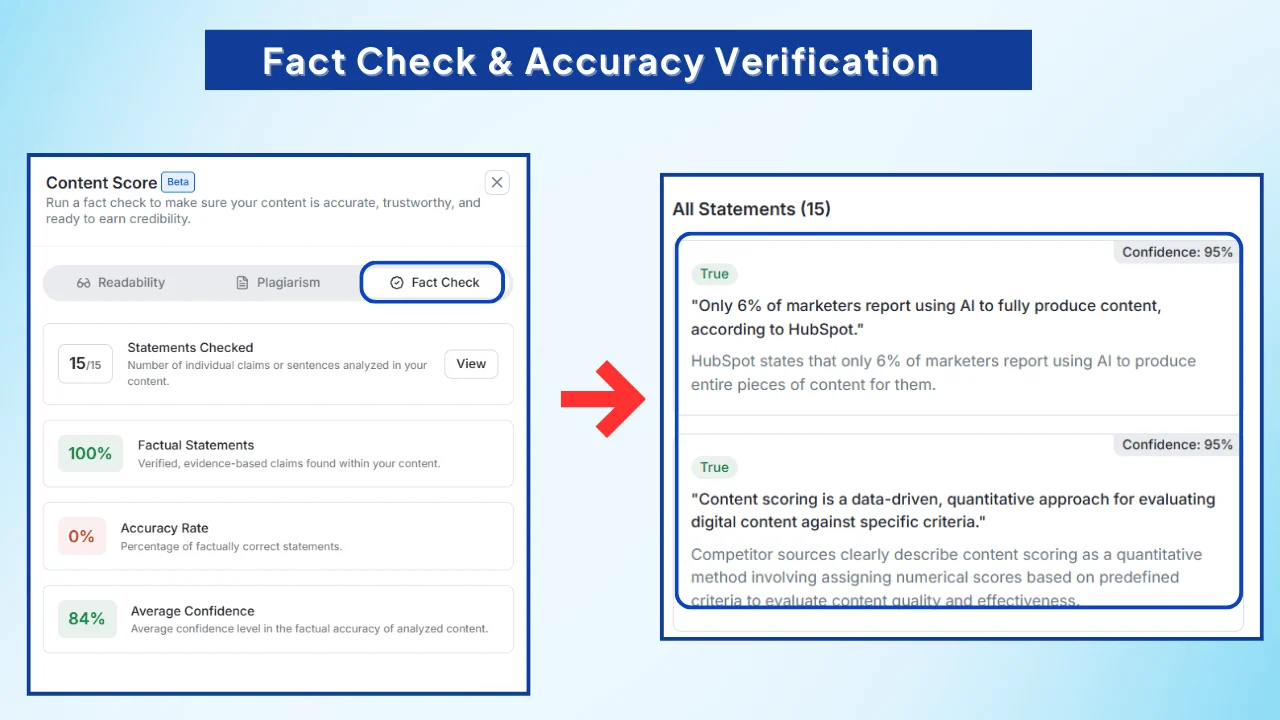
- Statement-level checks: Reviews individual claims for verifiability
- Confidence scoring: Summarizes how reliable the content appears overall
- Detailed analysis: Shows what was verified and what needs stronger sourcing
Step-by-Step Guide: How to Score Content for AI Search Visibility
Content scoring works best when you follow a simple, connected process—from choosing the right pages to turning scores into measurable improvements. The steps below show how to build a repeatable workflow that supports SEO performance and AI search visibility.
- Step 1: Select the Content You’ll Score:
Start by identifying the pages that matter most, such as high-traffic URLs, core landing pages, and content tied directly to conversions. This keeps scoring focused on assets with the highest potential impact.
- Step 2: Define the Right Scoring Metrics:
Once you know which pages to evaluate, choose metrics that align with your goals. Combine performance signals (rankings, clicks, conversions) with quality indicators like readability and topical coverage so your scores reflect both SEO and AI readiness.
- Step 3: Score Content and Benchmark Against the SERP:
Next, score each page and compare it to top-ranking results for the same query. This is where scoring becomes actionable—benchmarking reveals gaps in clarity, structure, originality, and accuracy.
Tip: Tools like Wellows, an AI search visibility platform, simplify this step by scoring content across readability, originality, and fact accuracy while letting you compare directly against selected SERP pages.
- Step 4: Organize Scores in a Content Scorecard:
Capture results in a simple scorecard so teams know exactly what to update. List each URL, its scores, and a recommended action (refresh, rewrite, consolidate, or keep). Automated reporting—such as Wellows’ Daily Update—can help keep this data current.
- Step 5: Apply Updates and Repeat the Process:
Prioritize updates based on impact, starting with pages that are close to ranking improvements or losing visibility. After publishing changes, measure results in analytics and search data, then repeat the same scoring cycle regularly to prevent content decay and maintain AI search performance.
How Can Small Businesses Leverage AI Content Scoring to Optimize Their Digital Content?
Small businesses often have limited time and budget for content optimization. AI content scoring helps by automating quality checks and highlighting the edits most likely to improve rankings and conversions.
1. Start Simple with a Lightweight Scoring Setup
Pick a small set of priority pages, score them using a few core signals (intent match, readability, on-page SEO, conversions), and track results in one sheet. As you scale, Wellows (an AI search visibility platform) helps you centralize content scoring and SERP benchmarking in one workflow. Tools like Semrush, Surfer SEO, and seoClarity can also support parts of the process.
2. Prioritize High-Impact Pages First
Focus on pages most likely to improve fast: high-traffic URLs that underperform, revenue-driving pages (services/pricing), and local pages that generate leads. This keeps effort concentrated on updates with the highest upside.
3. Score Against the SERP, Then Close the Gaps
Compare your page to top-ranking results for the target query. Identify missing sections, weak structure, unclear answers, and internal linking gaps—then convert findings into a short edit plan you can execute quickly.
4. Use a Simple Pre-Publish Quality Checklist
Before publishing, confirm the intro answers the query fast, headings are scannable, the primary keyword is used naturally, FAQs are added where relevant, and facts/links are accurate. This prevents weak content from going live and reduces rewrites later.
5. Track ROI Using a Few Clear Metrics
Measure impact after updates using simple metrics: impressions/clicks, engagement (time on page/scroll depth), and conversions (calls, bookings, forms). Tracking these signals shows what works and improves future scoring decisions.
6. Turn Scoring into a Sustainable Routine
Make scoring a habit. Start by improving a small set of core pages, apply scoring to new content, and run quarterly refresh cycles to prevent content decay and maintain visibility.
A simple cadence: Months 1–2 improve top pages, Months 3–4 score every new post, Months 5–6 add quarterly refreshes, Month 7+ delegate with a checklist-based process.
Common Small Business Mistakes to Avoid
❌ Optimizing for a score instead of customer value
❌ Flattening brand voice to “sound optimized”
❌ Scoring content but not applying the fixes
❌ Paying for tools before proving value with free options
❌ Expecting instant results (most lifts show over 60–90 days)
Actionable Content Scoring Tips to Improve AI Search Visibility
Once you’ve implemented content scoring, the next step is refining how you use it. These practical tips help you strengthen AI visibility, uncover hidden weaknesses, and turn strong content into authority signals.
- Review and Update Your Scoring Benchmarks Regularly:
AI search systems evolve quickly, so scoring criteria shouldn’t stay static. Review benchmarks at least once per quarter and adjust them based on algorithm updates, SERP shifts, and new competitors entering your space.
- Look Beyond Surface Metrics to Spot Hidden Weaknesses:
High clicks don’t always indicate strong content. Accurate scoring requires analyzing deeper engagement signals such as scroll depth, exit points, repeat visits, and sentiment to uncover friction or confusion users may experience.
- Improve Readability to Strengthen AI and User Signals:
Readable content performs better in AI-driven search because it’s easier to process, summarize, and cite. Simplifying language, shortening sentences, and improving structure often leads to higher engagement and lower bounce rates, making readability a key scoring factor.
- Use High-Scoring Content to Build AI Search Authority:
When content scores well, amplify those signals so both users and AI systems recognize its value. Highlight top-performing pages, showcase engagement indicators, promote content across channels, and surface proof points such as mentions or citations.
Read More Articles
-
- Boost AI Search Visibility with Knowledge Graphs
- Effective LLM Citation Strategies for SEO Success
- Does Google Ranking Ensure Visibility in ChatGPT
- 8 Most Effective Strategies for AI Visibility Enhancement
- How SERP Visibility Analysis Uncovers Competitor Gaps in 2026
- AEO Vs GEO (2026): Differences, Use Cases & Which To Prioritize
- How to Build GEO Brand Signals That Win AI Citations in 2025
- How to Design Content Briefs for GEO?
FAQs
AI content scoring evaluates content using algorithm-based criteria such as readability, relevance, originality, and accuracy. Unlike manual reviews, it applies the same standards across every page, allowing teams to score large content libraries consistently and at scale.
AI-based content scoring identifies gaps in keyword usage, structure, and intent alignment. By fixing these gaps, content becomes easier for search engines and AI systems to understand, which can improve rankings, engagement, and visibility in AI-powered search results.
AI content scoring works best for blogs, landing pages, product or service pages, case studies, and long-form guides. Any content that targets search traffic or conversions can benefit from scoring to identify optimization opportunities.
Most teams rescore high-value content every three to six months or after major search updates. Regular rescoring helps prevent content decay and keeps pages aligned with changing search intent and AI ranking signals.
Yes. Content scoring highlights pages that are close to improvement thresholds, slipping in rankings, or receiving traffic without conversions. This makes it easier to prioritize updates based on impact instead of intuition.
No. AI content scoring supports human judgment by surfacing data-driven insights, but final decisions still benefit from editorial review to maintain brand voice, accuracy, and context.
Final Thoughts
How to Use AI Content Scoring ultimately comes down to making smarter, more consistent content decisions using data instead of assumptions. By applying clear metrics, scoring content against search intent, and benchmarking against what already ranks, teams can focus their efforts where they matter most.
This approach improves content quality, supports stronger SEO performance, and increases visibility across AI-driven search experiences. When content scoring becomes part of an ongoing workflow rather than a one-time audit, it enables sustainable growth and long-term authority.
Platforms like Wellows help operationalize this process by connecting content scoring directly to AI visibility and measurable outcomes.