Search is no longer just about ranking on Google.
Today, AI systems read, understand, and summarize your content before users ever see it.
I’ve noticed something important: even well-written pages often don’t show up in AI search results. Not because the content is bad, but because AI can’t clearly understand it.
Large Language Models (LLMs) like Google’s AI Overviews, ChatGPT, and Perplexity don’t “scan” pages the way humans do and that difference is exactly what shapes how to rank in Perplexity in practice. They rely on structure, context, and meaning. That’s where schema markup and NLP (Natural Language Processing) come in.
Think of schema as the labels that explain what your content is about, and NLP as the way AI understands relationships between words, entities, and intent. When both work together, your content becomes easy for AI to read, trust, and reuse.
In this guide, I’ll show you practical schema and NLP best practices that help your content get picked up by AI search systems. No complex jargon. No theory overload. Just clear steps to help your pages become LLM-friendly, searchable, and visible in the age of AI.
If you want your content to be quoted, summarized, and surfaced by AI, not ignored, this is where you start.
- Why AI search engines like Google AI Overviews, ChatGPT, and Perplexity struggle to understand otherwise good content
- How schema markup helps AI read your pages by defining entities and relationships
- How NLP structuring helps AI understand context, intent, and topic depth
- Which schema types matter most for AI search visibility
- How to structure blog content so AI can summarize, quote, and surface it correctly
- What you need to do today to future-proof your SEO for AI-driven search
Bottom line: If AI can’t clearly understand your content, it won’t show it. Schema + NLP turn your content into something AI can read, trust, and reuse.
How AI Search Is Changing the Rules of Content Strategy
AI-powered search engines are changing how content is discovered, especially through AI search systems that summarize and synthesize information instead of ranking links. With large language models (LLMs) and entity-based indexing at the core, traditional keyword-focused strategies are quickly becoming outdated.
AI search doesn’t rank pages just because a keyword appears multiple times. Instead, it looks for clear meaning, strong topic coverage, and real-world entities, which is the foundation of entity-based content in AI search.
This shift changes how content should be written and structured. Today, content must be designed not only for users, but also for how AI systems read, understand, and summarize information.
An effective AI search content strategy helps systems understand your topic, identify context, and confidently use your content in AI-generated answers. This goes beyond classic SEO and requires AI SEO insights that focus on meaning, structure, and intent instead of keywords alone.
Did you know?
Here’s how AI search evaluates content today:
- AI often summarizes results instead of listing links, pulling information from well-structured sources.
- Content is understood through entity relationships, not just keyword matching.
- Clear semantics help AI interpret your message correctly.
- Users now expect direct, trustworthy answers, not endless search results.
- LLMs look for depth, intent, and meaningful connections between topics and entities.
- Repeating keywords matters less than fully explaining the core concept.
- Explicit signals like schema work best when combined with a clear, entity-focused narrative.
- Precise language and clean content hierarchy matter more than sheer word count.
- Real competitive advantage comes from blending explicit structure with implicit contextual cues.
This is why success in AI search depends on how well your content communicates meaning, not how often it repeats a keyword.
How Can Schema Markup Help AI Search Engines Read Your Content?
Schema markup helps turn your content into a format that machines can understand, through AI-readable structuring, not guesswork. It gives AI search engines clear signals about what your page is about, so they can use it in advanced search features and Knowledge Graph results.
You can think of schema as a bridge. It takes content written for people and explains it in a way that algorithms can easily read and interpret. Pairing that with an on-page SEO checklist also helps ensure your headings, internal links, and page structure support AI readability from the start.
If a brand wants to appear in AI-powered search results, using schema is no longer optional—it’s essential.
Schema markup helps by:
- Organizing your page information so machines can process it easily
- Powering AI features like Knowledge Graphs and AI-generated answers
- Improving accuracy and trust when AI summarizes or highlights your content
How to Use Schema Markup and Structured Data Specifically for AI Search Engine Optimization?
Implementing schema markup and structured data plays a key role in improving how your website appears in AI-powered search results. Schema gives search engines clear, direct signals about your content, helping them understand, interpret, and present it more accurately. When done right, schema makes your pages easier for AI systems to read and use.
Below is a practical way to apply schema markup for AI search optimization:
Schema markup is a type of structured data that helps search engines understand what your content represents. It turns regular web pages into well-defined data that AI systems can process quickly.
In AI-driven search, schema helps break your content into clear entities, attributes, and relationships, using entity-centric optimization. Instead of treating your page as plain text, AI sees it as organized information it can confidently analyze, summarize, or reference.
Each page on your site should use the schema type that best matches its purpose. Schema.org offers many options, including Article, Product, Event, and FAQPage.
Using a specific and accurate schema type helps AI systems match your content to the right search intent, which is why FAQ schema plays a key role in improving search visibility for question-led and informational content. The more precise your schema choice, the easier it is for AI to understand when and where your content should appear.
JSON-LD is the preferred format for adding structured data, especially for Google. It is easy to manage, flexible, and less likely to cause technical issues.
JSON-LD is added inside a <script> tag and stays separate from the visible content on your page. This makes it simple to update or scale your structured data without changing your layout or design.
You can place your JSON-LD code in the <head> section of your page or just after the opening <body> tag.
If you use a CMS like WordPress, schema can be added using SEO plugins or custom code in your theme settings. The key is to ensure the markup matches the actual content on the page.
Before publishing, always test your schema to confirm it is error-free and correctly implemented. Validation tools help you catch missing fields, incorrect properties, or formatting issues.
It’s also important to keep an eye on structured data reports in Search Console so you can fix problems quickly and maintain clean signals for AI systems.
After schema is live, track how your pages perform in search results. Watch for improvements in rich results, AI summaries, or enhanced SERP features.
By monitoring performance, you can see which schema types work best and refine your approach over time. Schema is not a one-time task, it’s an ongoing part of an AI-first content strategy.
By using schema markup correctly, you give AI search engines clear, structured information about your content. This improves understanding, trust, and visibility to help your pages stay relevant in AI-driven search experiences.
Which Schemas Matter Most?
Selecting the correct schema types is critical for maximizing search presence and AI interaction. Prioritizing high-value schemas enables content to surface in a variety of rich results and semantic features.
Here are key schema types that power both SEO and AI retrieval:
- Article schema: Optimizes blogs, news, and editorial pages by structuring titles, authorship, and publish dates.
- FAQ schema: Enables AI to surface concise Q&A directly in SERPs and voice assistants.
- Product schema: Delivers comprehensive information: name, price, availability, reviews, and support for complex attributes like 3D models.
- BreadCrumbList: Strengthens site navigation for both search and machine understanding.
- VideoObject: Supports video indexing and featured video snippets.
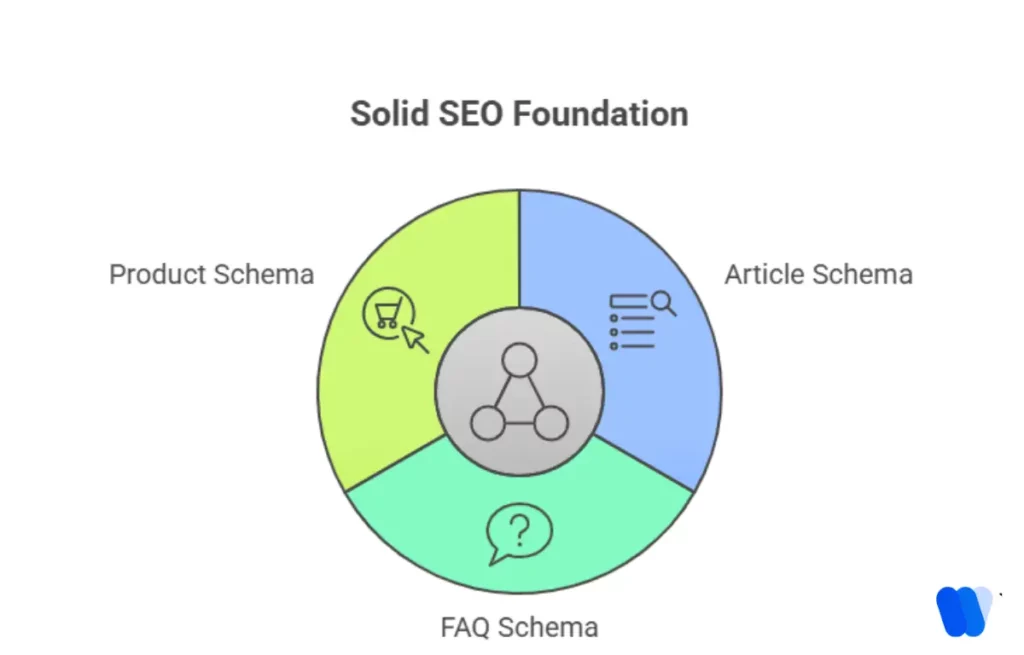
Using Article, FAQ, and Product schemas sets a solid SEO foundation, while specialized schemas open additional opportunities for visibility.
How to Integrate Schema Markup for AI Search Engines
A successful schema implementation for AI goes beyond simple markup; consistent mapping, linking, and validation—often guided by a technical SEO checklist for agencies—are vital for keeping pace with AI’s evolving requirements. Here’s a streamlined approach:
- Map each schema property to its matching on-page content to guarantee accuracy.
- Link out with
sameAsto authoritative sources like Wikipedia or LinkedIn, helping clarify entity identity for algorithms. - Test and adapt schema regularly using built-in validation tools as AI guidelines evolve.
- Periodically update and expand schema to support new engine requirements.
- Maintain an iterative process to ensure schema performance keeps pace with AI advances.
How Does NLP Structuring Help AI Understand Your Content?
NLP structuring is the counterpart to schema, providing implicit language signals that AI models use to interpret content. It ensures generative AI extracts the intended meaning, finds key entities, and presents answers with precision.
- NLP structuring provides implicit context, supporting the explicit details from schema.
- It helps AI models bridge intent and content for accurate content delivery.
What Is NLP in SEO, and Why Does It Matter for AI Search?
Entity SEO is built on Natural Language Processing (NLP). NLP helps search engines understand human language by looking at context, importance, and how different entities relate to each other through semantic knowledge integration. This has changed how platforms like Google decide which pages best answer a user’s question.
Instead of counting keywords, AI search now focuses on how well a topic is covered and whether the content clearly explains real-world things, such as people, brands, places, or concepts.
In sectors like digital finance, FinTech Startups gain an edge by applying entity-based structuring to explain concepts like P2P transfers, credit underwriting, or fee transparency, helping AI systems surface their offerings with clarity and confidence.
Entity-based SEO works because:
- Search engines reward content that clearly explains real-world entities, not just repeated keywords
- Context is created by consistently supporting main ideas with related concepts
- NLP helps match user intent with the most relevant and meaningful content
- Google updates like BERT and MUM focus on understanding topic relationships, not isolated phrases
- Strong entity coverage helps position your content as trustworthy and authoritative
As AI search continues to evolve, adapting to NLP-based SEO gives brands a clear advantage in gaining and maintaining visibility in AI-driven search results.
NLP SEO Techniques That Help AI Read Your Content
Optimizing content for Natural Language Processing (NLP) helps AI systems read, understand, and rank your pages more accurately. When your content is easy for AI to interpret, it performs better in search and delivers clearer value to users.
Below are practical NLP-focused techniques you can apply.
Write the way people speak and ask questions. Clear, natural language helps both users and AI understand your message. Instead of forcing keywords into sentences, focus on explaining ideas clearly and naturally. AI models are better at understanding intent when content sounds human and straightforward.
Use related terms and variations to support your main topic. This helps AI understand the full scope of what your content covers. For example, instead of repeating the same keyword, include similar phrases and supporting concepts that reinforce meaning without sounding repetitive.
Organize your content using clear headings like H1, H2, and H3 so both readers and AI can follow the flow. Lists, bullet points, and short sections make information easier to scan and easier for AI to break down and process correctly.
Short sentences and compact paragraphs improve clarity. Avoid long or complex sentence structures that can confuse readers and AI alike. Simple language helps AI interpret meaning more accurately and improves overall readability.
Examples help explain ideas clearly. When you show how something works in real life, AI systems gain better context, and readers understand your message faster. Practical examples add depth and make your content more useful and trustworthy.
Keep your tone steady throughout the content. Whether informative, instructional, or conversational, consistency helps AI understand the intent and improves the user experience. Sudden shifts in tone can weaken clarity and impact.
Don’t force keywords or write for algorithms alone. AI search systems prioritize helpful, natural content over aggressive optimization. Focus on answering user questions clearly and accurately instead of trying to game rankings.
By applying these NLP SEO techniques, you create content that is easy for AI to understand and valuable for users. This balance improves visibility in AI-driven search results while delivering a better reading experience.
How Can You Optimize Blog Posts So AI Search Engines Understand Context and Intent?
Structuring content for AI search doesn’t end with schema or headings—it’s about ensuring your material can be parsed accurately for featured snippets and summarized results.
- Consistently use lists and bullet points; AI frequently pulls these for direct answers.
- Add FAQ-style blocks that directly address common user questions and enable structured extraction.
- Apply semantic HTML tags (
<section>,<article>, etc.) for improved algorithmic parsing. - Keep critical content in raw HTML, avoiding reliance on JavaScript-rendered blocks which slow or prevent indexing.
- Optimize for featured snippets by structuring snippet-able content (steps, summaries, lists) near the top of your pages.
These content structuring for AI techniques ensure your site remains accessible and compelling to both advanced AI engines and end users.
What Role do Structured Data and Schema Markup play in boosting AI search Visibility?
Structured data and schema markup are key to improving visibility in AI-powered search. They give AI systems a clear, machine-readable structure, making it easier for them to understand what your content is about and how different pieces of information connect.
Defining Entities and Relationships
Schema markup allows websites to clearly identify important entities such as products, services, brands, people, or locations. It also helps explain how these entities relate to each other.
This structured setup removes confusion for AI systems. Instead of guessing, AI can accurately understand context, connect related information, and use it confidently when generating answers or summaries.
Improving Content Discoverability
Structured data does not guarantee that your content will appear in AI-generated answers, but it significantly improves the chances. When AI systems can clearly recognize and interpret your content, they are more likely to surface it in AI-driven search experiences.
Pages with detailed and accurate schema are easier for AI to process, which can strengthen brand visibility and credibility in AI search results.
Supporting Rich Results and Enhanced Visibility
Schema markup also helps content qualify for rich results in search pages, such as FAQs, how-to steps, and enhanced listings. These formats are easier for AI systems to extract and reuse.
For example, FAQ and How-To schema make it simpler for AI to pull direct answers, increasing the likelihood of your content appearing in AI-generated responses and summaries.
After implementing schema, use on page SEO factors to tighten structure, headings, and internal linking for AI extraction.
Facilitating AI Integration
As AI features like Google AI Overviews and conversational search tools become more common, structured data acts as a reliable input source. It provides AI systems with clear context, helping ensure your content is represented accurately across different AI platforms.
This makes structured data an essential part of preparing content for broader AI integration and future search experiences.
In short, structured data and schema markup help AI systems understand your content clearly and consistently. By defining entities, improving discoverability, and supporting rich AI-driven results, schema plays a vital role in strengthening AI search visibility.
How to Future-Proof Your SEO for AI Search
Maintaining long-term search visibility in the age of AI requires an adaptive AI SEO strategy that helps you boost brand authority with AI in search SEO through entities, structure, and trust signals.With AI algorithms, schema requirements, and entity hierarchies changing rapidly, forward-thinking approaches safeguard ongoing relevance and visibility.
Proactive steps not only preserve your AI search visibility but also position your content for next-generation features, whether that means supporting 3D models, new schema types, or deeper entity-based connections.
- Monitor and adopt the latest schema updates as AI search engines roll out new features.
- Double down on comprehensive entity mapping to outpace generic keyword strategies.
- Make AI search readiness a default part of your content and technical workflows.
- Anticipate new content formats, such as visual search and conversational interfaces, by leveraging new schema like 3D models and video objects.
- Regularly audit connections between your content and authoritative external entities for improved authority signals.
- Revisit FAQ, Product, and Article schemas to keep data current as requirements shift.
- Test how your site appears in experimental SERP features, not just classic search results.
- Stay connected with industry sources to quickly respond to AI-driven ranking and discovery updates.
Evolving within an AI-centric search future means proactively integrating new entity-based SEO, schema updates, and AI-focused structuring tactics as standard operating procedure.
FAQs
Final Thoughts
AI search is changing how content is found, understood, and reused. By applying schema and NLP best practices, you make it easier for AI systems to read your content, understand its meaning, and trust it as a reliable source.
Schema gives AI clear, structured signals about what your content represents. NLP structuring adds context and intent through language and entity relationships. Together, they help your content stand out in AI-driven search results—whether that’s AI Overviews, conversational answers, or generative summaries.
As search continues to move toward entity-based understanding and semantic clarity, these practices are no longer optional. Brands that act now will be better positioned to stay visible, relevant, and frequently cited by AI platforms.
If your goal is long-term visibility in AI search, this is the right time to build for it. Platforms like Wellows help brands turn schema, entities, and NLP signals into a scalable strategy—so your content stays discoverable wherever AI search goes next.