Search is changing fast.
People are no longer scrolling through pages of links to find answers. Instead, they’re asking full questions and expecting one clear response backed by sources they can trust. That’s exactly where Perplexity fits in.
Industry reports suggest Perplexity’s usage grew significantly in 2025, including claims of 200%+ growth in search demand, though estimates vary by source (Famewall, 2026).
For brands and content creators, this shift creates a new challenge. Ranking well on Google is no longer enough. If your content isn’t being cited by answer engines like Perplexity, you may be missing search engine visibility at the exact moment users are researching, comparing, or making decisions.
The good news is that ranking in Perplexity doesn’t work the same way as traditional SEO. There are no fixed positions to chase. What matters is whether your content is easy to access, easy to understand, and strong enough to be used as a source.
This guide breaks down how to rank in Perplexity, step by step using the same mindset behind GEO. You’ll learn how Perplexity works, why citations matter more than rankings, and what you can do to make your content more likely to appear in Perplexity answers — now and in the years ahead.
In 2026, Perplexity became a more common starting point for research-style queries, especially when someone wants a direct answer with citations instead of a list of links.
That shift matters because Perplexity’s interface concentrates attention on a small set of sources. If your page is cited, you can earn qualified referral traffic and influence evaluation. If it is not cited, your brand may be absent even when you rank in traditional search.
- Perplexity is an AI search engine that gives direct answers and cites only a few sources. If your content isn’t cited, it may not appear at all.
- Ranking in Perplexity doesn’t mean holding a fixed position. It means getting cited often for the right questions, which is why Perplexity AI rank tracking works differently from Google rank tracking.
- Perplexity favors content that is easy to crawl, easy to read, and easy to extract as a clear answer.
- Brands benefit from Perplexity visibility through higher trust, better visibility, and more qualified traffic.
- Answer engines work differently than traditional search—they show answers, not lists of links.
- To rank higher, focus on high-value topics, clear structure, strong credibility, fresh content, and topical depth.
- Technical setup matters: Perplexity must be able to fetch and render your content reliably.
- Measuring success requires tracking citations, mentions, and query coverage, not just rankings.
What Is Perplexity?
Perplexity is an AI search tool that gives direct answers to questions and shows links to the sources it used and those sources typically follow recognizable patterns explained in what AI search engines cite. Instead of listing ten blue links like Google, it usually shows one main answer with a small number of cited pages underneath.
People often use Perplexity when they want to:
- understand a topic quickly
- compare options
- check facts
- or research a decision
This mirrors how conversational AI search queries are structured and interpreted by answer engines.
Why Perplexity Ranking Matters for Brands
Perplexity AI is a newer type of search engine that gives direct answers instead of lists of links. It pulls information from different sources and combines it into one response. For brands, showing up in these answers is becoming increasingly important, for several reasons.
1. Enhanced Visibility
Perplexity usually shows one main answer at the top of the page. Brands that are included in this answer get instant exposure. Being visible at this stage helps position your brand as a reliable source, especially when users are researching or comparing options.
2. Increased Credibility
When Perplexity cites a brand as a source, it acts as a trust signal. Users often assume that cited sources are accurate and dependable. This can improve how people perceive your brand and influence their decisions.
3. Competitive Advantage
AI-driven search is growing fast, and not all brands are adapting at the same pace. Companies that focus on Perplexity early have a chance to stand out before competition increases. This can lead to stronger brand recognition and better long-term visibility.
4. Improved Conversion Rates
Traffic from Perplexity tends to be more focused. Users already have context and intent when they click a cited link. Because of this, brands featured in Perplexity answers often see higher engagement and better conversion rates compared to general search traffic.
5. Adaptation to Search Evolution
Search behavior is changing as AI tools become more common. People are asking full questions and expecting clear answers. Brands that optimize for platforms like Perplexity are better prepared for this shift and remain visible where modern users are searching.
In short, ranking in Perplexity matters because it affects how visible, trusted, and competitive your brand is in a search environment that is increasingly driven by AI.
How Answer Engines Are Different from Traditional Search
Answer engines and traditional search engines work in very different ways when it comes to understanding questions and showing results.
Traditional Search Engines
Traditional search engines scan and index large parts of the web, then return a ranked list of links based on keywords. A model that differs significantly from generative AI vs Google search behavior.
The user has to open those links, read through the pages, and piece together the answer themselves.
This often means:
- clicking through several pages
- comparing different sources
- and spending time verifying information
Answer Engines
Answer engines take a different approach and that’s why Generative Engine Optimization (GEO) matters — especially when you understand how AI selects sites to cite. They read the question in plain language and aim to give a direct answer right away. Instead of sending users to multiple pages, they pull information from several sources, combine it, and present a short response, usually with citations.
For the user, this means:
- getting the answer immediately
- seeing which sources support it
- and spending less time searching
The Main Differences Between Traditional Search and Answer Engines
- How information is delivered: Traditional search shows links. Answer engines show answers.
- How questions are understood: Answer engines handle context and intent better, even for longer or more detailed questions.
- How results are presented: Answer engines reduce the need to visit many websites, while traditional search expects users to explore on their own.
This shift reflects how people now prefer to search: faster answers, clearer explanations, and less effort to find reliable information.
How Perplexity Finds, Fetches, and Cites Sources (What’s Known vs Inferred)
Perplexity can access web pages in two different ways. Understanding the difference helps you diagnose why you are, or are not, earning Perplexity citations.
What’s known (from Perplexity’s documentation)
- PerplexityBot is a crawler designed to surface and link websites in Perplexity search results. Perplexity recommends allowing it in
robots.txtand, if you use a WAF, permitting requests from its published IP ranges (Perplexity Docs, Perplexity Crawlers). - Perplexity-User supports user-requested fetches when someone asks Perplexity a question that requires visiting a page. Perplexity states this fetcher generally ignores
robots.txtbecause the request is user-initiated. - Perplexity publishes official JSON endpoints for IP ranges and recommends using them as the source of truth for WAF allowlists.
- Perplexity also states PerplexityBot respects
robots.txtfor indexing text content, with limited metadata possibly still indexed when blocked (Perplexity Help Center, 2025).
Should you allow PerplexityBot in robots.txt?
Yes. If PerplexityBot is blocked, your content is less likely to be indexed and cited. Allowing the crawler helps Perplexity reliably access and evaluate your pages, which improves your chances of appearing as a cited source.
What’s inferred (practical implications)
If PerplexityBot can’t crawl or render your main content, your page is less likely to be available as a reliable citation candidate, one reason many websites are ignored by AI search.
That is why technical accessibility and extractable formatting often matter as much as classic SEO, especially for systems where AI agents use web search to retrieve and cite sources and when optimizing around generative engine visibility factors instead of traditional rankings.
How to Rank Higher on Perplexity AI for Blog Posts?
To improve how your blog posts appear in Perplexity AI, focus on making your content easy to understand, easy to trust, and easy to use as a source. The tips below cover what matters most.
1. Focus on High-Value Topics
Perplexity is often used for research-style questions, so matching user intent matters more than chasing keywords. Topics like technology, business, education, science, and AI perform well because people ask detailed questions about them.
If your blog covers these areas, go deeper than surface-level content by building around entities and structured context, as outlined in entity-based content strategies. Detailed guides, explanations, and comparisons are more likely to be cited than short or generic posts.
What Types of Topics Rank Best on Perplexity AI?
Perplexity performs best with research-driven and explanatory topics. Content is more likely to be cited when it helps users understand, compare, or evaluate information.
Topics that tend to rank well include:
- AI and machine learning (how tools work, comparisons, limitations)
- Science and research-based topics explained in simple terms
- Technology and software guides and comparisons
- Business and strategy content that supports decision-making
- Educational content that explains concepts or processes clearly
Promotional or opinion-heavy content performs less consistently. Perplexity prefers clear, factual answers that can be used as supporting sources.
2. Incorporate Semantic Keywords Naturally
Instead of repeating the same keyword again and again, use related words and phrases that naturally fit the topic — a process that becomes easier when guided by a keyword strategy checklist.
This helps Perplexity understand what your page is really about. Write for humans first, and let keywords fit into the content naturally. If the page reads well, you’re usually doing this right.
3. Reference Authoritative Sources
Perplexity prefers content that looks reliable, which is why applying a consistent E-E-A-T checklist across your pages strengthens citation potential. One way to show this is by referencing trusted sources.
Link to well-known websites, research papers, or official documentation when they support your points. This makes your content easier to trust and more likely to be used as a citation.
4. Build Topical Authority
Don’t rely on one blog post to explain everything. Instead, publish multiple articles around the same topic.
When your site covers a subject from different angles, Perplexity is more likely to see you as a reliable source, especially when your content is built around clear topic clusters. Over time, this increases your chances of being cited for related questions.
How Domain Authority Works in Perplexity
Building domain authority helps improve how trustworthy your site appears to systems like Perplexity. While Perplexity doesn’t use a public domain authority score, it still favors sites that show consistency, credibility, and external validation.
- Create High-Quality, Relevant Content: Publish clear, useful content that answers real questions. Strong pages are more likely to be cited and referenced.
- Conduct Thorough Keyword Research: Use search terms your audience actually uses. Add them naturally so your content matches real queries.
- Optimize On-Page SEO Elements: Metadata, URL structure, Internal linking must be optimized
- Acquire High-Quality Backlinks: Focus on links and mentions from trusted sites through guest posts and digital PR.
- Enhance User Experience (UX): Ensure fast load times and mobile-friendly pages to keep users engaged.
- Utilize Social Media Platforms: Share content consistently to increase reach and brand recognition.
- Regularly Update Content: Refresh pages to keep information accurate and relevant.
- Monitor and Analyze Performance: Track what performs well and improve based on real data.
Together, these steps help build authority that improves visibility in Perplexity and other AI-driven search tools over time.
5. Optimize for User Engagement
Content that keeps people reading sends a positive signal.
Use clear examples, simple explanations, and clean formatting. Avoid long walls of text. If users stay on your page and actually read it, your content is more likely to perform well in Perplexity.
Common Misconception: Interactive Content Boosts Perplexity Rankings
It’s easy to assume that adding quizzes, polls, or interactive widgets will help content rank better in Perplexity. After all, engagement is often treated as a positive signal in traditional marketing.
But engagement and citation eligibility are not the same thing.
Perplexity does not reward content just because users click, tap, or interact with it. What matters more is whether Perplexity can clearly read, understand, and extract the answer from the page.
Interactive elements often hide important information behind buttons, forms, or scripts. If the main answer is only visible after a user interacts with the page, Perplexity may not see it at all. When that happens, the content becomes harder to cite, even if users find it engaging.
This doesn’t mean interactive elements are always bad. They can improve user experience and help with conversions. However, they should support the content, not replace it.
For Perplexity, clear and visible answers matter more than interaction. If the content can’t be easily lifted as a readable block of text, it’s unlikely to be cited—no matter how engaging it looks to users.
6. Maintain Content Freshness
Outdated content is less useful for direct answers.
Update your blog posts when tools, data, or processes change. Even small updates—like refreshing examples or adding recent context—can help keep your content relevant.
Why does Fresh Content Matter so much for Ranking in Perplexity AI?
Fresh content plays a major role in how Perplexity evaluates and cites pages. There are a few key reasons why updates matter so much.
- Time Decay Mechanism: Perplexity places more weight on content that stays relevant and useful over time. Pages that don’t attract attention or get refreshed can lose visibility quickly. Regular updates help keep your content active and reduce the risk of it being overlooked.
- Enhanced Click-Through Rates (CTR): People are more likely to click on content that feels current. A page that clearly reflects the latest year, tools, or trends is more appealing than an outdated one. Higher click activity signals that the content is useful, which can improve how often it appears in Perplexity results.
- Semantic Relevance and Embedding Similarity: Perplexity looks at how closely content matches the intent behind a query. Fresh content is more likely to align with current questions, terminology, and context. This makes it easier for Perplexity to match your page to what users are actually asking.
- User Engagement Signals: Updated pages tend to keep users engaged longer. When people spend more time reading, clicking, or sharing content, it signals that the page is valuable. These signals help reinforce the page’s relevance and increase its chances of being cited.
In short, keeping content fresh helps Perplexity trust that your page is accurate, relevant, and safe to use as a source—leading to better visibility and citation potential.
7. Structure Content for Readability
Make your content easy to scan and validate your formatting against an on-page content checklist to ensure extractability.
Use headings, short paragraphs, bullet points, and clear sections. Perplexity often pulls short sections of text, so each part of your article should make sense on its own.
This is why Perplexity search visibility tips emphasize answer-first sections and quote-ready blocks that can stand alone.
8. Leverage External Mentions and Backlinks
Mentions from other websites help support your credibility by reinforcing the brand signals AI systems rely on.
Reviews, comparisons, guest posts, and backlinks from trusted sites give Perplexity more confidence in your content, which is why boosting brand authority in AI SEO directly impacts citation likelihood.. This is especially important for competitive or commercial topics.
By implementing these strategies, you can improve the chances of your blog posts ranking higher on Perplexity AI, thereby increasing their visibility to a broader audience.
What are the Best Ways to Optimize Content for Perplexity Rankings in 2026?
Optimizing content for Perplexity AI in 2026 means adjusting how you create, update, and present your content so it works well with how answer engines choose sources. Below are the key areas to focus on.
1. Prioritize Content Freshness and Relevance
- Regular Updates: Perplexity prefers content that feels current. If you’re covering fast-moving topics or industry updates, refresh your pages often. Updating examples, data, or explanations every few days helps keep your content relevant and useful.
2. Build Authority and Credibility
- High-Quality Backlinks: Backlinks still matter, but they are not the main driver in Perplexity. What matters more is whether your content looks reliable and is good enough to be referenced. Focus on publishing strong, well-researched content that others naturally mention or cite.
- Positive User Sentiment: How people talk about your brand online also matters, which is why tracking brand performance metrics in AI search helps quantify visibility beyond rankings. Good reviews, positive feedback, and a clean reputation help Perplexity trust your content, especially for commercial or comparison-based questions.
3. Optimize Content Structure and Clarity
- Use Structured Data: Schema markup helps Perplexity understand what your page contains, especially when implemented using schema and NLP best practices for AI search. Use it where it makes sense, such as FAQs or step-by-step guides, and make sure it matches the visible content.
- Clear Formatting: Keep your content easy to read. Use headings, bullet points, short paragraphs, and simple language. Well-structured content is easier for AI systems to scan and extract answers from.
4. Align with User Intent and Semantic Search
- Comprehensive Coverage: Cover topics fully instead of answering just one narrow question — the fastest way to expand coverage is by learning how to find queries for GEO. When your content addresses related questions and common follow-ups, Perplexity is more likely to use it as a reference.
- Natural Language: Write the way people speak and ask questions. Clear, conversational wording helps Perplexity match your content to real user queries.
5. Enhance Technical Performance
- Ensure Crawlability: Make sure your pages can be accessed and read easily. If Perplexity can’t fetch or see your main content, it won’t be able to cite it.
- Optimize Site Speed: Fast-loading pages create a better user experience. Slow sites are harder to use and less likely to perform well in AI-driven search results.
6. Expand Your Digital Presence
- Engage on Multiple Platforms: Perplexity often pulls information from more than just websites. Being active on platforms like Reddit, YouTube, or industry forums can increase your chances of being referenced.
- Leverage Multimedia Content: Adding visuals like videos, charts, or infographics can make your content more helpful and easier to understand. This also increases its value as a supporting source.
By focusing on these areas, you can improve how your content performs in Perplexity AI and stay aligned with how answer engines evaluate sources in 2026.
What’s the Best Tool to Check Perplexity Rankings?
Perplexity doesn’t work like a classic SERP with stable positions. In Perplexity, rank tracking focuses on how often your brand is cited or mentioned, since citations and mentions affect AI visibility in different ways. Which is why perplexity rank tracking tools are different from traditional SEO rank trackers. If you can’t measure those outcomes consistently, it’s difficult to improve them.
This is where most teams realize rankings alone are misleading. Instead of relying on SERP-style positions, teams increasingly use a Perplexity Visibility Tracker to monitor which queries actually cite their pages, which URLs are lifted into answers, and where competitors appear instead, making this the best tool for tracking Perplexity rankings.
It also helps to separate measurement layers:
- Citation tracking: when Perplexity links your page as a source for a query.
- Mention tracking: when your brand is named in an answer, with or without a link.
- Query coverage: how many of your target prompts you appear in at all (citations or mentions).
- Share of voice (SOV): your visibility relative to competitors across the same prompt set.
For SEO measurement more broadly, Google notes that traffic from AI features is included in Search Console performance reporting. That means Search Console can help you track outcomes like clicks and impressions, but it won’t tell you whether you were cited inside Perplexity or which prompt caused the citation.
A practical perplexity SEO rank tracking tool should cover three things, especially if you’re comparing different perplexity rank tracker software options.
- Prompt coverage: you can define a stable list of queries and re-check them regularly which mirrors how AI systems expand queries through fan-out.
- Attribution detail: it can tell you which URL was cited (or whether you were only mentioned).
- Trend reporting: you can track Perplexity rankings over time and see what content changes improved or reduced visibility.
If you want a single system for this workflow, Wellows is designed to track AI visibility and Perplexity outcomes, including monitoring citations and query coverage over time.
How CTR and Early Engagement Can Support Perplexity Visibility
Early user engagement can play a role in how content performs on Perplexity, especially shortly after publication. Some analyses suggest that pages which receive strong initial attention are more likely to remain visible over time.
According to research:
To maximize your content’s visibility, aim for at least 1,000 impressions within the first 30 minutes of publication, coupled with a CTR of 4.2% or higher (Mike Khorev, 2026)
In practice, this means content that earns a healthy number of impressions soon after going live—and encourages users to click—may have a better chance of being surfaced. Rather than treating CTR as a strict requirement, it’s more accurate to see early engagement as a momentum signal, not a ranking rule.
To support early engagement, many teams focus on light promotion at launch. This can include:
- sharing the post with an email list
- scheduling social posts around publish time
- notifying internal teams or partners to read and share
These steps don’t guarantee citations or long-term visibility, but they can help new content get noticed quickly. When combined with clear answers, strong structure, and credible information, early engagement can support overall performance in Perplexity.
How to Run a Perplexity Gap Audit (and Why Competitors Get Cited First)
If competitors are getting cited and you’re not, the fastest path is a repeatable audit. Don’t start by guessing “authority” or “content quality.”— instead, follow a structured framework like the AI search visibility audit checklist.
Start by isolating which layer is failing for the specific query set you care about.
A practical Perplexity gap audit has three parts:
- Eligibility: can Perplexity reliably access and read the page?
- Extractability: does the page contain quote-ready blocks that answer the prompt directly? This becomes easier when applying the LLM pattern analysis checklist.
- Authority footprint: does the brand have credible third-party support for commercial and category prompts?
Perplexity Gap Audit
| Audit area | Key question | Priority | What to do first |
|---|---|---|---|
| Eligibility | Can the crawler fetch and see the main content as readable HTML? | Highest | Check robots, WAF blocks, and whether the core text is present in view-source. |
| Extractability | Does the page answer the prompt in a way that can be quoted without extra context? | High | Rewrite section openers to be answer-first, add lists/tables, and keep key answers visible. |
| Authority footprint | Is there independent evidence (reviews, mentions, comparisons) that supports the brand’s inclusion? | Medium | Strengthen relevant third-party profiles and earn credible mentions tied to the category. |
Cautionary Tale: Technical Blind Spots
Scenario: Brand A holds Google’s #3 slot for a SaaS term but earns zero Perplexity citations. Brand B sits at #7 on Google yet appears repeatedly in Perplexity.
What changed the outcome: Brand A’s page relies on client-side rendering, so the main content is not consistently visible to crawlers. Brand B serves static HTML, uses clear headings, and includes structured, extractable blocks. Even if both pages cover similar topics, Perplexity can reliably access and lift Brand B’s content.
Minimum viable Perplexity audit checklist
- Pick 10–20 target prompts that represent your highest-intent queries.
- Log the cited URLs for each prompt (your site and top competitors).
- Eligibility check (your pages): confirm the main answer text appears in page source and isn’t blocked by robots or a WAF.
- Extractability check: confirm each key section begins with a direct answer and contains at least one quotable block (list, steps, table, or FAQ pair).
- Authority check: note which third-party sources appear for the prompt category and whether you are present there.
- Prioritize fixes by impact: eligibility issues first, then extractability, then authority footprint.
Did you know?
Using Wellows for gap analysis
Instead of checking prompts manually, Wellows can compare your brand and competitors across topics and show where your competitors are being cited and which queries you’re missing. That makes it easier to focus your updates on the pages and prompts most likely to change outcomes.
How I Track and Improve Perplexity Visibility
In partner work, this is the point where most teams get stuck. The feedback sounds the same every time:
“We know Perplexity citations matter, but we don’t know which queries to track, which pages to fix, or how to measure it without guessing.”
Here’s the workflow we guide partners through inside Wellows. Once the Perplexity view opens, your team can follow a simple path to turn raw AI search behavior into a focused Perplexity visibility plan.
Agencies running this across a client roster can systematize it further with the AI visibility for digital marketing agencies playbook, which turns the same Perplexity workflow into a repeatable client deliverable.
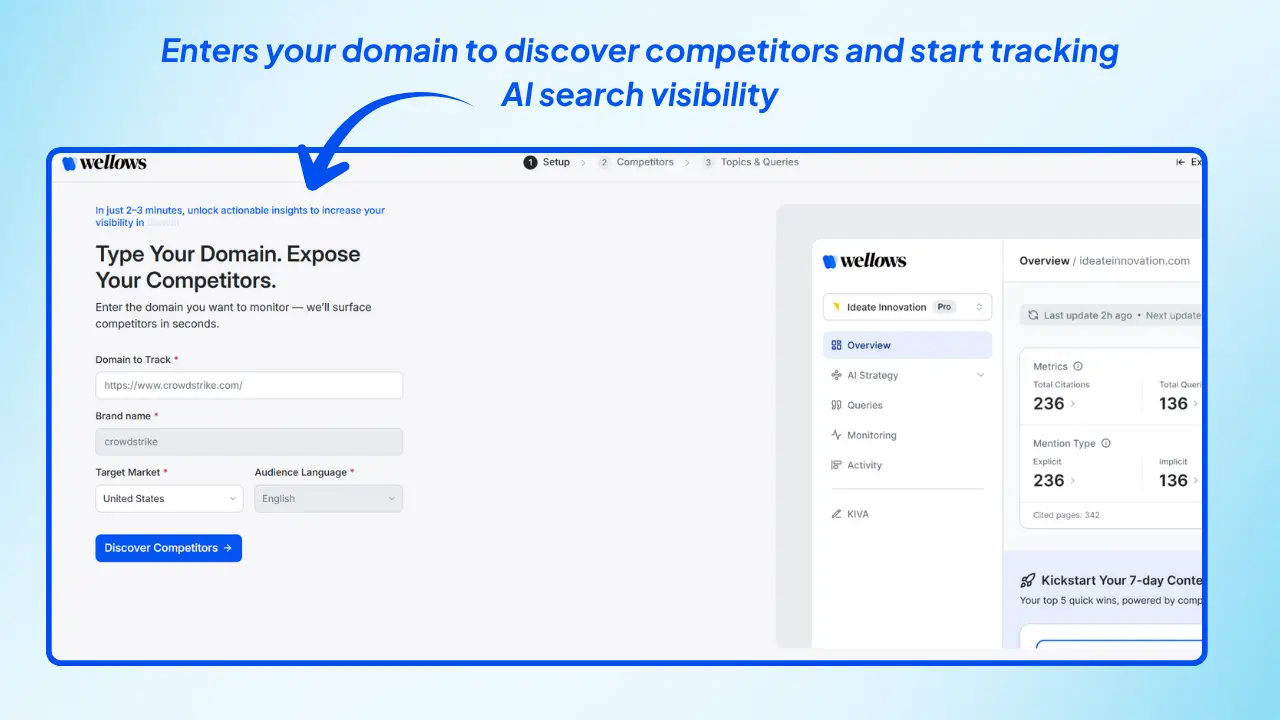
Connect your domain and analytics.
Add your website and connect analytics so Wellows understands your categories, key pages, and baseline organic performance.
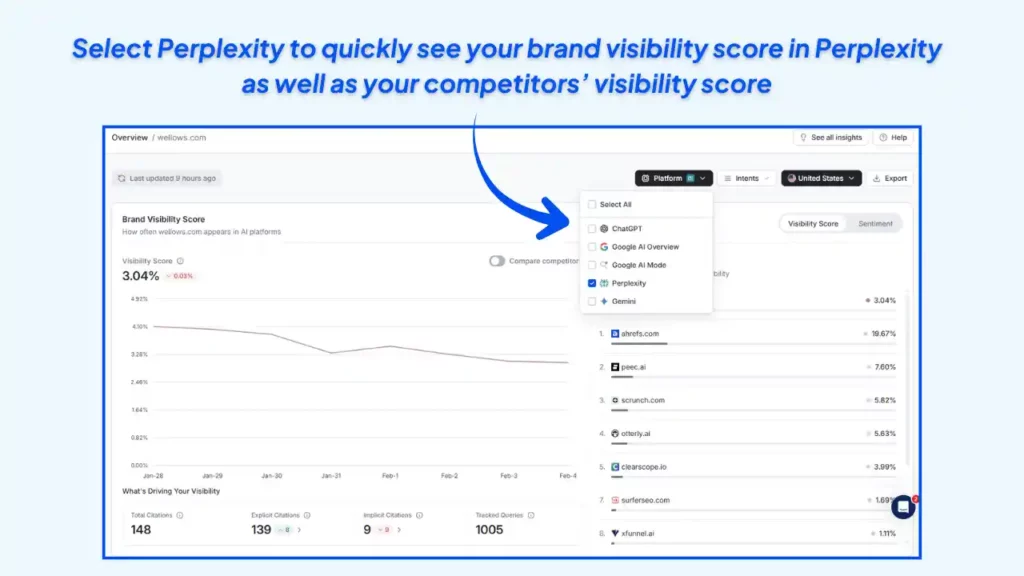
Pull Perplexity citations and AI queries.
Ingest Perplexity-driven traffic and AI citation data so you can see which URLs are already being mentioned and for which types of questions.
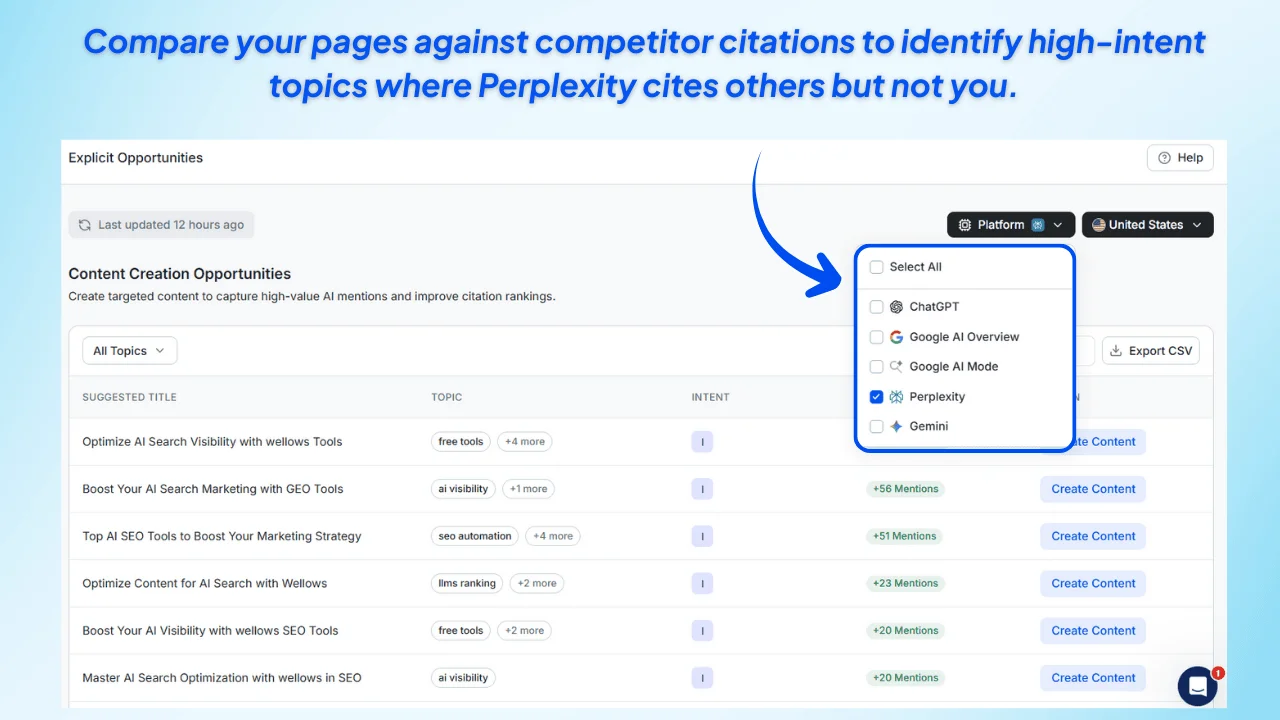
Spot citation gaps by topic and intent.
Compare your pages against competitor citations through explicit win to identify high-intent topics where Perplexity cites others but not you.
Map queries to answer-first content.
Link real AI queries to specific pages, then flag where headings, intros, or structure need to be rewritten for clearer, snippet-ready answers — a workflow supported by structured SEO briefs for AI search.
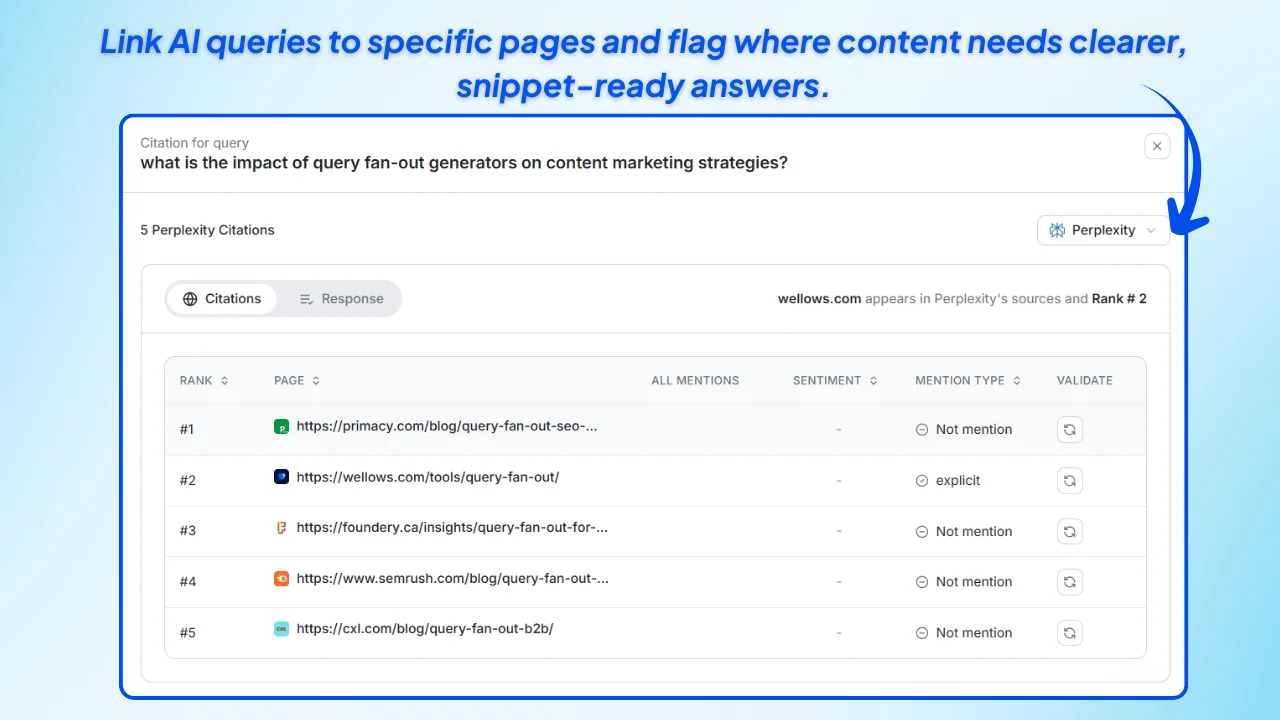
Prioritize fixes by impact.
Use intent, volume, and competitive coverage to sort which pages and topics should be updated first for Perplexity visibility.
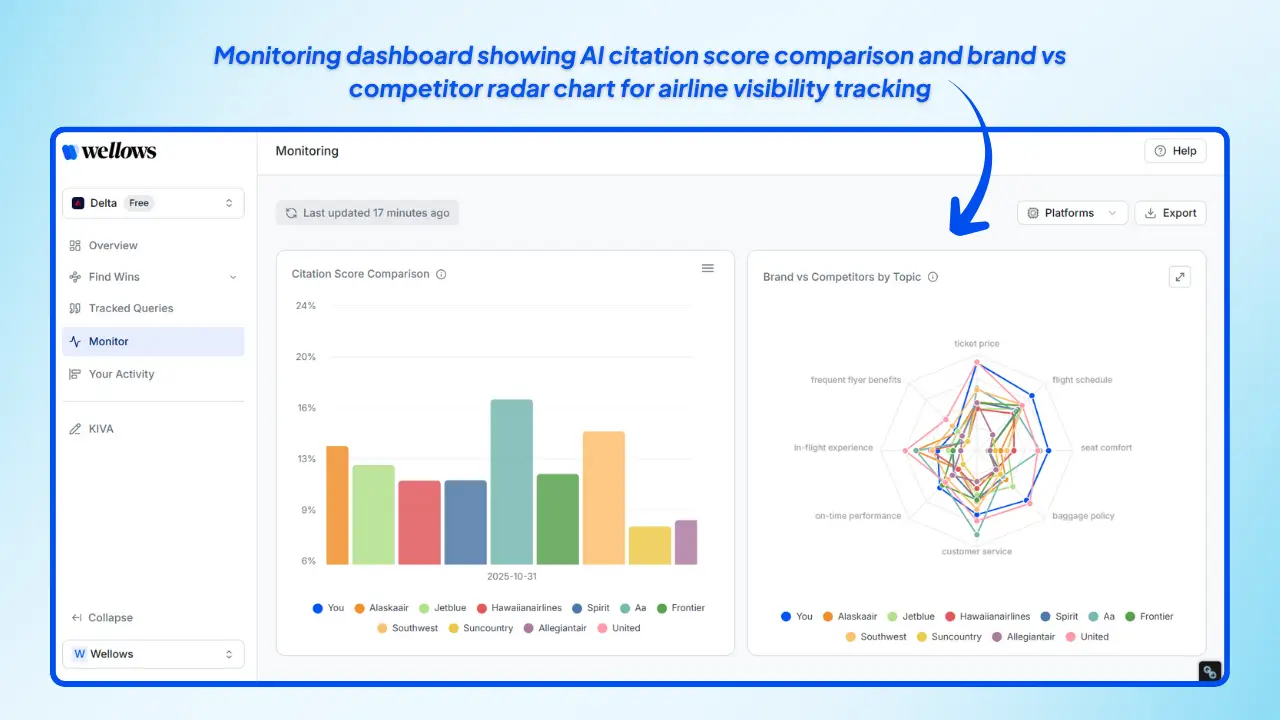
Track citation gains over time.
Monitor how technical fixes, schema updates, and content rewrites change your presence in Perplexity answers and which queries you’ve started winning.

This workflow replaces random Perplexity prompt tests with a repeatable, data-backed process, especially when reinforced by strong content governance practices. It shows your team not only if your brand appears in AI answers, but where you’re missing and which queries should guide your next Perplexity SEO sprint.
How Structured Data Helps Perplexity Understand Your Content
Structured data (often added as JSON-LD) can help systems interpret what your page contains, especially when you have clear Q&A blocks or step-by-step instructions. It can support extraction, but it’s not a shortcut. If the underlying content is unclear, inaccessible, or poorly structured, markup alone usually won’t fix that.
The most important rule is consistency: your structured data should match the visible text on the page. Don’t mark up answers that users can’t see, and don’t add fields that don’t reflect what you actually publish.
Did you know?
Implementation Checklist
- Mark up real Q&A sections with
FAQPageonly when the questions and answers are visible on the page, since visible FAQ schema is easier for AI systems to extract. - Use
HowTofor genuine step-by-step instructions that include visible steps (not for general advice articles). - Keep markup aligned to headings and blocks: if you change the visible wording, update the schema too.
- Validate your markup with Google’s Rich Results Test and Schema.org’s validator, then fix errors and warnings.
- Request re-crawls after changes where applicable (for example, via your indexing workflows), and watch server logs to confirm bots can fetch the updated HTML.
Example FAQ Schema (JSON-LD script tag)
This example shows the typical way FAQ schema is implemented: embedded in the page HTML inside a <script type="application/ld+json"> tag. The questions and answers below should also appear as visible text in your FAQ section.
<script type="application/ld+json">
{
  "@context": "https://schema.org",
  "@type": "FAQPage",
  "mainEntity": [
    {
      "@type": "Question",
      "name": "How long does it take for Perplexity to reflect an updated page?",
      "acceptedAnswer": {
        "@type": "Answer",
        "text": "There isn’t an official SLA. In practice, updates may appear after Perplexity can fetch the revised page and refresh its view of the content, which can vary by site accessibility and recrawl frequency."
      }
    }
  ]
}
</script>
Note: If you include timing estimates, keep them qualified unless you have an official source. Crawl and refresh timing can vary by site and by platform.
Schema vs Content Refreshes: What Should You Do First?
When choosing between adding schema markup or updating content for Perplexity, it helps to understand what each one actually improves—and where its impact is limited.
Schema Markup:
Schema markup is structured data that gives search engines extra context about your page. It can help systems identify things like FAQs, steps, products, or reviews more easily. In traditional search, this can improve how your page appears in results and may increase click-through rates.
For Perplexity, schema can support content extraction, but only when it matches visible text. Schema alone does not make outdated or unclear content more likely to be cited.
Content Refreshes:
Refreshing content keeps your pages accurate, relevant, and useful. Updating examples, data, and explanations helps your content stay aligned with what users are currently searching for.
Perplexity favors content that feels current and clearly answers questions. Fresh content is easier to trust and more likely to be used as a source, especially for research-style queries.
Recommendation:
Content refreshes should come first. Clear, up-to-date content is the foundation for visibility in Perplexity. Once your content is current and well-structured, schema markup can be added to support understanding and extraction—but it should never replace content updates.
FAQs
Conclusion
Understanding how to rank in Perplexity is less about chasing positions and more about becoming a source the platform can trust and reuse. Perplexity doesn’t reward small SEO tweaks or hidden tricks. It rewards content that is easy to access, easy to read, and clear enough to be cited as a direct answer.
To improve your chances, focus on the fundamentals: allow Perplexity to crawl your site, keep important answers visible in plain HTML, structure content so key points can be extracted, and refresh pages so information stays current. Building topical depth and earning credible third-party mentions further strengthens your position as a reliable source.
If you’re serious about learning how to rank in Perplexity, start with one high-intent topic, make it citation-ready, and track the impact weekly. That repeatable process is what leads to long-term visibility in answer-driven search.