Generative Engine Optimization (GEO) is emerging as a critical extension of SEO, focusing on content visibility in AI-driven search engines and chatbots.
With GenAI adoption among B2B buyers reaching 89% by 2024 (Forrester, 2024) and web traffic referrals from large language models (LLMs) to websites increasing more than tenfold between July 2024 and February 2025 (Adobe, 2025), GEO teams must ensure their content is well governed and AI-ready.
This means establishing clear processes to keep content accurate, consistent, and up to date across traditional and generative search channels.
Without clear governance, even high-quality content can fall out of AI retrieval pipelines over time, which is one of the primary reasons websites are ignored by AI search despite strong SEO performance.
In this guide, we answer the top questions on content governance for GEO teams—primarily targeting enterprise marketing and SEO teams (though the principles apply to agencies and startups alike)—drawing on global best practices and the latest data.
We focus on GEO-specific needs while noting broader AI content governance frameworks relevant to SEO, large language models (LLMs), and digital marketing. All facts and figures are cited with primary sources for easy reference.
What Is Content Governance And Why Is It Important For GEO Teams?
Content governance refers to the policies, standards, and processes that define how an organization manages and maintains its content (Celeste et al., 2023). It establishes “who, what, when, where, and how” content gets created, approved, updated, and distributed.
In practice, this means setting guidelines for content quality, branding, compliance, and workflow so that every piece of content aligns with business goals and regulatory standards
(Hardy et al., 2025).
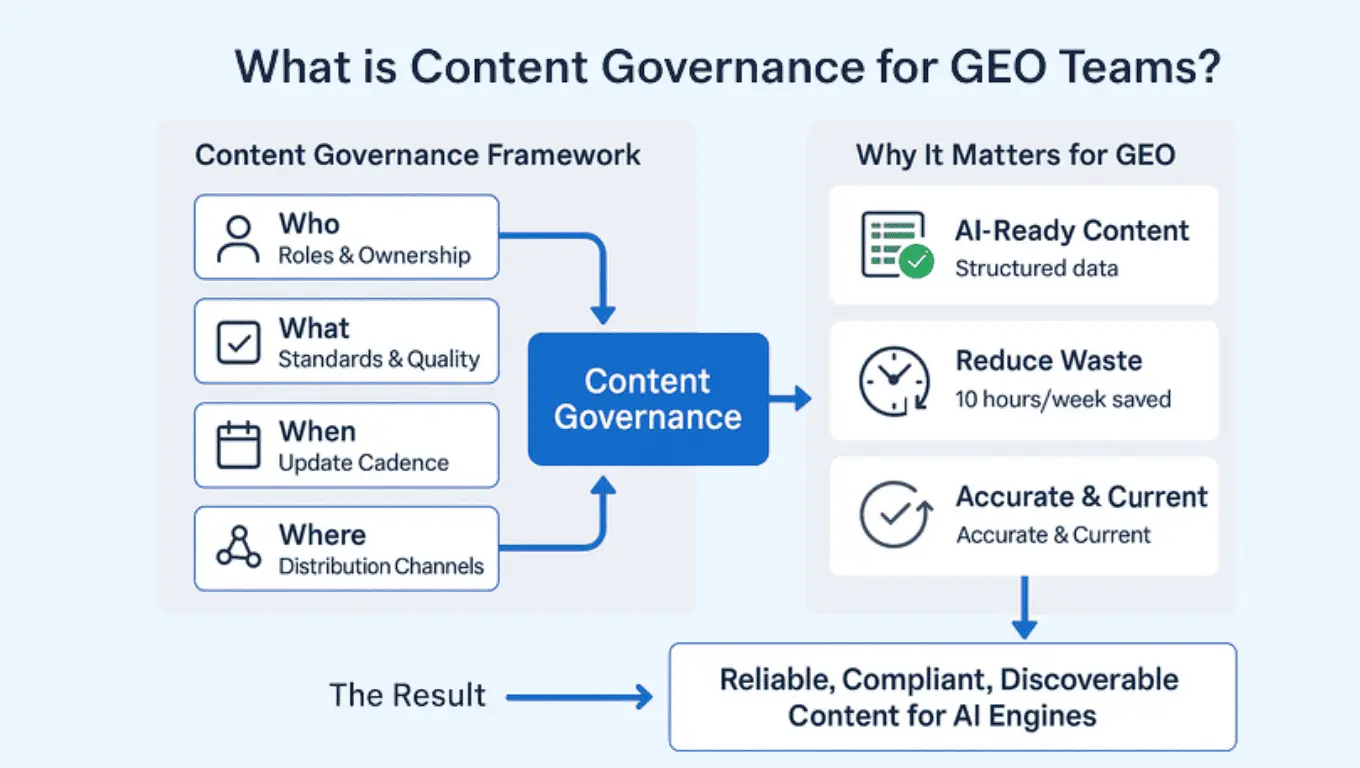
Think of content strategy as designing the content “blueprints,” whereas content governance is the system that keeps everything running smoothly and consistently.
For GEO teams—those optimizing content for generative-AI search engines—content governance is especially crucial.
GEO content must not only be high-quality and on-brand but also structured for AI consumption and kept up to date to remain relevant in fast-evolving AI models.
An effective governance framework ensures content is curated, consistent, and current for these AI platforms.
It provides clear roles and rules for content creators (marketers, SEO specialists, subject-matter experts) to follow, ensuring that what they produce is AI-ready and accessible to the team when needed.
This prevents “content sprawl” and misinformation that could mislead AI or customers. By implementing governance, GEO teams can reduce inefficiencies and deliver accurate, on-brand answers through AI channels at the moment buyers seek information.
In short, content governance supercharges GEO efforts by ensuring the content fueling AI-driven buyer engagement is reliable, compliant, and easily discoverable.
How Can GEO Teams Implement a Content Governance Framework?
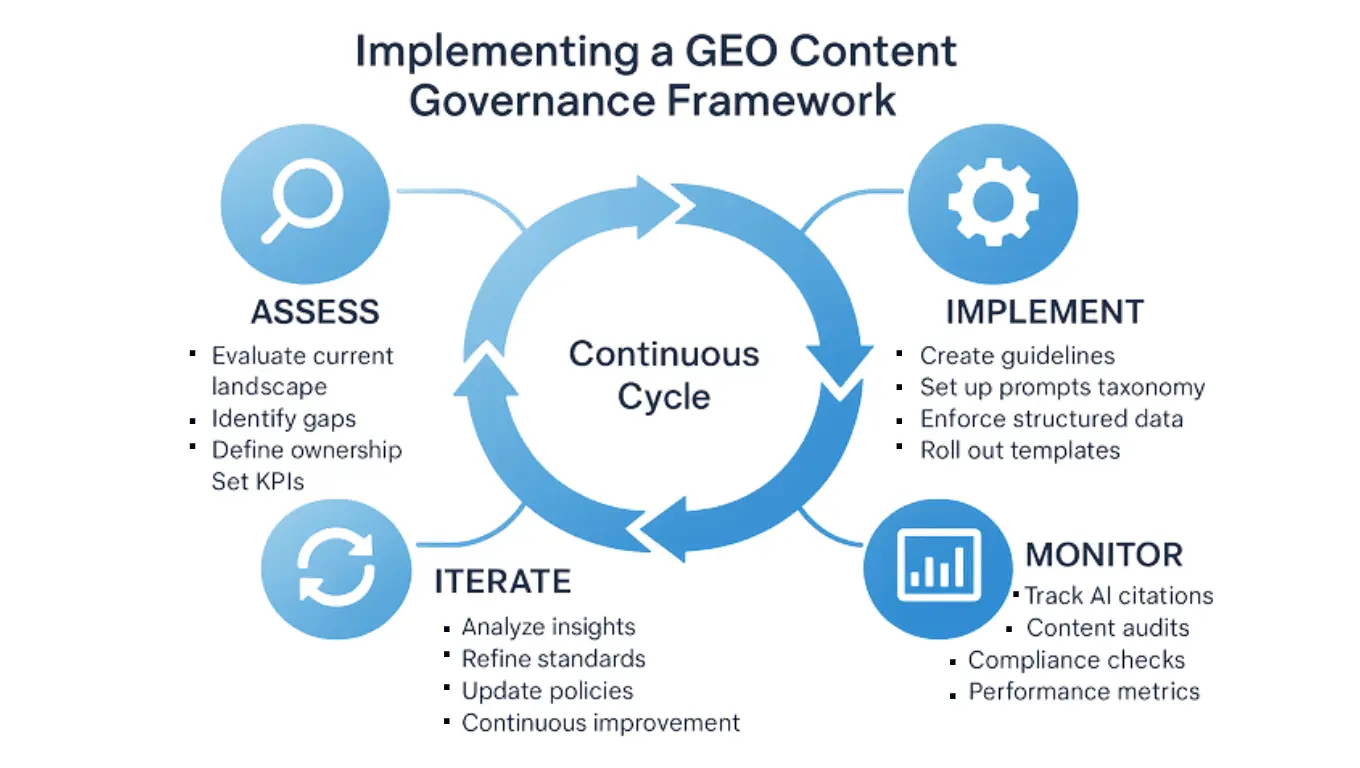
Implementing a content governance framework for GEO requires a structured, phased approach. A best practice is to follow a four-stage workflow: Assess, Implement, Monitor, and Iterate (Shah & Ram, 2022). Here’s how a GEO team can put this into action:
1. Assess
Start by evaluating your current content landscape and governance maturity. Identify what roles, processes, and tools are already in place and where the gaps are. Define clear ownership for governance—such as who on the content, SEO, product, and engineering teams will be accountable for maintaining standards.
Also determine key performance indicators (KPIs) that will measure governance success, such as AI citation share or content freshness.
2.Implement
Next, establish clear standards and apply them to your content. This includes creating guidelines for content format and style (e.g., using an answer-first writing approach), defining a taxonomy for consistent AI-facing phrasing, enforcing structured data and schema usage on pages, and managing entities (people, organizations, locations) to align with knowledge graphs.
During this stage, integrate these standards into workflows—for example, update your CMS to include required metadata fields and train the team on the new governance rules.
3.Monitor
Once standards are in place, continuously monitor content performance and compliance. Governance dashboards can track metrics like AI citation frequency, content freshness, and schema adherence.
Establish routine audits and review meetings to catch deviations—such as outdated statistics or off-brand phrasing—and correct them promptly. Monitoring also means watching how often your content is referenced by AI engines and ensuring that sources and metadata remain accurate.
4.Iterate
Content governance is not a one-time setup—it’s an ongoing, iterative process. Use insights from monitoring to refine and evolve your governance model. For example, if certain content pieces are not being cited by AI as expected, improve their structure or data depth.
Regularly update governance documentation and adjust workflows as needed. This continuous improvement cycle ensures the framework adapts to emerging AI search patterns and organizational changes.
By following these steps, GEO teams create a repeatable and auditable governance process that supports an enterprise AI visibility strategy across both traditional and generative search environments.
Defining standards upfront—especially for content structure, metadata, and AI content formatting—helps ensure every asset is optimized for both search engines and generative models.
Using dashboards to enforce accountability and maintaining an agile loop of feedback → update → feedback allows teams to confidently scale AI content creation with consistency, visibility, and quality.
What Are the Key Components of a GEO Content Governance Model?
A GEO content governance model includes many of the same elements as a traditional content governance model but is tailored to the specific needs of generative AI search.
The core components of a GEO governance model ensure that every piece of content is structured, accurate, and optimized for AI visibility while maintaining human readability and brand consistency.
To support that balance, you can run AI-drafted sections through the free AI Humanizer tool to refine clarity, tone, and natural flow before publishing.
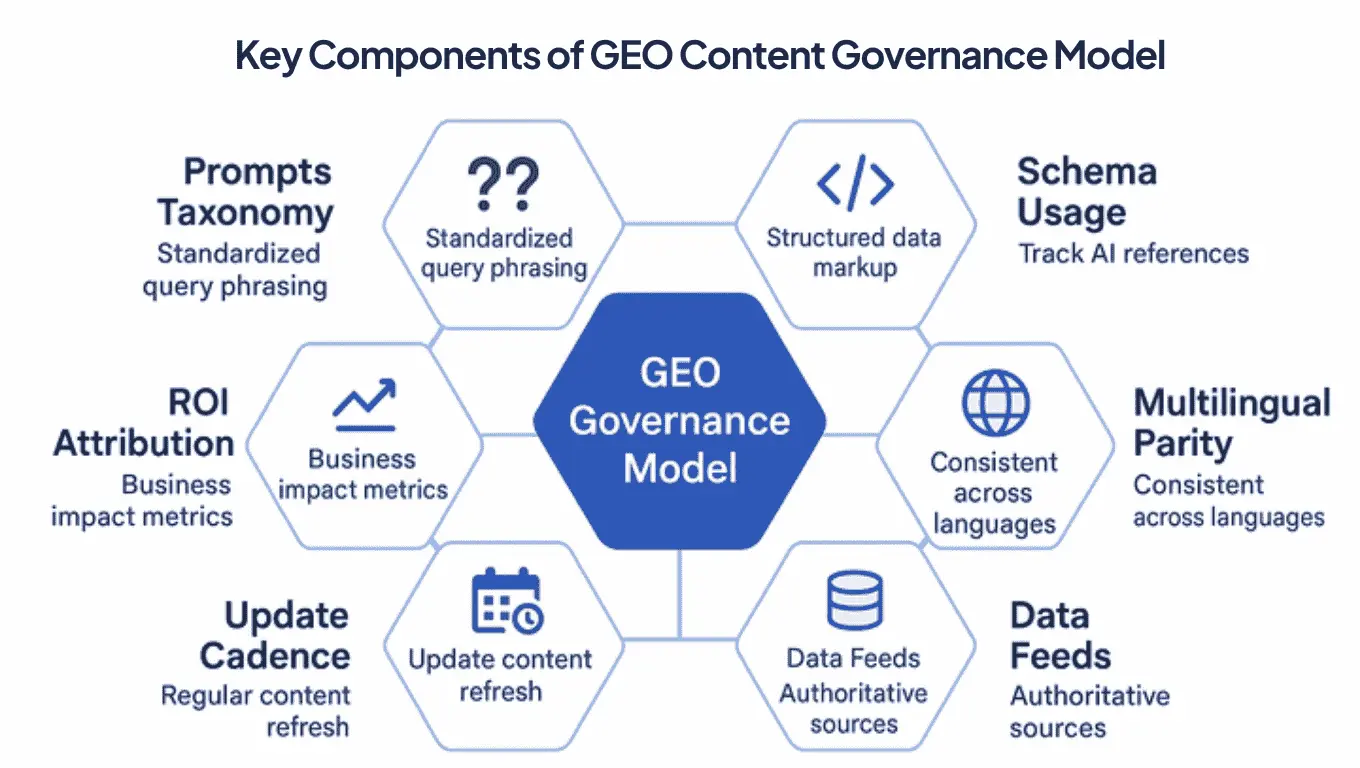
The following components form the foundation of a strong GEO content governance framework.
Prompts Taxonomy:
This involves standardized guidelines for how prompts or questions are phrased in content to align with how users interact with AI systems. It ensures that content addresses queries in a way AI engines recognize — such as phrasing headings as natural-language questions that match search intent.
A clear prompts taxonomy helps content appear in generative search results and improves the probability that AI systems will retrieve and summarize it accurately. To strengthen this, teams can apply principles from the Intent-Driven Search Model, which connects user intent with structured AI-ready phrasing for better generative visibility.
Schema Usage:
This refers to the comprehensive application of structured data, such as schema.org markup for FAQs, HowTo articles, organizations, and more. Rich schema helps AI systems interpret the context, relationships, and credibility of content.
It enhances the ability of large language models to verify and cite the material in their responses, strengthening both visibility and authority.
Citation Monitoring:
This includes processes and tools to track when and where a brand’s content is being cited by AI systems. It involves monitoring AI-generated outputs for brand mentions or URLs and assessing their accuracy, relevance, and context.
Citation monitoring provides valuable feedback on how well content performs across generative search platforms and whether the governance framework needs refinement, especially for organizations working with generative engine optimization agencies to operationalize AI visibility at scale.
This is closely tied to AI-powered external link analysis, which evaluates how brand mentions, citations, and contextual references across trusted sources influence AI visibility beyond traditional backlinks.
Multilingual Parity:
GEO governance should ensure that content quality, structure, and factual accuracy remain consistent across languages and regions. Organizations with global strategies must maintain equivalent standards in every language so that each market’s content achieves equal visibility in AI-driven search results.
This consistency reduces risk, supports brand integrity, and aligns all teams around a single source of truth.
Data Feeds and Sources:
This component involves integrating verified and up-to-date data sources within the content workflow. Governance must define rules for data collection, update frequency, and source validation to prevent AI systems from relying on outdated or incorrect information.
Incorporating reliable data feeds strengthens content trustworthiness and ensures factual accuracy.
Update Cadence:
GEO content requires a defined schedule or trigger system for regular updates. Unlike traditional SEO content, which may be updated periodically, GEO content must remain continuously fresh for AI systems that learn from evolving data.
Governance frameworks should specify update cycles, such as quarterly reviews or immediate updates after major product or policy changes, to maintain accuracy and freshness.
ROI Attribution:
The final component focuses on linking governance practices to measurable business outcomes. This includes tracking KPIs such as AI-driven traffic, leads, and revenue, and tying these outcomes to specific governance actions like improved schema markup, prompt optimization, or data updates.
Embedding ROI attribution allows GEO teams to demonstrate the tangible impact of governance on visibility and performance.
All these components are typically documented within a GEO Governance Checklist or Playbook. Together, they ensure accuracy, consistency, and accountability across all AI search ecosystems.
Mature GEO models often use Governance Dashboards to monitor performance and adopt standardized templates or playbooks that guide teams in implementing these principles across regions and content types .
Case Study: Marshfield Clinic Health System
Marshfield Clinic Health System, a leading U.S. healthcare network, enhanced its GEO performance by implementing structured schema and entity linking across physician and location pages. Partnering with Schema App, the team standardized schema markup, enriched medical data, and linked entities to verified sources like Wikidata and Google’s Knowledge Graph.
This governance-led initiative produced strong results — pages with Review Snippets achieved a 454% higher click-through rate, while entity-linked pages gained a 32% CTR increase. These outcomes boosted visibility across traditional and AI-driven search, proving that structured, governed data can future-proof enterprise content. The project also improved update efficiency and compliance across hundreds of pages, illustrating how governance translates into measurable GEO success.
How Does Content Governance Impact Brand Consistency in GEO Teams?
Content governance plays a pivotal role in ensuring brand consistency, especially within geographically dispersed teams (GEO teams).
By establishing clear guidelines and centralized frameworks, organizations can maintain a unified brand identity across various regions. A strong governance model allows teams to collaborate effectively, align their messaging, and ensure that all content produced adheres to the same brand values and tone.
This alignment also strengthens how AI systems interpret and rank your content across generative platforms. When brand voice and structure remain consistent, it directly supports better positioning within AI-driven visibility models, such as those explained in the Generative Ranking Algorithm framework.
Key Impacts of Content Governance on Brand Consistency in GEO Teams:
- Centralized Brand Guidelines: A robust content governance model provides a single source of truth for brand standards, including logos, color schemes, typography, and messaging. This centralization ensures that all GEO teams have access to the latest approved assets, reducing the risk of inconsistencies and maintaining a cohesive visual and verbal identity across all markets.
- Streamlined Workflows: Clear processes and defined roles within a content governance framework help prevent workflow bottlenecks. By automating approval processes and implementing structured review cycles, GEO teams can produce content more efficiently without compromising on brand standards or quality.
- Compliance Assurance: In industries with strict regulations, content governance ensures that all materials meet legal and industry requirements. This is especially important for GEO teams operating in multiple regions with differing compliance expectations, as governance helps maintain both brand consistency and regulatory integrity.
- Empowered Regional Teams: A well-structured governance framework balances control with flexibility, enabling regional teams to tailor content for local audiences while maintaining alignment with global brand guidelines. This approach enhances relevance and responsiveness in diverse markets while preserving the brand’s unified voice.
- Efficient Asset Management: Implementing a Digital Asset Management (DAM) system as part of content governance gives GEO teams easy access to up-to-date brand assets. This reduces the likelihood of outdated or incorrect materials being used and ensures that every communication reflects the brand accurately and consistently across all channels.
In summary, effective content governance equips GEO teams with the structure, tools, and clarity needed to produce localized content that aligns with a unified global brand identity. It fosters collaboration, ensures compliance, and strengthens brand trust by maintaining consistency and quality across every market.
What Are the Best Practices for GEO Content Creation?
Best practices for GEO content creation focus on making content easily understandable by AI systems while remaining relevant and valuable to human readers. Unlike traditional SEO that emphasizes keywords and backlinks, GEO prioritizes natural language structure, factual clarity, and machine-readable context.
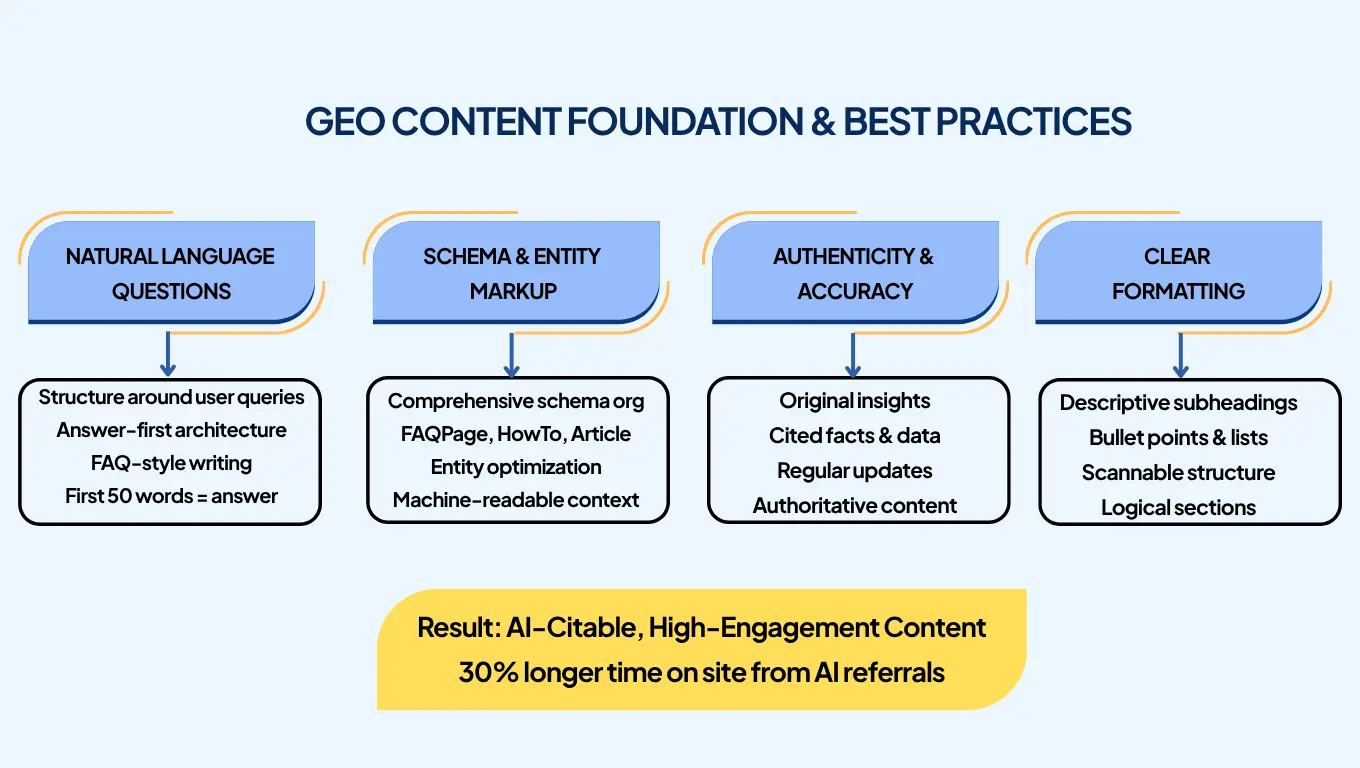
The goal is to create content that AI can accurately interpret, cite, and recommend.
- Structure Content Around Natural Language Questions: Generative AI favors content that directly answers user queries. Instead of focusing on short keywords, frame your content around complete, conversational questions. Use an “answer-first” format—provide a clear, concise answer in the opening lines, followed by context and supporting details.
- Implement Schema and Entity Markup: Apply structured data such as FAQ, HowTo, and Article schema to help AI identify the meaning and hierarchy of your content. Clarify entities like people, brands, or locations using precise, consistent naming. This makes your content machine-readable and improves its chances of being referenced by AI tools.
- Prioritize Authenticity and Accuracy: AI models value original, factual, and verifiable content. Include data, expert insights, and updated statistics to enhance credibility. Regularly refresh outdated information to ensure your content remains relevant for both AI and human audiences.
- Use Clear and Scannable Formatting: Break content into short paragraphs, descriptive subheadings, and bullet points where needed. Scannable formatting improves readability and helps AI models extract concise, accurate information when generating summaries.
By following these best practices—combining question-driven writing, factual precision, and structured formatting—GEO teams can create content that performs well in both search and generative AI environments.
This approach increases visibility, improves user engagement, and enhances credibility across AI-powered platforms. It also strengthens how information is connected within AI ecosystems through Semantic Knowledge Integration, ensuring that your content aligns with entity relationships and contextual meaning recognized by generative models.
How Can GEO Teams Measure the Impact of Content Governance?
To effectively measure the impact of content governance, Generative Engine Optimization (GEO) teams should focus on key performance indicators (KPIs) that reflect both the quality of content management and its influence on business outcomes. These metrics help teams evaluate accuracy, efficiency, and visibility across all governed assets.
1. Content Accuracy and Update Efficiency
Effective content governance ensures that information remains current, consistent, and accurate across all platforms.
Key Metrics to Track:
- Number of outdated content pieces identified per quarter
- Average time taken to update content after product or messaging changes
- Percentage of high-priority assets aligned with current standards
2. SEO and Content Performance
Strong governance positively impacts SEO results and overall content visibility by ensuring that updates align with search and user intent.
Key Metrics to Track:
- Growth in organic traffic to updated pages
- Improvement in keyword positions after content refreshes
- Increase in engagement metrics such as time on page and click-through rate
3. Internal Efficiency and Team Adoption
Governance should streamline workflows and be embraced by all participating teams, ensuring consistency and faster content delivery.
Key Metrics to Track:
- Percentage of proactive versus reactive content updates
- Time saved per quarter due to governance implementation
- Feedback scores from sales, product, and marketing teams
4. Compliance and Risk Mitigation
Content governance minimizes compliance issues and ensures all materials meet regulatory and accessibility standards.
Key Metrics to Track:
- Number of compliance or legal issues identified pre-publication
- Reduction in accessibility or regulatory violations over time
- Percentage of content reviewed and approved through governance workflows
5. Content Lifecycle Management
Governance ensures that every content asset is actively managed from creation to retirement, maximizing relevance and ROI.
Key Metrics to Track:
- Percentage of content with assigned owners and review schedules
- Number of assets updated, retired, or repurposed each quarter
- Performance comparison before and after governance adoption
6. AI Visibility and Citation Metrics
For GEO teams, AI visibility is a core indicator of how well content performs within generative search environments.
Key Metrics to Track:
- URL Citation Rate – percentage of AI-generated answers citing your content
- Domain Citation Rate – frequency of your domain cited by AI tools
- URL Mention Rate – instances where your brand or URL is referenced in AI responses
7. Lead Generation from AI Search
Assessing lead generation helps determine the direct business value of GEO-driven content governance.
If Perplexity is a key target, these same KPIs help you diagnose why you’re not being sourced — and what to fix next in how to rank in Perplexity.
Key Metrics to Track:
- Number of leads originating from AI-based search interactions
- Conversion rate of AI-referred traffic compared to other channels
- Engagement metrics such as pages per session and average visit duration
By tracking these key metrics, GEO teams can measure how effectively content governance improves quality, visibility, compliance, and performance across both traditional and AI-driven search channels. This data-driven approach helps refine processes and demonstrate tangible business impact.
It also supports smarter insights through Dynamic Answer Synthesis, enabling AI systems to generate contextually accurate, brand-aligned responses based on governed and semantically optimized content.
What Tools Are Available to Assist GEO Teams with Content Governance?
Global Enterprise Operations (GEO) teams managing content across multiple regions rely on the right tools to maintain consistency, compliance, and collaboration. These platforms streamline governance processes, reduce manual work, and ensure that brand messaging stays aligned across languages and markets.
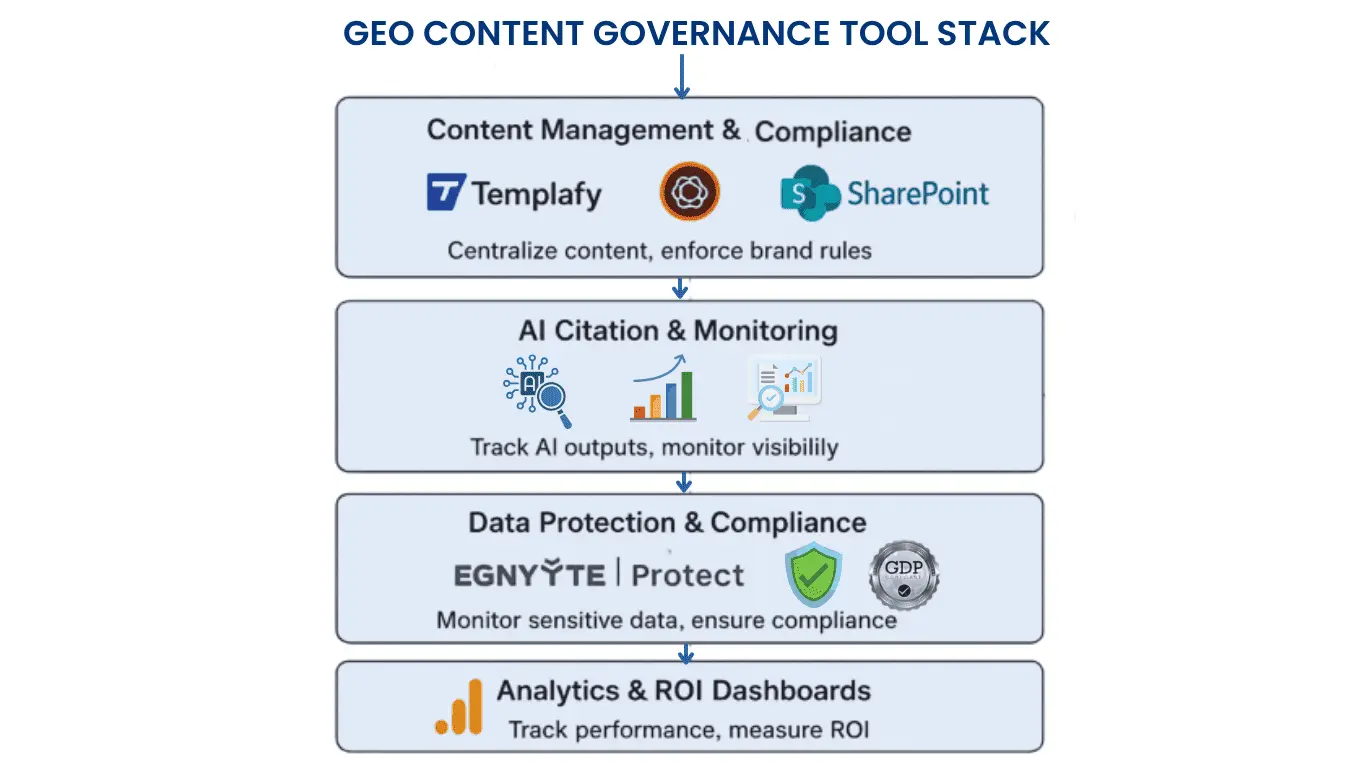
Here are some of the most effective tools that can help GEO teams strengthen their content governance strategies. These platforms not only improve accuracy and compliance but also support evolving AI workflows—laying the foundation for a more Personalized Generative Experience across regions and user segments.
1. Meegle’s Global Content Governance Framework
Meegle provides a structured framework for managing, regulating, and optimizing content across diverse platforms and geographies. It helps organizations maintain consistent quality and compliance by addressing cultural nuances, regional standards, and legal requirements. This framework ensures that global content operations stay aligned with brand and policy guidelines.
2. MadCap Software
MadCap Software offers a comprehensive suite of tools for modular, multi-channel, and multilingual content creation. Its key products, such as MadCap Flare and MadCap IXIA CCMS, enable teams to create structured, reusable content at scale. These solutions make it easier to manage technical documentation and ensure message consistency across all regions.
3. Gridly
Gridly is a localization and internationalization platform that simplifies managing multilingual content. It supports automation, version control, and real-time collaboration between content creators, developers, and translators. With its AI and bulk operation features, Gridly is especially useful for global product, software, and gaming teams managing frequent content updates.
4. Contentful
Contentful provides a centralized content platform that unifies creation, review, and publishing workflows. It’s designed to help global teams collaborate seamlessly and maintain consistent messaging. With automated processes and flexible integrations, Contentful supports efficient content reuse across multiple regions and platforms.
5. Acrolinx
Acrolinx uses AI to help organizations maintain content quality and compliance across languages and departments. It integrates directly into authoring tools to offer real-time feedback, content scoring, and brand voice alignment. By ensuring every piece of content meets established standards, Acrolinx empowers GEO teams to produce consistent and compliant messaging at scale.
How Does Content Governance Affect Compliance in GEO Teams?
Effective content governance is one of the strongest safeguards for compliance, especially for GEO teams operating in regulated industries such as finance, healthcare, or legal. It ensures that every piece of content adheres to legal, ethical, and organizational standards — including data privacy laws, disclosure requirements, and internal policies.
Without governance, non-compliant content can easily slip through, exposing organizations to legal and reputational risks. A structured governance framework establishes clear approval workflows, predefined templates with mandatory disclaimers, and review checkpoints by compliance or legal officers before publication. This ensures that all published material meets required standards.
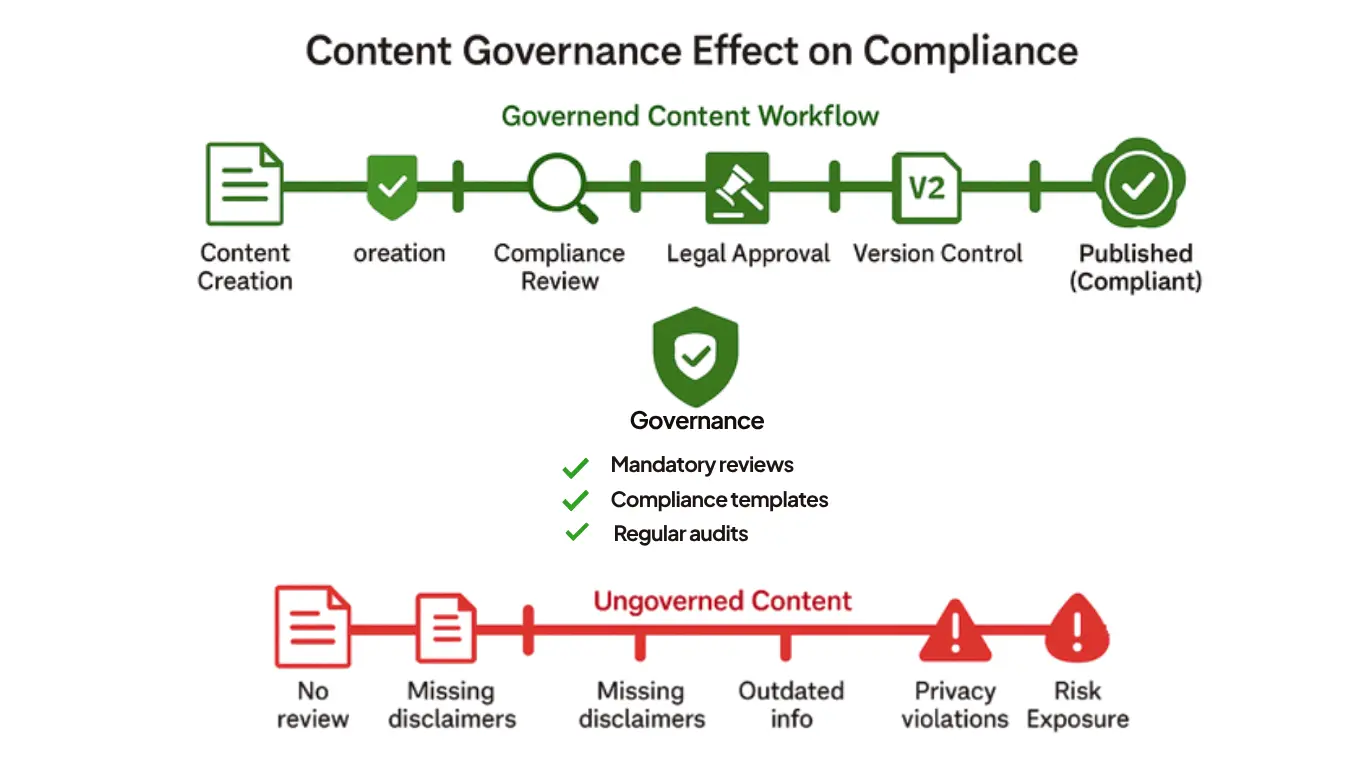
In the context of AI and GEO operations, governance also prevents accidental data exposure or misinformation. By setting strict guidelines for how AI tools handle, process, and distribute content, teams can ensure that no private or inaccurate information is propagated across global markets.
This also aligns with advancements in Generative Query Understanding (GQU), where AI systems interpret intent and context dynamically — making governed, compliant data even more essential for trustworthy AI responses.
Governance further supports compliance through version control and timely updates. As regulations evolve, governed workflows help teams identify and revise affected content promptly. Regular audits and content review logs make it easy to verify that every asset remains compliant with the latest requirements.
Many organizations integrate governance with compliance automation tools that scan for missing disclaimers, outdated references, or potential data risks. This automation reinforces manual oversight and minimizes the chance of human error.
In summary, content governance embeds compliance into daily operations, ensuring that every message a GEO team delivers is accurate, ethical, and legally sound. By building compliance into the content creation process rather than treating it as an afterthought, organizations reduce risk, build trust, and maintain a strong reputation across all regions.
What Challenges Do GEO Teams Face Without Content Governance?
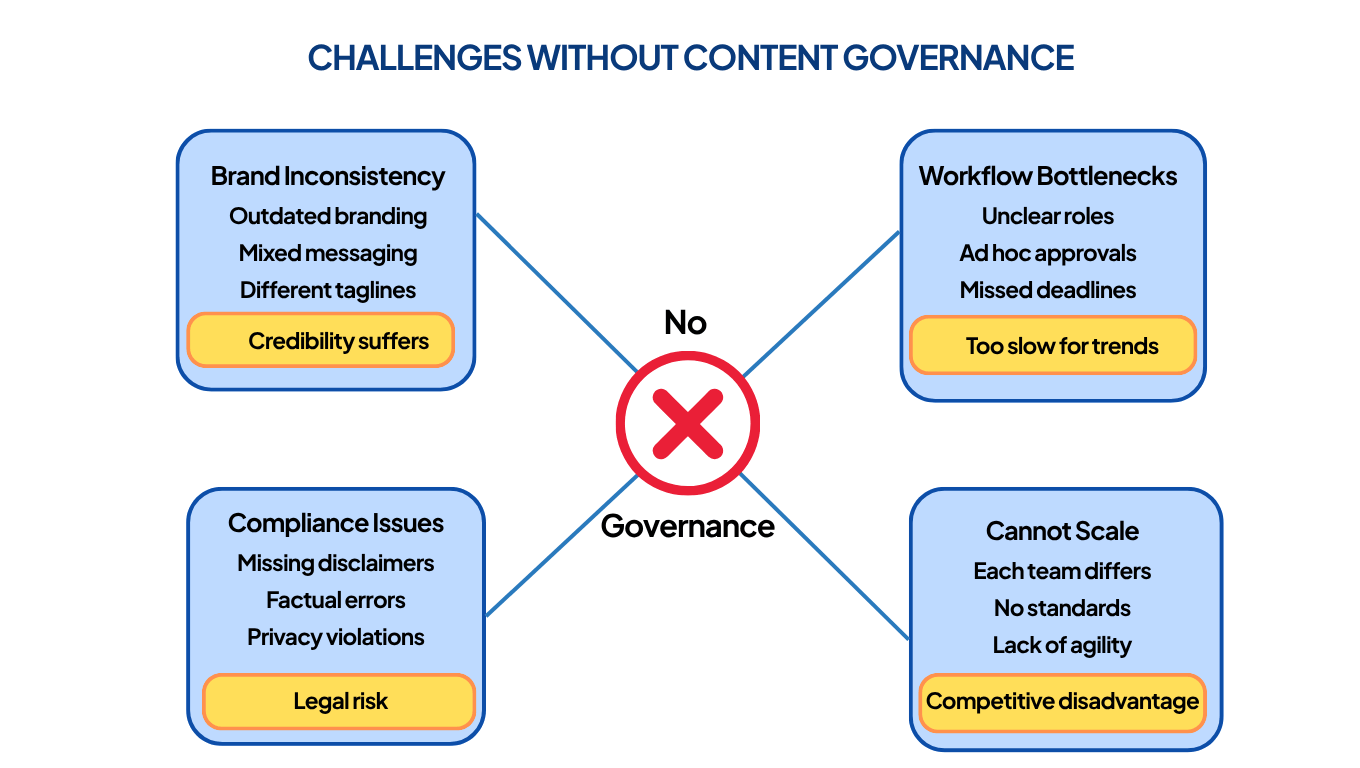
Without a content governance framework, GEO teams face several obstacles that slow productivity, reduce content quality, and create brand and compliance risks. The table below outlines the major challenges and their impact.
| Challenge | Description |
|---|---|
| Brand Inconsistency | Without a unified framework, content is often created in silos with no shared standards. This leads to inconsistent messaging, outdated visuals, and off-brand communication. For GEO teams, this inconsistency risks spreading conflicting information through AI and across regions. |
| Workflow Bottlenecks | Lack of governance results in unclear roles, approval delays, and inefficient feedback loops. Without defined workflows, GEO teams struggle to publish timely updates—especially when responding to fast-moving AI or market trends. |
| Compliance and Accuracy Issues | In the absence of review processes, content may bypass legal or factual checks, leading to potential compliance breaches. Errors or outdated data can easily spread through AI systems, amplifying misinformation and increasing regulatory risks. |
| Productivity Blockers and Content Waste | Teams often face “content sprawl,” with multiple versions of the same assets and no visibility into the latest updates. This causes wasted effort as employees recreate existing content, slowing down output and collaboration across regions. |
| Inability to Scale or Adapt | Without governance, scaling content operations across markets becomes difficult. Each region or team may develop its own processes, leading to inconsistency and inefficiency. When new technologies like AI emerge, teams without governance struggle to adapt quickly. |
In summary, operating without content governance is like managing a global team without a playbook—talented individuals working in isolation, but without coordination or consistency. GEO teams without governance face inefficiency, higher error rates, and lost opportunities, while governed teams operate with clarity, control, and agility.
How Can GEO Teams Ensure Cross-Functional Alignment in Content Governance?
Cross-functional alignment is essential for GEO content governance because it involves multiple teams — from marketing and SEO to product, legal, and engineering. Ensuring alignment means creating shared accountability, unified processes, and consistent communication across all departments.
When SEO and content teams collaborate effectively, governance can directly influence search engine ranking factors by improving structure, consistency, and semantic clarity.
- Establish a Governance Committee: Form a dedicated task force with representatives from each key department. This group defines and updates governance standards, ensuring every function — content, SEO, product, legal, and IT — has input and clear responsibilities.
- Define Roles and Ownership: Assign clear accountability within the governance framework. For example, content teams ensure tone and quality, SEO teams handle metadata and schema, product teams verify factual accuracy, and IT manages tools and access.
- Use Shared Dashboards and KPIs: Create governance dashboards that display metrics like content freshness, AI citation visibility, and compliance status. Shared KPIs keep all teams aligned around the same performance goals.
- Schedule Cross-Functional Reviews: Conduct regular governance audits involving multiple departments. These sessions help teams review content accuracy, schema setup, and brand tone together — fostering collaboration and continuous improvement.
- Maintain Transparent Communication: Centralize governance documentation in one accessible platform and keep everyone informed about updates. Encourage teams to flag issues or suggest improvements to keep governance dynamic and inclusive.
In short, GEO teams achieve true alignment when governance becomes a shared responsibility supported by visibility, collaboration, and communication. This unified approach not only enhances efficiency but also ensures consistent, compliant, and AI-ready content across all markets.
Read More Articles
- How Will Google’s AI Mode Transform Traditional SEO Practices?
- What is the Great Decoupling and how it Impacts Generative Engine Optimization?
- How to Design Content Briefs for GEO?
- Top 10 Visibilty Tips for Gemini AI
- Top 10 Visibilty Tips for ChatGPT
- Top 10 Visibilty Tips for Perplexity
- Top 10 Visibilty Tips for Claude
- What Roles Does Structured Data Play in LLM Visibility?
FAQs
For GEO teams, content governance defines how global content is planned, created, and maintained to ensure accuracy, compliance, and AI visibility. It helps align all regional outputs with brand standards while optimizing structure and metadata for generative engines like ChatGPT and Gemini.
GEO teams align governance with organizational goals by linking content workflows to visibility metrics—like AI citations, SERP presence, and engagement. Clear governance ensures every asset supports business objectives while maintaining quality and semantic consistency across markets.
Relevant programs include Northwestern’s *Content Strategy for Professionals* and SEMrush’s *GEO and Governance Masterclass*. These teach teams how to manage structured data, multilingual standards, and visibility optimization for AI-driven search.
Integration happens by embedding governance protocols—like schema validation, metadata enrichment, and AI visibility tracking—into CMS workflows. Using platforms such as Acrolinx or Contentful ensures every content update remains discoverable, accurate, and aligned globally.
Key visibility-focused metrics include AI citation rate, domain visibility index, schema validation score, and content freshness. These KPIs show how governance impacts discoverability, ranking, and credibility in generative and traditional search.
GEO teams can enhance visibility by adopting AI tools that automate schema updates, detect entity gaps, and analyze LLM citations. Regular audits and adaptive governance frameworks keep global content optimized for emerging generative engines.
Conclusion
Content governance is the foundation that empowers GEO teams to deliver consistent, accurate, and AI-optimized content at scale. By establishing clear roles, structured standards, and agile review processes, organizations can adapt confidently to the changing dynamics of generative search.
As AI-driven content discovery grows, governance ensures that every piece of content remains compliant, credible, and current. It connects strategy with execution — enabling teams to work efficiently, maintain brand integrity, and strengthen trust across all digital channels.
Key Insights from This Guide:
- GEO + Governance = Visibility: Well-governed content is more likely to be recognized, cited, and trusted by AI systems.
- Frameworks Drive Efficiency: Defined roles, workflows, and review loops reduce duplication, errors, and compliance risks.
- Consistency Builds Trust: Unified content standards preserve brand voice and reliability across global markets.
- Data and Monitoring Matter: Regular audits, dashboards, and AI citation tracking provide measurable proof of governance impact.
- Continuous Improvement Is Key: Governance should evolve with technology and collaboration to keep content AI-ready and competitive.
In an AI-first world, content governance is more than process control — it’s a strategic advantage. GEO teams that govern with clarity and consistency achieve stronger visibility, reliability, and impact across every channel.