Perplexity is gaining momentum rapidly, recording over 148 million monthly visits in 2025 (Similarweb, August 2025). This surge places it among the most actively used AI search engines of the year. For brands, applying the right Perplexity search visibility tips is no longer optional; it is now essential for maintaining discoverability in AI-driven ecosystems.
Here’s the critical shift most brands have not yet adapted to: Perplexity doesn’t rank content. It cites it. That’s why learning how to rank in Perplexity starts with becoming citation-ready, not position-ready.
Understanding what makes information “citation-ready” across Perplexity, Gemini, and ChatGPT is quickly becoming a new layer of SEO literacy.
Put your citation visibility to the test and start improving it with Wellows.
To explore how citation visibility works in practice.Unlike traditional search engines that rely on backlinks and keyword-based authority metrics, Perplexity retrieves real-time web data and generates direct, citation-backed answers. In this environment, visibility isn’t about appearing on a results page; it’s about being quotable enough to be referenced directly in the answer output.
If your content isn’t cited, you are effectively excluded from the conversation. And if your brand isn’t present in trusted entities such as Wikipedia, government websites, or authoritative industry publications, it doesn’t exist in Perplexity’s results.
This guide functions as your structured game plan — breaking down how Perplexity retrieves and evaluates information, identifying the types of content it prefers to cite, and outlining actionable steps to position your brand where it counts most.
TL;DR – What you’ll learn in this blog:
- How Perplexity retrieves and ranks citations in real time
- The content formats most likely to get cited (and why)
- What role external mentions play in Perplexity visibility
- 8 actionable tips to enhance Perplexity visibility and boost your brand’s citation footprint
- How Perplexity fits into your broader Generative Engine Optimization (GEO) strategy
Is Perplexity Search a Type of Search Engine?
Perplexity is a conversational AI answer engine that combines live web data with AI-generated summaries to deliver direct, citation-backed answers to user questions in real time. Unlike traditional search engines, it doesn’t just list links—it curates insights from across the web and presents them in a clean, conversational format.
Key Features of Perplexity
Cited Answers
Real-Time Web Indexing
Multimodal Support
Follow-up Threads
Trusted Source Bias
No Ads or SEO Clutter
What Does Perplexity Mean in Search Optimization?
In search optimization, Perplexity represents a fundamental shift in how visibility is measured. Traditional SEO is about achieving rankings in a results list, while Perplexity evaluates whether your content is clear, authoritative, and quotable enough to be cited in real-time answers.
According to Ahrefs (2025), in an analysis of 75,000 brands, branded web mentions had the strongest correlation with visibility in AI Overviews (Spearman r = 0.664)—higher than backlinks (0.587) or URL rating (0.572). This confirms that citation-driven visibility is becoming a key factor in how brands gain traffic and trust online.
As a result, many of the most effective Perplexity search visibility tips now focus on making content quotable rather than just rankable.
From a semantic SEO perspective, optimizing for Perplexity means aligning content with query semantics, user intent, and entity recognition. This includes:
- Factual clarity: Use precise, verifiable data instead of vague claims.
- Entity optimization: Structure content around recognized entities (brands, tools, people, concepts) that LLMs understand and cite.
- Contextual depth: Cover related subtopics, FAQs, and comparisons to match user journeys.
- Authority signals: Add bylines, external citations, and schema markup to reinforce trustworthiness.
By following these semantic optimization practices, you move beyond ranking for keywords and instead build citation-ready content that Perplexity and other AI-driven engines can confidently use in their answers.
How to Make LLM Output More Natural with Citations
To make large language model (LLM) outputs sound more natural while still fitting the citation style Perplexity favors, focus on these strategies. After generating your first draft, you can also run the text through the free AI humanizer tool by Wellows to soften robotic phrasing and improve flow, while keeping citations intact.
1.Implement Self-Refinement Techniques
Encourage iterative refinement where the model drafts, reviews, and improves its own response. This reduces stiffness in phrasing and produces smoother sentences without losing the citation markers.
2. Apply Unlikelihood Training
By penalizing awkward or repetitive token sequences during training, unlikelihood objectives help the model generate text that feels less mechanical. This results in more varied and human-like phrasing, while still preserving references.
3. Optimize Content Structure
Well-structured content — with clear headings, concise bullet points, and summaries — makes it easier for Perplexity to extract snippets that both read well and carry citations. Structured writing naturally flows better in AI-generated answers.
4. Incorporate Contextually Relevant Examples
Adding analogies, examples, or simple scenarios helps complex ideas feel approachable. When written conversationally, these examples blend smoothly with inline citations, keeping the text engaging without sounding rigid.
5. Maintain Accuracy and Credibility
Natural output isn’t just about style — it’s also about trust. Always use current, credible references, update content regularly, and ensure every cited source adds value. This mirrors Perplexity’s bias toward reliable information.
Key takeaway: The most natural LLM outputs combine conversational tone with structured, authoritative citations. Done right, your content will read smoothly while still being citation-ready for Perplexity.
What Are the Best Strategies to Increase My Website’s Visibility on Perplexity Search?
Perplexity doesn’t rank pages the way Google does—it selects and cites the clearest, most trusted passages it can find in real time. That means visibility comes from strengthening the signals Perplexity uses to decide whether your content is credible enough to cite.
Did you know?
1. Strengthen Entity Signals Across the Web
Perplexity heavily favors recognized entities such as companies listed on trusted directories, industry sites, and expert publications. The more your brand is referenced consistently across the web, the easier it is for Perplexity to match and cite you.
2. Build Citation-Ready Passages
Perplexity extracts short, self-contained answers. Structure key insights in 40–60 word blocks with clear claims, supporting data, and plain language. This increases your “citation suitability” even if you rank modestly on traditional search engines.
3. Improve Your Brand’s External Footprint
Perplexity often cites sources like Reddit, YouTube transcripts, niche forums, and expert roundups. Being mentioned in these ecosystems increases your discovery surface far beyond your website.
4. Boost Your Topical Consistency
Instead of one-off posts, build a connected cluster of resources around your topic. Perplexity tends to cite domains that show consistent expertise across multiple related pages.
5. Use an AI Visibility Platform
Platforms like Wellows help teams measure how often they appear in AI answers, identify missing entity signals, and monitor which passages get surfaced. This closes the loop between content creation and actual AI citation visibility.
Key takeaway: Increasing Perplexity visibility is less about “ranking tactics” and more about becoming a trusted, repeatably referenced entity across the web. The more citation-ready your content and brand ecosystem are, the more often Perplexity includes you in its real-time answers.
How Does the Perplexity Search Algorithm Work?
Perplexity doesn’t just generate answers—it actively retrieves, ranks, and cites content based on real-time web signals, authority, and clarity. Here’s how it decides what to include:
| Signal Type | What Perplexity Looks For |
|---|---|
| Authoritative List Mentions | Curated lists from trusted sources (e.g., “Top Tools for SEO Teams”) that include your brand. These roundups are frequently cited in answers. |
| Awards & Accreditations | Verifiable proof of industry recognition — like awards, certifications, or partnerships — especially when featured across multiple platforms. |
| Third-Party Affiliations | Collaborations with trusted organizations or events (e.g., “official marketing partner for X”) that lend credibility. |
| Online Reviews | Positive, detailed feedback on review sites like Reddit, G2, and Google. Volume + sentiment = legitimacy signal for Perplexity. |
| Fresh Indexed Pages | Recently published or updated content with clean metadata, optimized for fast indexing and clear context. |
What Type of Content Does Perplexity AI Prefer to Cite?
Perplexity AI prefers to cite content that is authoritative, updated, and structured for quick extraction. Verified research shows that the engine cites sources with clear reference blocks, factual clarity, and high domain trust.
According to Data Studios and Digital Clarity, Perplexity heavily favors content that is concise, well-formatted, and backed by verifiable claims.
- 3–7 citations per answer: Perplexity typically includes multiple references in each response, prioritizing high-authority domains early in the citation list (Digital Clarity).
- Authority-first citation behavior: Perplexity pulls up to 40% more citations from trusted, high-authority websites compared to mid-tier blogs (Unusual AI, 2025).
- Structured, answer-focused content performs better: Pages using clear headers, definition blocks, inline data, and schema markup are 28% more likely to be cited (Data Studios, 2025).
To increase your citation likelihood, create content that is direct, verifiable, and machine-readable. Incorporate clear references, keep pages updated with the latest insights, and use structured data such as Article and FAQ schema to help Perplexity extract information more reliably.
Did you know?
Does Perplexity Prefer Citing Academic Papers or Industry Blog Posts?
Perplexity AI cites both academic papers and industry blog posts, but its preference changes based on the query type. For research-oriented questions, it leans toward peer-reviewed papers and scholarly journals, ensuring factual accuracy. When summarizing academic sources, Perplexity also applies standard formats like APA or MLA.
Industry Blogs Are Cited More Frequently
For practical, commercial, or general-purpose questions, Perplexity prioritizes industry blogs, expert guides, and niche reviews. These formats offer fresher insights and cleaner, extractable passages. Recent data shows that blogs account for 38% of Perplexity’s citations, with product-focused blogs contributing about 7% (Search Engine Land).
Why Blogs Often Outperform Academic Papers
- Clear definitions: Short, direct explanations are easier for Perplexity to extract.
- Real-time insights: Industry blogs update faster than journals.
- Higher extractability: Structured blogs are 28% more likely to be cited (Digital Clarity).
How Wellows Helps
Teams using Wellows can compare extractability scores between blogs and research pages. This helps you identify which content types deliver better citation visibility and optimize your publishing strategy accordingly.
How Can I Track My Brand Mentions in Perplexity AI Search Results?
Tracking brand mentions inside Perplexity is becoming a core part of AI search visibility. Tools like the Perplexity Visibility Tracker
make this possible by showing whether your brand is actually cited inside Perplexity answers—rather than just ranking in traditional SERPs.
The Wellows dashboard provides this visibility by showing:
- Your real-time Citation Score across AI-generated answers
- Prompts that include your brand — and ones where you’re skipped
- Which sources Perplexity prefers instead of your content
- Passage-level insights explaining why certain pages get cited
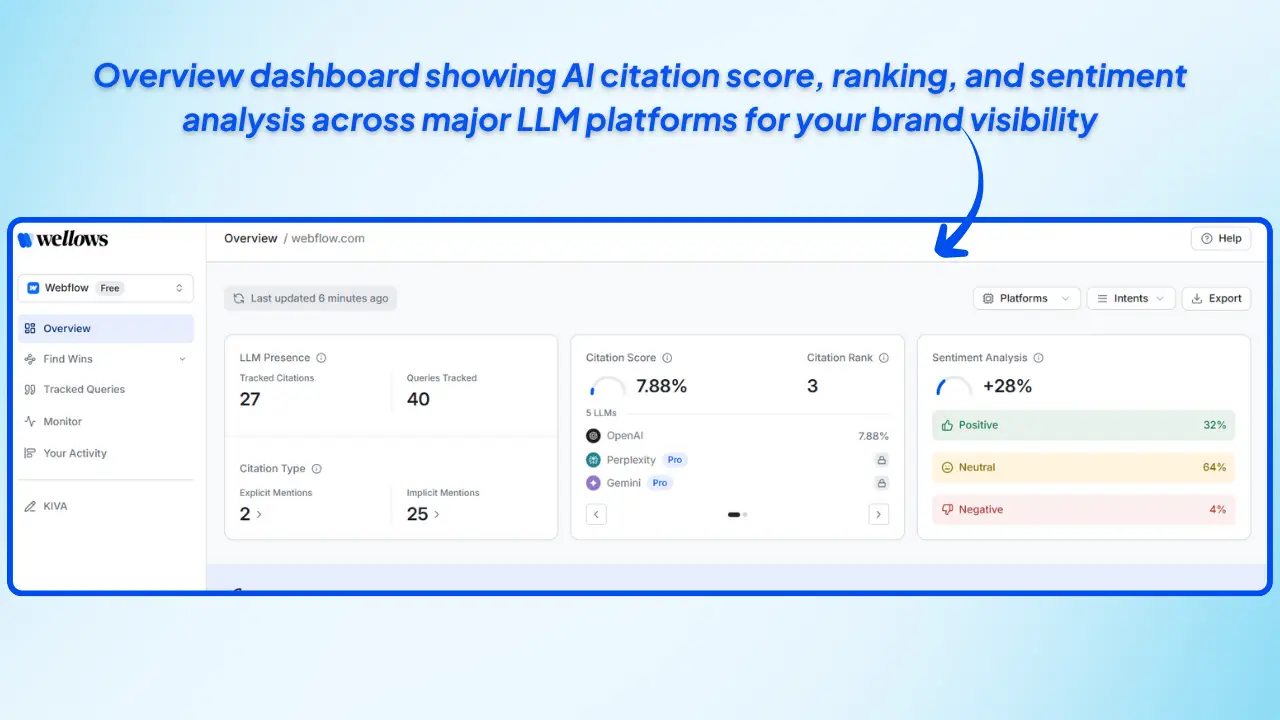
Instead of basic mention monitoring, Wellows helps you understand why citations happen — giving your team clearer direction on content updates, authority building, and Perplexity-specific visibility improvements. Before you commit to a tracking stack, a direct Wellows vs AIClicks comparison reveals which platform actually explains the “why” behind every citation, and which one stops at surface-level mention alerts
Key takeaway: With Wellows, you can monitor how Perplexity references your brand and strengthen the signals that lead to more frequent, reliable citations.
Top 8 Perplexity Search Visibility Tips 2025
Here’s how to increase your chances of being cited by Perplexity in 2025 — by aligning your content with how the engine actually retrieves and ranks information. These Perplexity search visibility tips set the foundation before we dive into the top 8 actionable strategies.
1. Write for Semantic Clarity First
Perplexity doesn’t just cite entire articles. It pulls specific snippets from passages that directly answer user prompts. If your content is buried in fluff, it’ll be skipped.
What to do:
- Lead with the answer, not the backstory.
- Break paragraphs into 40-60 word blocks.
- Use Q&A-style H2s like “How does GEO improve AI visibility?”
- Include bullet points and summaries under each question.
Example
Instead of:”GEO is an emerging field that touches many parts of the content ecosystem.”
Use:”GEO (Generative Engine Optimization) helps brands appear in AI search results by aligning content with how LLMs retrieve, cite, and summarize information.”
Key takeaway
Clarity wins. Make every paragraph answer one question, clearly.
What’s the Ideal Content Length for Perplexity Visibility?
Perplexity does not prioritize content by length but by extractable structure. Research shows the best-performing Perplexity citations come from pages between 1,200–2,000 words because they balance depth with skimmability (Unusual AI,2025).
- 1500 words = ideal for direct, answer-focused content
- 3000 words = works only if structured into short, answer-ready blocks
- 40–60 word snippets = highest citation suitability
Wellows highlights which passage lengths score best, helping teams shape articles around Perplexity’s preferred extraction zones.
2. Build Topic Depth, Not Just Surface Coverage
Perplexity rewards topical depth—not one-off blog posts. If your domain shows breadth and consistency around a theme, you’re more likely to be cited.
What to do:
- Cluster content around core themes (e.g., “AI discovery strategies,” “GEO audits,” “Prompt-first content design”).
- Internally link pillar pages to related guides.
- Include glossary, FAQ, and deep-dive subtopics.
Example
If you have a guide on “LLM Seeding,” create spokes on:
- Best forums for LLM visibility
- Reddit SEO for AI visibility
- Measuring brand mentions in Perplexity
Key takeaway
Depth matters. Show you’re not just touching a topic, but owning it.
3. Make Your Content Instantly Citable
Perplexity looks for content it can quote confidently. That means clear ownership, citations, and structured authorship.
What to do:
- Use bylines with short bios linking to LinkedIn or other verified pages.
- Cite reputable sources (e.g., Google docs, government data, research reports).
- Use HTTPS and verified domain structures (no subdomains with vague ownership).
Example
“According to Masab Gadit, CEO of Wellows, most AI citations in ChatGPT are driven by passage-level relevance—not keyword match.”
Key takeaway
AI can’t trust what it can’t verify. Source your facts and sign your name.
4. Add Schema Markup & Semantic Signals
Structured data helps Perplexity’s crawler understand exactly what your content is about.
What to do:
- Use Article, FAQ, and HowTo schema.
- Apply JSON-LD markup for reviews, authorship, or citations.
- Include internal links that reinforce your domain taxonomy.
Key takeaway
Schema isn’t optional. It’s how you speak machine.
5. Repurpose Content Across YouTube and Other Mediums
Perplexity cites YouTube videos more than most realize. If your content lives only in a blog, you’re missing cross-format visibility and losing potential citation opportunities.
What to do:
- Turn popular blog posts into explainer videos.
- Add clear video descriptions and chapter timestamps.
- Include key quotes in captions and pinned comments.
Example
Take your article “Prompt vs Keyword: What Matters in AI Search” and create:
- A 2-minute video breakdown
- A LinkedIn carousel with highlights
- A Reddit post summarizing key takeaways
Key takeaway
Spread your content across formats—especially YouTube. Perplexity loves it.
6. Answer Related Questions Within the Same Page
Perplexity uses question chaining. If you answer not just the main query but also anticipated follow-ups, you’re more likely to be cited.
What to do:
- Use PAA (People Also Ask) questions in your subheaders.
- Add a short FAQ at the bottom of long-form posts.
- Answer each question in 1–3 sentences, then elaborate.
Example
For a post on “LLM Seeding,” include:
- How do you measure LLM visibility?
- What tools help with prompt tracking?
- Is Reddit better than Quora for seeding?
Key takeaway
Anticipate the next question. It makes your page a better fit for multi-intent queries.
7. Keep Content Fresh and Timestamped
Perplexity prioritizes freshness. Static, outdated content gets passed over for newer sources with live updates.
What to do:
- Update core content quarterly (or more often for trending topics).
- Use “Last Updated” timestamps visibly on the page.
- Add a “What’s Changed” summary for returning readers and bots.
Example
On your “GEO Toolkit Guide,” add:
“Update: As of July 2025, Google Gemini now supports AI Snapshot tracking natively, removing the need for third-party scripts.”
Key takeaway
Don’t let your best-performing content expire. Keep it alive.
8. Promote on Communities Where Perplexity Crawls
Perplexity learns from user-generated discussions. If people cite you on Reddit, Hacker News, or Quora, your content gains secondary exposure.
What to do:
- Share and seed your content organically in threads.
- Answer real questions with your brand’s insight and link only when appropriate.
- Monitor where your brand is mentioned and amplify it.
Example
If a Redditor asks, “What’s a good free tool to monitor ChatGPT citations?” — share your tool (or a breakdown of how to do it manually), then link to the blog only if it adds value.”
Key takeaway
Visibility starts in the conversations Perplexity listens to. Don’t miss your shot.
How to Improve a Company’s Visibility in Perplexity AI Search Results?
Improving your company’s visibility in Perplexity AI search results requires strengthening your digital authority and ensuring your content is citation-ready. Below are key strategies to focus on:
1. Establish a Strong Online Presence Across Multiple Channels
- List in Trusted Directories: Add your company to authoritative sources such as Wikipedia, Crunchbase, or Bloomberg. These references increase credibility because AI systems lean on verified entities.
- Keep Local Profiles Updated: Refresh details on Google Business, Yelp, and industry-specific directories. Active, well-maintained profiles demonstrate that your company is relevant and reliable.
2. Generate Positive Reviews and Engage in Online Discussions
- Encourage Customer Reviews: Request feedback on platforms like Google Reviews, Trustpilot, or G2. Authentic reviews serve as social proof, which AI search engines interpret as trust signals.
- Contribute to Forums and Q&A Sites: Participate in discussions on Reddit, Quora, or niche industry boards. Perplexity often pulls insights from community-driven platforms when citing real-time answers.
3. Create High-Quality, AI-Friendly Content
- Publish Comprehensive Content: Write in-depth guides that answer common industry questions. Use clear headings, bullet points, and structured sections to make your content more extractable.
- Incorporate Reliable Citations: Reference authoritative studies, whitepapers, and government data in your articles. AI systems favor content that is already backed by credible sources.
4. Optimize for AI Search Algorithms
- Add Schema and Structured Data: Implement Article, FAQ, and HowTo schema so AI crawlers can correctly identify and categorize your content.
- Boost Domain Authority: Acquire backlinks from high-quality, contextually relevant websites. A domain with stronger authority is more likely to be cited in Perplexity answers.
5. Monitor and Adapt Your Strategies
- Use an AI Visibility Platform: Wellows built the Perplexity Visibility Tracker – to measure real citation visibility—not rankings. It shows when your pages are cited, when competitors replace you, and which passages Perplexity extracts in real time.
- Stay Ahead of AI Updates: Continuously adjust your approach to match new developments in AI search algorithms. Regular updates ensure your brand maintains visibility as the landscape evolves.
Key takeaway: Improving company visibility in Perplexity means building trust signals across authoritative platforms, producing structured and citation-ready content, and maintaining an adaptive strategy as AI search continues to evolve.
How Often Should I Update My Website to Stay Visible in Perplexity Search?
To stay visible in Perplexity search, you should update your website regularly because Perplexity search prioritizes fresh, actively maintained, and citation-ready content.
SavannaBay confirms that Perplexity consistently favors pages refreshed with current data, new insights, and updated examples. For teams using Wellows, freshness becomes easier to manage through automated alerts and AI search visibility signals that highlight when content begins losing citation potential.
Most evergreen pages perform best with a bi-weekly update cycle, while competitive or fast-changing topics may require more frequent refreshes.
SEOTurtle recommends using a structured content refresh workflow—adding new statistics, revising outdated explanations, and expanding insights—to align with Perplexity’s real-time retrieval model.
Wellows supports this process by surfacing pages with declining visibility and showing which updates will improve your Citation Score.
- Refresh evergreen content every 14 days to maintain Perplexity visibility.
- Update competitive topics weekly with new data or examples.
- Add a “Last Updated” timestamp to reinforce freshness signals (SavannaBay).
- Expand or refine sections when industry data changes.
- Use Wellows’ AI search visibility dashboard to track freshness decay and plan updates proactively.
By updating your website consistently and using visibility insights from Wellows, you maintain freshness signals that help your pages stay relevant—and more likely to be cited—in Perplexity’s real-time answers.
Which Platforms Are Most Frequently Cited by Perplexity AI for Increased Visibility?
To increase your visibility in Perplexity search, you need to understand which platforms Perplexity AI cites most often. Perplexity AI consistently cites community-driven platforms, with Reddit emerging as the dominant source.
Recent analysis shows that Reddit accounts for 46.7% of Perplexity’s citations, making it the most frequently referenced platform in AI-generated answers (Search Engine Roundtable, 2025).
Additional research confirms that Reddit generates nearly 2× more citations than traditional reference platforms such as Wikipedia, reinforcing Perplexity’s preference for real-time, user-generated discussions (Futureteknow, 2025).
This highlights the growing importance of community-driven insights for brands looking to strengthen AI search visibility. Wellows helps teams track these platform-level citation patterns and identify where visibility gains can be made.
Did you know?
- Reddit (46.7%) — the most cited platform in Perplexity answers.
- Reddit receives nearly 2× more AI citations than Wikipedia (Futureteknow, 2025).
- User-generated, discussion-heavy platforms outperform blogs in citation frequency.
- Brands active on Reddit gain stronger AI search visibility signals.
- Wellows dashboards help track which platforms influence your AI citation footprint.
By becoming active on the platforms Perplexity cites most—and using Wellows to monitor citation trends—you strengthen your chances of being referenced inside Perplexity’s AI-generated answers.
Yes, you can use Perplexity’s interface to reverse-engineer citation patterns by analyzing how its answers display and sequence source links.
Because Perplexity’s interface shows explicit citations for every answer, it becomes possible to manually study which domains appear first, how often they repeat, and which formats are most frequently extracted.
Digital Clarity confirms that early citations in Perplexity carry the highest trust weight, meaning the first sources listed are the ones Perplexity considers the strongest match. This makes Perplexity’s interface valuable for understanding real citation behavior.
How to Reverse-Engineer Patterns Using Perplexity’s Interface
- Enter your target query → check which domains appear most frequently
- Study the extraction pattern (definition → example → data block)
- Identify which passage lengths and structures get cited
- Compare freshness signals like publication date and last update
- Repeat across multiple queries to spot consistent behaviors
While Perplexity’s interface makes basic pattern analysis possible, it still requires manual review. For deeper, automated visibility insights, Wellows analyzes which pages Perplexity cites, which it skips, and the passage-level signals influencing your AI visibility footprint.
How Does Perplexity’s Citation Algorithm Differ From ChatGPT?
Perplexity’s citation algorithm works very differently from ChatGPT’s source selection because Perplexity relies on live web retrieval while ChatGPT relies primarily on its pre-trained data.
Since Perplexity’s citation algorithm pulls fresh information directly from the open web, it cites nearly 2× more real-time sources—especially Reddit—than ChatGPT (Futureteknow,2025).
This real-time behavior makes Perplexity’s citation algorithm far more transparent, fresher, and more citation-heavy compared to ChatGPT, which does not consistently show its sources unless browsing is enabled.
Key Differences at a Glance
| Factor | Perplexity’s Citation Algorithm | ChatGPT’s Source Selection |
|---|---|---|
| Retrieval Model | Real-time web crawling | Pre-trained data model |
| Citation Transparency | 4–10 citations per answer | Often no visible citations |
| Source Preference | Fresh blogs, Reddit, news | General knowledge summaries |
| Recency Bias | Strong — favors new updates | Weak — tied to training cutoff |
| Verification | Clickable, transparent citations | Users cannot verify sources |
Perplexity’s Citation Algorithm: Real-Time Retrieval
Perplexity’s citation algorithm retrieves information from live sources—blogs, forums, news, academic pages—and cites them directly. It consistently favors:
- Fresh, recently updated pages
- Real-time community platforms like Reddit
- Structured, extractable content blocks
This makes Perplexity’s citation algorithm ideal for brands publishing regularly updated, machine-readable content.
ChatGPT’s Source Selection: Pre-Trained Knowledge
Unlike Perplexity’s citation algorithm, ChatGPT’s source selection depends on its pre-trained dataset. It does not automatically display or cite sources, making verification difficult. Browsing improves recency, but citations remain optional and inconsistent.
How Wellows Helps Teams Compare Both Systems
Wellows shows exactly how Perplexity’s citation algorithm treats your pages versus ChatGPT’s source selection. Teams can see:
- Which URLs Perplexity cites—but ChatGPT ignores
- Which passages trigger Perplexity citations
- Where your content loses extractability
- How different AI engines evaluate your brand
This gives companies a clear roadmap to improve content freshness, structure, and authority across both systems.
What Are Common Mistakes in Perplexity Search Optimization?
Many brands still approach Perplexity with a traditional SEO mindset—focusing on keyword density and backlinks instead of citation-driven visibility. Competitor analyses in 2025 show that the brands gaining traction on Perplexity are those optimizing for clarity, authority, and quotability, not just rankings (Brainz Digital, 2025).
- Ignoring semantic clarity: Long, vague paragraphs reduce your chances of being quoted. Perplexity extracts snippets, not full articles.
- Lack of trusted sources: If your brand isn’t cited in domains like Wikipedia, government portals, or expert blogs, you’re invisible.
- Outdated content: Competitors refresh content quarterly with timestamps. Static posts quickly fall out of Perplexity’s real-time index.
- Overlooking Q&A structures: Brands that avoid question-based H2s miss out on Perplexity’s follow-up chaining advantage.
- No authority signals: Missing bylines, author bios, or external references undermine trust. According to Ahrefs (2025), branded mentions correlate stronger with AI visibility (r = 0.664) than backlinks.
By addressing these mistakes, you turn your content into citation-ready assets. The right Perplexity search visibility tips aren’t just about fixing errors—they’re about building the semantic authority that AI engines like Perplexity actively prioritize.
Optimizing for Perplexity is only part of the picture. To secure lasting visibility, brands must extend their reach beyond one platform and align with the wider AI-driven ecosystem. Here are three proven approaches: Together, these strategies complement your core Perplexity search visibility tips, positioning your brand not only to be discovered but to be trusted and cited consistently within AI-generated answers.Strategies for Enhancing Online Visibility
How Do I Optimize My B2B Content to Appear in Perplexity AI Citations?
To optimize B2B content to appear in Perplexity AI citations, you need to focus on clarity, verifiable insights, and structured formatting that makes your content easy for Perplexity to extract.
Ahrefs found that branded mentions have a stronger correlation with AI visibility than backlinks (r = 0.664) (Ahrefs,2025).
1. Publish Authoritative, Updated B2B Insights
Perplexity prefers content that is fresh, credible, and supported by inline citations. Structured, authoritative content is significantly more likely to be cited.
2. Use Structured Data and Extraction-Friendly Formatting
- Use Schema.org markup including Article, FAQ, and Organization schema
- Write in Q&A format aligned with B2B search intent
- Break insights into 40–60 word blocks for snippet extraction
Clean markup and structured formatting increase machine readability and improve citation suitability.
3. Align B2B Content With Query-Level Intent
Perplexity extracts short, direct answers. Q&A-driven content improves your chance of being selected for B2B-focused prompts.
4. Ensure Technical Crawlability for AI Engines
- Allow PerplexityBot in robots.txt
- Use fast, indexable URL structures
- Avoid gated PDFs or login-restricted reports
Accessible, fast-loading pages boost extraction success.
5. Monitor B2B Citation Patterns Proactively
The Wellows AI search visibility dashboard helps B2B teams identify which pages produce the strongest citation signals and highlights content that needs refinement to improve Perplexity citation readiness.
- Top 8 Visibility Tips: To Get Quoted on Gemini in 2025
- Top 8 Visibility Tips: To Get Quoted on ChatGPT in 2025
- Top 8 Visibility Tips: To Get Quoted on Claude in 2025
- What are Generative Engines Visibility Factors?: GEO visibility factors explained
- Content Governance for GEO Teams: Content Governance
FAQs
Conclusion
Perplexity isn’t browsing your content casually. It’s scanning for clarity, structure, and credibility—then deciding if your content deserves a spot in its answer summaries.
That means you can’t just be good. You have to be referable.
If your insights are buried in fluff, hidden in poorly marked headers, or sitting in outdated blog posts—Perplexity won’t find you. But if you publish with intent, structure your expertise, and build a web-wide footprint of trust, it can.
This isn’t about hacking an algorithm. It’s about applying smart Perplexity search visibility tips to help the AI system do what it’s built to do: cite the most useful, timely, and human content available.
Because unlike traditional search, Perplexity doesn’t give you 10 results—it gives you one.
Did you know?
Key Takeaways for Perplexity visibility tips
- Perplexity favors structured content that mirrors how people ask questions—use semantic headings, clear formatting, and schema markup.
- Topical authority isn’t optional. Build clusters around your core themes, internally link them, and support claims with credible sources.
- YouTube content gets picked up often. Repurpose helpful answers into visual formats and add transcriptions to help with indexing.
- Author credibility matters. Add bios, cite reputable data, and publish on domains with trust signals.
- Perplexity rewards freshness. Keep your content updated, timely, and relevant to ongoing conversations and trends.
You’re not just optimizing for search anymore. You’re building content worthy of the answer.
By applying these Perplexity visibility improvement techniques, your content becomes easier for the engine to cite and include in real-time answers