Remember when ranking on page one was the goal? You’d obsess over keywords, write for crawlers, and hope users actually clicked through. But at Google Marketing Live 2025, that playbook got a rewrite.
Google just introduced their AI Mode. The boldest shift yet in how it delivers search results. Instead of showing ten blue links, the engine now pulls answers directly from content and serves them up in real time. No click required. No website visit necessary.
For SEOs, this isn’t just an update. It’s a turning point.
Because now, visibility isn’t about ranking high, it’s about being the source that Generative Engine Optimization choose to reference, summarize, or rephrase. Your content still matters, but how it’s structured, semantically aligned, and entity-rich matters more than ever.
So what does this mean for traditional SEO? And how do you adapt when clicks, impressions, and traffic no longer tell the whole story?
This blog explores exactly how Google AI Mode is reshaping search, and what you need to do to keep your content relevant, visible, and aligned with the new rules.
TL;DR:
- AI Mode replaces “blue links first” with instant Gemini answers in the SERP.
- Visibility shifts from ranking high to getting cited inside AI responses (GEO).
- It’s built for complex, multi-step, and comparative queries with follow-ups.
- Standard Search lists links; AI Mode synthesizes an answer first, then cites sources.
- SEO still matters, but structure, entities, trust, and freshness matter more for AI picks.
- Expect more zero-click on info queries, so track visibility beyond CTR.
- Ads still show, but now compete with the AI answer layer.
- robots.txt/meta tags can block Google AI Mode from crawling or quoting your pages.
What is Google AI Mode?
Google AI Mode is the search experience getting a serious upgrade. Announced at Google Marketing Live 2025, it changes how people interact with search results—moving away from long lists of blue links to direct, context-rich answers right on the page.
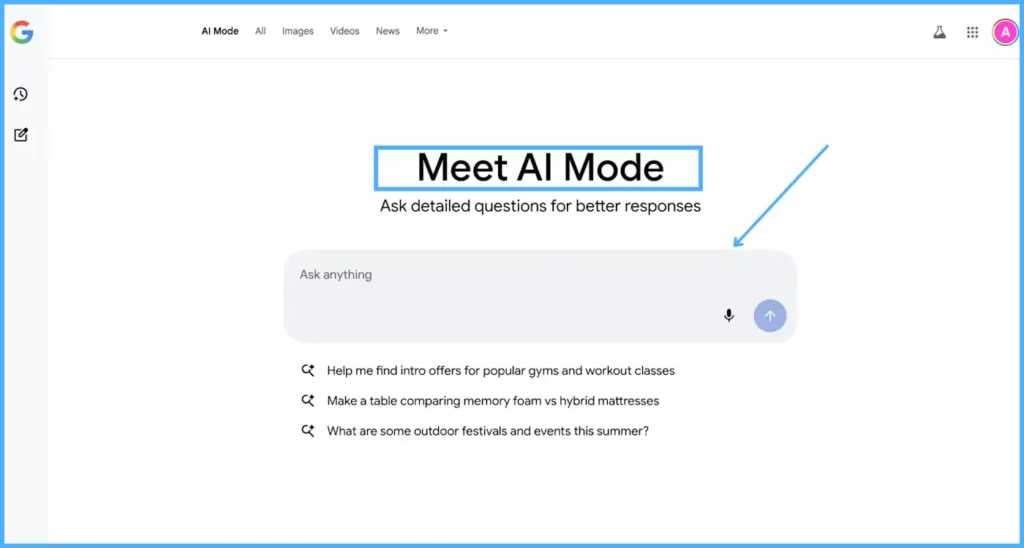
It’s built on top of Search Generative Experience (SGE), the same engine that powers Google’s conversational answers, and forms a core part of Generative Engine Optimization (GEO)—Google’s evolving framework for surfacing trusted, intent-driven content in AI-powered results.
So when you ask a question, you’re not just given a bunch of URLs—you’re given a quick, smart overview of what matters, backed by trustworthy sources and the option to dig deeper if you want.
And here’s where it gets even more interesting:
- It’s powered by Gemini, Google’s latest multimodal model.
- It’s backed by the Shopping Graph, making product-based searches not only richer, but also more shoppable.
- And it’s designed to feel more like a chat than a checklist of pages.
Did you know?
Quick Facts
Using a custom version of Gemini 2.0, AI Mode is particularly helpful for questions that need further exploration, comparisons and reasoning. You can ask nuanced questions that might have previously taken multiple searches — like exploring a new concept or comparing detailed options — and get a helpful AI-powered response with links to learn more.” (Google)
Key Features of Google AI Mode
| Feature | What It Does |
|---|---|
| Contextual answers in real time | Gives quick, to-the-point responses with supporting links. |
| Conversational interface | Lets users ask follow-up questions without starting over. |
| Integrated assistant feel | You stay on the search page while getting deeper insights. |
| Visual-rich results | Especially for shopping queries—expect images, carousels, and side-by-side comparisons. |
| Source transparency | Results are backed by links to high-quality sources for deeper reading. |
Google AI Mode is already live in the U.S. (in English), with global rollout expected in the second half of 2025.
It’s a big shift. but one that puts users first. Whether you’re searching for a product, a how-to, or a quick answer, AI Mode changes how, and how fast. you get what you came for.
Benefits of Using Google AI Mode
Google AI Mode delivers faster, context-rich results directly on the search page. For users, this means quicker answers, fewer clicks, and a more conversational experience. For businesses and SEOs, it means visibility opportunities inside AI-powered snapshots, where authority and clarity determine inclusion.
What’s The Difference Between Google AI Mode And Google Search Results?
In 2025, Google offers two different search experiences. Standard Google Search shows a ranked list of blue links, and you choose which pages to open. It’s fast and best for simple or navigational queries where you want to browse sources yourself.
Google AI Mode is a separate, Gemini-powered experience that generates a full answer inside Search. Instead of only listing links, it “fans out” to explore multiple related searches, then synthesizes a longer, conversational response with supporting sources and follow-ups.
AI Mode is built for complex, multi-step, or comparative questions, and it can also use multimodal input (like voice or images) when available. Google has described AI Mode as a deeper, more interactive layer of Search, and newer versions even include “Deep Search” for fully cited research-style answers.
| Feature | Google AI Mode | Standard Google Search |
|---|---|---|
| Result Style | AI-generated answer + cited sources | Ranked list of web links |
| How It Works | Synthesis across multiple sources | Ranking and retrieval of pages |
| Best For | Complex, comparative, multi-step queries | Direct facts, quick lookups, navigation |
| Interaction | Conversational; supports follow-ups | Click links to explore manually |
| Depth | Longer, context-rich responses; can run Deep Search | Short previews; depth depends on clicked pages |
| Model / Tech | Gemini-powered AI Search experience | Traditional ranking systems + SERP features |
| Source Exposure | Multiple sites may be cited | Many sites listed; user chooses |
How Does AI Mode Affect Traditional SEO?
Google AI Mode is fundamentally reshaping how search content is displayed—and consumed, extending the same visibility dynamics already seen in how to rank in Google AI Overviews. Instead of leading users to a list of websites, it delivers direct, contextual answers powered by generative AI. This changes not only how traffic flows, but what qualifies as “visible” content.
Here’s how it’s impacting key aspects of traditional SEO strategies:
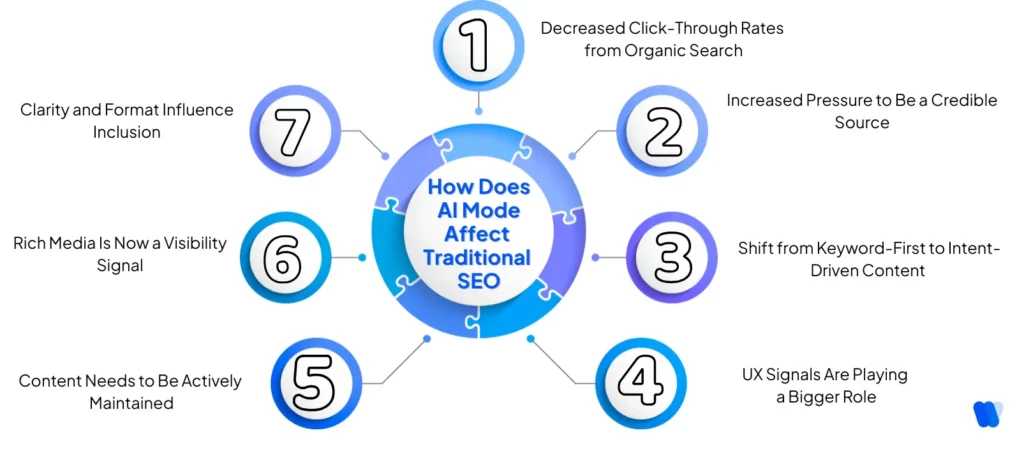
1. Decreased Click-Through Rates from Organic Search
When AI Mode generates answers within the search interface, users often get what they need without ever leaving the results page. This reduces the volume of clicks to websites—even those ranking in the top organic positions.
It’s the same pattern we’ve already seen: SEO doesn’t work in ChatGPT because there’s no SERP to click through—only AI-generated snapshots.
This is why ranking signals in ChatGPT rely less on links and more on whether your content is structured, authoritative, and extractable by the model.
Example:
A user searches “Is oat milk good for toddlers?” Instead of clicking through to parenting blogs or health sites, they’re shown an AI-generated snapshot that includes a quick answer, expert references, and perhaps a product suggestion. Sites that might’ve earned traffic from this query now appear lower in the scroll or not at all.
2. Increased Pressure to Be a Credible Source
To be featured in AI summaries, your content needs to reflect expertise, clarity, and trust. Google AI Mode prioritizes sources that are both topically authoritative and structurally sound. It’s no longer enough to just rank—your site must demonstrate that it’s a reliable source worth quoting.
Google also emphasizes security features of Google AI Mode by surfacing results from trusted, verifiable sources and filtering out low-quality or misleading content.
Example:
Two financial blogs explain “how to file self-employed taxes.” The one with clear explanations, verified examples, and structured formatting (e.g., step-by-step guides, FAQs) has a better chance of appearing in the AI summary than a loosely written opinion piece—even if both rank on page one.
3. Shift from Keyword-First to Intent-Driven Content
Keyword targeting is no longer the primary signal. AI Mode leans into semantic search—understanding meaning, relationships, and context. It favors content that comprehensively addresses the intent behind a query, not just the query itself.
Example:
Instead of just matching a phrase like “best AI tools,” Google’s AI Mode looks for content that differentiates tools by use case, includes real user scenarios, and addresses common objections—all of which reflect deeper understanding and usefulness.
4. UX Signals Are Playing a Bigger Role
User experience isn’t just for bounce rates anymore—it now influences how trustworthy your site appears to AI. Pages that are mobile-friendly, fast-loading, and logically structured are more likely to be considered for inclusion in generated answers.
Example:
If two recipe blogs explain “how to make banana bread,” but one has intrusive ads and pop-ups while the other is clean and responsive, the latter is more likely to be referenced—even if both have similar content.
To keep your writing clear and genuinely human (while still structured for AI extraction), polish the final draft using the free AI Humanizer tool by Wellows.
5. Content Needs to Be Actively Maintained
Outdated content—even if it ranks—can get ignored by generative engines. This aligns closely with pattern recognition in GEO and Google’s focus on freshness signals
That drop in visibility over time is often caused by content decay—when pages slowly lose impressions, citations, and relevance signals even without a major algorithm hit.
AI Mode seeks out information that reflects current standards, examples, and practices. Recency, revision history, and freshness signals now matter more than ever.
Example:
If you wrote a popular guide on “remote work tools” in 2021 and haven’t updated it since, Google’s AI is more likely to surface content from 2024–2025 that includes the latest platforms and team workflows.
6. Rich Media Is Now a Visibility Signal
AI Mode enhances search results with imagery, video, and other visual assets. Pages that incorporate helpful media alongside well-structured text have a higher likelihood of appearing in featured formats.
Example:
In a query like “how to install a ceiling fan,” a step-by-step blog post with embedded diagrams or a tutorial video will provide more value to the AI engine—and therefore stand a better chance of being cited in the summary.
7. Clarity and Format Influence Inclusion
AI Mode prefers content that is easy to interpret—both for users and machines. Clearly labeled sections, natural language, and a logical content hierarchy help AI engines parse, extract, and present your content accurately.
Example:
A product comparison article that uses clean tables, bullet points, and concise summaries will outperform a long, paragraph-heavy writeup with the same information. Structure isn’t just about readability—it’s now about retrievability.
Does Google AI Mode In SGE Use Different Ranking Signals Than Organic Search?
Yes. AI Mode uses a different selection process than classic organic search, even though normal SEO still matters for getting indexed. Organic search ranks a full list of results. AI Mode first pulls a smaller, best-fit set of pages to “ground” its AI answer, then summarizes from those sources.
Here’s what’s different:
- Fast, narrow retrieval vs. broad ranking: AI Mode runs a faster retrieval layer that surfaces only a few top pages quickly, instead of ranking thousands like standard search.
- Embedding-based relevance (RankEmbed): This layer uses embedding signals to choose sources by semantic match, not only traditional link signals.
- Higher weight on entity trust and topical authority: AI Mode prefers sources Google already recognizes as credible entities with strong depth on that specific topic. A page can rank well organically but still not be picked if it lacks those authority signals.
- Structure and extractability matter more: Clear headings, short direct answers, lists/steps, and clean schema make it easier for AI Mode to extract and cite your content.
- Less reliance on live user behavior: Traditional rankings can shift with CTR and engagement. AI Mode focuses more on speed, relevance, and pre-existing trust than on real-time clicks.
Thus, Organic SEO gets you into the pool, but AI Mode rewards the page that is most relevant, trustworthy, and easy to summarize for that exact question — not just the site with the strongest DA.
How to Optimize for Google AI Mode Without Abandoning SEO?
As Google’s AI Mode starts shaping the future of search, the question isn’t “should we adapt?”—it’s “how fast can we align?” You don’t need to discard everything traditional SEO has taught you, but you do need to shift your lens.
Here’s how to do just that—with practical strategies that balance visibility in generative AI answers and credibility in traditional results.
Rethink What “Performance” Means in the AI Era
It’s time to move beyond vanity metrics. Traditional traffic and rankings still matter, but they no longer paint the full picture—especially when an AI Overviews Tracker can reveal whether your pages are being surfaced or cited inside AI-generated answers even as click-through rates soften. Google AI Mode changes how people consume content—often delivering what they need directly in the AI Snapshot without ever clicking through. Teams choosing a dedicated platform to track this across engines often start by benchmarking Profound; our roundup of the best alternatives of tryprofound compares nine AI visibility trackers on citation depth and cross-engine coverage.
What this means for you:
- A drop in clicks doesn’t always equal a drop in value. Look at how users are engaging with your brand across channels.
- Consider tracking visibility in AI Overviews, branded mentions in queries, or presence in “People also ask” follow-ups.
- Combine classic metrics (CTR, bounce rate) with broader signals—like conversions, quote mentions in AI tools, or even time-on-page from indirect visits.
Example: HubSpot saw an 80% traffic dip but a 21% revenue increase—proof that visibility and value are no longer synonymous with traffic alone.
Build Content That Answers Before It’s Asked
Google AI Mode prioritizes content that anticipates the user’s next move. That means your pages should solve more than just the query—they should resolve the context around it.
Structure matters here:
- Answer the core question in the first 2–3 sentences.
- Layer in supporting insights, examples, comparisons, and follow-ups.
- Use subheadings that reflect real search intent—not vague marketing language.
Instead of: “Our Ultimate Guide to Website Performance”
Try: “What Slows Down Your Website? (And How to Fix It)”
Prioritize Conversational Formatting
Google AI Mode thrives on clarity. Its responses mimic natural language—so your content should too.
- Use shorter paragraphs.
- Write as if you’re responding in a live conversation.
- Break long explanations into bulleted points, mini-sections, or FAQs.
Bonus: This doesn’t just help AI interpret your content. It also makes your writing more accessible to users skimming or scanning for quick insights.
Strengthen Your Topical Authority, Not Just Domain Authority
In a world where AI tools pull answers based on credibility, “who said it” matters more than ever. That’s where E-E-A-T (Experience, Expertise, Authority, Trust) comes in.
Ways to build that trust:
- Showcase real authorship: Add bios, credentials, or bylines from subject matter experts.
- Use first-hand insights, internal data, or original research.
- Earn reputable mentions on external platforms (Reddit, Quora, LinkedIn, etc.).
- Contribute guest posts or be featured in articles around your niche—your brand’s reputation now builds outside the site, too.
Remember: AI models are trained on datasets pulled from across the web. Make sure you’re present wherever your topic lives.
Target the “Next Step” Queries That AI Can’t Fully Resolve
Even the best AI summary can’t do everything. Think product demos, pricing details, user reviews, in-depth comparisons.
This is your opportunity:
- Own long-tail queries and informational deep dives.
- Create content that complements AI Mode’s summaries—not competes with them.
- Build explainer videos, customer stories, downloadable tools, and templates.
For example: If AI summarizes “how to write a press release,” your site should go deeper—offering actual templates, real examples, and step-by-step instructions.
Focus on Structured Content That’s Easy for AI to Parse
AI Mode favors content it can break down. That means well-formatted, easy-to-process sections—not text walls.
Here’s how to make your content AI-friendly:
- Use question-based H2s and H3s.
- Include lists, tables, charts, and clear takeaways.
- Add schema markup where possible (FAQs, How-Tos, Products, etc.).
- Use semantic keywords to improve relevance across related concepts.
Think of each page as something Google could quote, surface, and reuse. Make every line count.
Double Down on Evergreen, Always-Relevant Content
With AI Mode surfacing context over clicks, content that ages well earns more long-term value.
- Regularly update core pages.
- Create cornerstone content for your most important topics.
- Refresh data, references, and examples every few months.
- Link new posts to existing hubs to reinforce topical depth.
Consistency builds familiarity, and familiarity breeds inclusion in AI-generated answers.
Use Visuals and Multimedia to Expand Discoverability
AI Mode now features shopping results, product previews, and image-rich responses. You need to think beyond text.
Try:
- Adding high-quality images with descriptive alt text
- Embedding videos for product demos or walkthroughs
- Using infographics to simplify complex topics
- Optimizing product listings through Google Merchant Center
If your content helps users visualize solutions, AI Mode is more likely to include it in visually enhanced summaries.
Optimize for Conversational Search and Follow-Up Prompts
Google AI Mode isn’t a one-click experience. It invites users to dig deeper with suggested follow-up queries.
You can win this space by:
- Creating pages that anticipate secondary questions
- Adding internal links to related content clusters
- Designing FAQs that reflect real conversational prompts
- Using schema to mark up key interactions
The more your site mirrors the structure of a helpful assistant, the better its chance of becoming one.
Adapt to New KPIs and Measurement Models
SEO tools aren’t fully prepared for AI Mode visibility yet—but you can still prepare your stack.
Track:
- Branded searches over time
- Increases in average engagement per visit
- Conversion performance from AI-related queries
- Indirect AI traffic via GA4 and custom source tagging
You’re not just chasing traffic anymore. You’re earning representation.
Embrace “Search Everywhere” Thinking
Google isn’t the only game in town anymore. ChatGPT, Perplexity, Gemini—search is happening across interfaces.
This means:
- Repurpose long-form blogs into short videos or carousel posts
- Answer questions on Reddit, LinkedIn, and TikTok
- Participate in community threads, webinars, and podcasts
- Think in content ecosystems, not one-offs
This isn’t about being everywhere at once, it’s about reinforcing your expertise in the places that train the next generation of search. Hence, just as SEO once meant learning how to rank on Google, today it also means learning how to rank on ChatGPT and other LLMs.
This means the focus is now on crafting content that shows up in AI-driven responses, training models through structured information, and building visibility in conversational discovery.
Comparison of Google AI mode with competitors
While tools like ChatGPT and Perplexity provide conversational search, they operate outside Google’s ecosystem.
See our ChatGPT search visibility tips and Perplexity visibility tips for platform-specific strategies
Google AI Mode is unique because it integrates directly into Search, combining Gemini’s generative intelligence with Google’s vast index and Shopping Graph. This means results are not only conversational but also seamlessly tied to the web pages, products, and publishers that Google already ranks.
How Does Bing Copilot’s AI Mode Compare To Google’s AI Mode For Visibility?
Bing Copilot AI Mode and Google AI Mode both use generative AI to answer searches inside their own interfaces, but they create different visibility paths for brands. Google AI Mode lives directly inside Google Search, so visibility depends on being cited inside the AI answer.
Bing Copilot works more like an assistant layered into Bing and the Edge browser, so visibility depends on whether Copilot pulls your page into its grounded responses while helping users explore or complete tasks.
Google AI Mode (inside Google Search):
Google AI Mode is a conversational layer in Search powered by Gemini. It generates a multi-source answer at the top of the SERP, and then links out to supporting pages. Because the answer often satisfies intent on the spot, the visibility win is shifting from “rank #1” to “get referenced in the AI response.”
Google is also upgrading the model behind AI Mode over time (for example, rolling out Gemini 3 improvements to AI Mode).
Bing Copilot AI Mode (inside Bing + Edge):
Bing Copilot’s AI Mode is tied to Microsoft Copilot in Bing and Edge. It helps users summarize pages, compare options across tabs, and move through tasks using one Copilot input. So it feels less like “a new SERP replacing links,” and more like “AI-assisted browsing.” Your visibility here grows when Copilot chooses your page as a source during those assisted flows.
What this means for visibility:
Google’s AI Mode is more disruptive for classic SEO because it sits above organic results in the core SERP. Bing Copilot can still drive valuable exposure, but it’s more contextual — showing up when users are browsing with Copilot help, not necessarily dominating the results page itself.
Practically, Google AI Mode increases the need to optimize for citation and extractable answers, while Bing Copilot rewards content that’s easy to ground and useful during task-style discovery.
| Feature | Google AI Mode | Bing Copilot AI Mode |
|---|---|---|
| Where It Appears | Inside Google Search, above organic results | Inside Bing/Copilot and Edge browsing |
| Answer Style | SERP-first AI summary grounded in multiple sources | AI assistant answers + tab/context-aware summaries |
| Main Visibility Driver | Being cited in AI answers for target queries | Being referenced during Copilot tasks/flows |
| Traffic Pattern | More zero-click risk when the AI answer satisfies intent | More assisted clicks during guided browsing |
| Best Fit Queries | Comparative, exploratory, multi-step searches | Task help, comparisons, browsing support |
When users move into Google AI Mode, your ads don’t disappear — but the way people discover and click them changes. AI Mode shows an AI-generated answer first (with cited links inside it), so attention shifts from scanning blue links to reading the summary. That means visibility is still possible, but clicks can behave differently.
Here’s what typically changes for advertisers:
- More “answer-first” journeys: Users often get what they need inside the AI response before they scroll, so traditional ad clicks can drop even if impressions stay stable.
- Higher zero-click pressure: AI summaries satisfy informational intent fast, so fewer users feel the need to visit external sites — and paid CTR can feel that ripple effect.
- Queries get longer and more specific: AI Mode encourages follow-ups and multi-part questions, so you’ll see more conversational, long-tail searches. Your keyword coverage needs to match that shift.
- Competition moves upward: Your ads now compete with the AI answer layer, not just other ads and organic links.
AI Mode doesn’t kill Google Ads, but it changes the click economy. Winning attention now depends on matching intent faster, cleaner, and more directly.
Will My Robots.txt Or Meta Tags Block AI Mode From Crawling My Content?
Mostly yes — if you block Google properly, AI Mode won’t be able to use your pages. Google AI Mode (and AI Overviews) are built on the same crawling + indexing system as normal Search. So the standard controls you already use for Google Search apply here too.
Here’s how it works:
1) robots.txt blocks crawling site-wide.
If a URL is disallowed in robots.txt, Googlebot can’t crawl it, meaning it can’t be indexed or used inside AI Mode summaries. This is the strongest “don’t fetch my content” switch for Google surfaces.
2) Meta robots and X-Robots-Tag control indexing + AI reuse.
If Google can crawl the page, you can still stop it from being indexed or shown in AI answers using tags like:
- noindex → keeps the page out of Search results and AI Mode.
- nosnippet / data-nosnippet → lets Google index the page, but blocks it from showing text snippets in Search and AI features.
- max-snippet:0 → allows indexing, but prevents Google from quoting your text in AI Overviews/AI Mode.
Google has explicitly confirmed that these snippet controls apply to AI Overviews and AI Mode, not just blue-link Search.
3) The limitation: these rules only work for compliant bots.
For Google, these controls are reliable. But outside Google, some AI scrapers have been reported bypassing robots.txt and similar standards, meaning these files can’t guarantee full protection from every AI crawler on the web.
Use robots.txt when you want Google AI Mode to stay completely out. Use meta robots/snippet tags when you want indexing but don’t want your text reused in AI answers. And if your bigger worry is non-Google AI scraping, combine these with bot protection or WAF rules.
What This Means for the Future of Search
Google AI Mode isn’t here to replace search—it’s here to reshape how people experience it. The search results we’ve known for decades are giving way to something faster, more conversational, and context-aware. And that means the way we approach SEO needs to shift too.
It’s no longer just about climbing to the top of the blue links. It’s about being findable in the new places users are paying attention to, AI snapshots, dynamic summaries, and conversational follow-ups. Generative engine visibility factors aren’t one-dimensional.
AI Mode is just one example of Google’s contributions to AI advancements, joining innovations like Gemini, Shopping Graph, and multimodal search features. Exploring Google AI technologies gives us a broader view of how Google continues to push the boundaries of artificial intelligence and integrate it into everyday tools.
This doesn’t mean abandoning what’s worked. Technical SEO, great UX, and E-E-A-T principles still matter. But now, we have to pair that with content strategies that anticipate user intent, align with generative models, and help Google’s AI understand not just what we’re saying—but why it matters.
So in the end, it’s not about chasing algorithms. It’s about meeting users where they are—and they’re already in AI Mode.
Read More Articles
- AI Algorithm Updates: SEO Impact & Recovery Tips
- Does Google Ranking Ensure Visibility in ChatGPT
- Effective LLM Citation Strategies for SEO Success
- Bridging Google Rankings and LLM Citations Gap
- 6 GEO + SEO Myths That Are Costing You Visibility
- How to Strengthen Brand Signals for Generative Engine Optimization?
- Can GSC Data Guide Your GEO Strategy?
- How to Design Content Briefs for GEO?
- My ChatGPT Visibility Experiment: Does It Use Google Snippets?
- Content Governance
FAQs
Google AI Mode is a new search experience that uses generative AI to provide instant, contextual answers directly on the results page. Instead of sending users to a list of links, it delivers summarized insights supported by trusted sources—offering a more interactive, assistant-style experience.
AI Mode is currently in phased rollout, primarily available in English within the U.S. If you haven’t opted in via Google Labs or your region isn’t supported yet, the feature may not appear. Keep an eye out as it’s expected to expand globally later in 2025.
Yes, it shifts the focus from rankings and CTR to visibility and content quality. Instead of competing only for page-one results, brands now need to optimize for inclusion in AI-generated snapshots—prioritizing clarity, structure, and topical authority.
Think conversational and comprehensive. Write clear, structured answers, use semantic-rich headings, and incorporate schema markup where applicable. Google AI Mode favors helpful, reliable content that answers intent-driven queries thoroughly and efficiently.
Conclusion
Google’s AI Mode is the tipping point where search shifts from ranking links to surfacing trusted, quotable answers. Winning now means building intent-driven, structured, entity-rich content, backed by great UX, fresh updates, and helpful visuals—then measuring impact beyond clicks.
Don’t abandon SEO; evolve it into GEO by becoming the expert source AI chooses to cite. Start today: audit your key pages for clarity, schema, and topical depth so you’re findable where users already are—inside AI snapshots.