Pattern Recognition in GEO is changing SEO faster than rankings ever did.
Not too long ago, SEO was about finding patterns in what people searched—spotting popular keywords, tracking click-through rates, and tweaking metadata. The goal was simple: make content show up.
But Generative Engine Optimization (GEO) isn’t about showing up. It’s about being chosen.
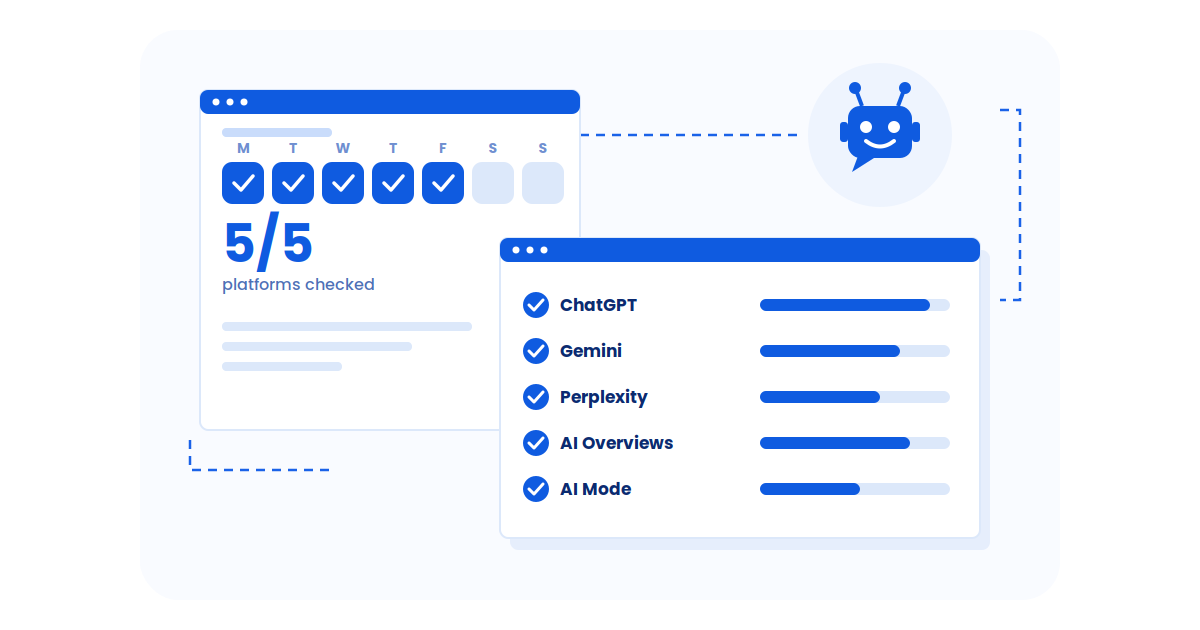
Today’s AI-powered engines like ChatGPT, Gemini, and Google’s AI Mode aren’t looking at your page the way a human might. They’re scanning it for recognizable patterns—semantic signals, formatting structures, and language cues that match the user’s deeper intent.
And here’s the thing: if your content doesn’t follow any pattern the model recognizes, you don’t just miss ranking—you miss retrieval altogether, especially as AI answer variability causes generative engines to surface different sources across similar prompts.
In this blog, we’ll break down what pattern recognition really means inside GEO, why it’s the hidden lever behind AI-driven visibility, and how you can write in a way that gets picked, parsed, and placed into answers.
Let’s explore how pattern recognition is quietly shaping the future of content visibility in generative search. This blog focuses on the GEO pattern so you understand exactly what it means in the context of AI-driven content visibility.
TL;DR
- GEO is about being chosen in AI answers, not just ranking.
- LLMs surface content that fits recognized patterns (structure + semantics).
- If your content doesn’t match those patterns, it won’t be retrieved or cited.
- Use Q&As, lists, comparisons, schema, and topical clusters to boost pattern fit.
- Wellows helps by turning keywords into AI-style queries and pattern guidance for LLM-ready drafts.
What Does Pattern Recognition Mean?
Pattern recognition refers to the ability of algorithms to identify recurring themes, relationships, and trends across massive datasets. In simpler terms, it’s how machines detect what typically happens, and what’s likely to happen next.
In the GEO context, pattern recognition refers to how generative engines use embeddings, structures, and semantic cues to decide what content to surface.
This process allows algorithms to move beyond surface-level inputs. Instead of just reacting to what’s typed, they begin to understand behavior, context, and intent. That’s what makes AI feel intuitive: its ability to spot familiar patterns and apply them in new ways.
Pattern recognition shows up in everyday examples like:
- Recommending products based on past purchases
- Finishing your sentence as you type
- Sorting emails into spam or not spam
- Suggesting what video you might like next
Pattern Recognition in GEO is all about identifying statistical relationships and turning them into predictions.
Instead of “looking up” your page like Google, LLMs scan for familiar content shapes and signals they’ve learned before. If your writing fits those patterns, it gets pulled into answers. If not, it gets skipped.
How Pattern Recognition Works in GEO?
To understand how pattern recognition operates in Generative Engine Optimization (GEO), we first need to get one thing clear: LLMs (Large Language Models) aren’t databases. They don’t retrieve pre-written answers or index pages like traditional search engines. Instead, they predict, and what they predict depends entirely on the patterns they’ve learned during training.
This is a clear example of how pattern recognition is used in GEO, since generative engines predict which answers match user intent instead of recalling indexed pages.
Let’s break this down.
1. GEO Isn’t About Recall — It’s About Prediction
Traditional SEO relied on keyword-based matching. If your content had the right terms, links, and structure, you had a greater possibility of ranking. But in GEO, the generative engine visibility factors are different.
Modern solutions such as an AI Search Visibility Platform for Startups are helping brands understand how these engines predict and prioritize content. The language models don’t retrieve—they predict.
When a user asks, “What are the best productivity tools for remote teams?”, the generative engine doesn’t scan for exact matches. It breaks that question into semantic tasks and uses learned patterns to predict what a good answer would include:
- A ranked or comparative list
- Tool names with clear feature breakdowns
- Constraints (like “for remote teams”)
So if your content doesn’t structurally or semantically resemble how those answers are usually formed, it gets skipped. Read here if you want to learn about more differences between SEO vs. GEO.
2. It All Starts with Pattern-Encoded Embeddings
LLMs process language by turning words and phrases into embeddings—dense numerical representations of meaning. The closer two embeddings are in this vector space, the more semantically similar they are.
In GEO, this matters for two reasons:
- If your paragraph on “Notion vs Trello” structurally resembles thousands of similar comparison articles, the engine sees it as a recognizable match for that intent.
- If your phrasing, headings, or layout deviates too far from what the model is trained on, it may not know how to use your content—even if it’s accurate.
Pattern recognition here isn’t about surface similarity. It’s about deep alignment with how ideas are usually expressed.
3. Passage-Level Retrieval Requires Pattern Isolation
AI Mode doesn’t score entire pages. It uses passage-level scoring, where individual sections are evaluated for how well they answer a sub-intent.
So, if a model breaks a query into 10 subquestions, it needs clean, modular content blocks that map to each one —formats that frequently emerge from real user Q&As on Reddit for GEO.
That’s where pattern recognition becomes make-or-break. You need:
- Bullet points with clean formatting
- Declarative, answer-first sentences
- Side-by-side comparisons
- Consistent syntax for feature breakdowns
These aren’t UX gimmicks—they are how LLMs isolate patterns from passages to construct fluid, coherent answers. A How to Audit Brand Visibility on LLMs can reveal whether your passages are being cited or skipped by generative engines.
4. Neural Networks Track Language as Interconnected Probabilities
The model doesn’t “remember” facts. It recognizes probabilities: “What word, phrase, or structure usually follows this kind of query?”
For “What’s better for time-blocking—Notion or Trello?” The model has learned that what follows is likely a pros-and-cons table, followed by a verdict.
Your job in GEO isn’t to be the most original. It’s to be the most predictably useful. That predictability—when done well—gets rewarded because the model can plug your content into the logic chain without friction.
5. Pattern Fit Determines Visibility
In traditional search, optimization was about surface-level relevance. In GEO, it’s about pattern fit.
- Does your section fit into a fan-out sub-intent?
- Is your summary structured like other high-confidence sources?
- Do you mirror the common linguistic structure of answers in your niche?
If the answer is yes, you’re not just seen—you’re used. Because the model doesn’t just find content. It builds with it.
This explains why SEO Doesn’t Work in ChatGPT —without fitting recognized content patterns, even well-optimized SEO pages are ignored by generative engines, which is why many teams validate whether their content is being cited, paraphrased, or skipped entirely using a ChatGPT Visibility Tracker rather than relying on rankings alone.
Pattern recognition doesn’t start when a query is typed into a generative engine. It starts with how your content is written, structured, and semantically understood by the model. The goal isn’t just to “optimize” for keywords anymore — it’s to help large language models recognize your content as a clear, consistent, and complete match to the user’s intent.
And to do that, your content needs to speak in patterns the AI understands. Here’s how to structure for that:
How Do Pattern Types Impact Visibility in Generative Engines?
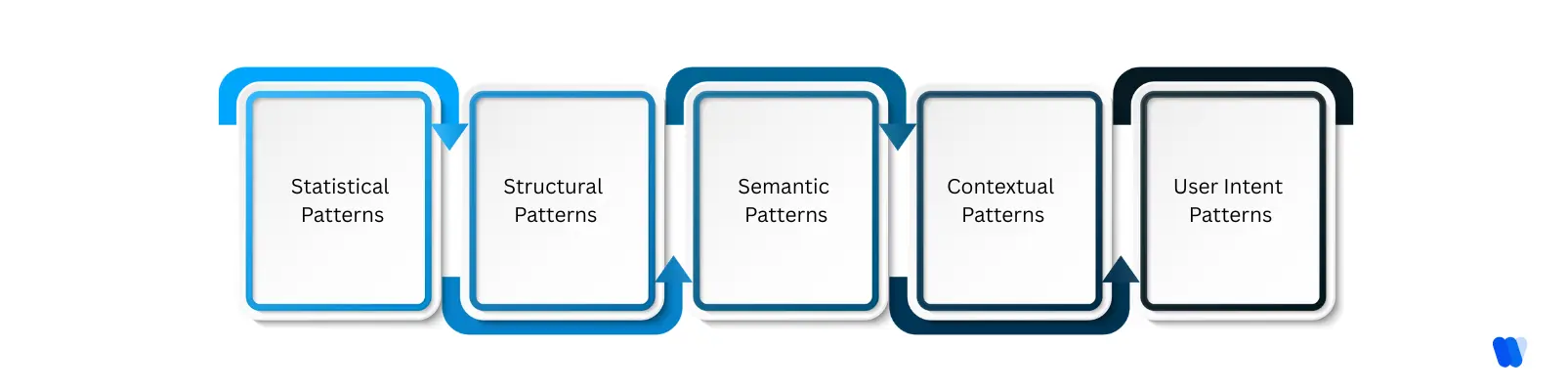
In Generative Engine Optimization (GEO), content must be engineered not just for human readers—but for how large language models (LLMs) recognize and synthesize information. These systems aren’t scanning content the way a human does. They’re identifying patterns—statistical, structural, semantic, and behavioral—that help them predict what information is most relevant.
Let’s break down the types of patterns that shape content visibility in GEO, with examples to make it clear. These types show what are the applications of GEO pattern recognition—from probability-driven structures to semantic clarity—each improving the chances of being surfaced in generative answers.
1. Statistical Patterns
LLMs like ChatGPT and Gemini rely on probabilities learned from training data. They don’t “know” facts; they calculate what word is likely to come next based on patterns they’ve seen before.
What it looks like:
- Using common Q&A structures (e.g., “What is X?”, “How does X work?”)
- Predictable sequences like “Top 5 tools for…” or “Step-by-step guide to…”
Example:
Query: What is CRM?
Content: “CRM stands for Customer Relationship Management. It helps businesses manage relationships with customers.”
This format matches high-probability patterns that LLMs are trained on—making it more likely to appear in generative answers.
2. Structural Patterns
LLMs break down content into retrievable parts. If your content is scattered or unstructured, it’s hard to surface. Structured content makes it easier to isolate meaningful fragments.
What it looks like:
- Clear hierarchy (H2 > H3 > bullet points)
- Short, skimmable sections
- Defined comparison blocks or pros/cons lists
Example:
Topic: Notion vs Trello
Structure:
- Ease of Use: Trello is better for simple boards.
- Customization: Notion allows more flexibility.
- Verdict: Use Trello for quick setups, Notion for complex workflows.
This format supports both fan-out subqueries and modular response generation.
3. Semantic Patterns
GEO content needs to be semantically rich—meaningful, unambiguous, and consistent. LLMs use word embeddings to group related concepts. The clearer your language, the stronger your content’s semantic profile.
What it looks like:
- Repeating full entity names (“Tesla CEO Elon Musk” instead of “he”)
- Using synonyms and related terms for topic clustering
- Explaining the role or context of an entity
Example:
Weak: “He made major investments in AI.”
Strong: “Elon Musk, the CEO of Tesla and founder of xAI, has made major investments in artificial intelligence startups like xAI and Neuralink.”
This helps LLMs recognize the entity and its relationships.
4. Contextual Patterns
Generative engines interpret meaning from context. Content that’s internally consistent—and externally connected—signals stronger contextual patterns.
What it looks like:
- Topical interlinking (from “AI in finance” to “Fraud detection with AI”)
- Referencing timely trends or authoritative sources
- Building content clusters that live together (a knowledge hub)
Example:
In an article about Remote Work Tools, you include:
- “ClickUp is a popular project management tool for remote teams.”
- Internal link: Best Time Tracking Apps for Remote Workers
- External link: ClickUp’s official pricing page
This layered context increases retrievability and perceived expertise.
5. User Intent Patterns
LLMs are trained to fulfill specific goals behind a query—known as user intent. If your content speaks directly to what the user wants (not just what they asked), it’s more likely to surface.
What it looks like:
- Matching depth to query complexity
- Delivering clear answers, steps, or verdicts
- Using headings like “Should You Use…” or “Is It Worth It?”
Example:
Query: Affordable DSLR cameras for beginners
Content:
- “Here are 3 budget-friendly DSLR cameras under $500.”
- “We compared them based on ease of use, image quality, and beginner tutorials.”
- “Our pick: Canon EOS Rebel T7—great starter, under $400.”
This anticipates the user’s real goal (a good, cheap camera that’s easy to use) and aligns with fan-out subqueries like “DSLRs under $500” or “best DSLR for photography beginners.”
How Wellows Supports Pattern Recognition in Generative Engines
In Wellows, pattern recognition is built directly into the content workflow. When you enter a keyword and move forward, you choose between Quick Generate or Build with Insights. Both paths are designed to surface the patterns LLMs recognize — so your draft lines up with how generative engines retrieve and cite content.

Once you proceed, the next layer you see is LLM Optimization paired with Brand Performance Metrics in AI Search so you can validate which patterns are actually earning citations and where visibility drops.
This section expands your keyword into AI-style queries and related angles, showing how engines fan out a single prompt into multiple sub-intents.
That query set becomes your real writing map: what to cover, what order to cover it in, and what phrasing matches the way users actually ask questions inside ChatGPT.
After that, Wellows gives you Pattern Analysis (OpenAI-powered). This is where the platform detects recurring structures and winning formats from high-performing AI-visible content. It highlights:
1. Actionable Guidance
Wellows surfaces tactics that repeatedly appear in content winning AI visibility — so you know what to include, how to structure it, and why it works.
2. Recurring Themes
These are the topic signals and angles that generative engines keep rewarding. By exposing them, Wellows helps you align with the “expected” patterns AI models look for.
3. Structured Approach
Wellows recommends repeatable answer structures (like Q&A blocks, comparison layouts, and step flows) based on real patterns found in cited content — making your pages easier for LLMs to parse and lift into responses.
Together, the query insights + OpenAI pattern layer act like a blueprint. They don’t just help you write faster — they help you write in shapes AI systems can recognize, extract, and trust. Inside Wellows, KIVA is the legacy drafting feature that uses these signals to turn your brief into a clean, LLM-ready draft.
Best Practices To Structure Content For Pattern Recognition In Generative Engines
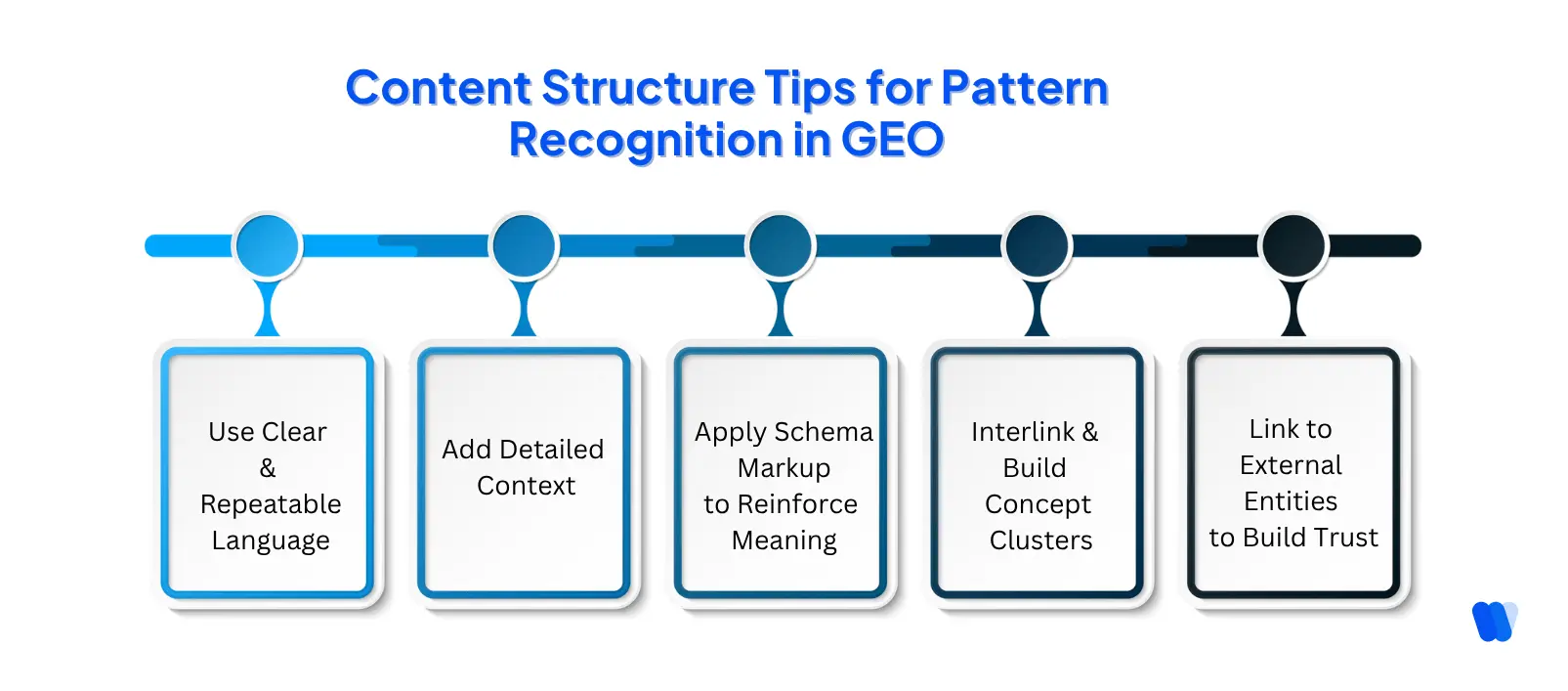
If LLMs surface content by recognizing repeatable patterns, then the fastest way to improve visibility is to write in formats they can easily predict, parse, and reuse.
Below are the best practices that make your content “pattern-friendly” for GEO — many of which are surfaced and validated when agencies use LLM audits for SEO to diagnose why content is or isn’t being retrieved.
- Answer user questions directly. Start sections with clear, intent-matching answers instead of long scene-setting.
- Use consistent entities and full names. Repeat key people, tools, and brand terms so models don’t lose context.
- Write in stable, reusable formats. Q&As, lists, comparisons, and step-by-step blocks are easiest for LLMs to lift.
- Add context that explains what something is and why it matters. Don’t assume the model already “knows” the role of an entity.
- Reinforce meaning with schema and structured headings. Clean hierarchy improves passage-level retrieval.
- Build topical clusters through internal + external linking. Clusters strengthen the model’s confidence in your authority.
1. Answer User Questions Directly
Generative engines prioritize passages that can stand alone as full answers.
So instead of building up slowly, lead with the takeaway first and expand after.
Example format that works:
“What is X?” → 1–2 line direct answer → supporting detail.
This matches fan-out intent patterns and makes your sections more retrievable.
2. Use Clear, Repeatable Language for Entities
LLMs don’t track references the way humans do. If you rely on “he,” “they,” or “this tool,” the pattern gets weak.
Instead of:
He led the company through multiple launches…
Do this:
Elon Musk, the CEO of Tesla, led the company through multiple launches…
Repetition improves semantic stability, which boosts pattern recognition.
3. Write in Stable, Reusable Formats
LLMs are trained on common answer shapes. If your content mirrors those shapes, it becomes easier to plug into AI responses.
Use formats like:
- Question → direct answer
- Top-X lists with short reasoning
- Pros/cons blocks
- Step-by-step how-tos
- Side-by-side comparisons
These structures help engines isolate passages cleanly.
4. Add Context — Don’t Assume Shared Knowledge
Pattern recognition strengthens when the model sees a clear subject → role → purpose relationship.
Weak:
GoHighLevel has great automation features.
Strong:
GoHighLevel, a CRM platform for digital marketing agencies, offers automation features that streamline onboarding and retention.
This gives the model a complete semantic pattern it can reuse accurately.
5. Reinforce Meaning With Schema and Structured Headings
Generative retrieval is passage-based. If your content hierarchy is messy, your best insights may never get extracted.
So make structure obvious:
- H2 for major intents
- H3 for sub-intents
- Bullets for answer blocks
- FAQ / HowTo schema where relevant
Schema doesn’t “rank” you in LLMs — it makes your meaning easier to verify and lift.
6. Build Topical Clusters With Internal + External Links
Patterns don’t only live inside one page — they form across connected pages.
Internal clusters show depth.
External references show trust.
If your GEO content is interlinked into a clear hub, LLMs recognize you as a stable source instead of a one-off paragraph.
It also plays a key role in how to increase citations on ChatGPT. When your content exists as part of a clearly connected knowledge cluster, generative engines are more likely to view you as a reliable reference point—making it more eligible to be cited in AI-generated answers.
If your GEO content is interlinked into a clear hub, LLMs recognize you as a stable source instead of a one-off paragraph. It also increases the semantic weight of your own writing , giving models a reason to include your material in generated answers and hence, giving you a higher benchmark against GEO KPIs.
Why Does Pattern Recognition in GEO Actually Matter?
Pattern Recognition in GEO isn’t a behind-the-scenes detail — it’s the main way generative engines decide what to use.
Unlike Google, which matches keywords and ranks links, LLMs work by spotting deep semantic patterns and predicting meaning from them. So to earn visibility, your content has to match the recurring intents, relationships, and answer formats these models trust.
That’s why structure, clear entity naming, and complete topic coverage matter so much. If the model recognizes your content as a high-confidence pattern fit, it selects and cites you. If it doesn’t, you’re invisible.
Bottom line: in AI search, being readable to pattern-based systems is how you show up — and stay found.
What Is The Future Of Pattern Recognition In Artificial Intelligence?
Pattern recognition is a cornerstone of artificial intelligence (AI). It enables systems to identify and interpret patterns within data, which supports tasks like image and speech recognition, anomaly detection, and predictive analytics. As AI continues to evolve, several trends are shaping the future of pattern recognition:
1. Integration With Edge Computing
Advancements in edge computing are moving pattern recognition closer to where data is created—like smartphones, wearables, and IoT devices. This reduces latency and improves privacy because analysis happens in real time on-device, instead of relying fully on the cloud.
2. Adoption Of Explainable AI (XAI)
As AI systems become more complex, understanding how they make decisions becomes critical. The future of pattern recognition includes stronger explainability, so machine decisions are more transparent and interpretable—especially in sensitive areas like healthcare and finance.
3. Advancements In Self-Supervised Learning
Traditional pattern recognition models need large labeled datasets, which are expensive and slow to build. Self-supervised learning is changing this by allowing models to learn from unlabeled data, spotting inherent structures and relationships. This improves performance even when labeled data is limited.
4. Development Of Neuromorphic Computing
Neuromorphic computing, inspired by how the human brain works, uses artificial neurons to perform computations. This approach aims to create energy-efficient, high-performance systems for complex recognition tasks like image and sound classification. These systems are more robust, adaptive, and scalable.
5. Emphasis On Human-AI Collaboration
The future of pattern recognition will rely more on human-AI collaboration. AI handles repetitive, data-heavy pattern detection, while humans apply judgment, intuition, and context. This partnership improves decision-making across industries like marketing, security, research, and product strategy.
What This Means For GEO And AI Search Visibility?
Generative engines such as ChatGPT, Gemini, and Google AI Mode rely on advanced pattern recognition to decide what content to surface. They look for recognizable structures, semantic clarity, and trust signals. That’s why brands need to align content with patterns LLMs understand.
As an AI Search Visibility Platform, Wellows helps teams track which patterns are being selected by AI engines, where their brand appears, and how to structure content so it matches retrieval and citation behavior across generative search.
Final Takeaway
In short, the future of pattern recognition in AI is moving toward systems that are more efficient, more transparent, and more collaborative. These shifts will strengthen AI’s ability to interpret complex data patterns—and will also define how content visibility works in AI-driven search.
Are There Privacy Concerns With Pattern Recognition In Generative AI Engines?
Yes — and they matter more as generative engines get better at spotting patterns across huge datasets. Pattern recognition is what helps LLMs answer well, but it’s also what creates privacy risk when the training data or live inputs include sensitive information.
Key Privacy Risks You Should Know
- Training data leakage: LLMs can sometimes reproduce parts of their training data. If that data included personal or confidential text, it may resurface in outputs. Real-world extraction attacks have shown that models can reveal fine-tuning data under certain conditions.
- Membership inference threats: Attackers may test whether a specific person, document, or dataset was used to train a model. This is a known privacy weakness in large language models.
- Re-identification (the “mosaic effect”): Even if data is anonymized, pattern matching across multiple sources can reconnect identities — especially when location, role, or behavioral details are present.
- Inference of sensitive attributes: Pattern recognition can allow models (or attackers) to infer private traits — like health status, political leaning, or income bracket — from indirect signals in text.
- Low transparency + unclear consent: Most users don’t know what data models were trained on, how their content might be used, or whether it can be removed later. This creates trust gaps.
How To Reduce Privacy Risk (Practical Best Practices)
- Strip PII before publishing: Remove names, emails, addresses, client identifiers, or internal ticket IDs from public content and case studies.
- Use safe examples: Replace real customer data with synthetic or aggregated examples that still preserve meaning but protect identity.
- Audit what your content reveals in AI answers: Test how ChatGPT, Gemini, and Perplexity summarize your pages. If private details are echoed, revise immediately.
- Keep author and brand info intentional: Add clear bios and entity context, but avoid inserting sensitive internal info just to “look credible.”
- Apply content governance rules: Define what can be published, who reviews it, and how updates are handled when AI surfaces outdated or risky text.
Bottom line: Pattern recognition makes generative engines powerful — but that same power can surface data you never meant to expose. So the best GEO strategy is one that grows visibility while keeping privacy guardrails on.
What Are The Limitations Of Pattern Recognition In Current Generative Engines?
Pattern recognition powers generative engines, but it also comes with clear limits:
Did you know?
- Mode collapse: Models can over-repeat a narrow set of outputs instead of showing real variety.
- No true understanding: They mimic patterns without a grounded “world model,” so answers can sound right but be wrong.
- Bias amplification: Any bias in training data can be repeated or even strengthened in outputs.
- Weak on rare cases: Uncommon facts or edge scenarios get missed because models favor frequent patterns.
- Hallucinations: They may confidently invent details when the pattern doesn’t fit reliable knowledge.
- Creativity ceiling: Outputs remix what they’ve seen; genuinely novel ideas are harder without new signals.
Read More Articles
- 6 GEO + SEO Myths That Are Costing You Visibility
- How to Use Digital PR for Generative Engine Visibility for Your Brand?
- How to Strengthen Brand Signals for Generative Engine Optimization?
- Can GSC Data Guide Your GEO Strategy?
- How to Design Content Briefs for GEO?
- How to Become a Trusted Source in AI Search
- How Does Google AI Visibility Tracking Fix the Search Console Blind Spot in AI Overviews
- AI SEO Automation for Generative Search Visibility (2026)
- How AI Search Marketing Strategies Target Semantic Search Intent (2026)
- How to rank in Perplexity
- How to Boost SEO with AI Content Ranking Strategies?
- How to Use Question Keywords for SEO Growth
- How to Optimize SEO Content Length for Higher Rankings?
FAQs
AI uses pattern recognition through a process called machine learning—where models are trained on large datasets to identify recurring relationships, trends, and structures. Instead of memorizing facts, AI learns how data points connect and uses those patterns to make predictions or generate responses in real-time.
To monitor brand visibility in AI-powered platforms like ChatGPT, Perplexity, and Google SGE, track how often your content is being cited, paraphrased, or referenced in AI answers. You can use tools like SEO testing environments, brand mention trackers, and conversational search audits to stay aware of your presence across generative engines.
General-purpose large language models like OpenAI’s GPT-4, Google’s Gemini, and Anthropic’s Claude excel at pattern recognition across text, behavior, and intent. For domain-specific recognition (e.g., medical or financial data), specialized AI models trained on narrow corpora often outperform broader systems.
To optimize for AI-driven search, structure your content around intent-specific tasks. Use clear headings, answer-first formats, and verified data. Incorporate entities, schema markup, and semantic linking to make your content easily retrievable, composable, and answer-worthy in generative responses.
It can repeat bias, remix content without clear credit, and sometimes surface private or sensitive data. Ethical GEO means pushing for transparency, bias audits, safe data use, and proper attribution.
Conclusion
Pattern Recognition in GEO is the real filter behind generative visibility. Your content isn’t competing only on “quality” anymore — it’s competing on whether an LLM can recognize your structure, entities, and intent fast enough to reuse it in an answer.
That’s why GEO strategy now means writing in predictable, extractable formats, backing your claims with context, and building connected topic hubs. When your pages match the patterns models trust, you don’t just show up — you get selected, summarized, and cited.
Final Key Takeaways
- Generative engines don’t rank pages like Google — they pick passages that fit trained patterns.
- If your content isn’t written in recognizable answer-shapes, it won’t be retrieved.
- Structure drives visibility: clean headings, short blocks, bullets, and comparisons win.
- Semantic clarity matters more than cleverness: repeat entities and add context.
- Topical clusters increase trust and citations by proving depth, not just relevance.
- Wellows helps you write for these patterns by expanding keywords into AI-style queries and surfacing proven formats through Pattern Recognition in GEO.