Brand signals decide whether AI engines mention you or ignore you—so if your brand isn’t showing up inside LLM answers, it’s not “just SEO” anymore. It’s a signal gap that many teams only discover after competing with brands already investing in structured visibility frameworks similar to those used by generative engine optimization agencies.
This page breaks down how credibility, consistency, and authority cues influence whether models like ChatGPT, Gemini, Claude, and Perplexity recognize, trust, and cite brands. And the timing is urgent:
Did you know?
Google’s AI Overviews already appear on about 13.14% of searches (March 2025), meaning a growing share of discovery now happens inside generated summaries—where only well-recognized entities get surfaced.(Semrush, 2025)
If you’re a SaaS marketer, founder, agency, or local business team, this guide is for you. You’ll learn what brand signals are, which ones matter most in 2025, how to measure them, and how to strengthen them in a repeatable way—so LLMs choose your brand, not just crawl your site.
Wellows analyzes how brands surface across AI search experiences by tracking citation patterns, entity recognition signals, and visibility inside generative answers. These insights help teams understand why certain brands get cited—and which signals actually move the needle.
That’s also why teams begin with a brand visibility audit on LLMs—it turns “brand signals” into a trackable baseline you can improve month over month.
We’ll also connect these tactics to findings from the ChatGPT Citations Report, so you can prioritize the signals that realistically drive citations instead of guessing.
TL;DR: Key Takeaways On GEO Brand Signals
- What GEO Brand Signals Really Are: Brand signals are the trust + identity cues LLMs use to decide if your brand is safe to mention—things like authority footprint, consistent entity info, proof-first expertise, third-party validation, and structured data clarity.
- Why They Decide AI Visibility Now: AI answers replace blue-link browsing. If your signals aren’t strong, models may ignore you even when your pages rank—because citations come from brands LLMs recognize as reliable entities, not just optimized URLs.
- Which Signals Matter Most in 2025: The signals that most predict citations are: authority/trust, evidence-backed expertise (E-E-A-T), visible freshness, entity consistency across the web, third-party mentions/reviews, schema for brand clarity, and cross-web reach.
- What This Guide Helps You Do: You’ll learn how to identify your current signal gaps, measure them against competitors, and strengthen each cue systematically so LLMs choose your brand inside answers—not just crawl your site.
What Are Brand Signals?
Brand signals are the reputation and identity markers that shape how both humans and AI models interpret your authority. In generative search, they act like “trust inputs” that LLMs use to decide whether your brand is credible enough to summarize, mention, or cite—following the same logic that determines how brands get recommended in AI search engines.
In practice, brand signals include verified reviews, expert or media mentions, clear author attribution, consistent online profiles, strong internal linking, and machine-readable structured data—all reinforced by disciplined on-page SEO that ensures those signals are structured, crawlable, and extractable by AI systems.
Signals that directly influence how brands earn mentions in AI search. They also overlap with answer engine optimization because the answer-first structure makes these cues easier for AI systems to extract and reuse.
One 2025 citation study based on SE Ranking’s analysis of 129,000 domains found that referring-domain authority is the strongest predictor of being cited in ChatGPT answers, meaning brands with deeper, higher-trust backlink footprints show up far more often in AI outputs. (Stan Ventures, 2025)
For GEO, the goal is simple: make your brand easy to recognize as a real entity, easy to trust as an authority, and easy to cite as a source —because that’s the foundation of how to rank in chatgpt consistently.
To keep that outcome measurable (not just theoretical), teams often pair their signal work with a Perplexity Visibility Tracker to confirm whether they’re actually earning citations and brand mentions for the prompts that matter. And then apply fixes based on how to rank in Perplexity.
When they’re fragmented, your content gets ignored even if it ranks.
Which GEO Brand Signals Influence LLM Citations Most in 2025?
GEO brand signals are the cues generative AI systems use to decide which brands are credible enough to mention or cite. Large-scale citation studies from 2025 show that a small, repeatable set of signals predicts which brands get pulled into answers. If you want to prioritize faster, a brand visibility audit on LLMs will show which of these signals correlates most with your current citation wins (and losses).
Below are the core signals to prioritize before you move into implementation.
- 1. Authority Footprint (Referring Domains + Domain Trust):
LLMs lean on authority as a trust shortcut. 2025 citation research shows that brands with stronger referring-domain profiles and higher domain trust are cited more frequently, because these signals reduce uncertainty about reliability at retrieval time.
- 2. Proof-First Expertise (E-E-A-T Cues):
AI models reward pages that demonstrate experience and expertise through concrete proof. In 2025 studies, content that clearly shows real-world outcomes, expert framing, and verifiable claims earns citations at higher rates than generic “SEO-style” articles.
- 3. Freshness Signals (Visible Recency + Updates):
Generative engines prefer sources that look current. Cited pages in 2025 datasets skew newer and more recently updated than non-cited peers, indicating that recency still acts like a ranking filter for AI-selected sources.
- 4. Entity Consistency (One Clear Brand Identity Everywhere):
LLMs build brand understanding from repeated, consistent identity signals. When your name, positioning, products, or people appear differently across the web, entity confidence drops—making your brand less likely to be selected during answer generation.
- 5. Third-Party Validation (Reviews + Independent Mentions):
Independent proof functions as machine-readable trust. 2025 citation analyses show that review pages, community mentions, and editorial references are disproportionately represented among cited sources, especially for commercial and “best tool” queries.
- 6. Structured Clarity (Schema + Brand Markup):
Schema reduces ambiguity for retrieval systems. Consistent Organization, Product, Person, Review, and FAQ markup helps models verify brand facts quickly, making your content easier to reuse and cite accurately.
- 7. Discoverability Reach (Traffic + Cross-Web Visibility):
Citations don’t require #1 rankings, but they do require visibility. 2025 findings indicate that once brands cross certain reach/traffic thresholds, AI systems treat them as more widely validated—raising selection probability.
Placement: Add this H2 right after your “What Are Brand Signals?” section and before “How Brand Signal Strengthening Strategies Increase LLM Recognition?” This keeps the flow clean: define signals → rank the signals that matter → then teach how to build them.
How Brand Signal Strengthening Strategies Increase LLM Recognition?
If you want to show up in AI-generated answers, your brand has to send the right signals, loud and clear. Here are the brand elements that help LLMs recognize, trust, and cite you, thus helpful in generative engine optimization:
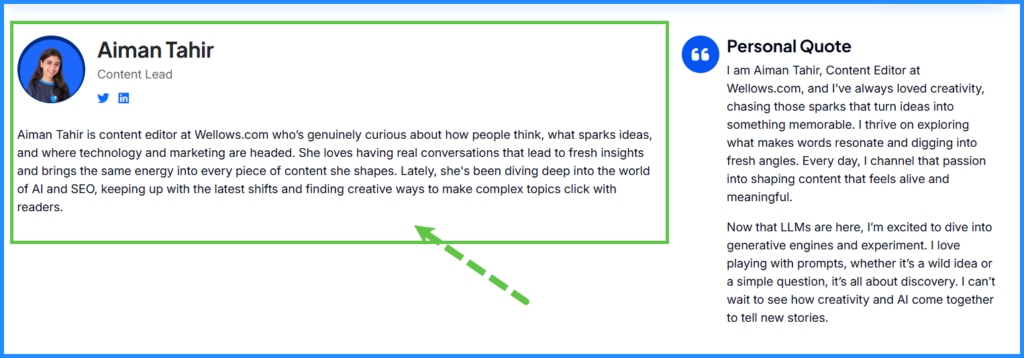
1. Author Attribution Systems Establish Content Credibility
Add robust author bios to every piece of content. Include:
- Full name and photo
- Role and company
- Credentials (certifications, degrees)
- Links to other content or social profiles (e.g., LinkedIn, Twitter)
Bonus: Use schema markup like Person, Author, or Review to help machines parse this information.
Did you know?
Why it matters:
Generative AI systems are trained to value human experience and authority. The clearer your authorship signals, the higher the credibility and the more likely your content will be referenced in responses.
These author bios are not just content details—they act as brand reputation signals that LLMs use to evaluate credibility. To make sure those bios (and any AI-assisted edits) still sound genuinely human and aligned with your voice, polish them with the free AI Humanizer tool by Wellows before publishing.
2. Content Quality Audits Eliminate Trust Degradation
Do a quarterly content audit. For each page, ask:
- Is the information current and relevant?
- Is the formatting clean and scannable?
- Does it match your brand’s tone and expertise?
Remove low-quality content or redirect irrelevant pages. Refresh strong evergreen content with updated facts, internal links, and improved clarity.
Did you know?
Why it matters:Language model algorithms evaluate your site holistically. Weak or stale content lowers your domain’s perceived quality—even if your flagship pages are strong. And since SEO doesn’t work in ChatGPT to boost weak content, quality signals are the only way to stay visible.”
Analyzing Brand Signals for Content Quality
Audits aren’t just about fixing broken links or updating facts—they’re about analyzing brand signals end to end. Even strong authority and mentions can be weakened by Technical SEO Issues that prevent AI systems from reliably accessing, parsing, or trusting your pages, which is why auditing Brand Visibility on LLMs is essential to ensure models interpret your brand accurately.
Integrating Google Ranking and ChatGPT visibility into your auditing process allows you to see the full picture of how your authority translates from traditional search results to conversational AI answers.
Leveraging an AI Search Visibility Platform for Startups can simplify this process by providing real-time insights into how your content is recognized across generative engines.
Check whether reviews, structured data, and schema markup are consistent across your content. Evaluate how often your brand is mentioned, cited, or trusted across platforms. The stronger and more aligned these signals are, the easier it is for LLMs to treat your content as authoritative during response generation.
A full breakdown of how to strengthen brand signals for generative engine optimization shows step-by-step ways to align reviews, schema, and mentions into one cohesive authority footprint.”
After your content audit, use these solutions to correct outdated brand messaging that generative engines surface: Tip: Keep one canonical “Brand Statement” page and reuse its exact wording in schema, bios, and PR.Correcting Outdated Brand Messaging in Generative Search Results
3. Trust Signal Architecture Reinforces Brand Authority
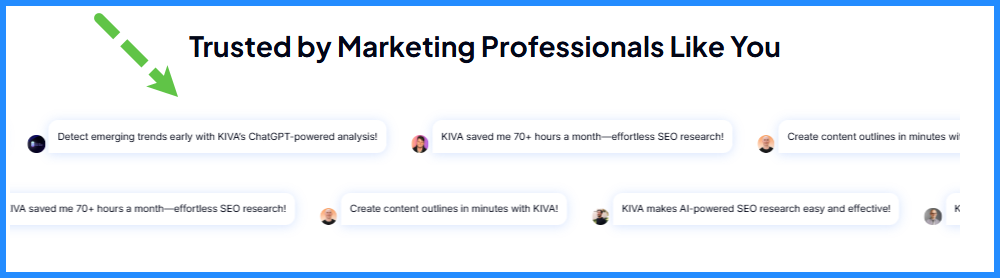
Trust is both technical and emotional. Across your site, reinforce trust by including:
- Contact forms and phone numbers
- Third-party review widgets (G2, Trustpilot, etc.)
- Trust badges (SSL, GDPR compliance, security certs)
- Real testimonials and case studies
Did you know?
Why it matters:These small details form a signal constellation—micro-credibility indicators that LLMs (and users) pick up on subconsciously.
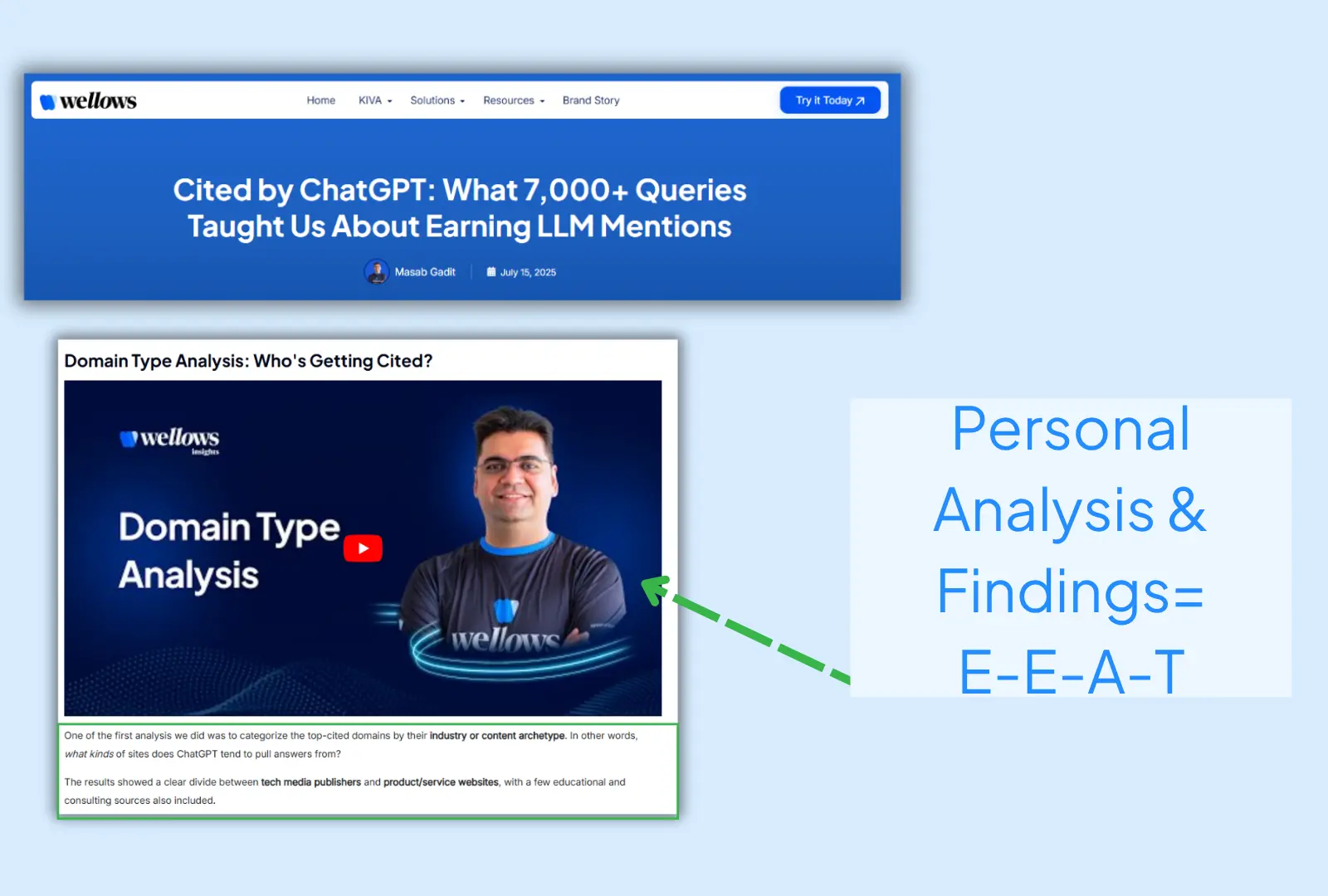
4. E-E-A-T Implementation Frameworks Generate Citation Confidence
Make sure your content consistently reflects:
- Experience: First-hand case studies, results, lessons learned
- Expertise: SME input, credentials, certifications
- Authoritativeness: Quotes in industry news, backlinks from niche sources
- Trustworthiness: Transparent sourcing, clear disclaimers, balanced tone
These metrics score higher when SEO fundamentals and GEO tactics are aligned—essentially when you combine SEO and GEO.
Did you know?
Why it matters:E-E-A-T principles are foundational to how Google and LLMs assess credibility. Even if not explicitly labeled in AI models, they are deeply baked into AI sourcing patterns. E-E-A-T optimization connects directly to your LLM seeding methodology, where authoritative content positioning increases citation probability.
You can further strengthen this by applying the most effective strategies for AI visibility enhancement, which expand beyond E-E-A-T into structured and technical GEO tactics.”
Your ChatGPT experiment results demonstrate that brands with stronger E-E-A-T signals receive more prominent mentions in AI-generated responses. While individual signal optimization matters, systematic measurement reveals which strategies generate the highest LLM citation rates.
Ways to Improve Brand Signals
Ways to improve brand signals include: verified author bios, consistent schema markup, mentions in niche publications, and proactive PR placements. Each reinforces your authority and ensures LLMs have multiple, reliable data points when generating answers.
Examples of effective brand signals:
– Verified Google Business reviews
– Mentions in top-tier publications
– Consistent author schema across blogs
– Case studies cited in industry reports
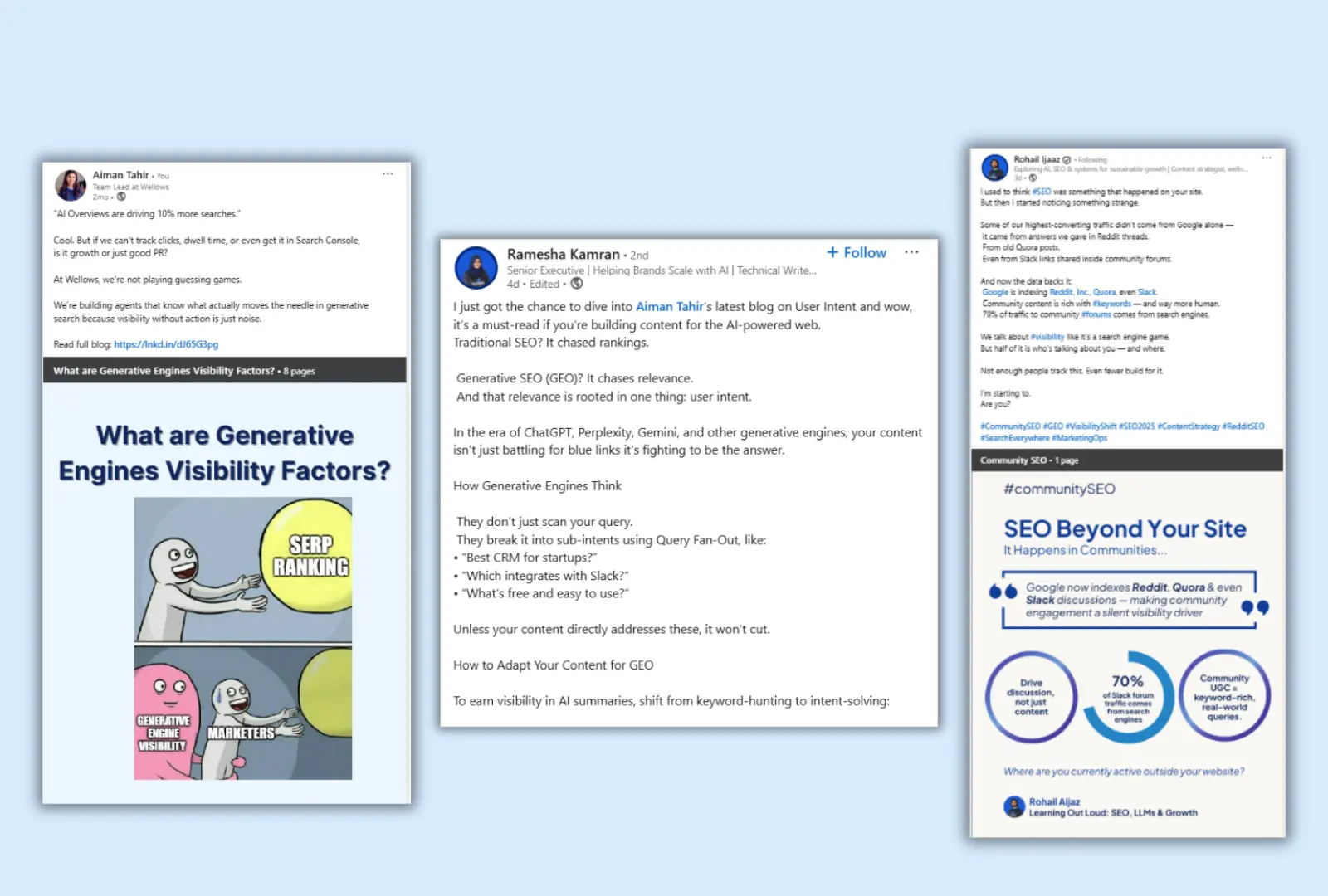
5. Expert Platform Presence Amplifies Topical Authority
Encourage team members to:
- Post regularly on LinkedIn
- Contribute guest blogs or Medium pieces
- Appear on webinars or podcasts
- Share takeaways from conferences
Consistent activity on LinkedIn, X, Reddit, and Discord creates
social brand signals, helping AI systems associate your brand with specific subject areas.
Did you know?
Why it matters:LLMs associate authors with topics. When individuals from your organization show up across reputable platforms, AI systems more easily connect that expertise back to your brand—improving visibility in AI-driven discovery experiences.
6. Brand Voice Consistency Creates Recognition Patterns
Develop a clear style guide that defines:
- Tone of voice
- Writing style
- Terminology and vocabulary
- Visual identity (colors, logo, image style)
Logos, imagery, and design consistency act as
visual brand signals that AI systems use for entity recognition.
Apply this consistently across:
- Blog content
- Social channels
- Community platforms (e.g., Reddit, Slack, Discord)
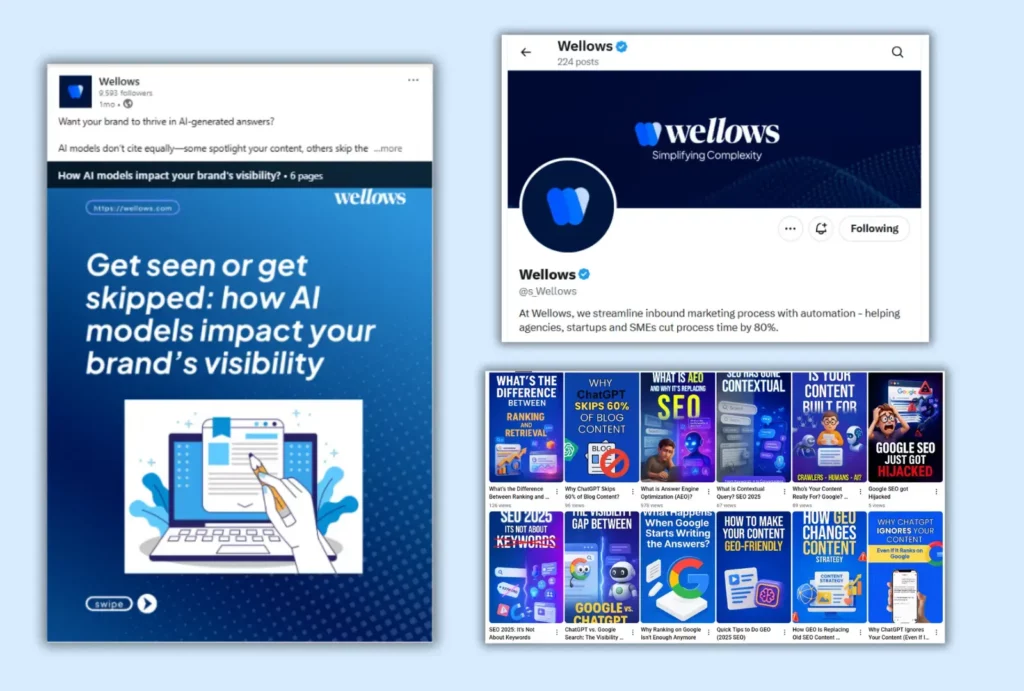
Bonus: Earlier Wellows workflows allowed teams to encode brand voice rules directly into content generation and review processes, helping maintain consistency at scale.
Did you know?
Why it matters:Consistency improves brand recall for both humans and AI. Repeated tone, phrasing, and structure help LLMs pattern-match your brand to specific topics and query types.
7. Hub-Spoke Content Architecture Demonstrates Subject Mastery
Structure your site around core themes using:
- A central hub page
- Interlinked spoke pages covering sub-topics
- Clear contextual internal linking
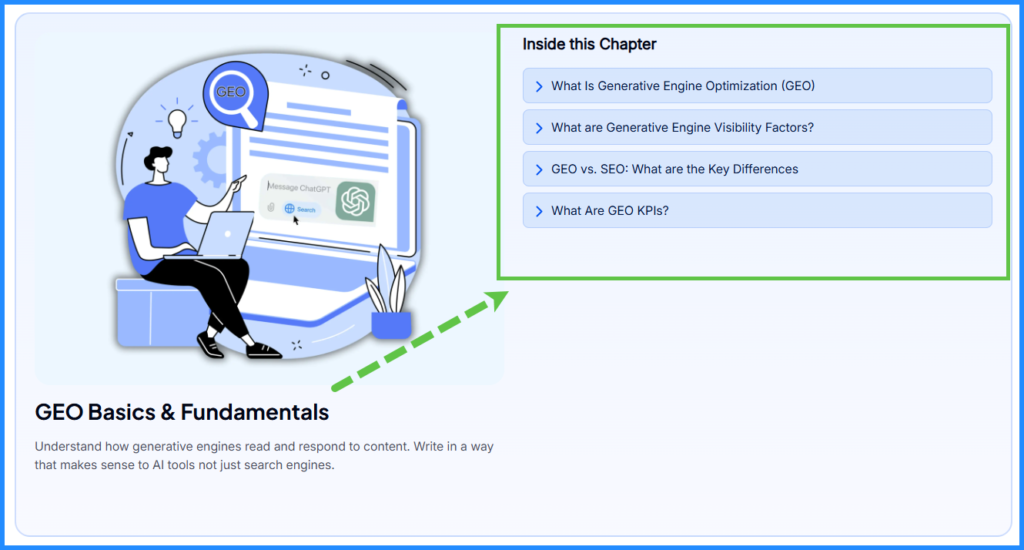
When combined with digital brand signals such as schema and structured data, hub-spoke architectures strengthen entity understanding across AI systems.
Did you know?
Why it matters:Conversational AI platforms prefer cohesive, interlinked knowledge ecosystems. Hub-spoke structures help AI models understand the depth and breadth of your authority, improving visibility for both core and adjacent queries.
8. Strategic Mention Distribution Builds Entity Recognition
Leverage:
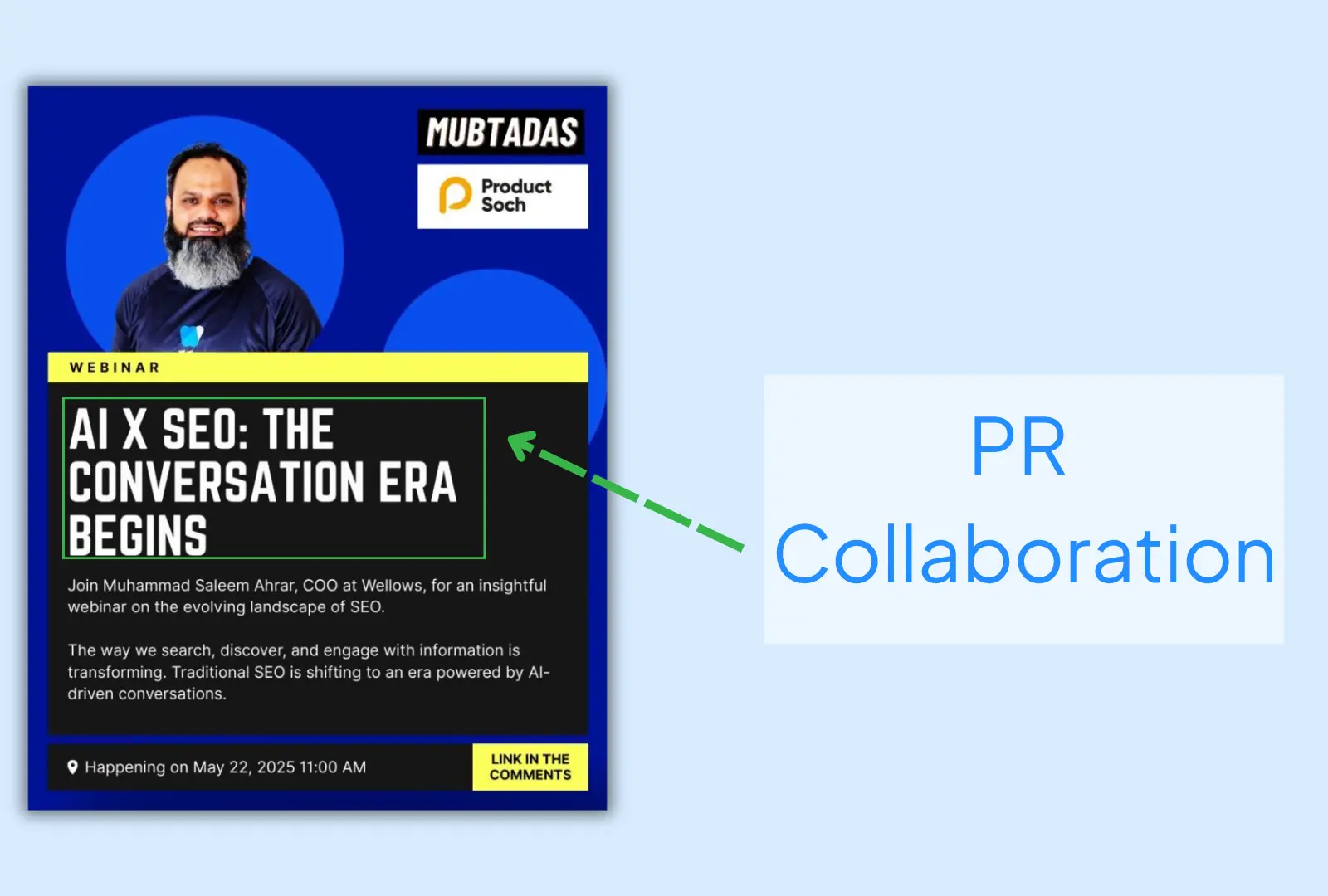
- PR platforms and expert request sites
- Niche and industry-specific directories
- Guest post roundups
- “Top tools” or comparison lists
- AI and startup discovery blogs
Did you know?
Why it matters:Even unlinked brand mentions contribute to how AI systems build knowledge graphs. Repeated, contextually relevant mentions help LLMs recognize and categorize your brand—even without traditional search rankings.
What Are The Best Practices For Creating GEO Brand Signals In 2025?
In 2025, GEO brand signals are the trust and recognition cues that make LLMs treat your brand as a safe source to cite. Generative engines do not rank pages only by keywords. They pull from entities they understand, brands they see consistently, and sources that show clear authority.
Your goal is to make those signals obvious across your site and across the wider web so AI systems can identify, trust, and reuse your content in answers.
- 1. Make Your Brand Machine Readable Everywhere:
- Add Organization, Person, Article, FAQ, and Review schema so LLMs can parse who you are, what you do, and why you are credible.
- Keep your brand name, product names, and positioning consistent in bios, headers, About pages, and schema properties.
Why it works: LLMs prefer structured, extractable sources with clear entity data.
- 2. Lead With Proof, Not Claims:
- Place case studies, benchmarks, screenshots, and numbers early on key pages.
- Back every bold claim with verifiable sources or first party data.
Why it works: Generative engines favor passages that look factual and self contained, which increases citation likelihood.
- 3. Strengthen E E A T Signals At The Author Level:
- Use real author bios with credentials, role, and topical expertise.
- Link authors to their other work and reputable profiles (LinkedIn, publications, talks).
Why it works: Author identity and expertise act as trust multipliers in AI retrieval.
- 4. Build Third Party Authority And Mentions:
- Earn mentions in niche publications, podcasts, review platforms, and forums.
- Encourage authentic UGC reviews on places LLMs scrape (G2, Trustpilot, Reddit, Quora).
Why it works: LLMs learn brand authority from repeated, contextual mentions outside your site.
- 5. Publish Hub Spoke Topic Clusters:
- Create one strong hub page and multiple linked spokes.
- Use internal links to reinforce entity topic association.
Why it works: Semantically connected clusters help LLMs map you as a consistent authority on a topic.
- 6. Keep Freshness Visible And Regular:
- Update core pages every 3 to 6 months and show a visible last updated date.
- Add new examples, integrations, or market changes as they happen.
Why it works: Generative engines bias toward current, maintained sources for citations.
Simple takeaway: GEO brand signals come from consistency, structure, proof, and third party validation. When those signals show up repeatedly, LLMs recognize your brand as an entity worth citing.
Placement: Add this H2 right after your “Understanding Brand Signals” block and before “How Brand Signal Strengthening Strategies Increase LLM Recognition?” so readers get the 2025 framework first, then your deeper tactic-by-tactic expansion.
Why Brand Signal Impact Mechanisms Drive LLM Selection Criteria?
In the era of prompt-based discovery, trust signal architectures are how AI decides who to trust and what to surface. Here’s why they matter:
1. Brand Signals Decide Whether You Get Cited
Even if you rank well on Google, LLMs won’t cite your brand unless you’ve built enough recognizable signals. Structured data, entity alignment, and schema markup help ensure AI models “see” your content and include it in responses.
2. You Win Even in Zero-Click Search
Users may not click through—but being mentioned or summarized in an AI response still gives you visibility, authority, and mindshare. Your brand becomes part of the conversation—even without the click.
3. AI Mirrors What It Trusts
LLMs don’t create content from scratch—they summarize what they’ve seen across multiple sources. If your brand isn’t consistently positioned as credible, accurate, and active, it simply won’t make the cut.
4. Prompts Replace Keywords—But Recognition Still Rules
Over 1 billion prompts hit ChatGPT every day. If your brand isn’t already showing up in those answers, your competitors will fill that gap. Prompt-based search gives trusted brands the edge.
5. Consistency Prevents Confusion
Machine learning systems pull from everything, your site, LinkedIn, Reddit, third-party blogs. If those touchpoints are misaligned, your brand story becomes fragmented. Clean, unified brand signals prevent misinformation or outdated answers from appearing.
6. Early Movers Get the Model’s Attention
More than 70% of U.S. users now search using generative AI tools. The brands who show up early and consistently, train the models on what to trust. That edge compounds over time.
How Can I Use GEO Brand Signals To Compete With Larger Companies In My Local Market?
Big brands win on scale, but local GEO brand signals let you win on specificity and trust. The goal is to make AI systems read you as the most verified and most relevant local option for your category.
1. Lock NAP Consistency Everywhere: Keep your business name, address, and phone number identical across your site, Google Business Profile, local directories, and review platforms. Consistent citations help AI models confirm you as a real local entity and reduce ambiguity in generative answers.
2. Win Reviews As Machine Readable Proof: Ask for fresh reviews that mention your city, neighborhood, and service type. LLMs pick up these local descriptors as trust plus relevance signals, which helps you outrank generic national listings.
3. Publish Local Intent Pages That Answer Real Queries: Create short pages for prompts like “best [service] in [city]” or “cost of [service] in [area].” Put a one sentence answer at the top, then add 3 to 5 tight bullets so AI Overviews can lift your answer cleanly.
4. Build Local Entity Coverage Not Just Content Volume: Add details bigger brands skip, such as service area boundaries, local turnaround times, regional policies, community partners, and real local photos. Those attributes strengthen your entity profile in AI retrieval.
5. Earn Mentions In Local Ecosystems: Get referenced by city blogs, chambers of commerce, universities, niche directories, local events, and newspapers. Even unlinked mentions expand your local footprint in training and retrieval datasets.
6. Strengthen Brand Schema For Local Context: Add or tighten Organization, LocalBusiness, Review, and FAQ schema on your homepage, About page, and service pages. Repeat the same positioning everywhere so LLMs see one clear local identity.
Did you know?
Local trust signals are a direct ranking lever for both search and AI. In 2025, about 71% of consumers read online reviews when researching local businesses, making reviews and consistent citations one of the strongest local GEO signals you can build. (BrightLocal / Backlinko, 2025)
What Brand Signal Measurement Methodologies Provide Performance Insights?
Here’s how you can measure brand signals in LLMs:
| Method | What to Look For & Why It Matters |
|---|---|
| Run Prompt-Based Checks in ChatGPT, Gemini, Perplexity | Type real user prompts (e.g., “Best SEO tools for startups”) and check if your brand is mentioned or cited. It’s a real-time pulse on LLM visibility. |
| Track Citation Frequency & Sentiment | Note how often and how positively your brand appears across answers. Frequent, favorable mentions signal strong LLM trust. |
| Monitor “People Also Ask” & Related Searches | Google’s related search features give clues into common follow-up intents. If your brand ranks there, it’s likely primed for fan-out citations. |
| Scan Organic Mentions on Reddit, Quora, YouTube | LLMs mine social platforms for insights. Brands with organic, relevant mentions are more likely to get surfaced in generative responses. |
| Compare Brand Presence Against Competitors | Run side-by-side prompts with competitor names to identify if they’re showing up more often. If so, it’s a signal to boost your authority footprint. |
| Audit Crawlability & Passage Structure | Check that your core pages are indexable, semantically rich, and broken into clear, passage-friendly sections. LLMs prefer modular, scannable content. |
How Do I Audit My Current GEO Brand Signals To See Where I Stand?
If you want to know whether LLMs recognize and trust your brand, you need a clear audit of where your signals show up and how strong they are. Use this quick process to find gaps and fix them.
1. Define Your Audit Scope: List the online surfaces that shape LLM training and retrieval for your niche. Include your website, G2/Trustpilot, major directories, forums, social channels, podcasts, and news mentions.
2. Run Prompt Based Visibility Checks: Search your core buyer prompts in ChatGPT, Gemini, Claude, and Perplexity. Note if your brand appears, how it is framed, and which pages are cited.
3. Track Third Party Mentions: Use BrandMentions, Mention, Google Alerts, or Ahrefs Alerts to capture where your brand is discussed. Track product names, founder names, and common misspellings.
4. Measure Citation Frequency And Sentiment: Record how often you are cited across AI answers and whether mentions are positive, neutral, or negative. Consistent positive citations signal stronger GEO trust.
5. Audit Structured Brand Data: Check that Organization, Product, Person, Review, and FAQ schema are present and consistent on your homepage, About page, and key product pages. Align positioning everywhere.
6. Benchmark Against Competitors: Run the same prompts with competitor names. If they show up more often or with stronger wording, that gap shows where your brand signals are weaker.
7. Fix Gaps And Recheck Monthly: Update weak pages, add missing schema, publish fresh proof, and restate core positioning across third party profiles. Re run the audit to confirm lift.
Did you know?
Why It Matters: This audit shows whether AI models are already pulling your brand into answers or skipping you. Once you know where the signal gaps are, your GEO work becomes focused and measurable instead of guesswork.
Read More Articles
- AI Search Marketing: ChatGPT vs Traditional Search
- Effective LLM Citation Strategies for SEO Success
- How to Understand User Intent in Generative Engines?
- How Can Pattern Recognition Improve Visibility in AI-Generated Answers?
- How to Design Content Briefs for GEO?
- Can GSC Data Guide Your GEO Strategy?
- AI SEO Automation for Generative Search Visibility (2026)
- Does Google Ranking Ensure Visibility in ChatGPT
- Bridging Google Rankings and LLM Citations Gap
- Optimize SEO with AI Topic Clusters
- How to Use AI for Competitor Analysis
- Real Time Alerts for Agency Clients
FAQs
Brand signals shape first impressions in AI and search-driven environments. When users see consistent reviews, expert attributions, and citations, they associate your brand with credibility. Weak or inconsistent signals create doubt, while strong ones build trust that directly influences conversion behavior in generative search.
In digital ecosystems, brand signals are the reputation cues LLMs and search engines rely on—reviews, structured data, mentions on forums, schema markup, social visibility, and author bios. These signals tell both humans and algorithms whether a brand is authoritative enough to be surfaced in AI-generated responses.
A strong brand signal is both consistent and verifiable. Examples include verified author profiles, recurring mentions in niche publications, positive third-party reviews, and structured trust data like Person or Organization schema. Together, these reinforce authority, helping LLMs decide whose answers are trustworthy enough to cite.
Brand signals can be measured through prompt-based checks (e.g., testing whether your brand appears in ChatGPT, Gemini, or Perplexity answers), citation frequency, sentiment analysis, and schema validation. Monitoring unlinked mentions on Reddit, Quora, and news outlets also reveals how visible your brand is within generative training and retrieval systems.
Strong brand signals increase the chances of your brand being cited in AI answers, even in zero-click environments. They amplify discoverability, boost customer trust, and improve long-term authority. For GEO, strong signals mean LLMs don’t just know you exist—they select you over competitors as the credible source.
Improving brand visibility in ChatGPT and Perplexity means making content clear, structured, and conversational, ensuring consistent mentions across forums and social platforms, securing coverage on authoritative sites, and keeping brand information updated so AI models recognize and cite you reliably.
To make your brand AI-visible across ChatGPT and Gemini, align content with schema markup, publish detailed authoritative pages, maintain consistent brand data across all profiles, earn strong backlinks and PR mentions, and refresh content regularly so AI systems surface you as a trusted entity.
Conclusion: How Can Brand Signals Keep You Visible in the Age of AI Search?
In a world where search is now served through ChatGPT, Gemini, and Perplexity , it’s not just your content that gets scanned. It’s your brand signals.
LLMs aren’t browsing your homepage, they’re scanning structured data, Reddit comments, citations, author bios, and trust markers. If your entity recognition markers aren’t showing up, your answers won’t either.
Key Takeaways
- Brand signals = visibility: The more structured and consistent they are, the more you get cited.
- Trust is algorithmic now: Verified authorship, review schemas, and digital PR matter more than backlinks.
- Mentions beat meta tags: Unlinked brand mentions across Reddit, forums, and news outlets are gold.
- Audit regularly: Outdated or inconsistent brand signals confuse AI models , clean it up.
- AI favors clarity: Centralized bios, FAQs, and schema help LLMs “understand” you faster.
Integrating these brand signal strategies with your query fan-out methodology —and reinforcing them with the Top GEO Tactics—creates comprehensive AI visibility optimization.
Brand signals aren’t optional anymore — they’re the foundation of how AI sees (and serves) your business. If you want visibility tomorrow, start signaling today.