Think about the last time you searched for something. Did you type it into Google and skim through a list of links? Or did you ask ChatGPT and get an instant answer in seconds?
That small shift says a lot about where search is heading. For years, SEO has been the backbone of visibility on Google—keywords, backlinks, domain authority, all the familiar levers. Those tactics still matter, but here’s the truth: the way people are finding information is changing, and the old playbook doesn’t apply everywhere anymore.
This is where Generative Engine Optimization (GEO) comes in. Unlike SEO, which is designed to influence rankings on Google’s SERPs, GEO is about making sure your content is discoverable and cited by generative AI tools like ChatGPT.
To put things in perspective: ChatGPT now handles over 2.5 billion prompts per day—a massive increase in usage signaling how many people are using chat interfaces instead of traditional search (tom’s guide, 2025)
ChatGPT doesn’t give you ten results to rank for. It doesn’t care about click-through rates or backlinks. Instead, it generates one conversational response, pulling from its training data and prompt understanding. That means if you’re only optimizing for Google, you’re already missing out on where audiences are starting to search.
In this blog, I’ll share 8 data points that show why traditional SEO doesn’t work inside ChatGPT the way it does on Google—and why I believe marketers, content creators, and businesses need to start thinking about how to optimize for AI-driven search engines as well.
1. No SERPs, Just One Answer
When you search on Google, you’re met with a results page (SERP) packed with options—organic listings, ads, snippets, videos, and more. That variety is exactly what SEO has always optimized for: ranking higher than competitors so users choose your link over the rest.
ChatGPT flips this model on its head. Instead of showing you ten blue links, it delivers a single, synthesized answer. There’s no scrolling through results, no weighing different websites, and no “position one” to fight for.
Why this matters: In a one-answer world, traditional ranking factors like backlinks, domain authority, or optimized title tags don’t directly influence visibility. ChatGPT doesn’t reward you for climbing a results page because there isn’t one—visibility depends on how well your content aligns with generative engine visibility factors, not traditional rankings.
The only “winner” is the response the AI generates—leaving brands invisible unless they’re directly referenced or cited.
This shift means visibility isn’t about outranking competitors anymore; it’s about finding new ways to ensure your brand is part of the answers AI tools generate.
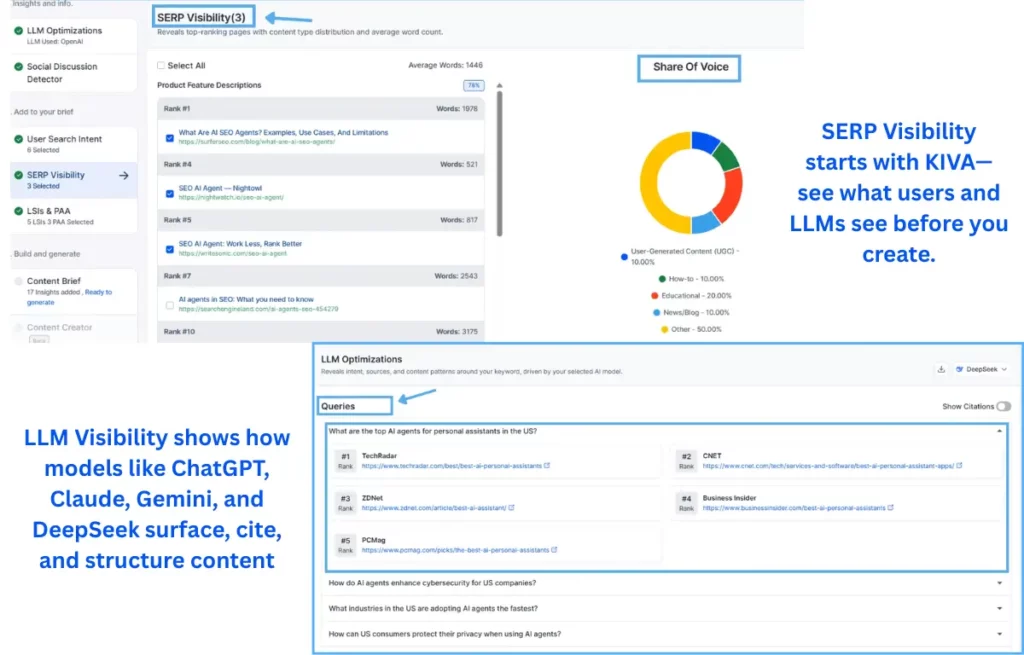
With features like SERP visibility and cross-model insights, KIVA shows how your content stacks up on Google while also analyzing how AI tools interpret the same queries—so you’re not flying blind in a one-answer world.
2. Lack of Click-Through Opportunities
On Google, SEO thrives on clicks. You can write the perfect meta description, optimize your title tags, and earn a prime ranking—all with the goal of convincing someone to click through to your site. That’s where the traffic comes from.
But ChatGPT works differently. It rarely provides outbound links, and when it does, they’re selective and not based on click-through optimization. Most of the time, users get their answers without ever leaving the AI’s interface.
Why this matters: If your SEO strategy depends on driving clicks from a search results page, ChatGPT bypasses that model entirely. The opportunity to “win” the click just isn’t there in the same way, which is why businesses are exploring ChatGPT search visibility tips to understand how discovery works in an AI-first model.”
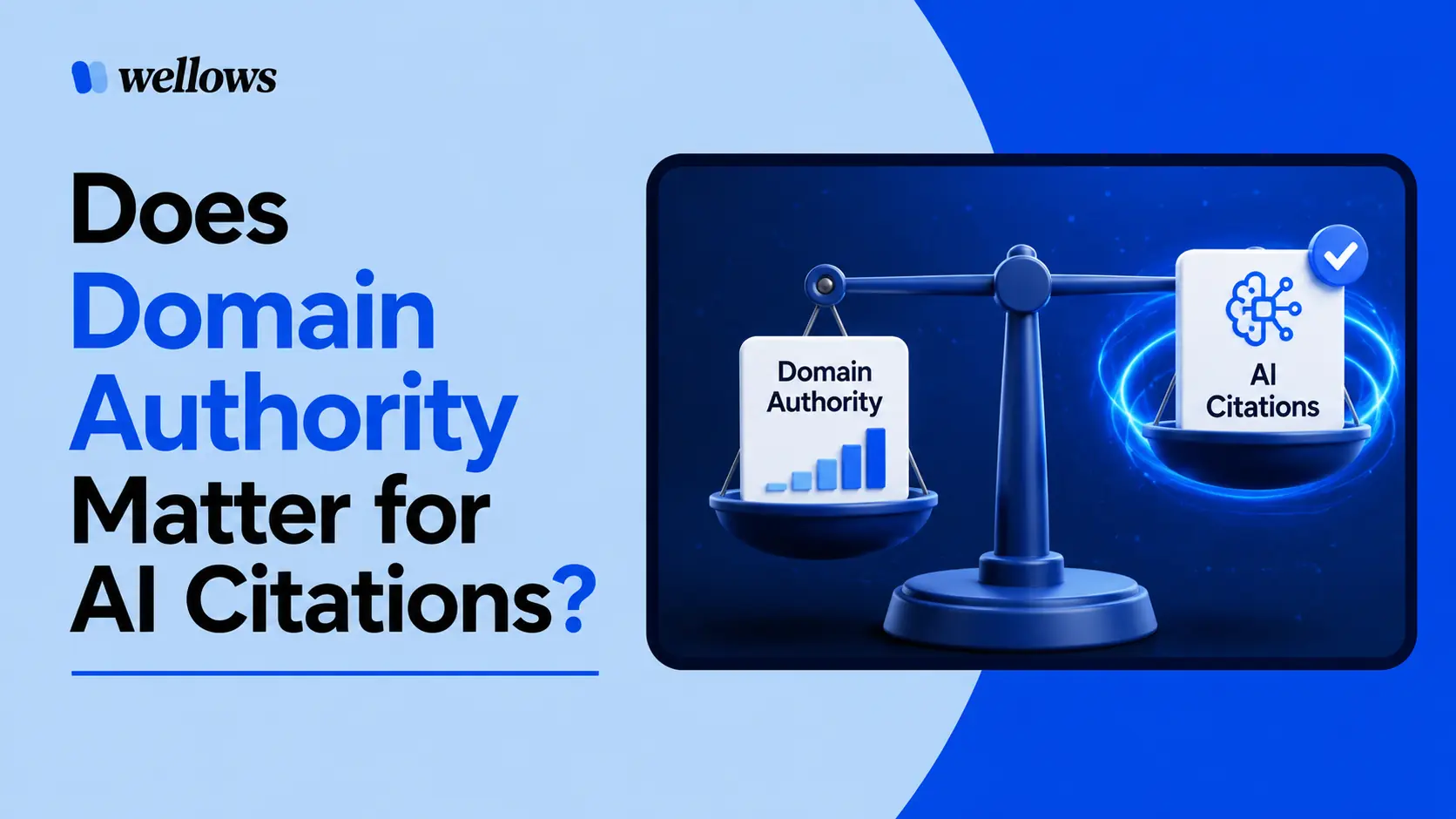
3. Domain Authority Doesn’t Influence AI Responses
In Google SEO, domain authority (DA) can be a game-changer. A strong DA often means better rankings and higher visibility, even when the content is similar.
ChatGPT, however, doesn’t operate on DA. Studies and user tests show it frequently cites smaller sites—or no sources at all—while ignoring big, authoritative publishers. Instead, large language models often rely more on brand signals and context than domain authority.
Why this matters: Investing in DA is still important for Google visibility, but it has little to no bearing on how ChatGPT builds its responses. In an AI-driven context, the size or reputation of your site doesn’t automatically guarantee inclusion.
4. Content Freshness Is Inconsistent
Google rewards fresh content. Publish a timely blog post or update an old page, and you can climb in rankings quickly thanks to recency signals.
ChatGPT doesn’t guarantee that freshness. Its core knowledge has a cutoff date, and even with limited browsing capabilities, it doesn’t always prioritize the most up-to-date information. In some cases, it may serve outdated or incomplete answers—a challenge often discussed in Google AI mode and its handling of recency.
Why this matters: If your SEO relies on being the first to cover a breaking story or trend, that advantage doesn’t necessarily carry over to ChatGPT. Recency isn’t built into its framework the way it is with Google.
5. Keywords Don’t Work the Same Way
For years, SEO strategies revolved around keywords: identifying them, placing them strategically, and optimizing pages to match search queries. While Google has become more semantic, keywords still matter for ranking.
ChatGPT approaches things differently. It doesn’t scan for keyword density or exact matches. Instead, it interprets user intent semantically, pulling from patterns in its training data rather than rewarding keyword-optimized content.
Why this matters: Keyword stuffing or over-optimization won’t help your content surface in AI answers. The focus needs to shift toward clarity, context, and intent-driven writing rather than raw keyword frequency.
Rather than keyword stuffing, a better strategy is to think in terms of prompts vs. keywords, which matches how AI understands queries.
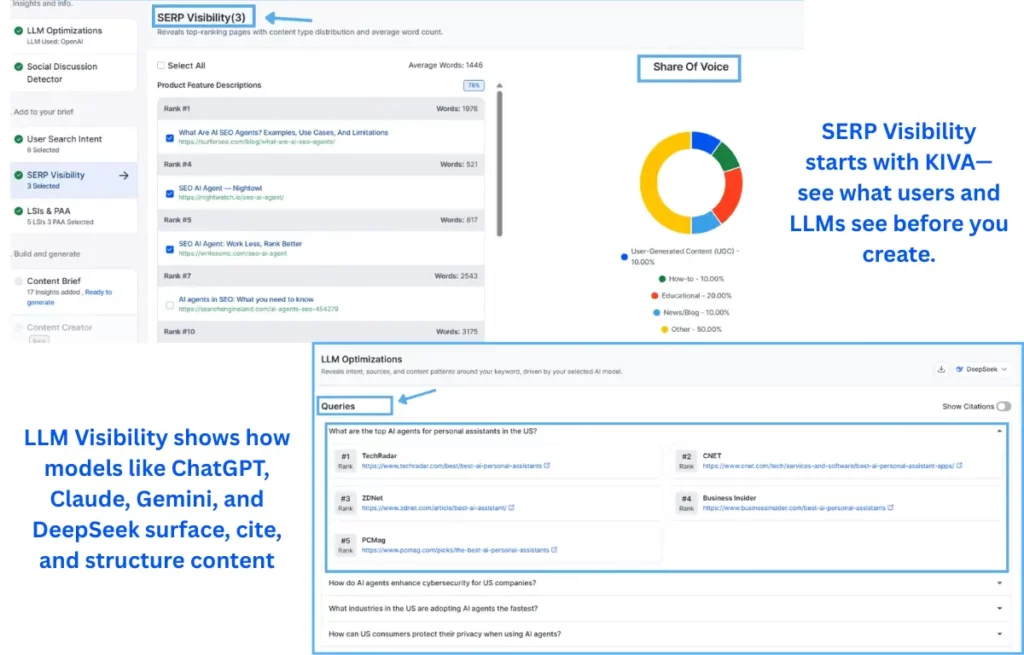
Instead of chasing keyword density, KIVA uses keyword clustering and intent analysis to help you write content that speaks to real user intent—the same way AI interprets queries.
6. Backlinks Have Zero Visibility
Backlinks are one of the strongest ranking factors in traditional SEO. Earn links from authoritative sites, and your rankings rise.
In ChatGPT and other AI-driven search systems, backlinks do not carry the same weight they do in traditional search engines. These models do not calculate link equity or pass authority between sites in real time.
As a result, even content supported by hundreds of backlinks is not guaranteed to appear in AI-generated responses. Instead, AI systems rely more on their ability to confidently identify, validate, and cite entities across trusted data sources—a process that LLM citation tracking helps measure and monitor over time.
Why this matters: While backlinks remain critical for Google rankings, they have no direct visibility in AI-generated answers. Building them solely for AI discovery won’t move the needle.
7. No Personalized Ranking Signals
Google tailors results. Your search history, location, device, and behavior all shape what you see on a SERP. That personalization is part of why two people searching the same phrase often get slightly different results.
ChatGPT, on the other hand, offers generalized answers. Unless a platform builds personalization into its AI features, everyone sees largely the same response to the same prompt.
Why this matters: Personalization is a cornerstone of modern SEO, but it doesn’t play a role in ChatGPT. Businesses can’t rely on tailoring results to individual users—they have to compete in a one-size-fits-all environment, shaped by pattern recognition inside large language models.
8. Proprietary AI Training > SEO Best Practices
At its core, ChatGPT doesn’t “rank” content in the traditional sense. Its responses are shaped by training data, reinforcement learning, and ongoing fine-tuning—not live web signals like backlinks, DA, or keyword optimization. This shift is often referred to as the great decoupling
of SEO from AI discovery.
Why this matters: This breaks one of SEO’s biggest assumptions: that optimizing content ensures visibility. With ChatGPT, optimization doesn’t guarantee your brand will be included in answers. Instead, visibility depends on whether your content has influenced the AI’s training data or fits into its retrieval patterns.
Where SEO Still Matters
Before you close the book on SEO, it’s important to recognize this: SEO is far from dead. Google still dominates global search, and billions of queries flow through its algorithms every single day.
Google receives over 80 billion visits per month, making it one of the highest-traffic websites in the world. (Fit Small Business, 2025)
If your goal is driving traffic, search engine optimization is still one of the most reliable ways to get visitors to your site.
And while ChatGPT doesn’t directly reward backlinks or domain authority, SEO can still have an indirect impact. When ChatGPT does cite references, it often pulls from well-structured, authoritative content—the kind of content that ranks well on Google in the first place. In other words, the effort you put into SEO can increase the odds of your site being among the sources AI tools choose to reference.
The key distinction: SEO is still essential for search engines, but its influence on ChatGPT is secondary. You’re not optimizing to “rank” inside the AI’s answers—you’re optimizing to ensure your content is strong, visible, and trustworthy enough that AI engines may select it as a reference when needed.
FAQs
ChatGPT = write clear, trusted, brand-driven content that AI can use in answers.
Conclusion
The data is clear: the traditional levers of SEO—keywords, backlinks, domain authority—don’t directly influence how ChatGPT delivers answers. Unlike Google’s SERPs, there’s no ladder to climb, no CTR to optimize, and no guarantee that years of link building will secure visibility inside an AI-generated response.
But that doesn’t mean the game is over. It means the game is changing. Businesses now need to think beyond ranking and start preparing for AI-driven discovery. That means building brand authority strong enough to be recognized and referenced, structuring content so it’s clear and accessible to AI systems, and focusing on direct engagement with audiences rather than depending solely on search traffic.
SEO is still vital for Google, but ChatGPT and other AI assistants demand a new layer of strategy. Those who adapt early won’t just protect their visibility—they’ll shape the way audiences discover brands in this new era of search.
Your next step? Treat SEO and AI optimization as partners, not rivals. The future of search isn’t either-or—it’s both.