You’re showing up in search more than ever, but clicks are dropping. You’re not alone. In fact, it’s happening to nearly every brand investing in organic growth. Visibility is climbing. Impressions are stable. Yet traffic—real user visits—is quietly vanishing.
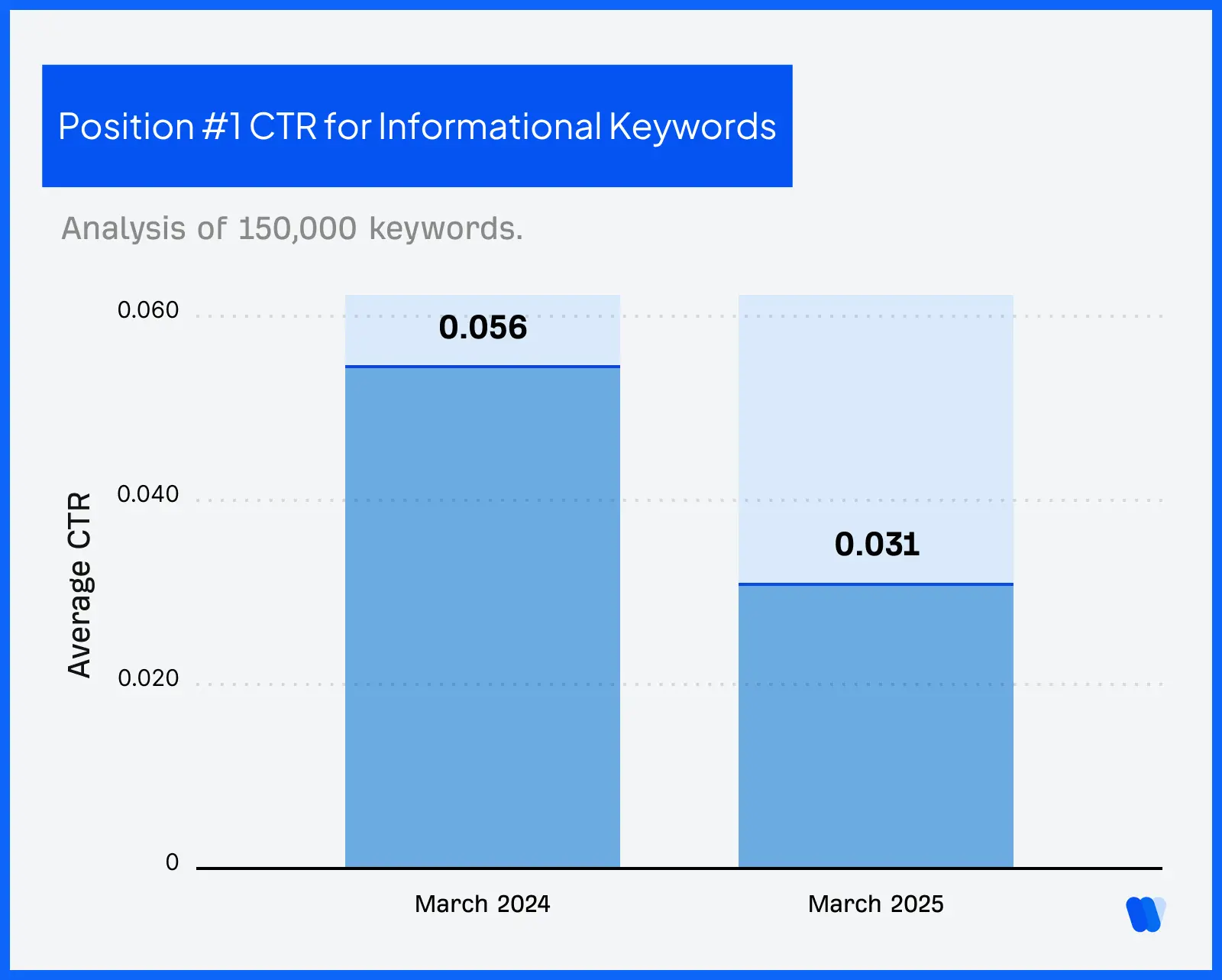
In March 2024, the average position one CTR for informational keywords was 0.056. In March 2025, this had dropped to 0.031. This isn’t a reporting glitch or algorithmic bug. It’s a real, measurable shift. And it has a name: The Great Decoupling.
This is the moment the old search contract broke. For decades, ranking meant traffic. Visibility meant visits. SEO meant growth. But now, generative engines like ChatGPT, Gemini, Perplexity, and Claude are decoupling those outcomes, delivering answers, not just links.
TL;DR — What You’ll Learn in This Guide:
- What the Great Decoupling really is and why it’s not just another search trend
- How generative engines retrieve and cite content (and what they ignore)
- The core difference between being indexed and being included
- Why traditional SEO still matters—but isn’t enough
- How to evolve your strategy for GEO across engines like ChatGPT, Gemini, and Perplexity
- Actionable steps to earn AI citations, not just rankings
And if your content doesn’t make it into those answers, it doesn’t matter how well you rank on page one. This is why Generative Engine Optimization (GEO) exists. It’s not a replacement for SEO—it’s the layer that sits above it. Because you’re not just optimizing for search bots anymore. You’re optimizing for retrieval, citation, and AI synthesis.
What is the Great Decoupling?
The Great Decoupling refers to the growing disconnect between visibility and actual visits. In the past, if your page ranked high and appeared in more searches, you could expect more clicks. But not anymore. As AI summaries take over the top of the SERP, impressions are going up, but clicks are going down.
This is the same dynamic I explored in SEO Doesn’t Work in ChatGPT—where generative engines surface your content without sending you the traffic.
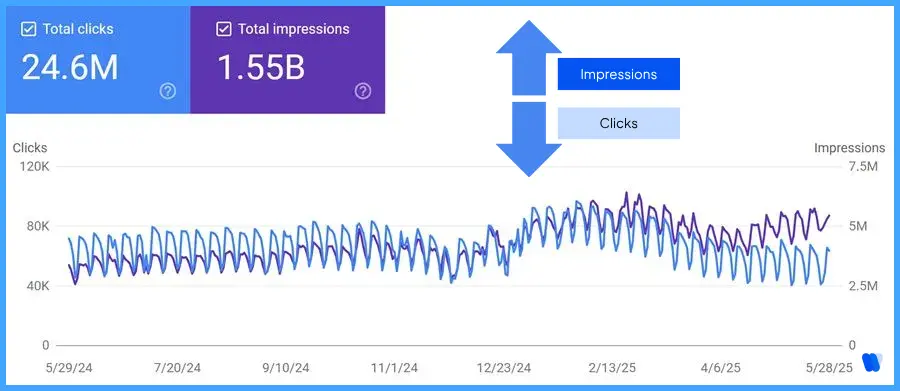
In short: being seen no longer means being visited.
Here’s what’s happening:
- Impressions are up: Your content is still ranking and being surfaced more often.
- Clicks are down: Users are getting their answers directly from AI summaries—no need to click through
- This isn’t just you: Major publishers like Forbes, NPR, and Wikipedia are seeing the same trend.
- Google has confirmed it: Pages included in AI Overviews are likely to get fewer clicks.
- The rules have changed: Traditional SEO metrics no longer tell the full story.
This shift is redefining how we measure success—and why Generative Engine Optimization (GEO) matters more than ever.
Why the Decoupling is Happening Now?
The visibility-click gap didn’t appear out of nowhere. It’s the result of rapid changes in both search technology and user behavior—especially the rise of large language models (LLMs) and AI-powered answer systems. Here are the key reasons why the Great Decoupling is happening now:
Key Factors Behind the Great Decoupling
Google’s AI Overviews Replaced the Click
- With the rollout of AI Overviews (previously SGE), users now see a full, AI-generated summary at the top of search results.
- These summaries are stitched together from multiple sources—often including your page—but satisfy the query without a user needing to click through.
- As a result, even if you’re cited, you don’t get the visit.
AI Summaries Increase Impressions but Suppress CTR
- If your site is cited in the AI Overview and also appears in the organic listings, you get two impressions—one in the summary and one in the SERP.
- But users increasingly stop at the summary. Internal benchmarks show CTR drops by 30–35% when AI Overviews are present.
Users Are Adopting LLMs as Primary Search Tools
- Tools like ChatGPT, Claude, Gemini, and Perplexity are becoming default search destinations, especially among younger users.
- These tools answer questions directly—pulling from the open web, Reddit, YouTube, and expert blogs—without sending users back to source websites.
Search GPT Experiences Are Fragmenting Discovery
- Instead of searching on Google, users now type full prompts into AI assistants and get synthesized, conversational answers.
- These experiences often cite you but don’t link to you—meaning visibility without traffic.
Passage-Based Retrieval is Replacing Page Rankings
- Search engines and LLMs now retrieve content by relevant passages, not entire pages.
- This favors highly specific snippets over full articles, and often results in your content being summarized without attribution.
Trust in Source Links is Declining
- A recent study shows that users “always or usually” click on links cited in Google’s AI Overview.
- Even when your brand is named, users often feel the AI answer was sufficient and move on.
LLMs Don’t Reward Ranking—They Reward Relevance
- ChatGPT doesn’t care if you rank #1. It cares if your passage best answers the user’s query.
- This shifts the focus from ranking for keywords to being semantically relevant across sub-queries.
The Rise of Zero-Click Searches
- AI search tools are training users to expect instant answers with no additional navigation.
- This “zero-click behavior” is now spreading from SERPs to AI interfaces—shrinking the traditional funnel between discovery and conversion.
How to Adjust Your GEO Strategy for the Great Decoupling?
It’s not enough to optimize for rankings anymore. To stay relevant in an era where visibility no longer equals visits, your GEO strategy must evolve to align with how AI engines interpret, select, and cite content. Here’s exactly how to adjust.
1. Build a Brand That AI Doesn’t Replace—It Recites
Generic visibility won’t protect you. Branded queries—like “Wellows reviews” or “Notion AI use cases”—are more resilient to AI interference. When someone names your brand in a prompt, the AI doesn’t generalize—it retrieves.
What to do:
- Invest in PR, podcasts, and mentions across industry publications.
- Seed your brand in Reddit, Quora, G2, and Twitter through authentic discussions and real testimonials.
- Ask loyal customers to include your name in their reviews and social shares.
Key takeaway
You’re not just competing for keywords—you’re competing for recall. Branded search is the insurance policy for the AI era.
2. Publish Content That Can’t Be Summarized Away
If your content is too surface-level or sounds like everyone else’s, it gets collapsed into a bullet. AI strips out fluff. But it quotes what’s original, specific, and experience-backed.
What to do:
- Share real internal data, founder POVs, or opinionated comparisons.
- Add insight no other site has—something LLMs can’t hallucinate.
- Replace generic intros with perspective: “We scaled AI-driven SEO visibility by 220% in 6 months—here’s how.”
Key takeaway
AI summarizes content it can predict. It quotes content it can’t.
3. Create Topic Hubs, Not Isolated Pages
One blog post won’t earn you AI authority. LLMs prefer semantic coverage—clusters of related pages that reflect expertise across a domain, not just one article.
What to do:
- Build topic clusters (e.g., /geo/, /ai-seo/, /chatgpt-visibility/) that mirror how agencies deliver AI search visibility across generative engines.
- Use structured internal linking with intent-aligned anchors.
- Make sure each page answers a different angle of the topic—not just a rehash.
Key takeaway
Clusters create context. When LLMs see topic depth, they see authority.
4. Understand How Your Audience Feels About AI Summaries
Your SEO strategy shouldn’t ignore audience sentiment. Some users trust AI Overviews more than others—and that trust affects clicks.
What to do:
- Use AI trust studies and demographic breakdowns to map how your audience behaves.
- Update customer personas with AI-related preferences (e.g., do they click citations or trust summaries blindly?).
- Adjust targeting and CTAs depending on AI comfort level—especially across age, industry, or location.
Key takeaway
Know your audience’s AI behavior before optimizing for it. Trust ≠ clicks.
5. Identify Keywords That Are Driving Zero-Click Searches
Not all keywords are affected equally. Some are fueling AI Overviews more than others. Instead of blindly overhauling everything, isolate the zero-click culprits.
What to do:
- Use GSC or tools like Semrush to track which queries have high impressions and low clicks.
- Check which of your pages are cited in AI Overviews—but receive no traffic.
- Decide whether to restructure, deoptimize, or retarget elsewhere (like LinkedIn or Reddit).
Key takeaway
Not all traffic loss is equal. Know which queries are silently bleeding your click-throughs.
6. Restructure Content for AI-Friendliness
Being cited in AI Overviews isn’t just luck—it’s structure. LLMs need clearly formatted answers, not walls of prose.
What to do:
- Rewrite intros to frontload the answer.
- Break content into H2s that echo common questions (use PAA, AlsoAsked, GEO tools).
- Add summary boxes, tables, and definition callouts.
Key takeaway
Content that’s easy to lift is easy to cite. Structure is strategy.
7. Track Visibility Beyond Clicks
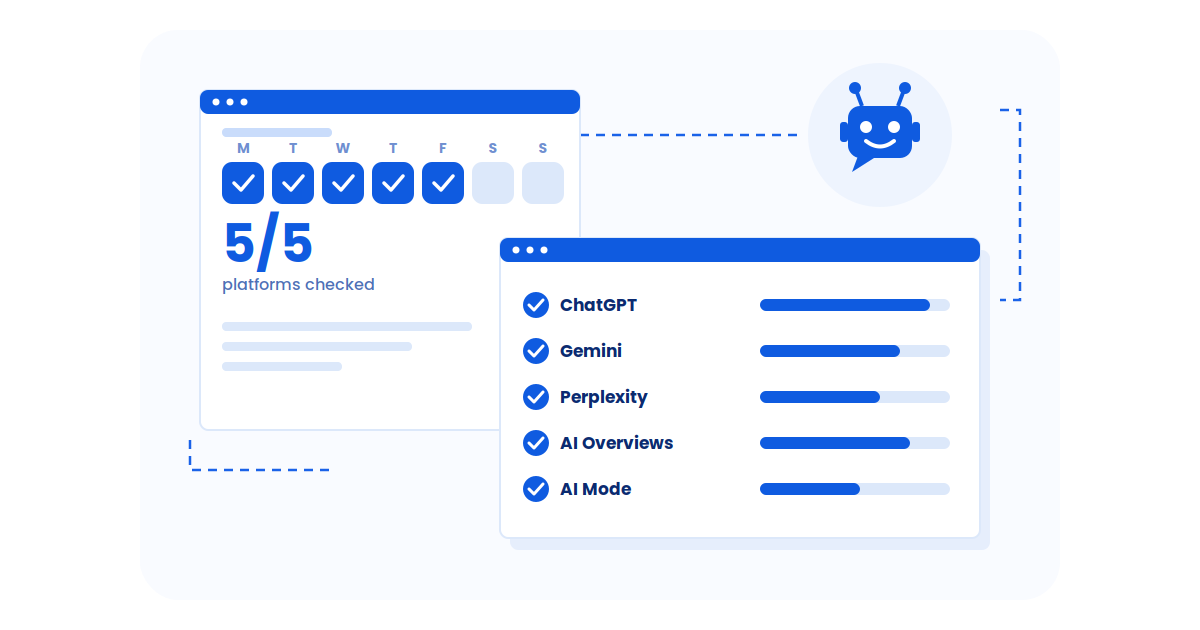
Old metrics (like CTR) don’t show the full story anymore. You might be cited by ChatGPT, Perplexity, or Gemini—and never know.
What to do:
- Use tools like Perplexity Source Tracker or GEO dashboards to monitor AI mentions.
- Track branded search lift post-content launch—it often indicates AI visibility.
- Add new KPIs like “AI Share of Voice” or “Multiplatform SERP Coverage.”
Key takeaway
Being visible in AI answers is the new impression metric—even if the user never clicks.
8. Repurpose Answers Into Multichannel AI Content
Perplexity loves citing YouTube. Claude scans longform PDFs. Gemini pulls schema-rich blog blocks. Stop treating your blog as your only GEO lever.
What to do:
- Turn your best-performing blog post into a YouTube video with the same structure.
- Reformat listicles into Reddit threads or Quora answers.
- Publish thought leadership as LinkedIn carousels with quotes pulled from your site.
Key takeaway
AI doesn’t care about format—it cares about clarity and reach. Meet it where it listens.
Read More Articles
How to Understand User Intent in Generative Engines?
How Can Pattern Recognition Improve Visibility in AI-Generated Answers?
Can GSC Data Guide Your GEO Strategy?
Does ChatGPT Use Google SERP Snippets for Answers? (My Experiment Included)
How Will Google’s AI Mode Transform Traditional SEO Practices?
FAQs
The Great Decoupling refers to a growing disconnect between search impressions and actual clicks. Pages are increasingly being seen (via AI Overviews or LLM citations), but fewer users are clicking through to the original site. It’s a byproduct of zero-click AI summaries becoming the destination—not just the guide.
This is a core sign of the decoupling. With AI-driven answers (like Google’s AI Overviews or ChatGPT snapshots), users often get their answers directly on the search page. Your content is still being surfaced—but it’s being summarized, not necessarily clicked.
Not at all. SEO is evolving. Instead of optimizing only for clicks, you now need to optimize for visibility within AI-generated answers. This means focusing on Generative Engine Optimization (GEO), where structure, authority, and unique insights are key to being cited by LLMs.
You need to shift focus toward AI visibility. That includes strengthening your brand footprint across trusted sources, publishing content with original value (e.g., customer stories, proprietary data), optimizing for semantic clarity, and using tools that track AI citations—not just keyword rankings.
Key Takeaways: The Great Decoupling Is a Signal, Not a Setback
We’ve entered a new phase of search—where visibility no longer guarantees traffic, and AI is rewriting how users interact with information.
But this isn’t a reason to panic. It’s a reason to pivot.
Generative engines aren’t eliminating organic opportunity; they’re just shifting it. Instead of chasing rankings alone, the new challenge is to earn a seat at the AI-generated answer table. That’s what Generative Engine Optimization (GEO) is built for.
Key Takeaways for The Impact of The Great Decoupling on GEO
- Being cited is the new being clicked. Visibility in AI summaries is now just as important as SERP placement.
- Generic content gets condensed. Only unique insights, real experiences, and proprietary data stand a chance of being quoted.
- Search journeys are shorter. That makes every impression more valuable—and every citation a form of silent influence.
- Brand signals are the new backlinks. If AI trusts you, users will too—even if they never land on your site.
The web isn’t shrinking. It’s splintering. Attention is flowing through new pipelines—ChatGPT, Gemini, Perplexity, Claude—and the brands that adapt early will own those channels tomorrow.
You don’t need to out-rank the internet. You just need to out-answer it.