A few weeks ago, I came across an experiment by Aleyda Solis that sparked debate across SEO circles. Her claim sounded almost like an OpenAI ChatGPT visibility experiment: ChatGPT may be picking up and reusing Google SERP snippets to generate its answers.
While not an official visibility study by OpenAI, it raised important questions about how AI tools like ChatGPT gain exposure and what tests can measure AI search visibility.
Many SEOs now ask, “What were the results of the visibility test?” or even “How does this kind of experiment affect user engagement?”
Others wonder, “How was the test conducted?” and “What are the implications for SEO and GEO?” This blog takes those questions head-on with a controlled test, live data, and clear takeaways.
Naturally, I decided to run the trial myself to reveal how visibility is measured inside AI products.
I designed a controlled methodology, verified each step through Google Search Console’s API, and compared ChatGPT’s output using screenshots, validated timestamps, and indexing status.
I also used Google’s URL Inspection Tool and Fetch as Google functionality to ensure accuracy—so the findings reflect a true ChatGPT visibility experiment.
TL;DR
This blog walks you through:
- I tested whether ChatGPT reuses Google SERP snippets like Aleyda suggested.
- I compared two pages on my site: one indexed, one not indexed.
- ChatGPT couldn’t fetch or reflect the unindexed page at all.
- ChatGPT summarized the indexed page using wording that matched its Google snippet.
- So ChatGPT doesn’t crawl sites directly; it leans on public indexes/snippets.
- Generative Engine Optimization (GEO) now depends on getting indexed and optimizing your SERP snippet (title, meta, first lines).
Let’s dive into the findings.
My ChatGPT Experiment Reveals Google Snippet Dependencies
While not framed as a formal ChatGPT exposure study, the results echo many concerns raised in the SEO community: ChatGPT’s reliance on snippets makes indexing and snippet optimization critical for visibility.
This experiment uses two of my published blogs to see what really happens when a page is indexed vs not indexed.
So I picked two pages from my own website:
- One that had never been indexed by Google.
- Another that was already indexed and ranking.
The experimental design isolated two variables: indexing status and ChatGPT’s content access capabilities. Building on Aleyda’s initial findings, I designed a controlled test to verify ChatGPT’s dependency on Google’s indexing system. Here’s what I did, and what I found step-by-step:
1. I Prompted ChatGPT Using a URL That Was Not Yet Indexed by Google
I started with Prompts vs Keywords in GEO, a live page from my site that had been published, but never submitted for indexing via Search Console or any search engine.
My goal was to test how ChatGPT would respond when I asked it to fetch content from a live, but unindexed URL.
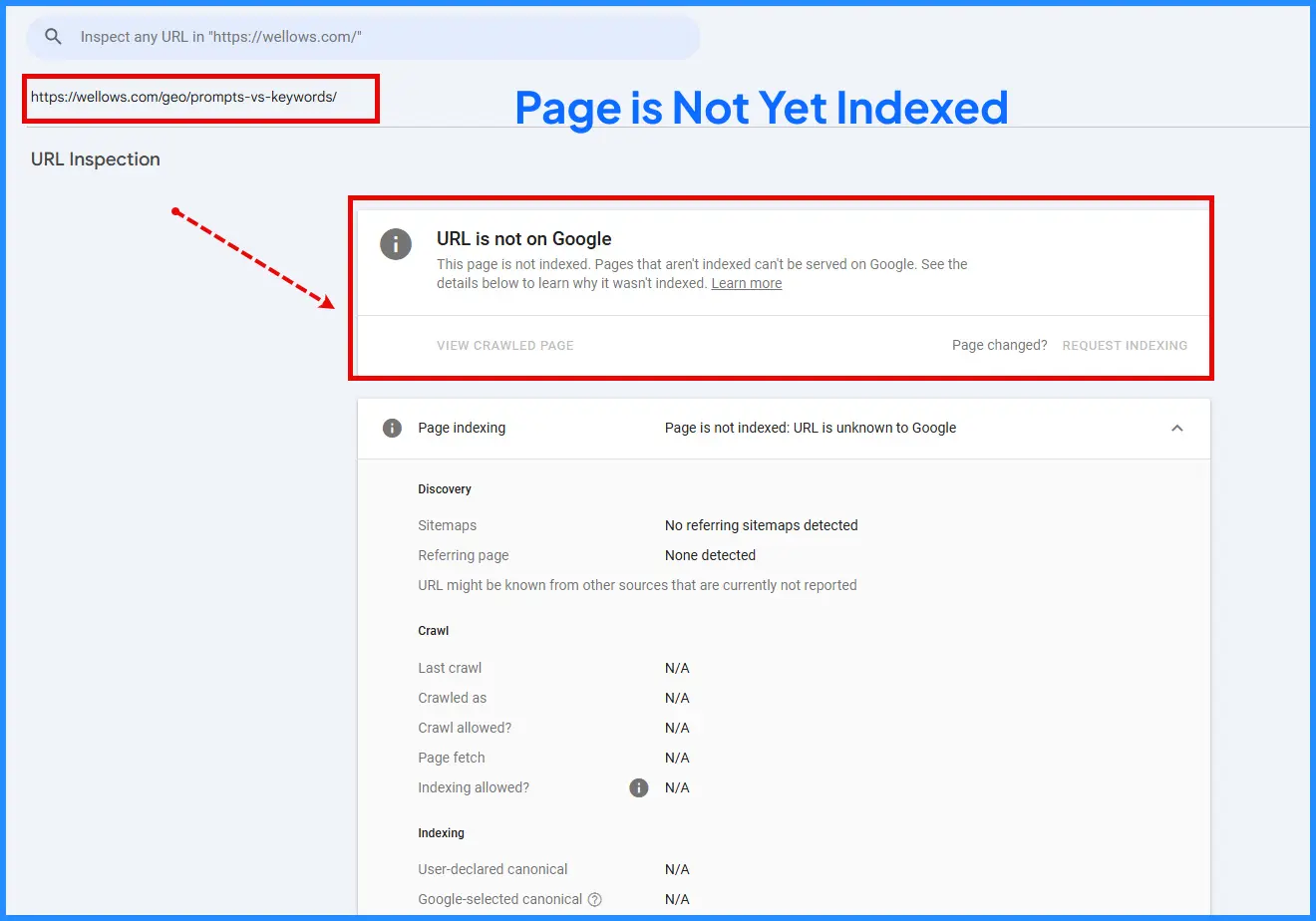
2. I Confirmed the Page Was Not Indexed on Google
Before prompting, I checked the indexing status of the page in Google Search Console.
As expected:
- No referring sitemaps
- No crawl activity
- Status: URL is not on Google
The page existed, but as far as Google’s systems were concerned, it was invisible.
3. I Asked ChatGPT to Fetch the Content Using That URL
Then, I opened ChatGPT and asked:
“Can you fetch content from: https://wellows.com/blog/prompts-vs-keywords/.Tell me what are the main differences between prompts and keywords using this link.”
The response revealed generative search behavior patterns. ChatGPT said it couldn’t locate the exact URL, and that the page appeared to be not publicly indexed or outdated. It did offer a general answer based on other content it had “seen” before—but not from this specific link.
This confirmed one thing: ChatGPT couldn’t fetch or reference a page that wasn’t indexed by Google.
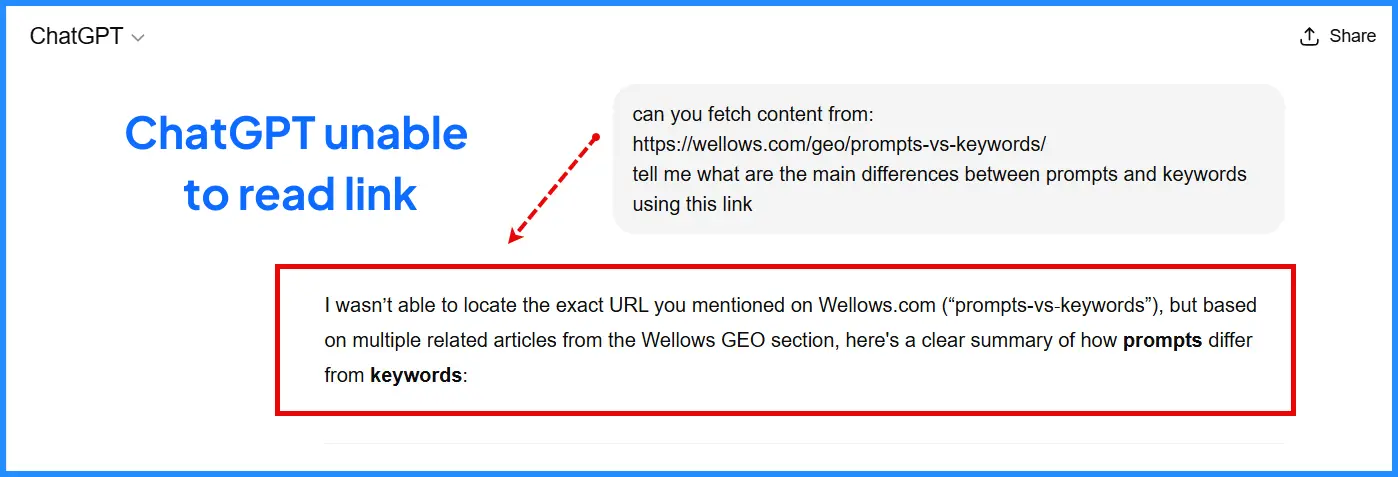
This initial result confirmed my hypothesis about indexing requirements. Next, I tested the opposite scenario with a fully indexed page.
4. Then I Switched to a Fully Indexed Page: “LLM Seeding”
To validate my hypothesis, I repeated the test using a second URL:
https://wellows.com/blog/llm-seeding/
This page had been live for a few days, and I had already submitted it via Google Search Console.
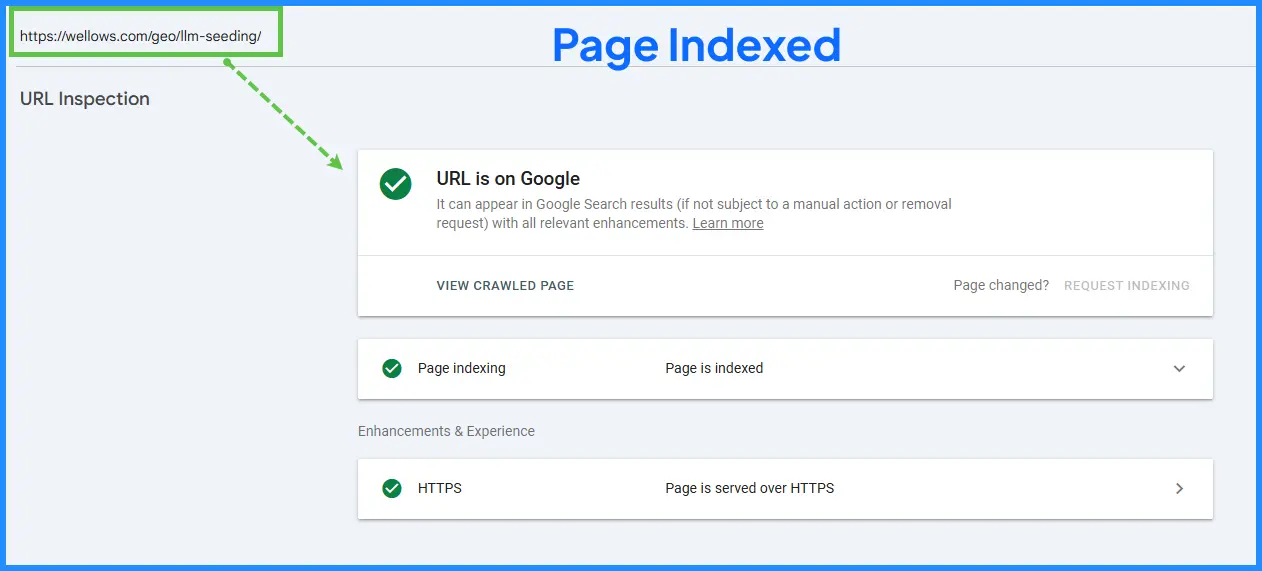
5. I Verified It Was Indexed in Google Search
Before testing it in ChatGPT, I again used Search Console and verified the indexing status.
- The page was indexed
- It appeared in Google’s search results
- A clean snippet was showing on the SERP
6. I Asked ChatGPT to Fetch the Indexed Page’s Content
Then, I used the same prompt format:
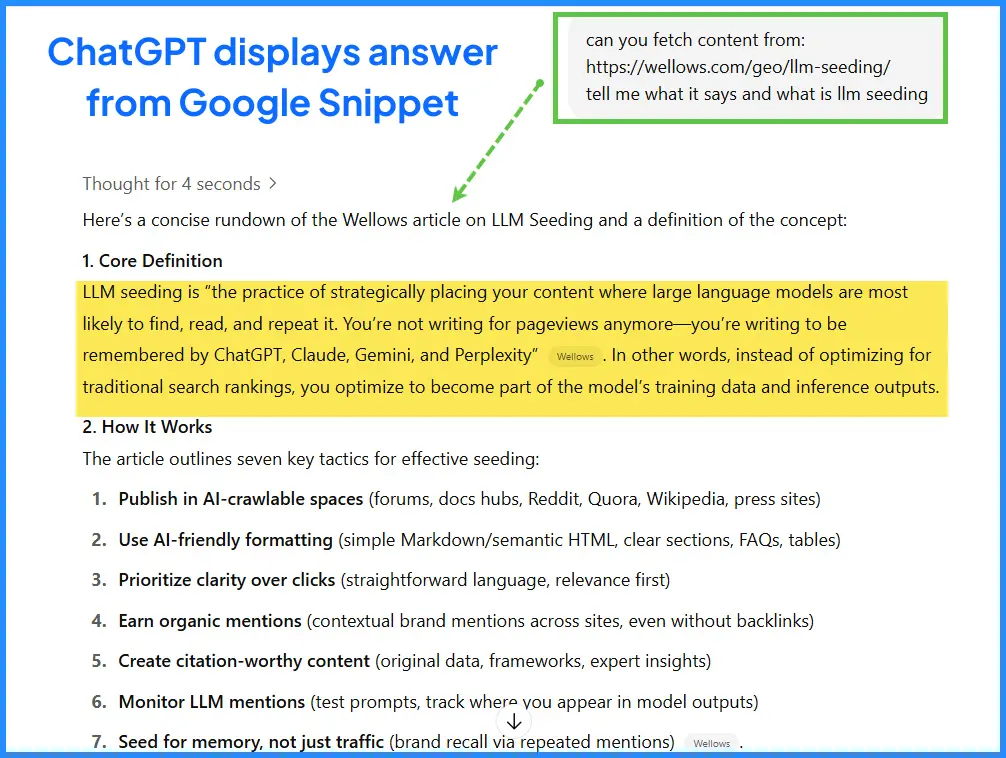
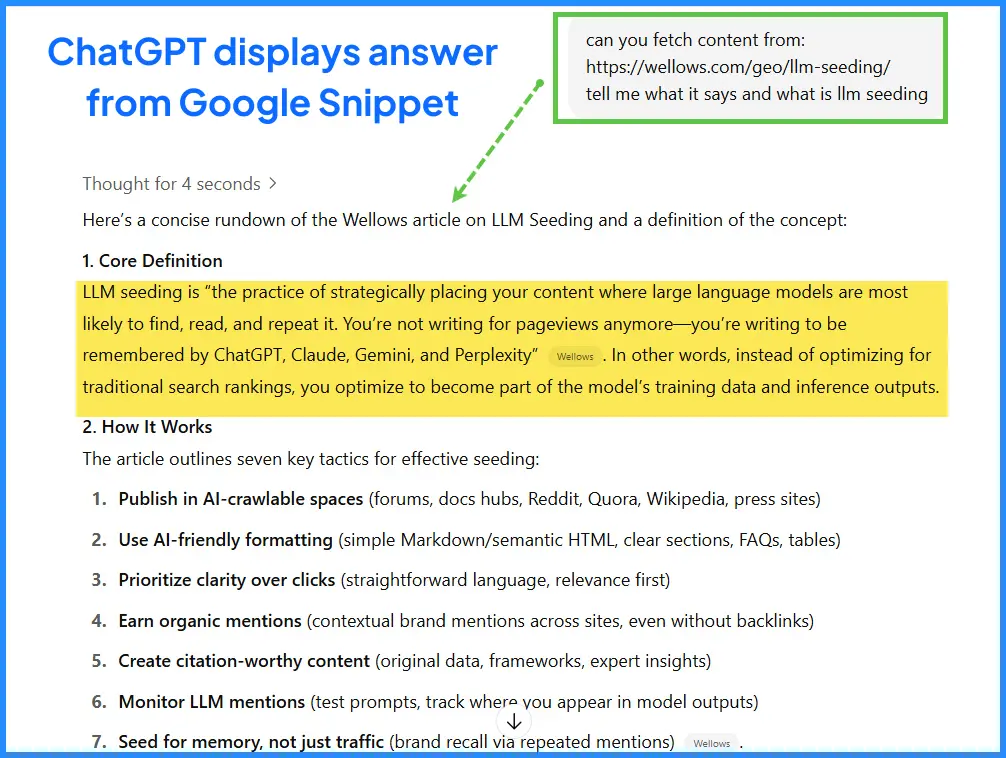
“Can you fetch content from: https://wellows.com/blog/llm-seeding/.Tell me what it says and what is LLM seeding.”
This time, ChatGPT returned a structured summary of the article, complete with formatting and headings pulled straight from the page.
It didn’t link to the URL, but the answer was nearly identical to the Google Search snippet.
These results provide a blueprint for how to rank high on ChatGPT through effective ChatGPT SEO, as they demonstrate that AI visibility is inextricably linked to how clearly search engines index and display your primary content data.
7. ChatGPT Pulled Its Answer from Google’s Snippet
When I compared ChatGPT’s output with the actual snippet shown in Google, the match was undeniable. It wasn’t hallucinating the content—it was summarizing the Google snippet.
ChatGPT even explicitly said:
“I was able to fetch a snippet from the publicly indexed version of the page… likely from search engine indexing.”
So the evidence was clear:
- ChatGPT uses Google Search snippets when it can’t access full content directly.
- It cannot extract anything from unindexed pages.
These contrasting results establish clear patterns in LLM content retrieval that have broader implications for content strategy, underscoring the need for more formal ChatGPT visibility research by OpenAI in this space.
What Did the ChatGPT Visibility Experiment Find in Simple Terms?
This experiment showed me something fundamental: ChatGPT doesn’t crawl or cache your content independently. It relies on existing public indexes and snippets when forming answers — and that changes what “visibility” really means.
Here are the merged results in a clear flow:
Did you know?
- ChatGPT visibility depends on indexing. If your page isn’t indexed, it’s effectively invisible to ChatGPT. If it is indexed, the snippet becomes the main text ChatGPT may reuse.
- Snippet optimization matters more than ever. SEO here isn’t just rankings or backlinks — it’s how clearly your title, meta description, and first 40–60 words explain the page, because ChatGPT often summarizes the SERP snippet instead of the full article.
- Prompt phrasing affects which brands appear. Slight changes in how a question is asked can change whether your page is surfaced. So visibility isn’t guaranteed from one query format — it’s shaped by multiple prompt variations.
- Repeated inclusion builds awareness without clicks. When your snippet shows up again and again across AI responses, users start associating your brand with that topic. In generative search, your snippet becomes your AI-facing elevator pitch.
- Web-enabled ChatGPT improves accuracy. When browsing is enabled, ChatGPT can pull fresher data and represent brands more accurately — but only if that information is publicly accessible and indexed.
In short: if you want steady AI visibility, you need (1) indexable pages, (2) snippet-ready openings, and (3) coverage of conversational prompt-style queries — because that’s what ChatGPT is actually pulling from.
What Steps Help Me Replicate This ChatGPT Visibility Experiment?
What steps do I need to take to replicate the ChatGPT Visibility Experiment for my own website?
If you want to run this same visibility test on your own site, here’s a simple framework you can follow. I’m keeping it practical so you can apply it fast—and, if you want to compare results over time, a ChatGPT Visibility Tracker helps log which indexed pages are actually being surfaced or summarized across different prompts.
- Pick 2 pages from your site: Choose one page that is indexed in Google, and one that is not indexed yet. The contrast is the whole point of the experiment.
- Confirm index status in Search Console: Open Google Search Console → URL Inspection. Note which page shows “Indexed” and which shows “URL is not on Google.”
- Write 3–5 conversational prompts: Use real questions people would ask in ChatGPT. Example: “Summarize what this page says and explain it simply.”
- Test each URL inside ChatGPT: Use the same prompt format for both pages. Track if ChatGPT can fetch the page, or only gives a generic answer.
- Compare ChatGPT output with the Google snippet: If the page is indexed, check whether ChatGPT repeats or mirrors the SERP snippet. This is the key visibility clue.
- Record results in a small table: Mark: Indexed / Not Indexed, Fetchable / Not Fetchable, Snippet Match / No Match. This keeps your conclusion clean.
- Repeat monthly to measure change: ChatGPT visibility shifts as pages get indexed, updated, or re-snippeted. A repeat test shows what’s improving and what’s still invisible.
Quick takeaway:
If ChatGPT can’t “see” your unindexed page, but mirrors your indexed snippet, you’re seeing the same dependency pattern I found — and that’s the visibility rule GEO needs to account for.
Why Google Indexing Matters for ChatGPT Visibility
Your experiment shows a simple truth: if Google can’t see your page, ChatGPT usually can’t use it. When you tested an unindexed URL, ChatGPT couldn’t fetch anything specific.
When you tested an indexed page, ChatGPT summarized what Google was already showing in the SERP snippet. That makes indexing the entry ticket for generative visibility.
Here’s why that happens:
Even with browsing turned on, it often relies on public search indexes and cached summaries instead of visiting every page live. In your test, the indexed page produced a usable snippet, so ChatGPT had something to pull from.
If your page is indexed and ranking, Google creates a preview (title + description + early on-page text). ChatGPT may reconstruct answers from that preview, meaning your snippet is what gets repeated.
An unindexed page has no SERP footprint. So even if the URL is live, it’s effectively invisible to retrieval systems that depend on search results.
But indexing doesn’t guarantee you’ll show up.
What this means for your readers: So, the experiment doesn’t just say “get indexed.” It says: get indexed, get snippeted clearly, and build real brand mentions. If you want to know whether ChatGPT can “see” your pages, you can replicate the same logic from my visibility experiment. The idea is simple: check indexability first, then test what ChatGPT can actually pull into its answers. Use a consistent format so your comparison is clean. Example: Document what happens: Manual tests are great for a baseline, but you’ll miss patterns across dozens of prompts. This is where Wellows’ AI Search Visibility workflow helps. Wellows explicitly frames visibility as a mix of mentions, citations, and intent match — not just classic rankings. Bottom line: If ChatGPT can’t summarize your indexed page cleanly, you’re not yet visible in generative search. Indexing is the entry ticket, and your SERP snippet is often the version of your content AI engines actually repeat. This wasn’t just a test of whether ChatGPT “knows” a link. It revealed something deeper about how Large Language Models (LLMs) actually retrieve and assemble answers. Let’s break down what this means: When you ask ChatGPT to fetch content, it‘s not using traditional web crawling like Googlebot or browser rendering engines. Instead, it relies on search API integrations, cached snippet databases, and pre-processed content indexes. These are maintained by search engines including Google Search, Bing Web Search API, and indexed content repositories. If that page isnt indexed, it might as well not exist. LLMs rely on pre-digested content pipelines whats already been surfaced and structured by search engines like Google. This makes indexation a prerequisite for generative visibility, something we also explain in detail in Why LLMs Need Context. The experiment confirms it: ChatGPT is tapping into Google Search results, not crawling the web directly. It doesn’t build its own link graph or maintain a live index like Googlebot. Instead, it leans on Google’s SERP structure—especially featured snippets and preview text—to construct its answers. When LLMs say “I found this snippet,” what they often mean is: “I pulled this from Google’s cached understanding of the page.” Your meta description, headline, and first few lines of copy? If your snippet is incomplete, vague, or cut off mid-sentence, that’s what the LLM will absorb—and reflect in its output. It’s not pulling your full page; it’s reconstructing meaning from the snippet. So the way Google summarizes your page becomes your brand’s AI-facing elevator pitch. Unless explicitly forced to trigger a web search, ChatGPT will almost always answer from memory. That memory includes content that was: The result? Unless your content lives inside one of those three zones, you’re out of the loop. Getting indexed by Google isn’t a win—it’s a prerequisite. But it’s not enough on its own. You must: Because if Google doesn’t frame it clearly, ChatGPT won’t either. Understanding these retrieval patterns enables strategic optimization for generative search visibility. If ChatGPT is reconstructing answers using Google SERP snippets (not your full page), then your Generative Engine Optimization (GEO) strategy needs to reflect this reality. The game isn’t just about being indexed. It’s about being snippeted, surfaced, and selected by AI. Here’s what to do: That little preview text Google shows in SERPs? That’s what LLMs are lifting. So: Why it matters: If your snippet doesn’t explain the value, LLMs have nothing useful to cite. Use tools like Search Console to: Why it matters: If it’s not indexed, ChatGPT won’t see it. Full stop. Help Google help ChatGPT. Use: Why it matters: Structured content tends to produce better snippets—and LLMs trust that formatting. LLMs often pull from site clusters, not just single pages. So: Why it matters: The more semantically connected your content ecosystem, the easier it is for AI to cite you meaningfully. Use a test prompt like: “Summarize insights from [your-page-URL]” If ChatGPT says it can’t access or only finds a snippet—you’ve got work to do. Consider: Why it matters: This is your live check on whether you’re GEO-ready. Go beyond your site:
Bottom line? GEO isn’t just about what lives on your site—it’s about what AI can access, summarize, and trust. That’s why you must optimize like your snippet is the whole story—because, to the AI, it probably is. This experiment confirms what many SEOs suspected, but the ChatGPT visibility experiment now proves it: ChatGPT pulls from Google’s indexed content and often surfaces the snippet directly in its responses. Instead of crawling your page live or pulling from your sitemap, ChatGPT relies on what Google already ranks and displays. As a result, if your content isn’t indexed—or if your snippet doesn’t reflect the core value of your page—you remain invisible in generative answers. Therefore, this shifts the game for content strategy. If you want to appear in AI-driven answers, you must treat snippet visibility as a priority. In today’s search, the snippet is no longer just a preview—it is the content that fuels visibility. Key Takeaways This is your opportunity to get ahead of the curve—because generative search isn’t just about content depth anymore. It’s about what gets surfaced, summarized, and stitched into answers. And that starts at the snippet.
Large-scale visibility research shows that even brands ranking on Google’s first page are mentioned in ChatGPT only part of the time. So Google visibility helps, but it’s not a direct 1:1 pipeline.
Studies on AI Overviews suggest that linked and unlinked brand mentions correlate more strongly with AI visibility than backlinks alone, which explains why learning how to earn mentions in AI search is now a core GEO requirement. This signals that AI systems look for clear entity recognition, not just links.
How To Check If Your Website Shows Up In ChatGPT?
1. Pick two test pages
2. Confirm indexing status in Google
3. Run the same “fetch + summarize” prompt in ChatGPT
4. Compare ChatGPT’s answer with your Google snippet
site:yourdomain.com "keyword" check.5. Track visibility at scale inside Wellows
6. Fix what the test reveals
What Does This Tell Us About LLM Retrieval Behavior?
1. LLMs Don’t Browse the Web Like Humans
2. Google Is the Primary Retrieval Interface
3. SERP Snippets = The New Citations
That’s the part ChatGPT might “quote” in place of the real thing.4. Retrieval is Memory-First, Search-Second
5. Visibility is Conditional—Not Guaranteed
Why GEO Strategy Requires SERP Snippet Optimization?
1. Make Your Snippets Count
2. Audit Which Pages Are Indexable
3. Use Structured Data to Train the Snippet
4. Strengthen Your Internal Linking
5. Monitor What ChatGPT Can & Can’t Fetch
6. Don’t Just Publish—Seed
FAQs
Not directly—but this experiment shows ChatGPT often references Google Search result snippets when using its web tool. It doesn’t crawl or index Google itself but may pull from publicly visible SERPs to generate summaries.
In most cases, it means ChatGPT didn’t access the live page. It may have retrieved a cached snippet, or generated a response based on training data or surrounding context—especially if the content wasn’t indexed or accessible via Bing.
Yes. The experiment suggests ChatGPT relies on search index data and snippet-level analytics to generate answers. It doesn’t perform full content crawling; instead, it leverages pre-processed information surfaced by search engines.
Absolutely. The findings directly tie to SEO because they reveal that ChatGPT depends on indexed pages and SERP snippets. This means optimization for snippet clarity, meta descriptions, and on-page SEO directly impacts AI-driven visibility.
Yes, indirectly. If ChatGPT reuses your snippet in its answers, that snippet becomes the impression users associate with your brand. Even without clicks, awareness grows through repeated AI-driven mentions.
Why it matters: LLMs cite what’s most visible, not always what’s original.