LLMs don’t understand language. They predict it. And what they predict next depends entirely on the context they’re given.
In traditional software, context was optional—UI state, cookies, maybe a few parameters. In the world of large language models, LLMs need context. It’s how the system knows what you’re asking, why it matters, and how to respond without hallucinating or going off-script.
Ask a vague question, get a vague answer. Feed the right context, get intelligence that feels effortless.
When content lacks sufficient contextual signals—entities, structure, or intent alignment—AI systems often fail to use it at all, which is one of the core reasons websites are ignored by AI search despite being factually correct. LLM citation tracking helps verify whether your content is actually being cited by AI systems, revealing where stronger context and content improvements are needed
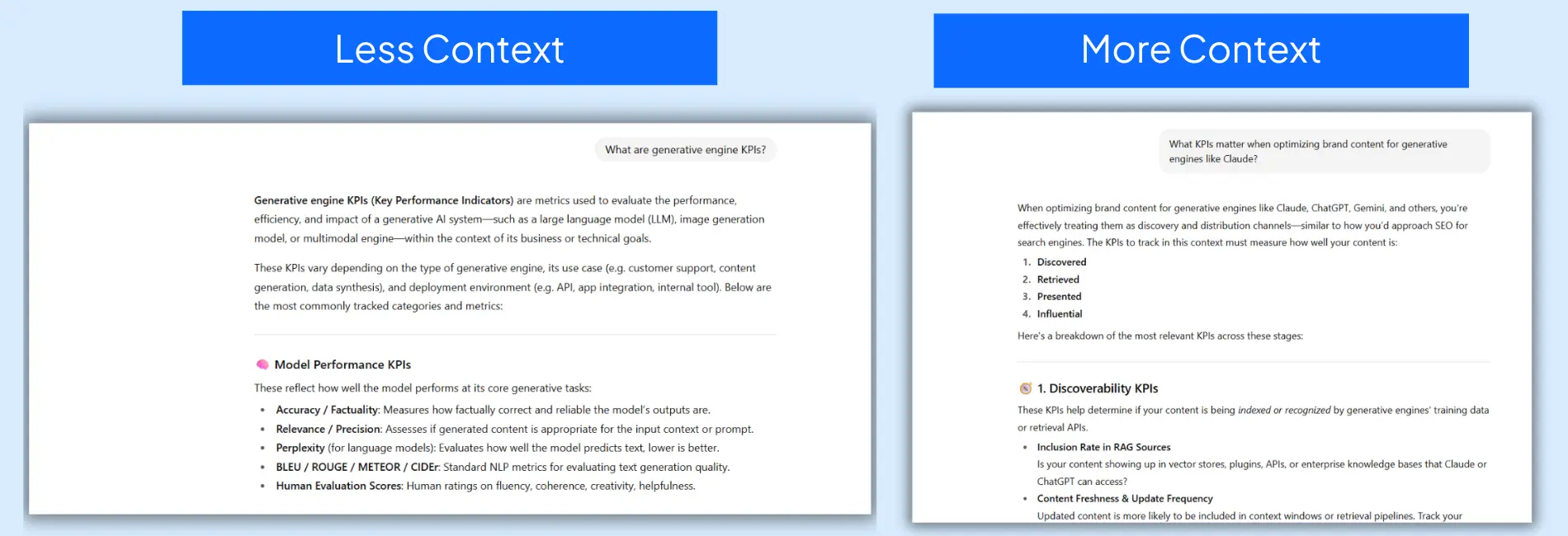
Suppose you ask, “What are generative engine KPIs?” You’ll probably get a basic list—accuracy, latency, maybe user engagement. But ask, “What KPIs matter when optimizing brand content for generative engines like Claude?” and now you’re giving the model direction. It can tailor the answer around visibility, content structure, trust signals, and how those impact performance inside AI-driven discovery.
That’s why context isn’t just a technical detail. It’s a design layer. A performance lever. A trust issue. And if you’re building with LLMs, understanding how context works isn’t nice to have—it’s critical for generative engine optimization.
TL;DR — What You’ll Learn in This Guide:
- What “context” really means in LLMs (and why it’s not just the prompt)
- How context windows work—and where they break
- The difference between implicit and explicit context
- Why RAG and tool use don’t work without context orchestration
- How to structure, inject, and control context to drive better outputs
- And why your LLM isn’t underperforming—it’s just flying blind
What Does Context Mean for LLMs?
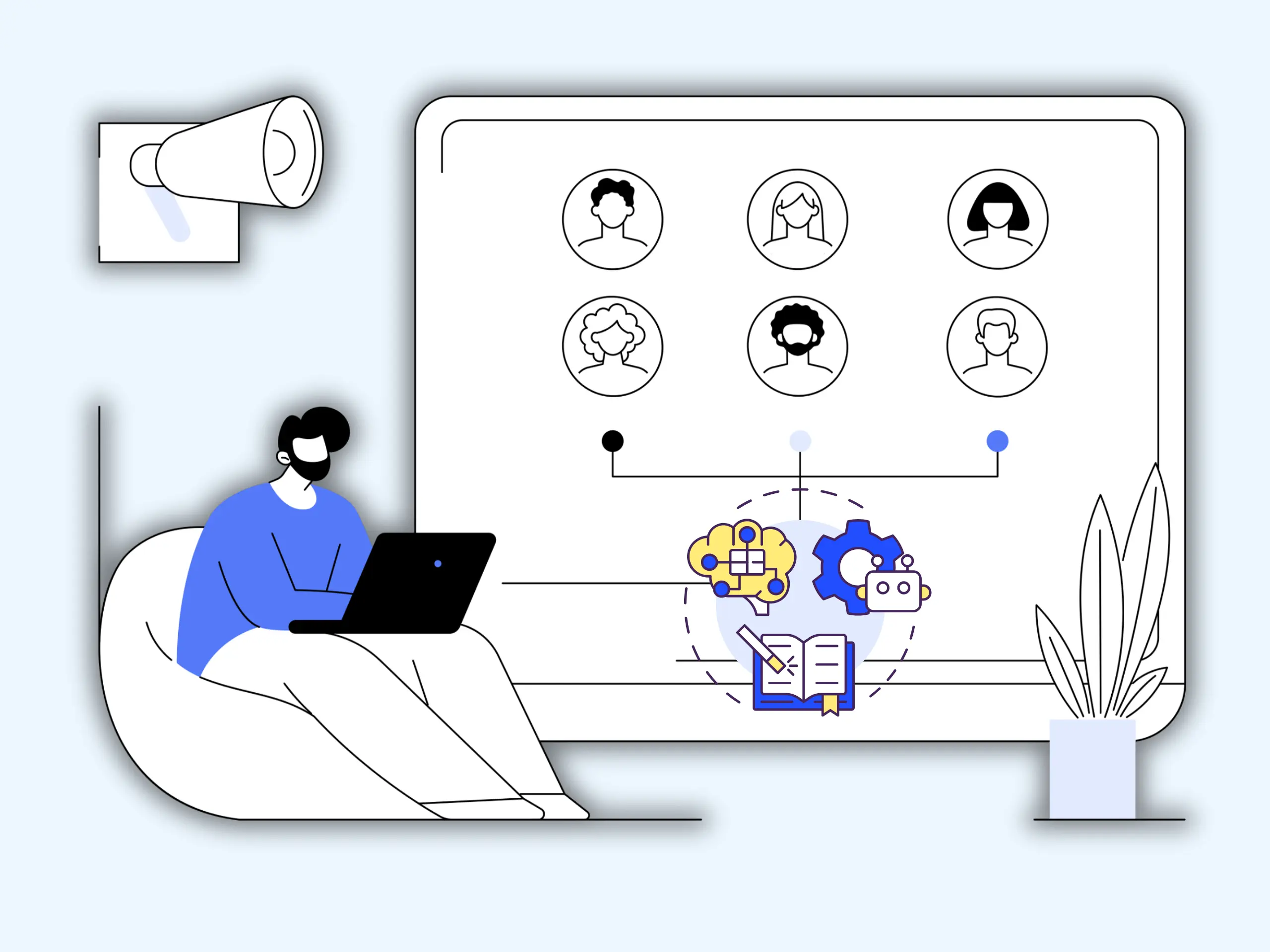
In the world of large language models (LLMs), context refers to the full set of information the model receives and processes in a single request. It’s not just about the latest message a user types—it’s a much broader input space that shapes the model’s response and forms the foundation of modern Generative Engine Optimization.
At its core, the context includes:
Context Elements for LLMs
- System instructions: that define the assistant’s behavior (e.g., “You are a helpful assistant.”)
- Memory: (if enabled), such as summaries of facts from past interactions to maintain continuity and personalization
- Conversation history: with previous user and assistant messages, typically limited to what fits in the model’s context window
- Current user input: which is the prompt or question the user just sent
- Retrieved knowledge: (via RAG), where the model pulls in relevant documents or facts from external sources
- Tool outputs: which are the responses from functions or APIs the model used during the conversation
- Tool definitions: including the names and parameters of tools available to the assistant
Implicit vs Explicit Context
Implicit context refers to everything the LLM infers automatically during a conversation—your tone, previous turns, behavioral patterns, shorthand references, or the natural flow of the dialogue.
It’s not manually provided; instead, the model deduces it from the ongoing interaction. This helps the LLM maintain continuity, recall earlier constraints, and adapt to your communication style without requiring repeated instructions.
Explicit context is the information you intentionally feed into the system—system prompts, role instructions, retrieved documents, structured data, or any constraints you specify directly.
This type of context guides the model with precision and ensures it understands what to prioritize, how to respond, and which details matter most to the task.
Together, implicit and explicit context form the backbone of how modern LLM SEO reason, reduce hallucinations, and generate accurate outputs. When both are orchestrated effectively, generative engines deliver far more consistent, high-confidence responses.
What is Context Length and Is it the Same for all LLMs?
Context length (also known as the context window) is the maximum amount of input an LLM can consider at once. It includes your prompt, conversation history, system instructions, retrieved content, and more. The longer the context window, the more the model can “remember” within a single interaction.
Instead of words, context is measured in tokens. In English, one token is roughly 4 characters or about ¾ of a word. So, 100 tokens = ~75 words.
But not all LLMs have the same limits, here’s how they compare:
| Model | Context Length |
|---|---|
| Mistral 7B | 8K tokens |
| PaLM 2 | 8K tokens |
| Gemini (Google) | 32K tokens |
| Claude 1 | 9K tokens |
| Claude 2 | 100K tokens |
| LLaMA | 2K tokens |
| LLaMA 2 | 4K tokens |
| GPT-3.5 Turbo | 4K tokens |
| GPT-3.5-16K | 16K tokens |
| GPT-4 | 8K tokens |
| GPT-4-32K | 32K tokens |
Why This Matters
- Longer context = better comprehension for tasks like summarizing lengthy articles, analyzing codebases, or managing multi-step reasoning.
- Shorter context = faster but more limited in complex tasks, especially where lots of reference material is involved.
- Choosing the right model often depends on how much context your use case demands.
Which LLMs Currently Offer the Largest Context Windows for Processing Long Documents?
In modern generative engines, long-context capacity determines how much of your content an AI can actually read, interpret, and reuse inside its answers. Models with expanded windows enable better reasoning, multi-document synthesis, and stronger visibility across AI-driven search engines.
Here are the leading long-context LLMs in 2025.
These extended context windows matter because the more an LLM can “see,” the more of your structured pages, entities, and semantic clusters it can reuse in its output.
Inside Wellows, our KIVA and visibility workflows leverage these expanded contexts to optimize content for generative engines across modern search surfaces.
How Modern LLMs Manage Context for Complex Reasoning?
Advanced large language models (LLMs) like Claude 3 and GPT-4o manage context for complex reasoning tasks through several key mechanisms. These help the model stay coherent, focused, and accurate even when dealing with long documents or multi-step workflows.
Here are the main techniques in play: 1.Expansive context windows: Models such as Claude 3 support up to ~200,000 tokens per session, enabling them to process long documents or datasets without losing track of earlier information. Meanwhile, GPT‑4o offers up to ~128,000 tokens in its context window, giving it strong ability to tackle moderate-length multi-step reasoning tasks. These large windows let the model “see” more of the task, reduce the risk of forgetting early context, and improve reasoning clarity. 2.Advanced prompting & in-context reasoning: Models apply approaches like REAP (Reflection, Explicit problem deconstruction) and HiAR-ICL (High-level Automated Reasoning in Context) to break down complex questions into sub-parts, then chain reasoning paths. This effectively uses the context window not just for content but for structured thought itself. 3.Tool integration & “extended thinking” modes: Some models allow alternating between internal reasoning and external tool use (APIs, knowledge retrieval, calculators). By offloading parts of reasoning or data retrieval to tools, the model preserves context in the main window for the most critical reasoning steps.How Claude 3 and GPT-4o Manage Context for Complex Reasoning
By combining large context windows, smart prompting, in-context learning, and external tool use, models like Claude 3 and GPT-4o can handle tasks that earlier models struggled with: multi-document synthesis, legal & financial analysis, long chat sessions, and complex codebases.
Why LLMs Prioritize Context Over Keywords?
Keywords might help LLMs find your content, but only context helps them use it. This is why many practitioners say LLMs need context more than keywords. Keywords can surface content, but only context makes it usable and accurate
1. LLMs Don’t “Know”—They Predict Based on What You Feed Them
LLMs don’t have real-time knowledge. Their training data is frozen—GPT-4, for example, only “knows” what happened up to late 2023 (unless browsing is enabled). Ask it about something that happened last week, and it will either guess, hallucinate, or stall—unless you give it the right input.
Example:
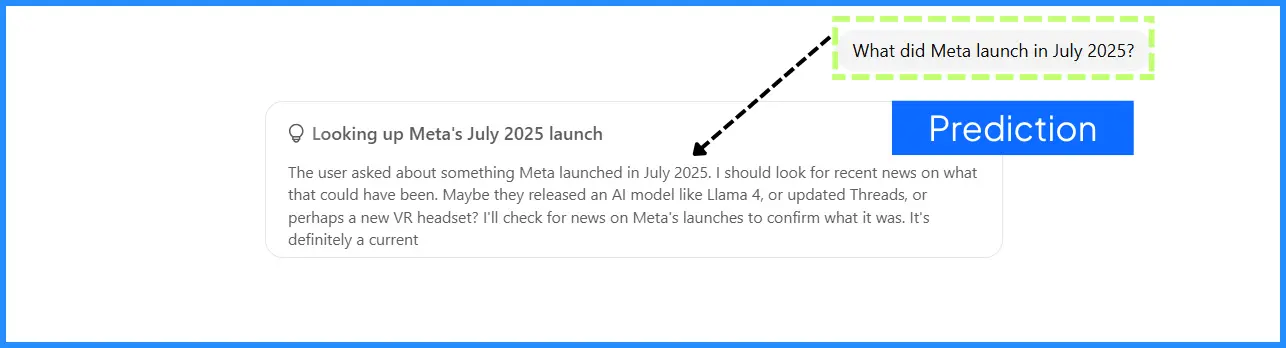
Ask ChatGPT: “What did Meta launch in July 2025?” Without browsing, you’ll get speculation. But provide a short press release or blog summary as context—and it can generate a confident, useful response grounded in facts.
This is why modern AI applications are shifting toward retrieval-augmented generation (RAG)—where external documents, live data, or internal knowledge bases are injected into the model’s context before generating a response. That is why snippet-ready, indexed content gets echoed in answers, as shown in the ChatGPT Visibility Experiment.
2. Context Shapes Relevance, Reasoning, and Trustworthiness
Think of keywords like a headline. They get attention. But context is the body copy—it’s where the meaning lives.
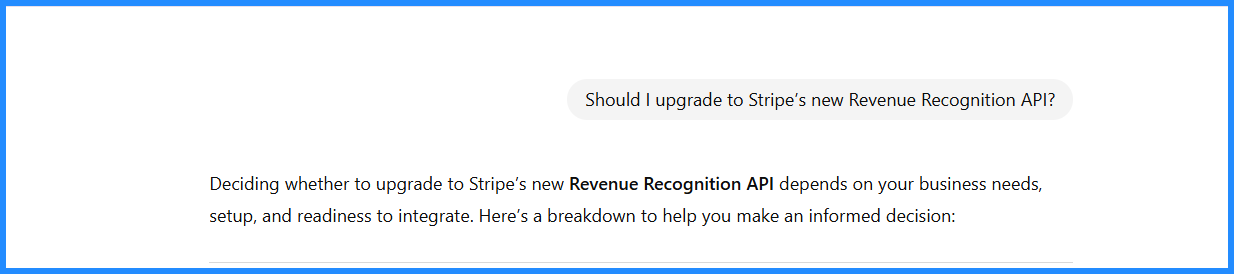
When you ask an LLM, “Should I upgrade to Stripe’s new Revenue Recognition API?”, the model needs to understand:
-
- What product or version you’re currently using
- What “upgrade” refers to (compliance, scalability, API changes?)
- Your business type or tech stack
- The date (because APIs evolve fast)
Without that context, the model can’t give you anything specific. With it, it can reason like a subject matter expert.
3.Impact of Contextual Data on LLM Accuracy
Richer contextual data doesn’t just change tone—it directly improves accuracy. LLMs given detailed context produce higher factual precision, fewer hallucinations, and more reliable recommendations.
Simply repeating terms is not enough LLMs need context more than keywords to deliver precise, trustworthy reasoning.
4.Why Keyword Stuffing Doesn’t Work Anymore
Unlike search engines, LLMs don’t reward repetition. Mentioning a keyword ten times won’t help you. which is why applying most effective strategies for AI visibility enhancement— such as structured data, topical authority, and community-driven mentions — is far more impactful than keyword stuffing.”
What matters instead:
- Logical flow
- Clear structure (headings, bullets, sections)
- Rich context around the topic (not just repeating the keyword, but explaining related ideas)
For example, a blog about Generative Engine Optimization shouldn’t just repeat the phrase—it should naturally cover concepts like:
- How LLMs retrieve and synthesize content
- The role of structured data in AI visibility
- Differences between SEO and GEO strategies
- How to earn citations in AI-generated answers
- Why content formatting matters for LLM retrieval
That’s context. And LLMs will pick it up—even if the query never includes the exact words “Generative Engine Optimization.”
5.Context Has Limits (And You Need to Design Around Them)
LLMs have a fixed context window—the number of tokens (words + structure) they can handle at once. Go beyond it, and earlier info gets pushed out or forgotten.
That’s why:
- Chatbots “forget” your question after a few back-and-forths
- RAG systems summarize docs too aggressively
- Long workflows break down mid-conversation
If you’re building with LLMs, managing the context window becomes a design constraint—not just an engineering one.
6.Fine-Tuning Is Not a Context Shortcut
Yes, you can fine-tune a model to improve performance. But it’s expensive, time-consuming, and brittle.
- Every time your data changes, you’re retraining
- You lose flexibility—because the model is “locked in”
- It’s inaccessible to most teams outside big tech
7.How LLMs Use Context in Text Analysis
When analyzing text, LLMs tokenize the input, weigh relationships across tokens, and use context windows to preserve continuity. This enables them to summarize long passages, detect patterns, and tailor outputs to specific framing.
- Tokenization converts text into manageable pieces
- Attention layers preserve semantic relationships
- Context windows maintain coherence across long text
8.Even Google Prioritizes Context Over Keywords Now
You don’t have to take OpenAI’s word for it. Look at how Google has evolved:
- Knowledge Graph (2012) introduced entity understanding
- RankBrain, BERT, MUM added semantic parsing and cross-modal reasoning
- AI Overviews (2024+) use query “fan-out” to expand meaning—pulling from semantically related pages, not just keyword matches
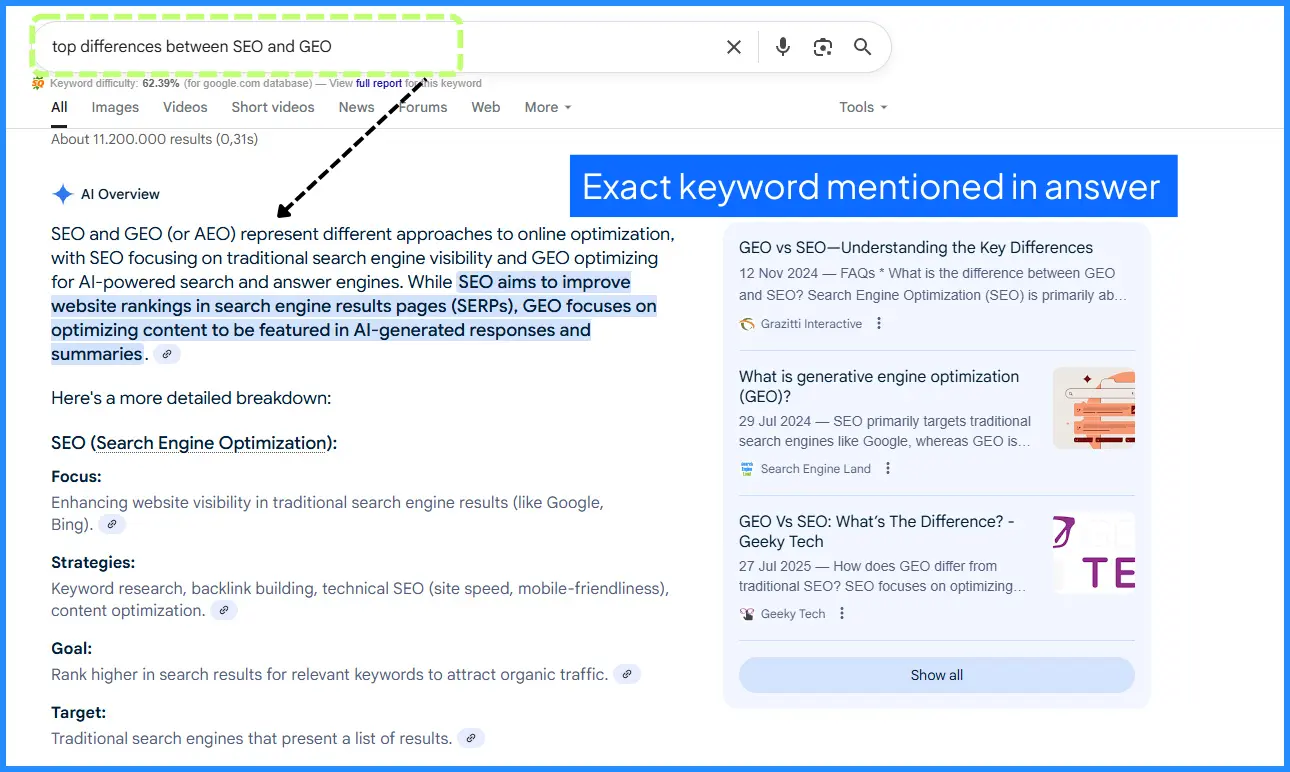
This is why your content doesn’t need to match a query word-for-word to appear in an AI answer. It just needs to be contextually aligned.
Example:
User searches: “top differences between SEO and GEO” Google’s AI Overview might include a blog titled “GEO vs SEO-key Differences”—even if that blog never used the phrase “top differences between SEO and GEO.” Why? Because the context matches.
How Context Window Size Impacts LLM Performance?
How does the size of the context window affect the performance of LLMs in real-world applications becomes a critical question once you understand that LLMs don’t interpret language—they predict it based on the context they’re given.
In generative engines, the context window acts like the “memory boundary” that determines how much the model can hold, reason over, and reuse in a single pass. The larger the window, the more the model can align with user intent, brand entities, and search visibility signals.
A larger context window typically improves:
- Accuracy and coherence: more of the surrounding information stays available, reducing hallucinations and preserving the meaning of earlier inputs.
- Conversational depth: the model maintains continuity across long multi-turn sessions without losing track of constraints.
- Long-document reasoning: tasks like summarizing reports, analyzing financial filings, or interpreting technical documentation become more reliable.
But bigger windows are not always better. They also introduce:
- Higher compute cost and latency, especially in real-time search-like experiences.
- Context decay, where the middle of the window receives less attention than the beginning or end.
- Reduced performance on short queries if the model becomes too dependent on long contextual scaffolding.
This balance—context depth vs. cost vs. precision—is exactly how we think inside Wellows when building AI-driven search visibility systems. Instead of stuffing keywords, we optimize context flow: the right entities, the right structure, at the right moment.
How Does the Size of the Context Window Affect the Performance of LLMs in Real-World Applications?
In real-world environments, the context window dictates how effectively an LLM can track dependencies, maintain reasoning chains, and deliver outputs that feel grounded instead of generic.
When the window is large enough, the model can integrate:
- previous constraints from the conversation,
- retrieved snippets from RAG,
- brand entities and definitions,
- structured data like tables or metadata,
- and user-specific preferences.
When the window is too small, the model collapses back into vague predictions. When it is appropriately sized—and context is orchestrated well—it delivers more precise reasoning, stronger relevance, and better alignment with user intent.
This is the foundation of modern generative engine optimization, and it’s the reason structured context consistently outperforms traditional keyword-driven methods.
Is There a Way to Increase the Context Window Size in Existing LLMs Like GPT-4 or Claude?
The context window defines how much information an LLM can process in a single pass. Because models like GPT-4 or Claude are trained with fixed architectural limits, you can’t manually upgrade their window size—but you can extend how much usable context they work with.
1. Use New Long-Context Model Variants
Latest versions introduce larger built-in windows:
- Claude Sonnet 4 now supports around 1 million tokens, enabling long-form comprehension and multi-document reasoning.
- GPT-4 offers a 128,000-token window, ideal for extended analysis and technical workflows.
2. Extend “Effective Context” Through Retrieval
Retrieval-Augmented Generation (RAG) lets models access more information than their native context window allows. Instead of packing everything into the prompt, external sources supply only the most relevant fragments. This keeps the active context focused and improves reasoning accuracy.
3. Use Positional Interpolation for Specialized Fine-Tuning
Techniques like Position Interpolation can stretch a model’s usable context range by adjusting positional encodings. While this method works in research settings, it requires fine-tuning expertise and isn’t typically applied to production models like GPT-4 or Claude.
More usable context means an LLM can read, interpret, and reuse a larger share of your structured entities, arguments, and page sections. That’s why inside Wellows, we focus on context orchestration—not keyword repetition—to improve how models retrieve and represent your content inside generative engines.
How to Give LLMs Context?
Designing context for LLMs isn’t just about what you include—it’s about how, when, and why you include it. Whether you’re a developer building applications on top of LLMs, or a power user trying to get better results, crafting the right context is essential for performance, coherence, and trustworthiness.
1. Start with Clear, Concise Prompts
A well-structured prompt helps the model focus on your intent. Avoid vague requests—be explicit about your objective, format expectations, or tone. For example:
❌ “Tell me something about climate change.”
✅ “Give me a 3-paragraph summary of the causes and effects of climate change, with bullet points at the end.”
2. Use System Instructions to Set Behavior
System-level context (like You are a helpful assistant…) sets the model’s persona and boundaries. It’s especially useful for:
- Role-playing scenarios (“You are a marketing consultant…”)
- Tone and style control (“Respond with a friendly and persuasive tone…”)
- Guardrails for behavior (“Never mention unverified facts…”)
3. Prioritize Relevance in Long Contexts
When adding external data (via RAG or memory), not all information is equally useful. Good context design:
- Surfaces the most relevant facts or snippets
- Summarizes or compresses long text when possible
- Places key facts early in the context window (proximity matters)
Too much irrelevant context can dilute the signal and lead to confusion or hallucinations.
4. Leverage Chunking and Summarization
When dealing with large documents or lengthy chats:
- Chunk content into logical sections (e.g., intro, key findings, conclusion)
- Summarize earlier chunks and include only summaries in the active context
- Tools like sliding windows or recursive summarization can help in automation
This balances completeness with the model’s token constraints.
4. Contextual Learning Techniques for LLMs
Few-shot prompting, chain-of-thought scaffolding, and in-context learning examples allow LLMs to adapt without retraining. These techniques only work when context is structured and sequenced properly.
- Few-shot prompting for adaptive reasoning
- Chain-of-thought scaffolding for step-by-step logic
- In-context examples to teach tasks without retraining
5. Use Retrieval Systems Thoughtfully
Retrieval-Augmented Generation (RAG) allows LLMs to fetch relevant knowledge on the fly. For best results:
- Ensure high-quality indexing of your source material
- Use semantic search, not keyword match
- Include metadata (timestamps, source info) to enhance context quality
- Filter aggressively—irrelevant snippets do more harm than good
6. Control Context Length and Order
LLMs prioritize recent tokens. Important details pushed to the end may be ignored. Strategies include:
- Placing critical instructions or facts near the end (or at both ends)
- Pruning stale or redundant content
- Using memory summarization in long conversations (as ChatGPT does)
7. Avoid Context Leakage
Be cautious about including sensitive or unintended information in the context. In multi-user or multi-turn systems, this can result in:
- Leaked instructions across users or tasks
- Inadvertent behavior conditioning
- Data privacy violations
Context should be tailored and scoped to the specific task or user.
What Techniques are Used to Manage or Optimize Context Length in LLMs?
Techniques to manage or optimize context length are becoming essential as modern LLMs handle larger documents, longer conversations, and multi-step reasoning workflows.
Since LLMs don’t truly “remember” information—they only predict based on what fits inside the context window—these optimization methods directly impact accuracy, latency, and retrieval performance inside generative engines.
This also shapes how AI-driven discovery surfaces content across search visibility engines, which is why platforms like Wellows help teams understand how different context structures influence LLM recall and citation behavior.
Techniques to Manage or Optimize Context Length in LLMs
Efficient Long-Context Training Frameworks
- ByteScale (HDP) reduces redundant communication by combining inter-data and intra-data parallelism. This enables long-context training without excessive compute overhead.
Context Extension Techniques
- Extensible Embedding enhances token embeddings so models can handle larger scopes of context without exponential memory usage.
- LongLoRA expands context windows up to 100k+ tokens using sparse local attention—ideal for fine-tuning long-context variants.
Chunk-Wise Optimization
- SeCO splits long inputs into sequential chunks for localized backpropagation, minimizing memory footprint.
- SpaCO selectively updates only crucial chunks, making training cost independent of full context size.
Context Compression & Pruning
- Selective Context removes redundant text spans and preserves only the highest-signal elements.
- Dynamic pruning & caching uses attention scores to drop low-importance tokens during inference.
Advanced Attention Mechanisms
- Squeezed Attention clusters keys into semantic groups and uses centroids to accelerate attention computation.
- Sparse Attention processes only a subset of tokens—dramatically reducing quadratic complexity.
Position Encoding Innovations
- RoPE (Rotary Positional Embeddings) improves long-range reasoning by rotating embeddings based on relative positions.
- ALiBi applies linear distance biases so models can generalize naturally to longer sequences.
Long-Context Stability Methods
- Gradient checkpointing improves memory efficiency during long-context training.
- KV caching accelerates inference by reusing previously computed key-value pairs.
Context Routing & Prioritization
- High-value tokens are prioritized using relevance scoring or semantic filtering.
- Low-impact segments are deprioritized or compressed before inference.
Retrieval-Aware Optimization
- RAG systems intelligently fetch only the most relevant chunks to reduce context bloat.
- Semantic search ensures models receive meaningful, high-precision context.
Together, these techniques help modern LLMs process huge context windows, reduce memory pressure, and remain accurate over long sequences.
They also support the rise of generative engine visibility—where structured, compressed, or retrieved context signals help AI models understand and surface your content accurately.
Read More Articles
Why Prompts Matter More than Keywords in Generative Engines?
What Roles Does Structured Data Play in LLM Visibility?
How AI Search Marketing Strategies Target Semantic Search Intent (2026)
FAQs
In-context learning (ICL) allows LLMs to perform new tasks simply by seeing examples in the prompt—without retraining. Its effectiveness depends on model size, quality of training data, and how well the prompt examples match the task.
What Context Really Means in the Age of LLMs
Tokens aren’t the bottleneck—context is. And as models scale, the winners won’t just prompt better—they’ll architect better context.
Static prompts are a starting point. But real performance comes from dynamic context pipelines: structured inputs, smart retrieval, and systems that feed models exactly what they need—when they need it.
We’re moving from clever one-offs to repeatable scaffolding. From prompt craft to context design.
Key Takeaways for the why LLMs need context
- Context is UX for models. The structure, format, and clarity of what you feed the model is as critical as what you ask.
- RAG isn’t a hack—it’s table stakes. If you’re not enriching with retrieval, you’re leaving accuracy on the table.
- Fine-tuning is expensive. Context is flexible. You don’t need a new model—you need better memory.
- Good context outperforms clever prompts. It’s not about tricks. It’s about relevance, order, and precision.
- This is a system design problem. And that’s where the next gains will come from.
That’s the core truth: LLMs need context more than keywords, and the systems that design better context pipelines will win.
Context isn’t just a wrapper. It’s the new interface. And getting it right is the unlock.