AI has changed what it even means to win a search. You no longer compete for one of ten blue links, you compete for one of about five citation slots inside a single AI-generated answer, and across the 11.1 million citations we analyzed, the engines agree on under 5% of which sources fill them.
The encouraging part: today two-thirds of AI answers name no brand at all, so the space is wide open. Closing that gap is the job of LLM SEO.
In this guide you’ll learn how LLM SEO works, how AI search engines choose sources, the Wellows 3-Layer LLM SEO Framework, eight proven tactics for earning citations, and how to measure AI visibility, grounded in our own citation data rather than recycled claims.
LLM SEO Explained in 30 Seconds
- What it is: optimizing content so AI engines cite and mention your brand in their answers.
- How it differs: traditional SEO wins clicks; LLM SEO wins citations, mentions, and source inclusion.
- Where you compete: about five citation slots per answer, and the engines agree on under 5% of sources.
- Key tactics: schema markup, E-E-A-T and named authors, entity clarity, freshness, and original research.
- How to measure: citation frequency, brand mentions, and share of voice, tracked per engine.
What is LLM SEO?
LLM SEO
LLM SEO (also called large language model SEO, AI SEO, or generative engine optimization) is the practice of getting your brand cited and mentioned inside AI-generated answers from engines like ChatGPT, Gemini, Claude, Perplexity, and Google’s AI Overviews. The unit of success is the citation, the source an engine pulls to build its answer, plus the brand mention in the text. Traditional rankings still feed the system, but the scoreboard is inclusion in the answer, not position on a results page.
In practice, that means optimizing content so models can interpret, cite, and recommend it, with success measured by inclusion in the answer rather than a ranking position.
This involves refining your content structure, semantic clarity, and technical accessibility so AI platforms recognize your pages as trusted sources.
It usually starts with an LLM visibility audit to pinpoint what’s being cited and what’s missing, work many brands handle internally or with specialized content marketing agencies familiar with AI-driven search.
For a wider foundation, AI SEO covers how AI signals affect research, structure, and optimization decisions across search environments.
Unlike legacy methods, LLM SEO prioritizes natural-language structure, clear entities, and reliable sourcing over keyword density and backlink volume. As AI answers absorb more discovery, prominent placement depends on semantic organization and demonstrable subject-matter authority.
How AI Search Engines Choose Sources
AI search engines build an answer by retrieving a small set of sources, interpreting them, and synthesizing a response, then citing or naming the ones they trust most.
Two mechanics drive this:
- retrieval (what the model fetches in real time) and
- training data (what the model already learned).
Understanding both explains why LLM SEO is a different from traditional SEO.
Most AI systems use retrieval-augmented generation (RAG), fetching live pages at answer time. ChatGPT, Copilot, and Meta AI lean on Bing’s index, Google uses its own, and Perplexity uses a mix.
A critical, often-missed detail is that most AI crawlers fetch but do not execute JavaScript, so content rendered client-side can be invisible to them. Server-side rendering or static HTML is what guarantees your content is actually readable.
Beyond retrieval, models also draw on training data, encoded as embeddings that represent relationships between concepts, which lets them reason without exact keyword matches.
The Library Analogy: if traditional SEO is getting your book onto the library shelf where people can find it, LLM SEO is having the librarian memorize and quote your book when answering questions. You want to be the source the model reaches for first.
This matters more than ever because user behavior has shifted. AI assistants now answer many queries inline, before a click ever happens, and for some products AI engines have become a leading acquisition channel.
Brands that aren’t structured for citation simply don’t appear in that answer, and a competitor takes the mention. Industries built on credibility, healthcare, finance, and legal services, feel this first.
What Is Multi-Platform LLM Visibility and Why Does It Matter?
LLM SEO extends beyond a single platform. Your content needs to rank across multiple AI search engines including Perplexity, Gemini, Claude, and emerging platforms like Google AI Mode and Meta AI.
Each platform has unique indexing patterns, but they share core preferences for structured, authoritative content. Multi-engine optimization differs from traditional Google SEO by prioritizing answer extraction over click-throughs.
LLMs pull content from their training data and real-time indexes, making visibility dependent on semantic clarity, structured markup, and third-party validation, rather than backlink volume alone.
The Library Analogy: If traditional SEO is like getting your book on the library shelf where people can find it, LLM SEO is like having librarians memorize and quote your book when answering questions.
You want to be the source they reach for first when someone asks about your topic, which is why teams often start by running an LLM visibility audit, often supported by a ChatGPT Visibility Tracker, to see where they’re already cited and where they’re missing.
- Platform Diversity: Content optimized for one LLM often performs well across others due to shared quality signals.
- Citation Mechanics: Each platform cites sources differently, some link directly, others mention by brand name.
- Real-Time vs. Training Data: Platforms like Perplexity prioritize fresh web content, while others rely more on training data.
- Tracking Requirements: Monitor visibility across all major LLMs separately to identify platform-specific gaps.
What We Learned From Analyzing 11.1 Million AI Citations
Most LLM SEO advice is opinion. To ground this guide in evidence, Wellows analyzed 11.1 million individual citations across 571,729 AI answers (Dec 2025–Mar 2026), spanning 363 brands and 35 regions, tracking which sources ChatGPT, Gemini, Perplexity, Google AI Overviews, and Google AI Mode actually cite. Six findings explain why LLM SEO is its own discipline.
Study methodology
- Dataset: 571,729 AI answers, 11.1 million individual citations
- Engines: ChatGPT, Gemini, Perplexity, Google AI Overviews, Google AI Mode
- Collection period: December 2025 – March 2026
- Coverage: 363 brands across 35 regions, 35,404 distinct queries
- Scope note: tracked-brand data skewed toward VPN/cybersecurity and martech (US and India); structural findings generalize, specific domain rankings reflect the brands tracked
- AI queries are questions, not keywords: Across 35,404 distinct queries, the average length is 10.9 words (median 11), versus the 3–4 words typical of Google search. 83.9% are eight words or longer, and 47.1% contain a question word. LLM SEO targets phrasing and intent, not short keywords.
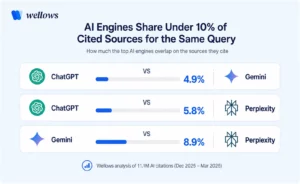
- The engines barely agree with each other: For the same query, ChatGPT and Gemini share only 4.9% of cited sources (ChatGPT vs Perplexity 5.8%, Gemini vs Perplexity 8.9%). Ask two engines the same question and roughly 90–95% of their sources differ, which makes LLM SEO inherently multi-engine.
- About five slots, and no page two: The average answer cites ~4.8 sources (4.44 for ChatGPT, the most selective, up to 4.99 for Google AI Mode), and 98.8% of citations sit in positions 1–5. Those slots are drawn from 293,294 distinct domains, 36% of which were cited only once. The competition is wider, but the winning surface is far narrower.
- Two-thirds of answers name no brand at all: Only 6.8% of cited sources carry any brand mention, and just 31.7% of AI answers named a tracked brand directly. That leaves roughly two-thirds of answers with no brand named, open space for whoever structures content to be cited first.
- Mentions outnumber links roughly 8 to 1: Brands are named in answer text about eight times more often than they receive a citation link (5.87M implicit mentions vs 0.70M brand-flagged citations). Being mentioned and being cited are different games, and most brand visibility happens without a link, which is why tracking mentions matters as much as tracking citations.
- Community content competes with brand pages: Community and UGC platforms (Reddit, Quora, YouTube, LinkedIn, Medium) account for 8.9% of all citations, more than any single publisher category, with Reddit the most-cited domain at 3.7%. Roughly one in nine AI citations comes from content no brand controls.
What kind of content earns the citation: across categorized citations, how-to guides (26.5%) and product or feature pages (18.4%) together account for about 45%, with reviews (11.4%), UGC (7.7%), and comparisons (7.1%) following. LLMs reward explanatory and comparative content, a pattern consistent with effective LLM citation strategies.
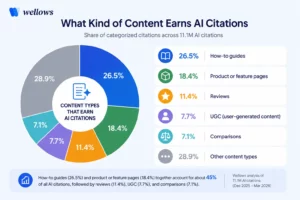
Methodology note: this reflects Wellows’ tracked-brand dataset (skewed toward VPN/cybersecurity and martech, US and India). Treat specific domain rankings as “across the brands we track.” The structural findings, query length, cross-engine overlap, sources per answer, and source-type mix, generalize well.
What are the Common LLM SEO Ranking Factors in 2026?
There is no single “LLM ranking algorithm,” but our citation data and the patterns across major engines point to a consistent set of factors that decide whether you make the answer. They sort cleanly into the three framework layers, and the table shows where each one bites.
| Ranking factor | Layer | Impact | Why it matters in 2026 |
|---|---|---|---|
| Crawlability and Bing/Google indexation | Accessibility | High | Retrieval runs through search indexes; unindexed pages can’t be cited |
| Server-rendered / static HTML | Accessibility | High | Most AI crawlers fetch but don’t execute JavaScript |
| Schema markup (Article, FAQPage, HowTo) | Accessibility | Medium | Explicit structure improves extraction reliability, not a guarantee |
| Answer-first structure and clarity | Understanding | High | Self-contained answers are easier to lift into a response |
| Entity clarity and consistent terminology | Understanding | High | Models match meaning, not keywords; fuzzy synonyms weaken signals |
| Natural-language question coverage | Understanding | Medium | Average AI query is ~11 words; 83.9% are 8+ words |
| Original data and first-hand experience | Authority | High | Engines avoid repetition; hard-to-replicate content gets cited |
| E-E-A-T and named-author credentials | Authority | High | Verifiable expertise raises citation confidence |
| Third-party mentions (community, reviews, “best of”) | Authority | High | Community/UGC is 8.9% of citations; Reddit is the most-cited domain |
| Freshness and last-updated signals | Authority | Medium | Retrieval favors current content; stale pages drop out |
| Traditional SEO strength (rankings, links) | All layers | Medium | Strong Google/Bing performance correlates with being cited |
Key takeaway: accessibility factors are pass/fail gates, understanding factors decide whether you’re relevant, and authority factors decide whether you’re chosen. A page can satisfy strong Google rankings yet still miss LLM citations if it fails the accessibility or authority layers.
How Does LLM SEO Differ from Traditional SEO?
LLM SEO prioritizes being cited in AI-generated answers over ranking for clicks, focusing on semantic clarity and structured data rather than backlinks and keyword density.
Traditional SEO aims to drive traffic through search engine rankings, while LLM SEO succeeds when AI platforms quote your content as authoritative, even if users never click through.
- Competes for rankings and clicks.
- Tracks rank, sessions, and conversions.
- Prioritizes meta tags, site speed, mobile usability, and
- Link-building to win one of ten results.
- Competes for citations and mentions.
- Tracks citation frequency, source mentions, and
- Share of voice across engines.
- Prioritizes well-structured, answer-first content, clear entities, and
- E-E-A-T to win one of ~five answer slots.
Success today is less about first-page rankings and more about becoming the AI’s definitive source. It also changes how you build queries, which is why a keyword strategy checklist built for natural-language search keeps content aligned with how people actually ask questions.
| Factor | Traditional SEO | GEO / LLM SEO |
|---|---|---|
| Primary goal | Rank and earn the click | Get cited and mentioned in the answer |
| Core metric | Rankings, traffic, conversions | Citation frequency, mentions, share of voice |
| Surface | Ten blue links | ~5 citation slots per answer |
| Main engines | Google, Bing | ChatGPT, Gemini, Perplexity, AI Overviews, AI Mode |
| Top signals | Backlinks, keywords, technical health | Entity clarity, structure, E-E-A-T, original data |
| Query style | 3–4 word keywords | ~11-word natural-language questions |
Note: GEO (generative engine optimization) and LLM SEO describe the same citation-first work; the column groups them together against traditional SEO rather than treating them as separate disciplines.
What’s the difference between LLM SEO, GEO, AEO, and LLMO?
These terms overlap, and the distinctions are simple once you anchor them to LLM SEO as the parent practice:
- GEO (Generative Engine Optimization): often used interchangeably with LLM SEO; optimizing content so generative engines use it as a source.
- AEO (Answer Engine Optimization): a narrower focus on directly answering questions to win answer boxes and featured snippets.
- LLMO (Large Language Model Optimization): the broadest term, covering brand presence across any AI output, including multi-modal and knowledge-base appearances. For deeper structuring, see LLM content creation strategy.
For practical purposes, LLM SEO and GEO describe the same citation-first work, and that is the focus of this guide.
The Wellows 3-Layer LLM SEO Framework
Every citation decision an AI engine makes runs through three questions in sequence. We call this the Wellows 3-Layer LLM SEO Framework, and it is the backbone of everything that follows. Most sites fail at Layer 1 and never discover why they are invisible.
- Layer 1: Accessibility (can the model read you?): Crawlability, indexation in Bing and Google, server-side rendered HTML, clean structure, and JSON-LD schema. If a model cannot fetch and parse your page, nothing else matters.
- Layer 2: Understanding (does the model know what you mean?): Clear language, explicit entities, consistent terminology, and answer-first formatting so the model can interpret your content and match it to a query.
- Layer 3: Authority (does the model trust you enough to cite you?): E-E-A-T signals, named-author credentials, original data, third-party mentions, and freshness, the trust layer that decides whether you make the answer.
The eight-step playbook below maps to this stack: steps 1–3 build Accessibility, steps 4–6 build Understanding, and steps 7–8 build Authority.
How Do I Rank in Large Language Models?
To rank in LLMs, implement these eight steps: set up Bing Webmaster Tools, add schema markup, write for Google and Bing best practices, answer autocomplete questions, keep content fresh, avoid over-relying on AI-generated text, earn third-party citations, and grow branded search.
Many teams also add an LLM.txt file to make key pages easier for models to discover.
Step 1: Set Up Bing Webmaster Tools
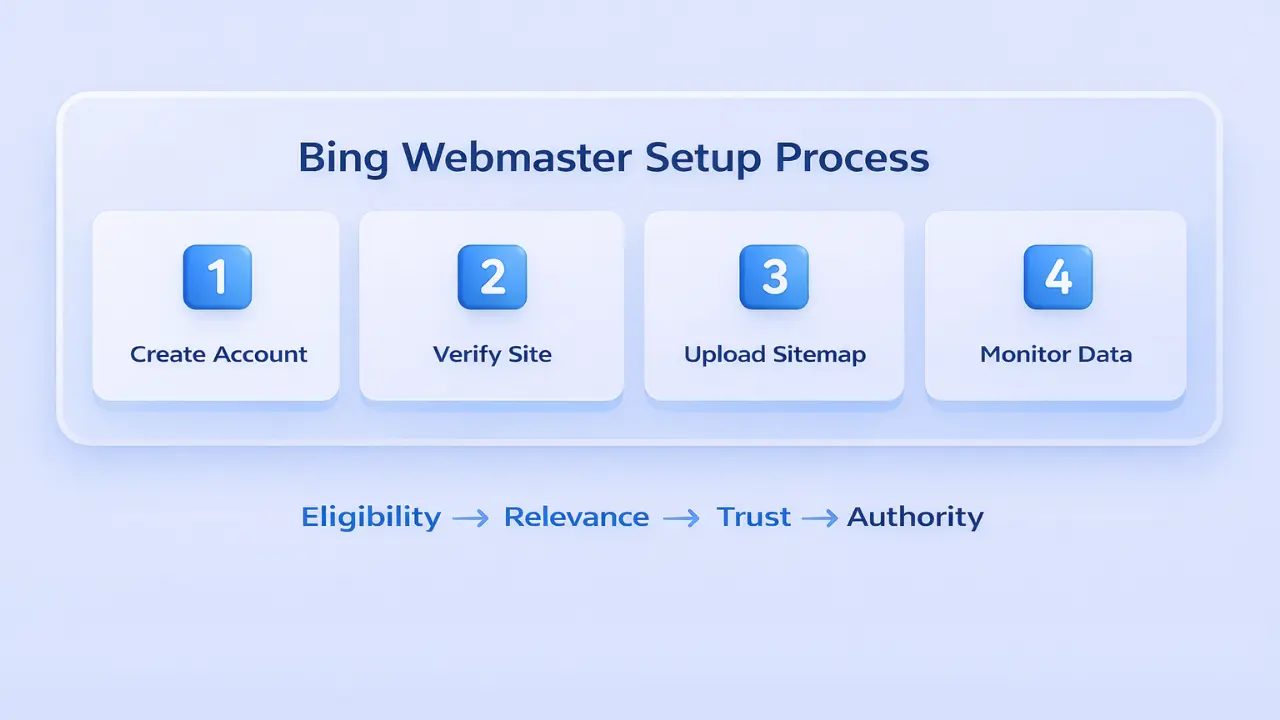
Because ChatGPT, Copilot, and Meta AI retrieve through Bing’s index, Bing Webmaster Tools is one of the fastest paths to LLM visibility. Verifying your site there gives you direct insight into how AI-feeding crawlers see it.
- Create an account, verify your site, and submit a clean, structured sitemap.
- Review Bing-specific performance and fix crawl errors that block indexing.
- Confirm mobile-first indexing status, since AI systems increasingly favor mobile-optimized content.
Pages that are indexed and healthy in Bing tend to surface in Perplexity, Copilot, and other Bing-fed AI results sooner than those relying on organic crawling alone.
Step 2: Add Schema Markup to Your Site
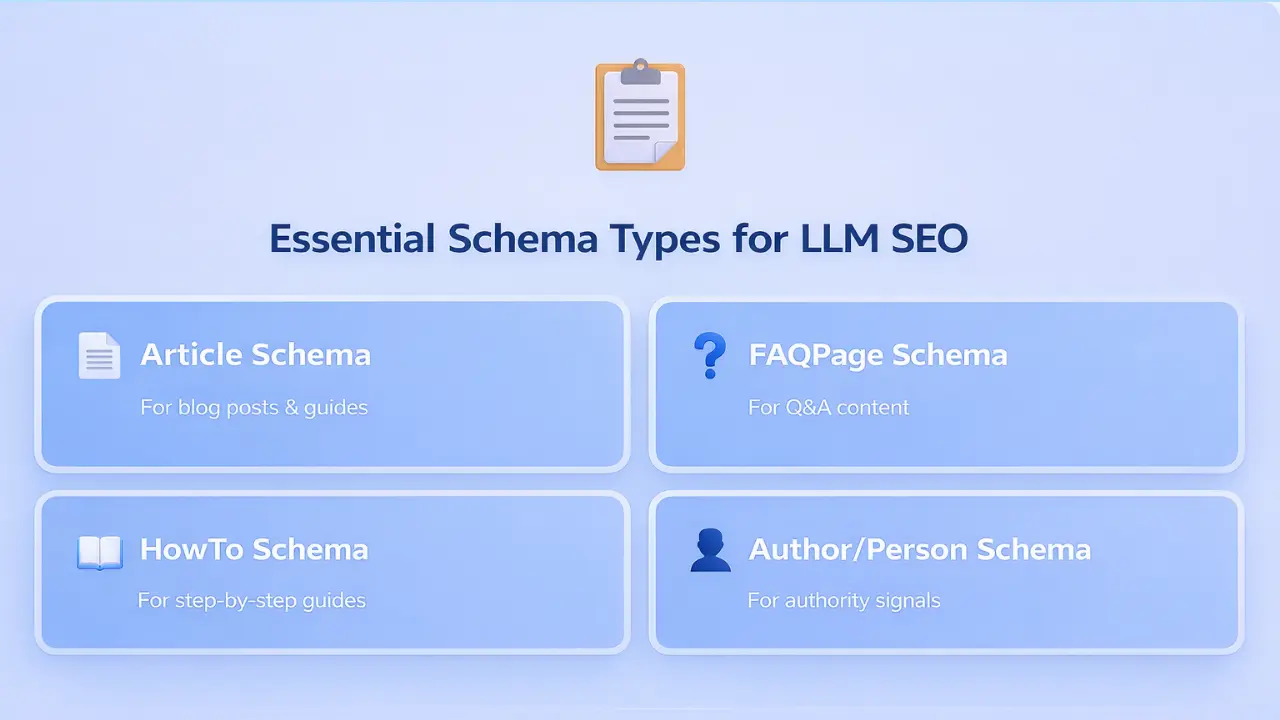
Schema markup gives models explicit structure to identify and reuse, a pattern reinforced in LLM citation trends. Structured data in JSON-LD (per Schema.org and Google Search Central) gives AI explicit signals about your questions, answers, steps, and entities. Validate your implementation with Google’s Rich Results Test.
- Add JSON-LD to your homepage and main landing pages to clarify purpose.
- Prioritize Article, FAQPage, and HowTo markup for AI benefit.
- Keep publish and revision dates accurate to reinforce recency.
Observation: pages frequently cited in LLMs nearly always have thorough schema implemented, because structured pages are simpler to extract than raw HTML.
Step 3: Write for Google and Bing Best Practices
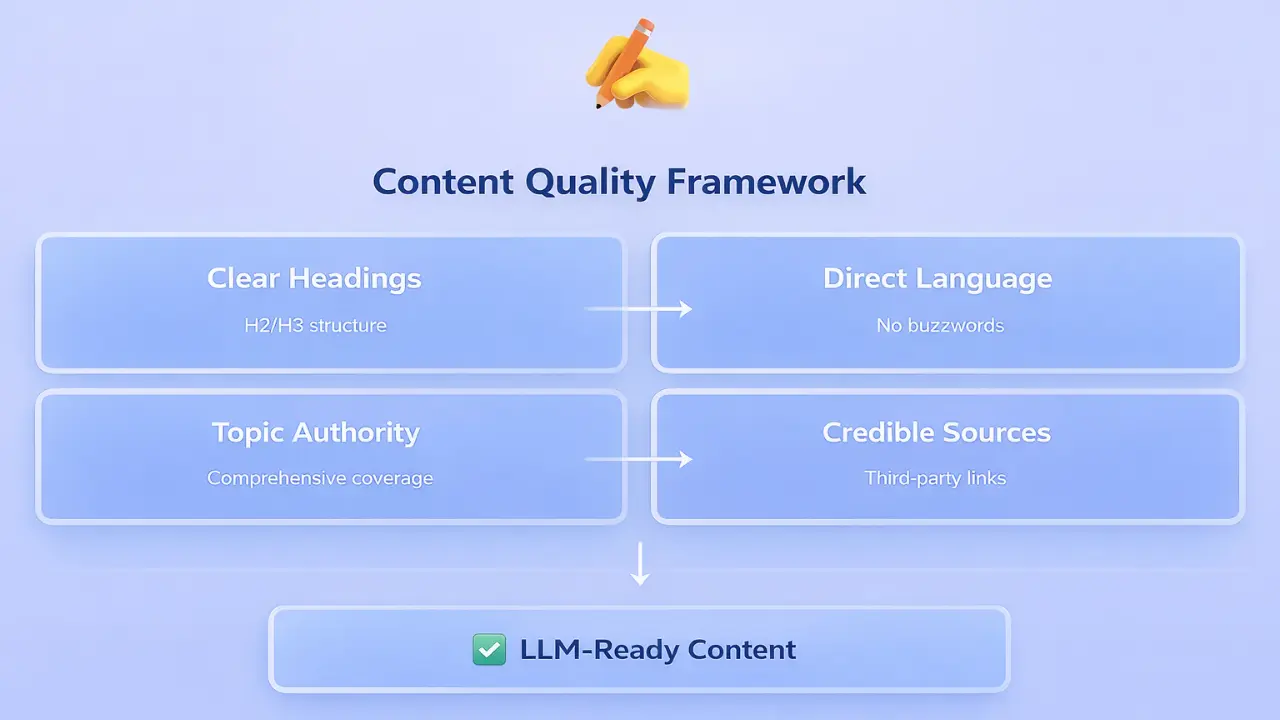
LLM SEO works best on strong fundamentals. The correlation between solid traditional SEO and AI citations is real, so writing to best practices serves both audiences.
- Use clear headings, organized sections, and direct language.
- Answer the real questions users ask and cover topics thoroughly.
- Support claims with links to reliable third-party sources.
- Build internal topic clusters that interlink related articles.
Write the way people speak. Use question-based headings that mirror real queries (the data shows the average AI query is ~11 words), and expand them into variations with Query Fan-Out. Enrich content with synonyms and related terms, validated with an LLM pattern analysis checklist.
Step 4: Find and Answer Autocomplete Questions
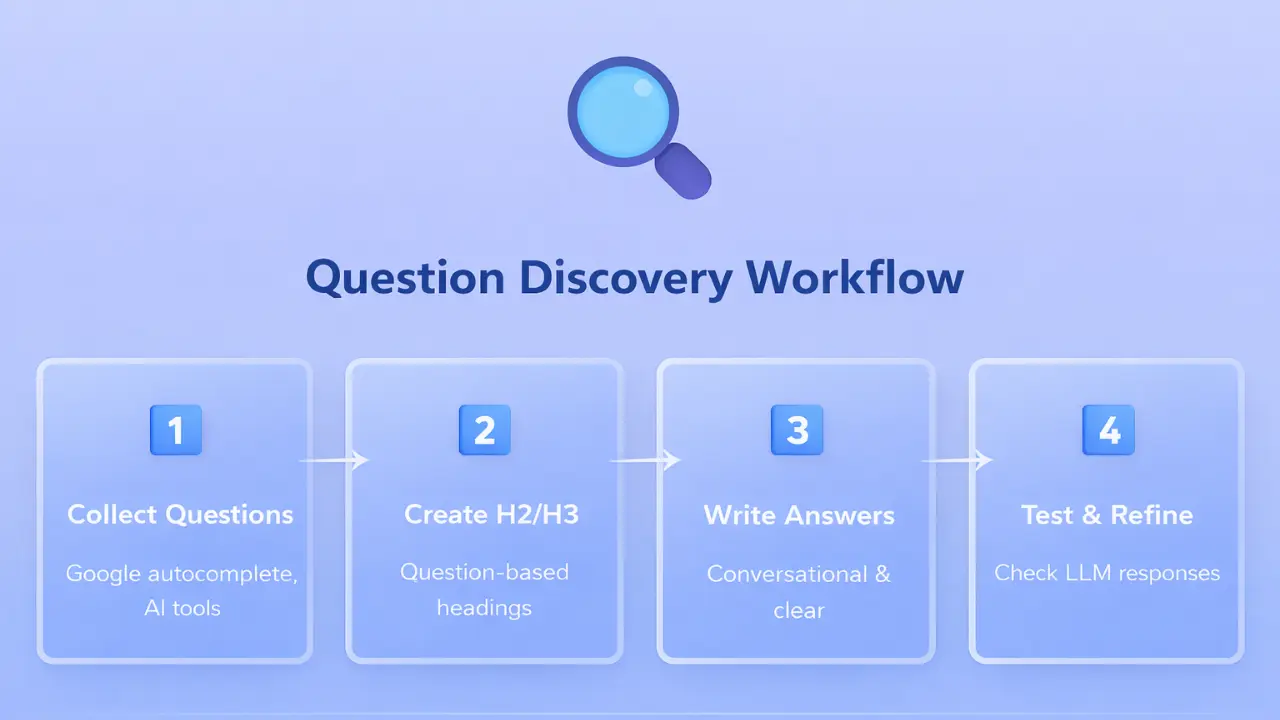
Target autocomplete-based questions, the high-frequency, intent-driven queries surfaced by search engines and AI tools. Since 83.9% of AI queries run eight words or longer, this is where the demand actually is.
- Mine autocomplete in Google, ChatGPT, Gemini, and Perplexity for live questions.
- Create an H2 or H3 sub-section for each real question with a direct answer.
- Ask multiple LLMs “what questions do people ask about [topic]?” to find semantic clusters traditional tools miss.
- Test target queries across Perplexity and Gemini with LLM citation tracking to identify answer gaps, keeping in mind that AI citations differ from traditional backlinks.
Step 5: Keep Content and Publish Dates Fresh
AI models prioritize current sources, and retrieval systems favor newer, higher-ranking content. Per Vercel’s published guidance, models re-crawl regularly, so stale pages stop being retrieved even when indexed.
- Review priority pages at 30, 90, and 180 days; refresh what’s stale, expand what’s working.
- Show publish and last-updated dates on the page and in schema.
- Remove obsolete information, fix 404s, and keep your sitemap clean.
- Summarize what changed in a short changelog block for transparency.
Step 6: Avoid Over-Relying on AI-Generated Content
Genuine authority depends on original, people-written content. The AI engines explicitly favor sources that add information they can’t find everywhere else, so generic AI text is a weak citation candidate.
- Don’t publish raw AI output; add unique insight, data, or experience.
- Fact-check every stat and claim to avoid AI-introduced errors.
- Use case studies, proprietary data, and first-hand stories to build E-E-A-T.
Illustrative example: the local law firm. Picture a small estate-planning firm with 15 pages. It adds FAQPage schema to its “What is a Living Trust?” article, rewrites intros answer-first, and updates content monthly with fresh case-law references. T
he realistic outcome, consistent with how small sites perform in our citation data, is that engines like Perplexity and Gemini begin citing it for estate-planning queries in its metro area despite competing with national legal sites, because cited sources are drawn from nearly 300,000 domains and reward clarity over size.
This is a representative scenario, not a named client, included to show how precise execution lets small sites win.
Step 7: Earn Brand Mentions and Citations
Authority depends on authentic third-party mentions. With community and UGC content making up 8.9% of all citations in our dataset, and Reddit the single most-cited domain, off-page presence is no longer optional. A practical accelerator is LLM seeding, earning presence in the sources models already rely on.
- Contribute genuine expertise in relevant Reddit communities, Quora, and forums.
- Get featured in comparison articles, roundups, and “best of” lists.
- Offer data and commentary via podcasts, interviews, and industry reports.
- Keep brand information consistent across every third-party mention.
Because brands get named in answer text roughly eight times more often than they get a citation link, monitoring mentions, not just links, is essential here.
Step 8: Grow Branded Search Volume
Branded search is a strong recognition signal: models cite well-known names more readily.
- Encourage searches that pair your brand with priority topics.
- Build exposure through partnerships and creator collaborations.
- Maintain a consistent brand identity across the web.
- Track branded-search shifts as a proxy for your standing in AI answers.
What Are the Key LLM SEO Optimization Techniques?
The core techniques are raising clarity, chunked answer-first formatting, demonstrating E-E-A-T, optimizing for summarization, and implementing schema. These make content easy for people and models to extract and cite, which matters because LLMs need context to interpret meaning correctly.
Did you know?
Write for clarity and extraction
Clear communication is fundamental. Describe topics in plain terms, and structure for the inverted pyramid so models can lift a complete answer.
- Example: instead of “innovative tool,” write “AI system that summarizes long reports in seconds.”
- Start each section with a direct, complete answer (answer-first).
- Use descriptive, question-style headings (e.g., “How to track LLM citations”).
- Keep paragraphs to 3–4 sentences and use bold for key terms.
- Use tables and structured blocks that LLMs can extract as standalone answers.
Demonstrate authority and transparency
Signals of E-E-A-T (Experience, Expertise, Authoritativeness, Trustworthiness) encourage citation, an area where this page leans on a named author, Tania Jabar, Marketing Manager at Wellows, with a visible bio and credentials.
- Show author bios, backgrounds, and credible references.
- Provide direct links for every claim, statistic, or benchmark.
- Include first-hand experience and original data where relevant.
Use explicit entities and schema
Models depend on fully explained references and structured signals.
- Spell out product, service, and industry names on first use; introduce acronyms like large language model (LLM) before abbreviating.
- Repeat your primary entity name in key supporting sentences for entity linking.
- Apply Article, FAQPage, HowTo, and Author/Person schema via JSON-LD.
- Use descriptive link labels, never “click here.”
What Advanced Tactics Boost LLM Visibility?
Once the fundamentals are in place, advanced tactics give you an edge in competitive niches: explicit entity context, dual-format FAQs, crawler configuration, and strong technical foundations.
Dual-format FAQs: for major questions, use a clear heading with a direct answer, then mirror the same Q&A in FAQPage schema so both readers and models extract it cleanly.
Guide AI crawlers: place a plain-text llms.txt at your site root listing key URLs (homepage, primary guides, FAQ hubs), and configure robots.txt to allow crawlers like GPTBot, OAI-SearchBot, PerplexityBot, Google-Extended, and ClaudeBot. Refer to OpenAI’s crawler documentation for accurate user-agent names.
Technical foundations: HTTPS, fast load times, mobile-first design, clean URLs, and strong internal linking all affect how reliably models crawl and interpret your content. Critically, because most AI crawlers don’t execute JavaScript, serve key content as server-rendered or static HTML.
How Do I Track and Measure LLM SEO Performance?
Tracking LLM SEO requires specialized monitoring, because Google Analytics and Search Console do not capture AI citations, prompt-level visibility, or mention frequency. You measure influence, not clicks: whether AI systems cite, mention, or recommend you across ChatGPT, Claude, Gemini, Perplexity, and Google AI Overviews. Because no two engines cite the same sources, you must track each platform separately, for example monitoring one engine directly through the Perplexity Visibility Tracker.
The metrics that matter:
- Citation frequency: how often you’re referenced for target queries.
- Brand mentions: named appearances in answer text (which outnumber links ~8 to 1).
- Share of voice: your slice of citations in a topic versus competitors.
- Platform distribution: which engines cite you most.
- Query coverage: the percentage of target queries where you appear.
- AI referral traffic: separate AI sessions in GA4 using source filters for chatgpt, perplexity, and similar.
How do you audit a page for LLM inclusion?
Run a structured brand visibility audit on a cadence:
- Test 20–30 core queries across Perplexity, Gemini, and ChatGPT monthly.
- Log which pages get cited and where competitors win instead.
- Check schema with Google’s Rich Results Test on underperformers.
- Review low-visibility pages for answer-first structure and clear entities.
- Use Bing Webmaster Tools to catch crawl errors blocking indexing.
Running 20–30 prompts across five engines every month by hand stops scaling fast, which is where a dedicated LLM visibility tool earns its place, tracking citations, mentions, and share of voice across engines so you can see and close the gaps.
Essential LLM SEO Tools For 2026
As of June 2026, several tools have emerged to effectively monitor and optimize Large Language Models (LLMs). For a full ranked comparison of 19 platforms by engine coverage, data refresh, and price, see our guide to the best AI visibility tools. Here are some notable options:
Wellows: Tracks AI search visibility by measuring where your brand (and competitors) appear inside AI-generated answers, including citations/mentions and the sources AI systems rely on useful for monitoring “share of AI voice” and closing visibility gaps across LLM-driven discovery.
AIclicks: Tracks AI citations and visibility across LLM platforms (including Gemini and Perplexity) so you can confirm where your pages appear inside AI answers.
Profound: Monitors brand mentions, tone, and source attribution across ChatGPT, Claude, Gemini, and Google AI. Overviews are useful for reputation + competitive tracking in AI search.
Fibr AI: Helps with visibility + attribution by showing which AI platforms contribute to awareness and downstream engagement (helpful when GA4 alone can’t explain “AI influence”).
SEMrush AI Features: Adds early AI visibility signals alongside traditional keyword/SERP tracking, giving a combined view of classic SEO + emerging AI search performance.
Manual Prompt Testing: Test target prompts across ChatGPT, Claude, Gemini, and Perplexity to validate real outputs, confirm citations, and spot competitor takeovers (still one of the most reliable QA steps).
Nightwatch: Combines traditional rank tracking with LLM monitoring; also shows the web searches AI systems run for real-time answers useful for tracking prompts, citations, and local AI results in one dashboard.
Keyword.com: Extends rank tracking into AI environments by tracking citations/mentions for keywords across platforms like ChatGPT, Claude, and Gemini, with reporting workflows for teams and clients.
Otterly AI: Tracks brand representation in AI search and reports “share of AI voice” style visibility, plus GEO-type audits to diagnose why your brand is (or isn’t) appearing.
Peec AI: Focuses on LLM brand visibility with sentiment + competitive benchmarking across major AI platforms, best when you need monitoring rather than full SEO tooling.
First Answer: Compares AI responses against approved/official brand documentation to flag inaccuracies, especially valuable for regulated industries or high-risk messaging.
LLM SEO Checklist: What to Implement
Use this as a practical audit for any priority page. Each item maps to one of the three framework layers, work top to bottom. Run it on a quarterly cadence and benchmark against competitors as you go.
- Indexed in Bing and verified in Bing Webmaster Tools (Accessibility)
- AI crawlers allowed in robots.txt (GPTBot, OAI-SearchBot, PerplexityBot, Google-Extended, ClaudeBot) (Accessibility)
- Server-rendered or static HTML so crawlers that don’t run JavaScript can read you (Accessibility)
- LLMs.txt at site root listing key pages (Accessibility)
- Schema in place: Article, FAQPage, HowTo, Author/Person via JSON-LD (Accessibility)
- Answer-first intros with a complete answer in the first two sentences (Understanding)
- Question-style headings mirroring real ~11-word queries (Understanding)
- Explicit entities and consistent terminology, acronyms spelled out on first use (Understanding)
- Named author with visible bio and verifiable credentials (Authority)
- Original data or first-hand experience that can’t be easily replicated (Authority)
- Visible last-updated date on page and in schema, refreshed on a 30/90/180-day cadence (Authority)
- Third-party mentions and varied formats earned on Reddit, communities, and “best of” lists, including video and podcast transcripts, plus growing branded search (Authority)
Common LLM SEO Pitfalls That Limit AI Visibility
Top LLM SEO Mistakes to Avoid
Relying on Outdated SEO Tactics
Ignoring Conversational Search Language
Missing Citations and Creator Signals
Skipping FAQs and Summaries
Allowing Content to Become Outdated
Failing to Conduct Regular Audits
Limiting Content Formats
Using Ambiguous Language or Excessive Jargon
Inconsistent Branding Signals
Neglecting Technical SEO Foundations
Overvaluing Backlinks Over Authority
Ignoring AI-Native Traffic Sources
What’s Next for LLM SEO and AI Search?
The future of llm seo will continue to develop as language models advance in capability, citation practices become widely adopted, and AI-enhanced search replaces more traditional listings. Upcoming AI trends anticipate expanded multi-modal search that blends text, image, and video, making it essential for optimization to include every available format.
Technical schema and integration with knowledge graphs will take on increased significance, with technical accuracy and fact-checking becoming central for sustainable visibility in LLM-driven environments.
Innovations in search may soon provide advanced tracking for model references and improved correction of errors or misattribution on a large scale.
The next chapter in SEO focuses on meeting the needs of AI-driven answers, quickly adapting strategies, and evaluating presence as AI search continues to redefine established practices.
FAQs
LLM SEO involves tailoring content so that large language models like Gemini, Perplexity, and Claude can easily interpret and display it in their outputs. It focuses on semantic clarity, structured data, and answer-first formatting to maximize citation across AI platforms.
While classic SEO focuses on backlinks and click-throughs, LLM SEO prioritizes clarity, structured layouts such as lists and FAQs, and explicit sourcing. Traditional SEO serves crawlers, while LLM SEO serves language models. Relying solely on legacy SEO may reduce visibility as information discovery increasingly shifts to AI responses.
LLM SEO aims at being visible in AI-driven search results, while LLMO covers wider brand presence in any context where large language models generate answers. LLM SEO is rooted in SEO basics, but adapts for how LLMs find and present information.
LLMs likely won’t eliminate search engines like Google, but they may make conventional search less essential. Google will remain but may become less central as users shift to direct answers.
A recent SEOFOMO survey found 39% of SEOs worry about AI Overviews, and 34% consider LLMs a challenge to their consulting work. This suggests that focusing on LLM SEO is vital for staying relevant in changing search habits.
Use dedicated LLM tracking tools like AIclicks, Profound, and Fibr AI to monitor citations across Perplexity, Gemini, and other AI platforms. Track citation frequency, query coverage, and competitor mentions separately from traditional Google Analytics. Manual testing across multiple LLMs provides qualitative insights into answer quality and positioning.
Structured data using JSON-LD schema helps LLMs accurately extract and understand your content. Schema markup identifies key entities, content types, and relationships that LLMs use to determine citation relevance. Pages with comprehensive schema (Article, FAQPage, HowTo) get cited significantly more often across AI platforms.
Yes. LLM citation criteria differ from traditional Google ranking factors. AI platforms prioritize semantic relevance, answer completeness, and structured formatting over backlink profiles. Content optimized for AI Overviews can appear in AI search results even if it ranks lower in traditional search results.
LLM SEO focuses on optimizing for citation in AI-generated answers across platforms like Perplexity and Gemini. Generative Engine Optimization (GEO) is a broader term covering optimization for all generative AI outputs, including image generation, code assistants, and conversational interfaces. LLM SEO is a subset of GEO focused specifically on text-based AI search visibility.
Absolutely. Small businesses often compete better in LLM environments because AI platforms prioritize content quality and relevance over domain authority. Focused topical expertise, clear answer-first content, and proper schema implementation can help small sites get cited alongside larger competitors in AI responses.
Final Thoughts
The path forward requires shifting focus from rankings to citations, emphasizing clarity and structure that makes AI platforms trust your expertise enough to quote you, start by optimizing one priority page with the 3-Layer Visibility Stack and measure results within 30 days.
As AI-driven platforms become central to information discovery, building a strong LLM SEO framework is critical for sustained digital visibility. By emphasizing clarity, credibility, and a structure accessible to both people and large language models, your content is more likely to be referenced and included in AI-powered responses.
The focus now shifts from rankings and backlinking to being selected and trusted by AI search platforms. Adjusting your strategy today secures a lead as user habits increasingly prioritize LLM-driven search tools.
Take your first step by updating a priority content page for LLM SEO: add FAQ sections, incorporate structured data, and answer users’ main questions upfront. This not only enhances your visibility but also establishes your authority in the rapidly evolving era of AI search optimization.