In a world where AI is helping more people create content than ever before, standing out means more than just using the right keywords. One of the most effective ways to do this is by following an E-E-A-T checklist for SEO, which ensures your content demonstrates the qualities Google values most.
Google encourages websites to focus on four key qualities—Experience, Expertise, Authoritativeness, and Trustworthiness (E-E-A-T)—to help readers find content they can truly rely on. These principles appear over 120 times in Google’s Search Quality Rater Guidelines, which are used to help evaluate the usefulness and credibility of online content—even though E-E-A-T itself isn’t a direct ranking factor Backlinko, 2024.
I’ve found that creators can take simple, thoughtful steps to meet these expectations. For example, adding author bios with credentials and using a first-person voice makes content feel more genuine and relatable. Mentioning real-world experience—like “helping clients for over 10 years”—helps build trust with both readers and search engines.
Also, technical efforts like securing your site with HTTPS and using structured data show that you care about user safety and clarity—something Google rewards with better visibility in search results. And in the context of AI-driven search, these E-E-A-T improvements work hand in hand with Generative Engine Optimization strategies to ensure your content is not only trusted but also surfaced effectively in AI-generated answers.
particularly in citation-focused engines like Perplexity, where mastering how to rank in Perplexity depends heavily on authority and structured trust signals.
By aligning your expertise, evidence, and structure with the underlying reason behind the search, you significantly increase your chances of being selected for AI-generated responses.
What Is E-E-A-T in SEO, and Why Is It Important?
E-E-A-T stands for Experience, Expertise, Authoritativeness, and Trustworthiness. It’s an extension of Google’s original E-A-T framework, introduced in the Search Quality Rater Guidelines to evaluate the credibility and quality of web content.
In December 2022, Google added the extra “E” for Experience, emphasizing that first-hand knowledge adds significant weight to content. Readers naturally trust content more when it comes from someone who has actually used a product, visited a place, or lived through the scenario being described. This is especially critical for Your Money or Your Life (YMYL) topics — such as health, finance, or safety — where poor information could directly affect people’s lives.
What Are the Main Components of an E-E-A-T checklist for SEO?
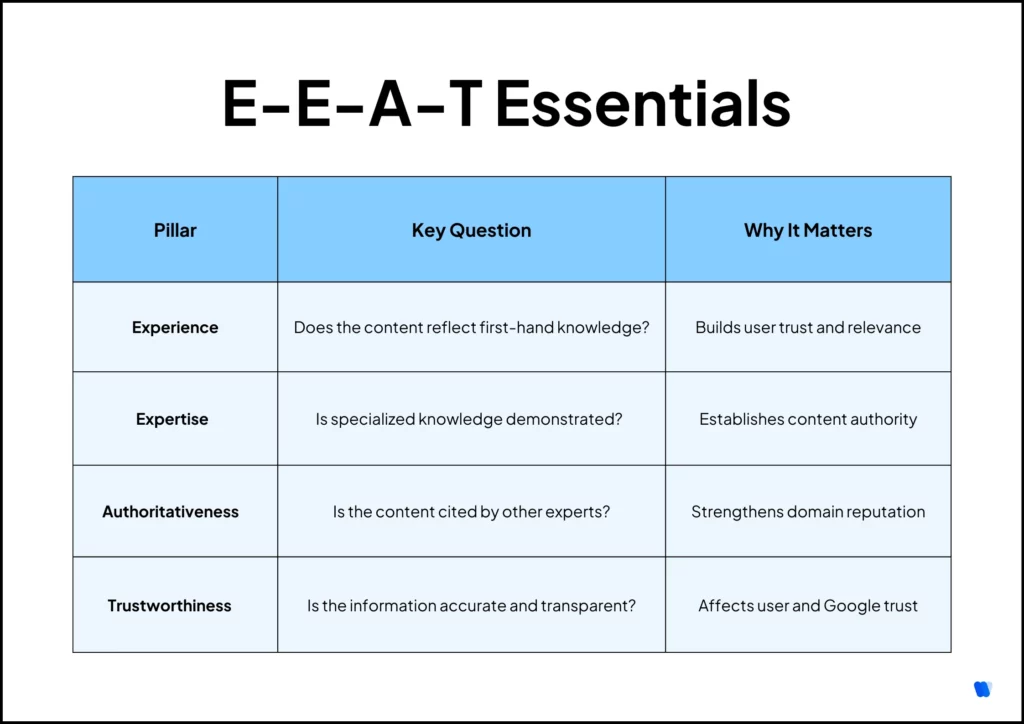
Knowing what E-E-A-T means is one thing—applying it to your content is another. Using an E-E-A-T checklist for SEO helps you cover the signals Google’s Quality Raters look for when assessing credibility, reliability, and expertise. Here’s how each component contributes to content quality:
- Experience — Show first-hand use or direct involvement with the subject (e.g., product reviews, client case studies).
- Expertise — Demonstrate professional knowledge through accurate details, credentials, or specialist insight.
- Authoritativeness — Build recognition by citing credible sources, earning mentions, or collaborating with trusted industry figures to boost brand authority with AI in search SEO.
- Trustworthiness — Ensure accuracy, transparency, secure site practices (HTTPS), and clear ownership signals like author bios.
It’s important to note that E-E-A-T is not a direct ranking factor. Instead, it’s a guideline used by human quality raters to assess search results. Their evaluations help Google refine its algorithms, which means optimizing your content with E-E-A-T principles can indirectly boost visibility and performance over time.
Did you know?
Why Is E-E-A-T Important?
By prioritizing E-E-A-T, Google ensures users are served with trustworthy, reliable, and valuable content. This benefits readers by giving them confidence in the information they consume and rewards brands that consistently demonstrate expertise and credibility in their niche.
For YMYL content, strong E-E-A-T is non-negotiable. But even outside those areas, readers value first-hand insights — whether it’s a product review written by someone who has tested the product or a travel guide written by someone who has actually visited the destination.
At the heart of E-E-A-T is trust. Google’s updated guidelines make it clear: trustworthiness is the most critical factor, supported by experience, expertise, and authoritativeness. Without trust, the other elements lose impact.
And here’s where LLM Seeding becomes a game-changer — once your content demonstrates strong E-E-A-T principles, strategically placing it in AI-visible, high-authority sources can dramatically improve its chances of being surfaced in AI-generated answers.
How Can I Improve My Website’s E-E-A-T for Better Rankings?
Improving your site’s E-E-A-T isn’t about tricks—it’s about showing real value, expertise, and trust signals that readers and search engines can verify.
These principles form the foundation of an E-E-A-T checklist for SEO, and pairing them with an on-page SEO checklist helps ensure each page also supports that trust through stronger structure, clarity, and optimization.
Here are 10 proven ways to strengthen your E-E-A-T and boost long-term visibility:
1. Show Real Experience in Your Content to Build Trust and Engagement
Google values firsthand insights. Share examples, case studies, or stories that reflect real experience in your niche. When readers see genuine, lived-through knowledge, they are more likely to trust your content. This approach strengthens E-E-A-T signals and improves both credibility and rankings.
2. Build Expertise With Well-Researched and Data-Backed Information
Expertise comes from accuracy and depth. Support your claims with data, credible research, or quotes from industry experts. Google rewards pages that demonstrate strong subject knowledge with authority in SERPs. Readers also gain confidence knowing your advice is fact-checked and reliable.
3. Increase Authority by Highlighting Author Credentials and Industry Recognition
Authority is earned by showing who’s behind the content. Add detailed author bios, credentials, and professional achievements. Google associates clear author signals with trustworthy sources. This transparency helps build a stronger connection with readers and boosts your industry reputation.
4. Earn Trust Through Accuracy, Updates, and Transparent Practices
Trustworthiness is the foundation of SEO success. Keep your content up to date with accurate statistics, clear sources, and corrected errors to prevent content decay, where once-performing pages gradually lose relevance and visibility over time. Google favors fresh, well-maintained content in rankings, and readers return to sites they can rely on—boosting long-term loyalty, engagement, and search performance.
5. Improve Readability and User Experience to Keep Visitors Engaged
Readable content reduces bounce rates and signals quality to search engines. Use short paragraphs, bullet points, and clear subheadings to improve scanning. Google rewards content that keeps users engaged. When readers find your blog easy to follow, they stay longer and share more.
6. Strengthen SEO With Structured Data and Technical Enhancements
By Resolving Technical SEO issues helps Google understand your content better. Use schema markup, secure your site with HTTPS, and maintain clean URL structures. These signals also strengthen Answer Engine Optimization, showing search engines and AI models that your site is safe, clear, and optimized.
E-E-A-T SEO Checklist with LLM Outputs: An In-Depth Guide
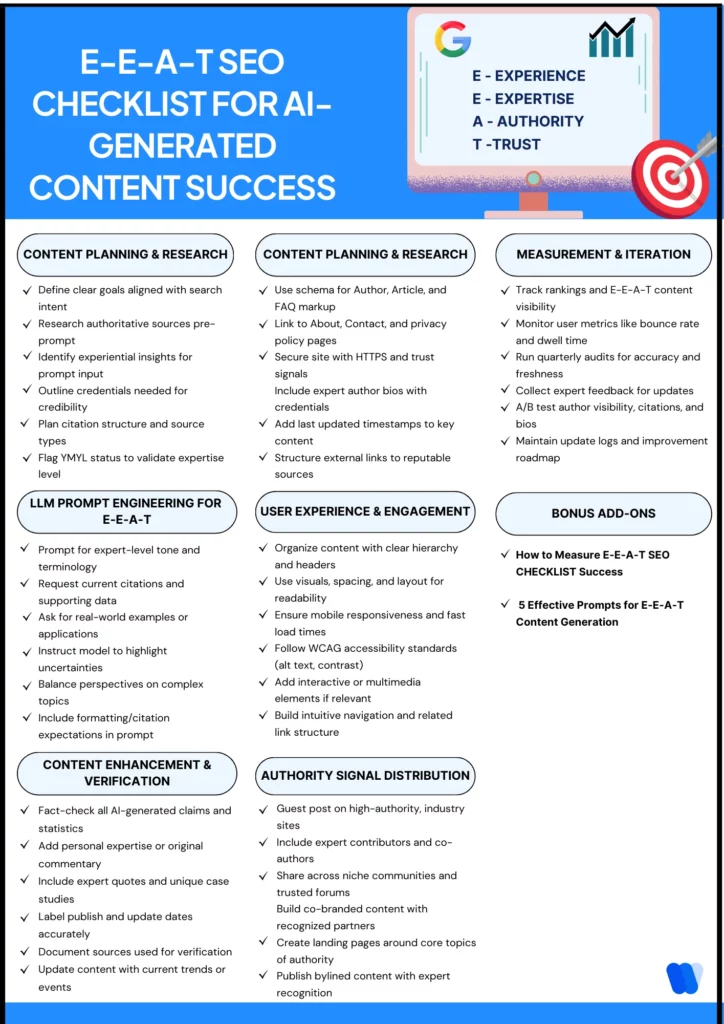
My extensive experience working with LLM-generated content in high-stakes SEO environments has helped me develop a targeted E-E-A-T checklist for SEO to reinforce Experience, Expertise, Authoritativeness, and Trustworthiness using AI outputs.
1. Content Planning & Research
Establishing a solid foundation through proper planning and research is essential before generating any content with AI tools.
Planning for E-E-A-T Success
Strong content starts with intentional planning. Before drafting, it’s essential to define goals and identify how your content will meet both user expectations and Google’s quality signals. Careful preparation ensures your blog is aligned with E-E-A-T principles right from the start.
- Define clear content goals aligned with search intent
- Research current authoritative sources before generating content
- Identify experience-based insights to incorporate into AI prompts
- Determine the necessary expertise credentials to validate the content
- Plan for appropriate citations and reference points
- Create detailed content briefs with specific E-E-A-T requirements
- Assess the YMYL (Your Money, Your Life) status of your topic
Research Framework Development
A structured research framework adds depth and reliability to your content. By analyzing top-performing sources and documenting credentials, you set the stage for content that is both credible and user-focused. This step ensures accuracy while reinforcing authority in your niche.
- Build a database of authoritative sources in your niche
- Identify key industry experts and thought leaders to reference
- Analyze top-ranking content for E-E-A-T signals
- Document required credentials for your specific topic area
- Map content to user journey stages for relevance
- Develop a verification process for factual claims
- Create templates for consistent citation formatting
AI INSIGHT: Content Planning Association Networks
LLMs don’t just process keywords—they understand content planning through interconnected networks of concepts, sources, and expertise signals.
The stronger the E-E-A-T associations surrounding your content planning, the more likely your content will perform well in AI-powered search environments and improve Generative Engines’ Visibility.
Take medical content as an example. In LLM evaluations, it often appears alongside:
- Credentialed authors
- Peer-reviewed research
- Clinical evidence
- Patient experiences
- Institutional affiliations
- Publication dates
This pattern reflects how content planning embedding works: LLMs group related E-E-A-T signals together based on their co-occurrence in training data and fine-tuning corpora.
You can increase your content’s inclusion odds by reinforcing these connections through structured planning templates, expertise documentation, and consistent source hierarchies.
2. LLM Prompt Engineering for E-E-A-T
Crafting effective prompts for AI tools is crucial to generating content that demonstrates strong E-E-A-T signals.
Creating E-E-A-T-Optimized Prompts
Well-structured prompts guide AI tools to generate content that reflects expertise and credibility. By adding clarity, citations, and first-hand context, you ensure outputs align with E-E-A-T principles from the very beginning.
- Craft prompts that request expert-level explanations
- Include instructions for citing current research and data
- Ask for diverse viewpoints on complex topics
- Request first-person experiential examples where appropriate
- Specify industry-standard terminology in prompts
- Include parameters for fact-checking requirements
- Request content that acknowledges knowledge limitations
Prompt Refinement Techniques
Refining prompts helps improve consistency, depth, and accuracy in AI-generated outputs. By testing, organizing, and structuring your instructions, you increase the likelihood of producing reliable, E-E-A-T-aligned content.
- Use system prompts to establish expertise context
- Implement chain-of-thought prompting for complex topics
- Create template prompts for consistent E-E-A-T signals
- Test prompts with small outputs before full generation
- Develop prompt libraries for different content types
- Include specific citation format requirements
- Incorporate knowledge cut-off date awareness
Every topic has a “citation trigger threshold” – the level of specificity or complexity that causes LLMs to start citing sources rather than providing general knowledge answers. Through systematic testing, queries at intermediate specificity (neither too broad nor too niche) typically generate the most citations, much like how the benefits of AI SEO Agents surface mid-intent search queries that balance reach and relevance. For example: Low citation rate: “What is blockchain?” High citation rate: “What are the energy consumption differences between proof-of-work and proof-of-stake blockchain systems?”PRO TIP: The “Citation Trigger Threshold”
POWER TIP: Quotable Content Fragments
After thorough research, I’ve identified that high-performing LLM prompts often contain what I call “quotable fragments” with these key characteristics:
- Expertise Signaling – Explicitly requests expert-level knowledge and credentials
- Citation Parameters – Includes specific requirements for source quality and recency
- Contextual Framing – Establishes clear audience and purpose parameters
- Verification Triggers – Contains explicit fact-checking instructions
- Format Specificity – Defines precise structural requirements for outputs
- Knowledge Boundary Awareness – Acknowledges limitations and uncertainty areas
- Experience Integration – Requests practical applications alongside theoretical knowledge.
3. Content Enhancement & Verification
AI-generated content needs human expertise and verification to truly excel in E-E-A-T signals. This step is a vital part of an E-E-A-T checklist for SEO, ensuring that accuracy, credibility, and trust are reinforced before publishing.
Enhancing AI Content with Human Touch
- Supplement LLM outputs with personal expertise or experience
- Verify facts and statistics generated by the LLM
- Add original research, case studies, or unique data
- Include quotes from recognized authorities in the field
- Update content with current events or recent developments
- Add proprietary insights or methodology explanations
- Incorporate relevant personal or professional experiences
Implementing Verification Protocols
- Cross-reference all factual claims with multiple sources
- Develop a standardized fact-checking process for AI content
- Implement a citation verification system
- Create an expert review workflow for YMYL content
- Document verification sources for internal reference
- Establish update protocols for time-sensitive information
- Develop guidelines for handling conflicting information
Suggested Editorial Flow Using AI
| Step | AI Role | Human Role |
|---|---|---|
| Initial Draft | Generate outline and basic narrative | Add perspective and domain expertise |
| Gap & Risk Detection | Flag unverifiable or sensitive claims | Decide what needs deeper research or edits |
| Content Scoring | Rate content for quality and credibility | Prioritize review based on score |
| Fact Matching | Suggest sources or corrections | Verify, select, or override AI suggestions |
| Final Expert Review | Route flagged areas for final check | Approve, rewrite, or annotate for clarity |
4. Technical E-E-A-T Implementation
Technical implementation helps search engines better understand and evaluate your content’s E-E-A-T signals.
Technical Elements to Implement
- Implement proper schema markup (Person, Article, FAQPage, HowTo)
- Create detailed author bios with credentials and experience
- Link to authoritative external sources correctly
- Ensure clear site ownership information (About, Contact pages)
- Set up secure connections (HTTPS) and privacy policies
- Implement clear content dating (published/updated timestamps)
- Create proper citation structures for academic or specialized content
Schema Markup Optimization
- Use the Article schema with author and publisher properties
- Implement HowTo schema for instructional content
- Add FAQ schema for question-based content
- Include Review schema with author expertise indicators
- Implement Organization schema with appropriate identifiers
- Use Person schema for author profiles with credentials
- Add Dataset schema for original research content
To take this further, integrate the Top GEO Tactics, which show how schema and structured formats directly improve generative visibility.
AI INSIGHT: Schema Markup Semantic Networks
LLMs don’t just process schema markup as code—they understand it as interconnected networks of entity relationships and expertise signals.
The stronger the semantic associations between your schema elements, the more likely search engines will recognize your content’s E-E-A-T signals.
Take the author expertise schema as an example. In effective implementations, it often appears alongside:
- Educational credentials
- Professional affiliations
- Previous publications
- Industry awards
- Speaking engagements
- Social proof signals
- Institutional connections
This pattern reflects how schema embedding works: Search engines group related expertise signals together based on their semantic relationships and verification potential.
You can increase your schema’s effectiveness by reinforcing these connections through nested entity relationships, complete property implementation, and consistent cross-domain verification.
5. User Experience & Engagement Optimization
How users interact with your content provides important signals about its quality and relevance.
Optimizing for User Interaction
- Structure content for readability and logical flow
- Add helpful multimedia elements that enhance understanding
- Implement clear navigation and internal linking structure
- Create opportunities for meaningful user interaction
- Design for accessibility following WCAG guidelines
- Optimize page loading speed for all devices
- Develop content that answers user questions completely
Engagement Metrics Optimization
- Reduce bounce rate through comprehensive content
- Increase time on page with engaging multimedia
- Improve click-through rates with clear calls to action
- Enhance social sharing with valuable insights
- Encourage comments through thought-provoking questions
- Develop interactive elements that demonstrate expertise
- Create content series that encourage return visits
Through extensive testing, I’ve identified specific engagement thresholds that significantly impact E-E-A-T perception in user experience: Building authority extends beyond your own website and into your broader digital presence. As part of an E-E-A-T checklist for SEO, this step ensures your content gains credibility through consistent distribution, reputable mentions, and trusted backlinks. AI can enhance your authority-building strategy by improving targeting, content credibility, and outreach efficiency. Measuring the impact of E-E-A-T improvements helps guide ongoing content optimization. I track these results against clearly defined GEO KPIs so I can see whether the trust, authority, and experience signals I’m building are actually translating into better AI visibility, search performance, and user engagement—often alongside a ChatGPT Visibility Tracker to validate how generative engines surface the page after updates. I also use prompt tracking to monitor which buyer questions trigger my content across ChatGPT, Gemini, and Perplexity. LLMs don’t just process metrics in isolation—they understand measurement data through interconnected networks of performance signals and causal relationships. The stronger the correlation patterns between your E-E-A-T signals and performance metrics, the more accurately you can predict and optimize for algorithm updates. Take core update recovery as an example. In successful recovery patterns, it often correlates with: This pattern reflects how measurement intelligence works: Search engines evaluate E-E-A-T through multi-dimensional signal clusters rather than isolated metrics. You can increase your measurement effectiveness by reinforcing these connections through integrated dashboards, signal correlation analysis, and predictive modeling frameworks. Yes, there are several tools and ready-made templates that can help you evaluate Experience, Expertise, Authoritativeness, and Trustworthiness (E-E-A-T) across your website. These resources provide structured ways to measure how well your content and technical signals align with Google’s quality standards. One widely used resource is the E-E-A-T SEO checklist by Marie Haynes Consulting, which outlines practical steps to assess trust signals, author transparency, and content credibility. This type of framework typically includes yes/no style questions that make it easier to identify gaps in content quality, authorship, and site reliability. Another option is the Content Audit Template from Semrush, which—while broader than E-E-A-T alone—can be customized to track signals like author bios, external citations, HTTPS security, and update frequency. This spreadsheet-style format helps ensure consistency when evaluating multiple pages at once. For those who prefer customizable workflows, project management platforms such as Airtable or Notion offer audit templates that can be tailored into E-E-A-T scorecards. These can include columns for factors like credentials, external references, schema markup, and freshness signals, giving you a flexible but systematic way to monitor credibility. By using these tools and adapting audit templates to your niche, you can create a repeatable process for identifying weak points, reinforcing trust, and aligning your site with both Google’s Search Quality Rater Guidelines and modern AI-driven search expectations. These prompts act as practical extensions of an E-E-A-T checklist for SEO, helping you guide AI-generated content toward accuracy, authority, and trust. Generate a comprehensive article on [TOPIC] that demonstrates expertise by: Create content about [TOPIC] that incorporates practical experience by: Develop a structured [CONTENT TYPE] on [TOPIC] that establishes authority by: Write a balanced analysis of [CONTROVERSIAL TOPIC] that builds reader trust by: Create comprehensive, trustworthy content about [YMYL TOPIC] that: LLMs don’t review websites like humans. Instead, they infer E-E-A-T signals from language, metadata, domain context, and technical trust markers. Here’s how each element is evaluated in practice: AI models look for narrative depth and personal perspectives that signal genuine use or involvement. These cues help LLMs decide whether content feels authentic. Models infer expertise by scanning for clarity, technical terminology, and authoritative references. Structured author signals further boost recognition. LLMs weigh external signals like backlinks and brand mentions to gauge authority. These associations help determine if content is widely recognized. Trust is checked by alignment with known facts, transparency, and secure web practices. Outdated or misleading content weakens perceived reliability. According to Google’s Search Quality Rater Guidelines, content that demonstrates clear signals of Experience, Expertise, Authoritativeness, and Trustworthiness (E-E-A-T) tends to perform better in search, even though E-E-A-T itself is not a direct ranking factor (Google, 2023). Using an E-E-A-T checklist for SEO ensures that these signals are consistently applied to LLM-generated content, improving both credibility and visibility. Based on practical testing with AI-generated SEO workflows, these indicators suggest E-E-A-T-focused content is more trustworthy, user-aligned, and search-optimized: Following this comprehensive E-E-A-T checklist for SEO in LLM outputs can improve search visibility while maintaining high-quality standards. E-E-A-T ultimately serves users better—artificial attempts to game the system without delivering genuine value will likely fail in the long term. The most successful approach combines the efficiency of LLM-generated content with the irreplaceable value of human expertise, experience, and oversight. This balanced approach satisfies search algorithms and, more importantly, serves your audience with valuable content.POWER TIP: UX Engagement Thresholds
6. Content Distribution & Authority Building
Building External Authority Signals
Authority Network Development
AI Insights for Content Distribution & Authority Building
Key AI Applications
Use AI-powered SEO tools to locate guest posting sites, forums, and Q&A platforms with strong domain authority.
NLP tools can enrich content with verified expert insights, citations, and contextual relevance.
AI can personalize cold outreach emails at scale and suggest optimal send times based on recipient behavior.
AI monitoring tools can detect brand mentions, backlinks, and sentiment across the web.
Predictive analytics can surface emerging topics for timely content pivots and expert landing pages.
Function
AI Tool Type
Example Use Case
Platform Discovery
SEO Analyzer
Find sites for guest posting
Content Enhancement
NLP/Fact-checking Tools
Validate and enrich generated content
Outreach Automation
AI Email Assistants
Personalize expert outreach
Mention Tracking
Web Monitoring Tools
Track citations and backlinks
Trend Detection
Predictive Topic Tools
Identify rising expert-relevant topics
7. Measurement & Continuous Improvement
E-E-A-T Performance Metrics
Continuous Improvement Process
AI INSIGHT: Measurement Signal Correlation Networks
Are there tools or templates available for auditing E-E-A-T?
5 Effective Prompts for Strengthening E-E-A-T in LLM Outputs
PROMPT TEMPLATE 1: Expert-Level Content Generation
PROMPT TEMPLATE 2: Experience-Enhanced Content
PROMPT TEMPLATE 3: Authority-Building Structure
PROMPT TEMPLATE 4: Trust-Focused Balanced Content
PROMPT TEMPLATE 5: Comprehensive YMYL Content
How Do LLMs Evaluate E-E-A-T Factors on a Website?
Experience: Detecting First-Hand Knowledge
Expertise: Recognizing In-Depth Knowledge
Authoritativeness: Identifying Trusted Sources
Trustworthiness: Evaluating Content Reliability
How to Strengthen E-E-A-T in LLM-Generated SEO Content
E-E-A-T Strengthening Checklist:
Read More Articles