If you run a marketing agency, you’ve probably felt the pressure. Clients want certainty. They want you to promise that AI will deliver X% ROI, Y leads, or Z conversions on a fixed timeline.
But the reality is simple: you can’t guarantee AI results, and it’s not a competence issue. It’s how AI works.
AI is probabilistic, not deterministic. Outputs change based on model behavior, context, data freshness, prompt phrasing, and frequent platform updates. Even when your process stays the same, the system around it shifts.
That helps explain why 95% of enterprise AI pilots fail to deliver significant ROI (Fortune, 2025). Many teams expect predictable performance from a system designed to produce variable outcomes.
For agencies, the move is to shift the promise. You cannot control what AI engines surface, but you can control execution and measurement — a reality that Content Marketing Agencies increasingly have to explain as clients demand certainty from inherently probabilistic systems.
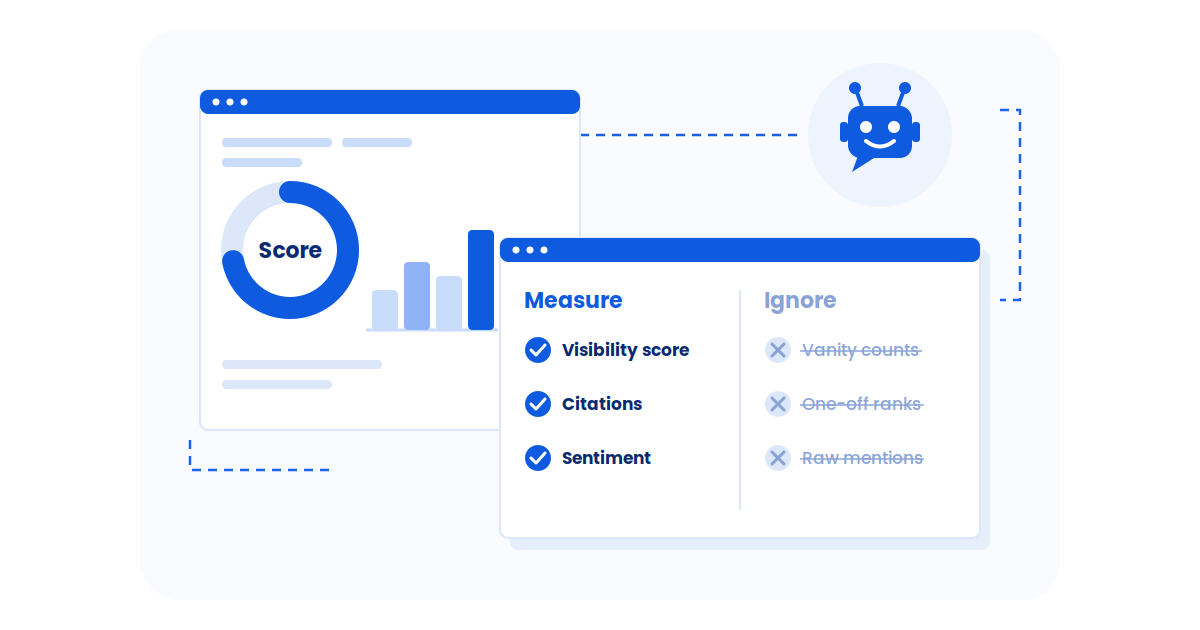
Wellows supports this by tracking AI search visibility for Agencies signals—brand presence, mentions, citations, and competitive movement—so agencies can report real change and iterate based on evidence, not assumptions.
That is how agencies protect credibility, keep trust, and still deliver growth in an AI-driven search landscape.
- AI is probabilistic, not deterministic’, so agencies can’t promise fixed outcomes from AI tools.
- Most AI projects underperform because agencies don’t control the biggest variables: data quality, platforms, user behavior, and market shifts.
- AI systems change and drift over time, so results require ongoing monitoring, retraining, and optimization, not one-time setup.
- “Guaranteed AI ROI” is usually hype: ROI depends on factors outside marketing (sales, pricing, product, service).
- The best agencies promise process + transparency, and use tools like Wellows to track AI visibility, prove progress, and optimize continuously.
Why Can’t Marketing Agencies Guarantee Results from AI Tools?
This is the foundational concept every agency needs to understand and communicate to clients, especially as optimization shifts from traditional search to AI-generated answers and summaries, which is exactly what Generative Engine Optimization (GEO) is designed to address.
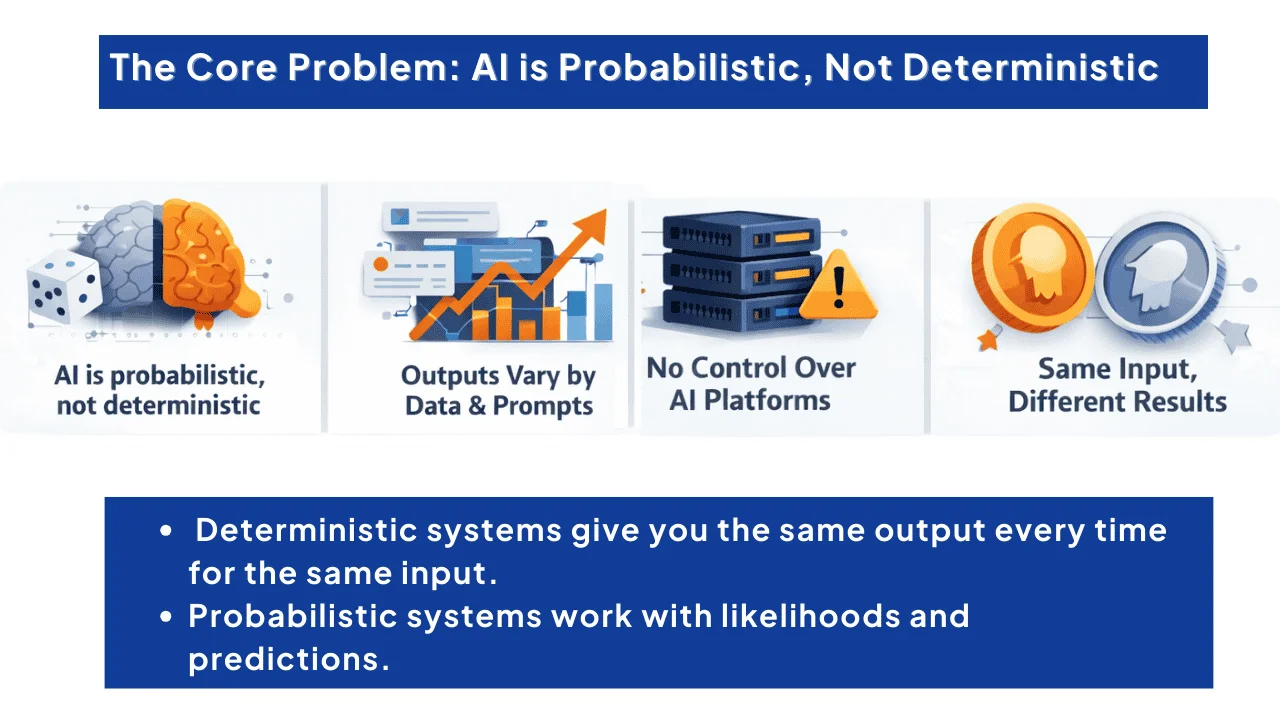
The Core Problem: AI is Probabilistic, Not Deterministic
- Deterministic systems give you the same output every time for the same input. Think of a calculator: 2 + 2 always equals 4. You can guarantee the result.
- Probabilistic systems work with likelihoods and predictions. AI analyzes patterns and suggests what’s likely to work, but there’s always uncertainty.
Did you know?
As one AI expert put it, “AI, like any intelligent system, must work with probabilities because that’s how real-world decision-making functions.” (Rajeev G.)
The Agency Pain Point
Here’s where it hurts: Your clients expect deterministic results from probabilistic tools.
They say: “We need 50 qualified leads per month.”
You think: “Our AI can optimize for that, but there are 20 variables we can’t control.”
They say: “Guarantee us a 25% conversion rate increase.”
You think: “The AI might predict 90% confidence, but that still means a 10% chance it won’t work.”
This expectation gap is killing agency-client relationships, including for AI SEO agencies that are often expected to translate AI visibility into predictable business outcomes. You know AI can’t guarantee outcomes, but clients hear “AI-powered” and expect magic.
When you promise guaranteed results from AI tools, you’re setting yourself up for failure, not because you did anything wrong, but because you’re fighting against the fundamental nature of how AI works.
Consider a real scenario: Your AI tool recommends the best time to send marketing emails. It predicts with 90% confidence that 10 AM on Tuesday is optimal based on historical data.
What can go wrong?
- User behavior shifts unexpectedly (a viral news event Tuesday morning)
- Algorithm changes on email platforms
- Competitor campaigns flooding inboxes at the same time
- Client’s audience composition changes
- The 10% chance of being wrong just… happens
None of these are your fault. But if you guaranteed results, you’re now on the hook for factors completely outside your control, and that’s exactly why agencies are investing in automation for agency workflows to tighten execution, reduce bottlenecks, and keep performance stable even when everything else is changing in GEO.
What Are the Main Reasons Agencies Can’t Promise 100% AI Success?
Let’s get specific about the challenges agencies face when implementing AI for clients.
Pain Point 1: You Don’t Control the Client’s Data Quality
The harsh reality: AI is only as good as the data feeding it. Bad data in = bad results out,and no algorithm can magically fix that.
As an agency, you’re often handed:
- Fragmented data across multiple platforms
- Inconsistent tracking implementations
- Biased historical data
- Incomplete customer profiles
- Data that doesn’t integrate with your AI tools
MIT researchers found that many stalled AI projects weren’t held back by algorithms, but by “flawed enterprise integration” and the inability to tailor AI tools to the company’s data and workflows, one of the core reasons agencies are rethinking how they approach AI search visibility delivery.
Why This Matters
The stat that should worry you: 71.7% of marketers cite lack of understanding and data strategy as the #1 barrier to AI adoption (Amra & Elma).
The agency dilemma: You can’t guarantee AI results when you don’t control the foundational data layer. Yet clients often resist the upfront work of data cleaning and integration because “we just want the AI to work.”
Pain Point 2: AI Models Are Black Boxes That Change Without Notice
Many AI platforms you rely on, Google’s ad algorithms, Facebook’s delivery systems, ChatGPT’s content generation, are black boxes. Their internal algorithms can shift overnight without warning.
What this means for agencies:
- A campaign performing well on Monday can tank on Tuesday because the platform’s AI changed
- You have zero visibility into why the change happened
- You can’t predict when the next change will occur
- Your optimization strategies might suddenly stop working
Even Wellows acknowledges this reality: no agency can guarantee placements in AI-generated responses, which is why disciplined execution frameworks like a technical SEO checklist for agencies matter more than outcome promises.
Even Wellows acknowledges this reality: “no agency can guarantee placements in AI-generated responses,” because so much depends on constantly evolving AI systems and context.
Why This Matters
The agency trap: You’re held accountable for results from systems you don’t control and can’t fully predict.
Real-World Agency Example: Platform Changes Without Warning
After Meta’s “Andromeda” advertising update, the agency ROI Minds reported that many marketers felt “confused, overwhelmed, and stuck” as ad delivery behavior changed under the hood, even though agencies hadn’t altered their strategies.
It’s a clear reminder: agencies can optimize within AI-driven platforms, but they can’t control when those platforms change the rules.
Pain Point 3: AI Models Degrade Over Time (Model Drift)
Here’s something most clients don’t understand: AI models decay. What worked last month might not work next month because the model experiences “drift” as real-world conditions change, which is why agencies need to continuously reassess what content is missing, outdated, or no longer aligned.
This is where using AI strategically to find content gaps becomes essential for staying relevant as models and user behavior evolve.
Why model drift happens:
- Consumer behavior evolves
- Market conditions shift
- Competitors adapt
- Seasonal patterns change
- New data creates new patterns
Why This Matters
The agency burden: You need to constantly retrain, monitor, and adjust AI models. This requires ongoing resources, expertise, and budget, often more than clients expect when they hear “AI automation.”
The painful truth: There is no “set it and forget it” with AI. Any long-term guarantee assumes stable conditions that don’t exist in reality.
Pain Point 4: Client Organizations Often Aren’t Ready for AI
This is the pain point agencies hate to admit: 87% of AI projects fail not because of the technology, but because companies don’t manage the people and process aspects correctly (Atheni AI).
What “not ready” looks like:
- Employees resist using the AI tools you implement
- Client teams lack training to interpret AI insights
- Internal processes don’t align with AI workflows
- Stakeholders chase trendy AI pilots but skip strategic alignment
- Fear of job displacement creates cultural resistance
Why This Matters
As Forbes contributor Andrea Hill observed, businesses “chase trends, skip strategy, and underestimate culture,” leading to faulty application of AI (LinkedIn).
The agency frustration: You can build the perfect AI implementation, but if the client’s team doesn’t use it properly or their internal processes conflict with it, the project will fail, and you’ll take the blame.
Pain Point 5: AI Outputs Can Be Wrong, Biased, or Off-Brand
This is the hidden risk that keeps agency leaders up at night: AI can and does make mistakes.
The statistics are sobering:
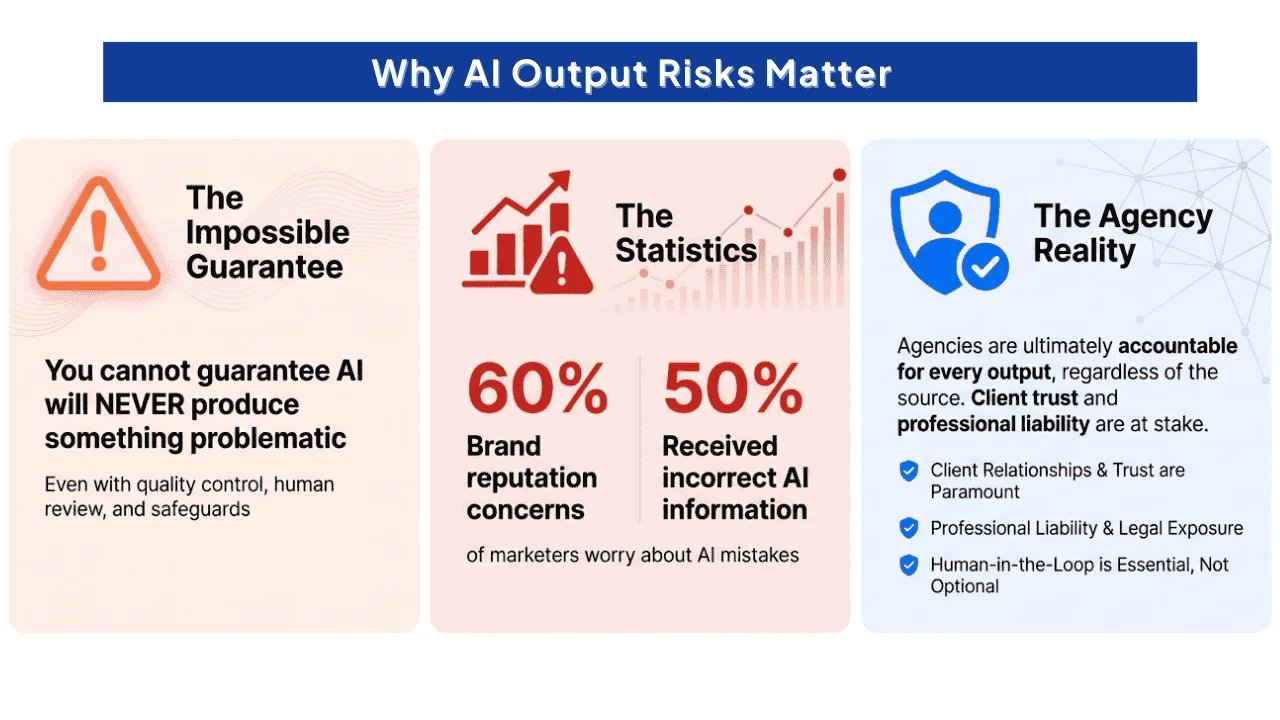
- 60% of marketers are concerned that AI-generated content could harm their brand’s reputation through biases or misaligned values (Amra & Elma)
- 50% of marketers report receiving incorrect or misleading information from generative AI tools (Amra & Elma)
Real agency nightmares:
- AI-generated ad copy that’s accidentally offensive
- Content recommendations that don’t match brand voice
- Chatbots that confidently state false information
- Targeting algorithms that develop unexpected biases
- “Hallucinated” statistics or facts in AI-written content
Real-life example (AI hallucinations + brand risk):
The agency FBD Agency breaks down how AI hallucinations can create real business and brand risk, highlighting why agencies can reduce risk with review and safeguards, but can’t guarantee AI will never output something inaccurate or problematic.(FBD Agency on AI Hallucinations)
Why This Matters
The impossible guarantee: You can implement quality control, human review, and safeguards, but you cannot guarantee AI will never produce something problematic. There’s always risk, especially when your client’s brand is being summarized, recommended, or cited by AI systems in ways you don’t fully control,so it’s smart to regularly audit brand visibility on LLMs before small issues turn into reputation problems.
What Hidden Risks Make AI Guarantees Unreliable?
Beyond the obvious challenges, there are additional risks that any guarantee would overlook:
- Security and Privacy Concerns:
AI systems often require large amounts of data, including customer data. This raises privacy and security risks. What if an AI tool gets compromised or leaks sensitive information? Or what if new privacy regulations limit how customer data can be used in AI models?
Many organizations cite data privacy as a significant barrier, around 40% list privacy concerns as a top obstacle to AI adoption (Amra & Elma).
And when you’re building AI-driven content pipelines, even “small” compliance constraints can ripple into performance issues,another reason teams are starting to pay closer attention to content clarity and risk signals like readability score in AI content.
An agency might do everything right from a technical standpoint and still hit a wall because a new law or regulation suddenly shuts down a critical data pipeline.
- Model and Vendor Reliability:
When agencies rely on third-party AI platforms, such as tools for ad targeting, analytics, or content generation,they are to some extent at the mercy of those providers.
If a vendor experiences downtime, introduces bugs, or changes policies, it can directly impact campaign performance. There are frequent cases where AI APIs change pricing, usage limits, or model behavior, forcing agencies to pivot with little notice. This dependency is a hidden risk, especially when clients are unaware of how heavily results rely on the stability of an external AI service.
- Unpredictable External Factors:
Even with the best planning, unforeseen events can disrupt AI-driven initiatives. Sudden regulatory updates, economic downturns, shifts in consumer behavior, or AI-specific disruptions, such as a vendor’s API going offline, can derail performance overnight.
These factors sit largely outside an agency’s control, making guaranteed outcomes unrealistic in real-world AI deployments. That’s also why staying on top of evolving AI visibility factors, like how search engines interpret content context and relevance, is essential; tools like AI detection trends help agencies understand how content might perform as AI prioritization shifts.
Why Should I Be Skeptical of Agencies Guaranteeing AI ROI?
If you come across an agency boldly guaranteeing a specific ROI (Return on Investment) from AI, pause for a moment. While it’s natural to want assurances before investing, guaranteed ROI claims in AI marketing are usually a red flag.
A better starting point is an honest baseline, what’s working today, what’s broken, and what “success” actually means, so an audit checklist can help you turn vague expectations into measurable, defensible benchmarks.
Understanding Client Pressure
Your clients aren’t being unreasonable when they ask for guarantees. They’re facing:
Board members or executives demanding ROI projections
Budget constraints requiring justification
Competitive pressure to adopt AI or fall behind
Fear of wasting resources on unproven technology
Personal career risk tied to the success of AI initiatives
The good news is you can still give them confidence without fake certainty: pair transparent reporting with inputs you can control, like improving how clearly your content communicates to humans and AI systems alike. This breakdown of readability score in AI content is a practical way to tighten that part of the equation.
They want certainty in an uncertain world.
Why You Still Can’t Guarantee Results
Even understanding their position, you cannot promise guaranteed AI results because:
ROI depends on factors outside your control:
Market conditions shift mid-campaign
Competitors launch countermoves
Economic downturns affect consumer spending
Client’s sales team conversion rates
Product quality and customer service
Pricing strategy changes
Did you know?
Real-life example (leads ≠ revenue without sales follow-up): Huble (a HubSpot partner agency) highlights how delayed lead response and weak routing/follow-up systems cause qualified leads to “fall through the cracks,” even when marketing is doing its job.
And the data shows why this gap destroys ROI: the InsideSales.com/MIT study Response Management study found that the odds of qualifying a lead drop 21x when contact slips from 5 minutes to 30 minutes,meaning ROI can collapse purely because the sales team didn’t follow up fast enough.
Over-Promising and “AI Hype”
We’re in a period of intense AI hype, everyone’s excited about the possibilities. Some agencies feel pressure to sell AI as a magic bullet and might make grand promises to win clients.
Chasing hype over substance can lead to what some call “AI theater”,doing AI for show rather than real value. Industry experts caution that agencies must “move beyond experimentation to strategic integration of AI… to avoid wasted resources.” (Campaign India)
One-Size-Fits-All Guarantees Don’t Work
Be skeptical if an agency offers the same blanket guarantee to every business. Successful AI deployment is highly context-dependent. What works for one client may fail for another due to different data, audience, or market conditions.
Agencies making generic guarantees might be glossing over important specifics (or they plan to fulfill the “guarantee” with some metric that doesn’t truly translate to business value).
And from an SEO/content standpoint, cookie-cutter “guaranteed results” messaging often leads to duplicated positioning across pages, exactly the kind of overlap that causes content cannibalization and weakens performance instead of strengthening it.
The better move is to ground expectations in the right optimization framework for today’s search reality, where visibility is increasingly driven by answer engines and AI summaries.
One simple way to frame this for clients is to explain the difference between optimizing for answers versus optimizing for AI-generated summaries, which is exactly what AEO vs. GEO helps clarify when you’re defining what “results” should mean in an AI-first landscape.
What Can Agencies Deliver with AI, If Not Guarantees?
At this point you might think: “So AI SEO agencies can’t guarantee results, what am I actually buying when I pay an agency for AI help?”
The answer: you’re investing in their expertise, process, and ability to drive progress (even if they can’t promise a fixed outcome). Here’s what a good agency can promise:
Promise 1: Expertise and Best Practices
What you CAN promise: “We will implement AI using industry best practices, proven methodologies, and our team’s expertise to maximize the likelihood of success.”
For agencies, this often means working from an AI Visibility Reporting Checklist for Agencies to ensure AI mentions, citations, and visibility trends are reviewed consistently across clients and reporting cycles.
And to make that promise real (and measurable), you need a strategy that’s structured and repeatable, down to the way you connect supporting pages and evidence across a site, which is where smart internal linking helps reinforce authority and improve how both humans and AI systems understand your content.
What this includes:
- Proper data cleaning and integration
- Appropriate AI model selection for the use case
- Rigorous testing and validation
- Human oversight and quality control
- Continuous learning from results
Why this works:
Clients get confidence that you know what you’re doing, without tying you to specific outcomes you can’t control.
Promise 2: Measurable Progress and Transparency
What you CAN promise: “We will establish clear KPIs, track them rigorously, and report progress transparently,showing you exactly what’s working and what isn’t.”
Instead of outcome guarantees, agencies can commit to a defensible reporting layer — how agencies monitor AI search mentions for client reporting gives client reports a citation-level audit trail that holds up regardless of how the underlying models shift.
What this looks like:
- Weekly or monthly reporting on leading indicators
- Clear documentation of tests and optimizations
- Honest communication about what’s not working
- Data-driven recommendations for adjustments
- Trend analysis showing directional improvement
Example framing:
Instead of “we guarantee 20% sales increase,” say “we will track and optimize toward increasing qualified leads by 15-25% in Q1, with weekly progress reports and monthly strategy reviews.”
Promise 3: Agility and Continuous Optimization
What you CAN promise: “We will continuously monitor performance, quickly adapt to changes, and optimize based on real-time data,treating AI as an ongoing process, not a one-time setup.”
This kind of agility matters even more as AI systems increasingly rely on contextual relevance and semantic signals,areas influenced by how well content is structured around concepts like LSI keywords rather than static, single-keyword tactics.
What this includes:
- Regular model retraining and updates
- A/B testing of different approaches
- Rapid response to platform algorithm changes
- Proactive identification of drift or degradation
- Iterative improvement cycles
Why clients value this:
It shows you understand AI requires ongoing management and you’re committed to long-term success, not just initial implementation
Promise 4: Risk Mitigation and Quality Control
What you CAN promise: “We will implement multiple layers of review and safeguards to minimize the risks of AI errors, bias, or off-brand outputs.”
This is especially important as AI systems increasingly interpret and amplify brand signals across search, summaries, and recommendations,sometimes in ways clients never explicitly planned for.
What this includes:
- Human review of AI-generated content before publishing
- Bias detection and mitigation protocols
- Brand voice and value alignment checks
- Regular audits of AI outputs
- Clear escalation procedures when issues arise
Why This Matters:
Addresses the 60% of marketers worried about brand reputation damage from AI (Amra & Elma).
How Wellows Helps Agencies Navigate the Probabilistic Nature of AI
This is where tools like Wellows become essential for generative engine optimization agencies trying to deliver value without making impossible promises.
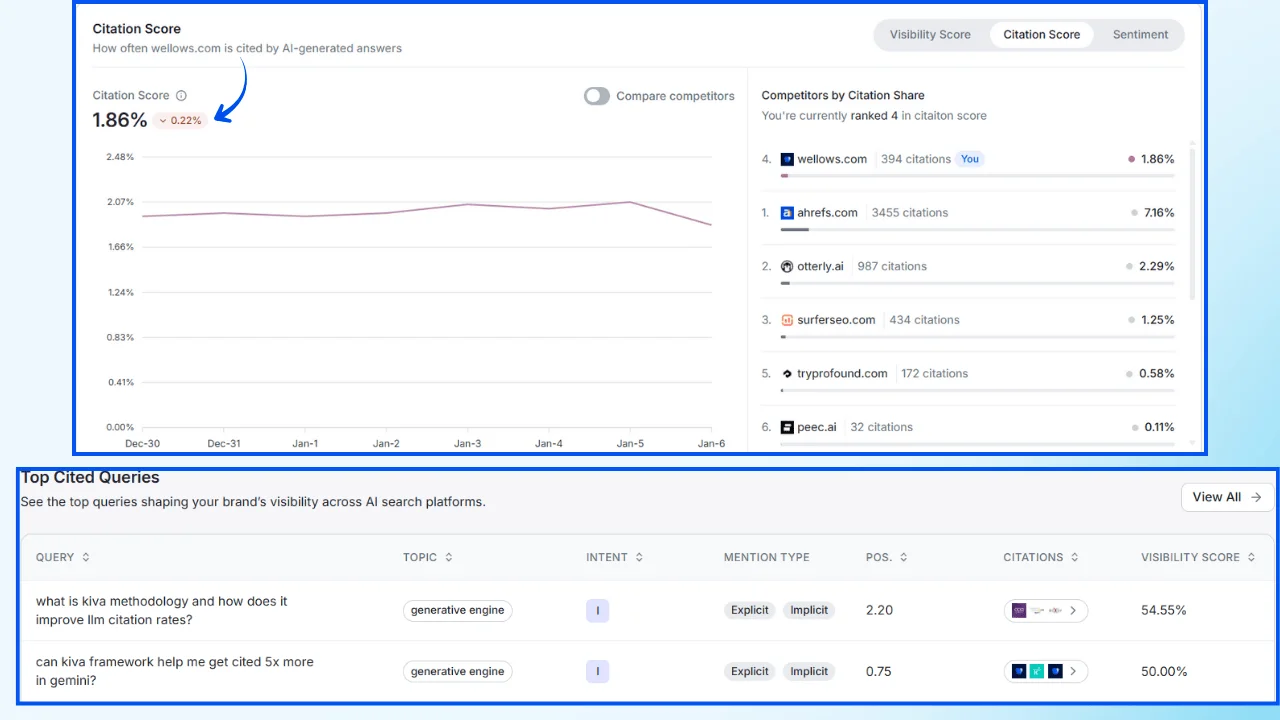
Wellows was built specifically for agencies who understand that AI is probabilistic. Rather than promising guaranteed placements in AI-generated search results, Wellows helps agencies:
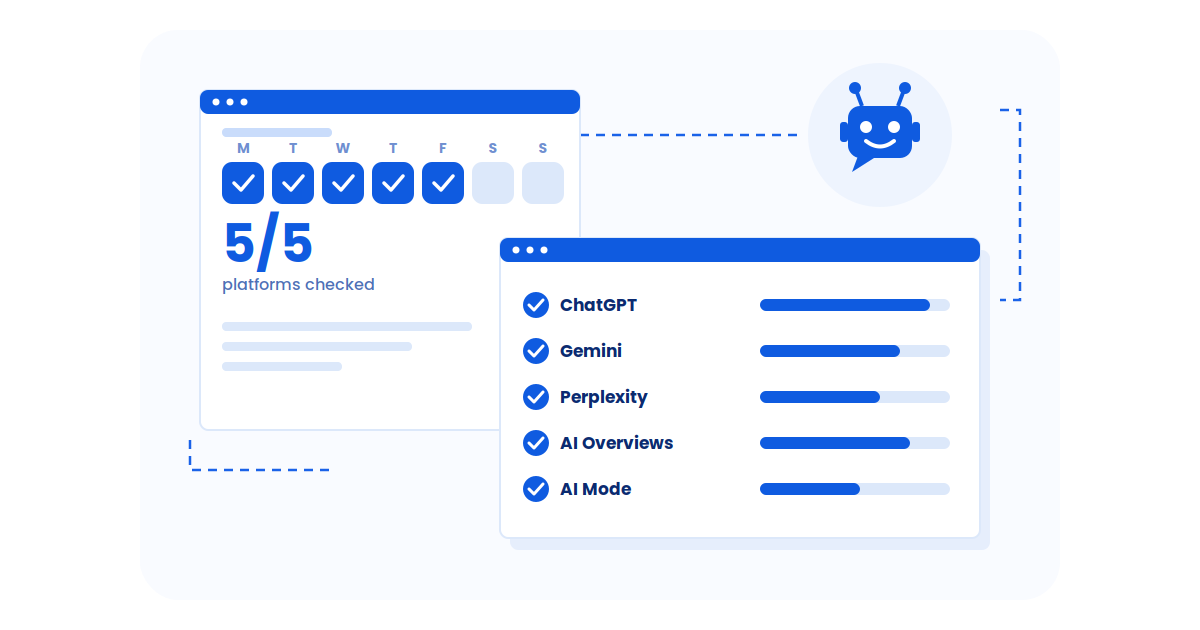
- Track AI visibility across platforms:
- Monitor where clients appear in ChatGPT responses
- Track citations in Google AI Overviews
- Measure presence in Perplexity answers
- Compare visibility against competitors
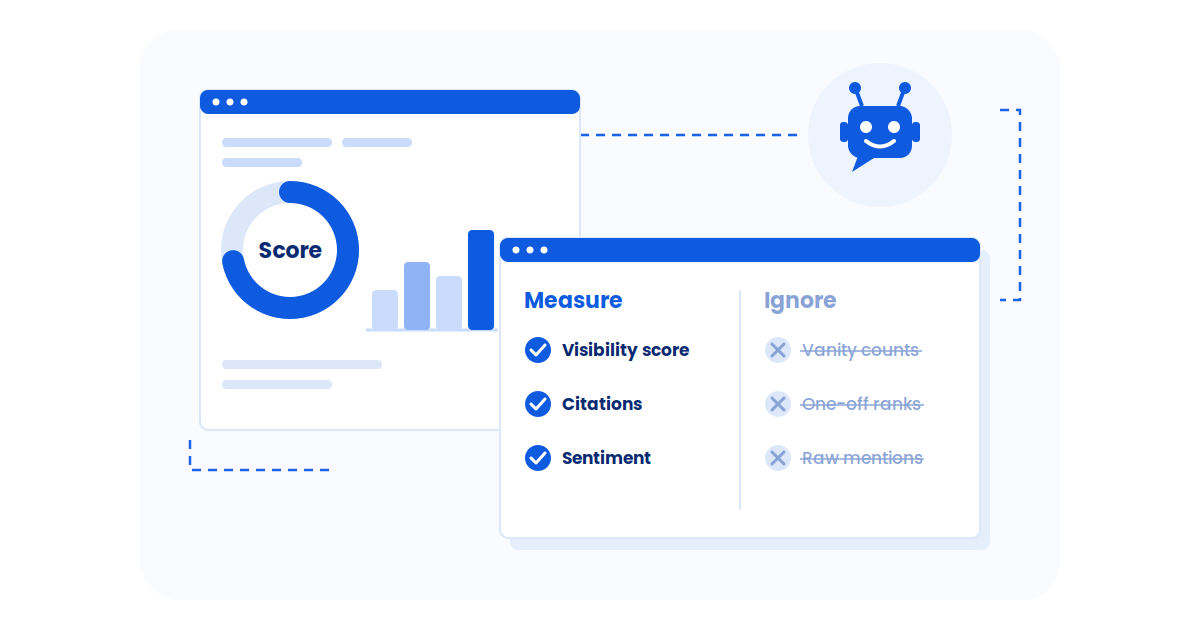
- Provide measurable progress:
- Citation Score metrics show trends over time
- Identify “missed opportunities” where the brand could have appeared
- Flag sentiment changes in AI mentions
- Document improvement patterns
- Optimize based on data:
- See which content types get cited most often
- Understand what triggers AI inclusion
- Test different optimization strategies
- Learn what works for each client’s specific situation
With Wellows, you can have honest conversations like:
❌ Don’t say: “We guarantee you’ll appear in 80% of AI searches for your keywords.”
✅ Do say: “We’ll track your current AI visibility baseline, implement optimization strategies, and show you month-over-month improvement in Citation Score. Based on our work with similar clients, we typically see 40-60% improvement in AI mentions within 90 days, but we’ll monitor weekly and adjust our approach based on what the data shows.”
The difference: You’re promising a process and transparency, not a specific outcome. You’re acknowledging AI’s probabilistic nature while demonstrating your ability to maximize success within that reality.
The Conversation Framework: How to Talk to Clients About AI Guarantees
Here’s a script framework that works:
When a Client Asks for Guaranteed ROI:
Client: “Can you guarantee we’ll see a 30% increase in conversions from this AI implementation?”
Your Response: “I appreciate that you need predictable results to justify this investment. Here’s what I can tell you honestly: AI is probabilistic, not deterministic, it works with likelihoods, not certainties. What I can guarantee is that we’ll:
- Implement AI using the same proven methodology that’s delivered X% average improvement for similar clients
- Track specific KPIs weekly and report transparently
- Continuously optimize based on performance data
- Adapt quickly when we see what’s working or not working
Based on our experience, we typically see 20-40% improvement, but I won’t promise a specific number because too many variables are outside anyone’s control. What I will promise is maximum effort, expertise, and transparency throughout the process. Does that approach work for you?”
When Explaining Why Guarantees Are Impossible:
“Let me share something important about how AI actually works. AI is probabilistic, it makes predictions based on patterns, with a confidence level attached. Even a 95% confidence prediction has a 5% chance of being wrong. That’s just the nature of the technology.
Beyond that, AI results depend on data quality, ongoing changes in algorithms, market conditions, and how your team uses the insights. We can control our expertise and process, but we can’t control all those external factors.
Here’s what’s more valuable than a guarantee: proven expertise, transparent reporting, and commitment to continuous optimization. That’s how we deliver real results for our clients.”
- Short-Form vs Long-Form Content: Short-Form vs Long-Form Content: Which Drives Better Results?
- Complete Guide: Content Marketing Agencies: A Complete Guide 2026
- E-E-A-T Checklist: E-E-A-T Checklist: How to Strengthen Trust and Authority
- Content Marketing Statistics: Top Content Marketing Statistics to Know This Year
- What Are SERPs?: What Are SERPs? A Simple Guide for Marketers
- Meta Tags Guide: Meta Tags Explained: Titles, Descriptions, and SEO Basics
- How Agencies Find AI Visibility Gaps: How Agencies Find AI Visibility Gaps for Clients (2026)
- Agency Client Onboarding: Agency Client Onboarding Using AI Search Visibility
- ASEO to GEO Transition Checklist: SEO to GEO Transition Checklist for Agencies
FAQs
Because AI outcomes depend on variables agencies don’t control,data quality, platform algorithm changes, user behavior, and market conditions. AI systems are probabilistic, not deterministic, which means they generate likely outcomes, not fixed results. Any guarantee would ignore this reality.
In most cases, “guarantees” rely on narrow metrics, fine print, or short timeframes rather than real business impact. These claims often prioritize sales over sustainability and can lead to AI theater, impressive activity without lasting value.
Not always intentionally, but they are oversimplifying. Many underestimate how much AI performance depends on client readiness, data integrity, and ongoing optimization. Promising certainty in a probabilistic system is misleading, even if well-intentioned.
Growth depends on more than AI outputs. It’s shaped by sales execution, product quality, pricing, competition, and timing. Since agencies don’t control these factors, they can’t realistically guarantee growth, even with excellent AI implementation.
They’re rarely realistic. AI can improve efficiency and decision-making, but consistent “wins” require continuous monitoring, human oversight, and adaptation. The most credible agencies promise process, transparency, and progress, not fixed outcomes.
No. Agencies can optimize strategy, execution, and measurement, but they can’t guarantee exact results because outcomes depend on factors outside their control, including platform algorithms, audience behavior, market conditions, and sales follow-up. This is even more true in AI-driven campaigns, where systems are probabilistic, not deterministic.
Conclusion: Embrace the Probabilistic Nature of AI
The agencies winning with AI aren’t the ones making bold guarantees. They’re the ones who:
- ✅ Understand and explain that AI is probabilistic, not deterministic
- ✅ Set realistic expectations based on past performance, not hype
- ✅ Promise process and expertise, not specific outcomes
- ✅ Deliver transparency through regular, honest reporting
- ✅ Continuously optimize rather than “set and forget”
- ✅ Use tools like Wellows to track measurable progress in AI visibility
The bottom line: You can’t guarantee AI results, but you can guarantee your expertise, your process, and your commitment to maximizing success within the probabilistic nature of AI.
That honesty will build more trust with clients than any hollow guarantee ever could.
Ready to manage AI visibility for your clients with transparency and data-backed insights?